Ten O'Clock News
- Transcript
And I have three boys with no one no. Idea. Oh. Oh. You're finding these aren't you. What somebody else was there so I can buy what you want to. Talk now. We've really. Taken this project. For great deals to begin with for this neighborhood. There are at least
three neighborhoods of a dramatically affected by the project itself. What's at stake is the very building of. The. Expressway setting up one remaining good house and there is an expert field and. Also at stake is the future of rapid transit in the southwestern portion of the city we just can't live with the existing orange one elevated in its current form. You know I think in the communities love with heavy increases in road service on the existing about now what's the timetable for this project. Well it goes well today. The federal government in the twenty fourth period. We promise them we will. It's conceivable that we have a girl in Fort Worth next year. That will leave us about a year and a half to do start construction on this part of the project. In September of 78. And the racial composition of people.
Doing these jobs what your perception of perception really is we have an affirmative action governor. Except. There are ways to make it better. But given the magnitude of this project coming up between now and the start of this name of the song I think we have a real obligation to show that those plans work. An additional plan that we have in operation is a minority contractor. Program which is a form of sort of what percentage minorities. Contract 37 percent provision in force now on the elevated patching up job will be in the context justification for the south tunnel under sixteen million dollars. First phase projects expect to use it in the middle division upgrading which is an 11 million dollar model as well as in the larger Southwest Card Project later on in addition to the so-called minority hiring plans a 30 percent plan
that would be used in the minority neighborhoods are affected by these projects namely Dorchester Southend and Oxford. Now how much is this project going to cost over a. Stated projected cost for the Orange Line and railroad portions of this project. Is three hundred ninety one million dollars of which 80 percent would be federal 20 percent local. In addition to hearing today is about an arterial street which could cost as much as an additional 20 million dollars. Beyond that. There are a series of related developments on the land cleared for formally namely community college. Housing at the lower Oxford Community Corporation and industrial park by the community the corporation Boston city building and a projected park. So I think it's a little hard to estimate but we're talking about half a billion dollars at a minimum. I think that this is a part of the interview for just a moment let me get a couple real quick cutaways.
Yeah. Well. First of all this way just don't talk for like 10 or 15 seconds. I think it's a static if you listen to some question. I mean there are going to try to move something which is something I don't want to laugh as hard as your hard question. I said well you get taken in for jobs just like I can't be smiling like I look at all. The hard part when the cameras the other way. Some might think we probably don't know that well enough. To get a. Shot of me talking. A little. To look like you haven't. So I'll keep talking. Can you answer but you
work for yourself which is office. You know. Maybe if I look over there. Yeah I think you probably. Are. Right.
Let's have a first. For. A long time. Especially if we keep redoing the voice over redoing the voice over We end up cutting cutting cutting the. Hair of you know. We can always
write if you want. OK. What's at stake in this project. What's at stake in this project. Eighteen thousand jobs. What's at stake in this project is final in the embankment. As we've known it for many many years what's at stake in this project is not only a narrowly defined transportation car but also a very large and potentially you know the greatest development car of urban land. We've got a I think a fantastic opportunity. To do some things that have never been done before. There are a number of community development corporations such as a Community Corporation as Rapp the Boston Development Corporation that have made a number of starts
already. There is housing that exists. There are two schools coming in the new community college and potentially the area that we're talking about on the corridor has the greatest potential for development in the city of Boston. And we've got to make sure for that reason that that card. It is a depressed garden fully depressed is as much as possible so that you know we can Bridget Carter and that you know there were no longer the barriers between the public housing population and Bromley Heath and Mission Hill and the other side of the car that should be any signs of the community should be able to deal with each other and come together and I think that's the most important thing that's at stake. The future development opportunities in the quarter itself. So what about the jobs now they are talking in terms of affirmative action program the cost for 30 percent minority. How does this sit within the roster of corporations. Well 30 percent basically represents a position that
has been taken. By third world but we have also asked Additionally for at least 50 percent of the jobs on that project for not only the people but for majority residents white residents along the corridor as well. There is a state law that was written in 1938 which calls for people from the surrounding locality being able to work on major public works projects. So we want the jobs to be in the community. There is in fact a great problem right now with unemployment. Its greater in that community where there are poor whites poor blacks poor Puerto Rican and everyone else we want to have a very specific impact on that because theres a four to six hundred million dollars out there in the card. And let me add that if there was a full depression we have 9000 more jobs than we would have. Its only partially right. OK and how long were these jobs last.
All the jobs would last approximately Well they would last the length of the project. Now we're talking really about three to four years but it could last could be six it could be seven could be eight jobs last the length of the project and they will also be generating other jobs that will exist because the because of the opportunities that are presented to community developers who live along the length. Of that Southwest guarded as it affects trying to make a plan. Now these hearings and this procedure that the Department of Public Works and they are going through with your group. Well I think the hearings are fun as long as we have the opportunity to talk about the real issues. And I think the real issues are the development issues the real issues environmental issues the real issues are the issues of whether or not the community which has gone through a very very long process which started nearly 11 years
ago are now signing that. In order to protect the interests of the community that resides along that corridor that certain kinds of things have to be done that the environmental issues and the job issues and development issues have to be dealt with because I think it is. Pointed out in his testimony today communities of. Roxbury and Jamaica Plain should be treated with no less equality than Cambridge and some of them where at this point in time there is a full bore road transportation tunnel being planned from Harvard Square out to Arlington. And you would almost think that with any road this major with any transportation car this major that the full bore should really be over here not over there. But I'm not going to get into a controversy about where it should be but it certainly is something that the public should be. OK thank you very much this concludes this part of the interview. Let's just get a few cutaway.
This is the optional part for me because I don't talk. OK. You. Probably just don't smile so much the vision on my PSA a serious question. I can. Think in terms of how long this hearing is going to last and then how to wrestle with the fact that you know when you want to go home and get if you're really going to show the interest in protecting interests you gotta stay. Let's see can we get a two shot cut away too. That's what we have. To do in the single now. OK. What else can I say that I'm not yet. Make you crack up. See the cameras carefully scrutinizing every hair crevassed see what's there. It's like a very good job. We have what tens of seconds and then we have a single me going the other way. Something that
frankly we've used to cover either one of these. OK. Ok to the natural shot camera that's compressing it looks natural. Those two points clear. OK. All right. Tell me what's this project all about. Well Southwest Karta coalition has been an active supporter of the Southwest Karta project I think for us now. The issues are how far down the trench is going to be in the cards. And really the future and survival of Roxbury in Jamaica Plain as stable neighborhoods. If the project is done right it could mean the Renaissance running back of Roxbury in Jamaica Plain as real stable neighborhoods where people live can easily access work. So far is it happening. Well it's not with the proposal that we have from the state on the modified oppression really hurts Bromley in Mission Hill which is where most people are living along the corridor
now. People would have traffic noise just under their first floor windows. So we're trying to find ways to lower the trench so that the impact on Mission Hill and Bromley is a lot less severe than those proposed to be now. And on the other issue. But we're also looking to set aside the jobs and particularly contracts and the current is about 400 million dollars worth of work here. Minority contractors which are hard pressed and Roxbury in the south and looking for a set aside of 30 percent of the dollar value of those contracts and we believe that it's only by setting aside jobs and contracts that we can get income into the community so that once the new transportation facilities are there the people will be able to stay there. Otherwise the communities are likely to turn over they'll be middle income upper middle income people moving in and will be faced with another West-End. And planning process taking into account. We've had conversations with Chairman Kiley and secretary say they haven't given us a formal response to the list of demands yet they have said informally that most of them
with the exception of the set aside for white residents in Boston oddly enough. So we're still waiting to hear from them more in particular responses to the issues that we put to them. OK thank you very much. You really going to crystallize this right a forester. Let's also get allies here. So this is the hard part because. I talk in business. To do this. And I just started television four months ago. I find the hardest part. Of this business. You said looking at Tenet supposedly asking some question. That. Camera might cut away to something else or cut back to answering this question. And if you don't do this you get in the editing room and you have to take. Or you can have none of it because there's no way of putting it together and then you get. The person is talking here and suddenly their hands are over
there or their head is to one side and the other side. Right.
- Series
- Ten O'Clock News
- AAPB ID
- cpb-aacip-15-ks6j09wd22
If you have more information about this item than what is given here, or if you have concerns about this record, we want to know! Contact us, indicating the AAPB ID (cpb-aacip-15-ks6j09wd22).
- Description
- Series Description
- Ten O'Clock News was a nightly news show, featuring reports, news stories, and interviews on current events in Boston and the world.
- Raw Footage Description
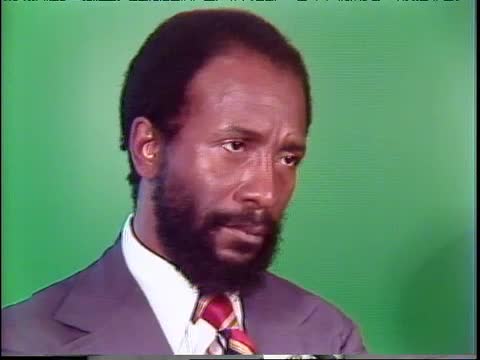
- Three interviews on southwest corridor mass transit and development project. Construction will create numerous jobs and have an affirmative action goal with a minority set-aside. $391 million (80% federal funds) will be for orange line and railroad relocation; plus an arterial street, community college, housing, and industrial park will make for at least a half billion dollar project. Residents are concerned about impact of noise and disruption in the adjacent neighborhoods, equitable employment opportunities, and environmental issues. Community groups want to be sure the new road and transit routes do not split the surrounding areas along socioeconomic lines. reporter: Curwood
- Created Date
- 1976-07-15
- Asset type
- Raw Footage
- Genres
- News
- Topics
- News
- Rights
- Rights Note:,Rights:,Rights Credit:WGBH Educational Foundation,Rights Type:All,Rights Coverage:,Rights Holder:WGBH Educational Foundation
- Media type
- Moving Image
- Duration
- 00:20:21
- Credits
-
-
Publisher:
WGBH Educational Foundation
- AAPB Contributor Holdings
-
Identifier: cpb-aacip-713dfdede45 (unknown)
Format: video/quicktime
Color: Color
Duration: 00:00:00
-
Identifier: cpb-aacip-f24ea3f6c2e (unknown)
Format: video/mp4
Generation: Proxy
Duration: 00:20:21
-
Identifier: cpb-aacip-66bfd0eb78a (unknown)
Format: video/quicktime
Duration: 00:20:21
If you have a copy of this asset and would like us to add it to our catalog, please contact us.
- Citations
- Chicago: “Ten O'Clock News,” 1976-07-15, American Archive of Public Broadcasting (GBH and the Library of Congress), Boston, MA and Washington, DC, accessed May 19, 2026, http://americanarchive.org/catalog/cpb-aacip-15-ks6j09wd22.
- MLA: “Ten O'Clock News.” 1976-07-15. American Archive of Public Broadcasting (GBH and the Library of Congress), Boston, MA and Washington, DC. Web. May 19, 2026. <http://americanarchive.org/catalog/cpb-aacip-15-ks6j09wd22>.
- APA: Ten O'Clock News. Boston, MA: American Archive of Public Broadcasting (GBH and the Library of Congress), Boston, MA and Washington, DC. Retrieved from http://americanarchive.org/catalog/cpb-aacip-15-ks6j09wd22