Ten O'Clock News
- Transcript
How well has the segregation worked in Boston in the past decade. What are the sort of high points and low points of the planets that's worked out. I think the high points have been twofold One is to establish some access to all of the children and parents within the system to the benefits of the system. And obviously Boston still has its own educational problems. But I think that the the issue that they faced in 73 74 74 when just dirty you know this order was that a significant number of minority children do not have access to the quality education programs that one city. I think desegregation if nothing else gave them access to those programs. The second point I guess that would be a profitable experience for Boston schools was in opening up a general airing out of the system. The partnership in relationship with the external communities the business community evolving into the compact the university agreement the recognition
that the school system can't solve all of its problems in collaboration with The Human Services agencies I think I'm extremely important also airing the very real problems of the system. Boston was a system of considerable educational delay long before Judge Perry's order. And I think it was not well known and the fact that. A great number of children minority and non-minority were suffering. I think hands of neglect was exposed and the system has had an opportunity to work on the kinds of programs that will make it improve as a system. It was obviously a violent and difficult at the beginning. Has that changed and and what problems remain. I don't think the violence remains. I think there's still a great deal of difficulty in desegregating schools obviously whether it's white flight or middle class flight or whatever the reason the school system now is predominantly minority overwhelmingly
minority as are most large school systems. But it happened in a short period of time in Boston and I think that makes the desegregation in the way that Judge Perry had to look at 74 very very difficult. Where we are. Seeing a school system trying to desegregate with almost imaginary youngsters the population doesn't exist within the system any longer and I don't know if it's profitable look at the segregation in in that fashion. I think we have to take a look at the segregation in creating the kinds of safeguards that don't indicate a return to a segregated and unequal system. But the focus of the desegregation effort has to be switched to education efforts and I think it really has over the past few years I think certainly since boatswain's been here we've seen a return to serious concern about education program and I think the parents are clamoring for that probably more than desegregation at this point which is ironic given given the fact that that was in the initiative of most
of the education reforms and consistent one of the things they are. The argument is this that as you said desegregation was to give particularly black parents and children the access to educational opportunities. There's some question as to whether the educational opportunities really exist now that it's a 70 percent minority system whether there's a lot of with a with a with a political system that's still not white majority whether they can support improvements in educational quality or no. I think it's mistaken to think that because the system has become a minority you can support educational innovation educational quality and you know I think that that's really what the black community resents the most is certainly an indication of something I resent. I think the issue is how you use the resources you have whether the system is 75 percent minority or 100 percent minority. We have 250 million dollars to deal with.
And it's how to use that wisely how to take the concerted stance for education that are really before the Boston Public Schools not whether or not they can balance by two or three children and individual school and I was convinced when I was a part of the system as I am now that the quality of education is what will populate your schools what will be segregated schools. I certainly found that to be true in Cambridge and until people pay a great deal of attention to that in Boston to get out of the political arena they'll still be mired in issues or range planning how we're going to be segregated. Is it freedom of choice or geo codes and all of the machinations of the segregation without the benefits of quality education. Freedom of choice. What's your opinion on that would it work. What if we segregate the schools which I'm some critics say or would it basically just return the choice to what schools they go to the parents themselves most of whom the problems are who are black anyway. I don't think that the freedom of choice plan can work in the city of Boston until the
quality of education is higher and more equal across the city. The issue of being able to send your child to school choice which really translates our people into the neighborhood school only makes sense if your neighborhood school was good strong and solid experience. I think there are still too many pockets of high quality in Boston at the expense of situations that are average perhaps and that's that doesn't really give you freedom of choice what allows you to do is to perhaps have a child close to you when you figure you're getting a pretty good education so things aren't so bad after all when in fact all of those children deserve a high quality education. I also think that the freedom of choice is a tough concept to sell after 10 years of numerical desegregation and the real reform. I feel is between trying to retain the real mandates of the desegregation order which we needed absolutely needed in the history of the. That led up to the decision was real
and purposeful and I think the decision was appropriate reaction to it. The switch of yourself fundamentally is very very difficult at this point. Here in Cambridge where they started with a with a freedom of choice cross-city plan said much easier to concentrate on the issues of education keeping the schools of higher quality to get people to send their children across town but have a non-voluntary. Assignment plan for so long to switch to freedom of choice is asking for a giant leap of faith for a substantial part of the minority community and certainly Judge Gary. We Westerners do think busing was a necessary means to the end. At the time I think it was I think the city had been given ample opportunity to in fact pursue other avenues. There were other models that might have been used in the nation. The resistance was there the very real resistance in court. The fact that the judges had to threaten contempt of court to school committee members at that time indicates the level of fierce
resistance that any type of desegregation is going to meet in the city. Given that scenario the and the only way that you really can begin to deal with the issue is to America we move the bodies around and to try to create an educational program I think the component that just Garrity attempted to put in place and then partially successful put in place in terms of magnet programs and business partnerships and the like were an effort to raise the quality of education in the city so that the busing issue would be diminished. And I guess I remain convinced as the judge that at that time that if there is a good quality education somewhere the parents will find a way to resolve their into conflicts inner conflicts and to bus their children across the program. I think when school proves that I think several magnet programs. Certainly give credence to that. But if a magnet schools are so successful and so and so both educationally and motivationally for parents to desegregate why not have magnet schools everywhere why not make
every school a magnet school and I think that's part of the current thinking. Maybe perhaps not magnet school but but for each building to contain something of such a dramatic educational value that parents will see values in the child through any school if you don't get your first choice and you know your Mr. second third will contain programs of value that has currency I think but until it's in place why should I you know risk my child is the feeling I get from people that I talk to. But if you can once again it's almost criminal to have parents. Trying to find that one school that they can and I think people are much my block the street I live in the south that really trying to find that one of the school or those two schools where they can feel comfortable sitting the child was a handsome sum somewhere else. I don't think that perception is necessarily totally accurate but it wouldn't be preferable. If each school. Was able to demonstrate its true educational value. It would be
called a magnet or an alternative or whatever. Not really important but someone's thought out a program implemented it and evaluated that it has come to you. What I want to spend that sort of downside are the are the problems with gardens. The segregation of the last years. I think the. Obvious problem is a major shift and for a period of time it's in the. Late 70s. Into early early 1980s of emphasis on the schools I think there is an abandonment of the schools by city officials and the community in general based on the residue of the segregation and the very real fiscal problems that were mounting for the city and the like I really think the communities surrounding the schools withdrew and left the schools pretty much on their own that's not a total result of the segregation but certainly came from the period of
people with Jordan children from from the schools and the belief I had I think on the part of politicians if they could these are the schools without any real harm to the city. What a shock it was for them to realize that the institutions of the city are are intertwined as a school system declines. People don't want to live here. And your other institutions were in some decline. I think that's part of the problem. The other problem is obviously that for better or worse there was flight from the schools have been a drastic reduction in the population we've had to close schools. That's somewhat fragmented neighborhoods. But the alternative to me was. To deny. A large population of the city their constitutional rights and I'm fine. A worse choice to me. Has it been reversed do you think that that trend is you we're talking about abandonment and flight. Certainly I think over the last two or three years the commitment of the schools have been restored on the part of. City state government and
business university communities. I think there have been some real innovations in the school system that have in fact improve the quality of education some standards have been set and I think that the beginnings of people returning to the system. The new baby boom the small baby boom. We're going to have for the next few years are increasingly looking at the Boston public schools as an alternative. Before it would have been rejected out of you. You know I think if you talk to the statisticians of the school system the leveling off of the decline and perhaps holding holding their own and maybe the increase of a few years. Judge Perry has spoken often about. Considering removing himself from the case a lot of parents who know a lot of black parents are particularly concerned that they may lose what they gained with him as a safeguard. Involved he is no longer involved day to day but he's still monitoring the situation. Is it tough for Gary to remove himself. What does he have to do before he does and
is the school department really ready to handle it on their own. I think it's time for the judge to bow out of the case. I think the school department could well handle the mandates of desegregation order and the changes dictated by the long range plan. However. I think there needs to be some safeguard for minority community and for the citizens in general that we won't have to return to prior practices or or the evolution of equally odious discriminatory discriminatory practices. One should remember that if we return to too would a segregated school system that citizens have the right to petition the court. Once again I'd hate to see us go through that. Again in Boston. But I think it's time for the judge to leave for the school system to assume its its rightful responsibility with the appropriate. Safeguards and assurances to the public.
Well with us records how would one. Work that. I think that's part of the problem with the funnier compromise on the freedom of choice point. I think that one must establish. Some some general guidelines for the city or individual districts within the city about a great deal of flexibility in assignments but be reasonably rigid with respect to percentages of children within within schools I think we also have to be much more concerned about the more important safeguard to me at this point given the fact that the system is as disaggregated as it's going to get under the current order of safeguarding educational gains for children that the standards that have been set have the proper support academically so that students can meet the standards required now and should. Be able to use that knowledge to make decisions about their lives. Those are the safeguards that I think people are really concerned about not necessarily whether black students it's next on which to. Ask the last question is because this is airing on Martin Luther King's birthday.
If Martin Luther King were alive today what do you think his impression would be of the decade of desegregation. In Boston and of the future prospects. I think he would have initially been terribly disheartened by the violence and turmoil within the city and would have hoped that this society had grown far beyond the need to express its opinions and desires and in violent and destructive means it would have he probably would have despair that the very real interaction between young people and the. Bitter. Interchanges between adults that spilled over into younger people. I think however as the desegregation suit moved along he would have been enormously encouraged by the people who responded by the gains made in the system by the attention to young people in the past few years.
And the fact that this is the system educationally is more sound today than it was in 1974. And the city. Has a government that is concerned about the issues and only of quality education but of equal access to its citizens throughout the city. So I think that over the 10 years after some initial disappointment I think would be a very upbeat feeling and feeling there despite a long struggle much like the civil rights struggle ultimate good came. Right there. Thank you very much for just got people like that or difficulty catching up with what's the current piece of rock for life I was involved in writing a good deal of the rest of the play and when I was there but now I have a hard time. I don't really think Larry has much choice. Oh yes well the alternative is going. He's it's up to last. Month right. And if you said it just because I think you because if you walk through the schools I mean the only I mean how many species are good at this point.
What you're basing your CV I mean that's all I can get out of it. We are safe and the safeguards are there after a fashion but they they could lead to some very empty schools which might not be a bad thing. And could we segregate some schools and something. The problem is enough quality in schools in a city to make me want to send my child anywhere wants in the south Boston. If someone was in school I was and she even integrated. The school aspect. So everybody's against a cluster of them close to home or doesn't send them at all. I think is going to have a heart.
- Series
- Ten O'Clock News
- Contributing Organization
- WGBH (Boston, Massachusetts)
- AAPB ID
- cpb-aacip-15-9jd4pp4r
If you have more information about this item than what is given here, or if you have concerns about this record, we want to know! Contact us, indicating the AAPB ID (cpb-aacip-15-9jd4pp4r).
- Description
- Episode Description
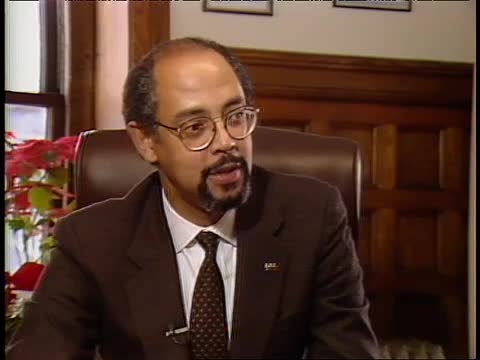
- Meg Vaillancourt interviews Robert Peterkin (Superintendent, Cambridge Public Schools) about school desegregation in Boston. Peterkin reviews desegregation in Boston, both the positive and negative outcomes. He talks about the challenges that lie ahead for desegregation. Peterkin discusses his belief in the potential for educational innovation and quality in a minority school system, stating that quality education will desegregate schools more effectively than a court order. He discusses the difficulties in moving from a "numerical desegregation" plan to a "freedom of choice" plan and notes that the Cambridge Public School System desegregated its schools through a "freedom of choice" plan. Peterkin says that busing was necessary to desegregate the Boston school system; notes that the city had been given opportunities to explore other desegregation models; that the resistance to busing was very strong. Peterkin discusses the magnet school concept and the need to institute valuable educational programs at every school. Peterkin talks about the problems with the court-ordered desegregation plan in Boston, but says that the positive result of equal access to the schools far outweighs the negative results. Peterkin discusses the prospect of more students returning to Boston schools in the future. Peterkin says that Arthur Garrity (federal judge) should end his supervision of Boston's schools; that the Boston School Department is able to assume the responsibility of continued desegregation of the schools, but that safeguards are required to prevent a return to discriminatory practices. Peterkin discusses his perceptions of what Martin Luther King would have thought about school desegregation in Boston.
- Series Description
- Ten O'Clock News was a nightly news show, featuring reports, news stories, and interviews on current events in Boston and the world.
- Date
- 1983-03-17
- Asset type
- Raw Footage
- Genres
- News
- Topics
- News
- Subjects
- Civil Rights; Segregation; Busing for school integration; Segregation in education; School management and organization; School superintendents; school choice
- Rights
- Rights Note:Media not to be released to Open Vault.,Rights Type:Web,Rights Credit:,Rights Holder:
- Rights Note:It is the responsibility of a production to investigate and re-clear all rights before re-use in any project.,Rights Type:All,Rights Credit:WGBH Educational Foundation,Rights Holder:WGBH Educational Foundation
- Media type
- Moving Image
- Duration
- 00:17:35
- Credits
-
-
Publisher: WGBH Educational Foundation
Publisher: WGBH Educational Foundation
Reporter2: Strand Of Oaks
Reporter2: Strand Of Oaks
- AAPB Contributor Holdings
-
WGBH
Identifier: cpb-aacip-58cddd976d7 (unknown)
Format: video/quicktime
Color: Color
Duration: 00:17:35;13
If you have a copy of this asset and would like us to add it to our catalog, please contact us.
- Citations
- Chicago: “Ten O'Clock News,” 1983-03-17, WGBH, American Archive of Public Broadcasting (GBH and the Library of Congress), Boston, MA and Washington, DC, accessed January 26, 2026, http://americanarchive.org/catalog/cpb-aacip-15-9jd4pp4r.
- MLA: “Ten O'Clock News.” 1983-03-17. WGBH, American Archive of Public Broadcasting (GBH and the Library of Congress), Boston, MA and Washington, DC. Web. January 26, 2026. <http://americanarchive.org/catalog/cpb-aacip-15-9jd4pp4r>.
- APA: Ten O'Clock News. Boston, MA: WGBH, American Archive of Public Broadcasting (GBH and the Library of Congress), Boston, MA and Washington, DC. Retrieved from http://americanarchive.org/catalog/cpb-aacip-15-9jd4pp4r