Frank Wilczek Talks at MIT
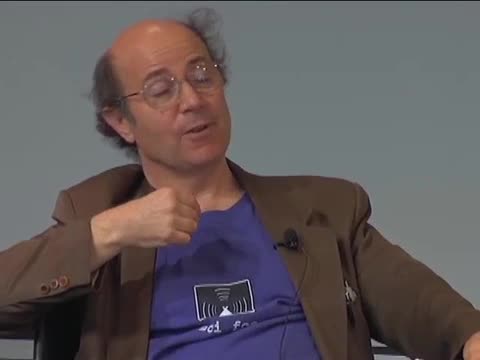
- Transcript
Today I'm delighted to welcome our first speaker Professor Frank we'll check he's the Herman Feshbach professor of physics here at MIT and winner of the 2004 Nobel Prize for physics. I'm delighted to be able to say but I suspect it will become obvious that in addition to his many accomplishments in physics about which he's much better equipped to speak than I am He's also a distinguished communicator of science and I think his most recent book The lightness of being very well reviewed book Bringing some Often what are regarded as quite difficult subjects to a wider readership. So we're doubly THE LIFE OF THEM FOR HAVING with us which was first of all thank you. What do you think. THANK YOU THANK YOU THANK YOU. Of the. Lovely to be here and thank thank you for coming in on this beautiful day. It's one of the nice things about Cambridge is you get to see so many intelligent faces looking in the neighborhood. And I'm glad to be here. So I
haven't prepared very elaborate remarks but I'm just some talking points to get the discussion going then I hope we can interact. So first obvious question what the heck did you get the Nobel Prize for. Yeah the citation says something about asymptotic freedom and nobody knows what that means. So there are four basic forces of nature. There is great gravity and electromagnetism. Which of the classic forces. And then two forces that really only became evident in the 20th century when people started to probe the interiors of atoms and atomic nuclei and these don't have such great names they just called the strong and weak force the strong force is the one that's responsible for making protons and neutrons out of more fundamental objects quarks and gluons and then for the protons and
neutrons interacting with each other to make atomic nuclei. And what I did was figure out what the equations the fundamental equations for the strong force are. And that's. That's what I did. And that's had all kinds of consequences as you know it's on. Important to understand the fundamental laws if you're going to understand the early universe if you're going to understand. Matter in extreme conditions. It's nice to know what you're doing. I've often asked Also what's it like to get a Nobel Prize. Well for me it was a very cold and wet experience. I thought it might be possible in 2004 that I'd be getting a Nobel Prize but I didn't. So I lost sleep that night. But I thought the announcement would always precede the telephone call. So I
knew the public announcement was going to come at 6:00 a.m. Eastern Time which is noon in Stockholm. So when I was tossing and turning and couldn't get to sleep finally at 5 a.m. I decided well I'm not going to get to sleep just in case maybe I should take a shower so I'll be ready. So I got into the shower and at 11 minutes after 5:00 my wife came in with the telephone and I didn't hear any any ringing because I was in the shower. I said there's a lady calling you with a beautiful Swedish accent then she says she wants to talk to you and that and that was it that was the way I got informed. The other thing I didn't know was that it's not just a matter of they call you up and say congratulations you won a Nobel Prize goodbye. It's not that way at all. They tell you about how
you're supposed to deal with the press about the practical arrangements and then people start congratulating. So I got congratulations from the head of the Swedish Academy the secretary of the Swedish Academy the head of the Nobel Foundation and the secretary of the Nobel Foundation personal friends people who were on the committee committee and so forth so it must have been 10 or 12 people each wanted to give their two cents. And there I was shivering and cold and wet in the front but it was glorious. Let me be a little more serious then about how one gets to that point. There are many ways but my particular story I think is instructive and important for people for the future. I am the second generation immigrant family my grandparents are all born in Europe and Poland and
Italy and we're really basically peasants. They came over here in the fallout of World War 1. They had very little education. My parents were born in the U.S. during the depression basically. Or shortly before think depression but grew up during the Depression and and and struggle they had to support the family. Neither one of them went to college but they were very they were very dedicated in to the idea that we should do better in the future. It's the classic American story unfortunately we lived in New York City in New York City really had a superb system of public schools. I didn't go to any special school just the public schools in the neighborhood. But there were great teachers. The whole country at that time was
mobilized for science. I think partly because of the memories of the atom bomb and how important that was and how powerful science seemed and spectacularly magic and powerful also because the Cold War was going on. And so we had a tangible rival a tangible enemy whose. Challenge was largely. Technological. And because of Sputnik particularly which really galvanized people as a little kid when Sputnik was launched. But it pointed people toward space. It also pointed people towards the fact that it wasn't clear that our our great country was anymore. At the top in science and so the whole. Country got mobilized and you could see this in the
schools. Now I think we're facing threats which are every bit and challenges and opportunities which are every bit as big as those in those days but they're less tangible. There are things like climate change what's our source of energy going to be. And on this opportunity side how we're going to exploit the possibilities of advanced information processing how we're going to develop new materials for undreamed of processes that we've learned so much about how matter works and that we've gained so much in power to solve the equations that I think the opportunities are unlimited It's just a matter of investing and having the vision and imagination that is worthy of them. Now let me say a few words about my current work and then we'll have to open the discussion.
One thing I'm working on is something called x e ons x e ons are a particle that I named after a detergent. There used to be just the Turgeon called X eon and I saw it in the supermarket and I said gee there really ought to be a particle named after they really ever really sounds like a party sounds very scientific they really wouldn't be nice if there were a particle like that. And so when there was a new kind of particle that solved it. A That cleaned up I should say a problem with an axial current. I could see that the stars were aligned and this should be the x e on. And fortunately I was able to sneak it past the editors of Physical Review Letters and now it's the standard name for this thing and it still hasn't been discovered but the theory has gotten more and more interesting.
And in fact now I think that it's very likely and other thing people think that it's at least worth thinking about that these axioms form the dark matter that astronomers have discovered. Dominates the mass of the universe. I mean the ordinary matter we've learned so much about and that you study in biology and chemistry and that we thought was everything until 20 or 30 years ago now we learn is only about 5 percent of the mass of the universe as a whole. There's something else out there and maybe it's actually and so I've been thinking about. How that could have happened in the first place and more important how you test experimentally for these very elusive very weakly interacting kinds of matter. Another thing I'm thinking about could be called Waiting for the
LHC you know there is. A great Excel arrayed are being completed now and near Geneva at the CERN laboratory called the Large Hadron Collider LHC which is going to concentrate unprecedented amounts of energies in particle collisions between protons and we've been waiting I've been waiting for this for more than 20 years to test some ideas about unification and supersymmetry and whole new worlds of phenomena that look very good and for which there's a lot of circumstantial evidence. But we'll really only come into their own when you have enough energy to actually produce the particles. And that should happen at the LHC. I've also been thinking about what happens after the LHC is taken so long to build this so expensive and still may not come off because of technological challenges.
Is there a next step. What are we going to do. We need radical radically new ideas for probing extreme conditions. But actually what I'm spending most of my time on is taking the ideas that were originally developed for fundamental physics for trying to understand the most basic. Structures of matter which turn out to be empty space for understanding empty space as a medium and ordinary matter as a sort of disturbances in that medium. To take those ideas over into the sky talking about things that are more conventional media solids and how to make them exhibit kind of exotic behavior a model for this an analogy is a model for this is superconductivity which is something that emerges from ordinary matter. When you put it in the right conditions but it's something that is very hard to
understand and wouldn't have been it clever if it had been predicted before it was discovered. That didn't happen but now we know much more and have much more experience and we can predict other exotic things that should be possible and might be useful. And I've been thinking about that kind of thing and how to harness the possibly the hidden possibilities of matter to do things like quanta what are called quantum information processing build quantum computers or maybe capture light from the sun in more efficient ways. So that's what I've been spending most of my time on. And I'm also writing a novel. About. Well I can tell you this. The main idea the main idea is that there are four physicists two from MIT and two from Harvard who nevertheless manage to collaborate and make a great discovery they discover what the dark matter is
and of its axioms by the way. And so it's clear that they should win a Nobel Prize for this however. The rules of the Nobel Prize are that at most three people can share. So somebody has got to go. And then one of them seems to commit suicide but isn't that convenient and wasn't really suicide. So that that's the idea. So with that said I think we have a few things to talk about and I'll open it up to your questions. Thank you very much. So it's over to you I can't resist just asking one very small question yes. Having decided to name a fundamental particle there was a of a detergent a detergent has a laundry detergent right did you ever get into the problem of trademarks. It has it has everybody so many complain I believe very strongly in something I learned from a Jesuit that he said he learned at seminaries at seminary and is called the Jesuit credo within within the just the word
order and that is it is more blessed to ask forgiveness than permission. So I didn't ask I just did it because I knew that if I asked they would have said no it's only about waiting for better or worse the the the laundry detergent I believe no longer exists it's going out of business. Certainly in the U.S. for a long time it was available in Europe but not in the US. And yes the only way the opportunity to ask forgiveness. Yeah well actually they did at one point raise the issue and in a book that I mentioned actually and I put a little trademark symbols. But it was sort of like a joke because I mean there's a vast scientific literature and which is just used as a as a common word. And so it's much too
late for that trademark I'm afraid. OK. Thank you so now. I might find myself in jail someday for that but we hope not. I hope not. I think I need to ask that if people are going to ask a question you should wait for Mike. Otherwise you won't get picked out not least by the WGBH folks who are here reporting. So please I saw a hand in the middle someone will bring you a mike. I heard something about cold fusion coming back I was wanting to there's any credence to that cold fusion coming back. There is the remote possibility that there might be controlled fusion if you can manage to focus. Energy into a very small spot having a sort of shock waves from collapsing bubbles things like that. But it's very unlikely to be economically useful. And it's what's first of all is very unlikely to occur. But even if it does occur it's very unlikely to be
economically even more unlikely to be economically useful. So I think reports of the life of cold fusion are grossly exaggerated. Thank you for that you're doing to make capturing light more efficient. I take it as an energy source. Is that what you write for. I wish I could talk more about it. But it's it's basically roughly speaking the the class of ideas is that you want to build. They've got objects but you want to get it to do the kind of trick that nature does in photosynthesis. But now to engineer it so that you don't have to build that you're not that put up with these trees and things. And so the idea is to make. Objects that are big enough that you can control them. And they.
Useful way but it's small enough that they exhibit quantum mechanical properties that make it possible for you to capture quanta of energy and keep them there in efficient ways so that that's the kind of strategy basically both for quantum computation and for that kind of use what you want to do is make systems that are big so they're not subject to quantum fluctuations so much and yet exhibit other characteristic behaviors of quantum mechanics such as the ability to superimpose different states it's technical I'm sorry but to superimpose different states to take the vantage of energy barriers and so forth. When people talk about quantum leaps.
It's almost always wrong because what a quantum leap a real quantum leap is something that's really really small but it's so small that you sort of can't tell if it's occurred at all. That's what's quantum about it I think. But what we want to do is make things that have the quantum behaviors so they leap and also superimpose but where the leaps are a bit bigger than in atoms or what comes naturally. So we want to be able to do that in a controlled way. Can I just extend back thought that one stage further and I mean thinking about the potential application for trapping solar energy. Yeah you mention focus and this is the obvious sort of natural competitive system right. And there are colleagues who are working on trying to engineer the living systems. Yes some of the engineering approaches are there's some potential advantages that your kind of approach to this has over say trying to engineer even more efficient organisms to do the same job using persons.
Well frankly their approach is much more likely to succeed in the short run. But. It said that they're there working on a sort of maybe five to ten year time scale we're writing what I'm doing is much more sort of changing the rules of the game and I don't know if it'll every lead to anything useful. But but sort of just seeing what's out there right now might it might turn out to be totally useless. But you know I just I really what motivates me is not directly the applications but just seeing the things that are fun and have mathematical potential and that I can play with. You know that's what every now and again I have a habit of changing the world. Yeah there's a check record of things like this is very good. You know most you know most of modern physics of course is completely useless.
And that's also true of most of classical physics always has but every once in a while there's something like. Faraday's work just trying to understand what electricity and magnetism were all about and he discovered it famously the the the effect called induction. And he demonstrated this at the London Expo exposition I believe in 1851. I'm in the midst of an earlier eight hundred twenty one I think. Anyway whatever the date was he demonstrated it. Maybe it was 1851. If you want the Great that you know that any and so we had this kind of apparatus with a magnet and things that whirled around and people who had an odd but the sort of hard headed guy that the chancellor of the Exchequer the guy who was responsible for money and taxes and taking care of the British economy at the time was not impressed. He said what
what use is this. And Faraday said Well according to one story he said. Of what use is a newborn baby. Maybe that's what he said according to another story however what he said is I'm not sure what the use is but I know someday you'll be taxing it and that's turned out to be true. You have to get this this induction effect is what underlies all the electric motors and every household now has dozens of them in every modern as of the power grid that takes energy from waterfalls or coal plants to their homes and so forth everything is based on that. Seemingly useful use less effect that Faraday. Discovered bit by investigations motivated just by curiosity. Yeah really.
Thank you great example. Please wait for the mike. Here comes. A question about the axioms if you could explain a little more. And what is it about him that makes him a good candidate for the dark matter. Yeah OK well to really really really do justice to it would take quite a while but I can tell you a few of the basic things. First of all what's the problem it's meant to solve. Well there's there's been a remarkable. Coincidence or feature of the world that seem to be a coincidence that people learned to take for granted until recently when when we sort of had developed higher standards for understanding the world which is that course in every day experience there's a tremendous difference between the past and the future. And Time runs one way and it looks very different running the other way.
But when you come to the fundamental laws and look at really small things. The fundamental laws don't seem to care which way time goes to a very good approximation. If you look at particle collisions or how billiards balls bounce or things and atoms are very accurate. Kind of ideal billiard balls if you took a picture of all of that and then ran in it backwards it would still obey the laws of physics. It would still look like something that was possible. So consistent with all the laws there are very very tiny exotic effects that were discovered at accelerators that violate that bits. But overall as we've learned more and more about nature this remarkable thing that the microscopic laws look the same run forwards and backwards. Has held up. Now in the 1970s we developed a rather
complete theory of matter called the standard model to make it sound boring I call it the core because it's great and it's the core of our understanding of nature. And in that framework so we know what the laws are we know what the you know what what the math the principles are that underlie the behavior of things that you study in the laboratory. And so we can investigate why what feature of the equations is it that makes things look the same forwards and backwards in time. And it turns out that it's almost an inevitable consequence a logical consequence of other principles deeper principles about consistency with relativity and quantum mechanics and something called gauge invariance. That tells you that if you try to introduce. Laws that violate.
This symmetry between past and future you also wind up violating other sacred principles so you can't. So that gives an understanding of why they look the same forwards and backwards in time and it works almost perfectly. Two guys named Kobayashi in Moscow. Showed that if you had enough quarks. You could introduce small deviations from this symmetry and they just got the most recent Nobel Prize for that. That idea enabled them to predict that they were going to be more quarks and then soon they were found experimentally with just the right properties. But there's a loophole in all this. There's another effect that the it that allows time reversal not invariance to sneak in. But that nature which would still be consistent with everything else but nature doesn't seem to make use of it. So there's a puzzle why not. Why is this effect not used. And
it turns out that by expanding the equations of physics introducing more principles of symmetry that you can explain why that. Otherwise possible effect that would spoil the symmetry between time forwards and time backwards doesn't occur. But this expansion of the equations of physics also predicts that there should be a new kind of particle and that's what the axiom is. And it has very special properties it's very roughly speaking like light. It's more like light than like solid matter it's very. Well it's very light it has almost zero mass. Yes it's a boat and so lots of lots of axioms can occupy the same space. Just like with light you can have laser beams with atoms you can have a Bose-Einstein condensates. But it interacts its predicted by the equations to interact much much
much more weakly with ordinary matter then light then photons do. That's why it's been so elusive. But now you can also run the equations through the big bang through the conditions that should have existed in in the early universe when it was very hot and particles are moving around fast the interactions were different and it turns out that under those conditions you produce lots of baccy ons and they would survive till today. And if you calculate then the amount is just about right to produce. The dark matter so I would also it's either a cruel joke on the part of nature or a grand synthesis gumming coming to what that's going to occur. So from these crazy you know while I'm very theoretical considerations about why it is time look the same forwards and backwards if you look at small things
to predicting a new kind of particle to saying that that dark at that particle is the dark matter. You know if it all works it would be pretty cool. But the experiments are still not in your case you want to come back. OK just a second so I want to pursue one aspect of that I wanted to because a rather talented science journalist asked the question in my presence last week and I thought well it can't be such a stupid question. But you're talking quite smoothly about problems in fundamental physics which you are then relating to the Big Bang and the question that this journalist asked which I'm just going to ask again now because nobody was that I answered at the time is why it apparently is work on the most fundamental aspects of what we know about matter seemingly so closely tied today to work on the very earliest. Yes stages of the origin of the universe with cosmology. You seem to be illustrating that say something about that. Well it's because of the nature of the big bang cosmology which tells us that.
Early in the history of the universe it was very much denser and very much hotter than it is now. Now we have an expanding universe which is gradually getting less dense and cooler. If you go the other way it's hotter and denser and in fact at present we don't know any real limitation that goes to as hot and dense as possible reaches a singularity and presumably we need new equations but when when you really get singular at the beginning but alright but we assume. That you know it's more blessed to ask forgiveness than permission so we use the equations we have and go back as far as we assume they're correct and work out their consequences and go back and forth. Now why. Fundamental Physics. Is tied up with the. Cosmology and the specific specifically the Big Bang is because fundamental
physics is about the most extreme conditions what happens at very short distances which turns out to be equivalent to asking about very high energies. The precise connection requires knowing something about quantum mechanics but roughly speaking you can think of. You know if you want two things to get really really close together you have to give them a lot of energy so they can get really close together. So if we want to understand the very very very early universe we want to understand what happens at very very high energies. And that's sort of the frontier of our ignorance in particle physics and fundamental physics too so. So the front here is of in ignorance at the earliest times in the history of the universe. And what happens at high energies are really the same frontier. OK in some sense and that that's that's why the two subjects are really to a remarkable extent emerged. Thank you that's really helpful.
Please I don't want to. And more specifically I didn't warn you the Nobel Prize. Yeah. So. There there was. Well there's this phenomena called the strong force which is the force between the force between the objects inside the protons which are things called quarks and also glue ons. Although it when we were doing our work it wasn't so clear what was inside it was clear something inside and that whatever what was inside it seemed to have the remarkable property that although the force is very strong. When you try to pull things out. And so these little entities let's call them quarks because that's what they are. If you try to pull them out they make they can't you can't pull them out. You can
do nothing with the properties of these quarks that you see sort of with Proton microscopes as ever shown up as an individual particle. We say they're confined so the force has to have this strange property that it confines the quark so it gets very strong if you try to pull it way out. And yet when you look inside the proton it seems to be that the forces were very small. So you have a strange kind of very different from the way gravity behaves where the forces fall off or where electromagnetism behaves or forces fall off with distance. A very strange kind of force with that seems to grow with the distance or putting it the other way at short distances seems to get weaker. And that's really paradoxical. I mean that almost sort of brings back astrology you know where distant things are having effects close by. The further away it is the stronger the force.
So it was very difficult to reconcile that behavior with everything else we understand. In detail. It's it's almost inconsistent with. Quantum mechanics and relativity to have forces that grow with the distance. And people thought it was people suspected it was just plain impossible. But a few of us were persistent and looked at some very special kinds of theories that were very poorly understood in the early 70s called non-A billion gauge theories. And it turned out that. Sort of uniquely among. Consistent implementations of relativity and quantum mechanics so-called quantum field theories this kind of theory had just had that property of forces that got weaker. As as you get the shorter distances. That's
called asymptotic freedom. And among these theories there was only one that even looked remotely plausible as a theory of how the actual quarks in our world behave. So we were able to give a very specific set of equations to propose a very specific set of equations for the strong force. And we also worked out some consequences of these equations for new kinds of experiments. And people didn't and. We were right. That's that. That's the story and so and it's been built on in many other directions that we didn't anticipate. It's enabled for instance. It's really enabled this opening into early universe cosmology because if you didn't understand the strongest force of nature. That comes into play at subnuclear distances then you certainly couldn't
get past nuclear densities and extrapolating back to the Big Bang because you'd start to encounter that very force coming in in a big way. But when we found that the fourth kinds of turns or kind of turns off and become simpler at short distances that really enabled the Nabl dust to get much much closer to the Big Bang has been very fruitful. Thank you. There's a question here. I thanks. I'm just wondering if you could comment on a couple of other exotic theories that seem closely related to your work but is it very far away. In a way also because of the inflation and string theory. OK so inflation and string theory are other important advance theories of physics that I've worked on and have some sympathy for this especially inflation inflation.
Is that the idea that. In the very early universe there was a period of extremely rapid. Expansion of the universe the universe is expanding now but the idea then is that way back then there was a period of much much more rapid expansion that would explain. And so you produced an enormously large universe from a small patch. That would explain a couple several things about our universe that are otherwise puzzling why it the laws seem to be the same everywhere. Even though our equations seem to permit the behavior to vary over large distances and also why the universe is flat. Spatially flat. General relativity certainly allows and.
Would encourage in fact in sort of the generic case that the universe to be a curved like a sphere or negatively curved like a saddle on large scales. But as observed it seems to be very accurately flat. And that goes with the idea of inflation because if you start with any old curvature and blow it up by an enormous scale it looks flat. Locally just like the surface of the earth looks flat. If you don't go over great distances and see it from space or you see ships going over the horizon it most purposes it seems pretty flat. So inflation is really cool and there is a lot of circumstantial evidence for it and it's been very fruitful goes together nice with axing ons which is a big plus. String theory is a
very ambitious attempt to incorporate. Gravity with quantum mechanics and. It's very poorly understood. I think it's fair to say it's not really a theory in the sense of having definite equations with definite predictions it's more. The wish for a theory or a program for constructing a theory with with different pieces that haven't been assembled. But it's promising because there aren't we don't know a lot of ways to logically join the theory of general relativity with quantum mechanics that don't have obvious. In consistencies or aren't obviously incomplete. Well I haven't worked out so much on string theory because I like to
work on things that are or may not have sounded like what I like to think. I think work on things that are a bit closer more closer to Earth are more down to earth. So in the way string theory is formulated now it's an essentially mathematical theory with very very little contact with experiment. And you know people who work on it are very brave in that if they're if if there is hope thinking that from such heights you can derive things about reality so far it's been rather disappointing that way. Meanwhile I think there are exciting ideas that are closer to experiment that would be significant steps in our understanding of the basic ways that nature works. And I like working on things like that. Yeah that actually raises something you refer to when you talk about what you're working on now you talked
about waiting for the LHC the Large Hadron Collider which as you said has taken a long time to come through and is still in the final stages of preparation as I understand it. And also I think you referred to kind of looking beyond it what might happen or what might be next and I assumed by that you meant what might be next experimentally. Yes. And what as a non physicist looking in what one observes is that to do meaningful experiments in many of the areas you're talking about ironically to probe deeper and deeper and smaller and smaller scale you need a larger and Rajat pieces of apparatus to the point where you want to know how far you can go exactly that's not sustainable. So that's. Could you say more about that because that could be yeah that could be the ultimate frustration for fundamental physics I suppose if you've got all kinds of needs which you can test right. Another approach to explore exploring very high energies historically and even today has been to use the gifts for nature.
It's either these indirect things from the early universe where you try to reconstruct from the relics we see today what might have happened under even more extreme conditions than the LHC or cosmic rays where nature by means that really still aren't understood but somehow produces very very energetic particles even more energetic than I'm going to have at LHC. And they fill space but they're not convenient to study because they collide high in the atmosphere you only see these showers and the ones that it would really break new ground as far as energy is concerned to occur about one per cent. per football field so if you want to study them you have to be very patient and think big. So true but so what I hope and what I've sort of been thinking about what it was you know how did it change the strategy so you would have
something in between some kind of machine that could be much much smaller than the LHC that would would produce higher energies but but fewer particles at those energies. You probably have to sacrifice in the quality of the beams and things to do but so it would be more like cosmic rays. But it would be a lot potentially cheaper and you could you could have not so thorough an examination but you could least have a better peak than from cosmic rays that much higher energies and how do you do that. Hat what kind of detectors are appropriate but what are the right questions to ask. These are the kinds of that I think is important for us to be thinking about because just building bigger and bigger versions of the same technology I think is not sustainable I mean the LHC is already 28 miles around.
So. I'm sorry I'm sorry. It's only it's 28 kilometers out only 17 miles you still get your point get the idea. But your point is well made by. Isn't it back in the early days of the Clinton administration there was to be a bigger facility in the States which they didn't go ahead with simply on grounds of cost. That's right. So these things cost tens of billions of dollars and a bigger one presumably would cost that much more. So it's not so I think it's important to think about other ways. And we've just had another question to go back to your earlier life you stopped in high school. You said you went to public schools and I guess my question is you know as a second generation immigrant What do you think or what advice would you give schools and school teachers today to encourage kids from families who don't come from a strong educational background or and then sort of a side related
question is At what point did you discover that you just love to think and think about it. That's the thing. Well let me answer the second one for us I mean hindsight is 20 20 but if I thought my my earliest memory which is pre-verbal it's all pictures I remember and I couldn't talk I remember this. So I was you know somewhere between one and two years old I think maybe. The. We had a percolator you know coffee percolator that have had several pieces and I just remember sitting there on the kitchen floor and taking it apart and putting it together and taking it and you know realizing that there was a way to do this that and you you know and I tried to put it together in different orders so that and then you know went at it. Shortly after that I
was learning about money and how to change money back and forth. And I thought if I if I had a notebook which I filled with this you know I could change 10 quarters and nickels and nickels into pennies and pennies into dimes and dimes back into quarters and so forth so. I did a lot of this I was trying to figure out a way to come out ahead by doing it you know. So I so I could have become I could have become an a banker I suppose they have figured out ways to come ahead or at least they seem to have into it. Ask any of them have they. But I mean so I think I was. Going I was wired to do something with mathematics and fitting things together in patterns and things like that. But. In there you know there are people like that in that there are also a lot of people who are extremely successful scientists are not like that
in you know many. Not all branches of science are essentially mathematical either. They come for different kinds of skills. How do you encourage people. Well you know there are so many resources out there now in the internet that don't cost a lot of money if you. So I would hope that. Teachers would could could have asked how should I say could be sort of brokers between what's out there and the kids who want to know things remembered that they should be there. The burden shouldn't be only on the classroom anymore and maybe there could also be. I think we should think big. I think investment in education I think is something that we know pays off historically and we need it more
than ever now that we should think about it. I don't know maybe each town should have as well as a library should have a Hall of Science where they were hands on experiments where they're you know with that were integrated with the resources on them. I don't know I you know I I think I think I think I think there's a lot of room for creativity but it hasn't been my primary focus I just have this intuition that there's a lot of room for creativity and I hope people take it up and I'd be happy to help if someone. Right and one thing you did mention as well in the course of that sort of autobiographical part is that you I think grew up during a period when the emphasis on science and technology was very great you talked about very great a postcard here is absolutely right. And what's quite interesting is that we're living through a period right now where some of the same emphasis seems to be happening I think now we might be rich that might be the time when
when people are waking up to the idea that you actually have to make you can to have prosperity you actually. You have to understand technology to use it intelligently and so forth. Let alone to advance. I think it's coincidence but I think President Obama has been giving is giving a speech today at the National Academies of Science That's right. And he seemed I looked at a pre release of what he was saying and it was very much along the lines of giving a greater priority again to science and he was referring back explicitly to the time when I'm guessing you would have been in training. Yeah yeah that's right. In some senses maybe quite encouraging. We have time probably for one more question then we're going to have to stop I think place in the center of the room. I don't know if he's the one you want here's last one but I said I think that in. You know hundreds of years ago when people had a sense that science explains something it was kind of concrete and that these
models were actually with things are and. It's a hobby for me for tracking physics but it seems that now we're going to a sink where I sense working physicists don't worry about whether these things are when things really are or whether they're just models of things. Just wondering as a physicist whether you were what you are or what your thoughts are about what do you wonder about. Whether you're dealing with things as they really are or just models and you don't worry about with things what things really are. Oh no I think this is it. This is reality. Now these equations Well I believe and there's every reason to believe it could have been different but that it appears from centuries of experience and very delicate experiments and we try very hard to test our equations as in as many ways as they as we can people get Nobel Prizes for finding deviations from them and from the predictions.
That. That there you can construct. A very detailed precise and remarkably complete map. From mathematical equations. That. Are very concrete but also require enormous imagination because they don't they or they describe the world that at first glance doesn't seem to have any resemblance to ours. Much more abstract Also it uses quantum mechanics where you have virtual particles you have very unfamiliar principles. You have confinement of quarks is just a minor example of all these odd properties are supposed to be our world. And. It is our world. But it requires enormous imagination and too to see that and and construction and solving the equations and hard work.
To me. That's a very empowering and enriching experience to realize that every day life. Is only a very part a small part of the story. But what we sense in everyday life what our senses pick up is actually only a very very small part of the universe as a whole if you like God's great design or in any case the universe that there's much more and and the more I learn about it. The more I love it because this one you know it's enriching. But I don't for a moment think that it's. Just a game or just I'm that that's it. I mean this is a. I guess the danger. Well you can get carried away with equations and add things that don't
correspond to reality. Then it does become a game. But as long as you confine yourself to the parts that actually participate in this map between the equations and observable properties of the world. And you don't find discrepancies. That's what we call an isomorphism. I think it's it's Or. Or a map that's so realistic and at least some of the aspects that it's an adequate substitute. Guide. For the real thing. There may be a one to one correspondence. So if I'm not take it very seriously I guess this is what you've called Platonism that the world of ideals is the same as the actual world. But. Thank you very much well I don't really know but I'd like to thank the president for such an intriguing
conversation I hope you will enjoy it as much as I do. Thank you.
- AAPB ID
- cpb-aacip-15-4q7qn5z940
If you have more information about this item than what is given here, or if you have concerns about this record, we want to know! Contact us, indicating the AAPB ID (cpb-aacip-15-4q7qn5z940).
- Description
- Description
- Frank Wilczek, physicist, gives an lecture at MIT.
- Genres
- Event Coverage
- Topics
- Science
- Media type
- Moving Image
- Duration
- 00:55:19
- Credits
-
- AAPB Contributor Holdings
-
Identifier: cpb-aacip-45366333dfc (unknown)
Format: video/mp4
Duration: 00:55:16
-
Identifier: cpb-aacip-8a4961a37e9 (unknown)
Format: video/quicktime
Duration: 00:00:00
-
Identifier: cpb-aacip-18ca453d778 (unknown)
Format: video/mp4
Generation: Proxy
Duration: 00:55:19
If you have a copy of this asset and would like us to add it to our catalog, please contact us.
- Citations
- Chicago: “Frank Wilczek Talks at MIT,” American Archive of Public Broadcasting (GBH and the Library of Congress), Boston, MA and Washington, DC, accessed May 30, 2026, http://americanarchive.org/catalog/cpb-aacip-15-4q7qn5z940.
- MLA: “Frank Wilczek Talks at MIT.” American Archive of Public Broadcasting (GBH and the Library of Congress), Boston, MA and Washington, DC. Web. May 30, 2026. <http://americanarchive.org/catalog/cpb-aacip-15-4q7qn5z940>.
- APA: Frank Wilczek Talks at MIT. Boston, MA: American Archive of Public Broadcasting (GBH and the Library of Congress), Boston, MA and Washington, DC. Retrieved from http://americanarchive.org/catalog/cpb-aacip-15-4q7qn5z940