The Forsyte Saga; 7; Into the Dark
- Transcript
.
Timothy may come down. He stayed in his room yesterday, of course. The farm, you know. Oh, yes. Monty dear.
No, thank you, Aunt Hester. But I'll push off in a minute or two today, right? Must you. What a shame. Why? When I thought I'd drop it at the court. Yes, he wants to be in it. But Dad, don't you, Monty. Dad, dear? Who's Dad? Well, good gracious, no front of the family. I was speaking metaphorically, Al. Oh, metaphorically. But some reason or another, and I can't imagine why Monty's taken the greatest light to Mr. Bussini. Oh, so has James, you know. And I can quite understand it. Mr. Bussini behave very bad here. The farm's house very, very bad. No, yes. It's inexcusable, of course, but the farm's is perfectly capable of dealing with that. There's no doubt as opposed to the farm as we'll win his case. Oh, no doubt at all. So, Irving assured me, so, himself. Oh, some murder. Oh, that's all right. Oh, but if he does, what will happen to Mr. Bussini? He tell me he has nothing. Nothing? Nothing except charm and talent. Well, they're not very respectable qualities, my dear. Hardly enough, if a young man has to make his own way. No, I don't know.
Anyway, I think he has sheep. Really? Really? Well, all I can say is he wouldn't have thought so if you'd seen the fellow yesterday tearing through the fog as if the devil were after him. Anything less sheep had to be hard to imagine. No, dear. Well, I'm afraid I must be off. He's got to kill us. Oh, dear. He's got to kill us. You can't just go and leave us all bursting with curiosity. I'm sorry, ma 'am. Freddie will tell you all the shocking details. Why don't you, Freddie? Goodbye, everyone. Well, we're in a friend. We're in a friend. What shocking details? What? No, I'm afraid. As far as I know, Monty was joking. Oh, dear. I quite thought we were going to hear something definite at last. Definite, Julie? The butt, Mr. Bussini and Irene. Are they or aren't they? That's what I want to rest. Oh, dear, are you listening to such things like that? And do you know, I think Julian has changed terribly this last year. We haven't seen much of him, of course, but James seems very anxious. What do you think, Hester? OK, yes, I do think that he is
aging tremendously. For dear Julian, something ought to be done about it. They are, Joe. You can cut a coat a bit longer in the future. Go talk to him now. I haven't many more years at my age. Well, father, I can't talk to you. A dog of yours, spoiling the garden. Not what you want for the dog. Oh, by the way, I've taken all my business out to your uncle's hands. James has passed it. And the young souls. He's a man of property. He won't miss the feed. So if there's anything good of Jack hearing, I still remember. I wish I could find the way for you, Father. Careful. If you said nothing more about it, too many years gone wasted. Wasted? Oh, I don't know. Well, for you, perhaps, you've learned a great deal, I dare say, with children. By the way, do you have something I'd like you to do for me? Hello, darling. Good morning. I'm just leaving.
How are you? Very well, thank you. Joe, your father was about to ask you to do something. Yes, Father. What is it? What can I do? No, it's a tom -full case. Soams and bus in it. I'm told it's coming up this afternoon. So? Yes. Well, what do you want me to do? Go there myself, but wouldn't be the thing. No. No hardly the thing. Because on one side, there are four sides, all the family of the four sides. And on the other, just for Mr. Buscini, the architect. And you? For you, it is difficult. I see the difficulty. You are four sides. So you should support them against this impute and young man who builds houses and races their money. On the other hand, the young man is engaged to June. So you should support him. But then perhaps he is making June. I'm happy, perhaps he doesn't love her anymore. Please be quiet. No, I shall say my say. Why not? Why not, indeed? I am outside. I have always been outside, so I can see you all quite clearly.
If you go to the trial, Mr. Buscini, you must take one side or the other, isn't that so? That is so. But this you don't want to do. Not outright so that all can see, because you don't know yourself who's side you're on. So now you ask Joe to do this for you. Isn't that what you want? It is. After nine years. Nine years when you don't care if Joyce did or starving. Now you come and say, please, Joe, do this for me. Do that for me, because for me. Julian, for sight. It is a hard little thing. When I get to the court, Father, what do you want me to do? There's no need. I don't want you to do anything. Well, I'll be going anyways, and what shall I do? Very well. If you will. If Buscini loses this case, but only Mark you, if he loses, ask him to come and see me. No, don't ask him. Tell him. I'll try. This could be a disastrous
case for him. I won't have the boy hounded no matter what. No, is that clear? That's clear as crystal. Good. I'll see you out. Good day. Elaine. Do you know why he came to see me? To ask you to go to the trial. No, no. That was an afterthought. A good afterthought. He takes, but he gives nothing. He asks for everything. Would you like to go? You really like me to tell you why he came. You feel which? To say that he'd changed his will. He said that coming here, and he's past few months, getting to know you and the children, talking to me, even though he didn't always agree with what I said, he said he felt at home here. So he's changed his
will. Without any conditions at all, he's settled on me, a thousand pounds a year. Now it wants. At his death, June is to have 50 ,000 held in trust. The rest comes to me. Over 100 ,000 pounds. You know what that means? They're more pinching and scraping. Security of the children. A decent life. And I tried to thank him. Do you know what he said? I should like to hear. You'll oblige me, he said, by saying nothing more about it. You're so English. So wonderful English. I'm ashamed. I'm so ashamed. I could kill myself. Good luck, sir.
They want this isn't a circus. I can't tell. I didn't ask them to come. Well, your mother wants you and I to read each other tonight. I'll come anyway. I'll tell you later. Good time, I see. The case is just coming off. Chanker me. I'll be very interested to hear what your client has to say. It may be a surprise, too. I doubt it. We respect what I doubt it. Still no sight of bussiness. Council, which is left? A water buck you see for souls in silky here. The junior Chanker is for Bosnia. Thank you. The big battalions on your side. Thank you. No sight of the buck in here. Ah, you'll be here. That chap's late for everything. But he'll call and not say, why? Because he's on the loser if he doesn't. That's right. I'll bet you three to
one. He doesn't turn up. In pounds. Here, on George. Four sight against Bosnia. And of the facts, in this case, well, I'm not in dispute. This being so, all we shall ask your lordship to do is to interpret the correspondence which took place between my client Mr. Searns' foresight and the defendant, Mr. Philip Bosnia, and architect, with regard to the decoration of a house. I would submit, however, that this correspondence can only mean one very plain thing and with your lordship's submission, I'll read it. Can I help you, miss? If you will. Where are they drying the case of foresight against Bosnia? In here. Thank you. You won't quite want to miss. The case is already on. Thank you. But why don't we raise your debt and be, and therefore I have to resign and I want Philip Bosnia. There was sinne. I did not mean to say that if you should exceed the sum named in my letter by 10,
20 or even 50 pounds, there would be any difficulty between us. And that being so, I should like you to reconsider your answer. You have a free hand in the terms of this correspondence, and I hope you'll see your way to completing the decorations in the matter of which I know it is difficult to be absolutely exact. Yours truly, soames foresight. And normally, final letter, they didn't may the 20th. Dear foresight, very well, Philip Bosnia. No, it's hardly surprising, my lord, but on receipt of that missive, short and sweet of a miss, they say so and to the point. My client, himself, do you like any more of four to one? A damnit, I wouldn't. Judge of his display, therefore. Second, two weeks later. He just got the money and shouldn't have asked me. I should continue that. A slight limit of 3 ,000 pounds by the very large sum of 350 pounds. No. There's a matter of principle, therefore. And this, I must emphasize, as a matter of principle and in the interest of others, my client has felt himself compelled to bring this action. He has now prepared to
go into the witness box and swear that he never did authorise. It was never in his mind to authorise the expenditure of any money beyond the extreme limit fixed. And so, without wasting any more of the court's time, I will call Mr. Serms Forsyte. Mr. Serms Forsyte? Mr. Serms Forsyte. Forsyte versus Bosnia. In here, sir. The case is already on. Am I late, sir? Are they... But if both, I should say, sir. Yeah. Yes, sir. In the course of a correspondence with this defendant, you wish to make it plain that you would not count on any expenditure beyond a certain limit. And you stated his limit in... What is your exact term? That's not what we were saying, Chris. And yet, when you received the
bill for the decoration of the house, you found that the defendant had exceeded this limit by 350 pounds. So, 400 pounds? But I was prepared to accept 50 pounds of that as exposed. Oh, quite so, very generous man. And it is to recover that 350 pounds that you have brought this action? Precisely. Thank you, Mr. Forsyte. When you agree that Mr. Pascini should do the decorations, did you not use the expression a free hand? No. Now, come, come, Mr. Forsyte. The expression I used was a free hand in the terms of this correspondence. And do you tell the court that this is English? Certainly. What does it mean? What it says. But what does it say? A free hand in the terms of this correspondence. And you do not consider this to be a contradiction in terms? Not at all. And yet, I believe that you are not an Irishman, Mr. Forsyte. Is it not perfectly obvious, Mr. Changri, that Mr. Forsyte, whatever else he may be, is not an Irishman.
Not yet. That would be that point. But why not? And you've expected him to come. What do you know about me? Well, this gibberish means nothing happens. Are you sure I wasn't a message? No message at all, sir. Oh, Mr. Forsyte. Why? I do beg your pardon. I thought you were someone else. And if your lordship had had the opportunity, as I have, to see the hubs, to examine the delicacy and beauty of the work executed by my client, an artist in a most honorable profession. I am persuaded. Nay, I am convinced that not for one moment where your lordship have tolerated this daring. No, I say blatant attempt on behalf of the plaintiff to avoid his legitimate responsibilities. My lord, I fear that some disaster must have before my client. I know he is much anxious to be here today to give his evidence and yet he is nowhere to be found. With your permission, I will call him again. I call Philip Baines for city. And your train?
May I get you a cab? Thank you. No. I should like to leave my luggage here if I may and send for it later. But by all means, thank you. It has been sought on behalf of the defendant to show that no limit to expenditure was fixed during this correspondence. If this were so, I can find no reason for the importation by the plaintiff into the correspondence of the sums of 12 ,000 pounds and subsequently of 35 pounds. It is manifest to me that by his letter of May the 20th, the defendant ascended to a very clear proposition by the terms of which he must be held to be bound. These reasons, there will be judgment for the plaintiff, for the amount claimed with costs. Thank you. Not at all, my dear captain.
Well, congratulations, cousin Sam. A noble victory. Look here, I suppose you're representing Uncle Jolium. Well, you can tell him that I won't be too hard on the silly. We'll come to some arrangement. I shouldn't worry too much about that if I were you. I'm sure this in his debt will be paid. So that's it. I see. No, really. Thank you. Phil isn't here. No, but
he's here. Except you. And I? Yes? I... I came to tell him Sam's one of the case. Of course. Phil wasn't there. I didn't expect him to be. Why not? Phil wouldn't defend himself. Why should he? He's done nothing wrong. No. All he did was to make the house more beautiful. What are you doing here? Don't stand there like that as if you were made of stone. I wish to God I were. So... It's all true. Everything I've tried not to think about. Everything
they've said about you. It's all true. I don't know what they said. I haven't been listening. You've no right to be here. I've left stones. You always said I should. Don't you remember? If it wouldn't have happened. I should never have got free. Don't tell me. I don't hear anything. I don't want to know anything. Why not? Are you afraid? You shouldn't be. You are my friend. I thought you were my friend. Yes. And you were a child. But you're no longer a child. You're a woman. And you should know by now that women don't have friends. They have a lover. And other people they just happen to have met. You've helped me. Yes.
But don't imagine if you had given yourself to Philip anything would have been different. Whatever you could do or say nothing would have been different. Tell me. Have you seen him since yesterday? No. Have you? No. And I have the strangest feeling. As if my life had suddenly come to an end. What are you talking about? You ruined my life. And you ruined his. So go away. I don't care what happens to you. Just go. Irene?
Irene? You're evening paper, sir. Thank you, Poffet. Miss June, coming here? Yes, she has, sir. Now, there you are. I want to talk to you. Come and sit down. Now, as you know, your father and I are
reconciled and I'm glad. You've got to come for two years. It is. Sir, I've decided on something. I thought I'd mentioned to you before I spoke to your father. I'm going to give up this great place. Sell it. And by a house near London, where we can all live together as a family should. Yes, Grand. As your stepmother, she's a good kind woman. You used to like her when you were a child. And she's very fond of Jo. The children, they're dear little things. Now, what do you say? And if by any chance you didn't get on with them, well, we find a little flat for you in London. I don't see why it wouldn't work splendidly. There's just one thing. Yes, what? I was going to suggest this anyway. If we're moving to the country, why don't you buy the house at Robin Hill? Why? It's all finished and perfectly beautiful and nobody's going to live there now. Why not? This is so important. I'm certain he isn't. I'm certain. So if you could buy it, and if you could settle soams, it
came on fill. That was already in my mind. Oh, Grand. You're so good. Oh, rubbish. I told your father I won't have the boy hounded by that grasping lot. No matter what he's done. You know what? What they say is going on. Yes. I know. No, I don't know. And I don't care. The things have changed. I want to help him, and I will. He wants your own way and everything. But that's for the house, I'll think about it. Well, there isn't much time. If you don't do something, it runs goodness knows what. He may do anything, anything. I won't go to soams. I don't want anything you want to do with him. But you needn't. Do it through Uncle James. Go and see him now. Now? Why not? Well, your father and stepmother are coming to dinner. Well, it isn't half past six. Please, Grand. Go now. Very well. Order the carriage. Dear Grand.
Dear, dear Grand. It'll all come right now. Thanks to you. I'm sure it'll all come right. My dear boy. What do you mean, left you? You never told me she was going to leave you? I didn't know. The soams are dreadful. Father, what's it to be done? You know, I should know what's to be done. What's the thought of asking me? Nobody tells me anything. They'll come and ask me what's to be done. I can't tell. Here's your mother there. She's standing. She doesn't say anything. Well, I should say you've got to do as to follow her. I don't know where she's gone. Didn't you leave anyone? Well, where do you suppose she's gone after that young Bosnie? That's where. Oh, and you, how did he be? Oh, why don't you go around to his room? Studio, what are you calling me? I've just come from there. She wasn't there. Neither was he. Then they've gone off together. Her broad, I shouldn't wonder. Not since James, they haven't a penny
between them. But mother, sounds what about her jewels? They're surely worth a great deal. She's taken nothing. Well, nothing at all. Just one for the reason. Some of her oldest clothes. We'll have a scandal. I always said so. Come now, James. Soms will do all that he can. Where you stand, you turn your mother. I don't know. But if she hasn't gone off with Bosnie, I advise Soms just to find her. And when you do, don't listen. Make her come back. Excuse me, sir. Well, what is it? Mr. Jolion, foresight, sir, has called to see you. Jolion? No, what should he want, eh? I have a very good idea, and I don't want to see him. But... Come along, William. We'll be in the other room, James. And don't try not to upset yourself too much. There's a deal. I'm upset, sir. All right, I'll ask my brother to come. Very good, sir. Please come this way, sir. I'll come to see you about this business between
Soms and Bosnie. I'm told this new house is a white elephant. I know nothing about white elephants. Bosnie's lost his case, and he likely go bankrupt. I shouldn't monger at it. So, Soms will be out of pocket. I don't say anything. Now, what I thought was this. If Soms is not going to live at Robin Hill, I don't want to know anything. I suppose I really need to put a foot down. But I'm looking for a country house myself. If the price is right, I don't say I might and look at it. So, spend a lot of money there. He wants a good figure. If he thinks he'll get a fancy price, he's mistaken. Let him try and sell it at the forced sales he will get. I'm told it's not every man's idea of a house. It's a gentleman's house. Anyway, Soms is here if you want to see him. Uncle James, I apologize for this interruption. But this isn't a social call. Otherwise, I should not have come. There's something I have to say to my father immediately. Yes, sir. What is it? You and Soms should hear it, too. Soms? What's going to be here, isn't it?
Soms? Yes? Here, I need it. Well, after you left, stand up, gate father. Police inspector called. Philip Pasini was run over yesterday in the fog. What? He is eager. Yes, he was killed instantly. He's lying in the hospital now. The inspector wanted to know if he would go there immediately. I will come at once. You and your son would better come, too. I should tell you... I should tell you this talk of suicide. Suicide? No, I'm suicide. Why should he want to do something like that? God knows. If you and your son don't... Mr. Pasini. We are all four sites.
I'll apply you, Steve, for coming so quick. What happened? We're not just sure. Maybe it was an accident, maybe not. The fog was not so thick just there. And the omnibus driver says the gentleman had ample time to avoid him. But he walked straight under the horses' hooves. It was an accident. You may say that, sir, and I'm not denying it. But he was very hard up. We found several pawn tickets in his rooms. And his account of the bag was overdrawn. And for a buy? Well, you've seen the account of the case of the day's papers. The case that went against him. With a step in here, gentlemen. I'd like a positive identification. He had an uncle, you know. He's abroad, sir. Would you mind? Excuse me. Do you identify the gentleman, sir? Yes.
That is Philip Buss in here. Quite a young, sort, cheerful man. Oh, I don't know. It's a waste. What about her? Yes. Zad. Don't forget me, Inspector. Wilson? You can discount suicide, Inspector. He had everything to live for. What do you make of this? Found you in his braised pockets. Any ideas?
No. I'm sorry. I can't help you. I'm sorry. Following immediately, actor John Bennett, who plays Philip Bussini, talks with James Day, president of NET. I'm sorry. A series of
conversations between James Day, president of National Educational Television, and some of the people associated in the production of the Forsight saga. Here in London, we're talking with John Bennett. Mr. Bennett, you play the role of Philip Bussini, an architect. I understand that you once thought you might become an architect. Is this simply coincidence that you should find yourself playing the role of an architect? Well, it's true. An architecture was the only other profession that I ever thought of doing, powerful acting. But actually playing the role of Bussini was pure coincidence. Was your idea or is your idea of architecture as unorthodox as Bussini's was? He was something of a rebel, wasn't he? Yes, his ideas were very advanced for his day. He was filled with a good deal of suspicion at the time. My idea is an architecture. Well, I think for the reason that I wanted to
consider becoming an architect, it was because I think architecture is very important. It instructs the whole environment on which we grow up. And I am still very hurt sometimes by the tower blocks I see going up that we and our children have got to live with the next 50 years. In the saga, you play one of the few significant roles that is not a foresight or not married to a foresight. Did you find yourself as an actor? What the reader of the novels might find himself doing and tracing the lineage of the foresight to keep the character straight in your own mind? Or were you able to enter the cast with an almost instant knowledge of a relationship to the other characters in the play? Well, I think the relationship with the architecture of the rest of the cast was implicit in the scripts. One of the difficulties I found playing the
character was that he is described rather fully by several of the other characters in a very suspicious way. He is variously described as a teen leopard by one of the other characters and an outsider. And so one has to try and fit all these descriptions in playing the part. Wouldn't that give added dimension to the challenge of the actor? Yes, it does. Because you've got to try and portray a character that will meet rather these rather false descriptions that they make of him, because they don't understand him very well. Why is he so complex and so difficult to understand? Is it because he is so much a non foresight? He is so much a non foresight and he is a very modern character. Modern? I would think so, yes. He cut assues through all the time on the attitudes of Victorian England and that is why he was considered so much suspicion by the foresight who had very died in the world.
Victorians, men of property. This is what the whole story is about and he was directly opposed to that attitude. Has any represents the beauty and the passion for its own sake rather than in conflict with property? Yes, of course. Did you find yourself as a non foresight setting your own dress and manners in contrast to the tradition of the foresight at all? Yes, this again is implicit in the text. He dressed in a very casual manner which upset the foresight. He was soft hats and casual clothes, which enraged him. I don't know if a man wasn't dressed impeccably for the occasion then he was to be suspected and you thought very carefully before you gave one of your daughters in marriage to him.
Mr. Bennett, the death of Bosini has been a matter of some dispute. Wasn't that true that Gauls were the originally intended that Bosini would commit suicide? Yes, it was his idea. Did it clear in the story itself what happened? Not absolutely. Because he was in two minds. He knew Gauls were in two minds about how to dispense with the sin. He had to get rid of him before he could get on with his plot. There is some correspondence which has turned out where he was discussing the problem with a friend of his. When he suggested that Bosini should commit suicide, this friend was adamantly against it. How did you feel in playing the role? I felt he would never have committed suicide. He had no reason. He wasn't that kind of character. He hadn't got that kind of emotional imbalance. And he had no particular reason because at the point where he does die, he has everything to gain and nothing to lose. He has gained Irene from what he desperately
wanted. She has agreed to go away with him. And he goes out without wishing to get away with the plot too much. But he goes out to get money to cover the journey and gets killed. And in fact, in this series, we leave it an open question. We don't see how it happens. It's open to question. Various members of the Forsyte family put their own interpretation on it. It's very clear what the Forsyte's thought of Bosini. What did you think of him in playing the role? Well, I like the character because it's interesting. It's a direct contrast to practically everybody in the cast. You liked him as an actor or as a person. As to say, you liked the role or you liked the person. I liked the person, I think. A difficult man to get on with because he was so way out in his ideas. Not an easy man to get on with. But very understandable. I mean, I felt in sympathy with him. Is it any advantage to you as an actor to appear in the earlier parts of the saga rather than in the 20th century sequences? Are the
roles more meaty? I think so. My own feeling is that the earlier parts of the story are probably the more interesting. But this is purely my own attitude to it. Certainly as a playing. You described Bosini as a modern character. Playing a modern character. You allow for a contrast, I suppose. Well, I think it is more interesting. Also, the character of Bosini is very crucial to the story. The repercussions of his particular part of the story are very widespread. It changes the whole plot lines. It changes Irene's life very much. Okay. Tune in at the same time next week for
another episode in the continuing series, The Forsight Saga. Thank you very much.
- Series
- The Forsyte Saga
- Episode Number
- 7
- Episode
- Into the Dark
- Producing Organization
- WGBH Educational Foundation
- British Broadcasting Corporation
- Contributing Organization
- Library of Congress (Washington, District of Columbia)
- WGBH (Boston, Massachusetts)
- AAPB ID
- cpb-aacip-15-13mw7kd2
If you have more information about this item than what is given here, or if you have concerns about this record, we want to know! Contact us, indicating the AAPB ID (cpb-aacip-15-13mw7kd2).
- Description
- Episode Description
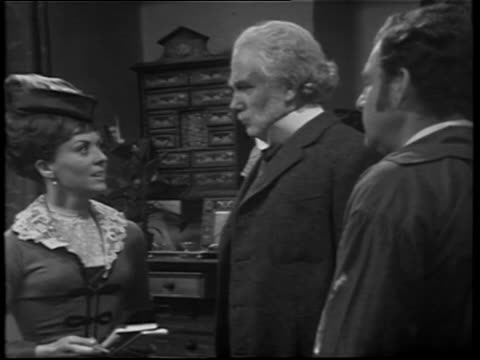
- Dazed and terrified by Soames' assault, Irene decides to run away with Bosinney. But an accident on a foggy street puts an end to her plans. In the filler, NET President James Day interviews John Bennett, who plays the role of Philip Bosinney, the young architect who becomes engaged to June and then falls in love with Irene. Day and Bennett discuss the offbeat character of Bosinney and speculate on whether Bosinney's death in the "Saga" is an accident or a suicide, a question that was left unanswered by Galsworthy. (Description adapted from documents in the NET Microfiche)
- Series Description
- This television series dramatizes the series of books, The Forsyte Saga, written by John Galsworthy. The music is from a composition titled Three Elizabeths Suite by Eric Coates (1886-1957) which has been recorded by the London Pops Orchestra on the Mercury label, LP 90439. Airing after each episode is a series of filler segments titled Behind the Scenes, which generally run about seven minutes. They feature conversations between NET President James Day and persons associated with the production of The Forsyte Saga, including in some cases the performers. The series consist of 26 hour-long episodes that were originally recorded in black and white.
- Broadcast Date
- 1969-11-16
- Asset type
- Episode
- Genres
- Drama
- Media type
- Moving Image
- Duration
- 01:06:37:00
- Credits
-
-
Producing Organization:
WGBH Educational Foundation
Producing Organization: British Broadcasting Corporation
- AAPB Contributor Holdings
-
Library of Congress
Identifier: cpb-aacip-83cf5294ecc (Filename)
Format: 2 inch videotape
Generation: Master
Color: B&W
Duration: 0:57:58
-
WGBH
Identifier: cpb-aacip-32247db7395 (Filename)
Format: 2 inch videotape
Generation: Master
Duration: 00:01:00
If you have a copy of this asset and would like us to add it to our catalog, please contact us.
- Citations
- Chicago: “The Forsyte Saga; 7; Into the Dark,” 1969-11-16, Library of Congress, WGBH, American Archive of Public Broadcasting (GBH and the Library of Congress), Boston, MA and Washington, DC, accessed June 6, 2026, http://americanarchive.org/catalog/cpb-aacip-15-13mw7kd2.
- MLA: “The Forsyte Saga; 7; Into the Dark.” 1969-11-16. Library of Congress, WGBH, American Archive of Public Broadcasting (GBH and the Library of Congress), Boston, MA and Washington, DC. Web. June 6, 2026. <http://americanarchive.org/catalog/cpb-aacip-15-13mw7kd2>.
- APA: The Forsyte Saga; 7; Into the Dark. Boston, MA: Library of Congress, WGBH, American Archive of Public Broadcasting (GBH and the Library of Congress), Boston, MA and Washington, DC. Retrieved from http://americanarchive.org/catalog/cpb-aacip-15-13mw7kd2