Dear Liar
- Program
- Dear Liar
- Producing Organization
- WGBH Educational Foundation
- Contributing Organization
- WGBH (Boston, Massachusetts)
- AAPB ID
- cpb-aacip/15-05fbgxpw
If you have more information about this item than what is given here, or if you have concerns about this record, we want to know! Contact us, indicating the AAPB ID (cpb-aacip/15-05fbgxpw).
- Description
- Program Description
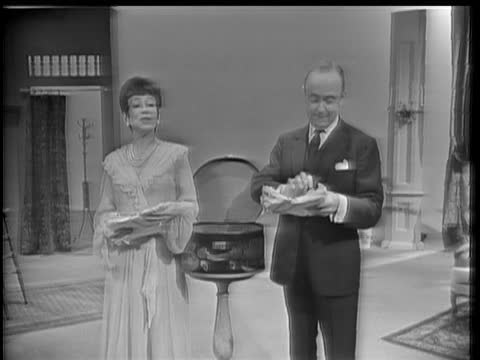
- Mrs. Patrick Campbell and George Bernard Shaw were two of the most brilliant figures in the theater in the first 20 years of this century. When they first met, she was at the peak of her profession with all the great English authors endeavoring to snare her for a leading role in a play of theatre. Shaw was just starting to develop a reputation as a dramatist. Apart from the fact that she was a great actress, Mrs. Campbell was beautiful, filled with a vitality that was freshened by a streak of irresponsibility and a sense of humor that maddened many. In 1893 when Shaw first saw Mrs. Campbell in Pinero's "The Second Mrs. Tanqueray," he wrote (he was then a drama critic), "Mrs. Patrick Campbell plays her author clean off the stage. She creates all sorts of illusions and gives on all sorts of searching sensations. It is impossible not to feel that those haunting eyes are brooding on a momentous past and the parted lips anticipating a thrilling imminent future." Six years later Shaw (now a dramatist) wrote Mrs. Campbell his first note suggesting she appear in one of his plays. More than 20 years later she appeared in "Pygmalion" and introduced to the world the unforgettable Eliza. And from that first note their correspondence continued for four decades. Were they in love? Of course, everyone says. But were they lovers? Some say, "Yes." Others say "No."Dear Liar is a comedy adapted by Jerome Kilty from the fascinating and often astonishing Shaw-Campbell correspondence. The correspondence was smuggled out of France in 1940 as Mrs. Campbell lay dying in Pau, France. The first act is based on events from 1899 to World War I. The second act, from World War I up to 1940.Jerome Kilty, who plays G. Bernard Shaw, adapted DEAR LIAR from the Shaw-Campbell correspondence and has produced and directed the two-act comedy in major cities all over the world. Mr. Kilty has been represented on Broadway as author, director, and producer. He is now in London working on a theatrical revue. Jerome Kilty was born in Pala, an Indian reservation in Southern California, on June 24, 1922. His father was an Indian agent. He was educated at the Mission School of San Louis Rey and later at Harvard University. During the war he was an officer with the United States Air Force in North Africa and Europe, flying two tours of duty in B-26 Marauders. He holds the DFC and Air Medial with eight clusters. In London, during the war he met Miss Agnus Claudius who had been with Mrs. Patrick Campbell at her death in Pau, France in 1940. Miss Claudius had managed to get over to England with the entire correspondence between Bernard Shaw and Mrs. Campbell which Mrs. Campbell had kept with her during the last years of her life. Mr. Kilty was shown the letters and thought about forming it into a play for two people. Bernard Shaw was still alive, however, so nothing could be done then. Mr. Kilty went back to Harvard University and after graduation in 1948, he founded the Brattle Theatre Company in Cambridge, MA, which became the most celebrated classical repertory in the United States since the war. In 1954, Mr. Kilty left the company and moved with his wife to New York where he was continuously active in the theater as director, actor, and producer as well as playwright. In 1957 he again started work on the Shaw-Campbell correspondence and this time was able to get permission from the Shaw and Campbell estates for its presentation. Mr. Kilty played it for the first time with his wife, Cavada Humphrey in Chicago in 1957. Since then it has been played all over the world including Warsaw, Leningrad, and Moscow. Many of the greatest stars of the contemporary theater have acted the two roles. Among them are Elisabeth and OE Hasse. Rina Morelli and Faolo Stoppa, Katherine Cornell and Brian Aherne, and Mira Casares and Pierre Brasseur. The Kilty's have themselves played it extensively in America, England, Ireland and South Africa.Cavada Humphrey (Mrs. Jerome Kilty) plays Mrs. Patrick Campbell. Miss Humphrey. who has been acclaimed for her portrayal of Mrs. Patrick Campbell by critics all over the globe, has had a Broadway career dotted with more classical appearances for a young actress than most can point to in a lifetime. She made her debut in Elizabeth Bowen's A House in Paris and played The Cherry Orchard the same year, Therese in 1945, and in Walter Kerr's adaptation of The Song of Bernadette in 1946. Later that year she joined the American Repertory Theatre and appeared in Henry VIII, John Gabriel Borkman, Alice in Wonderland, and What Every Woman Knows. An amazing switch occurred in 1949, when she appeared with Bobby Clark in the musical hit As the Girls Go. In 1951 she joined the Brattle Theatre and there appeared in King Lear, Othello, Henry IV, Part I. At the City Center she played the Duchess of Gloucester in Richard II with Maurice Evans and then went to Broadway for a season in The Devil's Disciple with Mr. Evans. She also played the revival of The Corn is Green with Eva La Gallienne. In 1956 she returned to the City Center and played in the Brattle Theatre productions of Love's Labour Lost and in Othello. She was the standby for Helen Hayes in Time Remembered and in 1960 appeared on tour with Billie Burke, Una Merkle, and Eva La Gallienne in Listen to the Mocking Bird. Between all these appearances, of course, she devoted a great deal of time to Dear Liar with her husband, Mr. Kilty. she has appeared prominently on all major television networks and is a graduate of Smith College. Dear Liar is a 1965 WGBH production for National Educational Television. This program runs approximately 90 minutes. (Description adapted from documents in the NET Microfiche)
- Broadcast Date
- 1965-04-16
- Asset type
- Program
- Genres
- Drama
- Topics
- Performing Arts
- Theater
- Media type
- Moving Image
- Credits
-
-
Actor:
Kilty, Jerome
Actor: Humphrey, Cavada
Director: Harney, Greg
Producer: Harney, Greg
Producer: Kellerman, Don
Producing Organization: WGBH Educational Foundation
Writer: Kilty, Jerome
- AAPB Contributor Holdings
-
WGBH
Identifier: P03148 (WGBH File Number)
Format: U-matic
Generation: Copy: Access
Duration: 00:00:30
-
WGBH
Identifier: 114930 (WGBH Barcode)
Format: VHS
Generation: Copy: Access
Duration: 00:01:30
-
WGBH
Identifier: 114924 (WGBH Barcode)
Format: Digital Betacam
Generation: Master
Duration: 00:01:34
-
WGBH
Identifier: 114925 (WGBH Barcode)
Format: Betacam
Generation: Master
Duration: 00:01:30
-
WGBH
Identifier: 0000259210 (WGBH Barcode)
Format: 1 inch videotape
Generation: Master
Duration: 01:28:00
-
WGBH
Identifier: 0000144639 (WGBH Barcode)
Format: 1 inch videotape
Generation: Master
Duration: 00:01:31
-
WGBH
Identifier: 0000259212 (WGBH Barcode)
Format: 1 inch videotape
Generation: Master
Duration: 00:01:31
If you have a copy of this asset and would like us to add it to our catalog, please contact us.
- Citations
- Chicago: “Dear Liar,” 1965-04-16, WGBH, American Archive of Public Broadcasting (GBH and the Library of Congress), Boston, MA and Washington, DC, accessed May 8, 2026, http://americanarchive.org/catalog/cpb-aacip-15-05fbgxpw.
- MLA: “Dear Liar.” 1965-04-16. WGBH, American Archive of Public Broadcasting (GBH and the Library of Congress), Boston, MA and Washington, DC. Web. May 8, 2026. <http://americanarchive.org/catalog/cpb-aacip-15-05fbgxpw>.
- APA: Dear Liar. Boston, MA: WGBH, American Archive of Public Broadcasting (GBH and the Library of Congress), Boston, MA and Washington, DC. Retrieved from http://americanarchive.org/catalog/cpb-aacip-15-05fbgxpw