North Carolina Now; 112; Interview with Don Higginbotham
- Transcript
Tonight it's the Fourth of July. Watch out for this guy. Good evening everyone.
I'm Bob Garner. Tonight we have an unusual show for you. It's the Fourth of July in a regular whole story and Mary Lou are taking what's actually their first holiday off since Christmas and since I'm filling in for them I decided it might be fun to share with you some of the stories I've enjoyed producing for North Carolina now stories that seem appropriate for this Independence Day. The highway patrol has been out in force this holiday weekend on the lookout for drunk drivers and speeders. I know I've been extra careful about my speed this weekend and actually for longer than that for the last couple of years I've been trying to overcome this little problem I used to have and used to get speeding tickets frequently. Here's a report I produced a while back on the subject. I am pretty well convinced that no one drives 55 anymore. Well maybe there's a nun somewhere who does. Maybe not tonight who passed the other day going 70 in a 55. I
like the song says we can't drive 55. Certainly not since the speed limit was raised to 65 on some interstates and on those stretches a lot of us are going between 75 and 80. Like these cars up ahead most of all we don't like to slow down from 65 to 55. We only slow down to 60 to hear and cars were still leaving us in the dust. We are the most impatient people probably in the world. We don't have time we don't take trips or AJ Albertson has been watching people's lives get faster for 20 years this is a guy you don't want on your tail. He's so tough he once pulled over 10 18 wheelers and once single handed and that's not all I had around my daughter a ticket. You wrote your own daughter a ticket. I rode my bad attitude simply because she broke the law. After that I was almost afraid to ask the next question.
But as a driver who has won say a few speeding tickets in his past it's been bugging me for a while. So I plunged ahead. OK what I don't understand is there are a lot of people speeding at their speeds up all over the state. You obviously can't catch but a certain percentage of them which means that you don't catch a percentage. And yet that the few that get caught really pay dearly for it in terms of insurance. Why is that fair. Why is it unfair to me. Well you just happen to be one of those few that got caught and the job of catching speeders is really like fish and there's no way you can catch them all. I've never in my career written a ticket that I wanted to ride because I know and I explain to every individual that I stop and issue a citation about me doing my job. I know it's going to hurt him. Insurance wise he isn't kidding. A couple of speeding tickets can more than double your premiums. In my case it's gone past hurt and is approaching disaster but I
know drivers with lead feet and absolutely clean driving records and I bet you do too. So I went over and whine to the insurance dept.. Why is it fair for me to have to pay so much for my insurance because I was one of the unlucky few out there who got caught. Bob I can't really say that is fair or not fair that you got called the Department of Insurance is not the one that regulates or enforces the speed limit so don't blame you guys don't blame us guys that's right. But in having the drivers without tickets get the very lowest rates the insurance department feels it's on solid ground. I think it is fair really. I really do. Now as far as who gets caught and who doesn't get caught I'm not talking about that I'm talking about if you actually have points on your driving record then I think the I think the plan that we are working with is very fair I really do because it doesn't penalize anyone who isn't guilty of going to that exactly. Doesn't mean it penalizes everyone who's guilty.
Considering how fast we're all driving it's clear that not everyone with a low insurance rate deserves it. On the other hand I guess I have to admit that just about everyone with a high rate does deserve it. We're done in by the statistics. The person with the convictions and whatnot is more prone to have accidents and ultimately is that unsafe driver if you would. No getting around it. I'm more of a risk by being just that clean up you're right. North Carolina has the 10th lowest auto insurance rates in the country so it could be worse out of financial necessity as well as increasing fear for my life I really have tried to slow down but like a reformed smoker trying to get others to quit I'm always thinking AJ and the rest of you troopers. Be sure to be ready the next time this guy breezes past traffic surveys show that statewide the percentage of drivers exceeding the speed limit has actually
decreased slightly during the past year. But driving is always a bit more hazardous on major holidays like this one. So please be careful as you return from your weekend travels. And remember all available highway patrol officers will be out there until midnight tonight. I'm sure a well-known tourist attraction in Wilmington got a lot of visitors on this Fourth of July weekend. What was once the world's mightiest warship is now a major east coast war memorial a tourist site seized the USS North Carolina more permanently across the Cape Fear River from Wilmington. This report looks at the North Carolinas glory days during World War Two and what lies in her future. At one time the USS North Carolina was the world's most powerful battleship. Now she's a memorial to the more than 10000 men and women from North Carolina who lost their lives during World War Two.
The USS North Carolina has been known through the years as the Schauble. She got the nickname in 1941 when she frequently steamed in and out of New York Harbor at the same time that the Jerome Kern musical Schauble was in revival on Broadway. Sailors on other ships occasionally use the term as a taunt. But North Carolina really was a technological sailboat at the time and she backed up the name by earning 15 battlestars more than any other battleship in World War 2. Eight battleships. The very heart of the U.S. Pacific fleet was sunk or badly damaged in the Japanese attack on Pearl Harbor in December 1941. So when the brand new North Carolina arrived in the Pacific several months later she was not only the world's greatest sea weapon but also a symbol of America's determination to fight back that North Carolina not of are a great deal as we were facing defeat after defeat in the early days in the Pacific battleships were designed to
slug it out with enemy warships that were miles away but that never really happened in the Pacific because a carrier aircraft could strike at much greater distances. So the North Carolina and other battleships instead used their 16 inch guns to shell Japanese held islands before and during amphibious invasions. Marine said The North Carolina's computer controlled guns could put a 16 inch shell right into the mouth of a cave full of enemy soldiers. Military historian Dr. Larry cable say fire control system onboard the North Carolina was the absolute state of the art for the world in computer technology. The big guns could put a shell on a target no bigger no bigger than the infield of a baseball diamond at twenty two miles. The fire control computers also made the North Carolina's anti-aircraft fire especially deadly and providing protection for aircraft carriers late in the war. The ship encountered a new Minnes Kamikaze or
suicide plane. Charles was a 21 year old radio man on the North Carolina and he still remembers his thoughts in watching the kamikazes approach. He's out to kill me. He is it doesn't make a difference what we do to him. He's down and coming to that place where I am kamikaze attacks were terrifying and I would always destroy the plane. I mean you had to absolutely blow it apart and it came flooding down after the war ended in 1945. The North Carolina was decommissioned after just two years of peace time duty several years later the Navy made plans to scrap the vessel. But some 70000 North Carolina schoolchildren contributed pennies nickels and dimes from their lunch money to help raise enough funds to bring the ship back to its home state in October 1961. The North Carolina came to rest across the Cape Fear River from Wilmington.
We had the state memorials of the veterans of World War 2 but we are also a major attraction in the city we draw on. On the average About 250000 people a year and we have on average done that for 27 years. In September 1995 the North Carolina will be the site of a national ceremony marking the 50th anniversary of the end of World War 2. They will be banquets speeches and a special fireworks display accompanied by a regional music performed by the North Carolina Symphony. No other battleship match the North Carolina's world record. And it seems only fitting that she play a major part in the commemoration of the end of that global conflict. You don't have to wait for the Fourth of July to visit the battleship North Carolina. It's open every day of the year from 8 a.m. to 8 p.m.. Follow the signs on U.S. 17 across the Cape Fear River where you'll find the battleship more directly opposite downtown Wilmington. Admission is $6 for adults and kids over
12. $3 for kids six to 11 and free for those under five. The phone number is 9 1 0 2 5 1 5 7 9 7. And now here's a story about another North Carolina historic landmark one that withstood its accuracy in the Civil War but now faces a different kind of assault from Mother Nature. This is Shepherd's battery. One small corner of what was once the largest earthen fortification in the Confederacy Fort Fisher. By the time of the Civil War brick forts which could be so easily blown apart had become almost obsolete. Earth forts like this one on the other hand could better withstand the blast of bombardment and they became the order of the day. Fort Fisher and several smaller fortifications near the mouth of the Cape Fear River only existed for one reason to keep the Confederacy's last port open. With the capture of Charleston and Savannah Wilmington had become the only remaining port of entry for supplies from Europe. They were brought in by a blockade runners fast
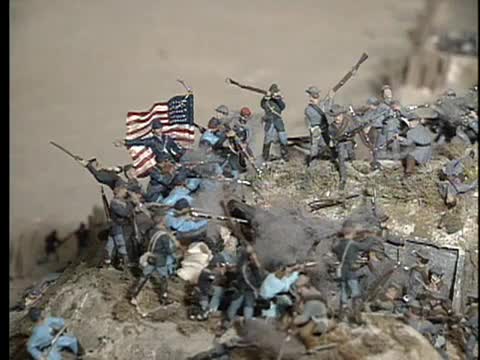
ships that had to elude the federal vessels patrolled. On the coast it was very dangerous to try to bring a ship and the profit margin was so high that many people were willing to take that chance. Wilmington was already North Carolina's largest city. But as the war went on in other ports we captured the city became further swelled with profiteers and speculators. They were in the business not only of bringing in supplies for the Confederate army but luxuries for the few civilians still able to pay for them in guarding the entrances into the Cape Fear River the path into Wilmington Fort Fisher was absolutely essential. They provided the heavy artillery of that blockade runners. Once they got close to the Fort Hood used to protect them from blockaders running them down and capturing them in their cargo. This model shows how Fort Fisher resembled a sideways figure 7 with the top running across the narrow strip of beach between the river and the ocean. This section guarded against land
attack from up the beach. The long side of the seven was made up of gun emplacements facing the ocean and the Union ships off shore in January 1865. Union forces made their second attempt to capture Fort Fisher and close Wilmington. They began the attack with the largest naval bombardment in history up to that time three days and nights of intense shelling. It blew the smooth sloping sides of the four to smithereens. After the shelling the union sent in troops two thousand Marines and sailors from the oceanside 3000 and for treatment from the woods on the river side of the beach. The initial Marine assault was repulsed by the Confederates but the army assault on the Riverside was successful for US forces and after that it only took about four hours to capture them. This is about where the outer edge of the fortifications stood and at the time of the battle of Fort Fisher The surf was a couple of hundred yards further away than it is now. As a matter of fact a good number of federal attackers who crossed that wide sandy exposed stretch of
beach were mowed down without much of a chance. Today it seems what's left of Fort Fisher may have no better odds. What wasn't bulldozed when the army built a training facility during World War Two is under attack from the relentless Atlantic Ocean 90 percent of the force structure has been washed away by the ocean. And it's washing. I don't know the exact figures. Per year Vegas Washington at least 10 feet per year. Despite a 10 year old rule against protected jetties on the North Carolina coast the coastal resources Commission has exempted Fort Fisher on historic grounds and a permit has been issued for construction of a 3000 foot protective barrier. This time jetty is always controversial because so many people believe it stops erosion in one place only to make it worse in another spot. It remains to be seen whether this one will ultimately be built in an attempt to say Fort Fisher needed the federal government nor the state has yet allocated its share of the 10 million dollar cost.
Meanwhile the live oaks that spread inviting pools of shade over the remains of the earthen walls give a curious sense of respite in beauty to a spot so threatened by the shells of the Union fleet. Now by the very elements for as long as it lasts. Fort Fisher is imminently worth visiting. If you would like more information about Fort Fisher contact the Fort Fisher State Historic Site. Post Office Box 68 fury Beach North Carolina 2 8 4 4 9. The telephone 9 1 0 4 5 8 5 5 3 8 0. North
Carolina played an important role in America's process of achieving independence. My guest tonight is historian Dr. John Higginbotham from UMC Chapel Hill. He's going to tell us some things about our colonial past as well as help us reflect on the changes we've undergone as a state and as a nation since those early days. Dr. Higginbotham how precisely were we a part of that early process of achieving independence. Bob North Carolina played an important part and the most important thing North Carolinians did was to be the first colony to authorize their delegates in the Continental Congress in Philadelphia to support independence. This was on April the 12th 1776 and that's why that date. It is on our flag. Virginia took the cue from North Carolina and edged its delegates a bit farther. In May they actually ordered them to introduce a resolution
for independence. But we know the North Carolinians and the Virginians had talked and there was support within the two delegations and so on June the 7th. 1776 Richard Henry Lee got up in Congress and introduced the resolution for independence which set off the chain of events leading to the creation of Jefferson's committee the declaring of Independence on July the 2nd which is actually our Independence Day not the fourth most people don't realize that. And then the formal adoption of Jefferson's document on the 4th and that's the significance of the 4th it was the date that Congress adopted Jefferson's document. You know broadening our discussion from North Carolina is a proud role to a more national picture I can't help wondering how the Founding Fathers would view our society technology aside were they to come back and see what we've created as compared to what they envisioned. Well of course I think they felt that the boundaries of freedom and liberty
would grow would expand. They felt already before the revolution they lived in the freest most enlightened society in the world and in many ways they did except for slavery and suffrage for white male suffrage varied anywhere from 50 to 80 percent in all the colonies. Most of the old established feudalistic institutions those that were left for a hollow shells like the few official churches that existed most of them were pushed over with relative ease during the during the revolution so we were already on the way really prior to independence. But what independents did was to give an intellectual rationale for the freedom that existed and for expanding that freedom. Ralph Barton Perry the philosopher once said that the story of American history the American story is realizing the eagle a Tarion implications of the Declaration of Independence he said a process that has come too slowly for liberals and
too rapidly for conservatives and I think that sums it up pretty well. Another hundred years or so to get rid of slavery finally I guess another hundred fifty or a hundred sixty two to get to universal suffrage. But the process had begun in the revolution and slowly but surely all the northern states began the process of Man U meeting their slaves and the Constitution provided. After a period of 20 years that Congress could abolish the African slave trade. And it's interesting that Jefferson who is quite rightly attacked for his inconsistency zone slavery nonetheless was president after that 20 years and he moved very boldly very swiftly to abolish the African slave trade just as soon as it was constitutionally possible he thought it was a terrible abomination. I'm curious as to how the Founding Fathers would view our debate these days about the right to bear arms. It's interesting. It's my personal view that the debate wouldn't make a lot of sense to them because guns have a unique role in the society then where virtually
everyone in theory was a member of the militia. And it's interesting to note that the Second Amendment links the two not with a semi-colon creating two independent clauses but with a comma which provides for a dependent clause. In fact as far back as 17th century England there were laws on the books for bidding certain kinds of people from having weapons. So I think we have to view that issue on the basis of what our needs are today. I don't think in reality looking at the Second Amendment in its historical context I don't think it has much to offer the National Rifle Association. Dr. John Higginbotham Thanks for being with us on this Fourth of July. Thanks Bob. Pleasure to be here. We want to hear from you. Simply call our viewer comment line at 9 1 9 5 4 9 7 8 0 8. Or write us at P.O. Box 1 4 9 0 0 RTP NC 2 7
7 0 9. You can fax a message to 9 1 9 5 4 9 7 0 4 3 0 or try our Internet address UN CTV at aol dot com and please give us a daytime phone number in case we need to follow up. North Carolina barbecue is GREAT any day of the year but it might be a special treat on the 4th. If you're a regular North Carolina now viewer you know I've been traveling our highways and byways for months looking for the state's best barbecue spots. Tonight let me take you to Stevenson's not far from Raleigh. When Stevenson's BBQ began thirty six years ago the location some 20 miles south of Raleigh was even more out in the country than it is now as a matter of fact. Paul Stevenson was a farmer with no prior barbecue experience. The idea dawned when a man bought 14 of his hogs for 11 cents a pound and he hauled those pigs away and I thought well this is making the money only big he was going to chop
them up and sandwiches and smell like roses on the side. I'd rather smell like roses. Really it started at the barbecue pit. After a spell of working on his own son Andy has rejoined his father in the business he learned as a youngster. Despite the trades they hear about cooking with the Stevensons not only cook airport shoulders with charcoal but are convinced that it gives the meat a better place and smoke your taste. Now this barbecue is very simply seasoned it just has been here two kinds of pepper red and black and salt. But the real secret is that they leave the pork shoulders in the pit overnight once they've cooked so they can soak up the maximum amount of smoke. And can you ever tell the difference. Stevensons barbecue has a very varied texture because of the way it's chopped. We separate the choice of meat which is a beautiful meat least short a few times the
meat this brown or top it a little vine that plays a very small amount of fat has chopped extra fine and added to the mixture preferred Labor. But by most standards this barbecue is very lean as some people call these boiled potatoes some people call them barbecued potatoes either way with a little bit of catch a batted for color and taste. You find them mostly in the eastern half of North Carolina and they're wonderful. They also have extremely more Oist flavorful barbecued chicken here which is served in combination with the pork barbecue. One of the videographer is on our staff said to be sure to try the color green So we're going to do exactly that. Now we won't talk too much about what it takes to properly season collard greens but I can tell you that collard greens are always a little bit better with some spicy vinegar on them.
One of today's specials is candy gams which go particularly well with the collard greens. Miss Louise has been a fixture here at Stevens's for 27 years making one of the house specialties chicken and pastry. She starts out by rolling out the dough back in the kitchen and dropping that into a simmering pot of chicken stock and adding chicken along with it until she fills up the whole pot. This is a real traffic builder on Thursdays when they fix it. Miss Louise I love you. I didn't have enough food here already so I wanted to introduce you to one more house specialty barbecued ribs. These are Cook until they're practically falling off the bone here. Oh they look wonderful.
And they are another touch that gets a big thumbs up as serving on real plates instead of those little cardboard trays. Paul's wife Ann is often around to greet customers and he says while other restaurant owners are having trouble finding good help much of his success is due to the members of his staff working so hard to maintain consistent quality and service. Now in addition to their barbecue business the Stevensons also have quite a large nursery operation on the property. As a matter of fact they've created a very pleasant landscape area just outside the main dining room. Stevensons is located in Johnston County 20 miles south of Raleigh on Route 50 from Interstate 40 take exit 319 for McGee's crossroads and follow the Route 210 West a short distance to Highway 50 then turn north. You'll probably see the sign for the nursery before you see the one for barbecue. What can I say. There's no way Stevenson's deserves any less than our very top rating. Five Little Pigs and will even add a plus sign.
Is this a great job or what. I will repeat those directions to make sure you got them from I-40 south of Raleigh take exit 319 and follow Route 210 a short distance to Highway 50 had to cross roads turn north on Highway 50 and look for Stephenson's approximately one mile on the right. The address is Route 1 box 63 10 Willow Springs North Carolina and the phone number is 9 1 9 8 9 4 4 5 3 0. Well I hope you've enjoyed this special edition of North Carolina now. Tomorrow night things will be back to normal. Mary Lou and Audrey will be here with a wrap up of the 94 session of the legislature so tune in. That's all for now. Good night and happy Fourth of July.
- Series
- North Carolina Now
- Episode Number
- 112
- Episode
- Interview with Don Higginbotham
- Producing Organization
- UNC-TV
- Contributing Organization
- UNC-TV (Research Triangle Park, North Carolina)
- AAPB ID
- cpb-aacip/129-47dr82kf
If you have more information about this item than what is given here, or if you have concerns about this record, we want to know! Contact us, indicating the AAPB ID (cpb-aacip/129-47dr82kf).
- Description
- Episode Description
- An informative report on local North Carolina news. Topics for this episode include an interview with Dr. Don Higginbotham (Professor of History, UNC-CH) on North Carolina's involvement in the 4th of July; speeding tickets, USS North Carolina memorial and tourist site, Fort Fisher, and Stephenson's BBQ.
- Series Description
- North Carolina Now is a news magazine featuring segments about North Carolina current events and communities.
- Created Date
- 1994-07-04
- Asset type
- Episode
- Topics
- News
- Local Communities
- Rights
- Copyright held by The UNC Center For Public Television, 1994.
- Media type
- Moving Image
- Duration
- 00:28:33
- Credits
-
-
: Moore - Davis, Scott
Director: Massengale, Susan
Host: Garner, Bob
Interviewee: Higginbotham, Don
Producer: Garner, Bob
Producer: Earnhardt, David
Producer: Madden, Jane
Producing Organization: UNC-TV
- AAPB Contributor Holdings
-
UNC-TV
Identifier: NC0107 (unknown)
Format: Betacam: SP
Generation: Master
Duration: 00:27:49;00
If you have a copy of this asset and would like us to add it to our catalog, please contact us.
- Citations
- Chicago: “North Carolina Now; 112; Interview with Don Higginbotham,” 1994-07-04, UNC-TV, American Archive of Public Broadcasting (GBH and the Library of Congress), Boston, MA and Washington, DC, accessed April 4, 2026, http://americanarchive.org/catalog/cpb-aacip-129-47dr82kf.
- MLA: “North Carolina Now; 112; Interview with Don Higginbotham.” 1994-07-04. UNC-TV, American Archive of Public Broadcasting (GBH and the Library of Congress), Boston, MA and Washington, DC. Web. April 4, 2026. <http://americanarchive.org/catalog/cpb-aacip-129-47dr82kf>.
- APA: North Carolina Now; 112; Interview with Don Higginbotham. Boston, MA: UNC-TV, American Archive of Public Broadcasting (GBH and the Library of Congress), Boston, MA and Washington, DC. Retrieved from http://americanarchive.org/catalog/cpb-aacip-129-47dr82kf