For A Deaf Son
- Transcript
Funding for, for a deaf son, is made possible in part by Accordia, a network of companies providing insurance brokerage, administration, and selected financial services across America, and by a grant from the Southwestern Bell Foundation. Funding also is provided by the Corporation for Public Broadcasting and the Southern Educational Communications Association. Thomas, it was two years ago when your mom called me on the phone. She was crying, and all I could think about was the music you would never hear.
We didn't know a thing about what it really needs to be deaf. In March of 1988, students at Gallaudet University for the Deaf in Washington, D.C. shut the school down. They were demanding that for the first time ever, the board choose a deaf person to lead the university as president. When the students won, it was hailed as a great victory for deaf people everywhere. My family and I were living in Dallas, Texas when all that was going on, and frankly,
we had other things on our mind. Laurie and I were expecting our second child, and our son Matthew couldn't wait to meet what he hoped would be his new baby brother. In September of 1988, Thomas, shy, trance, was born. After that came first steps and first birthdays, all the usual family stuff. I have to get closer, Thomas. Life was pretty normal until Laurie began to suspect that something was wrong. Don't you remember this little gurgling sounds he made? But it was about when he was a year old that I started thinking, hmm, something's wrong,
there's something different. We crept into his room and we both whispered Thomas, and he quickly turned around and you walked out going, see there's not a thing wrong with Thomas. I continued to have sort of suspicions and went and was examined, and the lady came out of the booth and said, honey, he couldn't, he wouldn't hear a train go by, and that was just so devastating for me. I thought I was just sad with a knife, but I held it together until I got in the car, and then got the kids buckled up and cried all the way home. When the month came out, she was crying, when I asked her what's wrong, she said, tell me a step. I think that was one of the sad experiments of my life. After Thomas was diagnosed, we went to Boston and had a whole battery of test on him. It lasted a week. And finally at the end of all these tests, there was a little ray of hope. We found out that he had high frequency hearing, and that meant that we'd be able to put hearing aids on him and that he could, with therapy, acquire speech.
That seemed great. I mean that's what we thought we wanted. And so we focused on hearing aids and speech therapy. We learned that there are about 23 million Americans with some kind of hearing loss. Thomas was classified as profoundly deaf, but deaf was a word we never used. We could ever tell us why Thomas had lost his hearing, and it hurt not to know. But I often wonder if there was something I did or didn't do that could have been avoided to prevent this. And I'll never know. Tommy can't tell us when he stopped hearing, or was he always like that? I don't know. Drop it when you hear it. Listen again, listen. As Thomas grew older, his audiologist helped us to understand the connection between hearing and speech. And slowly, we began to realize how hard you would have to struggle to communicate with our own child.
Children learn their language by overhearing it. They don't make a conscious effort. They overhear. They listen. They just absorb like auditory sponges. A deaf child is cut off from that. Now, let me show you what children here like who have some small amounts of residual hearing. I'll approximate that for you. So you hear the voice, and it's muffled, and it's unclear. Well, children speak the way they hear. So first of all, it's hard to even recognize that there's a language going on, so they won't pick up language code. And if they do pick up some, and they have to have something to say, when they have something to say, it will sound muffled. So if you'll excuse me for imitating deaf speech, when it comes out, it might sound them like this. This is the peak of somebody who hears very well in the low pitch, but not in the high pitch. So they speak like that here, and they speak very characterless.
We didn't care what Thomas sounded like. We just wanted him to talk. We didn't know then how complicated things would get. Each word Thomas spoke gave us hope, but the pain was never far away. The first time someone said it was made for my brother being deaf, it really hurt me a lot. And then people found out that it did hurt me. So other people started trying it and then denied it. What kind of stuff did they say? Like, I don't have a deaf brother, and like when they were playing a game, and throwing yells, come on Matthew, come on, follow me, and you don't hear them, and they ought, you're
deaf just like your brother. My brother, Thomas's deaf, but the good things about him are, you can sneak into his world when he's not looking, and you don't hear him. You can whisper bad things to him, and you won't know what you're saying. But the bad things are, he yells a lot, because he can't hear himself yell, so he yells louder. He needs more tension, which I don't think he needs, and you learn stuff about how what you should do to a deaf person, like, come on, put Thomas on the ground. If you go like this, Thomas, Thomas, he has to look up, or should go like this, he doesn't have to look up, he doesn't have to look up, he doesn't have to look up. He's going to use some bad things.
Is that easy bidsie spider? Are you doing the spider? Thomas, Thomas, it's a bidsie spider. Come on. Come on, come on. Come on. Come on. Come on, come. Come on, come on. Come on. Come on. Wash your hands. Come on. Come on. Come on, come on, come on. Come on, come on, come on. This way. Come on. I want to come on this way. See, it's very tough for Thomas to express himself, because he doesn't have a lot of words. Come on. How did you do this? Um, how'd you feel when um, he found out Thomas was deaf? I felt very sad. I cried for about three days. It was very hard. Little pig, little pig. Let me come in, said the wolf. And the second little pig said, no, no, no, no, no, no. Not by the hair of my chin, chin, chin. Then I'll huff, and I'll puff,
and I'll blow your house in any. Huff, huff, huff, huff, huff, huff, huff. Any? Huff, huff, huff, huff, huff, huff. Blue, the house down. Blue, the house down... What would you like me to do it? You should use your words. And what happens to spider's shoe?
It broke. When it was time for Thomas to go to preschool, we had a choice. We could put Thomas in a class where teachers used speech supported by signs. Or we could choose a speech-only classroom. We chose the speech-only class. It seemed to be obvious that that's what we wanted. We wanted our child to be like us. Well, also, too, a lot of people said if your child is signing, they will prefer sign over speaking because it's so much easier for a child to sign. And for a deaf child, they have to really work hard at listening. And so if they have to work hard at doing something versus doing something naturally, or whatever comes more easily to them, of course the kid's going to choose the easier route. Kenny Oriwello is one of Thomas' classmates. Kenny used to sign, but his parents decided to have him fitted with a cochlear implant, a surgically implanted device that imitates the way the inner ear works.
With the implant in place, the family has now switched to a method that requires Kenny to develop his listening skills. He can be deaf. If he wants to sign when he gets older, that's fine with me. I can live with that. I just wanted to give him choices. And the other way, I don't think he would have had the choice. I think, to me, it's really rewarding to see Kenny. Sometimes we are playing and a truck was by and blows a horn. And Kenny will turn his head to me and smile and go like this. Like he hears something. That he heard that saying, whatever it is. And to me, that's very rewarding before Kenny couldn't hear anything. I personally think it's important to be able to speak to whomever you want, as opposed to signing where very few people in the public sign. And in my opinion, when an individual signs and really doesn't have functional speech, or clear enough speech to function independently in the world,
in that event, the deafness determines what they can do in their life. We had to quit going to church when he lost his hearing, because in the nursery they didn't know what he wanted. And he would leave the nursery crying that to come get us out of church. I started calling different churches and out of a hundred churches in the area, we had a choice of one that provided an interpreter. And that's when I realized how limited his life would be if he couldn't talk. I would at least like him to have that choice, you know. Signing is very quick and it gets language and it gets expression very early. But in my opinion, in many children inhibits their ability to speak later on, especially the children that are more profoundly hearing impaired. This method may take a little longer to good get going, but the long term effects are an adult that can speak. Is this hamline?
Oh, hi. Since Thomas had some hearing in the higher frequencies, we were told that a cochlear implant wouldn't be appropriate for him. Still, Laurie and I wanted him to talk, and that meant hours of speech therapy. Thomas, listen. Laurie. Yes, Tommy? Yes. Papa, no. You heard it, Thomas. You were listening. No, I wanted it. Does the bell say, No, it doesn't. What does the bell say? It's sharp. Sharp. Sharp. But after more than two years of therapy, Thomas's language development was still poor. Thomas can imitate most of the speech sounds of English,
and he could respond to simple questions, but he couldn't really communicate. Often what he said was just gibberish. That's it, Molly. That's it. That's it. That's it. We had read that children's language development crossings between the ages of three and six. Thomas was four, and we felt that time was running out. Okay, Thomas, please, do not hit. Do not. Wait a second, okay? Laurie was especially frustrated. It's hard to say this now, but I had let her take most of the responsibility for dealing with Thomas's deafness. She was stronger, and it made it easier for me. All right, can I have a kiss? Can I have a kiss? Can I have a hug? When I was given a chance to make a documentary about Thomas,
Laurie knew it was a way for me to get more involved. I began my research by attending a conference of deaf people. I learned that their language, American Sign Language, is not simply a manual substitute for English, but a true language with its own grammar and structure. ASL is a visual language that uses not only the hands, but the body and the face grammatically. We deaf people have a culture, right? Hearing people, they look at us, and they're not satisfied with the deaf, because we don't talk. And I discovered a sense of community among the deaf that I never knew existed. And we've learned that the deaf community is not a loosely knit community, as one might say, the community of television people or the community even of blind people, but a true community, as you might say, the community of American Navajos, let's say, with their own language, their own special mores, values, history, heroes, all that goes with having a culture.
And what we found through our research and through our experience with the deaf community is that living in a world as a visual person is very different from living in the world as a hearing person. Of course, underlying it all is the same humanity that we all share. But how we process the world, how we process language, what we need as hearing persons and as deaf persons is very, very different in order to achieve our potential, which is, of course, the same for everyone as a human being. Gallaudet University has been called the cultural capital of the deaf world. Deaf is normal here, and hearing people are the ones who need interpreters. I wanted to learn more about deafness and about the issues affecting our family. 93% of all deaf children have two hearing parents. That means that the parents themselves, when they discover that they have a deaf child, have probably never encountered deaf people before.
So not only is it a shock, and they go through a grieving process because their child isn't what they expected, a normal hearing child. But they also don't really know what deafness means. They don't know what it means to be a deaf person. Hey, this one, hey, this one, hey, that one. Hey, I'm off. It was full. You know? Not yet. You want it more. But how much? In the house, how much does it have to be? I visited a class at Kendall Elementary School on the Gallaudet campus. The school's mission is to find ways to improve an educational system that almost everyone agrees has failed deaf children for years. One of the figures you hear when you begin to look into this is that deaf children on average achieve a fourth grade reading level upon graduation from school, from high school. Way better than waiting.
Let him sleep. Sleep. No, don't. He wakes up. She'll be a better five. Often parents, when they realize that their child is not achieving their potential, they're made to feel that it didn't work because they didn't work hard enough. Or their child didn't work hard enough. When the whole premise of what they were told in the beginning, I believe, is flawed. And the basic flaw, I believe, lies in the fact that our school system has not really accepted the fact that deaf children are deaf. And have tried throughout the years to make deaf children as much like hearing children as possible. That's been the underlying goal. Where's the juice? Charlie wants more. Where is it? In the classroom at Candle, speech was used very little, but there was plenty of communication.
And watching these children made me feel even more frustrated about Thomas. I mean, he's saying what? Mommy, daddy, milk. It says juice. Sit down right now. I don't want it. But that's all. He can't say, this is a lovely day. Thank you for being nice to me. Well, well, that's because he's been taught all the speech sounds as possible. But he hasn't been taught the concept, the vocabulary, with which to work. I think you've seen a class that we have here at Candle. You see the kids just bursting with language. They had the concept. Do you want any more? For sure, really. Do you want another story? Fine.
Okay, the title is, the eagle and the squirrel. Okay? At storytelling time, I saw how deaf children respond to visual communication. I don't know what to say, but I don't know what to say. I don't know what to say. No! I don't know.
I would love to see more hearing parents do some more type of this communication with their children, acting out stories, acting out ideas and thoughts, and trying to express themselves in any way that they know how, rather than locking themselves into using words all the time, which might mean very little to deaf children. I had a deaf child at the time, and I was wanting to have a pose. I was running courageously as English as much as possible because I didn't know the word of religion,
but I realized having learned English and that there is writing, reading, a probability that the father here will grow. But at the same time, I started to hear the language and I would encourage that I wouldn't have a pose. I learned that the sign language I saw being used on the Gallaudet campus had once flourished in American schools for the deaf. But around a hundred years ago, advocates of speech training fought a successful battle against sign language in the classroom. Until the early 1970s, sign language was forbidden in many schools, and there are deaf adults who remember those days with anger and resentment. Lots of those deaf adults have been treated. They have been treated out of good education.
They have been treated out of good, well, I like to put them around the families. They have been treated out of so many things because they were restricted only to one method, all of them. I was very angry. I was very angry. I was very angry. I was very angry. I can remember when I was 13 years old. I had a teacher, a hearing teacher, who was so high strong. She couldn't tolerate any type of noise that the deaf children made. And worst of all, she couldn't tolerate the sounds we made when we laughed. She said, you sound like animals in a zoo. And she picked on one boy by the name of Sam says, you're laughter sounds like chalk on a blackboard. So she made a stand and put our hands on her stomachs to let the air out and inhale and exhale. She made us do this.
We all practice inhaling and exhaling with our hands on her stomach. Then she said, now we'll add the voice. Add the voice like this. Not from the head, but from the chest. Let it all come out. Then she kept picking on Sam, popping him on the head and saying, you're not doing it right. We practice and practicing finally. We practice with our hands on our chest. Then we added the voice. And as you hear, that's how we laugh. And she said, oh, you sound so nice, so pleasant. So pleasant that hearing people would never guess that you were deaf. Intolerance is the subject of Clayton Valley's American Sign Language poem, Dandelion. Because it is a visual work, Valley told me the poem can't be translated.
So I'm going to add the voice. I'm going to add the voice. I'm going to add the voice. Your son is profoundly deaf. There's no way on earth that he could hear, understand, develop language based on what he hears. He needs everything visual. He needs you to introduce life, introduce love, introduce happiness through signs.
Because that's what he sees. He needs that. I was moved by the pride and independence of the deaf community. And I was grateful for the way they had reached out to us. But our family wasn't deaf. We didn't sign. And when I left Gallaudet, the distance between us and Thomas seemed even greater. Back in Dallas, I spent some time with the speech and sign class at Thomas' school. One day, I saw a little boy named Christopher kidding around with his teacher about purple potatoes. I was impressed because Thomas hardly ever made word jokes like that. I wondered what Christopher's parents would say about their choice for him. There's going to be instances when he's going to be around people that use sign libraries. There's going to be instances that he's going to need the communication with the oral. So we thought at the time that that would be the best way. So whatever situation he was put in, he would be able to handle it.
We go to sign language class on Tuesday evenings and after working, sometimes I really don't want to go. That's the last place I want to be. I make myself go for Christopher because I know that I have to be able to talk to him. And I keep thinking in the back of my mind, I'm really not going to need to know these signs because one day he's going to wake up and he's going to have his hearing and he's just going to start talking. He's going to have all these words saved from four years and he's going to just rattle off a whole bunch of sentences. I really know that's not true, but I guess I hope for that. Laurie and I took a beginning sign language class to see what it was like. It wasn't easy. We finished the course, but didn't register for the second session.
Thomas. Thomas was losing his temper a lot. We both wanted desperately to communicate with him. I thought we should work harder on sign language. Laurie wanted to stick with speech. We have a child who's different from us, and we've got to totally reevaluate our relationship to him and consider other relationships to the world that don't include hearing. You know what I'm thinking? I'm thinking, okay, it's like having a child not born with legs, but with fins. And all of a sudden you're going, oh my gosh, we've got to go live in water. This child doesn't belong here on land. This child needs to go someplace. Is that what you're saying?
To me, that's a dramatic change. What we have to do is go find him a deaf home, put him in a deaf community. We don't live in a deaf community. Robbie, we live in a hearing one. That's our family. We are Tommy's family. He came to us. Yeah, but we can come to him. Well, I'm not saying we can, but I think that we need to determine when. He needs to be in a position to be able to say, this is what I want. Thank you. Okay. Tommy. Tommy. Mommy. Mommy. Mommy. Mommy. Mommy. Mommy. Mommy. Mommy. That's what Tommy wants for Christmas. Tommy wants a dinosaur. Right? A dinosaur? Yes? Daddy's a dinosaur. And what else do you want? A truck? A truck. And one more thing, a crane? Yes. Well, you tell Daddy, Thomas. You tell Daddy what you want. You say, I want a truck. A truck. A dinosaur? Mommy. Mommy.
You have to be realistic. I don't want him to live in a world where he's going to need an interpreter all the time. I want to be able to give him that freedom to be able to travel and do what he wants to do. Whenever he wants to do it, without that restriction. If he lives the first seven years of his life, unable to express himself, what kind of freedom is that? Where are you giving him? That's maybe, in Thomas' case, the price of his freedom. I'm not happy with that, Robbie. Oh, Mommy, please you. Tommy, Tommy, it's okay. So, Mommy, please, please. Daddy, Mommy, please, please.
Sweetie, but I don't know what you're saying. I want that I'm sick of Tommy's. Tommy, I'm sorry. I'm sick of him. Hey, while I watch, he's going to eat that little dinosaur. Yay, didn't. And how old are you? I'm four, too. See, you're not older than me. I'm four and a half. I'm four and a half, too. I'm not yours. Just give him it. Give him it. It was hard not to compare Thomas to other children his age. The world seems so full of language. Did Thomas know how old he was? Or what a year is, or what tomorrow means. We knew he was happy with us, but we didn't want him to grow up alone.
I wanted to do more research, and so I visited the Central Institute for the Deaf in St. Louis, one of the oldest oral schools for the Deaf in the country. Children at CID are instructed entirely and spoken and written English. Sign language is not used. I like peanut butter and bananas. On my sandwich. On your what? Listen, on your hamburger. Oh, I think you are very silly. Parents need to know the consequences of the choices, because if you want a child to learn to talk, you must start that very, very young under age five. And you must educate that child in a system that focuses just on talking. I am glad that I had the opportunity to come to Seattle and to learn how to talk. Now I can communicate with anyone.
I met Scott Campbell on the day he was practicing his graduation speech. I cut the crest. I wanted him to learn how to talk. I wanted him to be able to communicate with the hearing world. I wanted him to be able to go into McDonald's when he was six, seven years old, in order his own food. And he's been doing that, and have people understanding, and for him to understand them. I want to talk to you about a couple of parts. On the part where you say, cut the grass. Okay, it's cut. Cut the grass. Not grass. Grass. Good. Cut the grass. Perfect. Say that again. The deaf children in this school feel very good about themselves. They walk with a great sense of pride.
And their pride is not in being deaf. Their pride is in being able to do so much in spite of the fact that they are deaf. Thomas doesn't know he's deaf right now. He doesn't. I mean, I think maybe he might know he can't hear very well, but he doesn't know I'm a deaf kid. And these kids are hearing, and I'm deaf. When did you first know that you were deaf? Well, does he have a name? Yeah. I would see that. Does he have? Yeah, it does help him. Yeah. Yeah. And sometimes he asks for them. But I don't think he thinks of himself as a deaf person. Do you think of yourself as a deaf person? Well, sometimes, at the beginning, when I was a little bit right, I wanted to show up. What I'm doing, I'm deaf, and I do not understand. And I do not understand what I'm doing. I thought I'm with hearing people. I was so confused. And sometimes I made me mad that I could not communicate with a hearing person. I think that being born deaf does not in and of itself make you a member of a different culture, unless you so choose to be a member of that culture.
I understand that there is another language, American Sign Language, and that if you choose to learn American Sign Language and to only communicate in American Sign Language, you are part of that deaf culture. However, if you choose to learn spoken English, then you can be part of the American culture. And I think that should be the choice of the families and the children. For a different point of view, I visited the Learning Center near Boston. Here, American Sign Language is the primary language of instruction. Most other schools that use Sign, use Signed English, which rearranges the signs of ASL into English word order. The method is supposed to help deaf children learn English.
But some people think that deaf children can master English more easily if they become fluent in a visual language first. We've got everything in the world to teach deaf children except the one language that they understand naturally and fluently, and that is totally given to them as a natural language, namely in our country, American Sign Language. Furthermore, many studies have shown that deaf children of deaf parents, most of whom grow up with ASL, typically do better in school than other deaf children. The conclusions from the research varied. But in 1984, the Learning Center began to hire deaf educators and involve the local deaf community. And so there were a lot of questions in terms of what is the role of deaf people in language and culture within this school. And many deaf children of deaf parents had advanced English in spite of their education. How did that happen? And how could we apply that to all deaf children who did not have deaf parents, not only that minority group? The educational system is put an unconscionable burden on parents like yourself. You're supposed to act as the language model for your child, but you can't. With all the good will in the world, no matter what you're ready to commit, you cannot be a language model for your child.
So it's an absolute necessity, if that child has one full natural language, that he or she be where there are deaf adults and deaf kids who have deaf parents and other deaf kids, so that the child can learn that language. Parents at the Learning Center told me that the deaf adults at the school were role models who sent their children an important message. You know, you're going to grow up and you're going to be deaf and you might be like me or you might be like this person, but you can go to college, you can get married, you can have kids, you can be satisfied with your life. That's enough. I mean, I think that's really enough. I don't expect Hannah to speak English fluently because I don't know that that's really within the realm of possibilities since she can't hear it, but I do expect her to grow up and read and write English fluently because she'll have a base in the first language. If you start reading about deaf education and you read over and over, the children don't reach anything beyond a fourth grade reading level, well, I don't have a whole lot to lose because, you know, Alicia have fluency and she can express herself in one language and we can communicate in one language.
And I can certainly learn, I mean, my feeling is I can learn ASL a whole lot easier than she can learn English. When the parents at the learning center asked me what I was doing for Thomas, I had to admit I didn't know. Thomas and I and his mom live in a virtual present. I mean, he's, he's learned tomorrow, but tomorrow is a vague future for him. I don't know the extent to which we can, my wife and I can, leave what we, the world that we have and, and intersect with another world that we know nothing you're about. Rob, I think you don't have to. That is your world. You don't have to give up your world, but you also need to understand your son's world. You can keep your own world. Of course you can. Just as the parents who can hear, just like Mary Jane and Eve, you're not giving up your world, are you?
I have a three-year-old. I can't give up my old world. This is his language time too. I can't just stop communicating with him because we have a 19-month-old deaf baby. I mean, it's been hard in a long road, but now that we're here, I mean, I wouldn't want her. I mean, I always want her, but I wouldn't want her any other way. She wouldn't be courting. You know, and you just have to follow your child's lead. One of the last people I met in my travels was Alina Engelman of Brooklyn, New York. Although Alina is profoundly deaf, she is near the top of her class in the mainstream hearing school. Alina was brought up on Cude's speech, a lip-reading method that uses hand shapes to help identify different sounds. It's a system that was invented about 25 years ago. It's used throughout the United States and throughout the world, but it has not gained significant recognition in part because of the war between the oralists and the manualists and the fact that it falls somewhat in between. In talking with Alina in her brother, Yon, I learned that Alina also signs.
I wanted her to define herself as a deaf person because if she defines herself as a hearing person, she will always feel like she's lacking something, and I wanted to feel like she's a full person. You need to not only expose yourself, but expose your child to the world of the hearing, the world of the deaf, and if you do that, your child will tell you where he or she wants to go. Then time, then, and just, then time, we can't repeat it here for a year, every month, nothing else. But there will be a pain.
Yeah, I bet. What should I tell my son when he grows up about being able to handle that kind of pain? What? What should I tell my son, Tommy, about helping him to handle that pain? Yeah, this thing, this thing, last time. When I returned home from Brooklyn, it was time to evaluate Thomas' progress in school. What is this? Ambulance. Laurie and I had to decide whether we wanted to keep him in the oral class or expose him to sign language. Did you fight Matthew? Did you fight Matthew?
We were under a lot of pressure about Thomas, and sometimes it made life around the house pretty tense. I'm the one that's caring for him, and you've gone off, and you've intellectualized about what's best for Thomas. I think that's a decision that needs to be jointly made based on research, emotion, and practicality. I don't think that you are giving the practical aspect of hearing parents raising a deaf child enough weight. Because there is a practical side, integrating a deaf child into a hearing family. Mommy! Mommy! Hi, Batman. Time for school? Why don't we make this one on our goals too for next year, answering what and where questions? And who? And why? Thomas' speech and language had improved, but not enough for either of us, and the evaluations at school were depressing. Does he know his last name?
Yes. So if you say, what's your name? He'll say Thomas. No, he'll say Thomas. But he really can't say his name. If you said, what's your name, little boy? He would say it. He'd be helpless. I'm going to give him an emerging on this, because he does have some kind of an awareness that he has a first and last name. Although he can't state it if you say, what is your name? What is your whole name? Look at that. Carla was always trying to give us hope, and she believed in Thomas. He's a happy mouth. We knew we had to do something, but we didn't know what. Thank you. What is this? Cow. A cow. We wanted Thomas to school to help us make a decision about whether or not to introduce Thomas to sign. But the school would not make a recommendation. They said the decision was ours. It's not a knife, and it's not a spoon, it's a... Fuck.
Good job, Thomas. Hold on. We're between a rock and a hard place, and the rock is that Thomas is deaf, and the hard place is that he does have some speech capability. So to deny his speech capability seems to me wrong. On the other hand, to deny the fact that his hearing ability is just this tiny little back alley compared to the superhighway that his eyes is also wrong. I don't think he'll have any difficulty accomplishing sign language, but I think his hardest task is to accomplish speech and oralism. It's because he doesn't hear. That's right. We're focusing on the least of his capabilities. I just want him to talk to me like any almost five-year-old kid. And I don't care whether it's sign language, whether it's Swahili. And at the meeting at the school, you said you didn't know who your son was. That's right.
I don't really know who Thomas is. That's a drawback. It's a serious drawback. Listen to what you're saying. It's a drawback. It breaks my heart. However, if he doesn't have an oral facility as an adult, he won't have the choice. And I will have failed. I will have failed as his mother. I feel by not giving him that choice. That's all I want. And yeah, it hurts. It hurts because, yes, my little boy says, I love you at night. Because I hug him and I kiss him and I tell him, I love you. And he whispers back, I love you. And I'm not sure he knows what it means. Except that he cares. It feels good to be kissed and hugged. That's important to me. And that he's happy and that he's safe. And that one day soon, you know, we'll hear jokes by Thomas, you know, or we'll have Tommy Read as a book report. And it's a pity.
It's a pity that he's deaf. I do believe that. And maybe that's where we're different. Deaf people don't think there's anything wrong with being deaf. I'm not deaf. I'm not deaf I hear. Too hard. You have to be more gentle. Thomas, please don't think you only made us cry. You've made us so happy. Just look at how much. We want you to be happy. But it's hard to know how. The world outside isn't kind sometimes. The student victory during a deaf president now strike at Gallaudet five years ago means a lot more to me now. The Gallaudet revolution was a tremendously important moment in American deaf culture. This was a civil rights movement. It's not just a hearing well. It's not a white world. It's not a man's world.
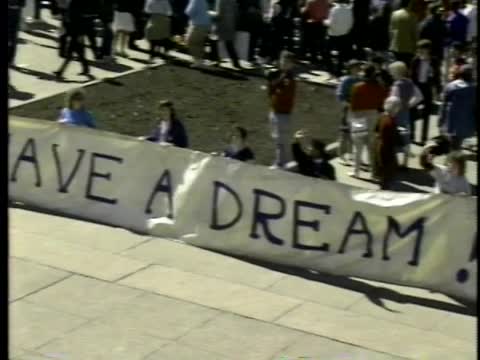
We all are in this world together. And there's enough millions and millions of deaf people. Just two, three million culturally deaf people in America alone that I'm not about to exclude them from what kind of world it is. Is English dominant? You bet. Are hearing people more powerful? Absolutely. So your son has the problem that confronts countless children in America every day. And that is he's born into a minority. In early spring, the deaf community here celebrated the anniversary of the deaf president now strike at Gallaudet. We have a dream. We have a hope. We have desires. We still do. We were there as new members of the deaf community. Thanks to the Gallaudet revolution, thanks to the civil rights movement in the United States. Thanks to the linguistic discoveries about ASL of the 70s and 80s. This is a magnificent time to be deaf. It's a time full of promise, full of recognition, full of appreciation. I'm just very happy for Thomas that in the years ahead, our society is increasingly accepting who he is,
recognizing his unique contribution to our society, and opening doors and careers to him. And these are very sharp. And what do we have here? Blushing. What's the tape? Bounce. We're still working on Thomas' speech. Hey Thomas. Let's play a game. And recently, the daughter of a person we know at Thomas' school has been teaching a sign language. Her name is Rebecca, and she's deaf. Oh, Thomas. Lion. Are you going to show us a lion? Get clipped. Okay. Good job. That's very good.
That's a lion. Horse. Can you do horse? No, no. What's the sign for horse? Yes. That's great. You know, the way you're ending this documentary bothers me. I'm not really happy with it because you end with Rebecca. That means you're ending with sign. After all this searching, we finally decided signing is wonderful. Well, I'm not adverse to that, but I haven't completely satisfied my need to answer all those questions that still lay out there. And ultimately, the questions will be answered by Thomas. It's up to Thomas. Thomas. Well, I'll open up. I'll open up. Listen. Are you going to kiss me? Just a minute. I like your new glasses. It's true. The story doesn't end here. We haven't made a decision yet on what we're doing at school next year with Thomas. Powerful kiss.
We know that whatever we do, it won't be easy. But for now, we're just going to enjoy each other. Well, we made up a sign in the car and it was all Tommy's doing. He wasn't just a little happy. He was big happy. Can you show? Big happy. Big happy. Big happy. Big happy. Big happy. We made a lot of mistakes, Thomas. And I'm sure we'll make some more. When you become a parent, I know you'll understand. We wanted to change you, but you changed us. You'll see this someday and wonder why we made such a big deal about it. Think of it as a gift, the way we think of you. Let me come in, little pig, let me come in.
Let me come in. Let me come in. Funding for a deaf son is made possible in part by Accordia, a network of companies providing insurance brokerage, administration, and selected financial services across America. And by a grant from the Southwestern Bell Foundation. Funding also is provided by the Corporation for Public Broadcasting and the Southern Educational Communications Association.
If you would like a video of, for a deaf son, call 1-800-368-K-E-R-A or send a check for 24-95 to the address on your screen. This is PBS. If you would like a video of a deaf son, call 1-800-368-K-E-R-A
- Program
- For A Deaf Son
- Producing Organization
- KERA
- Contributing Organization
- KERA (Dallas, Texas)
- AAPB ID
- cpb-aacip-fc2e3b94214
If you have more information about this item than what is given here, or if you have concerns about this record, we want to know! Contact us, indicating the AAPB ID (cpb-aacip-fc2e3b94214).
- Description
- Program Description
- Kera Producer, Rob Tranchin narrates this personal look at the challenges he has faced in raising his son who happens to be deaf.
- Created Date
- 1994-04-18
- Asset type
- Program
- Genres
- Documentary
- Topics
- Parenting
- Subjects
- Issues associated with raising a deaf child; Medical and Parenting issues
- Media type
- Moving Image
- Duration
- 00:58:13.824
- Credits
-
-
Executive Producer: Garcia, Yolette
Executive Producer: Komatsu, Sylvia
Interviewee: Berlin, Charles
Interviewee: Tranchin, Laurie
Interviewee: Daniel, Linda
Interviewee: Lane, Harlan
Interviewee: Gannon, Jack
Narrator: Tranchin, Rob
Producer: Tranchin, Rob
Producing Organization: KERA
Writer: Tranchin, Laurie
Writer: Martin, Ginny
- AAPB Contributor Holdings
-
KERA
Identifier: cpb-aacip-cafa9d82656 (Filename)
Format: 1 inch videotape: SMPTE Type C
If you have a copy of this asset and would like us to add it to our catalog, please contact us.
- Citations
- Chicago: “For A Deaf Son,” 1994-04-18, KERA, American Archive of Public Broadcasting (GBH and the Library of Congress), Boston, MA and Washington, DC, accessed April 4, 2026, http://americanarchive.org/catalog/cpb-aacip-fc2e3b94214.
- MLA: “For A Deaf Son.” 1994-04-18. KERA, American Archive of Public Broadcasting (GBH and the Library of Congress), Boston, MA and Washington, DC. Web. April 4, 2026. <http://americanarchive.org/catalog/cpb-aacip-fc2e3b94214>.
- APA: For A Deaf Son. Boston, MA: KERA, American Archive of Public Broadcasting (GBH and the Library of Congress), Boston, MA and Washington, DC. Retrieved from http://americanarchive.org/catalog/cpb-aacip-fc2e3b94214