Eyes on the Prize II; Interview with Reverend Jesse Jackson
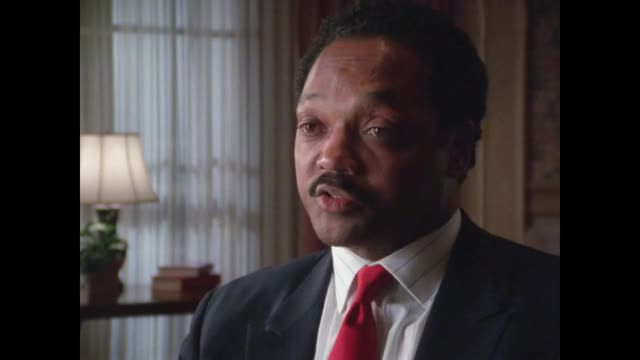
- Transcript
Let me take you back to 1980, it's May of 1980, the verdicts have come in on the policeman who killed Mr. McDuffy and one of America's works riots takes place. You go back there. Do you go to Miami and what do you have to come to? Well because that was a need and people with whom I had worked across the years are crying out for help, for fear that there would be even more killing and more rioting. There are two dimensions of the Miami scene as I have reflected on it. One is history of being one of the places where African people landed from West Africa to South America, Brazil, to the Caribbean, to the forts in Florida and Virginia up to coast.
It's a long and proud history of African Americans in Miami. Also because it is so close to Latin America and to the Caribbean, there's a great sense of internationalism in Miami, a port city. In the deepest days of segregation, there was some sense of a thriving African American community in Southern Florida, but then with the Cold War with Cuba, African Americans were made through the class citizens, whites were first class citizens in terms of access and opportunity. Cubans in some sense were encouraged to come here and struggle with Castro, with on the cut Castro, and thus that was this kind of subjugation and many promises made almost no promises kept. Why in the economic development, well you see a highway cut through the community, which undercut them economically and humiliated them because they did not have the political power to fight back and to protect themselves, banks and statements and loans, companies
were red lining the communities, no money was available for affordable housing, medium or small businesses, so that was a great sense of economic exploitation, but strangely enough even in the riots of the sixties, never did pure poverty inside the riot. It was always some police people spot that set the flame into explosion, and that's exactly what happened when McDuffe was killed in 1980. Now when you were there in Overtown, you stayed with a black family in Liberty City I recall, did you recall any impression or story that gives us some insight into how people felt? Well you know, the people are basically conservative, Christian, patriotic, but also humiliated. These are not people looking for trouble, they were looking for a job, looking for respect,
looking for protection, and they found none of that. And while the government made provisions to bring the Cubans in, they never made any provisions to allow the African Americans who live there to maintain a standard living or to grow. So they had a very high unemployment rate among the youth, inadequate job training, almost no program for building affordable housing, so what you saw in the riot really were voices of despair, the voices of the unheard, and so people with their backs against the wall, particularly the young, lashed out and fought back. And part I went there because of my concern and fear that they would simply be slaughtered, that they would be killed without any sense of mercy, but also at that time Mr. Carter was the president, and that was a bit more sensitive. There were a call present called ascending a team of people, Ernie Greene and LeMond
Goplin, Lexus Herman, a team of people from the White House to analyze what could happen in the short term in terms of some immediate relief. So there was a certain sensitivity from the White House, but there had been no program there that would provide in the kind of economic parity. You know, when Europe was down and had to be developed, they offered 20-year, 2% long-term loans government secured, that was the heart of the Marsha Plan, not just grants, but a chance for economic growth and development. Well, the Miami's about nation never got that kind of consideration, never got that development, and even this day, it remains a tender box. And that you stayed with those people in Miami, were you bullied by their sense of hope? I was, but also I wanted to share with them my sense of presence and concern. I also knew that because I had been there many times before, that my presence there
would attract the media in some measure. The media became their form of protection, because the elements that would garner them down in a violent way had to deal with them differently with their light zone. And we also met with the editorial board, trying to interpret of the crisis, because sometimes in the excitement, the media can incite more of a crisis in the given community, and what these people basically wanted was their civil rights, the right education, the right to the job, the right to decent house, the ability to walk the streets and save to insecurity. All right, let's stop down now. Marker, Mark II. Tell me more about me. When I think about the cities of great joy in the heart of the segregated south, Charlotte North Carolina, Atlanta, Georgia, Augusta, Georgia, where James Brown and Leon Austin, the
richest one in Quentin came from New Orleans, but Miami was a great source of joy and excitement in part because of the weather, in part because it was an international city, but also that was a thriving African American business community in Miami that was decimated with urban removal. Also recall that in Miami, there was a holiday in near the airport, it was the first holiday in America, but African Americans could stay. And all of the golfers, the professional golfers, and Charlotte Sifre, and Joe Lewis, and all of them would go once a year to the great tournament in Miami, in February. There was something special about being able to go to Miami and stay in the holiday in and go to the tournament and go to the race track or take trips of Miami and go to the Caribbean or go to South America.
There was a certain sense of joy and hope there, and Miami was torn asunder, but no sense of replacement, no sense of hope in development, and these riots are almost always expressions of disband desperation. Let's stop down again. Marker, one, three. Once the black community began in Chicago, direct your burn excesses, how did push begin to work with organizations and what was your role? You know, you really must put the Chicago scene within the context of a glorious history. I mean, Oscar the priest, one of our first African American congresspeople from Chicago, Bill Dawson from Chicago, the Dalit Dawson combination was delivered for Kennedy, the presidency, in 1960, and then the modern period would have to be thought the king come with the Chicago, deleting, open housing marches, and that's when I really emerged on the scene.
I have been with him as many others in Selman's 65th year before, and he made the judgment, really basically unappealed by Al Rabi and Bill Berre and the combination of people that come to Chicago, and it was said that you could not expose segregation in the North because it was subtle. In fact, as it was everything except subtly, it was dynamic, it was real blatant, ugly, violent, and there's the march toward the Gates Park, and march toward the southwest. Bricks were thrown, and that was just a great confrontation between the police and the residents there, because they had somehow been taught that the African Americans were dirty and indecent and violent. They had these fears that their fears had not been relieved, and that was a struggle for an empowered political community. The silent six, not the king began to give voice to those fears and frustrations in Chicago, and then Mail Daily died, and one of his loyal servants, Wilson Frost, was the
mayor pro-tem. It should have been acting mayor. They locked him off of the fifth floor of City Hall. Well then, Belandick was given that job in that arrangement. Well, Mail Burn beat him, but in public, a significant number of independence, African-Americans, Hispanics, progressive-wise, went with Jane Burns. She had a little pizzazz, a little gusto, and we knew it was a break. Our member, when several aldermen, who went with her for the first time, said, now that she has won, she has met with George Don and that group before meeting with us. We are afraid. And there was a meeting in my office with Harold Washington and several aldermen. They said, we need somebody to help us. There's a Harold, and I think NASA, Jefferson, two or three of us, went down to Jane Burns to transition office. And after meeting with her, it was so clear that she had no special sense of obligation to the element that made the break to elect her.
Harold said, we're going to have trouble with her administration unless something fundamentally changes. And there was a sense that we had to keep organizing because we had not yet been recognized with parity. That we were still somehow less than peers, and so the organization continued. But because she had a lot of exciting activity, Chicago fest, and because she'd get to reach out in ways that say, daily in Belandic never had, there was a sense that somehow you couldn't beat her. And she was female, she was not hostile, she was not polarizing the city per se, and yet we were not involved in the equation. So I should do a morning, a talk to you every Sunday morning. And on this particular Friday, Dorothy Tillman and Mary and Samson Lupomo were arrested after Chicago Housing Authority. I think we better stop down. I think you were telling me a story about you, Dorothy Tillman, and others going to
see Mayor Burns. You didn't know? I'm sorry. But after Jane Brown was elected, the alderman who had gone the independent rod and supported her, who had won, felt that they should have access to see her immediately. Her first meeting was with George Don in the forces that we had defeated. They felt very insecure and had a meeting in my office. In that meeting, I was here in Washington. In that meeting was NASA Jefferson and the combination of us who said, let's get an appointment with her. Since I had endorsed her, a public that decided it before, and she had gone downtown and said I was a significant leader in whatever that meant, I called her and was able to get through. But when we met with her, that was a sense that that was not the traditional hostility, but not the sense of partnership, the sense of parity, the sense of mutuality. And Harold Washington said, we're going to have trouble with this administration. We must really keep pressing forward.
She ran an administration that was not polarizing. It was not hostile and ugly. It was very difficult to get a grip on it. But one day, Dorothy Tillman and Mary and Samson Lupoma went to a Chicago housing authority meeting where you have a tremendous number of African-American Hispanics and poor people living, but no real power on the Chicago housing authority, but what. And they were arrested, and I want to help get them out of jail, as well as some other people. But I had become exhausted with what to do to really get people's attention to galvanize them. So I did this weekly radio show, and on this Sunday morning, someone called and said, well, just say, why don't you guys just boycott our coronation? After Chicago fest, really is just her coronation, her pretense for a running, for re-election. I wanted to say, but brother, you don't understand organizing a boycott against the Chicago
fest with all of the money involved, and the big audience coming, and the high expectation people coming from all around the country, the Chicago fest. I couldn't say he was wrong, but I could not tell him you don't understand. I said, I get back to you next week. So I called Lupoma, caravan Evans, and said, you know, we need to consider this boycott. They said, well, you know, it's hard to do. We can't say no, because it's rational. So by that Wednesday, about 50 art groups came together, Joe Gardner, a lot of people came together, many of whom, who had not been together for a long time, but we decided we were going to give each other a chance. I was a sense of redemption in that meeting, a sense of, let's give each other a chance. No matter what side of the spectrum, in the machine, not the machine, let's try. And that Saturday morning at push, we announced Chicago fest boycott. We then began to call the artists, people like, oh, that is it, I will not cross your picket line. Stephen Wander said, I will not cross the picket line.
When these big artists said they would not cross the picket line, that gave it an momentum. We then had 10 days of picketing in front of Chicago fest, and really 10 days of mass, media access, and education, because they imagined each day whether or not the boycott was successful. So that gave us a sense of focus. And we then said, but let's take this to the next conclusion. Ed Gardner of Solvshin Products, a finance, a voter registration drive, and Lou Palm had been argon in the case, we'll see, and eight of three, we'll see, and eight of three. And of the people who were considered for running, it was just a sense that Harold Washington was the best. Harold had been in the machine, but he had become an independent Democrat, so he knew forces on both sides. He had a sense of its internal mechanism, he had a sense of independence, thus he had credibility that made him a bridged builder, so to speak.
Harold said, you know, I really don't want to run, I'm in Congress now, I finally have something I really want to do, and he had become a good Congressman rather quickly because he had the background as a legislator. He said, I'll tell you what, if you really want me to run, register 50,000 new voters and raise 200,000 dollars, that was his way of saying, I don't have to run. Well because the spirit was high, we registered nearly 400,000 voters, raised nearly a half million dollars, Harold could not say no. And thus, out of that context, the Harold Washington candidacy was born, so it was the protest at the Chicago Housing Authority, it was the Chicago First Boycott, it was the mass education, it was the voter registration, and Harold said, I have three demands, one that must be one candidate, maximum unity in the base community, the African American community. He said, but we can't stop it, it must be coalition, reach out to the Hispanic community, the labor and the progressive whites, because Chicago is a coalition city.
We must find common ground across these lines of race, region, religion and award. And thus, that coalition was, in fact, the force that prevailed. Had you told me that the black middle class, too, was a significant factor, that they took the initiative after some reluctance at a certain point, this one? Well, I think it's fair to say that when you really make progress, just when you rise above these class divisions, which become a way of putting people down, like who is the most lawyer, or who is the blackest, who is the most dedicated? At some point in time, we must deal with our commonality, because our caste system, our skin color, is more pronounced than our class system. As people like MetCap, again, the fight, police brutality, for example, Dennis was beaten to death. And so it's your pedigree, not your class, that becomes the final factor. And when a community hits that point of dignity, and it fights insult with dignity, and finds
common ground above our skin color, and above religious denominations, and finds its commonality in its dignity, not division in its classes, you have a very powerful force. Tell me something about Harold Washington, from all I've seen and heard of him, he's a magnificent man. Give me some recollection and impressions of him. You know, I should never forget, when Dr. King always leading marches in Chicago, that was just the machine blacks, silent six, who could not protest, because they were offering with the context of Dennis apparatus, that was the independent struggle. Well, obviously the independent forces identified without the king. The machine forces, the religious leaders, the political leaders, actually had a press conference. Some of them were singing songs, they were serenading daily, must daily battle crossing on, and all the world go free.
Give me this day out daily bread, certain kinds of, well, it was humiliating, you see. And so we had this division, a kind of class division, in the movement, not in the movement, in the machine. And so one day I was talking to Harold Washington and Rupert Pope, and Harold's apartment right down from my office on Florida 7th Street, and so Harold gave me, it was a four-hour meeting. There's almost a typical analysis of how he had grown up, whether the desire to be free just like anybody else, and how he admired and respected Dr. King. But the Chicago political options were of such, there were some good people trapped in the machine, and there were some not so good people not in the machine, some not in it because they couldn't get in it. But it was more complex than with Dr. King or not with Dr. King, and he explained his evolution toward independence, he said, he knows it, he studied it, the present cabinet, don't like it. This is 1966, this was like six years before he really made his public break with the machine.
So Harold had a tremendous sense of ideology, Harold was an intellectual and a political activist. So when he became mayor, it was not just a ceremony, now mayor, he said, that really means reform government. It means open government, open the books, fair government, fair job distribution, and promotions, and contract distribution, and ethical government. Well in Chicago, that's revolutionary government, you know, open, fair, ethical government, where Chicago becomes our kind of town. So he had a sense of ideology and a sense of political integrity. He was a man whose shoulders was as broad as Chicago's broad shoulders. He was tough enough to be equal to the task of being mayor of that city. Let's stop down now. You just blown through about six of my questions.
Moses got to the Red Sea and had a rod, they had a fit of faithlessness. He dropped the rod and the blessing became a cursing and could have bit him and destroyed him. It was not that he regained his faith in God, that he picked up the rod and stretched out his hands. A people with a vote, with a broken spirit, will not pick it up and use it. Harold was able to renew our faith and bring about this broad based coalition in people's minds and their votes and their sense of obligation, opportunity, and privilege consolidated in this man. He had this tremendous person and within him we found a comfort and a security. And so the miracle was unity in the community and reform government, reform, open, fat ethical, reform government, maybe even for Chicago and maybe for the nation, revolutionary government.
Okay. Yep. There's a marker. Mark City, hammer out 10-7-8. Go ahead. Were there, tell me the story about Mondale coming to town in Toronto. Okay. Now we're ready. In Rhin route the Harold's victory, that was a sense finally the week of win. We didn't have the money. I mean, the burn had the money and daily had the favor of many. And yeah, Harold was a third, was a long shot. He didn't have the money he had to scale and the will to work. And we were on a roll, we had momentum. We heard that Ted Kennedy was coming to town to support Jane Byrne and Monday was coming to town to support daily.
So I called 50 leaders around the country, I got Willie Brown and Maxine Waters and congressional caucus members to appeal to them if they were for the liberal progressive agenda. He was Harold, a democratic congressman and don't violate us in this way. And they said we have to come because we made these commitments. Well, that was a sense that we had been abandoned by liberals that somehow liberators had to meet liberals. And if they, if the most progressive liberals, Mandel and Kennedy had this disregard for what the Chicago movement meant, we could only change that by becoming the appears. That meant someone had to begin the run against them in the primaries and function at their level of party politics. Well, I began to raise the question that a black author run. He was far from my mind for running because if I had had politics on my mind at that time
for myself, and Harold ran for me, I would have been considering running for his job as Congressperson. But that was not really on my mind. I was still protesting to open the system up. And I kept raising it and of course it was met with a certain amount of contempt. I'll be serious, who can run, who is qualified. I said somebody should run. Well, I met with Andy Young three times. I tried to convince Andy to run. And it just become me. He said, well, I don't want to do it, and I don't think it will work. I said, Andy, someone needs to do it. I met with Manit Jackson twice. Manit had, it was now out of politics. He was in the business. He was credible. He was a tickler. He had all of the right stuff. And he wouldn't do it. I kept raising the proposition. It became a part of national debate. Should someone do it or should they not? At some point, run just a run began to emerge. I want to pull back, but I couldn't because it would have appeared as if I had been insincere
that I was playing with the people. I was not playing, but I was not talking about myself. I had made almost no preparation to run, but then somebody had to run. Because it is out of that context of fighting for a hero and fighting against liberal contempt that my own candidacy emerged out of this crucible, out of this process. Let's talk down here. Marker. One second. Okay, give me some feeling for Resurrection City that was sort of like an early rainbow experience. What was it like with all the different kinds of people? The context of it is the Saturday morning before Dr. King was assassinated. We call this emergency staff meeting at his office in Atlanta, Georgia.
He had this vision that we should wipe out poverty, ignorance, and disease, but you couldn't do it on an ethnic basis, that there was never going to be in the plan to wipe out black poverty that would leave Hispanics and poverty, or whites, or women in poverty, or Native American and poverty, so we had to pull people together. On this Saturday morning, he said, I've had a migraine headache for three days, and sometimes because our movement is divided, I feel like turning around, just quitting. I may have become impressed in a Mohouse college, and the young said, Dr. King, but don't talk that way. He said, don't say peace, peace when there is no peace. Let me finish. He said, but I can't turn around. I feel like Du Bois and Frederick Dudleyston, Mary McLeopold, soon, they wouldn't let me turn back. He said, but then I thought about fasting, maybe to the point of death, and even though stokely and rapping and quitting and roaring, they have different points of view on strategy,
we're still friends. At the point of death, they would come to my bedside, we could reunite. Then he said, as if something struck him, but we would always be able to turn the medicine to a plus. We can turn a stomach block to a steppin' stone. Sometimes my works feel to be in vain, but then the whole spirit comes and I'm revived again. He preached himself out of the oppression, so let us move on from that onto Memphis. He was killed on April 4th. The struggle had to continue. We were going toward Resurrection City, renewal city. All not the King was killed April 4th. Robert Kennedy killed June 5th, who since the White House had abandoned us and our leaders were dead, and I remember on this particular morning, a coming to Resurrection City, and Dr. Abbinat at the point of me may have Resurrection City, and so there was the may of a Washington City, or not too far from the White House, and I looked in the faces of the people most
of women and children. And I had nothing to offer them, no money, and they had eyes for the water seen, and no money even to get back home. Now, I remember having read a book by Dr. Howard Thurmond, Jesus and the Disson Heritage, and he talked about, when you're down to your irreducible essence, and you have nothing else, no material thing you have, you're a person, you're still somebody, you're God's child. And I said to them, repeat these words, say, I am, they said, I am somebody. I may be poor, I may be unemployed, I may be unskilled, but I am somebody, respect me, protect me, never neglect me. The whole I am somebody came out of that context in the Resurrection City. The next day, we had to march for some food, so we decided to march to the Agriculture Department, because we were putting focus on feeding and nutrition. So, we went and took a couple of long to people there, and we had been eating out of the cans and the like down the Resurrection City, raining, in the mud, and good food
in the Agriculture Department, so we got through that. They were very nervous, of course, we were there, and the cameras were there, I said, well, thank you very much, I said, well, who's going to pay, I said, well, I tell you, you should submit us a bill between what you owe us and what we owe you will pay the difference. I said, no, you crazy. You said, this is not the Agriculture Department, this is the private service, as we've come to the Agriculture Department to eat, and count up what you owe us, and what we owe you, Dr. King, it preaches 1963 speech about the balance check, and so we left. They wouldn't arrest all of us, but the next day, they did make Dr. Abinathan, who wants us to pay for the meal, but that was the context of that meal. That was a sense of betrayal, a sense of abandonment. The dreamer had been killed in Memphis, and that was the attempt now to kill the dream
itself, which was to feed the hungry, which was to bring the people together, and rather than come forth with a plan to the wipe out malnutrition, they were wiping out the malnourished. The first time I had ever really experienced tear gas was in the resurrection center, they drove us out with tear gas, they gassed us, they shot not the king, now they were gassing us, and they'd been changed alone. After that period, no one else since that time has ever been able to set up in a kind of a tender protest arrangement there on those grounds. I was determined to keep the struggle moving, if you will, to keep hope alive, but left there was an awful sense of betrayal and abandonment. I skipped. More.
These are the 4th. Nine of the 3rd, right? One of the 3rd? Nine. Panther Raid. That was the 4th. Yeah, these are the 4th. How did you first learn about the police raid on Red Hampton's apartment? Well, the news blasted out. That was a sense of intolerance toward the Panthers by the police, because they had the sense of agitation to bring clarity to what they called exposing the contradiction. They would feed the children as a way of dramatizing the malnutrition, and they would challenge police brutality, which had become, in many ways, a way of life, and, of course, they irritated
the police, and there was this organized raid to kill them, and for some time there was an attempt to cover it up, but people like Dr. Charles Hurst wouldn't let it go. I remember Bobby Rush was Fred Hampton's closest friend. They went to kill him, too, but he was not what they wanted to get him. We got roll-out. We were talking about the Black Panther, and he was saying, Bobby Rush, Fred Hampton's best friend. Bobby Rush, Fred Hampton's best friend, was being sought. He felt to be killed. They invaded the house where he was living. I received a call early in the morning, one Saturday morning, that he was a fugitive, and he was going to turn himself in to me, before the people on the platform, at our regular Saturday morning, Brit Bastard meeting, and by turning himself in to the police before
several thousand people. That became his protection. I actually preached for it Hampton's funeral, and my sense was, in those first few days, the media was so anti-Panthe, it was as if there being keel was a kind of relief. Didn't the community realize that blood had been spilled, an assassination, and a massacre had taken place, and that is from the point of Fred Hampton's blood to Harold Watcherton's inauguration, it's a kind of straight line of indignation and dignity fighting insult. So Fred Hampton's assassination in Mark Clarke is very much a part of the equation for changing the politics of Chicago. Did the Pantheon use a great deal of profanity, like you're off the pig and threats?
How do you react to this? Well, I learned early on to separate their language from their message. It was their way of expressing a sense of violation, a sense of not being stockholders, or stakeholders of being locked out. And though I had another language pattern, a message was the same. I'd just met with Fred, for example, and Bobby a few days before he was assassinated, and had a sense of kinship with them, and of course, when he was killed, his parents asked me as well as the other Panthers to utter preach the final, because I had a sense of him and his history and what he was about. One final question, and not about the Panthers, about civil rights movement and us, what have we brought? What has been the price that we've had to pay for what we've done with the civil rights movement? Well, we've started from further back than anybody else.
After all, the Constitution designates African descent and says, three-fifths human. No immigrant group had to face that mathematical equation. Three-fifths human, a little lower than people, a little higher than animals, 250 years of free labor, just the interest of natural, with free as economic and now, another hundred years of legal apartheid and segregation in this country, and after all of this struggle, public accommodations equal access and protection under the law as opposed to separate, but equal. Now the right to vote, I mean the most fundamental shift from slave ship and route to championship has been to be empowered, to be enfranchised with this right to vote. And I submit to you that in 1988, I got more votes than Monday I got for the nomination in 1984.
Within our lifetime, this ongoing struggle will have an African-American as nominee of a party indeed as president of the United States of America. And so the goal is within reach. Okay, stop down here. Mark 11. Years 1972 as a convention in Gary Indiana is being planned for black politics. What stands out about Gary? Within the context of Montgomery, Birmingham, Atlanta, Selma, Memphis, Gary, Gary was up south. It was up north. Gary was a city where an African-American Richard Hatcher had taken control, had won, I mean, Richard Hatcher and Stokes were the first two urban mayors of this century. So you had the shift from southern focus to the north and you had a mayor who had achieved
this. He could have a convention in his city. There was a sense of dynamic all about that, but then there was a question, seven years after the Selma, seven to two, what plans that we have to make Gary and Cleveland happen in Detroit and other cities across this country. So it was a greatest or a moment, a great sense of history, but also a sense of independent politics. It was not a democratic party convention. It was not a Republican convention. It was a black political convention that gave strength to Hispanics and women and workers and all those of who it marched. Previously in the civil rights movement, they found in Gary a certain reference point. The idea of a third political party emerged in Gary, in fact it was put on the agenda.
Because that was a sense of alienation from the democratic party, Democrats taking us for granted, Republicans writing us off, and the agenda items for jobs and peace and justice would no longer be an afterthought for some other party, some other person. It was a sense that we had to assert this new dynamic and even with that, that was attention because even though that was the ideology, that was the mixed emotions about chillichisms candidacy. For example, the same people who believed that instead of two in A.D. 4 still were shaking in them about my candidacy in A.D. 4, but much of the crucible out of which that idea came forth, emerged in the context of Gary. It's not the first time that I did come forth, but somehow Gary gave it, especially meaning after all of the 10,000 people that are all over the country.
Do you remember the cultural trappings of Gary, the connection to Africa, the sense of hard to poetry? Well, in the sense that Amira Baraka played a tremendous role in that convention, and later a Gary convention gave strength to winning in Newark, for example, for Ken Gibson, who Baraka also played a tremendous role in that. It was difficult while it's pulling together all of these tribes and many plantations that we have come from. I mean, that was Coleman Young from Detroit and that was Hatchin' and that was Stokes. We had six, eight Congress people at that time, deep south. All these various forces, with these various views of themselves finding, if you will, common ground. And Gary became that, and though it was difficult to pull the people together and difficult to finance, somehow the spirit and the will and the people germinated, something happened in Gary.
Gary indeed was successful because it is an historical reference point. You're feeling after your deliberation time to speak? Well, I sense that I was speaking to the alien nation, but giving it some sense of direction. I had drawn much of the strength of nation time from a poem written by Leroy Jones. Amira Baraka at that time, the sense of people saying, what's happening, so nothing's happening, man. So what's really happening is nation time, it's time to come together, it's time to organize politically, it's time for partnership, it's time for new equation. It is indeed, while you're in California, Mississippi, it is nation time. And out of that speech, many young people around the country began to gravitate toward a sense of national, indeed, international consciousness. One memory, do you remember standing and watching the other delegates, one personal memory of that time?
The joy was so many people there, and yet with a certain sense of expectation and security, and the only real rough point was there were so many cameras there, they were blocking people's view, and with spent a lot of time, we were just trying to get the press to cover our activities, cover our events, but they came in such great numbers there, they actually got in their way. So we had to little stop to tear down their structure so people could see, they wanted to really see what was happening on the stage, and there was a sense of alienation from the press, and also was a part of it, and maybe the only kind of rough political point was common yarn protested and left, but eventually the fact that Coleman had come, the fact that all of us had come, gave us a sense of kinship and reference. I remember Gary with a great sense of affundance, and a great sense of love for all the people who were there.
Mark 12, the lead that was going to clear here, the line of part of 66, the word black power comes down to the last gate. Black power was presented, the connotation of black power in the media was violence. The fact is black power was power sharing, it was equity. White power was self-eppinant, no one had to scream it out, white power was all white ankle people in the morning and night, the TV shows, white power was all white governors, all white senators, may have ever made a city white. So white power was self-eppinant and stoked to do two things, one by declaring that this is a quest for power, and began to call racism, that disease, the soul of our country, which has divided us for so long, he talked about the need to have a share of power, and
that racism should not stop it. And I think it first, not the king, reacted to it because the media tried to make anyone who didn't have a black power as being a kind of leper. And finally, the king had to sit down on the right and define black power, and he became maybe the most articulate spokesman and exponent of it, and began to put it in some real perspective. I remember a group of black churchmen in New York, wrote a full page ad in New York Times, defining what black power meant, and what white power meant. You're in Chicago at this point, and the southern movement is looking for a northern location. It moves to Chicago, it's called the Chicago Freedom Summer. What were the things that were tried, or was the sense of... Critical to that movement is James Bevel.
It was Bevel's creative urge, I mean, and then some others were saying, let's go to New York, because that was a kind of base in Harlem. It was Adam Powell in Harlem, and others who had been associated for a long time. The Bevel sense that coming to Chicago was a place to go. He was a big factor, not only in coming to Chicago, but also in conceiving of the ways to heighten the northern contradiction, because it was said that we could find a bull con in a gem clock in the south, but racism at north was subtle, because after all, you could go to Rig the Field and the White Sox Park, and blacks and whites could sit together that you could not really prove northern racism, but of course, there we found, in open housing marches, once we marched off of that plantation, there was the rock throwing in Gage Park, there was the violent reaction in Cicero, and so the kind of field general of that was Bevel, but it was not just about confrontation to expose the contradiction. It also was an attempt to take the profit out of slums, because at that time, many former
NSA residents owned the buildings, they got tax write-offs, profits up, services down, so the slums with a sort of separation of capital incentives from development. Cicero was a kind of whole movement, it was both protests and development, and it was dramatic. What kind of adversary was Richard Daly? Well, he was a formidable adversary, because whereas gem clock and bull con it was white versus black, Daly had blacks on his staff, and black officials, in some black ministers who marched with Dr. King in the South, with the school with him at Morehouse, but on Daly's plantation, they had press conferences, and erred Dr. King to leave Chicago San Dez no place for you here, he really broke his heart to see some of his classmates
train on him in Chicago. A minister had a press conference on the west side, San Dr. King go to hell, and even though he was not a guy with a big church, the fact that a black minister would say Dr. King go to hell, it made national news. It was not the size of his congregation, he was not a political peer about the kings in that sense, but Daly had all these forces to use, and he used them. He would sometimes pre-empt things that you would try, he would send in the city to do better, like cooking up trash. Well see, Brit Basket became a factor in beginning to galvanize blacks and progressive whites in that city, but they would also use this downright intimidation. Reverend Clevver, a tremendous minister who was head of the pastors conference, the minister's conference at that time.
One northern program not the King had was Operation Brit Basket, getting ministers to fight for jobs from corporations, and they did not open up jobs to use the boycott. And so in Reverend Evans, I didn't have a Dr. King, he faced the shutdown of access to capital to build his church. Many ministers closed their pulpit down the Dr. King in Chicago, but if they opened them, they would face building and code of violation the next day. So in some sense, that was an intimidation of the boys of religion in Chicago. The Reverend Evans would not bow, because Dr. King was able to preach at his church, he faced the wrath of that machine, and for seven years, what was to be a new church was just steel and frame. We finally got it through the head of Reverend Don Benedict and others, see when Independence Bank, but seven years later, and that was the power of that machine.
I remember when that being downtown, Dr. King and the young Walter Fontroy and investment banker, until us daily has the power to let in the building in this town go up or shut it down. If you were just back off, we can get the church. Reverend Evans said, whenever that church is built, it would be built on a solid foundation. I would not bow, not surrender, I would not forsake Dr. King, and he held out, he held his own. Dr. King said he was more frightened than Chicago, Marquette Gage Park, than he's been anywhere else. You let it march there, going into Gage Park. Whites had been so oriented about the inhumanity of blacks, the crowds on both sides. The police were having to beat back quites with screaming and hurling insults, and eventually broke through the police lines, and they began to throw rocks, and Dr. King was hit with the rock.
He had not seen that kind of violent and aggressive action toward him, booing and hissing and namefully and rock throwing. He had not witnessed that in Atlanta, albreming him, a Montgomery Selma. He met it in Chicago. Did you determine to take a march into Cicero, perhaps one of the most frightening parts in that period, or any black person to go, if a young man had been killed there? It was an attempt to get the nation to make housing segregation illegal, to make certain that no group had the right to use racial covenants in housing, and so asked a lot of people out. In Chicago in 1966 there were actual operative covenants. This is Chicago, not Alabama, Mississippi, Georgia, Chicago, whatever some covenants have said, a black person can only live in the back of the big house. He had restrictive covenants, plus you had red lining, and real estate brokers would
only show you houses in certain areas, or they would do what they call blockbusting and simply export you economically. I suppose you had 25% of the people living on 10% of the land, which meant that the very laws of supply and demand made slum property valuable, because people were hemmed up. One concrete manifestation of that is the housing projects like State Red God, who got all these people living up on top of each other. All that was a part of a red lining, gym, manoring, political disenfranchisement process. All the kings would take six to eight years to break it up. The press gave him six months to set out the king failed, but the seeds that he sold in 1966, germinated in Harold Washington's candidacy and victory in 1983. It took us 17 years, but you can trace it in so many ways from not the kings marching for it Hampton's assassination, the boycutting in 1982, Harold's victory in 1983, a kind of
straight line of progress and struggle. Were you frightened? I really was not frightened. I was in the army, the nonviolent freedom army, and my expectations were of such I could not be disappointed, I had to be disciplined. I mean, that was a sense that what was happening was in the day. I remember one Sunday we marched, I added white and I were on the church steps, and while we were there, we were being stoned on the church steps. The axe that shakes us back into the black community again, now this is Chicago, you know, North 1966, while on one side of town they were hailing or in the banks as a great football hero, and later Gail sales as a great football hero.
That was these areas where we could not walk through without being violently attacked or killed and certainly could not move, and so we had the challenge, and really on the belt was leadership, we rose to the occasion. Nonviolence, which was such a key part of the Southern struggle, is not a Northern, you know. This is the last one. 1984, a Democratic National Convention in San Francisco, and you literally have the eyes of the country and the portion of the world you are a person born poor who has taken himself in that enormous journey. What are the feelings as you ascended that podium and all the tension and conflicts that I just felt an awful sense of burden and responsibility.
I felt that I was speaking for people who could not speak for themselves, and from that platform, I could only feel myself to be a servant. I knew there were people listening in their cabs, and all those in hospitals, and maids in people's kitchens, and ditched diggers, and teachers, and youth, and parents, and sharecroppers. I saw those people in my mind, and I felt some need to tell their story within the tradition of the struggle that made it possible for me to stand there, and so I remember that that night mostly with a sense of a burden and responsibility, and when people responded the way they did, there was a certain second of awful fulfillment that we had for a moment
pierced the veil, and it had been heard, but for an instant. I began this series with the death of Emma Till, which was my personal memory of the beginning of the movement, and we've carried it through, so Birmingham, Albany, up into the Chicago, and the great runs of the late 60s, the tragedy of the death. What do you think it's all meant, and what do you think it's done to the people who have made that move by the African-Americans? Move-come full circle. From coming here as slaves, descendants of African people, to the point that an African-American is now the number three Democrat in the House of Representatives. In African-American, now here's the Democratic Party. When I have three or five urban mayors for African-American, we are the centerpiece of
progressive coalition politics for workers and women and youth and peace activists in this country. We are now the central focus in American politics, the free South Africa, the peace in the Middle East, the peace in Central America, to end the arms race, so we are bigger than our race as a moral force, so we do not really represent left wing or right wing. We represent the moral center, and that's a coveted position. That's why we must resist the drugs and the killing and the fracture side and the immoral and decadent behavior, because what we have is really what the role wants. It does not really want more weapons and more materials that have no function. What we have is inviable moral authority, and when we speak, people are all over the world
listen, even when we don't have office, we have the position, and I would say to the young America, Malcolm had moral authority, and Medgevers had moral authority, and Martin Luther King had moral authority, Rosa Parks had moral authority, that is that one authority we may or may not get our place in the military or hierarchy, in the economic hierarchy, in the political hierarchy, we should fight to get our share, and we have to fashion it in humane ways, the one thing that we have that we must never lose, and that's moral authority as we fight for the moral center, after all hope and love and sharing and family and peace and justice are all moral center concepts. We must hold on to them with an obsession, with a sense of joy and a sense of responsibility.
What is this movement doing? I have to do a sound change. Great. How many feet do we have left? Got no feet. All right. The series of events, the series of people of moment we call the Civil Rights Movement, has touched all these things, does it have a time frame because of something that goes on forever? In one sense, it's an eternal quest for justice and peace. We may say that we're in a third stage now. After the first days, we were sub-ordinary in terms of designation as sub-people, or three-fifths human, fighting to end slavery, to end lynching, to end legal segregation or illegal apartheid. We were by law sub-people, so we fought against the sub-ordinary, to the ordinary.
The ordinary is equal protection under the law. Political accommodations, open housing, the right to vote, the school of your choice. These were hard earned victories, but they really are ordinary in the sense that we have a job to do greater than just arriving. We must not give leadership, and that becomes this generation's challenge. We cannot just accept equal access and drugs. We must use hope of a dope and offer leadership. We can't just accept equal access to decadence. We must have transformed the nation and make it better. And so ours is a greater challenge than to have a house. It's to fight for housing, or to fight to eat. It is to feed people, or to fight not to be killed. It's to stop the killing.
It's not just to get free, it's to free South Africa, and to free the Middle East, and free the Central America, and free the rule of its insecurities that drive us to make weapons that we cannot use in wars that we must not fight. And so let's say from sub-ordinary to the ordinary. And ordinary is great because of the sub-ordinary. We've been down so long until even seemed like up. The really up is offering a leadership beyond race and sex and religion. So when I win Maine, and Puerto Rico, and Alaska, and Michigan, and Mississippi, that's moving to another stage of our development. And I'm convinced that justice athletic skills have taken us beyond narrow boundaries of race. And our artistic skills have taken us beyond that, as in the case of what Marin Anderson did 50 years ago, Steve Wanda does today. Politically, we must now offer that quality of a political, social, economic, moral leadership
to the whole world. Because we came here on an international trade mission, slavery. And now the rejected stones must become the cornerstones of a new order of justice in our nation, in peace in the whole world. Thank you. Everyone's silent for 30 seconds.
- Series
- Eyes on the Prize II
- Raw Footage
- Interview with Reverend Jesse Jackson
- Producing Organization
- Blackside, Inc.
- Contributing Organization
- Film and Media Archive, Washington University in St. Louis (St. Louis, Missouri)
- AAPB ID
- cpb-aacip-ec5daf9b03b
If you have more information about this item than what is given here, or if you have concerns about this record, we want to know! Contact us, indicating the AAPB ID (cpb-aacip-ec5daf9b03b).
- Description
- Raw Footage Description
- Interview with Jesse Jackson conducted for Eyes on the Prize II. Discussion topics include Dr. Martin Luther King, Jr., Harold Washington, Overtown and the Miami riots, the National Black Political Convention in 1972 held in Gary, Indiana, and the1984 Democratic National Convention in San Francisco.
- Created Date
- 1989-04-11
- Asset type
- Raw Footage
- Topics
- Race and Ethnicity
- Subjects
- Race and society
- Media type
- Moving Image
- Duration
- 01:02:47;06
- Credits
-
-
Interviewee:
Jackson, Jesse, 1941-
Interviewer: Hampton, Henry, 1940-1998
Interviewer: Lacy, Madison Davis
Producing Organization: Blackside, Inc.
- AAPB Contributor Holdings
-
Film & Media Archive, Washington University in St. Louis
Identifier: cpb-aacip-fa5d8d01df3 (Filename)
Format: 1/4 inch videotape
If you have a copy of this asset and would like us to add it to our catalog, please contact us.
- Citations
- Chicago: “Eyes on the Prize II; Interview with Reverend Jesse Jackson,” 1989-04-11, Film and Media Archive, Washington University in St. Louis, American Archive of Public Broadcasting (GBH and the Library of Congress), Boston, MA and Washington, DC, accessed October 8, 2026, http://americanarchive.org/catalog/cpb-aacip-ec5daf9b03b.
- MLA: “Eyes on the Prize II; Interview with Reverend Jesse Jackson.” 1989-04-11. Film and Media Archive, Washington University in St. Louis, American Archive of Public Broadcasting (GBH and the Library of Congress), Boston, MA and Washington, DC. Web. October 8, 2026. <http://americanarchive.org/catalog/cpb-aacip-ec5daf9b03b>.
- APA: Eyes on the Prize II; Interview with Reverend Jesse Jackson. Boston, MA: Film and Media Archive, Washington University in St. Louis, American Archive of Public Broadcasting (GBH and the Library of Congress), Boston, MA and Washington, DC. Retrieved from http://americanarchive.org/catalog/cpb-aacip-ec5daf9b03b