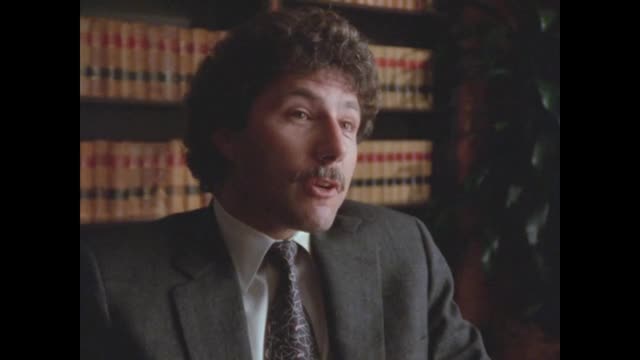
Eyes on the Prize II; Interview with Robert Links
- Transcript
Okay. Okay. All right. Okay. Okay. Sarah. Okay. Nine. Okay. Three. Two. Three. Three. Two. Three. Four. Four. Three. Four. Four. I'm sorry. Okay. Okay. Okay. Okay. Okay, to many people, Alan Baki is a symbol, but we need to know about the man behind the symbol. So I'll be curious to hear, when was the first time you met him? What kind of guy is Alan Baki? I first met Alan Baki about two days before we tried his case against the University of California, and if I could describe him without being overly dramatic, I don't think you would ever meet a quieter, more self-facing, more humble, more peaceful kind of guy in the world.
And I think if ever there is anything which demonstrates the kind of guy he is, he never sought any publicity, he never granted any interviews, he never quote went public or went Hollywood. All he wanted to do was let the court decide the case and go on with his life. I guess the most fundamental way you could describe him is he was a young man of enormous talent who just wanted to be a doctor and who felt that he had been denied that opportunity because of his skin color. And he's also a man of principle. He wanted an answer to that question, and he got it. Yeah. Cut. Am I okay for you? I mean, yeah. Two up. I'm out here. Let me know. Okay. Marker. Okay. When you and your partner took on this case, did you understand its national significance? And if not then, when did you?
I think from the day Bucky walked in our door, we knew what was at stake. We knew how vital the questions were. And above all else, we knew that it was going to take good loyering and not theatrics, not historians, not yelling and shouting, but some very deep thinking. And we tried to give that to the case, and I guess the most fundamental thing I could say was that from day one, we knew this was the case of a lifetime. Not just for the lawyers, not just for the client, and not just for the court. This was a case for America that come to grips with itself, with its past, and with its future. And I think all three of those elements intersected when this case was decided and throughout every day that it was litigated.
Now the national debate around this case centered on affirmative action versus reverse discrimination. Do you think that that truly characterizes the pivotal issues around this case? Whenever the Bucky case is discussed, the two phrases you hear are reverse discrimination and affirmative action. I have to tell you that I don't know what either one of those things means. I know that the issues in the case go far deeper than any slogan. They cannot be discussed in a half an hour and they can't be answered in a half an hour. They involve profound philosophical questions that go to the heart of our society and the kind of country that we are and the kind of a nation that we want to become. And a lot of people say on Bucky's side of the case, well it's a quote and you can't
have quotas. I happen to believe that's true but I don't think that kind of phraseology begins to answer the question. On the other side of the case, on the university side, people say there's been racial injustice and we have to correct it. I happen to agree with that but that doesn't answer the question either. And at stake you've got deep down and on the bottom line the question of whether the government should ever use race as a decision making factor. I believe the answer to that question is no. I believe the answer to that question must be no because if the answer is anything else, you have a Pandora's box of problems that you can never answer, that you can never solve and that will never end. And we can go into those if you want.
Okay, let's go back though to the debate. I like the way that you framed it with affirmative action versus reverse discrimination. Give me a sense of how profound or how simple-minded, however you choose to express it, the way that most Americans got to hear about these issues. Back then. I think the way most people heard about the Bucky case and the way most of the people who heard about it felt about it was that the university's policy was racial discrimination. It was turned around, if you will, against the quote majority, close quote, and that that was a reversal of discrimination against the quote minority, unquote. And therefore people said, well, it's discrimination in reverse, it's reverse discrimination. On the university's side, people felt that this was a quote affirmative action program. And that concept is something that I think all of us, in one form or another, endorse.
And so people would say, I'm for affirmative action. And one of the problems is that just like the people who would say, I'm against reverse discrimination, it doesn't mean anything. It doesn't mean anything unless you define what affirmative action is. And I think that people who tried to gain an understanding of the case through the editorial pages and the newspaper articles and whatnot, I think ended up with simply a very superficial discussion of the deeper issues. Great. Okay. So let's go forward now to the day that oil arguments were heard before the Supreme Court. You told me a wonderful story about the cab ride that you took with the radio that the cab driver had on. And then what you found when you got to the Supreme Court, Kim. So I have to cut for a second. I have a problem.
I have a battery problem. Not cut, sir? Yeah. So we're marking it. There you go. Okay. So the cab ride on your first day, the day of your oil arguments? I think one of the things that will stay with me forever about the Bucky case, aside from the fact that it was the very first case that I ever worked on as a lawyer, fresh out of law school, believe it or not. Because the day we went to the Supreme Court to argue the case, I was the one who wrote all the briefs and did all the research in my partner, Rennie Colvin, who really was the lead lawyer in the case, argued it before the court. We were staying at the Jefferson Hotel in Washington, D.C. And we had to take a cab over to the Supreme Court building. And we hailed the taxi in Guardian and we knew it was a big day. And as we drove to the court, the cabie had the radio on and there was one news report
after another about the big case at the Supreme Court and we kind of looked at each other and we knew who they were talking about and what they were talking about. The cabie turns around and says, Jesus, really something going on over there today. Now where do you boys want me to let you out? And as we drove up to the court, there they were all those hundreds, probably thousands of people who had stood in line camping out overnight to listen to that case and to watch that case be argued. And I don't think there's any bigger thrill for a lawyer than having started out in Yolo County where there were only about three people in the courtroom to go before the highest court in the land with the whole world watching. And it's something I'll never forget. Okay, now I'd like to have you tell me, Archibald Cox is opening remarks and the impression that it made on you. One of the things that happens in oral argument is you get to hear for the first time how
your adversary is going to put the case. And when the bachie case was argued, the adversary was formidable indeed. The university's lawyers were fine and good and they had some of the finest constitutional scholars on their briefs and they had Archibald Cox, who's one of America's great lawyers as their advocate that day. And I can remember still what he said. This case, which comes here on a writ of certiorari to the Supreme Court of California, presents a single vital issue. The answer that this court provides will determine perhaps for decades whether minorities are going to have meaningful access to higher education or words to that effect. And it was a very dramatic moment. I also remember Rene Colvin's first words, which I think were equally, if not more moving. When he said, the first thing I think I should tell this court is that I am Alan Bachie's lawyer and Alan Bachie is my client.
And he proceeded to explain to that court who this man was because our feeling deep down was that America had to look him in the eye and that court had to look him in the eye. And say, do we apply one standard to you and another standard to someone else because of your race and the other person's race, or do you both get judged by the same standard? And it was a very effective and dramatic way of framing a very important part of the case. Now, when you give us Colvin's opening lines, can you also give us a sense of what your strategy was? As dramatic as Archibald Cox's opening was, I think Rene Colvin's opening was equally dramatic.
I think even more powerful because what he said was, the first thing I must say to this court is that I am Alan Bachie's lawyer and Alan Bachie is my client. And the strategy and the thinking was that the most effective way to present Bachie's case is to tell the court about him and make them look at him and look him in the eye and make the court know that this wasn't some faceless, nameless issue. Some philosophical question, it was a human issue that the court had to deal with. And they had to say to a human being, to say to a person, a citizen, either you're going to be judged by the same standard as someone else, or you're not going to be judged by the same standard. And will that standard be different according to race and so his way of focusing the argument on Bachie was the strategy because fundamentally what you had in a legal sense was a debate as to whether the rights under the Constitution that we all love and enjoy and cherish are
rights that come to us as individuals or are they rights that we get because we're members of particular groups. And the point we were trying to make, and I think the point we drove home and the point the court hammered out in those six different opinions, is that in America, rights belong to individuals. They do not belong to racial groups. Okay. Now can you give me a sense of how you think the public has misunderstood Bachie? I think, in a technical sense, the public has misunderstood Bachie by saying, well, that's the case that just says no quotas. It clearly did say that, but it's much, much deeper than that. The court was so badly divided. I don't know that there was a clear ringing of the constitutional bell, if you will. We do have, and this is something I think is very important.
It's almost as if that decision is a prism through which we look at refracted light. We can see some thinking, starting to evolve. It wasn't intended to be, nor at least by me, was it expected to be the final word on these questions. We knew it was going to be important, and it was important. But it was a starting point, because you see until the Bachie case came along, America had been evolving in a way that I think historians can track, and you don't really even have to be an historian to track it. In 1954, when Brown vs. Board of Education was decided, which is, I think, for anybody who has studied and thought about constitutional and American history, one of the great moments, not just in American life, it's one of the great moments in human history. It was a day when a nation looked itself in the eye, and it said, for too long, we've
kept people separated, and that's all going to end. It was a day that, I think, America really came into the 20th century in terms of human rights, and it wasn't an easy struggle. Anybody who thinks that the plaintiffs' lawyers in the Brown case had it easy. Anybody who thinks that is wrong. Those were courageous people who fought. Not just tremendous odds. They fought against violence, they fought against attacks on themselves and their families and their clients and their clients' families, and they achieved a great victory. It was the achievement of a moral principle that had been too long and coming, and a lot of people felt then that all we had to do was open the doors. Even if you look at the 1960s, a movement that I think moved all of us, everybody had a common goal.
Just take the barriers down, and once we do that, everything's going to be all right. When we got into the 70s, and I know this is a generalization, but I think it's pretty close to what happened, when we got into the 70s, everything got a little more complicated. Everything wasn't all right. We found that integration, however we defined that term, wasn't moving as fast as we wanted it to move. The question became, how can we advance this process along? Well, the easiest way to change the numerical disparity is to do it by the numbers, is to start a quota system, and say we want to have 20% of a group in a certain profession or in a certain job, just hire people or let people in until you have 20%. That's pretty easy, and it's pretty fast, and it's pretty effective. People I think started to do that, and everybody would think, well, it's a good thing, it's
a good cause, we all want to correct the problems of the past, and then the issues started to get a little more difficult. Whereas you might talk in an economic arena about jobs with an open-ended situation, you don't worry about the person who gets excluded, you figure there's enough room for everybody. When you start taking these principles and these concepts and applying them to a fixed pool, say a medical school where you only have 100 places, if you let one person in because of race, you're keeping another person out because of race, and that's when the issue started to get framed. Once it got framed, we had a whole host of questions that leads us into some very, very thorny constitutional thickets, and that's how we got to the Bocchi case, because it was right in the middle of that procedural and substantive sagebrush that we found ourselves,
and there were some precedents to help us, but there were very few clear answers. Okay. Marker. Okay, so you've talked about Bocchi the case, what about Bocchi the man? How do you think the public misunderstood Alan Bocchi as a person? I think the public misunderstood Alan Bocchi as a person because many people, not all people, but many, simply label them as a racist. I can remember reading articles where they spelled his name, B-A-K-K-K-E, and it bothered me because it was so far from the truth that it was unfortunate. I mean, here's a guy who is 32 years old, he's got a wife and two children to support, and he wants to be a doctor.
He works nights in an emergency room, volunteering. He goes to take all the classes, he takes the MCAT, the entrance exam, and scores exceptionally well, and he's just a hardworking guy who wants to provide a service to humanity. That's what he wanted to do, and I think the greatest testament to his character is that he saw it through, he graduated, he now works back near the Mayo Clinic, and he is an accomplished fellow in more ways than one, and he did it very quietly, in a very peaceful way, in a way that was not done for public media or public consumption, and I think it says something very special about him as a man. Now you also mentioned in talking about what an emotional issue this is, the hate mail that you got. I think some of the scariest mail that I got in connection with the Baki case was the mail I would get from people who thought they were supporting me, who would say, yeah,
let's keep all those niggers out of medical school. I got mail like that, and I threw it right in the trash can, because that isn't what this case was about. This wasn't about keeping anybody out of anything. It was about how we're going to interpret the 14th amendment to the United States Constitution, which is designed to treat everybody equally, and it's a little bit scary how people misconceive important questions, and how they debase a lot of noble principles by a rank hatred. I don't know the names of the 16 people who admitted it Davis, and I don't care because it doesn't matter who they are, what their grades were, it doesn't matter.
The fact that they graduated, it doesn't matter because those 16 people have an asterisk next to their name, and what the asterisk says is they couldn't make it on their own, and that's unfair and it's unfortunate, and think about the person who got in without the special program who's from a minority group. That person gets tagged with an asterisk too, and that's the problem. When people graduate, the degree should mean the same thing for everybody with no questions asked. One of the things I'm going to remember until a Tei die are the first words that one of my heroes Archibald Cox spoke to the Supreme Court in the Baki case when he said, this case which comes here on a rid of Sertirari from the Supreme Court of California presents
a single vital issue, whether a state university is free under the equal protection clause of the 14th Amendment to erect a special admission program to encourage the admission of members of disadvantaged racial groups. The answer which this court provides to these questions will determine perhaps for a decade whether minorities are going to have meaningful access to higher education. Those were powerful words. Okay. Now, let's go on and have you give me as concise as you can description of this, as you call it, Pandora's box of questions. Well I think that the way you can assess and sense the difficulty of racial preferences in an American or democratic society is this. Once you allow it to happen, even if it's any changing, whatever it is of the university's admission process, to have a greater number of minority people or a lesser number, any
difference based on race, you open up a box of unanswerable questions and insoluble problems. Who gets the preference? Which groups? How do you determine who's a member of which group if you're half Asian, do you qualify? How do you determine what the percentage is going to be, do you tie it to the local population, the state, the nation, the world? How do you make that determination? How long is the preference going to last and who decides when it's going to end? These are the types of issues and these aren't all of the questions. But once you start pondering these things, you can realize what we're dealing with and how hard it is. Do you prefer a black person over an Hispanic person? If so why and if not why not? Do you treat every black person the same? Did you treat a black person who comes from a wealthy family, the same as a poor black
kid from the ghetto? I don't think you should. I don't think they get the same number of points or the same size, plus as Justice Powell would say. I think what you have to do and what the bottom line is in America, you have to look at people as individuals and you have to listen to their story and you have to address their problems and their needs on an individual basis. That's what affirmative action is all about. You know when we were working on the Bockey case, I had a lot of friends who disagreed with me about having a colorblind constitution and they'd say, what's so wrong about having this program? We're just going to do it for a couple of years. Let's take care of business and then get on with it. And I think the thing that bothered me the most about that is anybody who thinks these
programs are going to be in place for five years or 10 years or 15 or 20 years is dreaming. It isn't going to happen that way because we are going to raise up a generation of Americans who will have ingrained in their psyches, the proposition that legal rights and the benefits and rewards of society should be a portion because of race. That is a very dangerous idea. And if I can continue, I think the real danger in the idea is when you start dealing with groups that, quote, overqualify, unquote, you take a group of Jews who perhaps are in medical schools way beyond their numbers in the national local state population. And you start saying, you know, we don't have anything against Jews, but they're taken up too many places. And we've got to hold them back just a little bit so we can let these other people in. And I think anybody who thinks back to the 1920s when there were the quotas keeping Jews
out of Harvard Law School doesn't need much of a refresher course to know what's wrong with that. And that's the problem we're dealing with now and that we will be dealing with for a generation to come. Okay. Cut. Yeah. Wait, let me think a minute before we start cranking it. I want to know what goes on. Steve. And Marker. Okay. Okay. Back then people said that these programs like the Davis program are great things because they include people and bring them into the class. And I think the shortcoming of that analysis is they forget that when you bring in one person you're keeping out another person. And the real problem that you get to philosophically, if you will, is that these programs don't work with over qualifying groups.
If you get Jews or Japanese Americans or whatever groups that get into professional schools far beyond their percentage levels in the general population, then you confront the following kind of problem. You say, you know, we don't have anything against Jews, but they're taking up too many places and we need to spread it around a little bit. So what we're going to do this year, we're going to hold the Jews back a little bit and we'll let some other people in. And any Jew who ever faced a quota knows that that is a system that results in injustice. It does not result in fair play. It does not result in equality. It doesn't move us forward. It moves us backward. And it says to people, you don't count as an individual. You only count as a member of a group. And I think the same would apply for any member of any group who's ever been kept out of anything because of the color of their skin, whether they're black and they couldn't become a doctor or whether they're white and couldn't become a doctor.
It's wrong from either perspective. Discrimination is discrimination. It's not reverse and it's not positive. It's discrimination. It is morally and legally wrong. Okay. I think we've got it cut.
- Series
- Eyes on the Prize II
- Raw Footage
- Interview with Robert Links
- Producing Organization
- Blackside, Inc.
- Contributing Organization
- Film and Media Archive, Washington University in St. Louis (St. Louis, Missouri)
- AAPB ID
- cpb-aacip-ea5d0a4c061
If you have more information about this item than what is given here, or if you have concerns about this record, we want to know! Contact us, indicating the AAPB ID (cpb-aacip-ea5d0a4c061).
- Description
- Raw Footage Description
- Interview with Robert Links conducted for Eyes on the Prize II. Discussion centers on his legal work on the Allan Bakke case and it's challenge to affirmative action programs at the University of California, Davis School of Medicine.
- Created Date
- 1989-03-03
- Asset type
- Raw Footage
- Topics
- Race and Ethnicity
- Subjects
- Race and society
- Media type
- Moving Image
- Duration
- 00:28:40:02
- Credits
-
-
:
Interviewee: Links, Robert
Interviewer: Shearer, Jacqueline
Producing Organization: Blackside, Inc.
- AAPB Contributor Holdings
-
Film & Media Archive, Washington University in St. Louis
Identifier: cpb-aacip-768ab4521a8 (Filename)
Format: 1/4 inch videotape
If you have a copy of this asset and would like us to add it to our catalog, please contact us.
- Citations
- Chicago: “Eyes on the Prize II; Interview with Robert Links,” 1989-03-03, Film and Media Archive, Washington University in St. Louis, American Archive of Public Broadcasting (GBH and the Library of Congress), Boston, MA and Washington, DC, accessed April 1, 2026, http://americanarchive.org/catalog/cpb-aacip-ea5d0a4c061.
- MLA: “Eyes on the Prize II; Interview with Robert Links.” 1989-03-03. Film and Media Archive, Washington University in St. Louis, American Archive of Public Broadcasting (GBH and the Library of Congress), Boston, MA and Washington, DC. Web. April 1, 2026. <http://americanarchive.org/catalog/cpb-aacip-ea5d0a4c061>.
- APA: Eyes on the Prize II; Interview with Robert Links. Boston, MA: Film and Media Archive, Washington University in St. Louis, American Archive of Public Broadcasting (GBH and the Library of Congress), Boston, MA and Washington, DC. Retrieved from http://americanarchive.org/catalog/cpb-aacip-ea5d0a4c061