Black Horizons; 2536; Sybil Wins
- Transcript
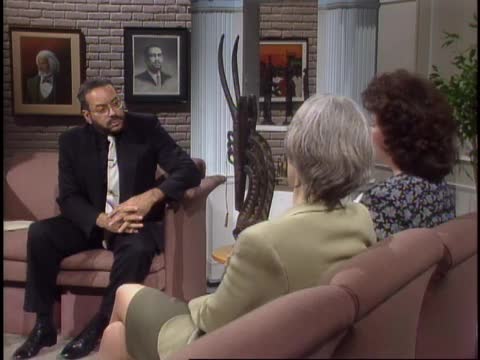
Hello and welcome to Black Horizons. We've been away for the last three weeks because of March pledge, but we're back and we have a brand new show for you. Today we'll take a look at up with people a culturally diverse national touring performance group whose message is synonymous with their name. Also, you'll meet Sybil Berry who has won the prestigious Lorraine Hansberry Award and playwriting. She also happens to be a production assistant on Black Horizons and we're very proud of her. Later, we are going to share some program information about some shows on QED that will be of interest to you. And Dr. Ralph Proctor joins us for one of his famous, Did You Know Black History Moments? But before we do any of that, I want you to meet Ginny Kahnfelder and Dana Erlebacher of Pittsburgh's Urban Redevelopment Authority. They are here to tell you how you can afford the American Dream of Home ownership. The Urban Redevelopment Authority has a big program, an event in fact that's about to happen that's going to tell people about how they can own homes.
Is that correct? That's right, Chris. On April 23rd, down at the Sheridan Station Square, we're going to have a big event called Pittsburgh Home Ownership 94 and what we want to do is introduce the general public to the home ownership and home improvement programs offered by Urban Redevelopment Authority's Department of Housing. Now, these programs that people normally don't seem aware of or seem to be able to take advantage of and so forth, you need a big media splash kind of event so people will know. Well, we want to encourage people, more people to use our loans, both our home improvement and our home mortgage. I think we want to increase our home improvement by 100 loans this year. And what will the public get to do, Dana, when they come down? Well, there'll be a lot of things for people that want to buy homes in the City of Pittsburgh. They don't have a home now. We have a lot of things for them. They're going to be able to be introduced to credit counseling opportunities. We'll have workshops on that, which will be running all day long. So if you're not really right for home ownership, you can get right for a few times. As far as credit, there
will also be lenders there who will be pre -qualifying people, one -on -one, actually sitting, you can sit down with you as an applicant and tell you whether or not you are actually eligible for one of our home mortgage programs. We have three of them that we're going to be introducing there. And so you'll actually be pre -qualified for those. And then also we have neighborhood groups from around the city and real estate agents who will be showing all the different homes for sale in the City of Pittsburgh and the north side, south, east and west. It's not like a big effort. Now, these are not the homes that URA is repossessing, it's just trying to get on the tax rolls and it's going to take another $1 ,000 to fix them up. Although they will be there, too. So you can shop around. Absolutely. Plus, people who already own homes in the City of Pittsburgh, we want to encourage them to come, too, because we have three different home improvement loan programs, three different kinds, one with zero percent interest, one at five percent interest. So we have various programs for people who already own property that they live in their own house. But we want to encourage them to stick around in the city, and so we're going to
show them how they can qualify for financing to improve their house. Okay. So there's a lot that's going on, a lot of people will see a lot of things. Is it free? Admission? Yes, it is free. We'd also like to mention that at 11 o 'clock that day, Mayor Tom Murphy will be there, as well as Franco Harris and Eta Cox and Jack Ezzel, so on. So you're making it a pretty glitzy event so that people are attracted for whatever reason, but home ownership is the bottom line. That's right. What's the biggest hurdle that most folks have to overcome in terms of qualifying to be a homeowner? Two of them really having enough down payment is a big one, and credit can be another one for people. You know, and... Will you be working on the down payment, or telling people to just save your money, is that basically all right? Yes, although in one of our home ownership programs, we actually have a grant for up to $1 ,000 that people can apply towards their closing costs and down payment. So, you know, and we'll be pre -qualifying people for that grant as well. Yeah, there's some construction going on
down there. Is it going to be hard to get around, you think? People will be able to get to the Sheraton. It's a good point because Smithfield Bridge is closed, but you can get to it from the West End Bridge if you're coming from the north side, or if you are coming from the south end, you can come up on the T, or you can come up on East Carson Street. All kinds of ways to get there if you really want to get there. You can parachute in. Hey, get there anywhere you can, I guess. What's the phone number to call if people are interested in getting more information on who, what, why, when, and where? 255 -6666. We have a full -time staff person that can answer all their questions. Okay, would you repeat that number again, please? It's 255 -6666. Okay, anything else you want people to know about this program, and why they should be taking advantage of it? We just want them to come live in the city if they don't already, and if they do, we want them to stick around, so we're going to make it real comfortable that day. We're going to talk in simple, plain, English, so there's no need to fare. Okay, don't you? Well, we wish you
much success with the program, and I hope many of our views will get out there and take advantage of what you're offering. Thank you. Thank you for being here. We appreciate it. The American Dream is something that we all pursue, but often don't achieve. Even Native Americans pursued their own dreams, but they were often thwarted. Tonight at 8 p .m. on QED, the American Experience Profiles Geronimo, the legendary warrior who fought for his people. It's a program I don't think you should miss. While we don't have a promotion spot to show you, we do have our resident historian, Dr. Ralph Proctor, who is in this edition of, did you know, examines the treatment of Native Americans in this country? Did you know that had Native Americans or Indians and Africans been the uncivilized savage portrayed in the popular literature, the conquest of Africa and the land now called America could never have occurred? Just think about it. Had Africans and Indians killed the first European explorers, the world would have followed a different path of development. Since the most widely accepted theory was that the world was flat and that if you sail
too far, your ship would fall off the edge into oblivion, had the first European explorers to not return, that theory would have remained, at least until air travel was discovered. No American Vespucci, no Cortez, no Balboa to read about in history books, and no Christopher Columbus. And speaking of Columbus, did you know that Columbus first allegedly discovered this land? Hey, wait a minute. I thought when you discovered something, no one else knew about it. Oh well, when Christopher's first came here, there were between nine and 12 million so -called Indians already living here. They welcomed the strains -colored settlers, even saved the pilgrims from starvation, but were repaid for their kindness with slaughter. The process of plant and unplanned genocide, the nine to 12 million person population of Native Americans was reduced to less than one million souls by 1910. They died from being given gifts of smallpox -written blankets taken from infected U .S. forts. They died from wars resulting from
broken treaties. They died from being pushed on long journeys from their own lands to barren reservations. They died because settlers almost wiped out their buffalo. They died because greedy Europeans needed their land. And they died because they were not Christians. They died because they were exposed to European diseases against which they had no natural immunity. They died because they too were enslaved by the Europeans, the English, the French, the Portuguese and the Spanish. And by the way, the Indians did not sell Manhattan for $24 worth of beads. In the first place, the bill of sale would be declared invalid in today's course because the Indians could not read European languages and more important. The Indian could not sell land. Land belonged to God, not men. They would have died in greater numbers, had not a Spanish bishop serving in the New World, written to the king of Spain to beg for the cessation of Indian slavery because was wiping out the entire population. Unfortunately, the priest, Bartolamade la Casas, suggested in the same letter that Spain began to experiment with
African slaves. But more about that on the future, did you know? For more on the American Indian experience, we hope that you'll tune in tonight to the American experience at 8 p .m., it's called Geronimo and the Apache Resistance. You know, one of the joys of being in this business is that you meet so many talented people who are doing great things. One of those people is my next guest, Civil Berry. Civil is a production assistant here on Black Horizons, but she's much more than that. She's also a graduate student at Carnegie Mellon University. She's a playwright, and she's just won the American College Theatre Festival's Lorraine Hansberry Playwriting Award, and you was robbed, by the way, second place, gee whiz. But tell us about the play. Well, the play is called The Miracle Church. It's a play that I wrote for my entrance into Carnegie Mellon, drama department, and it's a balance of woman named Odetta Jackson, who is using churches for her economic
aggrandizement, and she's forgetting about her responsibilities to her children and to her community while she's busy pursuing the dollar. Boy, there's a lot to pursue in that, both real and imagined in our own communities, I would imagine. But it seems unique because usually it's the male preacher that's characterized in that role, but you have an Odetta Jackson, I love the name that way. Odetta manipulates the ministers. Is that right? Yes, while they're manipulating their congregation, she's manipulating them. And it's our young son, Odell, that wants her to change her ways. That sounds interesting. And so when you enter the competition, how did this all build up, and when will you notify that you won? Well, my mentor is Dr. Vernell Lillick with the Country Reptory Theatre at the University of Pittsburgh. So we had to put on a production of the Miracle Church. It was a staged reading. Our actors had scripts in hand, and they were blocked for movement. And we had to perform the play before an adjudicator
who represented the theater festival. So we did that in December. And then we had a period of waiting to hear the results because there's many regions all over the country where people are submitting their plays as well. A national competition. It's a national competition. And so finally, I think it was March 3rd. I was called here at QED in a form that I had one second place. Is that why you were doing card rules down the hall? Okay, I wouldn't. Okay. And so what's next? You continue your studies at CMU? I'm going to finish my studies in May, and I'll be graduating with an MFA in playwriting. Okay. And I hope to continue writing for theater and screens as well. Okay, you won't forget us when you're big time, will you? No, not at all. I'll just call you Miss Barry, and you'll still - You call me simple like you always do. Okay, all right, just checking. Now, you also have a production that's coming up in April. Is that right, at CMU? Right, yeah, it's called the Sable Skin of the Hot and Tud Venus. I love that. Say that again. The Sable Skin of the Hot and Tud Venus. It's based on a real woman who lived in Southern Africa in the early
1800s. She was taken out of Africa by a trader and taken to 25 picket -a -dly circus and London and put on display because of her physical characteristics. And I've played around with some of the facts and actually changed the story to have her come to America at the World's Fair in New York in 1853. And that show will be for three days in April. And it's free. It's at the Studio Theater at Carnegie Mellon. So I hope everyone will come up and see it. What was it about her, a physical appearance that caused her to be put on display? Well, her physical proportions, her buttocks, were larger than European woman. The African aesthetics were not appreciated in the body. So, in fact, there was a distorted version or vision of the African body. So that was a fascination for European people at the time. And there were several hot and tud venuses, actually. There were some in France as well in Paris and they were
displayed in front of royalty. And there were others that were used as sort of a carnival act. And what became of some of these people? Well, because they were taken from their countries at an early age, some as early as 12, my personal feeling is that since they were taken away, they weren't with their families, they weren't in their environment, they died very young. And they died of diseases that were common at the time, for example, like typhoid. The one woman that I'm writing about, Sarah Bartman, died only five years after she was brought to London. And before she, her name is Sarjet and Dutch, and they baptized her Sarah Bartman, I don't know what her real African name is. How do you pick your subjects about what you're going to write about? All things come in a different way. The sable skin on the hot and tud venus came from a girlfriend who was studying black women writers. She's a French woman who was studying black women
writers. And she told me about the hot and tud venus about seven years ago. And she stayed on my mind, so eventually I just sat down and wrote a play about her. I had to because the woman has never been really observed properly in her death, you know. And it sounds tragic. It is tragic because these people were scientific experiments also, besides being side shows. Some of their remains were kept in hospitals in Europe to be studied for all sorts of unusual purposes. But generally to prove that African people were a valour species of humanity, then European people were. That was a common practice at the time. So that's how I came onto that topic. What do you hope to do with your work? Do you have to turn some of those old ancient practices and ideas around by showing how people of African descent particularly have been mistreated and misused and abused? Or do you hope to make people laugh, cry, what?
A lot of all of that. I hope people will examine their perceptions that they have in greater depth after they leave the theater. Their perceptions of reality and of themselves and who they really are. I think with the Houghton Todd Venus, there's so many images of women's bodies that keep women in cages in a sense. And this woman in the play is in a cage. And if you don't have a body or physical attributes that resemble that which is popular in the mainstream or European, then you cannot be considered beautiful or sometimes not even normal. And you can say that for a lot of different women, even overweight women of any shade or color. So it has a lot to do with people's perceptions of their body and what is the body really for it? How's the spirit? We're getting ready to promote a program that's airing on the 29th. I called a question of color that examines some of those same issues. Light, dark, good hair, all that kind of stuff. Will your work be that kind of socially provocative
stuff? Again, and I go back to the other questioner, are you going to just make people laugh, cry? I hope that people can come away with it and draw things that make them question what society does to individuals. I hope that those decisions can be made by them. I don't want to write that for them. You see what I'm saying? I don't want to dictate anything. I want them to come away with their own ideas and share them with me. I guess that's like anything that you bring to art. It looks different to the observer depending on what they bring to it. Not to tell you about the most exciting project that I'm going right now. That's the Pittsburgh musical based on Pittsburgh in the 1930s. The wonderful jazz that came out of the Hill District. And one thing that really influenced that work is Wiley Avenue Days. You just say that. It's the truth. And it's really exciting. It's about to promote her. That'll be my thesis project. Really? Yeah.
It's a really big musical. It's going to be performed. I certainly hope so. You're meeting all these people, all the tap dances, all the musicians around there telling you all these stories. All kinds of people in Pittsburgh telling me stories about the Hill. And when do you expect it to be mounted? I'll say in two years. In two years. So that it can be done properly. I can't wait to see it. Pittsburgh's next August Wilson, I guess, right here. Is that what you hope to? Is that what you aspire to? Well, August Wilson has definitely influenced me a great deal. Great deal. I'm so glad I'm in this city because I know people who know him and I've met him. And so I've met some really interesting people since I've been here. Okay. Now, you know, we keep these interviews in about five years. We'll pull it out when you have big time and on Broadway. And I'll say, personal friend of mine. I know what. I certainly hope so. Okay. All right. Thanks for being here with us. Okay. Thank you. Thank you. When you leave, take the set decoration. It's a joke. That's my job every week. Okay. There are so many exciting
programs that are on public broadcasting. The next one is called A Question of Color. That's what I was looting to civil about. It's a tough program. It examines some of the taboos among the brothers and the sisters. You know, if you're light, you're all right. If you're brown, stick around. If you're black, get back. Good here, bad here. Well, those of you who know what I mean, know what I mean. There's no black person who hasn't been insecure about color. Whether you're light -skinned or dark -skinned, somehow you've been challenged. You can't identify what's looking in the mirror's head. Am I too dark? Look like an African with them big, live -alive. You know, don't talk to her because she's too dark. You can't grow up in an environment like that without it having some effect on you. I look at color consciousness and a question of color. Tuesday night at 11, here on WQED -13. Looks like some show. I hope you'll watch. I first saw up with people, the
International Touring Troop of Young Performance, in 19... When I was a student at Gremlin College in Louisiana. Many years later, they are still on the road learning more about the people of the world, our similarities, and our differences. They are coming to Pittsburgh soon. And here are two up with people, kind of people, Carrie Blake and Damon Jones. Gee, you guys haven't aged at all. What happened to me? I don't know. How long have you been with up with people? I actually began last January 93, with an internship through college. Where are you from? Toronto. Toronto, Canada. Yes. And it is an international troop. Is that correct? That's definitely... People are from where? We have people in this cast from all over the world. We have people... We represent 22 different countries throughout the world. People as far as Denmark, Germany, Switzerland, Estonia, parts of Russia. We also have people from California.
- Series
- Black Horizons
- Episode Number
- 2536
- Episode
- Sybil Wins
- Producing Organization
- WQED (Television station : Pittsburgh, Pa.)
- Contributing Organization
- WQED (Pittsburgh, Pennsylvania)
- AAPB ID
- cpb-aacip-e37b22f549d
If you have more information about this item than what is given here, or if you have concerns about this record, we want to know! Contact us, indicating the AAPB ID (cpb-aacip-e37b22f549d).
- Description
- Episode Description
- This episode of Black Horizons is titled "Sybil Wins" and it first aired on March 28, 1994. The program number for this episode is 2536. It is hosted by Chris Moore and includes several segments. The first segment features a conversation with Dana Irlbacher and Jenny Kohnfelder, both from the Urban Redevelopment Authority, about an event called *Pittsburgh Homeownership 94*. The event aims to increase homeownership and home improvement by providing programs and loans. The second segment features former *Black Horizons* host and historian Dr. Ralph Proctor presenting a “Did You Know?” lesson on the colonization of Native Americans and Africans. Chris Moore also promotes the *American Experience* documentary titled *Geronimo and the Apache Resistance*, airing on WQED. The third segment includes a conversation with Sybil Berry, a playwright, graduate student at Carnegie Mellon University, and production assistant on *Black Horizons*. She discusses winning the American College Theater Festival's Lorraine Hansberry Playwriting Award. The episode also features Carrie Blake and Damon Jones from *Up With People*.
- Series Description
- WQED’s Black Horizons was launched in 1968 and was designed to address the concerns of African American audiences. More than just a forum for the community, the series served as a training ground for Black talent in front of and behind the camera. Through the decades, the program featured various hosts and producers until Emmy winning journalist Chris Moore took over the program in the 1980s. He was later joined by Emmy winning producer Minette Seate before the program evolved into WQED’s Horizons in the 2000s.
- Broadcast Date
- 1994-03-28
- Created Date
- 1994-03-24
- Asset type
- Episode
- Topics
- Public Affairs
- Media type
- Moving Image
- Duration
- 00:21:01;08
- Credits
-
-
Producing Organization:
WQED (Television station : Pittsburgh, Pa.)
- AAPB Contributor Holdings
-
WQED-TV
Identifier: cpb-aacip-fc5d86ff0ae (Filename)
Format: Betacam: SP
Duration: 00:26:42
If you have a copy of this asset and would like us to add it to our catalog, please contact us.
- Citations
- Chicago: “Black Horizons; 2536; Sybil Wins,” 1994-03-28, WQED, American Archive of Public Broadcasting (GBH and the Library of Congress), Boston, MA and Washington, DC, accessed April 27, 2026, http://americanarchive.org/catalog/cpb-aacip-e37b22f549d.
- MLA: “Black Horizons; 2536; Sybil Wins.” 1994-03-28. WQED, American Archive of Public Broadcasting (GBH and the Library of Congress), Boston, MA and Washington, DC. Web. April 27, 2026. <http://americanarchive.org/catalog/cpb-aacip-e37b22f549d>.
- APA: Black Horizons; 2536; Sybil Wins. Boston, MA: WQED, American Archive of Public Broadcasting (GBH and the Library of Congress), Boston, MA and Washington, DC. Retrieved from http://americanarchive.org/catalog/cpb-aacip-e37b22f549d