Swank in The Arts; 126; Lon Tinkle Retrospective
- Transcript
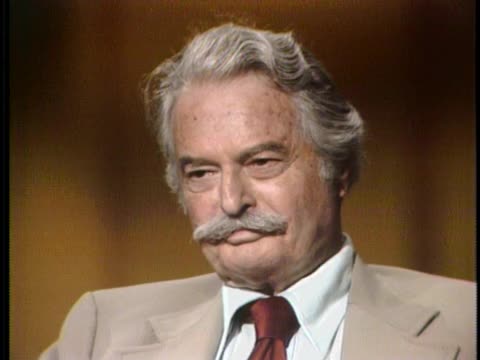
On January 11, 1980, Lon Tinkle gave up a long and quietly spirited battle with cancer. With that graceful capitulation, this country lost one of its best writers, one of its truly superb teachers, and one of its most lucid and trenchant critics. Lon Tinkle had a healthy view of what he wanted to do with his own talents, but his energy was not turned only inward. He lived with elegant pervasiveness in the house of the mind. He was fascinated with ideas, particularly as they related to literature. In his pursuit of them, his loving concern with a state of literature and his vigorous optimism about its future brought him recognition from all over the world.
It is a book which will miss him most. A part of his heritage was French, and his life was cup-out, but his roots and his heart were in Texas. He worked and taught and traveled in other places, New York, Europe, Africa, but only for given periods. The source of his energy was in the Texas Earth. It is a familiar paradox in this part of the country, that mixture of old and new, but seldom has it been more valuable exemplified than in the life and work of Lon Tinkle. Though already ill, he worked with stubborn determination to finish his last book, a biography of his longtime friend, J. Frank Dobby. From the occasion of its publication and the festivities surrounding that event in September of 1978, he was a guest on swank-in-the-arts on KERA TV. We would like for you to see that program again.
Yes, I was born right here in Dallas and grew up in North Texas. My father, my grandfather, was a rancher farmer in Rockwall, Texas, only 30 miles north. And my great-grandfather founded the Rockwall, and I grew up in Dallas in O'Clair. My father loved nature of everything else, and he felt that O'Clair was the most beautiful area in Dallas, and some of it is indeed. He loved like Frank Dobby to be self-sufficient and to live off the land if possible, but he had this tremendous love and feeling for nature, and for things that grow and that you make grow, he gave him a creative sense. And I suppose all his sons picked up from my father that this great love of the outdoors, in this sense that we belonged in it, that if you just walked on the soil, something
came up in through your feet into the whole personality. I had three great loves in my life, and not one of them has been work. The first was tennis, and I aspired to be the best tennis player in the United States. I would go to the public library and get out books on tennis, I really studied it, and it became the junior champion of the state when I was 17 years old, and I nearly became a tennis bum, and then my second great love was the City of Paris, which I loved more than I loved any human being for about 10 years. It's hard to explain. There was nothing about the rhythm, the tempo of Paris. Above all, I think, and you will be sympathetic to this, the sense that there is more than one kind of excellence.
My third love was when I went to Mexico City to interview Diego Rivera for the Southwest Review, and I met Maria through mutual friends, and decided the moment I saw her and immediately experienced this was the moment with whom I want to spend the rest of my life, and so I told her that and took a year to persuade her that she wants to spend the rest of her life with me, that we were married in Mexico City a year later. I believe Longtingle has given up tennis, but he is still very happily married to his beautiful wife Maria, and they now have seven grandchildren. He's still a devoted, frankophile. But not all the lures of Paris could keep Longtingle away from his roots. He absorbed all he saw and experienced, but he came home to use it and to teach. He stayed at Southern Methodist University all of his teaching career, despite interesting offers from several other universities, including Colombia.
The same devotion to teaching, and to Texas, was characteristic in a different way of his great friend, the late Jay Frank Dobey. Once biography, an American original, the life of Jay Frank Dobey, will be published tomorrow by Little Brown. When Lon and I first met, I was a cub reporter on the Dallas Morning News, and he was already working on the paper's book page. He was still in the flush of his Parisian experience. Well, my grandmother was French, of French stock, and spoke French, and made wine. And I was prepared with the sort of adivistic response to love, France, I suppose. It was in the blood. When I first went out, first went over there, right after getting out of college. But likewise, Patsy, when I was just out of college, the left bank in France was in Paris, was flourishing, and everybody who wanted to be a writer, which I had wanted to
be from childhood on, I was a great, just, voluminous reader. Everybody who wanted to be a writer, wanted to get to Paris and meet him in a way and meet Scott Fitzgerald and Eugene O'Neill, and all that group. So the attraction for France for me was double, one, the sort of inherited interest in France. But it was also because everybody from Greenwich Village, and all of the United States, he wanted to be an artist of any kind, was gravitating to Paris back in the 20s and the 30s. And since I wanted to be an artist, that just seemed to be the natural place to go to learn how to live as an artist. I loved Paris, and I tried to stay, had a job on the old, Harold Tribune, his Paris edition. But the depression hit, and I had no income, my father went broke, desperate situation,
he had to cut off sending me any money, and I was getting $60 a month from the Harold Tribune. So I had to come back, and I remember on the boat coming back to New Orleans, how I wondered at the attachment that I had for Paris and for France, and yet was so delighted to be coming back home, and every time I went to Paris there after five or six more times, I would eventually reach the point where I felt the need to take anchor again back in the southwest. Once again, it's this sort of unexplainable, mystical attachment to the land, the soil in which I had grown up. I wish I could explain this. It is simply like I suppose me to all the important things in life, beyond words or reason. Did you always want to be a teacher?
I became conscious of wanting to be a teacher I suppose when I was in college. The way Frank Dobie did, and I had an identical experience there, Frank had a very great teacher at Southwestern University, and Frank said them, started up more grows within his mind, a man who expanded his mental fibers, more than any teacher he ever had in his life. Well, I had some marvelous teachers in high school, but at Southern Methodist University, I had his teacher, the legendary John H. McGinnis, who was not simply a professor of Shakespeare, but an important man off the campus. McGinnis was editor of the Dallas News book page, and he served on the board of the Dallas Museum of Fine Arts. He edited the Southwest Review. McGinnis instilled in his classes, and you had to turn the students away, they thronged to get to McGinnis.
McGinnis simply enjoyed his life so much more that other people with whom we came in contact that you simply wanted to do something. We wanted to imitate him. And you always wanted to stay here and do it, though, you didn't want to do it anywhere else. I have told elsewhere, I've told at Columbia's a guest professor, for example, and there again, I think is a parallel with Frank Dobie, that some sort of attachment to the earth, to the portrait, say, of the Southwestern earth, that kept on drawing me back, something beyond words, beyond reason. Also it was a challenge, Pat Singh. I felt that there was perhaps more teaching to be done in this region, that was not being done, that was true in many other parts of the country. In what way? At Columbia, I had to teach across the hall from the great Jack Bazin, who's well-known in Dallas.
In a rupte, my course, because of the applause that he was getting, every time he would utter a billion sentences, the students would break into applause, as though they were watching Bob Hope in a stand-up routine. Half the time I was drowned out. There weren't many teachers of that stripe in Texas. And that was the sort of teacher you wanted to be? Of course. There was enough ham in me to want to be the kind of success that the barge was. But actually it was a wish to follow a certain kind of lifestyle in which the life of the mind had its proper share. By the way, one of the best books is called The House of Interlect. When I became a teacher, it was partly because I registered the chance to live with books, to live with the ideas.
Well by the time you and I met, you had already come to the Dallas Morning News on the book page. And your life was from that time on, I suppose, divided. Was that a professional wife or a professional mistress? Both, I should say. I was immensely lured, of course, by the chance to write criticism. Under McGinnis, I had been primarily taught in the field of critical analysis and a careful argumentation and of logic and so on. And criticism, unlike, say, creative writing, portrait, drama, fiction, criticism allows you to utilize the tolerance that you have for clear exposition. You don't have to be able to narrate, you don't have to sustain a storyline. You simply have to have a certain kind of momentum of, say, sharp observation from paragraph to paragraph.
But criticism appealed to me, might, because of my instinct for French logic. My training in French culture, French civilization, had made me love clarity and order and coherence. And criticism was just an ideal medium for fulfilling that kind of aspiration. Now, I want to make a point that I don't love those things beyond measure. I realized the importance in life of incoherence at times, of the depths of human experience that are completely irrational, and are deeply and profoundly beyond the grasp of reason, of my logic. Well, did that lead then directly into the writing, because most writers who have had the success that you've had have been writers first and critics later, wasn't yours a rather unusual order?
It is a reverse order, but that is all because people do not know how much writing I did that never got published before I became a newspaper critic or a literary journalist. What I had wanted to be all my life, from the time I was a boy reading and just taking great delight, guffforing it, books that I would read, my grandmother used to stop me and say, well, if it's that funny, read it to me, which I would do, I wanted to be a writer and above all, I wanted to be a storyteller. And I subsidized myself several summers to not teach it, and to try to make it in the field of fiction. I must have written a score of stories before I sold one, and it made so little ripple that I decided that I did not have the talent for fiction, and it's true that I am frustrated and storyteller, but criticism was an outlet and an alternate.
But 13 days certainly was a story, 13 days to glory. That comes, I think, from another side of my training, which was in drama. I was in the drama club at Southern Methodist University and was president of the drama club and then organized the alumni group, and I should say that my first ambition had been to be a writer, my second was to be an actor. The usual thing, people wanting to be what their least equipped or endowed for. I wasn't tall enough to be an actor in the sense in which I met, a John Barrymore. I had a very poor voice. There was no conceivable possibility for me to become an actor, and yet immediately upon graduation from college, my first ambition was to go to New York and try to get on the stage.
Well, fortunately, obviously, that failed. But then I did a great deal of acting with the Dallas Little Theta. I served as vice president of the Little Theta and the chairman of the place selection committee. Then I was vice president of the Margot Jones Theta in the round for about 11 years, and drama has remained one of my central interests. Have you ever written a play, or tried to write a play? Yes, I have. I've written a number of one act plays in my apprentice period when I was trying to discover whether or not I could be a writer and exist as such on as a writer. I did a number of plays. But biography must really have been it for you, Lon, because that's the area where you have found the most success, and I would gather the most satisfaction, is that right? It's quite true, but I think there again, that comes from a limitation in the altered ambition of wanting to write stories.
I have no capacity to invent plots, nor did Frank Dobey. On the other hand, when you're writing a biography, the plot is ready made. You cannot invent. You have to follow what happened. Try it. I don't mean to sound egocentric about all this, I'm just outlining the fact that I think human beings have so many potentialities, and a good teacher can recognize in a student which way he ought to go, and give direction as McGinnis sent me into criticism. But those three have served you well, and you seem never to have been pulled from one to the other, the writing and the all the rest. I think you can do a great deal in tandem, many people do. One of my favorite artists is unfashionable to admit this was, of course, anger. I used to stand as a louvre for hours before the celebrated painting of that beautiful
young maiden with her earned, dropping, dripping water over her shoulder and her pool in which she was standing, the one called Last Source, The Fountain Head, anger. And above all else to be admired for his violin playing, as you know, the famous angriest violin, there are many examples of that in art. Well let's turn for a minute now to our friend Frank Dobey. We were lucky, we knew him, but for a lot of people who didn't know him, this is the way that the teacher, the writer, the cowboy Frank Dobey looked. We've been talking to some degree about the parallels between you and Frank. You both were born teachers, you both love the outside world, but you love Texas best. And both of you had a strong, strong streak of the poet.
But I never thought of you as any kind of a cowboy, Lawn. How did you happen to ride this book? I indeed, another ambition of mine, as a child, of course, was to be a cowboy. But my grandfather was a rancher farmer, and I spent my boyhood on horseback. And I still remember how I would, for entertainment, ride bareback without saddles, you know, with other boys of my age. And we would play games pretending that we were cowboys. Well, did that lead you into Frank, or was it the friendship over the years? How'd you happen to do an American original? I think that the real affinity between Frank and myself was this feeling, this attachment to our native land, was something that was profound in both of us, by profound, I mean, very deep rooted.
We had this deep running, as Paul Horton says, love of one's native soil. And I suppose it was that more than anything else. Well, as I remember, wasn't Bertha going to do the book, or was there some talk of Bertha doing it, or Frank completing an autobiography before he died? Frank wanted, above all else, Patsy, to write his autobiography. This would have been the master of work. Frank's first period of writing, Karinata's children, Apache Gold and Yaki Silver, Tongues the Montianse On, was a period of celebration of the past, of the Southwest. And then in his second stage, after he had been to England, he had taught it as a guest professor at Cambridge, where he was scared to death. He boned up and kept one day ahead of the students. He was a tremendous success. But after that, Frank became an enlightened polemicist, a liberal in Texas, advocating long before the churches of the government advocated desegregation.
Frank was fighting for equal rights for him, in education for all citizens. After the stage of what I'm calling enlightened polemics, Frank wanted to write his autobiography. And he wrote many chapters of it, a chapter on his mother, chapter on his father, chapter on his college days, and so on. But he never got beyond because of ill health, the time when he started writing books and publishing books. But he wanted to do this in consequence in the book which he asked me to do in his will. He asked for me to beam the liberal executor of his estate with his wife, Bertha. And he asked for me to write the autobiography, if I would, of course I would. I have tried to let Frank write his own autobiography by using an enormous amount of quotations from his correspondence, from his writings, and from the autobiographical notes that
he would drop into boxes to keep. But the interesting thing about the book to me, and I realize very clearly as I read it, what you were doing, there is a very helpful side of it in which you look at Frank not only as a friend but as a critic, which to me gives an enormous depth to the book because you see him as it would have been impossible for him to see himself. That is one virtue, but there are other virtues, however, that the autobiographer has. He knows much more than the biographer, provided he wants to tell it. But I do think that a certain asset in detachment, Frank was a man characterized above all else by attachment. He was so terribly attached to Texas, and to Mesquite Trees, for example, to the concrete things in his experience, like why Mexican prim roses, and to having statuary on the address to Texas campus would be characteristic of the state.
What do you think the book, of course, ends, your book, ends when Frank died? Yeah. 1964. 1964. All the things that he cared about, the values that he held so strongly, how do you feel those have been affected by the turmoil of the 60s, which he didn't live to see? I think they've been greatly affected. Frank was, like nearly all Americans of the 19th century, born in the 19th century, a child of the French and the American revolutions. He believed above all else in democracy, as the kind of faith and the perfect ability of humankind, gradually, through universal education and through the advance of knowledge of knowledge and of science. Therefore he was an optimist. He really felt that life could be steadily better, and I'm afraid I think so too. I think indeed it is being steadily better than the civilized.
Is that your considered opinion from where you stand looking backward as far as you are now able to look? Yes. It is. It doesn't 100% adherence to this notion. But if you take a balance, I think that life nowadays yields more pleasure. People who are alive by a great deal than it did say 100 years ago. There are more people who have had the advantages of education, or who have had the advantages of the technological revolution, or who can watch television and become inhabitants of what Macleurean, who has been a guest of years, I think, Marshall Macleurean calls the global village. And of course, half an hour we transported from Syria to China, or to Japan, or to South America, to Nicaragua currently. And I think the possibilities for the knowledge explosion have been immensely increased since
I was a boy. What's next on your schedule? What project do you go to next? Well, now I'm going to try to do what Frank Dobie did not do. I want to write my memoirs. A book that you could write yourself passing will be called, and I get the title from John Rosenfield, who didn't live to write his autobiography. John wanted to write a book about his experiences in the cultural field, in the southwest, to be called Memoirs of a Midwife to Texas Culture. They decided to maybe better change that memoirs of an intern to Texas Culture. I'd like to appropriate that title, and write about the changes that seemed to have occurred since I was a boy. Well we will certainly look forward to that soon, I hope. I'm so glad you came today, thank you.
Thank you, Patsy. This beautiful book is among La Tinkle's most prized possessions. It is from a special printing of Lamy of Santa Fe, a book which won a Pulitzer Prize for its author, Paul Horgan. Thank you. .
. . . . . . . . . .
. . . . . . .
- Series
- Swank in The Arts
- Episode Number
- 126
- Episode
- Lon Tinkle Retrospective
- Producing Organization
- KERA
- Contributing Organization
- KERA (Dallas, Texas)
- AAPB ID
- cpb-aacip-c0b9168ec61
If you have more information about this item than what is given here, or if you have concerns about this record, we want to know! Contact us, indicating the AAPB ID (cpb-aacip-c0b9168ec61).
- Description
- Episode Description
- Lon Tinkle interview - Julien Lon Tinkle was a historian, author, book critic, and professor who specialized in the history of Texas.
- Series Description
- “Swank in the Arts” was KERA’s weekly in-depth arts television program.
- Broadcast Date
- 1980-01-22
- Created Date
- 1980-01-21
- Asset type
- Episode
- Genres
- Talk Show
- Topics
- Literature
- History
- Subjects
- Historian, author and teacher, Lon Tinkle; Texas History
- Media type
- Moving Image
- Duration
- 00:31:28.662
- Credits
-
-
Director:
Parr, Dan
Executive Producer: Howard, Brice
Interviewee: Tinkle, Lon
Interviewer: Swank, Patsy
Producer: Swank, Patsy
Producing Organization: KERA
- AAPB Contributor Holdings
-
KERA
Identifier: cpb-aacip-fa186142dca (Filename)
Format: 2 inch videotape: Quadruplex
If you have a copy of this asset and would like us to add it to our catalog, please contact us.
- Citations
- Chicago: “Swank in The Arts; 126; Lon Tinkle Retrospective,” 1980-01-22, KERA, American Archive of Public Broadcasting (GBH and the Library of Congress), Boston, MA and Washington, DC, accessed October 14, 2026, http://americanarchive.org/catalog/cpb-aacip-c0b9168ec61.
- MLA: “Swank in The Arts; 126; Lon Tinkle Retrospective.” 1980-01-22. KERA, American Archive of Public Broadcasting (GBH and the Library of Congress), Boston, MA and Washington, DC. Web. October 14, 2026. <http://americanarchive.org/catalog/cpb-aacip-c0b9168ec61>.
- APA: Swank in The Arts; 126; Lon Tinkle Retrospective. Boston, MA: KERA, American Archive of Public Broadcasting (GBH and the Library of Congress), Boston, MA and Washington, DC. Retrieved from http://americanarchive.org/catalog/cpb-aacip-c0b9168ec61