Dedicated to Serve
- Transcript
This is the Nebraska Educational Telecommunications Center. Its construction marks the beginning of a new era for ETV in Nebraska. It is one of the great milestones of an institution that has spent over 17 years dedicated to serving the Nebraska public. Educational TV began in Nebraska in November 1954 when KUO NTV began operating from the studios of a commercial television station in Lincoln. You know, it's been said that television is a pipeline to everywhere. A pipeline to the best in the arts, in literature, in music, in agriculture, and other fields. We here at the University of Nebraska, together with Mr. John Fetzer, will be teaming up to keep
outstanding programs moving into this pipeline. These programs will originate not only on our own campus, but from other great universities throughout the world. In so doing, we will focus our attention on the best in education. Certainly, this should be a most satisfying experience for all of us. And at the same time, provide a real laboratory for training of students in television production and television programming. From that time on, KUO N and the Nebraska ETV network were constantly on the moon. In 1957, a cafeteria in the Temple Building on the University of Nebraska campus was converted into a studio. Practically, all programs were broadcast live until 1959, when the first videotape machine arrived on the scene. Before that, the only recording device owned by KUO N was a kinescope. Because of cramped quarters, it was necessary to store scenery
and props in Nebraska Hall. ETV was beginning to spread out. In 1963, the legislature enacted a bill which created a statewide ETV network and appointed a commission to carry out its provisions. Money, appropriated by the legislature, along with federal funding, went toward construction of the current nine station network. Office and storage space became even more of a problem. During the Howling Blizzard in 1964, the Art Department, Information Department, Engineers, Directors and Teachers moved offices around the corner from the Temple Building to a former grocery store and barbershop. The following year, administrative departments moved into three old houses at 16th and R streets. Life in these old structures was humorous, if not downright disastrous. Soon after the buildings were occupied, sores backed up and the floors began to buckle and squeak. Flash flooding in the art department brought on by rain caused cabinets to burst open and
furniture and supplies had to be set out on the street to dry. In 1966, the attic at 1610 Harstreet was declared unsafe for more than two people at a time because it caused plaster to fall on people working below. Progress continued despite faulty buildings and poor working conditions. In 1966, a remote studio on wheels, Big Red, was purchased and garage space was leased near the state fairground. In 1965, Nebraska Video Nursing was established to provide programs for nursing schools in Nebraska and Western Iowa. And the Nebraska Educational Television Council for Higher Education was organized to provide college level programming. With the expansion of the Great Plains Television Library, more videotape machines were added, forcing the need for even more space. By 1969, network agencies were spread over nine different locations, including the Seaton Hall Dormitory and Old Printing Office and a section under Memorial Stadium. Despite being spread out in numerous
locations, the Nebraska ETV staff remained one big family. Everyone shared in the humorous calamities had seemed to occur all too often. The radiators in 1600 flooded when turned on and the radiators in 1610 wouldn't turn off. Windows were often left slightly open in the dead of winter just to get some fresh air. In 1970, an overanxious garbage truck driver accidentally backed into the garage at 1600R, it collapsed into a pile of rubble. Some of the more serious casualties caused in part by the dilapidated conditions of the buildings, included broken wrists, a fractured foot, and sprained ankles. While Nebraska ETV was constantly expanding and on the move, there was always the hope of combining everything under one roof. In July 1967, the idea became more than just a dream when the legislature passed LV922, a bill sponsored by Senator Terry Carpenter, authorizing funds for the planning
and designing of a state telecommunication center. Later in March, the ETV commission contracted with Omaha Architects Henningson, Durham, and Richardson for a building design. In December 1968, the design was completed. It called for a six -story building at an estimated cost of three and a half million dollars. It was to be one of the most modern facilities of its kind in the nation. Construction would be financed through issuance of revenue bonds by the city of Lincoln, as authorized by the legislature. Specifications were let out for bid, the ball was rolling. On February 5, 1969, bids were opened at the Nebraska Union Ballroom and contracts were awarded. A general building contract was awarded to Kingery Construction Company of Lincoln. ABC Electric received the electrical contract, a mammoth job because of the thousands of watts and miles of cable required, for four television studios and their lighting systems. That couldn't company receive the mechanical contract, and O 'Keefe elevator was hired to install the two
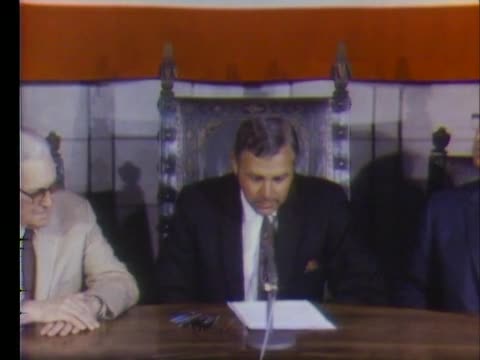
elevators needed to haul passengers and freight, two floors below and three above ground. On August 25, 1969, the legislature passed LB -65 authorizing the city of Lincoln to finance construction of the building through revenue bonds, three days later, Governor Norbert team ensign the bill into law. Gentlemen, I would like to make a comment or two about the signing of LB -65, which was introduced by Senator Carpenter of the 48th District, authorizing contract with the city of Lincoln, the Nebraska Education Television Commission for Building of Facility, which has been desperately needed for so many years. In the use of Senator Carpenter, I want to commend you on your splendid leadership in achieving this thing, which is not long ago, with almost virtual impossibility or looking possible. And to get hold of 40 to one, that's a pretty good majority, you know, that's even not even eligible for a veto.
Lisa agreements were drawn up, and on December 15, 1969, contractors and members of the ETV commission met in the office of Mayor Sam Swartzkov to make them official. And all I can say for the city of Lincoln is the fact that we are very happy to be able to participate in a venture like this and have this ETV building in our city. We have more of this intergovernmental cooperation on our levels. I think we'd have a much better place than Mr. Leop. On January 7, 1970, the temperature dipped to five degrees below zero. Windchill was 46 below. Despite frozen ground and shivering spectators, groundbreaking ceremonies took place on the new site just north of the Nebraska Center for Continuing Education. Speeches were made and shovels of dirt were tossed, symbolizing the beginning of construction. Moments later,
bulldozers moved in to begin the real work. A hole resembling a miniature Grand Canyon was dug deep enough for a foundation and the two floors below ground level. Within months, a seven -story crane was planted in the middle of the hole and the building was constructed around it. Framework scaffolding and concrete began to form the first two sub -floors of the structure and by June of 1970, the ground level floor peaked above the hole. Specifications called for a six -story building of reinforced concrete and buffed brick. Four studios, the largest being 60 by 100 feet, required sand -filled walls for sound -proving. Studio floors needed to be smooth and perfectly level and ceilings had to be strongly reinforced to support the heavy lighting system.
Music Circular staircases would give quick access from talent rooms to studios and technical areas. A complex air conditioning system was needed to create an environment for peak performance of all studio and electronic equipment. Music 13 ,000 volts of power would eventually flow through 23 miles of cable for the
studio one lighting system. Music 13 ,000 volts Music 13
,000 volts Music 13 ,000 volts Music 13
,000 volts Music 13 ,000 volts
Music 13 ,000 volts Music
- Program
- Dedicated to Serve
- Producing Organization
- Nebraska Public Media
- Contributing Organization
- Nebraska Public Media (Lincoln, Nebraska)
- AAPB ID
- cpb-aacip-953b77d4cb6
If you have more information about this item than what is given here, or if you have concerns about this record, we want to know! Contact us, indicating the AAPB ID (cpb-aacip-953b77d4cb6).
- Description
- Program Description
- Program looks at the history of Nebraska's public broadcasting station, KUON / Nebraska Public Media.
- Created Date
- 1972
- Asset type
- Program
- Genres
- Documentary
- Rights
- Access to material from Nebraska Public Media’s archival collection is for educational and research purposes only, and does not constitute permission to modify, reproduce, republish, exhibit, broadcast, distribute, or electronically disseminate these materials. Users must obtain permission for these activities in a separate agreement with Nebraska Public Media.
- Media type
- Moving Image
- Duration
- 00:15:19:12
- Credits
-
-
Producing Organization:
Nebraska Public Media
- AAPB Contributor Holdings
-
Nebraska Public Media
Identifier: cpb-aacip-29705f28b87 (Filename)
Format: Betacam: SP
Duration: 00:14:21
If you have a copy of this asset and would like us to add it to our catalog, please contact us.
- Citations
- Chicago: “Dedicated to Serve,” 1972, Nebraska Public Media, American Archive of Public Broadcasting (GBH and the Library of Congress), Boston, MA and Washington, DC, accessed October 8, 2026, http://americanarchive.org/catalog/cpb-aacip-953b77d4cb6.
- MLA: “Dedicated to Serve.” 1972. Nebraska Public Media, American Archive of Public Broadcasting (GBH and the Library of Congress), Boston, MA and Washington, DC. Web. October 8, 2026. <http://americanarchive.org/catalog/cpb-aacip-953b77d4cb6>.
- APA: Dedicated to Serve. Boston, MA: Nebraska Public Media, American Archive of Public Broadcasting (GBH and the Library of Congress), Boston, MA and Washington, DC. Retrieved from http://americanarchive.org/catalog/cpb-aacip-953b77d4cb6