Eyes on the Prize II; Interview with Jean McGuire
- Transcript
So I want you to tell me about your first teaching assignment in Boston, 1960s, the Weasemail Club School, what were the physical facilities, what we should class like, and maybe you could wind up by telling me about the music book that you were given to teach from. I remember going in as a student teacher to a number of schools in Boston, including the Dwight and the Farragut and the Tobin, but my long-term assignment was at the Weasemail Club, built in 1842, doors open directly onto the streets, under the Assistant Principleship of Doris Warner, who had been a member of St. Prathal and his church in Cambridge. And I trained in the third grade under Doris, and then I learned to do teach first and second grade from a wonderful first grade teacher named Jewel Vanderhoop, and one of my first
students was Mel King's daughter, Judy King, who's now a daughter in Chicago. My class had 42 students and 36 seats. We didn't have enough paper and soap and crayons and scissors. We just, everything was old, used, and not enough of it. And the books were old, they were 19, 20, Scott Foresman, where the boys had dresses on with smart tops and little Mary Jane shoes with socks that hung down at the ankles. And the stories were of a time gone by, and of course there were no children of color in there whatsoever, no Asian children, no Hispanic children, such as I had in front of me. And it was noticeable to me as a teacher that there weren't any references to the larger life that was these children's experience. And we had what we call wrote music books. And then we had some other music books which were very old. I think they were published in 1903 and 1904.
They had Victorian clothes and hairdoes, sort of like the original Wizard of Oz books, Oz Mavaz, The Wild Witch of the West, and stuff like that with hairdoes. And here was this book I found which had the word niggers, and it's ten little niggers sitting on a fence, nine little niggers playing in a line. And it was just like ten little Indians, nine lignus, and it was very offensive. And it was very upset that that kind of book was in the classroom and had been there for all these years, because these were old books. And I must have had about 25 or 30 in my room. They were dark green covers, and I collected them all, and I went around to other teachers in the primary grades to see any of you have any of these books. And of course some of them did. They had bits and pieces. I must have had a complete set. And I collected them all, and I took them to the NACP, and I said these are offensive. My principal said, well, just don't use them.
She said, and a lot of people don't use them. They just use the wrote song books. But these books had music in them, you know, with the G clef and F clef, and I wanted my children to learn how to read music. It was all I had. It was indicative of the state of affairs that was in Boston and probably the rest of America then. People accepted Little Black Sambo without comment. And I don't think you have to censor a book like that, but I think you have to use it as a teaching tool. So then, what was the quality of the education like for a black student in Boston in the 1960s? I just need to stop one more. Yes, speak. Mark. Take nine. Okay, so speaking as a black teacher, what was the quality of the education provided for black kids in the 60s? It was probably the same in terms of offerings as what was offered other children in the school system. I'm sorry, do you give this a complete sentence? Yes. I mean, repeat the question. Okay, I understand. The quality of the education that was offered black children was probably pretty much the same
in terms of content as what was offered other children. There actually weren't that many black children in any one classroom except in a few schools like the one in which I taught the Louise May Alcott because many of the schools except for the hide and the average and the Sherwin and a few others were sort of mixed. I mean, neighborhoods weren't completely segregated but there was enough mixture so that you didn't get a completely different education as you do under other segregated situations. What was missing was that in many ways education was somewhat rigid. I didn't mind it being old-fashioned since I felt that much of the literature and many of the offerings were absolutely necessary for children to have but they were very narrow and focused. It was probably the primary version of major British writers and you did everything as the teacher. You taught music. You taught art. You taught physical education.
You took the kids out to recess. You ate lunch with them. You helped them put their coats on. You wrote notes to their parents. It was not a time when you had teacher raids and we had no audio visuals. We had DC current in that school. We didn't have enough line paper. The school smelled of a hundred years of peanut butter and salami and bread and bananas and oranges. The stairs were worn down. So I want you to go back in time, your beginning teacher, 1960, give me the litany that you were just giving me of what you didn't have to worry.
If I can remember, the thing that hit me the most when I came in was the dichotomy between what I had seen as a student teacher and at the present doing some graduate work where I went out to Tufts and to be you and took courses to further my master's was that this school didn't have so many things that I thought we should be taking for granted. It didn't have primary type writers. We didn't have new crayons. We had a box of old nubbly crayons. Pencils had to be collected at the end of the day so you would have enough for the children for the next day. There was enough white paper. The yellow paper was brown on the edges. It had been stored and saved and hoarded so there would be enough. And primary line paper was very hard to come by. We didn't have a record play because we had DC current. We didn't have a tape recorder. We didn't have a music teacher to come in. There were no music lessons. I brought a flute of phones for the parents who couldn't save up a dollar and we used to play music on the flute of phones so I could teach music. There were no science labs. There was no gymnasium. And the yard was so small it was a size of maybe a large classroom, one for the boys and one for the girls.
You couldn't do run games, duck duck goose and name ball and things like that where you stood in place. But you couldn't play tag or have relay races or other things that were in the curriculum. There were no other kind of art labs or jewelry classes or anything you would see in a school like Shady Hill where there's really wonderful facilities for children. There were just so many things that would have made life for the teachers and the students so much more exciting and so much more meaningful. And then of course our schools in many parts as you were very crowded, particularly in the areas where blacks were complaining about the need for changes. There were books like Little Black Sam ball, there were no pictures on the wall, anything that would let you know there were anything but white people in America. We had to read the Bible in school then. And it was a Catholic Bible and because I had Chinese and Asian kids and kids from different religions I used the Old Testament and stories like Esther and Ruth and Daniel and Lyons and then in Proverbs and so on. Things that were literature to make it great, we got it.
Take 11. Just need that one for me. So can you give me that topic sentence? Here I was a brand new teacher coming into my first teaching experience and I walked into this old building built in 1842, named after a wonderful New England writer, Louise May Alcott and I had 42 students, 36 seats and had to set the kids at the kidney reading table and not enough of anything to make an easy teaching experience. And that was my entree to a school system that I had attended during 1938 and then again and during the war in 1943-44 when I had orchestra and music lessons from Vincent Salker and French class and cooking at the Durban school, it was all gone. Great. Good. Wonderful. I want you to tell me about the quality of the leadership that white elected officials provided as a desegregation process was underway.
It was almost totally lacking. Basically those who were pushing for access to the city's resources for their children were going in a loan so to speak and that created in people a great deal of uncertainty as to whether or not city officials and city line departments like police and fire would perpetuate what had happened in the South. I think in everybody's minds there was the picture of the water hoses being used against civil rights activists and the police setting dogs against people and civil rights demonstrations in many states in the South and the deaths of many college students at Florida, state and Jackson, state, long before a Kent state. And so here we were in Boston with a man attacked in the South Boston, a young Haitian worker who in a mindless way was attacked by people who had not been provided the kind of assurance that this was a city for all the people of Boston and that the 14th Amendment guaranteed access to everyone in America, not just certain people of a certain color, a certain class
or a certain neighborhood, but this city should have been open to everyone and it wasn't and it was that fear that if you stepped out of your place you could be attacked. There was no leadership that said it's off limits. You can't have an open season on people because of the color. And I think that carried over very clearly to young people and to teachers and I think there's a certain legacy which is still here where people feel embittered by issues which were not explained, which were not discussed, for which there was no public discourse or dialogue around affirmative action, around curriculum change, around multicultural curriculum. I'm going to interrupt you because we're not going to travel back to the present life. But what could elected officials have done that they didn't do? Well, basically one of the things that Ruth Batson and Paul Parks and Mel King and many other leaders, El Malua's were asking then were the things that we knew made for appropriate responses during school integration and they were the things that changed the atmosphere and the climate within the building and within the community.
You have to understand what people bring with them in terms of baggage that you have to get rid of. None of that was discussed. Decegregation took place without discourse between teachers and districts, between parents and teachers, between book suppliers and people who supplied this school system with teachers, say the universities. It just like happened without any leadership to prepare the way. There were no round tables. There were no ford hall forums. There were no in-service meetings where people discussed the need for. If you're going to put black and white kids together, what would you want if you were integrating a few white students into an all-black school system? Where would you have looked to for that kind of leadership? From the mayor, first of all, a person who's a leadership in the city, from your city councilist, from your state representatives, from the governor, certainly from the federal government if that was necessary, but your local leadership is empowered to protect all the citizens of the city and if you can't protect your children, you're highly suspect in the minds of the public.
Yes. I want you to bring it down to home a little bit. How did you personally feel? You've been a resident of this city, the city that's called the cradle of liberty. How did you feel watching all this go on? Basically, I listened to most of it. I didn't have a television then, so I depended upon the print media, newspapers, and my actual experiences then having been in the system in the years prior to desegregation and then being director of Meco, where our buses, which were rolling as they had since 66 out to the suburbs, were catching much of the response to school desegregation because the yellow bus was seen as an enemy. Often by children who didn't know, I mean, even black children didn't understand that the bus was carrying their brothers and sisters too, and sometimes they would throw stones at them. But basically, we found that people would sometimes attack buses or go buy you, make obscene justice, adults and cars, to the children and to the drivers, and you felt naked. You felt unprotected by that public environment, which you as citizens say is for us.
I mean, you know if you have a fire, the firemen are going to come. You know if there's a need for a public safety, the police will come, or the state police, or whoever, the sheriff, whatever, you know they're supposed to be there for you. We did not feel that public government was there for us. We felt very much alone, except for a few people who provided leadership and who joined with us. And we often considered pariahs by whites in their own community. It took a lot of healing to heal up the wounds that didn't need to be open in the first place. Great. Good. Take 13. Now, I want you to remember not to come into the present, speak from back then, and tell me if you felt that what the black community was going through was worth it. I felt that what took place absolutely had to happen. It may not have had to happen that way, if they had been a different kind of leadership
provided by white boys, donions, of all classes, and all neighborhoods. However, once labor starts, it doesn't stop, and the baby must be born, and there is no turning back. And once you get caught up in the overarching feeling that that aspect of the two-century long civil rights movement, you couldn't step outside of it. It was in conversations at the supermarket, at the streetcar stop on the bus in church at the hairdressers. It was something the black Americans talked about all getting our rights. We'd gotten rid of legal segregation. We'd gotten rid of public accommodations being segregated. We were fighting for access to jobs. Once the door is open, people pour through. You can't turn back the clock. It was worth every minute of it, because you must go forward. I think that when you are the anvil you bear, and when you are the hammer, you strike, and we were striking, and there was no turning back.
Great. Cut. Good. Speak and mark. Take 14. Okay. So I want you to speak as someone from Boston's formerly timid black community to the process of self-definition that was part of this whole bigger process. I feel that my memories bring back to mind that although there was fear out there, whether you'd lose your job if you organized, people began to redefine who they were to change their name. You know, I asked Jesus if I could change my name, and he said it would be all right if I changed my name. That was a very painful experience. Black teachers organized at the NECP office in 1961, the beginning, people concerned about desegregation, and continued that process by organizing the Massachusetts Negro Educators Association, and then later on the Black Educators Alliance in Massachusetts. But in an overarching way, there were new organizations, SNCC, and CORE, and all kinds of groups, say even like the back Panthers, Tutorial Groups, the Fort Hill Mental Health
Chapter, formed by Barbara Elam, where people said, this is what we need.
- Series
- Eyes on the Prize II
- Raw Footage
- Interview with Jean McGuire
- Producing Organization
- Blackside, Inc.
- Contributing Organization
- Film and Media Archive, Washington University in St. Louis (St. Louis, Missouri)
- AAPB ID
- cpb-aacip-924c516780b
If you have more information about this item than what is given here, or if you have concerns about this record, we want to know! Contact us, indicating the AAPB ID (cpb-aacip-924c516780b).
- Description
- Raw Footage Description
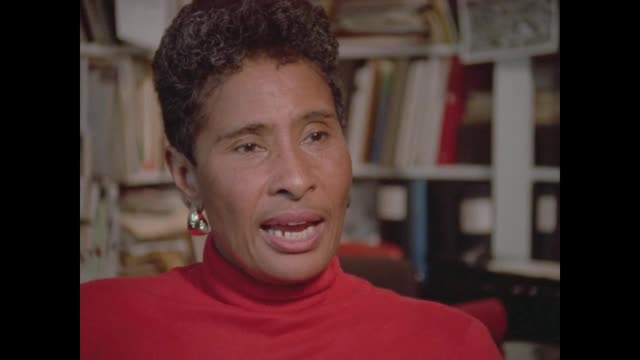
- Interview with Jean McGuire conducted for Eyes on the Prize II. Discussion centers on her experience as a primary school teacher in Boston in the early and mid-1960s in Boston.
- Created Date
- 1989-09-29
- Asset type
- Raw Footage
- Topics
- Race and Ethnicity
- Subjects
- Race and society
- Media type
- Moving Image
- Duration
- 00:17:07:35
- Credits
-
Interviewee: McGuire, Jean Bernice
Interviewer: Shearer, Jacqueline
Producing Organization: Blackside, Inc.
- AAPB Contributor Holdings
-
Film & Media Archive, Washington University in St. Louis
Identifier: cpb-aacip-f925b13bf4c (Filename)
Format: 1/4 inch videotape
If you have a copy of this asset and would like us to add it to our catalog, please contact us.
- Citations
- Chicago: “Eyes on the Prize II; Interview with Jean McGuire,” 1989-09-29, Film and Media Archive, Washington University in St. Louis, American Archive of Public Broadcasting (GBH and the Library of Congress), Boston, MA and Washington, DC, accessed June 5, 2026, http://americanarchive.org/catalog/cpb-aacip-924c516780b.
- MLA: “Eyes on the Prize II; Interview with Jean McGuire.” 1989-09-29. Film and Media Archive, Washington University in St. Louis, American Archive of Public Broadcasting (GBH and the Library of Congress), Boston, MA and Washington, DC. Web. June 5, 2026. <http://americanarchive.org/catalog/cpb-aacip-924c516780b>.
- APA: Eyes on the Prize II; Interview with Jean McGuire. Boston, MA: Film and Media Archive, Washington University in St. Louis, American Archive of Public Broadcasting (GBH and the Library of Congress), Boston, MA and Washington, DC. Retrieved from http://americanarchive.org/catalog/cpb-aacip-924c516780b