West of The Imagination; 104; The Wild Riders; Final Version
- Transcript
I heard of an Eastern girl that asks her mother, Ma, says she, to cowboys eat grass. No deer says the old lady, they're part human. The great cattle drives and the men who work them existed only briefly in history for just two decades. But Frederick Rammington and Charlie Russell captured the life and times of the cowboy. He has exploits, real and imagined, and made him an epic figure in the saga of the West. This program is made possible by the NELDA-C and H.J.
Lutcher's Stark Foundation, owner and operator of the Stark Museum of Art in Orange, Texas, and NELDA-C Stark. One of the most enduring characters of the Old West
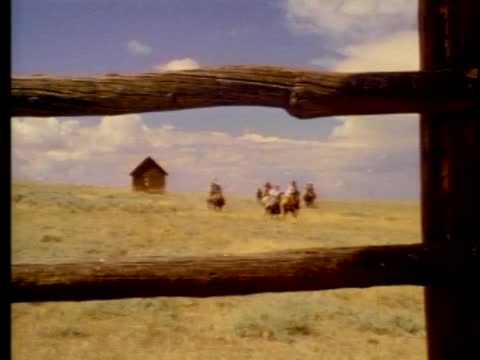
is the cowboy, man and horse together on the open range. This is the story of two very different artists, Frederick Rammington and Charlie Russell, who portrayed the American cowboy in his own time and created a legend. In bronze, in cobbler's illustrations and on canvas, Frederick Rammington presented a world of frontier action
and violence populated by what he called men with the barcom. Rammington's characters were tragic heroes, men who raced with death at high noon, or drew the line and made their last stand on a parched and desolate ground. Though he lived at the same time as Rammington, Charlie Russell's view was quite different. His people are a genial, friendly crowd. Their world was a small cow town saloon, where good times and tall tales counted for more than high drama. Russell himself lived in this world. He was a working cowhand for 11 years, and he could easily have fit right into some of the whimsical outrageous scenes he painted.
The great cattle drives and the men who work them existed only briefly in history for just two decades. But Frederick Rammington and Charlie Russell captured the life and times of the cowboy. His exploits, real and imagined, and made him an epic figure in the saga of the West. Rammington was the only son of a well-to-do newspaper publisher in a small, respectable town in upstate New York. After several dismal boyhood years in a military academy, he disappointed his parents by insisting on enrolling in the Yale School of Fine Arts.
Of course, Yale was a respectable place, even in those days. And it did have a very respectable football team of which young Frederick became a valued member. But his choice of studies could not possibly lead to a respectable profession. Rammington himself had his doubts, particularly after his first taste of tedious lectures on anatomy and drawing that went something like this. You see it, gentlemen. You see it. Align may break upon us with the angular flesh of lightning, or it may create an impression of perfect unity, even before we are conscious of a single image. Rammington's only other classmate in first-year drawing was the sophisticated but irreverent, Poltny Bigelow. Bigelow observed that these lectures
seemed especially designed to dampen the art of anybody Michelangelo. It would be easy to accumulate examples from many artists. Their professor was a famous German classist who insisted that his students could only learn by sketching plaster casts of Greek sculpture. This was not entirely to Rammington's taste, and he was known to indulge his own imagination when the professor wasn't looking. The great pain to unbelieve the study of lime was so important that he often insisted that his students do nothing but draw. Drawing, he said, is the probity of art. And that is what I expect you to recollect as you make your sketches. Yeah? Rammington actually learned much here that would prove useful, but he always dreamed of being and belonging someplace else.
Some place else was a Kansas Prairie, in the year 1883. Rammington went west, shocked all pretensions of respectability, and together with a few comrades and arms tried his hand at sheep ranching. There were also Jack Rapids. In the three years that followed, young Fred squandered his inheritance and generally affected the role of a swashbuckling frontier character. Rammington was no cowboy, and this
was not the romantic west of his dreams. But it was during these years in the 1880s that he began to develop his peculiar vision of the west. A vision that he would track with dogged perseverance for the rest of his life. To Rammington, these vast open spaces seemed like a stage waiting for action, a blank page waiting to be filled. Rammington's first credited illustration was called the Apache War, Indian Scouts on Geronimo's Trail. It appeared in Harper's Magazine in January of 1886. Three months later, he was back in school at New York's celebrated art students' league. In painting, as in pistol shooting, the whole object is to pay attention to the object being aimed at. Keep your finger gently on the trigger, making it close slowly, deliberately, imperceptibly, like fate.
Some of the greatest artists of the day lectured at the league. There was a spirit of freedom and innovation here. And Rammington now had a clearer sense of what he lacked and needed to hone his talent as an artist. Work simply, but get what you want. Chris Cross it, sit on it, pour an out bottle over it. Only get it. If the line is straight, make it so as nearly as possible at once. Working simply and decisively was not only the key to painting, but the successful illustration. Every line counted. It was an understanding of this, economy of line, Terce Crisp and full of energy that enabled Rammington to launch his early career as a popular magazine illustrator. He got his big break from Century Magazine,
64 pictures for the serialized story on the Western adventures of Teddy Roosevelt, called Ranch Life in the Hunting Trail. But something else that was taught at the league was to hone Rammington for his entire career. They palette and brush down and ask as if your life depended on it what is the color. Color. Throughout his life, Rammington wanted to paint in color, but he became known first as an illustrator in pen and ink. In spite of this, he struggled and persevered with the painter's palette. His first success in color came at age 26. When he submitted this painting to the prestigious National Academy of Design,
return of a Blackfoot War party, received critical acclaim. The composition of interlocking figures was to evolve in the artist's work until, in dash for the timber, he felt he'd truly found his form. Arrayed in a dynamic freeze, his riders and horses hurtling through space seemed a far cry from the awkward sketches he'd first drawn for Harper's. The New York Herald proclaimed this, marked the advance of one of the strongest of our young artists. By 1893, Frederick Rammington had grown formidable. Both in sheer bulk, he now weighed 263 pounds and is the foremost illustrator of the day. Amid his forays in the West,
he encountered in Yellowstone National Park, a talented young Philadelphia author named Owen Worcester. Their meeting in this bizarre setting marked the beginning of one of the most remarkable collaborations of Western literature and art. Rammington still had his abrupt swashbuckling role to play. Worcester was a nervous young man whose neurologist once prescribed annual visits to the West. They made an unlikely pair, but out as it may seem, they needed each other. Public interest in traditional Western stories was now showing signs of falling off, and with it, the demand for Rammington illustrations. But if a gifted rider like Worcester could be persuaded to write glorious stories about cowboys, Rammington would happily illustrate them. The artist alternately flattered and badgered the rider for two years.
Finally, Harper's published the result of their efforts. With one illustrated essay, Rammington and Worcester joined Buffalo Bill Cody in transforming the cowboy into a mythic American hero. In illustrating the evolution of the cow plunger, Rammington painted their hero first as the last Cavalier, a knight errant in Shaps, surrounded by a legion of ghosts, all brave mounted warriors, who had gone down in history and legend before him. In another illustration called what an unbranded cow has caused, the cowboy is a tragic figure, making his last stand at the center of violence, death, and devastation. In the last of the series, the Barb wire fence under a bleak winter sky is not only the end of the trail for the weary cowhand,
it's the end of the open range over which he once was king. In Rammington's imaginary world, there were no small passions, no teacup tragedies. Men were wrenched out of predictable everyday life and flung into vast and terrible dramas in the West. Somewhere always there was a threat, a fateful doom in store, but nothing was more frightening to Rammington than the end of the era and the end of the era of man and horse. As civilization encroached on the West, Rammington obsessively documented the horse. He kept a scrapbook filled with photographs of horses from every angle. He also paid close attention to the work of San Francisco photographer Edward Mybridge, who pioneered studies in animal locomotion. But Rammington was determined to outdo the camera.
He told a friend, I can beat a codec because codecs have no brains, no discrimination. In his painting called the Stampede, we can see the influence of Mybridge's photograph. But there's a compelling tension in the painting that the photos simply doesn't have. Carden of thunderstorm, horse and rider are transfixed by lightning, frozen in a split second of desperate drama. Mybridge was also studied closely by the celebrated artist Thomas Aikens, but one has only to compare his treatment of horses to appreciate the energy and dynamism of Rammington's work. In spite of his mastery of the horse,
critics on the East Coast consistently derided Rammington's work. In New York's Exclusive Players Club, dedicated to the theater and the arts, Rammington bragged loudly of his exploits in the West. The distinguished members were amused, but not persuaded to hang his work on the walls. Here in such bastions of sophisticated society, Rammington felt like an outcast. An alternative, an opportunity to free himself from the bounds of his own limitations, came quite unexpectedly in the fall of 1894. A neighbor who observed Rammington's work commented that he seemed to have a sculptor's vision, an uncanny ability to see his subjects in the round. Rammington took to sculpting, or the mud business, as he affectionately called it, with all the zeal of a new convert.
He wrote to his old friend, Worcester, that he had finally found a recipe for being great, and he labored for six months on the figure of a Bronco buster. The figure of the horse and rider supported only by the horse's two hind legs, was a technical feat that even experienced sculptors said couldn't be done. But he did it. The Bronco buster, completed in 1895, was the first try for Rammington at establishing a new career. Casting in bronze was a new world to Rammington. It required a whole team of highly skilled craftsmen. A lost wax technique of casting could reproduce the precariously balanced horsemen, but it was every bit as difficult as the creation of the original clay model. Rammington's last chance to affect the finished work was when the positive wax mold was presented to him for inspection and final correction. After that, it passed out of his head.
It took days, sometimes even weeks, to prepare for the pouring of a single bronze. First, the model was encased in a forest of wax rods, called gates. These would provide channels for the poured molten metal. Then the whole assembly had to be carefully covered with plaster, delicately thrown on by hand, and just the right consistency. Meanwhile, all Rammington could do was wait, not just for the bronze to be complete, but for a vindication that would silence his critic. That year, the press was still describing him as the busiest illustrator in America, and he was sick of it. He'd begun to doubt his talent as a painter, confiding in a friend that he felt he was going colorblind. His health was poor, due to his obsessive indulgence in food and whiskey. His marriage was on the rocks,
and as the Old West faded away, he felt he was losing his vital personal vision. It seemed to Rammington that everything depended on the success of the bronze. Only this could establish him once and for all among America's masters. What Rammington waited for was greatness. Rammington. Rammington. Rammington. Rammington. Rammington. Rammington.
Rammington. I am sculpting, and I find I do well. I just finish two riders and bronze, and I'm going to rattle through all the ages, unless an artist invades the old mansion and knocks it off the shelf. Other art forms are a triviality. Bronze is a thing to think of when you're doing it, and even afterwards, it doesn't decay. The moth doesn't break through and steal. The rust and the idiot cannot harm it. With bronze,
Rammington did indeed achieve a triumph. After his first two pieces, the Bronco Buster and the Wounded Bunky, he went on to create more than 20 other bronzes. They've stood the test of time and changing critical values. In Rammington's bronze, in three dimensions, the Old West seems to live forever. And yet, one more time, Rammington was tempted back to illustration. He said he wanted to see firsthand what men did best and the thing that inspired so many of his paintings. To Frederick Rammington, what men did best was war. In Texas, his old acquaintance, Teddy Roosevelt, recruited his rough riders and set off for Cuba. The destruction of the battleship Maine had triggered American involvement in the Spanish-American War. The flames of patriotic hysteria
were fanned by an eager press. The invention of the motion picture camera enabled audiences to be thrilled by dramatic reconstructions of battles on land and its sea. But this was a different kind of war from those Rammington had studied in the West. The troops came in by ship. Journalists were everywhere. The enemy lurked in the jungle and picked off the Americans from thick cover. Much like the Vietnamese were to do 70 years later. Try as he might, Rammington could never find the action. The classic set-piece battles he had imagined. Instead, he stumbled on a field hospital and for the first time in his life, he actually saw the gruesome reality of war. But then he realized
that what the American public wanted from him were not the appalling facts, but a mythic structure to interpret them. The scream of Shrapnel is Rammington's testament to heroism. His record of men facing invisible death would determination. When the facts didn't fit the myth, he altered them. In the charge of the Rough Riders at San Juan Hill, he painted Teddy Roosevelt proudly leading the Rough Riders to glory. In fact, it's been suggested that Roosevelt had been half a mile away at the time. Years later, as president of the United States, Roosevelt agreed to write a preface to an article on Rammington in a popular magazine.
His gratitude may have something to do with the artist glorification of him at San Juan, but there is much in his words that is sincere and genuine. I regard Frederick Rammington as one of the Americans who has done real work for this country, and we all owe him a debt of gratitude. He is, of course, one of the most typical American artists we have ever had. Then he has portrayed a most characteristic and yet banishing type of American life. The soldier, the cowboy, the Indian, the horses and the cattle of the plains will live in his work I barely believe for all time. It is no small thing for the nation. It's such an artist and man of letters should arise to make permanent record of certain of the most interesting features of our national life. Art is a sheer devil of a mistress.
If at times during the earlier days, she would not even stoop to my way of thinking. I have persevered and will so continue. Rammington returned from Cuba without hatred, wounds and suffering that replaced his old love for war. Gradually over his last few years, his paintings became gentler, warmer, more impressionistic. He no longer contained his figures with hard edges and his paintings lost the effect of illustration. Instead, he used heightened color and bolder, freer brushstrokes.
As a result, Rammington moved closer to nature and acquired humanity emerges. My art, he said, requires me to go where the human beings are. I was first in that grand silent country, following my own inclinations when I was 19. Not there was a heavy field in the atmosphere. I knew the railroad was coming. I saw men swarming into the land. I knew the Derby hat, the smoking chimneys, the cord binder, the thirty-day note
were upon us with a restless surge. I knew the wild writers and the vacant lands were about to vanish forever. The more I considered the subject, the bigger the forever loomed. Without knowing how to do it, I tried to record some of the facts around me. And the more I looked, the more the panorama unfolded. I saw the living breathing ant, of three American centuries of smoke and dust and sweat. Music In the 1880s,
the northern plains, what is today part of Montana, Wyoming and the Dakotas, was wide open country. In those years before the Barbwire fence, small empires were built on the Texas Longhorn, and cowboys rode herd on some of the biggest cattle roundups the world has seen. Music A kid from St. Louis who began working for the big cattle outfits in 1882 was to become the greatest competition to Frederick Remington in the field of western art. His name was Charles Marion Russell. Charlie or Kid Russell, as he was known in those days, grew his vision as an artist from 11 years of life and work on the range. Music
Long before anyone took serious note of him as an artist, the kid was well known around the saloons of Utica, Lewiston and Great Falls. He was a teller of tall tales and a general commentator on the life and times of the cowboy. Here is what he said about the men he worked with. Kalpunches put in their time at the stage station, playing moddy or stud poker. He was good around horses, and most always was a gambler. Back in the east, there's not much known about cows and cow people. I heard of an eastern girl that asks her mother, Ma says she, to cowboys eat grass. No deer says the old lady,
they're part human. I don't know, but the old gal had them sized up right. If they are human, they're a separate species. When Charlie wasn't entertaining with words, he made quick sketches for friends in the back of the bar. It's not surprising that his first paintings also told stories. In a series of watercolors, he made for the walls of the silver dollar saloon. He depicted the life of the range hand. He called this a little sunshine, and its companion, a little rain. On visits to town, our hero might indulge in a little pleasure, although the life he lived was not without a little pain. Some paintings were direct accounts of real people in places. This one called a cowboy camp during Roundup
includes all the cowboys that Charlie worked with in Nelson Cruz outfit in the summer of 1883. He even included recognizable portraits of each of their horses. Russell sometimes wrote stories about cowboys, like the ones he drew and painted. One such character he invented was a long-winded, but likable barfly by the name of Raw Hyde Rollins. Rollins even had the nerve to reveal some embarrassing information about his own creator. Good Russell tells me he wrote one summer for Ben Philps, who owned a pea brain. Now, pea horses was no tortoise. Kid Gleanby didn't take on no weight tall. He couldn't eat supper thinking of the horse he had to fork the next morning, and in our made no triad breakfast tall. His hands as a shaky all that spring he has to get a friend to roll his cigarette. Russell conceded that he was no Brockbuster, but he also observed that the West
was inhabited by an entire breed of fanciful liars. They weren't vicious liars, Russell said. It was love of romance and the wish to be entertaining and made them stretch the facts. In Charlie's pictures, even the bad guys were rendered with a certain affection. This is the notorious hold-up artist known as Big Knows George. There's not been very careful about disguising his most prominent feature. This isn't grand melodrama. It's a comic scene, which says more about the passengers robbed of their wallets and dignity than the villains. Jake Hoover is another figure
that appears in several of Russell's watercolors. This Montana pioneer and mountain trapper adopted Charlie when the kid lost his first job with a sheep rancher. Hoover became an important friend and teacher, strongly influencing the way Russell saw the world around him. Russell lived and trapped with Hoover during the winners of 1882 and 83 and an isolated camp in Montana's Judith Basin. Of this time and place, Russell wrote, nature has surely done her best here. No king of the old times, but claimed a more beautiful or bountiful domain. Russell's education in this school of all outdoors, as he once called it, enabled him
to paint landscapes in the sculpt animal forms with a kind of native intimacy. That's completely different from what Remington had ever achieved. In spite of the charm life that Charlie briefly lived with Jake Hoover, Montana was no garden of Eden. In 1883, the northern Pacific Railroad completed its tracks across the country. And as Charlie put it, the trails of the mountain man and prospector were being rapidly ploughed under. Some of the men Charlie worked for, the big ranchers, took the law into their own hands to deal with the growing problems of cattle rustling. But nothing was more devastating than the winter of 1887. It was the coldest winter in living memory. Trains were stopped dead in their tracks by blizzards, food ran short in many towns, and cowhands froze to death in the saddle, trying to save the remnants of the great herds. In the spring of that terrible year,
a cattleman named Lewis Kaufman waited in hell enough for a report on his losses. Legend has it that his foreman hadn't the nerve of the heart to send a letter, spelling out the extent of the damages. So instead, he sent a small sketch made by a hired man. The artist turned out to be none other than Charlie Russell. Russell called his picture of a starving cow beset by coyotes waiting for a Chinook, a warm wind that brought the end of winter. Kaufman, who was compelled to face total ruin, had his own words for it. He called it the last of the 5,000. It was just a rough little drawing,
something that Charlie made to pass the time at a lonesome line camp. But passed around from hand to hand in the town of Helena, it gripped those who saw it and became a symbol of their common loss. Unexpected, this was the beginning of recognition for Charlie Russell, the cowboy artist. Waiting for a Chinook was reproduced and widely circulated in Montana. Yeah, Charlie himself seemed unsatisfied. He still patronized his old haunts, places where he claimed a rattlesnake would be ashamed of me, his mother. The garrilist spirit of Raheid Rollins lived on in his work, an imagination. Local newspapers noted the display of his paintings in the window of a general store. A wealthy patron even offered to send him to art school in Philadelphia, just about the same time that Remington was studying in New York.
Yeah, Charlie seemed to be fighting his time, waiting for something. In the end, he surprised everyone. In the fall of 1888, he simply walked away from his cowboy life, leaving all civilization behind. He went north to Canada to visit one of the last remaining bands of black-feet indies that had not been starved and could jolt into living on a government reservation. Few hard facts are known about the period that Russell lived with the Indians, but the art that grew out of it reflects a sympathetic view of their everyday life. Some portraits, especially of women,
seem downright personal. Other pictures tell stories like this one, called Lost in a Snowstorm. We are friends. We are friends. Taken as a whole, Russell's Indian paintings
are like a visual poem, an ode to man living in perfect harmony with nature. Russell lived with his Indian friends for only six months, but he never forgot them. Near the end of his life, he was to write, the red man was the true American. Their God was the son, their church, all outdoors. Their only book was Nature, and they knew all his pages. About the time Russell reached 30, he quit the wild country and began to consider making a living as a full-time artist. In the city of Great Falls in 1891, a saloonkeeper offered him a deal, but it wasn't exactly what he'd been looking for. When I arrived in that berg, I was introduced to Charlie Green, who pulled a contract on me as long as it wrote. Everything I drew, modeled or painted,
for a year, was to be his. Then he had me working from six in the morning until six at night. Well, I argued that there was some difference between painting and so on wood. So we split up and I went to work for myself. I put in with a bunch of cow punchers and a prize fighter who was out at work. We read it a two by four on the south side. Feed was short at times, but we winnered. I came to Cascade in 95, married Nancy Cooper in 96. She took me for better or worse, so I'll leave it to her what she got. Nancy Cooper was a lovely headstrong girl from Kentucky.
Charlie courted her for a year. Word got out that he'd actually gone so far as to give her his favorite horse. This clinched it as far as his friends were concerned. No one was surprised when the two were married. Though Charlie was much older than his bride, Nancy possessed an iron will. She was determined to see two at the Charlie Russell made something of himself as an artist. Nancy's first step was to ration Charlie's whiskey and get him to settle down and paint something every day. Her second step was to appoint herself his agent. As a new couple trying to make ends meet, they needed more than the few dollars that Charlie charged for his paintings. Russell was amazed that the woman he married seemed able to convince anyone that he was the greatest artist in the world. Charlie wrote that he used to think that a man could take more punishment than a woman.
But after Nancy came into his life, he observed that a woman can go further on a lipstick than a man can with a Winchester and a side at Bacon. It wasn't long before his buyers in Great Falls were referring to his wife as Nancy the robber. The name stuck years later in New York when she drove tough bargains with gallery owners. Charlie said, you just can't disappoint a person like that so I did my best work for her. In 1911, an exhibition in New York brought Charlie Russell a claim as a chronicler of the American West. At Nancy's bidding, he traveled east to meet the buyers and the critics. On the road from the smoke of the tall teepees, as he put it,
he wrote a series of humorous illustrated letters to his friends. He noted that the streetcars only ring their bell after passing over a human. But I think that's to call the wagon which calls you to the morgue. The loose ways of New York outstripped even the body houses of the Old West. Maybe you think this lady is stripped for a bath he wrote to his friend Bill Rantz? But you're wrong, she's a dinner. He knew a story of an imaginary meeting with John D. Rockefeller would amuse the folks back home. But the bartenders he complained won't even drink with you. In 1914, the Russell sailed for England for an exhibition of Charlie's work in London's Bond Street. Charlie faithfully sketched the steamship they sailed on and the memorable experience of losing his breakfast in a pitching state room. In London, he observed that the royal guards are about as fancy a bunch of bulls as I ever saw, but he was feeling far from home.
He was taken to the Tate Gallery to see the new abstract art. Looks like a slice of spoiled summer sausage, he said. It represents the feeling of a bad stomach after a duck lunch. When the bell hops in his hotel turned out to be better highwayman than Big Nose George, he knew he'd rather be home in Montana. Grizzly bears were nothing compared to the rogues of the big wigwam in the east. Nancy built her husband a log cabin studio out of telephone poles right in the middle of great falls. Here, Charlie lived increasingly in the past. In a time part remembered and part imagined. But Nancy never gave up on her ambitions for it. With her young adopted son, Jack, she traveled to California, bought a house in Pasadena and talked up the price of her husband's paintings. They played host to celebrities, like Douglas Fairbanks,
Will Rogers, the Prince of Wales. But Charlie tried his best, but he didn't have enough money. But Charlie tried his best to remain unaffected by fame. Talent is no credit to its owner. What a man can't help he should get neither credit nor blame for. It's not his fault. I'm an illustrator. There are lots better ones, some worse. But any man who can make a living doing what he likes is lucky. And I am that. So anytime I cash in now, I win. Papers have always been kind to me. Many times more kind than true.
I've had many friends among cowmen and cow punches. I had friends when I had nothing else. Some of my friends were not always with the law. But then I haven't said how law-biting I was myself. Charlie died shortly after he wrote these words. He was already a legend. But he also became quite consciously, a living representative of the West, he portrayed.
He was the native spokesman, the poet laureate of the West. He was the native spokesman, the poet laureate of the West. He was the native spokesman, the poet laureate of the passing frontier. In 1920, he wrote, time only changes the outside of things. It scars the rock and snarls the tree. But the heart inside is the same. The works of Charlie Russell and Frederick Remington tell stories about the West. One shows violent drama, the other gentle humor. Together, they created a gallery of heroes that live on in the American imagination today. Together, they created a gallery of heroes that live on in the American imagination today.
To most of the world, a cowboy is the quintessential American. Our fascination with the image of the horseman on the open range and doers to this day. Purely surprised winning a story in William Guetzman is the creator of this series. Dr. Guetzman, what about Charlie Russell and Frederick Remington? Now Russell was considered to be a very down-earth man, the cowboy painter, and an honest painter. What about Remington? Well, Remington was an honest painter, an honest illustrator. He had to get his pictures correct, because he was a journalist in his veracity,
depending upon getting these pictures correct. That's why he was so proud of saying he knew the horse. In other areas of his life, he wasn't always too honest. When he married his wife, he told her. He told her parents that he was running a steel rail mill out in Kansas City when, honestly, he was a saloonkeeper or what they called a common bucket shop. And his wife lived with him in Kansas City for three months without finding out what his profession was when she found out. She went back home tomorrow. What about Charlie Russell? What sort of a man was he? Well, he is as simple and down-earth a guy as he's supposed to have been. Sure. Charlie knew how to dramatize himself. He always wore a red sash and that hat. And it was a lot like Will Rogers, his good friend. But basically, he was a down-earth person who seemed surprised when other people liked his paintings. And his wife Nancy was his chief promoter.
They called her Nancy the robber, because she got such high prices for his paintings. And whenever he interviewed Charlie, he always said, you know, I owe it all to my wife Nancy. And I think it's true. He enjoyed what he was doing. There's something interesting about Remington's development to me. And that is that it seemed to change at one point in his career from an illustrator to a painter and became more of a painter. Whatever that means. Could you enlarge on that a little bit? I think Remington was always being teased by his colleagues as being a mere illustrator. He felt inferior. Even after he made the bronze, those wonderful bronzes like the Bronco Buster. And he worked hard at becoming an impressionist painter. And he did become an impressionist painter with a highly successful show at Nodler's Gallery in 192. And he said, I must go with a human beings go. But he also had to go with the impressionist painters go.
And he succeeded. I'm going to put you on the spot. Dr. Guestman, in your opinion, which of the two men? Remington or Russell, best portrayed, more honestly portrayed, the cowboy? I think on hesitatingly, Charlie Russell. He was a cowboy for 11 years. Remington only heard it sheet. Thank you, Dr. Guestman. Thank you, Dr. Guestman. Thank you.
Thank you, Dr. Guestman. Thank you, Dr. Guestman. Thank you, Dr. Guestman. Thank you, Dr. Guestman.
This program is made possible by the NELDA C and H.J. Lutcher's and operator of the Stark Museum of Art in Orange, Texas, and NELDA C. The companion book to the west of the imagination is a superbly illustrated heartbound volume and can be ordered now through this toll-free number. The 416-page book features 150 color plate reproductions and 200 black and white of the famed artist's scene in the series. Order now by calling 1-800-441-3000. The price is $34.95 with a Visa or Mastercard and please have your credit card ready when you call.
Thank you, Dr. Guestman.
- Series
- West of The Imagination
- Episode Number
- 104
- Episode
- The Wild Riders
- Episode
- Final Version
- Producing Organization
- KERA
- Contributing Organization
- KERA (Dallas, Texas)
- AAPB ID
- cpb-aacip-896264542dc
If you have more information about this item than what is given here, or if you have concerns about this record, we want to know! Contact us, indicating the AAPB ID (cpb-aacip-896264542dc).
- Description
- Episode Description
- A discussion between narrator James Whitmore and series creator William Goetzmann follows the episode.
- Episode Description
- The American Cowboy as a figure, primarily focusing on the two contrasting views of the figure in the art of Frederic Remington and Charles Marion Russell.
- Series Description
- Documents the American West as seen through the eyes of artists photographers and filmmakers.
- Series Description
- Historical Documentary Series.
- Created Date
- 1986
- Asset type
- Episode
- Genres
- Documentary
- Subjects
- American Cowboy; Wild West History and Art
- Media type
- Moving Image
- Duration
- 00:59:19.390
- Credits
-
-
Actor: Dempsey, Jerome
Actor: Brandt, Max
Actor: Young, Richard
Narrator: Whitmore, James
Producer: Kennard, David
Producer: Goetzmann, William H.
Producing Organization: KERA
Writer: Goetzmann, William H.
Writer: Kennard, David
- AAPB Contributor Holdings
-
KERA
Identifier: cpb-aacip-3c787d889db (Filename)
Format: 1 inch videotape: SMPTE Type C
If you have a copy of this asset and would like us to add it to our catalog, please contact us.
- Citations
- Chicago: “West of The Imagination; 104; The Wild Riders; Final Version,” 1986, KERA, American Archive of Public Broadcasting (GBH and the Library of Congress), Boston, MA and Washington, DC, accessed April 1, 2026, http://americanarchive.org/catalog/cpb-aacip-896264542dc.
- MLA: “West of The Imagination; 104; The Wild Riders; Final Version.” 1986. KERA, American Archive of Public Broadcasting (GBH and the Library of Congress), Boston, MA and Washington, DC. Web. April 1, 2026. <http://americanarchive.org/catalog/cpb-aacip-896264542dc>.
- APA: West of The Imagination; 104; The Wild Riders; Final Version. Boston, MA: KERA, American Archive of Public Broadcasting (GBH and the Library of Congress), Boston, MA and Washington, DC. Retrieved from http://americanarchive.org/catalog/cpb-aacip-896264542dc