Eyes on the Prize II; Interview with Taylor Rogers
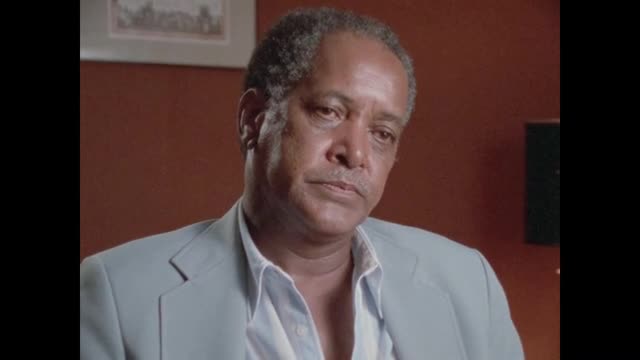
- Transcript
Okay, camera roll 4,008 continues, sound roll 4,001 continues, sound 6. Hello Rodgers. I want you to think back to that first night, I guess it was a Sunday night. What was that? How did the strike start? What was that first meeting like? That first meeting was, you know, we was all concerned, you know, we wanted to keep our job, but we wanted some dignity and some decent stuff out of it. And, you know, we had tried and tried, and T.O. Jones, our president had talked and talked, and did everything that he could to get the balls to try to see some of our grievances. We couldn't get anything done, so we all met that Sunday night. T.O. Jones decided to go up and talk to Blackburn, who was the director, and he couldn't get anything out of those people and he came back and told us.
And that's when we decided we were just working on taking it more. And then the next morning, we went to work. And we, instead of meeting that I would respect the workplaces, we met at the Fast On Rubber Hall Union, on Fast On, and we marched from now to sit at Hall, where we talked with Henry Lowe, and he used to talk about his old and old policies you don't need on a union. You know, I'll take care of you. You know, when we said back to him, you know, you haven't taken care of him. We don't want you to take care of all you want to do is give us some dignity and dignity. And some rights. You know, we didn't have any rights at all. You know, the balls, whatever the balls said, that's what we had to do. We now know him putting in working conditions or nothing. You know, whatever they said, that's what had to happen. And so we just had to take that tag. You know, had to work in the rain, and that was one of the really the main thing
that really set us to strike, was that they wanted us to go out and work in the rain. And we decided we weren't going to go anymore. And then when we had our last meet, when we had that meeting, and all of that was in there, and that's really what we were talking about. And they wouldn't give us nothing on that. So we just said, we weren't going to take it anymore. You told me over the phone about making a decision to stand up. What did you mean by that? Oh, well, we made that decision. That's when the word came out, I'm a man. We decided that, you know, if you keep your back bent, somebody can ride it. But if you stand up, they'll have to get off your back. So we decided we were going to be men and stand up and be men, and that's what we did. 1,300 men decided that they was tied, and we weren't going to take it anymore. Why don't we stop for a second? Okay. Mark, did you say number seven? Okay. You were at Dr. King's mountain top speech. What stands out about that night? Well, his speech was really...
You could tell that he felt that something was going to happen to him. You know, maybe not the next day, but he knew in the future something was going to happen to him. Because he said, you know, I've seen the Promised Land. I might not get there with you. You know, and then he said that long jeopardy have a place. But, you know, that brought out a lot of feelings among the crowd. He had a rose of the crowd. And I believe that night it was really a stormy night on outside, and Mason Temple was jammed. It was standing room on it. It was just a night, and that speech had just brought the crowd to the feet, and everybody had the feeling that he felt that probably that would be his last speech. And that's, you know, when I can always remember that part of the speech.
Like I said, I had my kids with me again. My wife and my kids. And, you know, we was all concerned because I need to go back to work. We're done with that room? Yes. Admiral, 4,09, sound number eight. You know, thinking about this strike and thinking about the things that you guys were risking. I mean, you personally must have been risking a lot. Well, I was up, you know, I had seven kids in school trying to educate my kids and trying to buy a home. It was just, it was really rough. But I know that something had to happen. That we couldn't continue on making a dollar for a Senate hour. You know, we just couldn't continue on with that with no benefits. And I saw and knew what the union could do for us. And we had some people that had started going back in before that last,
before Dr. King was assassinated. We had people going back in. But after that, those people came out. And in a couple of days, the strike was over. You know, they put pressure on Henry Lowe. After the King got killed, they put pressure on Henry Lowe to recognize the union. How did the community come together to help you? With money. Raise money and they did everything. I'm not going to give her one second. Just when you say this, tell us how the community did. So then when I say how did the community help you, just say that the community did this, as opposed to yesterday. Oh. How did the community help you? Well, the community raised money. And anything that they thought that we needed. And then the minister got involved. And everybody just got involved. I don't know. We had meetings at Mason Temple. We could pass around garbage cans and get garbage cans of money.
And that money went to help distract us. So try to keep them encouraged to stay out and give them a little money to take home their families. And you know, we had food. Or we cleaned up on temple. We had food that people could go down and get to feed their families. And in the National Union, and money came in from all over the country. So that we could survive. That's actually all right. Sound nine? Okay. Okay. I want you to think back. There you are with your two young sons. On that march that Dr. King left. What did you see? What did you do? Well, we really could do anything but try to stay out of the way. And watch what was happening. People were looting. And you know, they were. And the transit part about it. All this happened on Bill Street in the black community part. The stuff on the main street didn't get touched hardly. But now Dr. King was probably main in Gioza.
And when it all broke out, they just surrounded Dr. King. Put him in a car and took him, you know, just take him from out of the picture. Now where you were, you were there with your sons. Right. Okay. And then like I said, once it all broke out, then everybody started scattering. And most people was trying to get back to Cleveland Temple. And that's when we all went inside Cleveland Temple. And that's when they maged us and you know, and everybody run out. And my car was parked down behind me some temple. And I got lost from one of my sons. And we was trying to find him. So we could get to the car and leave. But everything just went haywire that day. Can you talk specifically and tell us, you know, that you were there with your sons and then what you did when violence broke out? Well, just like I said, we just start to try and take cover. No, no, I want you to mention the fact that you were there with your two young sons. And so tell me about you and your two young sons.
We can start about this safety. Right. That's kind of questions. Yeah. I'm trying to get together. Well, we was marching together. Who was that? Me and my young son. And my position was to try to see that nothing happened to them. But all the wonder breakings and glass scattering and police cars running and maze spraying. So I was trying to protect them. And they stayed with me until we got to Cleveland Temple. We went inside Cleveland Temple. And that's where we kind of got busted up. Then in my other son, we tried to find him before we went to the car. But when we got to the car, he was at the car. And so that's when we got the car left. Can you just go down for a second? Sound number 10. Okay, hit it.
Okay. So tell me about the more. Okay. Well, in the mine, me and my two sons, we was marching together. When all the glass started breaking and the noise and the police cars were running the sirens and everybody was all confused and just running over each other. My concern was to try to protect my two sons. To get them back to Cleveland Temple. And when we did get back to Cleveland Temple, got inside Cleveland Temple. They started putting gas in Cleveland Temple. Me and one of my sons got lost from us. And we started looking for him. And when we come outside, the police were still out. And we looked out to get the chance to get to the car. Well, another thing come to mind. Some guy I thought would have bricked at the police. And that created another disturbance. So we had to go back inside. And we were still concerned about what would have happened. So when things finally quieted down, we went and looked out the door again. And we finally got a chance to run out the door.
When we got to the car, he was at the car. And we got in the car and left and came home. That's the last thing I want to ask you. The march ends in violence. And Dr. King leaves. Nothing. Good. That's going to be a whole lot on camera roll. Sound roll. That was great. That was fantastic. Sound roll for two starts. Sound number 11. Thinking back to that march. I mean, it must have been an awful day. And then King leaves. Did you have any doubts that Martin King would come back to Memphis? No, my first thought was that he would come back. Because I don't think the march was really organized like he would want it to be organized. And when we did get the word that he was coming back, and then he was talking about marshals, and he wanted organized to keep those people that were interrupting to keep them out of the march. And I felt for sure he had to come back. To ensure that to ensure people that he was nonviolent.
Because the whole idea of disrupting the march was to make Dr. King look bad. And to say that, you know, wherever you go, violence would break out. So I was sure that Dr. King was coming back. And when we got the word, and we started organized and giving people together so we'd had a march properly organized. And you know, so he'd never get a chance to do that march. So Dr. King had something to prove? What was that? That it was a nonviolent. Yes, Dr. King. Sorry about that. What do you think Dr. King had to prove by coming back? Dr. King had to prove that he was nonviolent. In my opinion. Was it that he was nonviolent? Or that nonviolence could work? Well, the nonviolence could work. So what if Dr. King had to prove that? Saying that Dr. King? Dr. King had to prove that nonviolence really worked. And he came back to have a peaceful march.
Well, he got assassinated. I think the march was supposed to be in the next day. Is there anything else that you want to tell us about that stands out about this whole strike before Dr. King? Well, you know, the main thing really is the courage of the men. They had the courage to stay out. Because it was difficult for us to try to live. But what we were getting from the community and what we were getting from the unions to try to make end meet with our family. I think it was outstanding in those men to stand out and stand up and be men as they did. Thank you. Thank you.
- Series
- Eyes on the Prize II
- Raw Footage
- Interview with Taylor Rogers
- Producing Organization
- Blackside, Inc.
- Contributing Organization
- Film and Media Archive, Washington University in St. Louis (St. Louis, Missouri)
- AAPB ID
- cpb-aacip-8790344bf9a
If you have more information about this item than what is given here, or if you have concerns about this record, we want to know! Contact us, indicating the AAPB ID (cpb-aacip-8790344bf9a).
- Description
- Raw Footage Description
- Interview with Taylor Rogers conducted for Eyes on the Prize II. Discussion centers on participating in the 1968 Sanitation Workers Strike in Memphis, Tennessee.
- Created Date
- 1988-10-17
- Asset type
- Raw Footage
- Topics
- Race and Ethnicity
- Subjects
- Race and society
- Media type
- Moving Image
- Duration
- 00:13:19;12
- Credits
-
Interviewee: Rogers, Taylor
Interviewer: Stekler, Paul Jeffrey
Producing Organization: Blackside, Inc.
- AAPB Contributor Holdings
-
Film & Media Archive, Washington University in St. Louis
Identifier: cpb-aacip-ca43cb39da9 (Filename)
Format: 1/4 inch videotape
If you have a copy of this asset and would like us to add it to our catalog, please contact us.
- Citations
- Chicago: “Eyes on the Prize II; Interview with Taylor Rogers,” 1988-10-17, Film and Media Archive, Washington University in St. Louis, American Archive of Public Broadcasting (GBH and the Library of Congress), Boston, MA and Washington, DC, accessed June 9, 2026, http://americanarchive.org/catalog/cpb-aacip-8790344bf9a.
- MLA: “Eyes on the Prize II; Interview with Taylor Rogers.” 1988-10-17. Film and Media Archive, Washington University in St. Louis, American Archive of Public Broadcasting (GBH and the Library of Congress), Boston, MA and Washington, DC. Web. June 9, 2026. <http://americanarchive.org/catalog/cpb-aacip-8790344bf9a>.
- APA: Eyes on the Prize II; Interview with Taylor Rogers. Boston, MA: Film and Media Archive, Washington University in St. Louis, American Archive of Public Broadcasting (GBH and the Library of Congress), Boston, MA and Washington, DC. Retrieved from http://americanarchive.org/catalog/cpb-aacip-8790344bf9a