Woman; 430; Women and Age, Part 2: Age is Money Blues
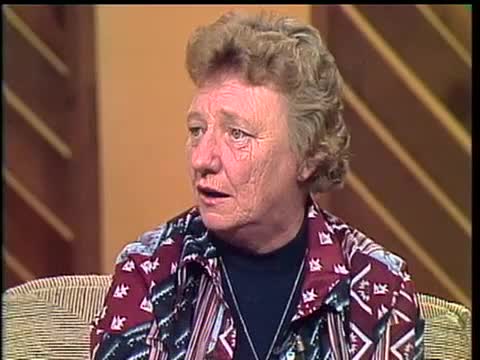
- Transcript
Eat eat eat eat eat eat eat eat woman. And good evening and welcome to woman. Tonight we're going to continue our discussion on older women. With me is Lori shields Lori is national coordinator of the Alliance for displaced homemakers. Also with me is Tish Sommer's tissues co-coordinator of the task force on older women for the National Organization for Women. Welcome to both of you. Thank you Sandy. Is it true that older women are the poorest segment of American society. Well actually I don't have the statistics on it but the last Department
of Labor figure I saw indicated that those living underneath the poverty level are there are more widows elderly widows living underneath the annual poverty level. I think it's $2000 isn't it. So yes I suppose you'd say that and certainly it's true within the minority group the blacks that yukata woman women in their middle years are very definitely living under the poverty level. What are the obstacles against older women getting jobs. Oh you want me to start. Principly I guess you have to start with the one beast we're all beating and that is the high unemployment figure. But aside from that there is the conditioning or the thinking within the traditional job market that is definitely ages. Older women are not considered to have the delight to have and in the end the officer on the staff. If you were to take a
walk through the department stores for example you'd find the types of jobs older women are filling and they're mostly part time jobs. What about these part time jobs I mean that at least they are available right. Well yes and I suppose the women who have them are very grateful for having them but that doesn't mean that they're the most desirable jobs because part time jobs for in many instances are without any fringe benefits at all which means that it's cheap labor exploited that leaves them with very little to fall back on come later years. So really people shouldn't be so grateful for some of those jobs. I don't know. I've got ambivalent feelings about that I know our mail reflects the fact that women are grateful to have any kind of a job but I don't think that's the option we want to give women who have for the most part the we're talking about women who have filled the role that society told them was their greatest and the role they should be fulfilling their women at our full former full time homemakers. Now if this is what we want it that
her only option should be a part time job maybe. And there aren't that many to go around for everyone or general assistance. And we have to stop and think about the problems of older women. I demand that older women like for instance that there's a tremendous turnover if you hire you know if you have lots of older women on your staff is that I don't know that older women have been given that many opportunities to invest in them if they're not I do know that from an economic point of view I mean I'm sensible enough and pragmatic enough to understand that the the the employer and within our system our profit system who has a large payroll on has insurance and health insurance and and pension plans to think of possibly has had to think about whether you can afford to hire an older woman and not I do know that those studies that have been done world women have held jobs as they are. They're much more consciences about
doing it where they do not take off. Obviously pregnancy is not a problem. The but we should be talking about those anyway sadly because those are jobs that are nonexistent right now and the other thing is we ought not. Older women ought not be in competition with younger their younger sisters for those jobs. Did you know what I was referring to the studies. Well I mean I know for example that there that this myth that. Older women are not reliable has been debunked. That is a matter of fact. Partly because they have fewer options. Older women are likely to stay put they're likely to. Give their all because they are that desperate. Doesn't mean they're not exploited. All right there's there's a large segment of the female population that is not covered by Social Security disability unemployment insurance things like that. And and where you're very involved in that kind of
alternative for that Marge to go yes if you think you know and it's called the displaced homemakers bill. Yes yes that's true. Actually displaced homemakers legislation covers both bills there existed a state level and also national right. I guess I was referring to the national bill because that's the one that that I was familiar with. Well it seems like I've been doing this for a hundred years and I'm sure people now today who have learned to live with the phrase this place don't like or think it's been around for a while but the truth is before April 10th in 1975 no one except the woman who coined the phrase Tish Summers even heard it had even heard of this place don't like it. Perhaps start at the most basic We want to talk about what it is right is based on my career and I'd like to yield the floor to the woman who coined the phrase who could best do it. Tish What is this. Well there were a number of us who had been trying to get those jobs to get to get jobs of any kind. These were older women who were divorced widowed
separated. Who had been home makers who had done this job for the society but then needed to earn a living themselves. We found that we were stymied in every way we experience age discrimination in employment. We found no real understanding of the problem. We got out and demonstrated to try to get the Age Discrimination Act enforced and found that hardly. Helped us very much because the factor just weren't enough jobs to go around. And he took to the streets. We did take his group to the streets there was over 75 of us when it's out in front of the Fairmont Hotel in San Francisco seeing the old gray mare she's better than she used to be and we got a few jobs out of it and we we did at least raise the issue about age discrimination. But we recognized particularly when Jazz began to get tight in the end of 75 we recognized we needed the government to sift and assist to draw attention to the problem nationally in the first place. And secondly. So that older
women could get together to work on their own problems. Nobody liberates anyone else we have to do that for ourselves. And we recognized that we needed to organize and it was around that basis and to find ourselves displaced homemakers and with the help of a young lawyer who was working with us by the name of Barbara Dudley a public interest lawyer. Wrote a model bill and went to Washington. To try to get a team to do SED. What are the provisions what does it provide for. Well briefly five things and that is what makes it different and innovative as far as legislation goes it does talk in terms of providing. As a separate entity a multi-purpose service center which women over 35 women in their middle years I think the national builder finds this would get peer counseling would find a way to have their native and or acquired talents evaluated. I would certainly get training and would positively get placing but
far more important there would be a way to identify or at least there would be experimenting to identify community needs. To create jobs for which these are the former homemaker skills would qualify her to fill jobs needs that you know not necessarily new. Opening up new fields but perhaps a new twist on an old job an existing field that hadn't been thought it I mean we have to open up the barriers in the election's over we can stop using that phrase create new jobs as rhetoric. We're talking about actually creating new jobs and that's what this legislation about. And that's what's different and that's why it deserves really the experimentation because of its co-opted within existing programs it won't work. Do you get this reaction I mean and this is mind it at the moment not just give it to you straight. Do more money I mean we can spend more money for social services. You have your option. It's it's that a relatively small appropriation.
Short range wise move as against increasing your option to increase general assistance or welfare because these will be the only options we're talking about an increasing number of women. Last year you just talked about how many women you had last year 53 percent of the American women in this country who were married were and are full time homemakers. We estimate that there is a potential of 15 million who are women who will fit this definition of displaced filmmakers. We don't start doing anything. We're not talking about legislation that will create batches of jobs. What is innovative and different about this legislation is it creates a minimum according to the bill a minimum of 50 of these to purpose centers where this experimentation can take place while these women are getting all these other services they do need that they are not getting right now. But much more to the point it means they are creating job models which can be explored in other words that women are experimenting themselves to find new ways of using their skills. It's a self-help concept. In the process for
example all. The trainees at the center that I was working with are in the process of getting training are teaching others and there is nothing that helps to overcome that sense of having nothing to done nothing of value. As going out in teaching and talking. And beginning to really try to address some of the community problems that we face in the society society has conditioned us to believe that what we do is homemakers really has no more no value other than within the framework of the small world of the home even though they say at the same time this is the basis of our society. When a homemakers role is finished and that's what we mean when we say a displaced filmmaker a woman who is depended upon an income most of her life who has been a homemaker for a substantial number of years who loses that income either through widowhood or divorced or separated. OK when that happens then society says you're no longer of value.
There is no use for your skills and these workers have none of the cushions that other workers have. There is no one employment insurance for and there is no there are no known special training programs for him and none of the other kinds of cushions that workers have. To ease the pain. And we don't we don't believe that because that it's not only that the condition of society that says that homemakers role is finished when when her or her husband leaves or dies or her children grow up and leave home. There are various also. The idea that homemaking is a series of household chores. I mean one of the one of the things that bothers me as a displaced homemaker is that my 15 years admittedly not many but my 15 years of homemaking is reduced by those studies that exist today and I mean some rather important studies that academically are accepted as being very valuable. It's all put on the basis of the assessment of a total number of towards how much
time spent doing that's incentive nonsense. A homemaker learns to be a manager a homemaker learns to use judgment. A homemaker learns to be a bit to budget to be a consultant. My goodness gracious when one considers the family problems she becomes a psychiatrist as well. I mean there are lots of talents we must look at the overall picture and China's responsibility as well. So your intention is to redevelop these skills. Yeah I want to redirect him. Wright said what makes us. Not angry. That's not it but sad certainly in my case is when we get letters that start out. I've never worked. I raised 12 children. Now That's Ridiculous. One means that she believes that she did nothing of value except raising children but that wasn't work. Yes that that's like you know I read I never really had said that it was obscene as well as absurd because they're specially as I said one of the things that pleased me most about. This legislation is that a group not only grew out of the grassroots and came out of the
actual experience of some women who had. The problem. But that it is that the bill has taken off. I mean the legislation is taken up. We did. We nobody spent a lot of money promoting this bill. It is gone like crazy for one good reason and that is that women all across this country in every state because every state has displaced all makers have opted to do some work for themselves and that's the trick. We're talking about my generation. I'm 56 who grew up learning that there were two things two subjects you never mentioned one was politics and the other one was religion. Well these women are beginning to learn that if they don't think politically for themselves they don't work together. And act together collectively. Nothing is going to be done. We can't fault legislators that we elect and then forget that they're there and don't tell them about our needs. So they're telling them about their needs. I guess if there's one message through all of this it's organized right. Oh absolutely and collect it what is collective action except the sum total of individual acts. And that's what's happening.
But it also takes a certain kinds of drive and leadership and I think that Laurie is a perfect example of a displaced homemaker who found her net chip on the tell us that she had lived in that kind of political or you didn't always have this higher consciousness did you. Oh no I would I would I'm a late bloomer he felt that he was tough but that's what I think that I can relate to the women I talk to. I've met the tissues and done it or other families have been a bit I mean I've done the Girl Scout Lady and the president of the mothers club and and all the rest of the you know and and and was very proud and I mean very please the misses are here she'll tell me what haven't you. Denning always curious to know how this happens. Oh well you were walking down that street I had a you know that the dud 970 and that we had made plans to let in Compton last we wound up in this semantic argument that the lads in Washington were having whether we were in a depression or a recession it really didn't matter to me all I knew is I didn't my income was insufficient.
But I had worked before my marriage and I just felt I had good enough credentials to get a job. But I did and I kept running into what loads of women are hearing you're overqualified or all of my homemaking years and I think that Dean's a nice round figure. That work was all just put aside wasn't even acknowledged they'd look at my record of being in advertising merchandising and say that's a marvelous work record. Too bad it's not recent. You know. Those are the things we've got to raise filmmaking to the level of the status of a profession. But back to my own. I couldn't get it. Annette Annette and employment agency woman in San Francisco finally said to me Lori I'm 48 and I'm over the hill. And I was facing my 50 50 birthday so I figured she had a message for me. Then I met Tish Somers and she had a message for me. A. The result of which was don't agonize organize write and go out and do the like what I see and I've been sort of galloping from one end of the
country to the other. Ever since doing something that I love I thoroughly enjoy it. I really do. But a job I never would have sought out male. What do you see in the displaced homemakers feel as a stepping stone to something further. Very deaf or do you see it as an engine it's an end in itself. Oh yes. Yeah. If nothing else and I almost I mean it's all I'm almost joking and saying that if I was going back to say if we don't get a bill but I know we're going to fail and we're going to get a bill signed by President Carter by May 8th because that's Mother's Day and he does like symbolic action. Please note I didn't say gesture because I don't think this is a man who makes gestures. Anyway. If we did nothing other than that then raise the consciousness of people make them more aware of the resources at hand. We are not disposable like diapers. We are too young for Social Security. We are too old for the traditional job market but by going to Greece we have a lot to give to this country.
And we can make a fuss and I think that the interesting part of that actually was when we first conceived of the spill Interestingly I didn't believe we could get it passed nationally at least I thought but it will be a terrific handle. For organizing women raising consciousness to make make people recognize this problem exists. You know partly through Laurie's efforts are now the efforts of women everyplace acting and women but everywhere else the old girls network is what we call that's right and that's really what happened. The old girls network helps everyplace I didn't know we had one. Oh we do we have one we have a gorgeous wedding in California they've got a good one in Baltimore the Baltimore center is a very good example of what can come out of this bill. There are only three states that have the Act passed. Now that's what I said only three I should have stopped myself because that's fantastic. Just since April 1975 three bills have made a real mistake. Why that necessary if there's a national bill to have the states passed bill. I'm not so I don't know because I don't I know we need a national bill because we need national guidelines
that's that's one thing. But the other thing we need tissue is the proper word when she said when this legislation was first conceived it was to get an assist. In other words older women are really frugal. We don't we don't believe the answer to curing a problem is to throw a lot of money at it. But we do know we do recognize the fact that we are going to need an assist with this now the national bill will provide both. Incidentally representative Burke's bill which is a chart 28 and just recently Senator Birch by has introduced his which is Senate 4 1 8. And there are identical bills and what they do is provide the federal monies provide 90 percent of the funding after the states have have committed themselves to 10 percent for the senators how many senators per state depends upon the bill and what the state wants to invest which I think is a very good saying because the states are first level of government their first contact and they should be more conscious more quick quick to jump to meeting the needs of constituents.
Where is the opposition coming from. Tissue we can say that. I was just going to say in answer to that other question to why do we need state bills. Because. Women are mobilizing only women are organizing around the state displaced homemaker legislation for one thing and they're not waiting. We didn't wait. We recognized that we needed to move fast to get the state. A state model a demonstration going in California. And that has been happening all over the country wherever Laurie has been. But I think that the means that not all news are steppingstone on a national level but we're beginning to get to see displaced homemaker legislation as an organizing vehicle on a state level as well. Yeah. Women see where all of us men and women going through it we've gone through a traumatic time when we felt very far removed in the city from government. Now with this bill and the state builds women can really identify and they
are making some progress they are getting through where is the opposition coming from is what you asked. OK on a state level it's coming generally only from the departments working within states who have been charged with the responsibility of creating jobs and have not been able to existing programs for instance that could train and older women have been unable to place older women in long term jobs. I'm not talking about eight week jobs I'm talking about long term jobs. That's that's that's one reason why we need. We also need the state we need the state builds to convince members of Congress that this was a national problem. You see there are no existing figures that countess to begin with because homemaking isn't recognised as labor we don't count. And so these bills prove we're out there and the thunder that's going to be heard on the Hill this session is going to be the thunder roll ladies and tennis shoes I'll tell you that and it proves that the stereotype has got to be broken up that not all ladies and all the ladies in tennis shoes are flaky. That's one of the main reasons why aware of Aside from the fact that they're very comfortable.
It's a splendid movement and the thing that is it's so consistent with what President Carter started to do you know that's really what gave me the first real surge of hope that we had a chance to get the bill July 12th he endorsed this legislation Birch by when he was a congressional presidential candidate endorsed it early. Senator Dodd is bringing up the bill as he hinted he has introduced it in the Senate it's asked for one aide. But the main thing that I like about it is that we are talking about a back to the people. This time I think we're going to believe it because I don't think anybody of any other candidate's going to have a chance to offer us the opportunity I don't think we're going to let up. This is our last chance to believe government and once we get this bill passed that we will move immediately on to other kinds of reforms whether it's in Social Security system whether it's disability insurance for home makers the inclusion of homemakers under the unemployment
insurance program so and so that there will be have some protections. Health insurance in a variety of other things. So once this group is mobilized we will be able to really have a voice and we will have some impact. I think not only and not only on the women's movement on the aging movement and on getting what you want people to do. Oh my goodness basic but I'm not sure that you're ready to do that. First of all sit down and write a letter. You should know who your representative is for your district in Congress. You should know obviously who your senators are within your state. Don't worry about how you address it and what the right form is for get that. He doesn't think about whether you call him honorable or anything else when you put you put your X on that ballot in front of his name. So don't worry about how you address it. Just simply in your own words tell him why. If you recognize yourself in a description of the displaced Tameka why this legislation is so needed and ask him. If you don't know
about the legislation then write your very first letter and ask for a copy of the bill and study it. It's in very simple language. It is not it. It's not the usual kind of bill. Maybe because it doesn't deal with the usual sort of problem that most legislation does. So get the bill study it talk it up and then use your secret weapon. Every one of us has an address book mine I've had since high school. The back of it is covered with little tired the back ends of Christmas cards with addresses and changes pledge yourself to write to pick 10 names and write to 10 of your friends and tell them about the bill and ask them to do that. This is how to do the same thing. This is how we built up the network in California. This is our Building up the network. Every other place across the country will do it if everyone acts not just for herself but everyone acts for every woman. I've met her. Please feel free to join us. Laurie and Tish Will you here we only have a couple of minutes yes. There's another thing that I want to ask you
that it's a question that many women ask and that is if they are employed and they feel that they are being discriminated against because of age what can they do what is their recourse. First thing to do is to. File a complaint with the Wage and Hour Division of the Labor Department. And if there's a state and I discrimination law in their state at the same time to file a complaint with that. State agency if that agency covers age as well as a sex and race and so on. It is not necessary to prove age discrimination that's very difficult you don't need absolute proof. You know I let them play. Their responsibility is up to the. Party in which you're complaining against must prove that they didn't prove that they didn't. Therefore it's very important to mediately to file a complaint the more complaints are filed the more action is going to be on this. Doesn't cost anything
and it's possible at least to get an investigation of the case. And one other quick point of view because there are 10 million members of AARP in this country. They all know what everybody else should know is that they've begun a grand promotion against discrimination there is a special address you can write to if you feel you've been discriminated against Gyp's check with your local chapter of AARP and if that won't do write to either one of us and we'll see that your letter gets on past back to what they did. They do not let me make a point that they do not take your particular cases they are trying to get a file of cases so that they can work for legislative change in this area because the law needs to be strengthened Is that what is right and the law needs to be strengthened. And of course forced the one that exists the word the laws that exist. Is there a backlog of cases now. You know this but not as bad as the USC. Yeah it is the on the sex discrimination cases. It's still very important to get get complaints while.
We're out of time. I thank you both for being here. Oh thanks for having us. Next week we'll be back with Tish and we'll be joined by Marjorie Collins editor of prime time and Lydia bragger of the great Media Watch task force. Also if you're interested in further information you might want to look at the following address. This program was produced by W. N. E. D Keating which is soley responsible for
its content maker funding was provided by a public television station. Additional support was provided by unrestricted general program grants from the Corporation for Public Broadcasting and the foundation.
- Series
- Woman
- Episode Number
- 430
- Producing Organization
- WNED
- Contributing Organization
- WNED (Buffalo, New York)
- AAPB ID
- cpb-aacip-81-77fqzfdr
If you have more information about this item than what is given here, or if you have concerns about this record, we want to know! Contact us, indicating the AAPB ID (cpb-aacip-81-77fqzfdr).
- Description
- Episode Description
- This episode features a conversation with Tish Sommers and Laurie Shields. Shields is the National Coordinator of the Alliance for Displaced Homemakers. Sommers is the co-coordinator of the Task Force on Older Women for the National Organization for Women.
- Series Description
- Woman is a talk show featuring in-depth conversations exploring issues affecting the lives of women.
- Created Date
- 1977-01-28
- Asset type
- Episode
- Genres
- Talk Show
- Topics
- Social Issues
- Women
- Rights
- No copyright statement in content.
- Media type
- Moving Image
- Duration
- 00:29:33
- Credits
-
-
Producing Organization:
WNED
- AAPB Contributor Holdings
-
WNED
Identifier: cpb-aacip-077569d5184 (Filename)
Format: DVCPRO
Generation: Master
Duration: 00:29:33
If you have a copy of this asset and would like us to add it to our catalog, please contact us.
- Citations
- Chicago: “Woman; 430; Women and Age, Part 2: Age is Money Blues,” 1977-01-28, WNED, American Archive of Public Broadcasting (GBH and the Library of Congress), Boston, MA and Washington, DC, accessed October 13, 2026, http://americanarchive.org/catalog/cpb-aacip-81-77fqzfdr.
- MLA: “Woman; 430; Women and Age, Part 2: Age is Money Blues.” 1977-01-28. WNED, American Archive of Public Broadcasting (GBH and the Library of Congress), Boston, MA and Washington, DC. Web. October 13, 2026. <http://americanarchive.org/catalog/cpb-aacip-81-77fqzfdr>.
- APA: Woman; 430; Women and Age, Part 2: Age is Money Blues. Boston, MA: WNED, American Archive of Public Broadcasting (GBH and the Library of Congress), Boston, MA and Washington, DC. Retrieved from http://americanarchive.org/catalog/cpb-aacip-81-77fqzfdr