Rap About It; Senator Ernie Chambers
- Transcript
I'm sorry Rap about it. A monthly series of the minority affairs unit of the Nebraska educational television network. Reporting on achievements and attitudes of black Americans from art and literature to politics, and from education to employment, a new service to bring you a continuing view of news and cultural developments in the lives of American minorities and now your host, Mel Adams. Good evening ladies and gentlemen and welcome to this edition of Wrap About It on the Road. Today wrap about it is visiting the Spencer Street Barber
Shop here in Omaha, Nebraska. And I have as my guest for the second time on Wrap About It, Senator Ernest Chambers, a statesman, a father, a brother, a public official, and last but not least a barber. Welcome brother. It's good to be here. It's good to have you here on my turf. All right. It's good to be here. Ernie, you set the stage for the most recent victory that you experienced toward the end of the legislature, and I'm speaking of the votes that you were able to muster to override the veto of your school district by election vote. Being completely frank about that particular situation, I don't know how it occurred. All I know is that it did occur. There were a number of men who hadn't voted at all on the original bill. At least one had voted against it. When the final day for the override attempt came, the ones who had not voted enough of them voted for it, the one man who had voted against it voted for it. We got the 30 votes, and the veto was overridden. I had to talk quite strongly to one of the gentlemen who had voted for the bill all the way across, but he became a little shaky when the school board and its machinery went into
operation and put pressure on him, but fortunately he stuck by his convictions and voted override. That's how it happened. Now, this represented five years of struggle on your part, five grueling years. What do you think about the attempts on the part of the school district, the Omaha school district, to continue to spend money to defend their position on the grueling by the eighth district circuit court of appeals? Is that right or not? Right. And I think that's just a face -saving gesture. The schools still, although they've been caught, so to speak, with the smoking gun, cannot acknowledge that what they've done to black children and white children to some extent has been criminal and improper. So although the segregation in Omaha schools can be considered classic, it follows the pattern right down to the tee, the court's decision followed what would look like a script and outlawing that kind of segregation. The school people cannot acknowledge their wrongs, so they're going through a face -saving gesture now
and wasting taxpayer money. Naturally, the lawyers will go for it because they're job is to make money. And if they say, now, I've got a dummy like this who's going to throw money down a rattle, I may as well be there to take it. So they filed an action asking for a rehearing by the entire eighth circuit of the three judge opinion. First of all, I don't think there'll be a rehearing granted. They have to get five of the eight judges to agree. If a rehearing should happen to be granted as a courtesy, I don't believe the eighth circuit will reverse the three judge panel. Why only three judges for an eighth judge court? On a situation like this where a local district judge, in this case, judge shots in Omaha gives an opinion and it's going to be appealed. That usually goes to a three judge panel and three judge panel generally is upheld. And especially when there's so much federal law and so many court decisions going the way that this three judge panel went, I don't think there's a prayer for the school boards to win. Okay, so the next step is to get a rehearing and then to the Supreme Court. That's what they say, but then I don't get anything but another whipping. And I offer them
the night of the school board meeting where they're going to go through this nonsense. I said that if they give me one tenth of what they're going to pay their lawyers, I'd give them the decision right then, but they didn't accept my offer. They were other ways that money. In retrospect, looking over your career as a state senator, would you say that this is one of your most outstanding victories or where would you place this? I would say it's very important and it's very rewarding because so much time was taken to get the job done and it benefits far more people than just those in the district that I represent. I think ultimately it's going to set the guideline for establishing district elections throughout the state for various political subdivisions where enough people are involved so that an at -large election wouldn't give you a chance to know who your representative is going to be. Next year, Lincoln is going to be given the opportunity to elect school board members by districts. So I would say due to the effort that I had to put forward, the fact that I was defeated time after time by the governor through his veto, this victory
has to be very sweet and I hope it will show young kids in school and some of the older kids not in school who need to be in school and by that I meant 40 on up, that to lose an individual encounter, to lose it the second time, the third time doesn't mean that all is lost. If you believe in yourself and what you're doing, you keep pushing until you win. Do you think that the problem is the same or are severe with small towns in Nebraska outstate? No. There's no comparison because some of those districts are so small that everybody in the district knows everybody else and they have difficulty in some cases finding enough people in an at -large election who want to run for the school board so it's impossible to make one size hat that would fit all size heads. But when you come to a city like Omaha and its environs which make up, which is comprised of about 500 ,000 people, that's considering the suburbs and the rest of that. It's impossible for the people electing somebody to a school board to know
intimately the qualifications and ideas the people were running. And one interesting note, Senator Goodrich and other Omaha senators who opposed this bill kept saying they didn't want their vote to manage where they could only vote for. One member instead of 12, I asked him to name the 12 people on the board now. If he wants to vote for the 12, he certainly should know their name. He didn't even know their names so how can he be acquainted with their qualifications. Those are the kind of species arguments that were given in opposition to this bill. But it's an idea whose time has come. Okay, from that standpoint, do you think that since the idea basically was adopted that it will rub off on the political subdivisions of the city, the municipalities like in city council elections? Well, we're going to try to rub it off onto them for them because cities have shown themselves to be incompetent really to do the kind of job for the citizens that they should do. And at that point, I get a lot of questions directed to me through the news media and criticism directed at me through the news media based on the fact that I'm opposed to the federal government imposing a 55 mile an hour speed limit on the state.
So people say if I'm against the federal government doing that to the state, how can I be in favor of the state imposing election by districts on Omaha? First of all, the federal government has its power based on grants from the state. The federal government was created by the states and has only the power that's given to them. On the other hand, the state completely and totally controls the schools. The state created the school districts. The federal government did not create the states they created the federal government and granted it certain powers. Well, since the state constitution gives the state legislature total power over the operation of the schools, it's the legislature's responsibility to determine not only that there will be public schools, but how they will be operated locally and the method of election of the local boards. So if these people had gone to school and properly understood the operation of the state, the federal and local governments, they wouldn't even ask stupid things like that. When I say stupid, I mean it because I think it's stupid to ask an ignorant
question when you're ignorant by choice. When the information that would answer the question is readily obtainable in any library or from any teacher and they choose to be ignorant, then I think that kind of ignorance is stupidity. All right. Then would you say that the state should have the jurisdiction in making a decision or regulation regarding the local government? Oh, without a doubt. The federal government. Well, it becomes a bit more complex because the schools exist and are under the control of the legislature. There are such things as cities with home rule charters. They're given a tremendous amount of leeway in governing the city that they're over. However, the ultimate responsibility of the state is to see that certain rights and privileges are guaranteed to citizens. And if the city adopts a method of election that denies those rights to citizens, it then becomes a state's responsibility and obligation to establish a method of election that is truly representative. Right. So that's how that would be the basis for the state mandating district elections of city
councils. And that question was submitted to the Attorney General's office as to whether the state could do this and the answer was a resounding yes. You mentioned the state's 55 mile an hour speed limit. Uh -huh. You recently received a citation for exceeding that limit, yes, by somewhat 13 miles per hour. We'll tell them the amount and then let them figure it out. I was given a ticket for going 74 miles an hour and a 55 mile an hour zone. What have you done about that? I filed a brief in the county court of Sarpie County challenging the constitutionality of the law because when it was adopted, the title of the bill said that it was to be in compliance with an act of Congress. And within the bill itself it gave the president the power to change the speed limit in Nebraska by declaring there's no longer fuel shortage. And it also said that if Congress amended its original act, the Nebraska law would automatically be amended by the action of Congress. So I challenge these provisions on the basis of them being an improper delegation of legislative authority by the Nebraska legislature to the federal government. You as a
citizen should be able to go to Nebraska's laws to find out what your duties and obligations are, but the way the speed limit bill was drafted, you'd have to do research to find out if the president had declared there's not a fuel shortage or to see where the Congress had taken action. And that is totally improper. How does the law stand at this time in the state of Nebraska? How does it read? This past session of the legislature just ended, modified that speed limit law and wiped out all of the unconstitutional language that I'm talking about and established a 55 mile an hour speed limit in the fashion that it should have since they felt there should be one. Excuse me. You, I love you been barbering. You worked your way through college barbering, is that? Well, I've been barbering too long actually. Barbering is unfulfilling, unrewarding, it's in a depression and has been for a long time, but it's something that allows me to work whatever hours I have available for work. I'm not
beholden to anybody and nobody can tell me what to do. Unless somebody sits in the chair and says I want my hair cut a certain way and if they don't like how I cut it, well, they don't come back. Right. Right. But this serves as well as barbershop as an office of law and a place where people can come and speak to you about their concerns and proposed legislation. Anything they want to talk about, disagree with me, tell me that they think I'm doomed and damned forever, that I'm on my way to a devil's hill where I'm a burned forever and they're happy about that. Other people want to tell me that they think I'm jiving when I say I'm not religious because they don't think without religion you could believe in trying to do things to make changes. A lot of people don't even get their hair cut here just want to come and talk. So when the doors are open, anybody can come in and talk about what they want to talk about. Do you consider yourself religious? Oh, certainly not. Why do you say that? Because religion believing in what you stand for and what you say. Well, if we were going to establish a definition originally, then maybe I could determine whether by that definition I'm religious, but based on the traditional notions of it,
I don't have a religious bone in my body. Usually to most people religion means you have a church that you identify with, you go to church, you give money to a preacher and you say prayers, you don't live anything, you know, you don't practice what they preach, but you go through the motions and I'm not like that. You don't believe that you are guided by any supreme being at all. Well, I have a four year old son named David and if he qualifies as a supreme being, he puts a demands on me that sometimes I can't resist, but other than that, I don't believe I'm guided by anything other than my own mind and understanding. If I was guided by something I'd never make a mistake, never. Because supreme means that there's nothing above and beyond that. So if any human beings are guided by the supreme being and there's so much confusion and turmoil in the world, then the supreme being is not really what's happening. By that I mean it's kind of out of kilter needs somebody to guide and direct it. What would you say one of your biggest mistakes has been in your life? Well one time I thought I was wrong and I
wasn't. You have other hobbies and interests besides, of course, your full time job of public servant and writing legislation and one of them is art. I see here on the walls that you have some of your work displayed. I want to talk about some of those and as you can look over, just tell me what motivated some of those pictures and what did they symbolize? Well I think that drawing gives you an opportunity with a pencil, colored crayons, which usually is what I use or oils, tempera, whatever the medium is. You try to express a thought or an idea that you have in your mind that you might feel words won't convey to people and by taking a picture I think you can say a lot more than if you wrote volumes and volumes. So maybe I'll draw a picture of a policeman sitting on a motorcycle and label it the symbol of our oppression because of the lawless fashion that these men conduct themselves in our community. When we file complaints with the mayor or the safety director, nothing worthwhile is done in the way of correcting their conduct.
Not too long ago a black woman named Annie Worlds was handcuffed by police and shot in the back and then they file charges against her. Fortunately she found some attorneys who were filing a million dollars suit against the city of Omaha and I think she should win it. But anyway, those are some of the things that will cause me to draw a picture trying to express something that words really won't get across the way I want it to. These days I don't have a lot of time to do much drawing though. Besides drawing do you ever write other than for legislation or legal documents, I mean for publication? Yes, they did, right? They say in the heart of every lawyer is the wreck of a poet. Well I'm not a lawyer so maybe the poet in me is not wrecked yet but I think the people who gravitate toward professions where you utilize language to a great extent tend to have a nature that could be described as poetic or artistic. So you may not be able to find anybody that at a certain time you can express thoughts that you want to get out of you
so you can commit them to paper. So there are a number of things that I've written which have never been published which nobody else has ever read but I write them for myself. You obviously have gravitated toward a career in law. You trained at Creighton University in law school. Would you retrace that for us and tell us the circumstances on which you did not receive your degree from that college? When I was in Creighton in law school many, many years ago we were in Omaha trying to bring about changes in housing patterns which were segregated and discriminatory. There was not job opportunities. Creighton at that time was it had off campus housing which was discriminatory not open to black students. They would receive office for employment through their employment office and the specification would be made that they didn't want black students so when I was taking issue with these matters while I was on campus some of the faculty members and others became embarrassed and said that I should spend time in the classroom in law school but since law is so hard for
some people, the only people in law school beside me were white so I have to say law is so hard for those white people that they felt I couldn't possibly pass by missing as many classes as I was missing. I was working at the post office many, many hours far in excess of 40 a week. I had a family and they were sure that I'd flunk out. Well instead of flunking out I was number four in the Dean's Academic List so some of the students got together and circulated the petition and tried to put pressure on the administrators and faculty to enforce an absence rule which had not been enforced saying that if you absent equivalent to two weeks of a semester you are dropped from that class well it was not enforced so the following semester I was absent a good deal again didn't flunk any exams didn't flunk any courses so this went on for about two years and the pressure continued to be brought by students who were not doing as well as I was doing and by people who didn't want to see me engage in the activities I was and trying to improve conditions for black people in this town conditions by the way which are not improved that
much so the Dean made an administrative decision the former Dean that I would not be allowed to re -enroll in law school when I went back in the fall he said I could appeal to the faculty which I did they all signed a paper which looks like a petition saying they agreed with him that I should not be allowed to re -enter law school all that water is under the bridge now that was about ten years ago they have a new Dean who has a great deal more enlightenment and in these times ten years later they don't see me as the fearsome threat that I guess they must have seen me as being at that time a lot of the things that I said have come to pass not only in this state but throughout the country so he allowed me to re -enroll in law school a couple of years ago and I took a semester and the following year I ran for governor the legislature intervened so I haven't been back do you plan to continue I don't know law doesn't have the greater attraction for me individual issues come up that I have a great amount of interest in but to sit in a classroom and listen to some of the things I have to listen to watch naive students who think they know everything and they don't even know
how a law is written or how to interpret it is as they say a bit much for me I'm almost 40 years old I'd be sitting around here with those little children I've made the law and I'm not trying to be facetious and I have to sit there and listen to things that I know are incorrect it'd be difficult for me to sit in a classroom now is this why you proposed the public examination for the bar in the state I wanted to have a ruling that you did not have to belong to the bar association of practice law because that gives lawyers a virtual monopoly the lawyers define what constitutes the practice of law then they get the Supreme Court which is composed of lawyers to say that nobody can do these things unless you're a lawyer well if they had an outside agency defining law very respectively then that would be all right but practically anything you do that has legal consequence they wouldn't want me to draw up a divorce paper for somebody and they have forms for this they wouldn't want me to draft a deed for anybody they wouldn't want me to draft a will and anybody who can read and use common sense can do these things apparently though a lot of lawyers can neither read nor have common sense because they do these things incorrectly and improperly and a lawyer
is the only one who's allowed to be ignorant of the law if he threw in competency draws up a trust arrangement and the trust is defective and does not work then the lawyer is not punished for the damage that is done to the people who are received to receive the benefits of the trust but if you do something as a private citizen who is not allowed to practice the law because you're not presumed to be competent enough they say to you ignorance of the law no matter how complex that law is is no excuse your action is violative of the law you must pay the penalty so I think law is a sham and a hoax it's a place where they protect the incompetence and the mediocre but would you like to write wills and would you like to represent people in court I would like to do anything I could to help people can't help themselves but I certainly wouldn't want to be restricted to writing wills and doing the things that if you read a foreign book you could do for yourself I'm mentioning those things because there are a lot of things that I think citizens can do but to feel fulfilment from the law would mean me challenging the titans of this society who are at liberty
right now to walk on people it's hard to find a lawyer who's the police department it's hard to find a lawyer who sue a large store which has falsely arrested or humiliated somebody falsely accusing them of shoplifting a lot of the things that happen routinely in the society the things I'd give my time to how would you describe the power structure in this community that is responsible for many of the political policies that are to the detriment of black people and low income people in this community I think you about summed it up it is just it is racist totally insensitive to the needs of people it perpetuates itself there's never been a crusading medium in this time who would attack canoeson and the wrong things that school board has done to all of the children in this city for all these years maybe a reporter will write a decent story do some investigative research and then an editor will say you can't use that the newspaper the largest one in this time will sit back and watch these terrible things happen and see
the results of that education by having people apply for jobs who can't fill out application blanks they can't write a sentence they can't spell they can't punctuate and if you read some of these newspapers look like the editors can't do much better but the point I'm trying to get to is that the power structure is benefited when you have unintelligent uneducated people because you can formulate their opinion for them and you can cause them to do things that are hurtful to themselves while putting money in your pocket if you're the power structure so I would say it's a self -seeking exploitive totally amoral or immoral collection of individuals how would you summarize the civil rights movement right now during the 60s it was made visible through demonstrations and rallies and rhetoric how has it changed now and at what stage do you think the news media originally latched onto it as a new thing was they thought would peter out and fail I think the need for that type of activity
still exists because the same injustices are here and some of them are worse now than they were then but the news media under the control of the people that they are are doing everything they can to diffuse and make this type of action aimed at solving the problems seemed like something's wrong with it that it's no longer acceptable there are people who are reluctant to protest even verbally but I think there's going to be a recurrence of those things because there are white people now who are being put in the same boat as black people been in all the time and these white people who condemned us and said you don't have a job cause you're lazy and now they're throwing out of work with college degrees instead of looking at the things they said to us and applying it to themselves the first thing they want is why me I want my children to go to school I want to mind to go but they said they shouldn't well I have house payments to me so do I I can't even get a house but they didn't care so what goes around comes around it's ironic by the way this is slightly off the subject but again on it Malcolm X allegedly was silenced by the Muslims because when John Kennedy was assassinated Malcolm X made the public statement the chickens have come home to ruse
meaning that the CIA had caused the assassination of various foreign leaders and dignitaries well now the investigations of the white politicians in this country are showing that what Malcolm X said was true the chickens have come home to ruse what was given is coming back and Rockefeller's commission without naming names said that some of the parties responsible for these assassination plots were themselves assassinated to me that means right away Robert Kennedy and John Kennedy do you then believe that they were the CIA was involved in domestic assassinations and if white people would listen to us they would have known with the CIA and the FBI are from the beginning we constantly told them what these agencies were doing that they get white people used to accepting this by seeing it done to us white people never complain then when the tools of oppression and repression are sharp known us they turn them on white people now even congressman are kept under surveillance and they cry like stuck pigs and young monkeys but when we were trying to point out how our rights were being systematically stepped on nobody
wanted to listen so the CIA and what it's doing is news to them but not to us do you think it's gone too far do you think it's beyond the point of return the CIA is organized crime as much as the mafia or kosenostra except that the CIA has the open complicity and allocations of money from congress to carry on their illegal activities there are a bunch of gangsters and criminals and they ought to be dealt with accordingly so when I hear the term organized crime I think it's the FBI and the CIA and who do you think what individuals are group is that the control of that who pulls the string it'd be hard for me to say for sure but I know that money wields power so if you follow the strings from the puppets who run the CIA like Colby and Kelly who now runs the FBI those strings will wind up in the hands of some financier or financiers now take a look at my head it was certainly that's what
all of y 'all to have confidence in faith in me I certainly do I'm not through yet okay by the way if I took this long and everybody's here I'd be busted you got about three minutes left what are you working on right now or at least do you have plans for the future in a way of legislation for the upcoming session I do have plans but I'd like just comment on something that's on my mind right now Terry Carpenter's motion to have the well it's not actually Carpenter some voters in his district are asking the federal court to call state officials to count certain ballots that were cast for Carpenter that were obviously cast for them and I hope the court will agree to hear this action brought by these citizens that the court will require the counting of these ballots and I believe Terry Carpenter will receive his seat the reason I believe it and the legislature knows it too they tuck tail and ran like scared mice from the only way to solve this situation and that's to
open those ballots and count them the ones that clearly are for Carpenter count them for the man but the legislature knew that if these ballots were counted Carpenter would get his seat and some of them fear him more than they do the locust in the summer or drought you think the governor fears Terry Carpenter oh without a doubt in fact the governor is not going to run for Congress this year running for the Senate because Carpenter scared him all he said X and if you run I'm gonna come after you now he didn't say exactly I did loaded for bear and I'll have your hide on my wall and X and got the thing and he said now Carpenter blusters and blows a lot but if McCollister gives a strong run with Republicans and I'm running out there for the demigods and Carpenter comes in here in the middle my hide might be hanging on that wall I don't know how to do anything else I'm not a learned man I can't write I can't give speeches I couldn't win a seat in the legislature so Carpenter frightened I think X and out of running for the Senate that's the only reason he's not going to run in 76 you say you don't really know how you were able to muster the votes or how it at least ended
up in an override how you got that many mm -hmm how do you relate with Carpenter can you predict how Carpenter is going to vote on legislature floor in a general way you can but on specifics you have to wait and see how he votes but when strong people who have confidence self confidence and a belief in in themselves come together it's not a thing like disabumping a lot of times it's mashing and we're in agreement on far more things than we disagree on I've welcomed them back and that's not to say Bill Nichol who has a seat you know has been loaned his seat is not a good person and he's not doing his job the best way he can but he's voted wrong on a few issues and not voted at all on other so I would really like to see Carpenter back but the main reason I want to see him back is because justice in the constitution from the way I see a demand that he be seated again well senator I wish we had more time I enjoyed the conversation so did I I'm enjoying the haircut thank you time thank you for having
us here yeah you can come back in your body and thank you ladies and gentlemen for looking in that's it for wrap about it on the road at the Spencer Street barber shop in Omaha Nebraska this is Mall Adams for Senator Chambers thank you and good night
- Series
- Rap About It
- Episode
- Senator Ernie Chambers
- Producing Organization
- Nebraska Public Media
- Contributing Organization
- Nebraska Public Media (Lincoln, Nebraska)
- AAPB ID
- cpb-aacip-7db1f62185c
If you have more information about this item than what is given here, or if you have concerns about this record, we want to know! Contact us, indicating the AAPB ID (cpb-aacip-7db1f62185c).
- Description
- Episode Description
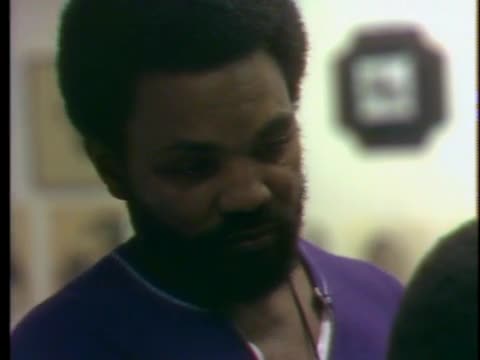
- [Description from the original press release] State Senator Ernest Chambers is interviewed in the Omaha barbershop he operates in a special broadcast airing Saturday, August 9, at 7 p.m. While giving program host Mal Adams a haircut, Senator Chambers discusses his political views, personal background, and recent legislative victories.
- Series Description
- RAP ABOUT IT is a weekly "Minority Affairs" series hosted and produced by Mal Adams
- Created Date
- 1975-08-09
- Asset type
- Episode
- Genres
- Talk Show
- Rights
- Access to material from Nebraska Public Media’s archival collection is for educational and research purposes only, and does not constitute permission to modify, reproduce, republish, exhibit, broadcast, distribute, or electronically disseminate these materials. Users must obtain permission for these activities in a separate agreement with Nebraska Public Media.
- Media type
- Moving Image
- Duration
- 00:33:59;29
- Credits
-
-
Producing Organization:
Nebraska Public Media
- AAPB Contributor Holdings
-
Nebraska Public Media
Identifier: cpb-aacip-b775f57c380 (Filename)
Format: 1 inch videotape
Duration: 00:29:40
If you have a copy of this asset and would like us to add it to our catalog, please contact us.
- Citations
- Chicago: “Rap About It; Senator Ernie Chambers,” 1975-08-09, Nebraska Public Media, American Archive of Public Broadcasting (GBH and the Library of Congress), Boston, MA and Washington, DC, accessed October 8, 2026, http://americanarchive.org/catalog/cpb-aacip-7db1f62185c.
- MLA: “Rap About It; Senator Ernie Chambers.” 1975-08-09. Nebraska Public Media, American Archive of Public Broadcasting (GBH and the Library of Congress), Boston, MA and Washington, DC. Web. October 8, 2026. <http://americanarchive.org/catalog/cpb-aacip-7db1f62185c>.
- APA: Rap About It; Senator Ernie Chambers. Boston, MA: Nebraska Public Media, American Archive of Public Broadcasting (GBH and the Library of Congress), Boston, MA and Washington, DC. Retrieved from http://americanarchive.org/catalog/cpb-aacip-7db1f62185c