Religions of Man; 9; Taoism
- Transcript
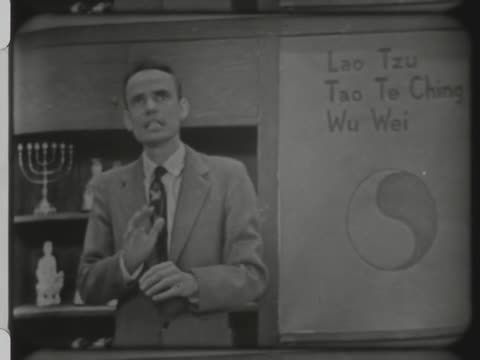
University College of Washington University and KETC, the St. Louis Educational Television Station presents a course for television. The Religions of Man to Houston Smith, Associate Professor of Philosophy at Washington University. This is a picture of the founder of the religion we are going to be considering tonight.
We know very little about this man. We don't even know what his real name was. Many scholars doubt even that he lived. All we really have is a mosaic of legends which have come down to us. Some of these are obviously quite fantastic that he was conceived by a shooting star was carried in his mother's womb for 62 years and was born already and old man was white hair and wise. Other legends, other parts of the legends have about them, the ring of authenticity, that he lived a very quiet and secluded life, that his occupation was that of the keeper of the archives in his native state, that people found him very baffling. On the one hand, they sensed a real depth in the man and his spot, but at the same time there seemed to be something about it with him which was beyond them, so that they found his saying cryptic and baffling.
The legends of his life conclude with the account that as he reached his later years, he wanted even greater solitude than he had had during his life. So he climbed on the water buffalo and rode out towards the northwestern frontier of his country. There, according to the legends, a warden recognized him and learning that his mind was made up, that he was going to his draw permanently from society. The warden asked him if he wouldn't at least leave a testament of his philosophy of life for humanity. Now to the finally consented, he withdrew for an evening and came back the next day with this tiny volume, the Taoda Ching, consisting of only 5,000 characters in all you can read it in an hour, a testament to man's basic at wholeness in the universe, the Bible of the religion we are considering tonight.
Now, what a curious life this was for the founder of a religion. He didn't preach, he didn't organize a following, he wrote a tiny little book, and then he climbed on a water buffalo, rode off, and that was the end of it. How unlike Buddha, who stayed around for 45 years, trudging the dusty roads of India to get across his perspective to the people? How unlike Jesus, unlike Mohammed, even unlike Confucius, as a matter of fact, this life is not like that of any other founder of a religion that I can think of. Here was a man so little concerned even about the success of his own ideas, to say nothing of fame and fortune that he didn't even stay around to answer the questions of the class. And yet there is something in this attitude towards life which makes it a fitting symbol for the religion itself.
We're going to be looking at this attitude in just a few minutes. But first of all, there are some terms that sound foreign at the start, but we need to get them into our equipment before we can go on with our consideration of the religion. And first of all, the name of the supposed founder himself. Here it is. Laozi is the way it is pronounced. Literally, Lao means old, and two means of fellow, or boy sometimes, or one. So this can be translated the old one, the old fellow. Now, this in itself is strange, a strange title for the founder of a religion. Jesus was called the Christ, the anointed. Buddha was called the Enlightened.
These are terms of status, of tremendous dignity. But what do we have here? It's really a kind of nickname, isn't it? In order to ring the full meaning from it, though, I think we must note two connotations which the word old has. One is a term of affection. Have you ever noticed, if you're like most people, even with regard to small children and babies, you will sometimes use the word old. Not that it has any chronological accuracy at all, but it does have a kind of affectionate overtone. For Chinese, the word old has another overtone which is foreign to our culture. And this is the connotation of respect. In the West, I don't know why, maybe it's because we lay such stress on the material. But we tend to look at the prime of life as being youth.
The late teens, the early 20s, when the body is in its prime. It's very different in the Orient, where the prime of life is the period of age and presumably wisdom. When a person in our culture says he or she's 50, the retort is likely to be, while you don't look a year over 40. In China, if someone happens to mention that he's 50, the report will be, while you look every bit of 60, the intent is the same in both cases, courtesy. But it reflects in a very telling way, I think, a difference in evaluation. So when this man was titled the Old One, it carried with it these meanings of affection on the one hand and a steam and respect on the other. Now, the other term that we need to get clearly in mind is this, which it's a phrase which is the title of the basic text of Taoism.
It's pronounced Tao the Jing, if we want it in the Chinese. And this term means literally the way. And it's a central term in the religion. It's so central that it is carried over in the name of the religion itself. Te means for its power and Qing means book. So if we translate this literally, we get the book on the way and its power. All right, I think this is our basic equipment. Tao, the basic idea, the name of the religion is Taoism. The founder of the religion is Lao Tzu, and the title of the Bible of Taoism, so to speak, is the Tao that Chang. Now, we'll come back to the last term in a few minutes.
But first of all, we have to make another distinction. Because really there is not one Taoism, there are three. One kind of Taoism is what we might call popular Taoism. This is the Taoism of the masses. And I must say that this is, as far as I can see, a far from beautiful thing. The Taoism, the popular Taoism, which I was acquainted with in my years in China, struck me, I want to be charitable, I want to say, as I see these things, struck me as comprised largely of a mat of superstition, of magic, of concern with warding off the evil spirits. The path from the Taoism itself to popular Taoism is like moving from a crystal clear mountain spring down to the waters of a muddy and scummy and stagnant canal. There's a tremendous gap between this basic book and the popular religion.
We will not be talking about popular Taoism this evening, but we need to know that it exists. A second kind of Taoism is what we might call esoteric Taoism, and we're not going to be concerned about this much either. This was occupied basically with psychic phenomena. It borrowed yoga techniques from India, and through concentrating on stillness, and what they call sitting with a blank mind, it would shut out all the interferences of the world, and try to bring the individual in touch with Tao, which would sort of a transfuse, infuse his life with psychic power, which then he would radiate to the community in which he lived. It's a very interesting phenomenon, but again, this is not the Taoism, which has left its mark on Chinese culture. The Taoism, which has left its imprint and in an exalted way on the Chinese culture, is the third kind,
what we might call philosophical Taoism, and this is the Taoism, which we should be considering this evening. Now, what is the meaning? What is the meaning of Tao itself? Well, if we open up the basic text, the Tao duching, the first chapter and the first verse, we read these words. The Tao, which can be named, is not the true Tao. This means that ultimately Tao in its fullness is beyond human understanding. It's beyond the power of words to grasp. We are confronted here, then, with the basic mystery, the mystery of all mysteries, the entrance to the ultimate mystery of life. You can, Lao Tzu felt, know this ultimate Tao, but only through a kind of mystical awareness, which transcends all words.
And so, as he puts it in his cryptic epigram, those who say about the ultimate Tao do not know, and those who know do not say, because they know it cannot be conveyed in words. But though Tao is transcendent in its ultimate nature, it is also imminent. And in its imminent form, I think we can refer to it as the way of the universe. It is the norm, the rhythm, the driving power in all nature. It is the ordering principle behind all life. And what is the character of this principle? Well, it is spiritual rather than material, and so it can never be exhausted. The more it is used, the richer the fountain will gush. It is generous, infinitely giving towards man and towards the world.
It also has a touch of inevitability about it, but coupled with a gracefulness. This then would be the Tao as manifest in the universe. Now a third meaning of Tao or the way would be the way of life, the way in which man's life ought to be lived as geared in with this way of the universe. And now we turn towards what this way of life actually is. Now the basic concept in this way of life, which is geared in with the basic power of the universe, this way the quality, the basic quality is what is called woo way. Now this is frequently translated as inaction, but that's really not quite right. In fact, it's really far from right. This is not non-action. It is not a do-nothing attitude towards life.
What it is is creative quiet. This is a kind of force, which is infinitely subtle and infinitely intricate. It is a consummate gracefulness, which is born not out of willowy weakness, but out of abundant vitality, in which there is no violence and no jerky. When simply lets the Tao flow in and flow back out again until all life becomes a kind of graceful dance in which there is no feverishness, no imbalance. Wooway is life lived above tension. As the Tao duching says, keep stretching a bow, you repent of the poor. A whetted saw soon grows thin and dull. But far from being non-action, woo way is a kind of pure effectiveness towards life in which there is no outward show, but neither is there any wasted motion.
Again, as the text puts it, one may move so well that a footprint never shows. Speak so well that the tongue never slips. Reckon so well that no counter is needed. It is then the subtle force, which makes its way by seeking out the opening and the empty spaces in life and moving through these. This basic attitude approach to life is illustrated in many little anecdotes in the Taoist literature. Let me just tell you a couple. One is the anecdote of the butcher who all his life had used a cleaver and he'd been hacking up carcasses all day long but had never lost the razor sharpness of the cleaver yet he never had to sharpen his cleaver. And this was very strange to his associates and they asked him how he achieved this and he said, really it's very simple. In every joint, the bones never quite meet. If they did, they would lock and there would be no movement at all.
There's always a small, very small space between the bones in every joint and what I do, I seek out the space between the bones and my cleaver moves in this space and then the bones fall apart of their own accord. There's also the story of the fisherman who landed tremendous fish with a very fine line and again they asked how this was possible and he said, well for a line to break, there must be a weakest point in it but this line has been made with such skill that there is no weakest point and therefore there's no place at which the line can break and you can land a fish of any size. There are just stories of course but they illustrate the approach to life of this intricate effectiveness which doesn't jar but makes its way nevertheless.
Now another quality, another quality in this whole approach is that this is a way of life which puts no stock in competition in self assertiveness. The world as we all know is full of people who are determined they're going to be somebody or else give trouble. They want to get ahead to stand out. Taoism has little confidence in this way as they're fond of saying the axe falls first on the tallest tree. Again they say standing on tiptoe you lose your balance and therefore at no time will a man who is saying overreach himself, overspend himself, overrate himself. A few lines from another chapter, surrounded with treasure you lie ill at ease, proud beyond measure you are brought to your knees, do enough without lying, delivering, not dying.
Because of this almost reverence for the attitude of humility they placed great honor in the hunchback and the cripple because these people were so humble in their outlook. Again they were fond of saying that the value of a cup lies precisely in its emptiness and another saying be as selfless as melting ice. Man at his best like water seeks his own level, the common level of all life. Again illustrating the point against assertiveness they will say nature does not have to insist she can blow for half a morning, can rain for half a day. Well not only was man not to be strident and insistent and pushing aside in his relations towards other men but also in his attitude towards nature.
What should be man's relation with nature? This is a tremendous point for every people to saw. By and large our Western attitude seems to be that we look upon nature as an antagonist. Something to be conquered to pit ourselves again, something to be dominated, something to control. In Taoism it's different. Nature is something basically to be befriended. Do you remember when Everest was conquered what the terms we used were the conquest of Everest. An oriental said to me if we were to look upon that achievement we would have called it something different. We would have called it not man's conquest of Everest but man's befriending of Everest. So too in Taoism the ideal is to become tuned in with nature. It's really a very ecological approach. And maybe that's why Frank Lloyd Wright has found so much of value and has drawn so heavily on Taoism.
When you see the Taoist temples they don't stand out from the landscape. They are nestled against the hills back under the tree so they sort of blend in with the environment. At the best man is identified with nature. So those who flow as life flows, know they need no other force. They feel nowhere, they feel no tear. They need no men, no repair. Another quality and this I think is the last one we will be able to take up is the doctrine of the relativity of all opposites. Here is the Yang and the Yin which symbolizes this, the basic dualism in all thought. But the dualism in China is not one of antagonism, not one of opposition.
But rather the thought that both parts are needed. And so Taoism is very fearful of clean cut and sharp antagonistic dichotomies between anything in the world. And this holds with regard to good and evil for one thing. We draw a sharp distinction between what we regard as good and what we regard as bad. The Taoists are never quite so sure of our evaluations. There is one story for example about the man whose horse ran off and his neighbor came over to commiserate with him. He said who knows what's good and what's bad. Sure enough, the next day the horse came back. It had a grove of wild horses brought back with it. And so the neighbor came over to congratulate him this time and he said well who knows what's good and what's bad. Sure enough his son climbed on one of the wild horses the next day fooling around fell off and broke his leg. So the neighbor comes over this time to commiserate with him and once more the man says who knows what's bad, what is good.
And sure enough the next day the person comes around from the government recruiting for the draft and the son doesn't have to go because he's got a broken leg. This symbolizes perhaps the attitude of the relativity of opposites and against our clean cut distinction. I want to close with two attitudes towards life which I think are very deep in this outlook. One is an attitude of lightness. There is a kind of gayity, a charm about this approach to life which is the opposite of the heavy booted approach. This too is epitomized in certain stories. The story of Tronzu who dreamed that he was a butterfly and then he woke up and this puzzled him because he didn't know whether now he was Tronzu who had dreamed he was a butterfly or was really a butterfly now dreaming that he was Tronzu. There's the other story about the pleasure that fish enjoy where the Taoist Tronzu is on a bridge looking down at the fish alongside his companion who is a logician.
Tronzu says look at those fish darting back and forth how gay how pleasant is the life of a fish and the logician looks over at him and says you're not a fish fish how do you know that the life of a fish is gay and delightful. Tronzu turns on him and says you're not me how do you know I don't know what the life of a fish is like well always there is this kind of urban sophisticated never too serious on the surface and yet with a real point of seriousness. The other quality well I want to give you to my favorite couplet in connection with this quality of lightness this couplet which says he who feels punctured must once have been a bubble or economy in statement and making a point I think that's one of the masterpieces in all literature. The other quality is serenity a deep serenity towards all life and death as well.
Well blending together like the young and the young themselves Confucianism and Taoism represent the two great Poles of the Chinese mind Confucius stands for reason Lao Tzu stands for intuition in our terms we might say Confucius represents the classical Lao Tzu the Romantic Confucius stresses social responsibility Lao Tzu exalts naturalness and spontaneity Confucius has his focus always on man Lao Tzu beyond me as they say Confucius roams within society Lao Tzu roams beyond society. Probably there is something in human life which reaches out in both these directions certainly I think we can say Chinese civilization would have been poorer without both of them but last time we talked about Confucius tonight we have talked about Lao Tzu and I think it's fitting that we conclude with one of Lao Tzu's hymns to the Tao this ultimate principle beyond around which his whole life was orient. There is a being he said wonderful perfect it existed before heaven and earth how quiet it is how spiritual it is it stands alone and it does not change it moves around and around but does not on this count suffer
it wraps everything with its love as in a garment and yet it claims no honor it does not demand to be law I do not know its name and therefore I call it Tao the way and I rejoice in its power the religions of man is produced by Washington University and KTC channel nine the St. Louis Educational Television Station and production center this is
NET National Educational Television you
- Series
- Religions of Man
- Episode Number
- 9
- Episode
- Taoism
- Producing Organization
- KETC-TV (Television station : Saint Louis, Mo.)
- Contributing Organization
- Library of Congress (Washington, District of Columbia)
- Thirteen WNET (New York, New York)
- AAPB ID
- cpb-aacip-75-956djsq4
- NOLA Code
- RLGM
If you have more information about this item than what is given here, or if you have concerns about this record, we want to know! Contact us, indicating the AAPB ID (cpb-aacip-75-956djsq4).
- Description
- Episode Description
- A Chinese religion less well known than Confucianism is introduced in the ninth episode of the series. Profoundly mystical, Taoism teaches a subtle and skilled approach to living that avoids violence, jerkiness and self-assertion in favor of subtlety, grace and pure effectiveness. (Description adapted from documents in the NET Microfiche)
- Episode Description
- Presents the story of Laotzu and his book, The Way of Life. Discusses the basic concept of Taoism, creative quietude. Characterizes this belief as one which does not favor competition, but rather allows man to seek his o-w-n level with his fellow man and with nature. (Description from NET Film Service Catalog 1960)
- Series Description
- The first college accredited course given on TV in St. Louis, this series features Dr. Huston Smith, associate professor of philosophy at Washington University. A survey of the great living religions of the world and how they influenced human history, the course covers Hinduism, Buddhism, Confucianism, Taoism, Judaism, Christianity (Protestant and Catholic) and Islam. Lectures traces the start of these religions, their founders and what each teaches as lifes meaning and the way to its fulfillment. Born in China of missionary parents, Dr. Huston Smith has had first-hand acquaintance with the religions of both East and West. Dr. Smiths graduate studies were completed at the University of California and the University of Chicago, where he received his PhD in 1945. He is president of the Missouri Philosophy Association and is the author of The Purpose of Higher Education, published in 1955 by Harper and Brothers. Dr. Smith taught at the University of Denver and the University of Colorado before joining the Washington University faculty. His course on The Religions of Man grew from 13 to 140 students in the first seven years he taught it. The 17 episodes that comprise this series were originally recorded on kinescope. (Description adapted from documents in the NET Microfiche)
- Description
- With the recent rebirth of interest in religion and its effect on the life people live, Religions of Man is a timely and informative series. The programs give a clear insight into the great living religious of our world: Hinduism, Buddhism, Confucianism, Taoism, Judaism, Christianity, and Islam. Dr. Huston Smith discusses their origin, founders and what each teaches as to lifes meaning and the way to its fulfillment. A Chinese religion less well known than Confucianism will be introduced in the ninth program of the series. Profoundly mystical Taoism teaches a subtle and skilled approach to living that avoids violence, jerkiness and self-assertion in favor of subtlety, grace and pure effectiveness.
- Broadcast Date
- 1955
- Asset type
- Episode
- Topics
- Religion
- Rights
- Published Work: This work was offered for sale and/or rent in 1960.
- Media type
- Moving Image
- Duration
- 00:29:40
- Credits
-
-
Producing Organization:
KETC-TV (Television station : Saint Louis, Mo.)
- AAPB Contributor Holdings
-
Indiana University Libraries Moving Image Archive
Identifier: cpb-aacip-5103ce58472 (Filename)
Format: 16mm film
-
Library of Congress
Identifier: cpb-aacip-50a3d1c00a1 (Filename)
Format: 16mm film
Generation: Master
Color: B&W
-
Thirteen - New York Public Media (WNET)
Identifier: cpb-aacip-c2e08490bee (Filename)
Format: 16mm film
Duration: 00:29:01
If you have a copy of this asset and would like us to add it to our catalog, please contact us.
- Citations
- Chicago: “Religions of Man; 9; Taoism,” 1955, Library of Congress, Thirteen WNET, American Archive of Public Broadcasting (GBH and the Library of Congress), Boston, MA and Washington, DC, accessed September 5, 2026, http://americanarchive.org/catalog/cpb-aacip-75-956djsq4.
- MLA: “Religions of Man; 9; Taoism.” 1955. Library of Congress, Thirteen WNET, American Archive of Public Broadcasting (GBH and the Library of Congress), Boston, MA and Washington, DC. Web. September 5, 2026. <http://americanarchive.org/catalog/cpb-aacip-75-956djsq4>.
- APA: Religions of Man; 9; Taoism. Boston, MA: Library of Congress, Thirteen WNET, American Archive of Public Broadcasting (GBH and the Library of Congress), Boston, MA and Washington, DC. Retrieved from http://americanarchive.org/catalog/cpb-aacip-75-956djsq4