Briefing Session; 507; Minimum Wage
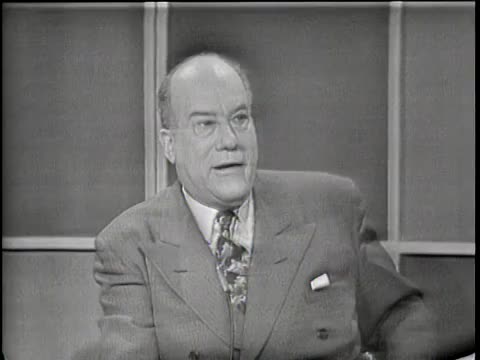
- Transcript
From New York City, National Educational Television presents briefing session, the facts behind the issues in the world today. The funds for the production of this program have been provided equally by the AFL CIO and the National Educational Television and Radio Center. Your host, the noted Washington correspondent of the American Broadcasting Company, Edward P. Morgan. Welcome to another edition of briefing session. One of the sharpest issues to divide Congress is the federal minimum wage. This has been true since the issue first arose in 1938. The House and the Senate right now are locked in debate over the question of how deeply the federal government should be involved in the private sector so called of the nation's economy.
At the very core of this is the issue of the minimum wage. As we talk to you, the administration's minimum wage bill or an amendment to it may well have passed. But whether it has or not, this issue will continue to divide liberals and conservatives in and out of Congress. Minimum wage is what might might call a 20th century phenomenon. To discuss it, we're fortunate to have two guests, Mr. Merrill S. Rucaiser, syndicated financial columnist and business consultant, and Mrs. Mary Dublin-Kaiserling, consulting economist and member of the Board of Directors of the National Consumers League. Mrs. Kaiserling, is this phenomenon good or bad for the country? It's a very good thing that this discussion is going on. But I hope it will get quickly beyond the discussion stage to the stage of passage of a much stronger Fair Labor Standards Act.
The Fed-Ralact now on the books is quite out of date. Only 24 million people are covered. 20 million wage earners are not protected. The Fed-Ralor now provides for those who are covered the assurance of only a dollar an hour. This means only about $1,600 a year for the average worker. This is a pittance wage on which no American can live. No one alone living alone or the head of a family can possibly make ends meet on a dollar an hour. Mr. Rucaiser, do you want to join the issue? Well, like Mrs. Kaiserling, I'm for high living standards increased material well-being. The issue is how to achieve these economic benefits. I wish it was as simple as just passing a law because our friends in the island of Cyprus just the other day told us they were preparing a five-year
economic plan and they're going to seek economic aid in the West. Well, according to Mrs. Kaiserling's proposal, we just tell them to pass a minimum wage law and they'll be all right. It's obvious that we've got a discussion and probably a debate incipiently cooking here. First, though, to fill us in on the facts of the law, let's hear from briefing session's news analyst, John McVeigh. The Fair Labor Standards Act, passed in 1938, was designed to be the first step in a new direction. It put a 25 cent floor under some wages rising to 40 cents by 1945. It established a normal work week of 44 hours to be reduced by stages to 40 hours. In general, the Constitution grants the federal government the power to regulate interstate commerce only. So, of course, the new law affected only those industries thus involved. The policy declaration of the law said its purpose was to correct and as rapidly as
practicable, to eliminate labor conditions detrimental to the maintenance of the minimum standard of living necessary for health, efficiency, and general well-being of workers. Before the law was more than a year old, a test of its constitutionality had begun at a small lumber mill in statesboro, Georgia. The firm involved was F.W. Derby, incorporated, and the issue was overtime wages. The case moved rapidly to the Supreme Court where the law was upheld by a five to four vote. It has never been seriously challenged since. In 1949, Congress increased the wage minimum from 40 to 75 cents an hour after the tremendous economic growth and price rises that came out of World War II. But at the same time, about one million workers were removed from its coverage, mostly in retailing. The minimum was increased again in 1955 to a dollar an hour, but with no expansion in the categories of jobs covered. As of January 1961, an estimated 24
million workers come under the provisions of the act. A minimum wage of at least a dollar an hour with time and a half for overtime, but for every five workers protected by the act, they're at least four who weren't an estimated 20 million in all. These include farm hands who haven't any coverage at all, workers in retail trades, and service industries such as hotels, restaurants, laundry, and hospitals. Our opponents of the law maintain that the state should protect their own workers. Since the federal law was passed 23 years ago, many states have enacted minimum wage laws of their own. Some of them are fairly high. New York, for example, ranges up to $1.5 an hour, but only 12 states, including Alaska and Hawaii, have general minimums as high as $1. In many states, the minimum is appallingly low.
Arkansas for one prescribes a minimum wage of a dollar and 25 cents a day, or about 15 and a half cents an hour. In others, such as Ohio, Arizona, Colorado, the law applies only to a few industries. And in 21 states, there is no minimum wage protection at all. At this year, the administration's proposal was for a graduated minimum wage increase. All he rakes for workers already covered by the law would rise to a dollar 15 minimum now, and a $1.25 within two years. In addition, coverage would be extended to more than four million workers not now affected by the law, principally in retail trades and services for them. The minimum would start at a dollar an hour, gradually rise to the dollar and 25 cents figure. Now, those opposing any expansion and coverage argue that many businesses, not now paying minimum
wages, would be wiped out if they were forced to do so. The United States Chamber of Commerce cites a 1960 Labor Department report showing a 10 percent drop in employment in low wage plants in the south after the last minimum wage increase. Those in favor maintain that higher wages for these workers will mean more buying power for them, resulting boost in the economy. They also point to the fact that as long ago as 1959, the Labor Department felt that a city family of four needed a breadwinner making at least $2.60 an hour, more than twice the legal minimum, just to get along. Let's return now to our guests for their opinions on the issue and Ed Morgan. Mr. Rukaiser, let's try to clarify one point right off the bat. Do you think that a federal legislation on minimum wage is necessary or even legal? Well, the question of legality stems from the constitutional provision in the 10th amendment
that the states reserve to themselves, the power is not delegated to the federal government. And in this previous minimum wage legislation, it's been defended on the ground that interstate commerce has involved. And as a result, retailing and various service occupations, such as laundries, were excluded. But in this new agitation, they've found a way to get around the constitutional barrier. They say that if an enterprise has a gross income of $4 million a year, and if one or more of its employees regularly travels or communicates across state lines and his work or orders, or keeps records on goods from outside the state, then this comes under the federal jurisdiction. You didn't quite answer my question. Let me try to put it another way. Would you repeal the federal minimum wage laws that are now in the books? No, I wouldn't do that at all because I think the society has adjusted themselves to those
standards, and I think it's very upsetting to try to turn the clock back. Any more than I would want to go back to the pre-World War II dollar, much as I regret the 100 percent inflation or more that's taken place, I think it would be more upsetting to turn the clock back and return to a previously existing status quo. Mrs. Kinesling, how did we arrive at a dollar in a quarter? If minimum wage floor is a good thing, why not go higher and make it a dollar and a half and make it a better thing? Because we know that a dollar is totally inadequate for American families and for American workers in general and wage owners. We know that it must be higher. Then the question is how much higher? And that becomes a question of what would be a reasonable adjustment? This is a 25 percent increase in the minimum. In 1955 the law was amended and the wage was raised from 75 cents to a dollar. And this doesn't apply to all workers. No, this is a very not at all.
Lifting the administration bill would lift the wage to only a dollar and 15 cents. This, for those now covered, would provide additional wages to only 1.9 million additional workers. It would not cause unemployment. This, even if it went to a dollar and a quarter, which I believe it should do as rapidly as feasible, it would be a smaller relative increase than was made in 1955 when the law was last amended. And when that law was amended and the wages were lifted, the minimum wage was lifted 33 and a third percent or more than the dollar and a quarter, there was no provable impact on employment. Actually, when the Secretary of Labor made an intensive investigation, he could find only 1,800 people in this entire USA who might possibly have lost their job because the minimum wage was increased at that time. We've obviously got a bone of contention
here. The US Chamber of Commerce as Mr. McVane quoted flatly says that it would cause unemployment. Do you agree, Mr. Rookhizer, and how grave would the unemployment be? Well, Mr. McVane referred to the report of the Labor Department studying the impact of the 1956 increase in minimum wage. And that report showed that in the group of 12 low wage industry segments, there was a 9% drop of employment. They were in such industries as sawmills, children's, hosieries, cigars, workshops, and fertilizer. Obviously, if we're having unemployment now as we are during the recession, at present wage rates, it seems a little bit fatuous to argue that we would end the unemployment by paying more for the less efficient workers. But on the overall picture, I think it was Mr. George Meeney, the President of AFL-CIO, who said addressing himself to this point that rather than
lower our wage standards or keep the minimum low, he would prefer to push for higher wage standards abroad. And this gets into a point that we can explore a little bit later on, Mr. Skryzer Ling, about whether we're pricing ourselves out of the market. But what about that general position? These are not either all positions, Mr. Morgan. I think it is a very desirable thing that wages be lifted everywhere. We now have the capacity as human beings to meet men's needs. We have a potential which we can realize. And it's very desirable that living standards be lifted abroad and even more desirable that they be lifted here in the United States, where our potential is so vast. Mr. Rukhizer, I do have to say one thing. It's simply fantastic. That in a country as rich as ours, we should have to be fighting so hard to get a wage higher
than this tragically low dollar and now. Is what you're saying in a sense, Mrs. Kyzer Ling, a legislated redistribution of the wealth? No, it isn't actually. What it is isn't incentive to greater efficiency. We have found in the past that when a minimum wage was raised, it led employers to become more efficient, to use their labor force more intelligently, to lower their costs so that they could pay their employees more and even keep their prices constant. If we agreed you correctly, you would agree with that. No, it isn't a question of that. I want to be responsive to your question. I think we've heard from this gracious lady about many emotional and humane ambitions of hers. But I'd like to give an answer to your question of what we think of means. Mr. Meeney's suggestion that the way to
survive in global competition is to use some of our do-goodism abroad and encourage the labor leaders overseas to get their wage standards somewhere in keeping with American wage levels because for the first time in our history, this is of crucial importance until very recently we were able to offset high hourly wage rates here way above the global level through unique efficiency and technological methods. But under the Marshall Plan and under economic aid, we've financed these countries in buying machinery and equipment more modern and more efficient than our own. So for the first time, we're smack up against this type of competition. And as a remedy, they're proposing that we get further out of line and widen the gaps. Well, I don't know whether it would be further out of line and the widen the gaps if you prevailed on them in some way or another to raise their own wages. Let me be narrowing the gaps. I'm talking about this type of legislation that we're discussing
today. I'm talking about the steel settlement a year ago when our steel wages were about four times those of competitive countries in Europe and Japan. We widen the gap through a collective bargaining agreement and as a result, we turned a recovery into a new recession. Let me ask you this, Mr. Rukhizer, and then I'm going to yield the floor to Mrs. Kaiseling. Do you argue that the low rates of, say, a laundress getting 65 cents an hour or a migratory worker getting a dollar a day for picking peaches is a healthful state of the economy? No, indeed. It's one of the casualties of our economy. Well, wouldn't the minimum wage legislation as I understand it helped to remedy that situation? No, the minimum wage legislation is based on a completely false diagnosis of the trouble. The trouble is that in certain areas, in certain groups of our workforce, we have people who are handicapped either by age or illness or by inexperience or lack of training and who are less productive than other workers. So, to think that we can correct that by passing a
law saying that no matter how little a person produces, it's illegal to pay him less than a arbitrary amount. What you do would be a shove into the unemployed, many marginal and sub marginal people who are earning at least pen money and contributing something to the family support. Mrs. Chryslerling, you're the doctor now and we'd like your diagnosis. Well, an awful lot of false issues have been raised. First, let's settle very briefly this international one. We've talked of raising the wages of retail clerks and of laundry workers. That's what this bill would do. That wouldn't change our position. These are the world trade. We don't trade in laundries and retail trade. Oh, I totally disagree with you. One of our costs. One of our costs is going to be a lot of money. And then you interject. The wages of those who are now covered in manufacturing would not be affected by lifting the minimum wage from a dollar to a dollar and a quarter, about four fifths of the commodities which we produce for export are made by workers who get
more than the minimums. So that lifting the minimum would not rate harm our competitive position. I find that people throw this foreign trade argument in to bedevil the argument. Well, I want to depend on this to many. I don't think he was trying to develop the best of it. No, I don't think he was. I think it was. I think it was a constructive state when he was pointing to one of the most serious disparities in our economic life. And let's face these issues realistically without too much sense of virtue. Let's get down to the last time. Could I talk to? I've been very patient in listening to your soliloquies. I'd like to point out that we face very serious competition all over the world. And that we're facing it in countries that have turned away from new dealism and government intervention in the economy. We're facing it from countries such as West Germany, which had had its stomach filled with inflation before and which is based its recovery and its expansion and its economic growth. Number one on sound money and number two on the open
pre-competitive market. And this is just one step in the direction of destroying a competitive society. Would you agree? Let me just interject a question to you both. But address first to Mr. Rukhizer. Isn't it logical? Isn't it a logical progression of your argument that we should cut wages in order to give more? No indeed. I have worked out and written extensively on the subject. What we should do is to get as Secretary Goldberg has so wisely and astutely said before the NAM and elsewhere, let's get the unions and management together to discuss this serious competition through consultive consultation, through not collective bargaining, but collective consultation. So they both face the problem so that we can expand job opportunities in the United States. And instead of cutting wages which would be extremely destructive, which would not only be bad from the human standpoint, but would interfere with the capitalization of our banks and our great financial institutions. Instead of that, I say that the unions and
management together in the spirit of cooperation and harmony should look at the cost sheet and eliminate from it all types of waste. Some of them are posed by legislation. Some of them imposed by outside pressures. Some of them imposed by feather betting and by obsolete work rules. And that if we if we do that, we end by uneconomic tax measures. If we look at those things and take the water out of the cost sheet, then we can go up with an onward in the rated merit in the adventure of setting living standards for the whole world. Mr. Kaiserlink, as I read Mr. Kaiser's argument in a sense, he is indicating that he is arguing from a sound economic base and that you're arguing from a humanitarian but a not sound economic face. Well, I don't mind being called a humanitarian. I think that's virtual. But I think I am arguing from hard economic facts. I believe that the reason we are in the fourth recession since the end of World War II is simply that purchasing power of our people has not been rising as rapidly
as the increase in our capacity to produce. Well, only last year, Mr. Kaiserlink, this has not just let me finish this, Mr. Kaiser. I didn't come from way up. Personal incomes of some people. Overall, I'm talking about the pay of wage owners in manufacturing today is no higher than it was in 1956. This means that purchasing power has not been rising as our capacity to produce has increased. This is as profits are higher, but overall, what has been happening is that millions of our low income families have been left behind. I wonder if people know that there are more families today with incomes of under three thousand dollars than there were in 1953 measured in dollars of constant purchasing power. Some people have been getting income rises, but the people who need the most have been left behind. Mr. Kaiser. That is why from a strictly economic point of view,
we must get purchasing power to those at below income levels within our country. This will help to stimulate the economy. It will help to turn the wheels of industry. It will take us out of the recession, and it will help to prevent the recurrence of new recession. Mr. Kaiser, let's try to get to specifics to illuminate the thing a little more if we can, assuming that an annual wage for a coal miner of between $600 and $1,500 a year as I learned a few weeks ago in Kentucky was the case, or that that of a peach picker is anywhere from $800 to $1,600 a year, assuming that these situations are not helpful. How would you move to correct them? John Alois already moved to correct the situation in the coal mining industry. He elected through deliberate choice to have many
fewer jobs in coal mining, but to have well-paid jobs, and the average wage of the coal miner today is higher, not lower, than the average industrial wage. I picked a bad example. As a result of that, we have a tremendous decrease in employment in West Virginia, Pennsylvania, and other coal areas, and they've become distressed areas. Now, at a time when we have distressed areas, the proposal is to try to relieve the situation by paying people more who can't find jobs at even these prevailing wage rates. Let me conclude, because I've been patient during these soliloquies. It's been suggested that some of the inefficient people at the bottom, the badly trained people who are not adjusted to the changes in our technology, are not earning enough to live well. I agree to that. I think that we have a social problem. I think that possibly the remedies through the food plan, or through giving them tax exemption, or giving them some kind of
government aid, but the fallacy in this bill that is putting the subsidy burden on the small employer, he's not only unable to bear it, but he's unwilling to bear it, in a wrong order. Mr. Rook has used using the same arguments that were used in 38 and 49 and 55 against the act in the first place and against extracting at the two later occasions. It's too bad to post it in listen, because you've had 100% inflation during this. Yes, but what's wrong? Oh, but that has, it hasn't been the minimum wage that's done yet. It's been a contributing factor to the equipping inflation. Yes, that's right. How can a hundred of listen? That was your great follow-up thing. Oh, no, wait a minute. The talk too much and didn't learn. Passing a minimum wage law doesn't raise prices. We have an excellent study of 50 industries in New York State, 50 large-scale enterprises of what happened after New York State lifted the minimum wage. And what happened in these industries which were the ones most affected in mid-state New York by the improvement, the considerable lifting of minimum wage? Do you know that in those industries
where wages were most lifted, prices did not rise and why? Because employers were stimulated to be more efficient. I've got to ask you both to shift gears now and give each one of you a minute to sum up and will you start Mrs. Kaiserling? I'd be delighted too. We've been talking about a very vital issue before Congress. Should the federal minimum wage law be strengthened? Millions of Americans say yes because the existing minimum wage of a dollar an hour is tragically no. No one can live on this patents wage. We should lift it to a dollar and a quarter as rapidly as possible. We should extend the axe coverage as rapidly as possible, five or six million more people. Pittance wages are bad for the wage earner. They're bad for the taxpayer because they patents wages lead to ill health and other social abuses which for a burden on the taxpayer. We taxpayers must subsidize inadequate wages through relief payments. Inadequate patents wages
are bad for business. They're the cause of recessions. Let's do away with them. I agree with you. Pittance wages and the way they get rid of patents wages is to retrain ineffective and inefficient workers and to improve a technical method, not to pass along Congress. Minimum wage standards are as Professor Samuel Simmelton of the economist of MIT and present Kennedy's advisor recently pointed out by no means an anti recession measure. At best minimum wage provisions represent social amelioration. They won't give any lifting power. Experience shows that the short run effect is to curtail job opportunities as it did last time. A more sensible approach would be to retrain the unskilled and the inefficient workers. If this is impractical and if their productivity needs to be supplemented by a subsidy, the burden should not fall on the small and marginal employer, but on governmental or private philanthropy. In a competitive society, a worker is expected to give a quid pro quo in productivity. Now your time is up Mr. Rookizer.
About the only thing that it seems possible for us to agree on completely today is that we've had a minimum time to discuss the minimum wage. I don't know what significance it has, but in listening to the Saliliquiz and the Coliquiz this afternoon and this evening, I'm reminded of the fact that many more years ago than I cared account, my minimum and maximum wage for mowing lawn out in the West Coast was about 25 cents an hour and now babysitters are getting over a dollar. Whatever that means, we can talk about it later. Next week, briefing session will take up one of the great and growing challenges to American foreign policy. The emerging nations of Africa will focus on the countries that have yet to achieve independence and try to foresee what's ahead, chaos as in the Congo or an orderly transition to self-government. We hope to see you then. Briefing session was produced by Joel O'Brien,
Associate Producer John Seever. Film supervise a Bill Buckley production assistant, Barbara Schemman. Our guests today were Mr. Merrill Rookizer, syndicated financial columnist, and Mrs. Mary Dublin-Kaiserling, consulting economist. Your host Edward P. Morgan of ABC and news analyst John McVain, funds for the production of this program were provided equally by the AFL-CIO and National Educational Television and Radio Center. This is NET, National Educational Television.
- Series
- Briefing Session
- Episode Number
- 507
- Episode
- Minimum Wage
- Producing Organization
- National Educational Television and Radio Center
- AFL-CIO
- Contributing Organization
- Thirteen WNET (New York, New York)
- Library of Congress (Washington, District of Columbia)
- AAPB ID
- cpb-aacip/75-4947dd83
- Public Broadcasting Service Program NOLA
- ECON 000114
- NOLA Code
- BRSN
If you have more information about this item than what is given here, or if you have concerns about this record, we want to know! Contact us, indicating the AAPB ID (cpb-aacip/75-4947dd83).
- Description
- Episode Description
- Guests this episode are Mr. Merryle S. Rukeyser, former financial editor of the New York Herald Tribune, author, and business consultant; and Mrs. Mary Dublin Keyserling, member of the board of directors of the National Consumers League and the National Federation of Settlements, wife of economist Leon Keyserling. (Description adapted from documents in the NET Microfiche)
- Series Description
- Briefing Session is a public affairs series.
- Broadcast Date
- 1961-04-02
- Created Date
- 1961-03-13
- Asset type
- Episode
- Genres
- Talk Show
- News
- News Report
- Topics
- Economics
- News
- News
- Public Affairs
- Employment
- Media type
- Moving Image
- Duration
- 00:29:22
- Credits
-
-
Guest: Keyserling, Mary Dublin
Guest: Rukeyser, Merryle S.
Host: Morgan, Edward P.
Producing Organization: National Educational Television and Radio Center
Producing Organization: AFL-CIO
Reporter: MacVane, John
- AAPB Contributor Holdings
-
Thirteen - New York Public Media (WNET)
Identifier: wnet_aacip_1820 (WNET Archive)
Format: 2 inch videotape
Duration: 00:29:02?
-
Library of Congress
Identifier: 2335358-1 (MAVIS Item ID)
Format: 16mm film
Generation: Copy: Access
Color: B&W
-
Library of Congress
Identifier: 2335358-2 (MAVIS Item ID)
Format: 16mm film
Generation: Copy: Access
Color: B&W
-
Library of Congress
Identifier: 2335358-1 (MAVIS Item ID)
Format: 16mm film
Generation: Copy: Access
Color: B&W
-
Library of Congress
Identifier: 2335358-2 (MAVIS Item ID)
Format: 16mm film
Generation: Copy: Access
Color: B&W
If you have a copy of this asset and would like us to add it to our catalog, please contact us.
- Citations
- Chicago: “Briefing Session; 507; Minimum Wage,” 1961-04-02, Thirteen WNET, Library of Congress, American Archive of Public Broadcasting (GBH and the Library of Congress), Boston, MA and Washington, DC, accessed April 2, 2026, http://americanarchive.org/catalog/cpb-aacip-75-4947dd83.
- MLA: “Briefing Session; 507; Minimum Wage.” 1961-04-02. Thirteen WNET, Library of Congress, American Archive of Public Broadcasting (GBH and the Library of Congress), Boston, MA and Washington, DC. Web. April 2, 2026. <http://americanarchive.org/catalog/cpb-aacip-75-4947dd83>.
- APA: Briefing Session; 507; Minimum Wage. Boston, MA: Thirteen WNET, Library of Congress, American Archive of Public Broadcasting (GBH and the Library of Congress), Boston, MA and Washington, DC. Retrieved from http://americanarchive.org/catalog/cpb-aacip-75-4947dd83