The Art of the Theatre; Stage and Backstage: Space for Illusion
- Transcript
This is National Educational Television. Station KUN TV, University of Nebraska Television. In cooperation with University Theatre presents the Art of the Theatre, the
Art of the Theatre. There is no standard form for these. The program gives us a kind of a pre -performance briefing of the play. But we have come to the theatre to see a play.
We see the actors, the liplovic, the crude and unkept superintendent of the local hospital. Look -ish, the spineless and self -pitying local school administrator, mission, a servant in the mayor's household, and Laptkin Tapkin, the provincial judge in the local Don Juan, even if he's somewhat old for a Don Juan. All of that which is taking place here before us seems to be happening spontaneously. The curtain rose and there it is. And this is as it was intended. We are the audience. And how all of this came about isn't for us to know. But what we just saw was created. It just didn't happen. Of course you know this. You realize that nothing of what you just saw existed except the play, the lines, the characters. A few suggestions about settings and a few suggestions about stage business. But all the rest was visualized, designed and built
by the artists, designers, the craftsmen, the technicians, and the theatre. Now their names are right here on the program. But they're easily overlooked. And it had to bend these people. Actually there had been no performance of this play in the first place. Now in the next few minutes we want to take you backstage. We want to show you these people where they work and what they work with, the materials they use. You know there's more to a theatre than simply a stage and not a toy. So then this is our program. Stage and backstage. Space for illusion. Now let me give you an idea about all the people that are connected with the play. Basically the production staff for a play would divide yourself into four groups. The director and his associates. The designers.
The craftsmen. And the technicians. Now we've left out the actors. Not that we should but you know about them for meeting your program. Now there may be fewer people than here depending upon the play, upon the characters and so forth and so on. But what's important these are the unsung heroes of the theatre. They don't take curtain calls and they don't stand in the spotlights on the stage. Now this is a chart showing these people. We're coming back to them in a minute. There may be even more people than listed here. There may be a musician for example to compose music. Music technician to handle the sound equipment to play recordings. There may be a choreographer to arrange dances and pantomimes and work with ensemble groupings on the stage. But even here there are at least 50 people in this particular play. Now this production staff was used for the inspector general as produced at the University of Nebraska. Now where do these people work? What do they do? What do they do
all the work that needs to be done in order to produce this play? Well let's go back four or five weeks. Actually these people take about four or six weeks in which to do their work. And their work period is divided into three parts. The planning and the design period, the building and the construction period, and then the period for the technical rehearsals. Now in the first period the production staff meets in several conferences in order to arrive at an agreement on the play's meaning. The style of form is to take in the theater. And in a general way the means by which the theatrical form of the play is to be created. The number of these conferences will vary depending upon the play and the problems the play presents. These are basically the four groups we saw a moment ago on the chart. Now let's meet them. Obviously if the production staff is to work smoothly and their work is to be integrated there must be a supervising artist who stands between the play and the production staff. This is the director explains his concept of the
play, its theme, meaning, mood, characterization, and in general the production style or treatment the play should receive. The technical director stands between the director and the rest of the production staff. His job is to guide and supervise the designers, the craftsman and the technician. The director's assistant helps in directing the actors, prompts the actors while they are memorizing lines and holds the script off stage during performance. The stage manager is in complete charge of the production during technical rehearsals and performance. She will supervise all scene changes, give all actors and cues, warn actors of their entrances, and in general she runs the show backstage. The costume designer is responsible for all the costumes. Like all the others she has read and analyzed the play before this conference. Consequently she has ideas of
her own and she has brought some preliminary sketches with her. The head costumer and the costume crew will sit close to the designer for their responsible for making all costumes. Throughout the entire production staff there must be a close relationship between the designer and the craftsman who interpret and build that which has been designed. Now this is the light designer. He knows that light, its color and intensity is related to the style moved in content of both the play and the director's interpretation of the play. He is one of the key people on the production style because light can do more than any other technical element to express the meaning and to harmonize all of the elements of the production. The light technicians will set up the lights according to the light plots prepared by the designer and handle the lighting instruments and the control board during the technical rehearsals and the performance. The scene designer has the responsibility of designing the scenery and stage properties and this includes
not only designs but working drawings and instructions for painting. He will make notes on the script and make preliminary sketches that he listens to the other designers and the director express their ideas and feelings about the play and the characters. The head -scene carpenter, the properties manager, the head -scene repainter and the head -stage technician and their crews will question the scene designer as he expresses his concepts of the play. Since the makeup and the costumes are to be worn by the actors, this work of the designers must be closely correlated. The color and shape of the face and the hairstyle is an integral part of the total effect of the costume. It is best that the actors do their makeup from their makeup plots prepared by the designer but this isn't always possible and usually a makeup crew working under the designer will help with the makeup. Now there are hundreds of ways of interpreting a design and there must be close understanding
between the designers and the craftsmen and the technicians who comprise the play production staff. Well now that we've met these people, seen their responsibilities, let's look to see where they work, their equipment and materials, the things that they use in creating their part of the production style for the play. Let's look in on the design room. It is here that the second part of the planning period takes place, preparing the actual designs, models and working drawings. There must be space for models of scenery, supplies, drafting paper, watercolor paper, drawer space for working drawings and blueprints. These are the designers for the play, the Inspector General. Since it is the job of the technical director to check and integrate the work of the designers, he will make frequent visits to the design room. The costume designer sketches must reveal the color, style, form and effect the costume
is to have when worn by the actors. The accessories to the costume, jewelry, purses, gloves and so forth must be clearly sketched alongside the costume. The designer will paint on the design samples of cloth from which the costume is to be made. She checks with the light designer to make certain that the color and cloth of the costume will not be killed or disagreeably changed by the wrong color of light. Here is the scene designer. Now he is not merely designing a room in a house. He must remember that the actors must move freely and unhampered in this setting he is designed. The setting must help the actor can fade the characters to the audience. The designer must translate his designs into working drawings and blueprints, drawn with meticulous care and accuracy. There must be instructions for construction and painting. Hand properties and stage properties must be carefully
drawn and described. The scene designer will integrate his designs with the light plot prepared by the light designer. The light designer must know the form and color of the scenery before he can decide upon the color, balance and the intensity of the light. The technical director will check the light plot with the movement of the actors in the stage setting to see if the light designer has put light in the right place at the right time. The designer of the light knows that he must create a mood through color, light and shadow, but at the same time the actor must be seen. Well, this is but some of the work that goes on in the design room in preparation of the play. In this room the ideas about the production style of the play, those formulated at the conferences are translated into actual designs. Now in the planning period for a play, nothing is left to chance, nothing is left to accident. Designs are drawn and
redrawn, plans checked and rechecked. Because all of these artists know that an artistic achievement of the performance of a play is the result of a plan calculated design calculated to achieve a very specific effect. Now when designs are finished, working drawings complete, the craftsmen take over. Now we enter the second phase, the building and the construction period. Now let's go to the workshops to see where all this is done. This is the scenery workshop. Now the atmosphere here is quite different from that in the design room. There's more noise and more activity. The craftsmen work here, the corporates and the painters, and there's the director and the technical director. The last time we saw these they were at the drafting and design tables. Here is the sketch and the model for the scenery. The head carpenter will make sure that the scenery is constructed according to the design and specifications. To construct scenery accordingly, the scenery workshop must be well equipped. Power tools
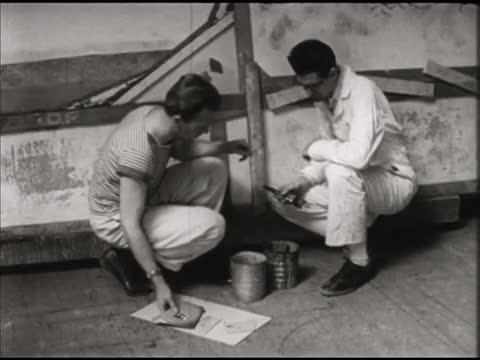
and a tool and supply room in which the hand tools, paintbrushes and hundreds of small items used in constructing scenery are stored. Over here the head painter and his craftsmen are preparing to paint the scenery. Here as in the construction, the designs will be followed in detail. The painters know that the details of the sketch must be exaggerated. The painting must be done in a bold and free manner. This scenery is for the stage and the audience gets its impression from a distance. The stage lighting must be considered. Light has a tendency to change, not only the quality of the color, but its intensity as well. And the makeup and its effect against the painted scenery must be considered. So here in the scenery workshop, as in the design room, the craftsmen relate their construction and painting to the stage and to the actor.
They show devotion and respect to the designers. For only in this way can the scenery, when it reaches the stage, help the actor express the play to the audience. Well now let's move on to another workshop in the theater, the costume workshop, the working area for the costumers, the dress makers, those who build the costumes from the designs. Here are the sewing machines, tables for cutting and laying out the materials, dressmaker forms for modeling costumes, storage drawers and shelves and compartments for materials and supplies. A sink for dyeing fabrics, racks for hanging costumes as they are constructed, space for the storage of costumes. This equipment and these facilities are only a means to an end, the construction of a costume, which is as effective on the actor as it was in the sketch on the designer's table. Next, the makeup
workshop, another space in the theater building vital to the play. Now ideally, each actor should be capable of applying his own makeup, but many times they are not, and it becomes necessary for the makeup designer and his assistants to come to the makeup workshop or make up room to assist the actors. Here again the actor, like the costumer, must follow the design, the color of the costume and the color of the face must harmonize. It is to the actor's advantage to have the best and most useful tools in his makeup kit, grease paints, pencils, powders, bases. The actor must realize that makeup is an art, closely aligned to portrait painting, for the actor literally paints a portrait on his face. An understanding of the principles of color, light and shadow are indispensable to the actor in the application of his makeup. Now in the property,
workshop of the theater, the property crew is fabricating a prop according to the specification set down in the sketch prepared by the scene designer. Their work resembles that of a furniture and a poultry shop. These people are actually building furniture for the play. It has to be built, covered with cloth and the wood stained or painted. Other members of the crew are collecting hand properties from the list prepared by the designer. If the precise articles can't be found in property storage, they must be built too. And here is the trim property crew, responsible for draperies, pictures on the walls, rugs for the floor and bases and lamps for the table. The designer has specified what is needed and it is up to the crew to provide it. Now let's look at the workshop for the stage technicians.
Their workshop is in the theater itself. Now this model here, the Howell Memorial Theater at the University of Nebraska, will show us precisely what this workshop includes. This is the stage itself. The theater audience sees only a small portion of the complete stage, the part in which the scenery is set. The entire stage is called the stage house. It includes the wing space to either side of the acting area. This is the acting space, and actually it is but a small part of the stage. Above the acting area is the fly space, where scenery, drapes, backdrops and other pieces of scenic equipment are stored when not in use. At the top of the fly space is the grid eye. A system holding the pulleys in cables by which the scenery and drapes are flown into the fly space. In one of the wings we will find the counterweight system, a method of controlling the scenery being flown. This however is but one method of handling scenery.
The modern stage floor may be equipped with special devices such as elevators, revolving platforms or stage wagons. The stage technicians must be adept with each method of handling, moving, setting and striking the various pieces of scenery used in the play. To help them perform their work, a number of pieces of equipment have been devised. Stage braces, screws, lash lines and scenery jacks, while these are about a few. Now with the scenery in place, we are ready to look at the music technicians and look into their workshop. Their workshop likewise is in the theater itself. More specifically it's right back here, right in the back of the auditorium. From here they can follow the action of the play and hear the
dialogue through microphones on the stage and speakers in the booth. The sound system in the well -equipped theater will have speakers in the auditorium and on the stage. The tape recorder captures the dialogue to be played back to the actors for study. Turn tables are needed to play the recorded music and sound effects used to heighten the mood, atmosphere and emotional levels of the play. A mixing console controls the intensity and quality of the music. A telephone system connects the booth with technicians in the backstage areas. A sound library adjoining the booth provides the technicians with a large variety of selections from which to make their final selection. The music crew will come here to listen to music in order to select that which is needed
for the play. If original music is not to be composed, the only remaining technicians we haven't seen at work are the lighting crew. Their workshop is the auditorium and stage in which the play is to be produced. Their equipment is the lighting system in the theater, basically in two parts. The lighting instruments in the control apparatus for this equipment. The lighting instruments are of three general types. Spotlights, floodlights and striplights. All used to light the acting area according to a particular plot prepared by the light designer. The various types of lights are hung in a catwalk built in
the ceiling of the auditorium. They are mounted at the sides of the auditorium and hidden from the audience. Sometimes they are hung backstage on either side of the proscenium, sometimes they are mounted on the front of the balcony and overhead just behind the act curtain. They are used as backlight, side light to list but a few of the uses of light for the theater. Here the light technician and his crew are following the lighting plot and setting up lights for a scene in the Inspector General. A crew member is checking the gelatin for spotlight to see that it conforms with the light designer's specifications. Another focus is a spotlight to make sure that the beam of light strikes the stage in the area specified by the light plot. A technician adjusts the floodlight in a door backing. Now this activity will continue for several days.
In this particular plot, the Inspector General, the 35 spotlights used in one scene. Each instrument has to be checked for color and focus. As the lights are being set, other light technicians will be at the light control board, regulating the intensity of the light from each instrument. The lighting controls often are located just to the side of the stage, but ideally the light booth, light the sound booth, will be located at the rear of the auditorium overlooking the stage. Here in a soundproof booth, the technician controls the intensity, color and distribution of each light instrument in full view of the results. The control board is capable of pre -setting the lights
for five different scenes at one time. Well, with the lighting of the scenes out of the way, we've watched the entire production staff at work. We saw each through the planning and design period, we saw each through the building and construction period. Now we're ready for the third and final period, that of technical rehearsal. Now this is the period where all the various elements come together for the first time. Where the entire production is assembled and rehearsed on the stage, sometimes at great length, depending upon the complexity of the play. The production manager now takes charge and runs the play. All the weeks of planning, designing, constructing and rehearsing
are culminating now. All the elements of the production have been polished and blended toward a single purpose to reveal the meaning, the mood and atmosphere of the play to the audience. At this point, and only at this point, can the audience assemble, the curtain rises and the play begins. This is the magic moment, which all of the collaborative artists in the theatre have worked. This is the result of their combined effort, acting, scenery, costumes, makeup, lighting and sound. From these elements of the media of the theatre, is born the illusion of the theatre. And so when the audience reads their program, they will find not only the name of the play, the author, the director and the actors, but they will also see the list of the production staff, those who are responsible for the production of the play. Now we've shown you these people, how they
organise their work, where they work, their design rooms, their workshops, the materials and the equipment they have. So this is our program, stage and backstage, space for illusion. Next week, the play, Idea for Illusion, program 4 in the series, the art of the theatre. Featuring Dr. Dallas Williams, associate professor of speech and dramatic art, and director of university theatre at the University of Nebraska. Mr. Whitaker is assistant professor of speech and dramatic art, and director of laboratory theatre. Mr. Ledger is managing director of the Lincoln Nebraska community theatre. Also featured were students from university theatre, University of Nebraska, filmed by University of Nebraska photographic productions.
Music Produced by station KUN TV, University of Nebraska television, or the educational television and radio centre. This is
national educational television.
- Series
- The Art of the Theatre
- Producing Organization
- Nebraska Public Media
- Contributing Organization
- Nebraska Public Media (Lincoln, Nebraska)
- AAPB ID
- cpb-aacip-6beaa4c7de1
If you have more information about this item than what is given here, or if you have concerns about this record, we want to know! Contact us, indicating the AAPB ID (cpb-aacip-6beaa4c7de1).
- Description
- Episode Description
- This episode is the third in a series of 12 episodes about the fine art of theatre. This episode focuses on the role of the production crew, including designers, craftsmen, and technicians. It shows procedures followed by production staff during the creation of a play, including where they work, how they work, and which tools they use.
- Series Description
- [Description provided by WNET] This series depicts how and why Theatre is a Fine Art. The programs introduce the audience to each of the collaborative artist of the theatre: the playwright, the director, the actor, the scenic designer, the costumer, the makeup designer, the lighting designer, the composer – the artists, designers, craftsmen and technicians of the Theatre. The program illustrates the work of each and show how all combine to present the play to the audience – to create the “illusion” of the theatre. Examples and illustrations are drawn from other fine arts by guest painters, sculptors, dancers, violinists, art critics and symphony conductors. Sketches, illustrations and dramatic vignettes from plays are used throughout. By examining the medium, subject and form of theatre art and by showing the creative efforts of the contributing artist of the theatre, it is planned to increase the audience’s understanding and appreciation of the theatre. The series was produced by KUON-TV, the University of Nebraska Television. [12 episodes, 1957]
- Copyright Date
- 1957
- Asset type
- Episode
- Rights
- Access to material from Nebraska Public Media’s archival collection is for educational and research purposes only, and does not constitute permission to modify, reproduce, republish, exhibit, broadcast, distribute, or electronically disseminate these materials. Users must obtain permission for these activities in a separate agreement with Nebraska Public Media.
- Media type
- Moving Image
- Duration
- 00:29:11.125
- Credits
-
-
Producing Organization:
Nebraska Public Media
- AAPB Contributor Holdings
-
Nebraska Public Media
Identifier: cpb-aacip-6d7b6f8dfb4 (Filename)
Format: 16mm film
If you have a copy of this asset and would like us to add it to our catalog, please contact us.
- Citations
- Chicago: “The Art of the Theatre; Stage and Backstage: Space for Illusion,” 1957, Nebraska Public Media, American Archive of Public Broadcasting (GBH and the Library of Congress), Boston, MA and Washington, DC, accessed June 11, 2026, http://americanarchive.org/catalog/cpb-aacip-6beaa4c7de1.
- MLA: “The Art of the Theatre; Stage and Backstage: Space for Illusion.” 1957. Nebraska Public Media, American Archive of Public Broadcasting (GBH and the Library of Congress), Boston, MA and Washington, DC. Web. June 11, 2026. <http://americanarchive.org/catalog/cpb-aacip-6beaa4c7de1>.
- APA: The Art of the Theatre; Stage and Backstage: Space for Illusion. Boston, MA: Nebraska Public Media, American Archive of Public Broadcasting (GBH and the Library of Congress), Boston, MA and Washington, DC. Retrieved from http://americanarchive.org/catalog/cpb-aacip-6beaa4c7de1