Black Journal; Part 2. 356-11-11. 1968-12-09-- Episode 7
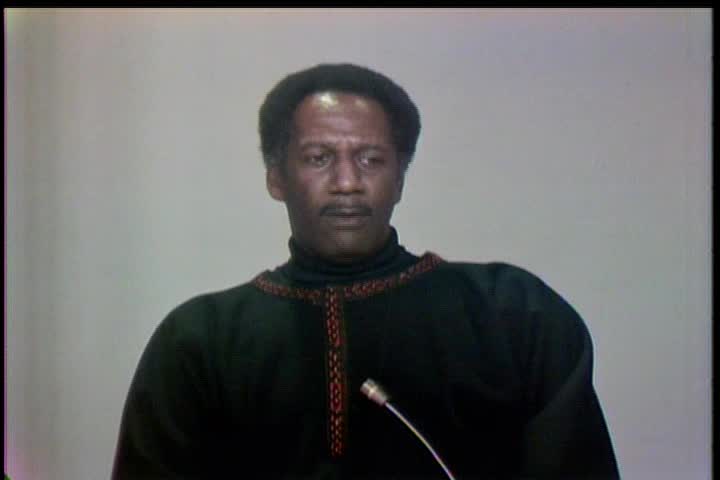
- Transcript
Yeah, and that's important, you know, but you've got it and you came all together. I don't know. I don't I don't want I say human resource is so valuable. I don't want to waste anything. Yeah, to me, this is what I say. I say just both and we need to help them all. I say if you've got a job that a father can do and a job that a C.A. son can do, we have the job. Good evening, Jean-Baud. That's a lot of Malaykin brothers and sisters. This is Black Journal. I'm Lou House with William Greaves. I have a panel of guests with me this evening. We're going to talk about some of the things that happened to Black folks in 1968 and maybe talk about, I hope, anyway, where it's going to be at 1969 for Black folks.
And also along the series of Black Journal, some of the things that we won't have an opportunity to finish up here, we'll stick in along the series and you'll always have a chance to look at some of our good and esteemed brothers and sisters like Bill Strickland on my left who is a writer and historian. Next to me is Reverend Andrew Young, the executive director of the Southern Christian Leadership Conference on my right is very vivacious sister and wife, Mrs. Eldridge Cleaver, who is a communication secretary of the Black Panther Party. Robert Johnson, who is the executive editor of Jet Magazine and for sake of a little mirth and laughter on my far right, Alexander J. Joe Allen, who is the regional eastern director of the National Urban League, it's a geographical location, just geographical. What's happened to us in 1968 to the brothers and sisters, what's happened to change the thinking in some of the ideology and political viewpoints of young Black people in America, especially those young people who have been active on the political platform as a done any good.
Those who are in the streets, those who are in our schools, the question for dignity as the question for self pride and for determination and control and if we're looking and seeking these things how we're going to go about it. I think it's the important issues and also other issues that come up this year, how does the situation in Africa affect Black people in America and what we do here, how does it affect Black people in Africa and the islands and South America and many other places. Let's take a gaze at that and I think I was talking earlier with Bob Johnson from Jet and he was talking a little bit about the dignity thing. Bob, we were talking earlier about that and I don't know if you wanted to express those ideas you had concerning the self dignity and pride in the Black awareness.
We simply, the question was raised and you know what are we about and I said among many things that Black people are about, this quest for human dignity. I mentioned there was also the matter of equal justice, I talked about equal opportunity but much of what has been happening during the year 16th, the 1968 that is the student protest movement and the high school level, the college level. The predominantly Black colleges as well as the mixed colleges so-called, you've had an override and concern for Black dignity, Black students wanted to identify with the part of a history that Black people had contributed. George Washington history, they got plenty of all but they didn't get all of it and this is part of the thing that Black people were concerned about. I mentioned for example in the city of New Jersey in a 6th grade class a Black student when they just happened almost in an off the wall kind of a thing.
Why is it that we always have holidays for white people? Why don't we have holidays for Black heroes? Now of course this teacher didn't stick strictly to the letter and allowed room for this digression, who do you have in mind? Well, this student happened to mention Chris was at it but he went to the Black board and students were throwing names at him, Fred Douglas, Nat Turner, W.D. Du Bois, Martin Luther King, Miles Comet, et cetera. Finally when they got a Black board for me and they decided to let's board it down. If we were going to try to get one of these for New York, which one was settled upon? So the way the poll turned out, it was in favor of Chris was at it. So then how do you go about doing this? They petitioned the school board, they got the politics and all this other thing together. Now March 5th, this year, 1960, for the first time in the history of the United States and the city of New York.
Every public school closed its door because March 5th was Chris without exam. Now you can imagine the problem that you had with some white parents that morning, you know, when little Stephanie didn't get up to go to school and Stephanie wanted to go to school. There's a holiday, you know, this is Chris without a say, the mother probably said Christmas, who? But they're definitely had to educate a mother about Christmas addicts, rollin' American Revolutionary War, so forth and so on. Now here was a constructive thing. It's too bad that you don't have national holiday on a black hero. Now a lot of them, you don't have to stick with Christmas addict. And then you have a lot of black heroes. We should have monuments, stand in tall, and the cities, you should have buildings and streets and institution names for black people.
The city of Chicago, where we come from, Luke. Well, as a matter of fact, as a matter of fact, you'd like to keep referring to Dusabla, the first non-Indian resident, you know, around the first black resident. He didn't come there as a citizen from justice. He didn't come there to get on somebody as well for a relief role, you know, or to put up climb statistics and so on. And now on the property, you have the regular building, the Chicago Tribune, a portable life, as a matter of fact, that's some pretty good property. Now in Chicago has not seen fit. The owner of the founder of the city, over in Missouri, they did lay a gravestone market. Let's see, that was where he was going. And that was in Missouri. And that's not in Chicago. I would like to say that what you have for constantly, a hunk of metal. No, this is not necessarily a defecation to art lovers. I appreciate, you know, this because I understand the cost of barred extensively from our African brothers.
But that would be an ideal location to place a statute of equal height and size of a black man, Dusabla, or instead of having say, or the school flows out, or to honor Dusabla, the entire city could have a holiday, honor the black times. This also brings out the point to Bob concerning the black student movements across the country. And I think that they're also pointing at this particular type of thing that you're talking about. Not only for heroes, the curriculum that is being taught in schools is basically not relevant to black youngsters. Black youngsters are demanding that they see themselves and their heroes in those books that they're having in their school system that is being jammed down their throat. And we can go back to the racist society that we live in that deletes the large segment of its population from any recognition in its book. I just want to pause you also for a moment and say that we're very happy to have join us, the good brother from across the river here from Newark, Leroy Jones, writer, and one of our esteemed black brothers.
I'm so happy to have you with us brother. But we all our cities have had this upheaval of students. And I think the student movement has to be looked at very closely by black adults to know which direction we are going to go in because the students are going to move. Because if I'm not mistaken, that is the basis of nucleus of a very strong group that is moving in this country right now, the black times. As a matter of fact, the founder of the black times party, Huey P Newton, started as a college student at Merritt Campus moving to get Afro-American history on the curriculum of that college. At this point, now in 1968, Merritt College has a black studies program and you can get a degree in that. This is where Huey began actively in his black national activities on the coast. But in terms of the black student movement, you have to go much further than that back to 1960 in Greenville, North Carolina, where the first sit-ins began, and this is the beginning of the whole overt protest movement in this country.
Again, with black students, the black times party in Miles County, the student nonviolent coordinating committee, black students, the black times party, Bobby Seale and Huey Newton, black students. And wherever you look, the real impetus of change has come out of the youth who were in school and who were in a position to sit back and analyze some of the things that were going on and were willing to take action. The most significant now is it's not the college students only that are moving, but it's all the way down to junior high and even elementary schools, they're all moving. And even in the first second grade, the little kids now, they don't even relate to that foolishness. They have their own little things, they have their own clubs and their own activities because they relate to all their older brothers and sisters. They're doing, after they've gotten out of school, but I say that the student movement is essentially just a vital part of the most vital part of the black movement.
You can't separate students as a separate category among black people. There is a student movement in the mother country among the white people, but there's a black movement among us that students participate in and lead. And if this is the students in their quest, you know, we have in search like Huey, the time of the Afro American studies in merit college is also brought up another field that we have an exam and I think is black people as close as we possibly can or should. And that is our relationship with our African brothers and the still that's the same colonization program that's going on. It's the same thing that reaches out and smears up. Well, as a matter of fact, if you look right in terms of time, it was the liberation of Ghana that sparked much of the activity on the part of black people. And here was the Afrika that had been depicted as a land of savages and tarzan and apes. This was the Afrika that black people knew. And so after the Garvey's movement had planted much African identity among our parents is this new generation related to Africa and another way they could see it. They could relate to Ghana, they could relate to Nigeria, they could relate to many things and now their active guerrilla movements going on in southern Africa.
And I say most black people are aware of their identity with Africa, except some of the older ones are very reluctant to admit that. There are also basic things that we face in many of our black communities and that is that we can sit here and discuss these things. But in reality, do all the masses of black people are they aware of these many things or if there's an awareness of it? I think we touched on a little earlier when we said that the black community is victimized in many different ways and one of the ways it's victimized is that its channels of communication are not controlled by them to any large degree. I'm thinking about data rest, I'm thinking about the media and the rest of it. What is needed of course is a better way of being able to get the information. I think of the emotional kind of response that you saw and felt throughout the black community in the recent Olympics, for example, the victories of those black runners from Kenya met the great deal to black Americans. In fact, I guess it was ironic that here you have American citizens who were more enthusiastic about seeing an American runner beaten by a black runner from Africa than they would have been if the American had won.
I think part of it is that we were glorying in that as we had a black man, Malwhitsia, you know, in space who trained these Africans who found a lot of talent. I wanted to digress this one moment to get this in and then we could move on when we were talking about the students and this whole movement on the college campuses and the life. One of the things that I felt was prideful about, I know one black college in particular, I don't care to call the name for an indictment, that used to boast about the fine drama department it had and yet that had never been a place produced on that campus. It was written by a black author or about black people until some students decide they want to do the works of Leroy Jones and insisted on it being done. And that was a breakthrough for 1968. Perhaps Mr. Jones might even know whether or not there have been other means what there have been.
I respond to some colleges in high school who would like to incorporate some of his work in heaven to further this idea. I would say add to that about the student movement a lot of times you find on the Negro college campuses that the students are being held down harder than they were on these predominantly white campuses because they're usually able to get a strong sense of collective. Collective effort when they're isolated on the white campuses and they moved from the rest of the Negro campuses and I went to Howard. The administration and so time is you know that they go out of their way like at Howard you know when neighbor we once looked up to they go out of their way to suppress you know so that you see we we can appear on white campuses for a black student union. Actually more quickly than we can appear at you know at a Negro college you know for our own people I mean it took more I think effort to get us that shore and Howard in fact I went to Howard one time and they wouldn't even let me speak in the auditorium we finally had to go out on the campus and speak in front of the school religion because they closed all the doors you know.
And they're so the Negro a lot of times are so paranoid that the white people are going to get them or something you know what I mean. That they're worth actually the Negro administrators turn out a lot of times to be you know we're worse than what administrators. Well I had a I was interested in this student with billionaires revolve this one in high school and college campuses. You write and build right and they're talking about curriculum changes talking about things that should be relevant to black students. Well how do we get into this? Where do we start to make these lines and then get you know let this the student now we're talking about black students.
Well we were fighting this in Newark and still are you know Newark is Italian controlled city you know between the mafia and the other one you know like Imperiala you know who got into this fraudulent election. But we were fighting that last year we had a big student boycott 3000 students we took out for a Malcolm Day and took them to the armory you know. And the students are there where but we we were fighting for basic curriculum changes for instance at the predominantly Jewish high school used to be predominantly Jewish now and bloods and then to everywhere in Newark. Because that's our town in terms of numbers but you could always get Hebrew you know what I mean and you could get Latin of course. And in the predominantly Italian school you could get Italian when I went to school you could get Italian and Latin. But then suddenly they asked for Swahili or Arabic is somehow a racist you know rather than just you know the sense of you know where it's cultural pluralism you know in America. And so far it's not like garbage but it's just that we don't have courses relating to us and we grew up a curriculum and got it approved by the black students by 3000 black students at an armory overflowing that included courses like Arabic and Swahili and first aid in case you have any more police rights in our neighborhood.
We thought that even the little ones rather know how to you know fix their parents up and karate courses you know in place of you know throwing ball back and forth you know something useful to them. Although we found out in the Italian suburbs they teach karate as part of the classes you know part of the curriculum. But we asked for karate as part of the curriculum in our grammar schools right away it becomes you know some kind of a strange violence and we said if you're going to teach mathematics why don't you teach the history of mathematics. Teach the children who invented ours mother who invented the concept of zero. Did you know that was an Eastern Hindu concept you know zero. Did you know the difference between Arabic numerals and Roman numerals you know why expensive watches have Roman numerals instead of Arabic numerals. But a lot of the things we said if you taught the history of them and instead of these cultural tips taking these children out to see a white art you know camel suit cans and go look at some other irrelevant stuff.
Take them to their own communities and explain why their fathers have to sit out 100 houses unemployed or explain why these people have these bars on each one of our corners and we can't get any health and welfare. You know explain that to the children on the early age explain about narcotics who sells narcotics who benefits it is and so forth. In other words start the total education you know and we weren't talking racism in the sense only as maybe an accountant to the white nationalism that's taught in the school. But the children are hit to it. You know they've always been hit to it and in Newark especially the young people all the way down. In the grammar school my wife teaches a black school two or three years and we have our school you know in Newark where we teach the children about themselves you know about their culture about their own languages you know teach them that when we say classical music we're talking about Duke Ellington. Duke Ellington on Africa not you know in Europe.
Doesn't that oppose another problem to them doesn't it? That is the training of those who teach our black youngsters and here again new right, built right, pop right probably all in some way or another right or we voice things but yet still the group sitting right here. I said you go into a school and start teaching these things. Well you teach all the time but not through the established panel. Well the main activity of the black dance party is educational. Here in Newton is a profound teacher of the community of black people. Stokey Carmichael is a teacher of Malcolm X. All these people are teachers this is where we receive our education and back to the question of students I think that definition needs to be broad and considerably because you must look at the brother Malcolm and Eldridge also as students because the whole time that they were in jail what they did was study, study, study and teach themselves. They taking from the western tradition and whatever tradition they get their hands on what they wanted and putting it together for themselves. They were not trained by these institutions which are really brainwashing centers for black people.
But they trained themselves in the black man's jail and the white man's jail is really the black man's university and these are our teachers. So much of the creative writing that being done in the black community is done by people who did not have the opportunity for college education. This is because they can be creative. Until just recently it's hard to find really creative writing that reflects our interest from people who come out of our university. No, no, it's not that. It's a writer like Eldridge, these call that protest revolution. It's not really the issue that's classical Afro-American literature. A writer like Du Bois, a writer like Walker. These are people that have mastered the tools of the English language to express what's inside of themselves.
You see that's the thing about protests. That's always been a white man's definition. I can look out of my window and describe the events on that speed at any given moment and a white man will call it social protest literature. Our people have always written from an Afro-American point of view from time they've got it. There's been people who have been accommodationists and Tom. But there's always been writers, black men on the scene who have told about America the way it actually was. And this is what we're talking about for the students. This is what we have to relate to them and relate to them. The history of our own traditions. You see, if they have to relate to their own writers as protest writers, you see what I mean? That is, they're seeing them through a white definition rather than seeing the long history of black and Afro-American writing as being full of social consciousness. The African tradition stresses that good and beauty are a synonymous and the same. We don't split them up. We comment on what is good and what is beautiful because of our tradition as African and Afro-American.
It's only your opinions that make this kind of schizophrenic split between what is good and what is beautiful. They have to find a convenient label until they understand it. Then they usually try to copy it and move away from it. But you don't have to question it. Let me make this point. On the question about the amount of teaching that Mrs. Ellen Cleaver alluded to. I think the teaching can go on. This is where we've got the straightening of black teachers who are in all of the school system. You see, you don't have to wait until a school board comes through with a curriculum in order to teach black history. As a matter of fact, you can pick up any class no matter what it is and just simply find out what will black people do it and talk about it.
For example, even in a math class, you're going to start talking about math and so you say something about euclids and so on. Well, let's talk about Benjamin Vanita, the inventor of the striking clock and the math tools that he used to help the design lay out the city of Washington, or if you're trying to construct a citizen, diagram it. Let's get Claude McKayne's poetry, or Langston Hughes's poetry, or Leo Jones's poetry. Let's diagram no sentences and find the subject in the verb and adverb. Or if you're talking about history, if you're talking about the Civil War, and this teacher just simply talks about this quite recently, then you talk about there were black people on both sides. There were some gregs of melons of water, and you know, and so forth and so on. All these teachers have to do is just arm themselves with the black literature. I mean, died yesterday, so on the show.
Ebony. There's two other things here that needs to be in it too. Right, I would just want to catch up on that. I think Bill's going to find it. It's supposed to be. Yeah, it's supposed to be. I thought that we, this is indeed a new stage because several years ago, you wouldn't have brothers from the Urban League and the Black Panther sitting here in great fraternity. Which is an indication of how far we've come. But I think there are two things that are important on the question that brother Lee Roy raised. The false definitions of protest literature, which is a white definition of the problem. What's happening and perhaps one of the reasons why brothers who've been in jail are producing significant literature is because they're talking about reality. And what we've been, Karinga makes a point because a distinction between education and propaganda, that I call a distinction between education and knowledge. And Stokley and Hamilton's book, they make the point that a society cannot condemn itself. And one of the things that Richard Wright said, and I think said correctly, that if a true analysis of this society is to be made, it will be made by black people. Because white people are not able to face the significance of all those dead Indian bodies, of all those black bodies in the Atlantic Ocean.
They're not able to face the significance of a so-called system based on law that has seen thousands upon thousands of black people murdered. Yet has never taken the life of one white man for having murdered a black. At the hypocrisy and the contradictions of this system are just overlooked. And what the literary establishment does when you write about that, they say that's sentimental. Or they say you're a moralist or an absoluteist. They will not deal with the basic contradictions of the society. And therefore, one of the reasons why black students are rebelling is because that, which they're being taught, is irrelevant. And that was clearly proven in the book that the brother had out on the table. The Riot Commission clearly destroyed all of American sociology. Because it said the problem between blacks and whites was not one of a failure in communication or failure in intergroup dialogue. It said the problem was racism.
Well, that's a case in these students, I think, are leading us down a new path along with the rest that listen to what they are. And if we look now toward 1969, what will we find in store for us coming up then? Let me make a suggestion here. Somebody thought that what is needed is a greater degree of information than perhaps a little more intestinal fortitude on a part of black teachers to make sure that students get some of this history and some of this information that they don't have. I would just want to say it really requires more than that. And I don't think we really disagree on this. But the significance of what's happened in New York City and the continuing effort to achieve control of the schools in the ghetto decentralization is that here you would not have the kind of experience we've had in many systems in which black teachers try to do this. The white teacher, as the classic case of the man in Boston and other cases too, when he quotes from Langston Hughes or he quotes from other black poets, then he is fired because this is not a part of the curriculum. When we begin to achieve control and meaningful participation on the citywide system and control of the system in the black ghettos and in the neighborhood basis, then you begin to be able to spell out the kind of curriculum that's needed.
I think one of the most important things that's happened in 68, which I believe will inevitably continue in 69 and 70, is this drive toward decentralization and education? Because as much as we may want to do it through whatever institutions or agencies or organizations we may have, the task is so immense that it's impossible really to get the kind of results that we need to get. We don't yet have the kind of institutions, for example, the Jewish community has by which it can convey and transmit its heritage and history and so forth by means other than the public school system. We've got to take control of the public school system, at least to the degree of making sure that we begin to inject these things into it. The 11th of January 1969, you'd look forward to seeing more of the decentralization and community control of schools, and therefore this will bring about possibly the change in the institution and relationship to black people. The fundamental as the drive toward freedom on a part of a person who's in slavery, I think the tragedy is that it's not perceived and not understood by so many people. Even the trade union movement, which has always been our ally and so much of this, has been blind on this subject, I think it's tragic.
I think we fall into the trap that we are closed in the last session and say we can't look to the establishment for anything, and now we're talking about one of their primary institutions, the schools, and talking about curriculum changes. Now, I think that this is essentially a dead end myself, because it's an activity that a lot of people can release energy in, but it's also like voter registration and balancing, because we're not going to attain the control of the institutions within a short enough time to serve our needs. These are institutions of the establishment designed for the establishment needs, and I think if you look throughout the history of black people, the black community is a very educated community in the sense of education and preparing you to deal with your environment. Not in the institutional sense, you've been kept out of so many of your institutions, and as many people have said, you learn by observation, you learn through studying, or you learn by doing, and the basic and the most effective way the black people have learned anything has been through doing.
And in terms of what will happen in 1969, I think what you will see is some of the very significant lessons that have been learned by the black community in 1968, because there have been many, many, many profound lessons taught in 1968. I think some of that will be applied in 1969, and I'd like to speak in terms of the lessons taught by the Black Panther Party specifically, because there's some very key lessons that have been made starting in this year. The free Huey movement began, the minute Huey was shot, but in January, it began to build, in February, we had a rally, a mass rally that received international attention in Oakland, California, which needed as a student non-violent committee, and the Black Panther Party, and the Peace and Freedom Party, and as a matter of fact, the city councilman and our attorney all spoke in the same platform. This is a very significant period in terms of the development of coalition, coalescing of leadership.
We date our coalition that made the Peace and Freedom Party with the Peace and Freedom Convention that was held in March. This is an activity in the mother country, and our coalition actually began earlier, but we dated from March. In February, also, 1968, a 1968, the book, Soul on Ice, has become increasingly, increasingly referred to and significant, was released in April of 1968, there was a shootout in Oakland, which Bobby Hutton was murdered, and Elders was wounded and jailed in June of 1968, he was released. And this is a very, very interesting and revolutionary decision, as a part of the judge. This is the first time any Black convict that has been taken as a parole violator has been released as a political prisoner and recognizes a political prisoner. I think this is the first black or white or any color person in the United States that's been imprisoned that was defined as a political prisoner.
In July, the trial of Huey Newton began, and this is something that the entire world focused on, Black, White, Oriental, African, everyone. Their eyes are focused on the United States and see what will you do now with this black man who's been jailed accused of murder of a white cop. What is the response of the establishment? This is very, very, very educational to many people, because in the verdict that was delivered in September, found a very peculiar activity in the part of a racist establishment that came out with an inconsistent verdict. It was not guilty of murder, but guilty of something called voluntary manslaughter on one count and not guilty of shooting another cop that was involved in this. And a conviction on manslaughter, two to fifteen years imprisonment. This was unprecedented. A black man had been accused of killing a white man and lived. And then in September also, Elder Cleaver was ordered to return to prison. The same day that Huey Newton was convicted, the sentence.
And then in November the day Elder Cleaver was supposed to turn himself in, he didn't show up. Now, in that series of events during which time the black cop party had been growing and growing and growing and growing across this country, like wildfire, many, many black people learned quite a few things. And the awareness of it is very, very high in the West Coast. And I think it's being seeping, being taking further further across this country. And the move to really create a revolutionary international perspective where black people align themselves with their brothers in Cuba, in Vietnam, in Africa, in Red China. People that are struggling against the same thing has also been put into practice by the black cop party in our trips and statements, etc. And I think that that has been a very profound education. And I think in 1969 we'll see some of the proofs that both in repression and in activity in the part of the black community.
How about the, you talk about this activity. And you mentioned, you know, these countries. I think earlier we mentioned the same about the Yellow Panthers. How about the situation that we're faced with right now, not only in this country, but in 1969 we're going to have a problem and we do have problems. And relating to these problems of the African, we have the Nigerian ebo houses. We have the imperialism. Right. So we have a creating conflict between people like they've been doing throughout history. In the South Africa. In the South Africa. In the South Africa. And then we have a campaign that was staged in 1968. It was based on law and the order. So how do we look toward a new president in 1969 in the personate of Richard Nixon? How do we look at this? We don't look to him. And I think so if we need to look to Africa and we can learn a lot of lessons about what we're in store for.
The propaganda would have you believe that Kwame and Krumas government fell because of his ego. They don't tell you how they were juggling cocoa prices and pulling the economic rug out from under it. You've seen one government after another overthrown by the same military and economic forces that are going to invite us into black capitalism. Now, I think that the world realities ought to be viewed very carefully. And I think we can learn a lot from the Vietnamese people. That's the thing that worries me about the present student generation. Vietnamese people realize that freedom is a lifelong struggle. They've been struggling 20, 30 years. And they're not giving up. I would be terribly disappointed in this student generation if they would see failures as the seat that we've got to prepare our people for a year of frustration. There will be no victories that we can count on. I think if we can hold our own this coming year and not get discouraged and organize ourselves and increase our numbers.
The tragedy of the whole school movement is that the black teacher has not yet become the real ally except in places like Philadelphia. I don't know about New York, but Philadelphia and Chicago, you have concerned parent teacher movements where the teachers are beginning to develop some consciousness of the plight of their children and quit teaching for three o'clock Friday and payday and begin to love their children and be concerned about their education. I think that the struggles abroad, I think, are very good lessons for us. And if for no other reason, then they are much clearer mirror of our oppression. I think there's two couple of things I think. We don't give enough attention to. The future of black people in the country is not occasioned by what we wish it to be, what we desire it to be. It's occasioned by the objective social economic and political forces in the country. I think that there are two quick things we can say about 1969.
The first is that the plight of black people, the thing that sparked the rebellion, the two things that sparked the rebellion. First of all, at the historic role of black people, we were brought here to this country to be agricultural servants. And in the 20th century, we were industrial servants. Now the problem is that black people are economically obsolescent. We have no role any longer in the American economy. Now that this economy is in the American economy, is in a crisis situation, high taxes, higher prices. You have the rebellion in terms of white labor movements who demand more money because of the inflation in the situation. All these things are putting squeeze on the system. And when, in fact, there has historically been a squeeze between competing white power groups, the first group to be sacrificed is us. So it seems to me that we have to realize that the economic conditions of black people face are going to be just as drastic next year. In fact, more drastic with the kinds of people going into the White House than they were before. That's going to put more pressure on blacks. And secondly, the important thing is that all of the presidential candidates ran on a racist platform of law and order.
Except all the white candidates. That is to say they were pandering to the white vote. And we're in a situation that's very analogous. All the people don't want to face this fact with Germany, where the people that rule the country, the class that rules the country, interprets all of the problems of the country as being the fault of black people. Black people are going to begin to become the scapegoat for all of the problems of this society. And what that means is that there's going to be a new white political tradition, which has come out in Newark, where you see they say there's some little conflict that Wallace was elected, but little local racists were elected all around the country. And if the war is resolved, those same racists are going to say I'm going to appeal to white chauvinism and nationalism to explain the defeat of the war. And if in fact the war is continued, they're going to be in there trying to escalate it even further. So all I can see in this lecture is more struggles.
But like to add something to that, what he said about national and local politics, nationally we see that they're taking these steps from Kennedy, say to Nixon as a giant step to the right. Especially as he says economically, it's going to mean where a lot of those social illusions that the Democrats spout are going to be just summarily cut out. But it was interesting to see that black people, especially in Newark, who are trying to keep Wallace out of the White House, let Imperiality, who's on the other side of Wallace, in their house, right on a local level. Like he says, the grassroots white man has already taken his step. You see those little American flags on those little cars, all those little birchite policemen. And in Newark when the police went on the strike, they had a curfew in a black city where we couldn't come out the house after 12 o'clock, because the police, many of whom don't even live in the city, went on strike. What I'm saying is on a local level of repression is going to go even more violently to the right.
And now, at the national level, they'll be able to justify it, you know, Hipper. And I think as America, you know, like some move to the conclusion that it is, you know, weak and about to be taken off by all the people in the world. That the more and more violent repressions will come, and the next Wallace that comes around, the next time he will be much slicker, much Hipper, he will have the benefit of a psychedelic, you know, hippie oriented speech writer, you understand? Yeah, with a much slicker publicity thing, that old corn poem, you enjoyed Wallace got, you know, by the time he will be right in here. We actually could have that in the President Nixon. We can watch the way he moves on the appointment of a Supreme Court justice, and the Attorney General, the Attorney General is the man who has been forced to law, and Supreme Court interprets that, and you may have a slick maneuver. And this is very important for black people to watch. Who's going to be the next Attorney General? And who's going to be on that Supreme Court justice?
I was just wondering, I was just wondering, I'm going to be on the President. We are standing far. That's it. Don't out now, racist. I'm saying that you can look at the appointments that are made in terms of bringing in Regan's number two man from California to be in the cabinet. And Moynihan, and Moynihan, who says that all of our follows can be solved if we simply get in the army. I think we're getting down to a time problem here, so we're getting down to it. I want to take 10, 6, or 69, because I don't think this is necessarily bad. So I think that if we learn that we can depend on Big Daddy in Washington, and begin to get together, I think that 1969 could be the beginning of a new unity, of a new power, of a new cooperation, across the society, of black people, and four people, and people of goodwill. I just say that 1969, we'll see the out and out conflict between people that could be characterized as that pig, Nixon, and Panther Man.
Panther Man is going to win. How do you look at it Bob, for 1969? Do you see any thing that will be hopeful, or things that we'll have to move to? My outlook is generally pessimistic. I have to be personally honest with you. I can't see that civil line in the cloud. I want to struggle in that direction. But I say my concern is who's going to interpret this law, and who's going to enforce it, and that mission of the ministry? Well, my direction is to be that the selfish, self-interest of this country does not lie in the direction of racial conflict. That it is possible, I believe, for people who have convictions to move this country in the direction of some new opportunities, and to begin to relieve some of these critical problems. I think we're going to have to leave racism as irrational.
I'm sorry we have to cut this off at this point, although I know that in the future, all that we didn't get on the program on Black Journal tonight will have on in future programs. So you'll be watching, so we'll have a little excerpts in there to see how it says we move along here. I think Black Journal would be an accomplishment of 1968 after we've had very good ones. 1969 till March. You want to be watching Black Journal. Our next Black Journal will be on Monday, January the 27th, and as you look, you will probably once again see some of our guests as we disperse them through the program, wrapping about some of the things we talked about that we couldn't get on tonight. Our guests and brothers and sisters with us today have been Brother Leroy Jones, our writer and poet from Newark, one of our fine leaders. Joe Strickland, a writer and historian, Reverend Andrew Young, executive director of the Southern Christian Leadership Conference, a good sister, Mrs. Eldridge Cleaver, the communication secretary of the Black Panthers, Bob Johnson, executive editor of Jett,
and the good brother of my far right, the close of the opener to Joe, Alexander J. Joe Allen, regional Eastern director for the Urban League. I'm Lou House with William Grease here on Black Journal, and so brothers and sisters until Monday, January 27th, I'll be with you then, one gay to gay. Okay, we can build off some. We don't have that. I really don't know when she started playing around with that Batman idea.
I talked with one of the guys in Chicago after that speech explosion, and we were going over statistics, you know, dead and injured and so forth, and I think it was something like maybe 10 to 1 in terms of black people who had been killed, and so that's a D. That's a pretty solid piece of statistics, you know, 10 to 1. He said, we got one, you know, so he said, that's a victory, that's a what do you mean a victory? He said, don't you know, Whitey is a Batman, he's a Superman, he's Dick Tracy, you know, and we got one, that's something else I want to give you, we don't know, we don't know, we don't know. Well, they don't have nothing but plays rhythm, Western European culture, like, you know, five man is in touch about that.
There's got, you know, his brother, you know, when he's dark, he said, I dug so whitey-picked upon it, you know, I dug hip and whitey-picked upon it, you know. I dug jazz and whitey-picked upon it, I dug freedom, and I lost whitey. He'll pick up on it superficially, you know. So he can't pick up on anything, you can't, it's so black, he'll say it. He can't get into that, that's the only thing he can do. Did you underestimate, you know, because I think that one of the things I see is that in 1950, MacArthur had totally killed any movement towards liberalism, change, progress, and it was black people that woke up the country, and have been defining the issues. You look at any issue in the society, it's black leadership, ideologically, morally, culturally, since about 1960. Now, it's very interesting that, for all you talk about black campus, you all probably have as many if not more white followers on the West Coast, and yet as white people following black leadership.
Of course, that's the only way it's going to work out. That's the end of the conversation. Let's say you don't have to get credit for it. No, see, that's the end of the conversation, right there. No, you see, that's where you get revolutionary leadership. Don't go along the racist lines. The reason why? The reason why there's a white counterpart to Malcolm was that fire and force. We don't need a white counterpart, we need a white counterpart to come along. We don't need a white counterpart to come along. We don't need a white counterpart to come along. Well, because they came to this. That is the problem. That's the problem. They're white counterparts, they don't hit where Yankee do, Yankee do, they're white. But there's a whole different culture though, you know, like Jason, she's talking about them. They come out of a racist bag. They're talking about a totally different thing, you know. And when it's translated into that particular culture, it comes out very different, you know, it's just a different thing. Who could be, I mean, who would be, you know, like, you're saying white, now come. No, no, no.
I'm sorry, I'm sorry, I'm sorry. I'm sorry.
I'm sorry. I'm sorry. I'm sorry.
- Series
- Black Journal
- Producing Organization
- National Educational Television (NET)
- Contributing Organization
- Library of Congress (Washington, District of Columbia)
- AAPB ID
- cpb-aacip-6586b51af60
If you have more information about this item than what is given here, or if you have concerns about this record, we want to know! Contact us, indicating the AAPB ID (cpb-aacip-6586b51af60).
- Description
- Episode Description
- No description available
- Created Date
- 1968-12-09
- Asset type
- Episode
- Topics
- Race and Ethnicity
- Media type
- Moving Image
- Duration
- 00:56:01:17
- Credits
-
-
:
Producing Organization: National Educational Television (NET)
- AAPB Contributor Holdings
-
Library of Congress
Identifier: cpb-aacip-725a0f866ba (Filename)
Format: 2 inch videotape
If you have a copy of this asset and would like us to add it to our catalog, please contact us.
- Citations
- Chicago: “Black Journal; Part 2. 356-11-11. 1968-12-09-- Episode 7,” 1968-12-09, Library of Congress, American Archive of Public Broadcasting (GBH and the Library of Congress), Boston, MA and Washington, DC, accessed April 3, 2026, http://americanarchive.org/catalog/cpb-aacip-6586b51af60.
- MLA: “Black Journal; Part 2. 356-11-11. 1968-12-09-- Episode 7.” 1968-12-09. Library of Congress, American Archive of Public Broadcasting (GBH and the Library of Congress), Boston, MA and Washington, DC. Web. April 3, 2026. <http://americanarchive.org/catalog/cpb-aacip-6586b51af60>.
- APA: Black Journal; Part 2. 356-11-11. 1968-12-09-- Episode 7. Boston, MA: Library of Congress, American Archive of Public Broadcasting (GBH and the Library of Congress), Boston, MA and Washington, DC. Retrieved from http://americanarchive.org/catalog/cpb-aacip-6586b51af60