One On One; David Broder
- Transcript
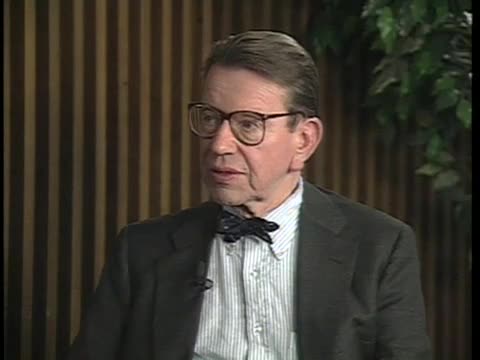
No. It's a pleasure to have you join us and we have a special guest today. David Broder I think in general regard it as America's most widely respected columnist. He's printed not only in the United States but around the world. And he's originally from the state of Illinois. Dave we're happy to have you I was very glad to be back with the U.S. senator. You will. Thank you. Why don't you give us the first 60 second autobiography for people who don't know who'll know only read the column and don't know what. Well I grew up around Chicago Heights which is dust trail town about 30 miles perhaps south in a little bit west of downtown Chicago
south end of Cook County. My dad was a dentist there and I went from high school there to the University of Chicago and then to the Bloomington pantograph after a couple years in the army and between college and starting a newspaper work in the pantograph was still very proud of your being an alumnus of the air they taught me a lot I didn't know any beans about reporting until I went to work there and they basically taught me what the craft is all about. Well what do you major in at the University of Chicago liberal arts. And as was the HUTCHENS era where you all took the same curriculum in college and there wasn't a journalism course I worked on the school paper The my room and that kept my interest in journalism. But I really didn't know anything about it. When I got out of the army and paragraph took a chance on me and wonderful editors there from the community taught me how to be a reporter.
Now you have been a reporter for some years. Got you. You and I share probably roughly the same age bracket. As you look back what are we moving in the right direction is in the nation are we not. What kind of boy you want to question young huge picture question. I think this country has enormous advantages and unlimited potential and the problems that they're wrestling with in Washington these days are not nearly as difficult as problems that we've seen in this country to overcome in our lifetimes. Right. The terrible legacy of slavery. The challenge of Naziism and and fascism the Great Depression all of those things that we've lived through. We're much much harder than anything that we face now. And I think we
have the capacity to deal with the challenges that we face now. I worry sometimes about the loss of confidence in our political system and the loss of trust in our system of representative government that something that we can deal with as well I think that we lost that. My sense is that the loss of confidence is much greater than it was 30 years ago. There's no question about it. I mean people unfortunately have come to believe that both journalism and politics have been corrupted. And by the same thing I think by money and personal ambition and in the case of politics partisan ship is run as well. But even as we talk the Congress issues perhaps for the first time about to do something significant. In this area of campaign finance is not.
And if you were to ask me whether we would would do anything significant I would have doubted it. And you know I thought we were headed in the right direction and that I mean you and others like you fought for a good long time against very heavy odds to try to make that possible. But you have to give credit to John McCain I think because yes he put the issue in front of people in a way that they could really understand and certainly if it hadn't been for his persistence and courage and saying I'm going to make this an issue I remember going with him up to New Hampshire very early in his campaign. And he said in the speech that day people tell me that there's no public audience for campaign finance that people don't care about it. I'm going to make room for campaign finance as an issue in my presidential campaign and damn if he didn't do it. And it really became kind of the centerpiece of his effort.
You mentioned the media. One of the things that's happened is a greater concentration of ownership newspapers radio television is that good thing is that a bad thing. You know we skirting you know are we getting under the knife. Well I you know in Washington I started out working for The Washington Star the afternoon paper. It no longer exists I was and the reason for the demise of the store. Now I recall you know help you know. But at the Washington Post where I worked can have worked very happily for 35 years now. We missed that kind of release strong competitive voice. Every day the city was better off when we had that kind of calm competition. So the loss of any news organization I think is a real loss for the community. I've got to say that the thing that worries me
more is to see news organizations becoming parts of larger and larger corporations I mean my friends at NBC News now are a very small part of the General Electric Company. General Electric may or may not have top executives with any commitment to news coverage. But. The news people are a long way down in that corporate pyramid and I'm afraid that they just don't have the same get the same kind of attention and support from their top management as would be the case if it was still an independent NBC news organization. In in the auditor's too much for making the decisions. Well that's certainly true but all of us face I mean we work in private profit making organizations and we're aware of that and particularly on the print side. As you know the publishers are very much in a quandary as to whether the students at
this university and others in their age group are going to find newspapers a useful way in which to get the news. In the future we don't know the answer to that. But it is. It is clear that there are other short term kind of responses. Politics tends to be short term rather than yes looking long term. I now serve on some boards that actually pay me money for serving on boards. I find the same in the private sector. But part of the corporate buyout That's correct and I find the same thing in the private sector. You know you're looking at the next quarterly report the next annual report rather than working long term and I tend to think that a newspaper that looks more under one of your competitors a New York Times. Clearly they're investing in ways that don't pay off
immediately. But I think will pay off in the long run. Well I hope so and there is some encouraging news for example USA Today which started out as a kind of a print version of television news with lots of little bit scenes little stories has discovered that people who pick up the newspaper want something more substantial to read and that newspaper which fortunately is available all across the country is now are very much on the road to becoming a good serious newspaper. But your comment about the short term and the long term they might say something. As you know there's been for years going back to Lyndon Johnson's time a wonderful program in Washington called the White House Fellows program where they bring in people mostly in their 30s from private business from the military from academia and explains to have them spend a year working for the
president the vice president or cabinet officers in very close relationships with them. I had a lunch with the White House Fellows recently and I was asking them as I often do you know what surprised you about the experience and the comments were interesting because the theme that emerged from several of them was this We come from worlds where the people who are the top executives are expected to think strategically and we thought that dealing with the top officials in government that that's what they would be doing. He said this particular person said instead they are crisis managers. He said there are very good crisis managers but. I will leave here wondering who is thinking strategically about the challenges facing the government. That really is true in that it's interesting that the intelligence
agencies made a report to the president. There was a story in December 18 buried in the. And the only newspaper I saw it in CIA and the others who were going to be 15 years from now. And they said 15 years from now the great resource shortage is going to be water not oil and we're going to be having wars over water. But it hardly gets any attention either by policymakers or by the media. And this you know this strategic thinking that they talk about really is a problem. And let me ask you something from your experience in both state government and the federal government is there a way to build in that component of the day to day work of government is hard to build into the day to day.
Now you can work on the Budget Committee. You do get projections but. But those projections on like the circles we're talking about now for the next decade. They can be wildly wrong but that's the only place I know we're doing much in the way of one term thinking. And your comment about the budget reminds me of the observation that Paul O'Neill who is now the secretary of treasury and 20 years ago was the assistant director of the budget made when I was in an interview with him a couple weeks ago. He said that from their first budget review now for President Bush that he was disturbed by what he thinks has been a loss of a exactly this capacity in the Office of Management and Budget. He said they're still doing very good technical work there but they're looking at it program by program.
And as far as he could see not trying to say here's where the country needs to be focusing its resources to be prepared for the kind of thing that you're talking about which is not speculative. I mean the evidence is clearly there. It's just that the crisis hasn't arrived yet. But we ought to be thinking about how we're going to deal with it now rather than waiting for the crisis absolutely. And the national government really has to lead in the field of education for example. I don't mean anything disrespectful to local school boards here but they have a difficult time knowing what that national need is. And if the federal government doesn't provide some leadership we just kind of drift just as one example we're going to be addressing this in a symposium that Dick Riley and some others are going to be have former Secretary of Education. How many days we can grade school and high school. Singapore two hundred eighty days Japan two hundred forty three Germany two
hundred forty. United States most any state does a designer need eight hundred seventy six I recall your pointing that out to me some years ago when you have a good memory I might my wind hasn't changed but we have we haven't had any results I regret that I think that's probably the case. You know education is a place you ask me where my you know where this is an area where I think without being Pollyannish you can read and say that at least for the federal government there is some genuinely hopeful signs for the first time we have a Republican president who is strongly committed to the cause of education. And I thought about you while I was doing this because I was covering the markups of the Elementary and Secondary Education Act in the Senate committee. You know what used to be labor and public welfare that is now has a new theme Maggie for you and is now a Health Education
Labor and Pensions and there are. Really bad corny name change for no good reason but any rate in that in that committee and it was it was really striking to see how little partisanship there is now about the fundamental ideas there are still some areas where there's disagreement vouchers are controversial and will not be part of the plan when it's passed. But for the most part you've now have really broad consensus including among the Republicans who not that many years ago were talking about abolishing the eating more than the verification. And I think you also have to give credit. I supported Al Gore and but I think you have to give credit to the president for taking a little of the partisan edge away from him. Well I hear him. I don't know that he has very many passions about government but he has a genuine passion about education. And when he says that
his goal is to see that no child is left behind he means that it's not going to be an easy thing to do in a country as decent where our education system is for good reason as de-centralized as ours is. But the commitment is real on his part. And I think that is that is the case and that that has to be good news for the country and yet when you look. Fiscal year 1949 we spent 9 percent of our federal budget on education. We're now spending about 2 percent and maybe move up a little now but we're still one way from where we might be going in this field. The other thing that's encouraging just in the subject of education is that the business leadership of this country now understands that they have not just a citizenship stake but they have real economic stake in improving the quality of the education because
otherwise they're not going to have the workforce that they need to be competitive in the world. And so I hear this from you know business leader after business leader they are very concerned about this even here in southern Illinois where we have relatively high unemployment. For historic reasons river education hasn't been stressed as much in this area as in some other areas but the number one complaint about the part of manufacturers in this area. We can't get that skilled labor force. So there is clearly a recognition that the shift over to another area where apparently there are maybe some tensions developing between the Department of Defense and the State Department are those. And there always have been some tensions or of those tensions greater than normal do you think. I'm not a very good witness for you on that subject because almost all the reporting that I do is on either domestic policy or domestic
politics I think. What do I know in just in terms of the personalities is that both Colin Powell and Don Rumsfeld are among other things. Very very skilled and tough bureaucratic infighter. So I am not I would not be surprised if it turned out that if they have policy disagreements that these are two men who know every trick in the business about how to move the president or move the White House in their own direction and theres kind of a feeling on the part of some Dick Cheney's going to have to be the referee. Well he's the 800 pound gorilla on a lot of issues energy and name. And I think the environment and it wouldn't be surprising if he were weighing in on these subjects as well. You mention you're covering the political scene. What have we learned from the experience we went through in the last election.
Well I can tell you what I've learned which is to pay attention to how votes are cast and how votes are counted. I had never given a moment's thought to the way in which a ballot is arranged physically to simply have never crossed my mind that that might be a critical factor in the political outcome of the political race. But you know after learning about the butterfly ballot in Palm Beach County I'm certainly going to look the next time to see how the ballot is arranged. And I've always known in this sort of a general way that there were some ballots that were discarded and some votes that were cast but not regarded as being valid really filled out and so on. But I have no idea what the size of that was and I certainly never thought well is that are affecting the outcome of the election. You know the word chad before I had never heard the way I'd know where you're going to Chad and I have to tell you it's last Saturday night at the Gridiron Dinner in Washington where we the press makes fools of itself on purpose and we invite as you've been the guest
before the politicians and our publishers and so on the biggest hand of the evening went to the ambassador from Chad. Those are in one of the good things is we still can make fun of ourselves. Yes and the president did a wonderful job of poking fun at himself at that dinner. But go back to your serious question. I think there's likely to be some significant remedial efforts at the state level about how all elections are conducted how the ballots are counted arranged and how they're counted. I think that the concern that was expressed immediately after the election in Congress is being dissipated very quickly and I'm going to be surprised if it turns out that there's much help in this area from the federal government.
Yeah and that's kind of my mind since the end. And there this is an area where states also are very sensitive to government moving when they secretaries of state who are the election officers in most states had their meeting in Washington six or eight weeks ago. I covered the meeting and I learned from that that it's not just a question of antiquated or worn out equipment that they are as much concerned about their difficulties in recruiting and training the frontline workers on election day as any single problem that they face that great supply of women the housewives who were willing to take a day off or work for 25 or 30 dollars at the polls is not there any longer and that they don't feel that they have the kind of assistance available to voters at the polling places that they really ought to have here just a little more talk about some kind of a moving.
Time period so that we can vote at the same time literally in Florida as in Oregon as in Alaska and Hawaii. Well I think that would be a good idea if we could have uniform poll closing times across the country. The other trend is you know that's developing is that in more and more states they're relaxing the rules for absentee voting so that a higher and higher portion of the people are filling out their ballots at home at their own leisure not having to get themselves to the polling place during those specific hours on a Tuesday in the state of Oregon where you had that mail ballot for a special election for a United States senator. You had 67 percent of the people in Oregon doing which Yes amazing. Yes. There is a catch 22 that I've learned about with that which is that the error rate and the spoiled
ballots are higher among absentees than among those at the polls because there's nobody around to say you know am I doing this right. And there so there's unfortunately a little bit of a tradeoff. While it may be much more convenient to vote absentee and therefore we get a higher turnout we're also going to get more spoiled ballots that way. That is interesting. A very simple question toss your way. Who will be the Democratic nominee for president and you may be ready to think about 2004 I am not so efficient is the evil thereof it will deal with it well but there are already articles appear immune and you know that Al Gore is a paralegal making some contacts and you know keeping these options well and I'll tell you something that will shock you even more.
There are a number of your former colleagues in the United States Senate. Each of whom is convinced that he ought to be president and perhaps at least one she thinks she ought to be president. And quite a few incumbent senators who feel the same way to that's what I meant when I said former colleagues I mean the people were a lot older. Alright yeah. Oh I thought you meant former senator. Yeah well there maybe i should we put Joe on the I don't know you know you made me you know but now I win just a few votes and I would have made a great difference. Could have but I'm not going to repeat that say that experience when you mentioned you have any specific senator in mind. Would you believe Hillary Rodham Clinton. Oh I think that's a possibility. I guess my instinct is that she will not be a candidate but what do you what is your. You know I don't I have no idea and I have I'm not. This is obviously not based on
anything that I've ever heard her or staff say. But my observation is that the Clintons set their own rules and where you or I might think that implausible they might not think it implausible at all. Well I don't think it's implausible but I think it's unlikely but that's just pure pure instinct and Joe Lieberman clearly emerged as a major figure and came away with a very favorable in progress and he's clearly part of the picture. Well I am getting a signal over here the Broder It's an honor to have you are and so I don't want you to be on this campus. Great to have you. Thank you thank you. Oh. Oh. Oh. Oh.
Oh. A VHS copy of today's programme is available by setting a check or money order for one thousand ninety five Ws are you TV Please include the date of broadcast. The. The. The. The. The what have we learned from experience we went through in the washboard. I had never given a moment's thought to the way in which a ballot is arranged physically. You just simply have never crossed my mind that there might be a critical factor in the
political outcome of a political race. Washington Post reporter David Broder is Paul Simon's guest on the next one on one here on WSI you w us on ITV. The.
- Series
- One On One
- Episode
- David Broder
- Producing Organization
- WSIU 8 (Television station : Carbondale, Ill.)
- Contributing Organization
- WSIU (Carbondale, Illinois)
- AAPB ID
- cpb-aacip/61-752fr87r
If you have more information about this item than what is given here, or if you have concerns about this record, we want to know! Contact us, indicating the AAPB ID (cpb-aacip/61-752fr87r).
- Description
- Series Description
- One on One is a talk show featuring in depth conversations with public figures.
- Description
- Conversation with David Broder
- Created Date
- 2001-05-08
- Asset type
- Episode
- Media type
- Moving Image
- Duration
- 00:27:56
- Credits
-
-
Guest: Broder, David
Producer: Tichenor, Jak
Producing Organization: WSIU 8 (Television station : Carbondale, Ill.)
- AAPB Contributor Holdings
-
WSIU Public Broadcasting
Identifier: 01102 (WSIU Archive#)
Generation: Master
Duration: 00:26:30
If you have a copy of this asset and would like us to add it to our catalog, please contact us.
- Citations
- Chicago: “One On One; David Broder,” 2001-05-08, WSIU, American Archive of Public Broadcasting (GBH and the Library of Congress), Boston, MA and Washington, DC, accessed April 4, 2026, http://americanarchive.org/catalog/cpb-aacip-61-752fr87r.
- MLA: “One On One; David Broder.” 2001-05-08. WSIU, American Archive of Public Broadcasting (GBH and the Library of Congress), Boston, MA and Washington, DC. Web. April 4, 2026. <http://americanarchive.org/catalog/cpb-aacip-61-752fr87r>.
- APA: One On One; David Broder. Boston, MA: WSIU, American Archive of Public Broadcasting (GBH and the Library of Congress), Boston, MA and Washington, DC. Retrieved from http://americanarchive.org/catalog/cpb-aacip-61-752fr87r