Behind the Lines; 321; The New Yorker : Eustace Tilley at 50
- Transcript
music this program is made possible by a grant from the Martin Wiener Foundation and and by a general program grant from the Ford Foundation.
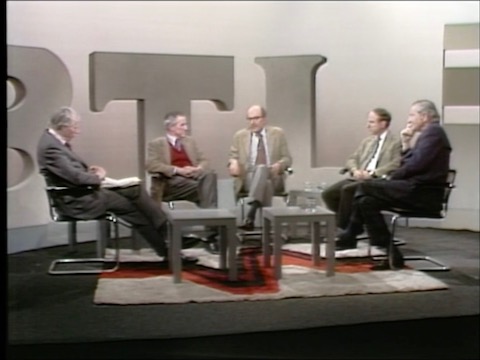
Good evening. I'm Harrison Salisbury. Welcome to Behind the Lines. Usually on this program we're discussing very critical issues of the day economic social political something of that kind. Tonight we're going to talk about a phenomenon. A magazine the New Yorker I think it's the best magazine in the world probably the best magazine it ever was and that's my uncritical opinion. It happens to be celebrating its 50th anniversary and I wouldn't be surprised if it's a familiar to you perhaps you recognize this cover you should it's the cover that appeared on the first issue of the magazine and it
still appears every year on the anniversary of the first issue. To discuss what the New Yorker is how it got that way and perhaps where it's going we have four of the men who have created it over the years to talk with us tonight. First we have Charles Adams who's Ghoulish cartoons are famous everywhere Calvin Trillin an author and reporter for the magazine Roger Angel editor and contributor and Brendan Gill drama critic an author of a new book which is called here at the New Yorker good evening gentlemen. In thumbing through this magazine just before we went on the air the first issue which I remember reading when it came out in 1925 I guess I came upon an item which I've often seen in the magazine I wonder if you could any of you here could explain it. It's a small item and it says the optimist pop a man who thinks he can make it in par Johnny what is an optimist pop how did that come to be and why is it repeated so often in the magazine. If you want me to answer that one that's it's an uncharacteristic
of the magazine ever since it was simply a mistake a typographical era. You mean there has been a mistake in the New Yorker and every year and there were many mistakes in the beginning and every year almost as a reproof but also as a celebration of our improvement that's published but what is curious and Roger and I were just talking about that that also contains inside itself a typographical era which nobody notices an extra letter in there and that was taken out at some point over the years so we perpetuate an era that has been nevertheless been partly corrected. It says a man who could make it in a par that's right. We repeated this in the 50th anniversary issue and the only official notice we took that this was a special issue and somebody had taken out the AI I don't know when that happened at some point in the past we edited our own joke. It's pretty hard for us not to edit things it's almost invariable. I have an impression that no magazine has ever been edited so intensively as the New Yorker. Would that be accurate? I think so I think it's
partly the function of our general success that we were able to afford to have the most carefully edited material in the world and that we are so scrupulous and can from one week to the next maintain that very high level because there are all those editors backing us up and the famous checking department backing us up so that any mistake that I might make in my theatre department for example would be I'd be protected from being known who have made because it would be 15 people would have read that copy but it isn't even it doesn't just a matter of mistakes it's a matter of style it's a matter of reworking materials a matter of concepts. We all think we have our own style that's one of the things I think that Roger and Bud would feel very strongly about that we can recognize each other's styles is absolutely separate and if I feel certain way about a semicolon I'm allowed to have my kind of semicolon and Roger his. I think the only trick in editing is to it's impossible to describe is to edit a piece of copy and keep it the writer's own copy and that's that's the greatest. That's the hard part that
exists in the world. I think the only advice I ever got from Bill Schoenl and I came to work at the magazine was and the only advice I ever heard of anybody like this he said it's very easy to take a piece of copy and make it much better to make it as good as it possibly can be that's easy but it's much harder to make it as good as that writer could make it. I think that I think what he said to me when I first got there was that editing was done in the first place is a suggestion and in the second place as an attempt to help the writer say what he wanted to say that it is an editing done to conform to certain style or conform to some political view and I think Brendan says I mean very important it is kind of a luxury in a way I mean the New Yorker has chosen over the years to invest what really amounts a lot of money in things like the checking department a lot of different people reading each galley and editors who instead of editing something very quickly and getting it out will sit there in a conference and say to me or to Brendan do you
really need that comma there or wouldn't this sound better this way with enough time to say yes or no or I'd rather not and in a way it is a luxury it's a very important luxury. Would it be true to say that Harold Ross the great man who created his magazine that he was editing to improve the individuality of the column or of the article or was he editing to impose his personality in a certain way. I wouldn't say his personality but I think he was always in terror of being horn swaggered by the writer he was afraid the writer would be would be cheating him wouldn't be given enough information and Ross having been an itinerant newspaper man himself and having cheated himself constantly was on the lookout for that in us and so he wouldn't allow anything even in a way of indirection famously at the beginning he wanted had to go from step to step to step and put everything in and often this led to disimproving the writing for the time being and then if the writer protested Ross would say well do it again now you rewrite me and finally we'll get it the way it ought to be. I think someone someone to find
indirection once is of something that if there isn't any of it in a piece it's a very boring piece and but but the fact that someone tells you you know you've kind of snuck that in on the reader or why didn't I know this just an intelligent third party reminding you that you may have not made that connection in your mind it's very important as long as it's not done unilaterally which it isn't there. And something like the same kind of thing was going on with Ross with drawings from the beginning where if an artist in fact was trying to cheat a little was doing something just wrong and Ross would ask the famous question where am I in this picture or if the shatters would be cast in two directions at once Charlie was very strict in the beginning of course but I think it was also because I was incompetent in very beginning too. I'm just starting drawing for the New York Ross kind of eased me along as he did many others and I had a great respect for his artistic comments but he was always a realist and you could not help but agree. From the very beginning did you bring what I described I think
inaccurately as a Ghoulish style did you bring that to the magazine was that was that you know I know I'm supposed to be Ghoulish and I still appear Ghoulish from time to time. The Ghoulishness did not start until about 1938 I suppose when I'd been working for the magazine maybe for three or four years but I described Charles once as coming from harmless Westfield New Jersey and once again. Yes but then what did you take exception to that yes it is a time where even recently a man killed five people in his family and let's get through we assume Brazil and it's never been found again a boy in my class in school dressed up as a woman stole an automobile and died in the Georgia chain gang and my dentist hung himself in the local swamp so so much for harmless. Do you think that had a psychic influence on you and I don't think so I think that growing up there I thought that's the way things are. Maybe it is our
child. I want to ask a question that has puzzled me and troubled me for years about the New Yorker and this the only way I can describe it is this is is a question of afterlife there are great many people who are no longer living whom I still think of as being at the New Yorker and appearing in New Yorker practically every week for example Wilkins Gibbs it's incredible to me that he is not writing a drama reviews I know Brendan that you write them today but I pick up the magazine expecting to find him and I think well perhaps he's not in this particular week I pick up the magazine and I I'm sure that within the last few months I've seen Peter Arno in the magazine is this true I think that's something that's wonderful about the magazine that that is filled with benign ghosts of this kind I miss and go on missing somebody like John McNulty whose piece is I keep hoping to see again I don't think of him as not being among the the group in this curious assemblage at the New Yorker and then it's partly because also for those of us on the magazine some writers never do
show up or disappear for years at a time or only their wives come in to pick up their paychecks on Friday that I sometimes suspect that in the point of fact those checks go on being picked up years after the authors have died but there is the feeling that maybe somebody will turn up again and I think that's nice I think this is very true and I and I feel that once having become a New Yorker person whatever that is then in a sense you stay being a New Yorker person through your life now I am well aware of the fact that that Alexander Wilkins is no longer alive because he has been dead for a very long time but I've entered safe I were to make a list of living in dead New Yorkers that there be a great deal of lack of correspondence to the fact I think this is happening all the time it seems to me that this may be because the New Yorker is very important to its readers or at least to a lot of our readers it feels a significant place in their life it always has seemed to so these figures become in a way part of one's family and when they die or move on they still
exist in the same way that family members do and I think this is happening right now I think that the New Yorker today is very different and very much alive and it's in a very special way maybe better right now than it's ever been I think but the younger writers that we're running right now and the younger artists are having the same effect on on subscribers out there at this very moment I'm sure one one thing that may cause that I'm not sure of this is that the magazine has a certain amount of distance from its readers that is the names are at the at the end of the column there aren't slash lines saying see somebody on somebody there's not a attempt to picture somebody in a publisher's note and say this is so-and-so who wrote that or taken ad saying here's the man who covers Bombay for us and and show him in his trench coat and I know he'd be white wrote a notes and comments once about how when the publisher of time invited everybody who's going to be in New York for the world's fair to drop by and say hello and he said he was just appalled in the
first place that the reception room in New Yorker wouldn't hold over a dozen or two and then he didn't really exactly want to meet them it didn't mean any disrespect but because of that I think people have say a vision of EBY in their head that hasn't been troubled with a lot of pictures over the years and a lot of constant biography in the magazine so that they in a way their their view of say who Walcott Gibbs is I think that's very true as a reader of the New Yorker over the full course of his life I must say that I certainly have images in my mind of the various writers and they persist and I still think of EBY writing white as writing the notes and comments and I suppose he hasn't done that for many years but I assume that he's still doing it even though I know as a fact that someone else is and for young readers I think coming along just as Charles Adams has always had a cult a booth who was a young artist has a cult now that's coming to exist and some people feel passionately about
booth as they always have about Charles or Ed Corn with his wonderful furry creature people care about that that's right and so when you mentioned about speaking about the future who can tell what the future would be when you think that a booth or a car or an Adam comes in out of left field just without a bit of warning you know it all just it's all in suspense how do they come here all of the trans and how does a booth come in how did you come to the New Yorker Mr. Axe I saw the New Yorker I suppose first in about 1931 and I decided this is a magazine and I wanted to work for and I kept sending in some foolish efforts and finally when I was an art school one or two were taken and then my first sale was to the New Yorker as the magazine I wanted to work for and for some crazy reason it's the one I still do work for it's remarkable and I think well with with this this process still goes on we are always looking for
writers and for artists and and for for people who are going to become famous contributors the process goes on every day we read every single thing that is sent to us people always ask me young people said how do I how do I get a story into the New Yorker and the answer is write it and send it in and it gets read and and we buy more material for new writers of course than any other magazine we buy from Yale undergraduate last year for example yes we we bought yeah from a young man who was still at Yale and but they come from everywhere and and some of our some of our really exciting writers have have come in in this way it's still happening just over the trance of this work yeah is there any way of defining a New Yorker writer it's impossible it's just you're really talking about a lot of different things I mean that there there are people who who you would think of as as New Yorker writers who who write say nothing but humor what the New Yorker calls casuals people who are New Yorker writers who write nothing but very serious nonfiction so they're really and or people who say critics I mean Pauline Kale is a New Yorker writer and she's a
movie critic and she say not like Woody Allen or not like Richard Harris but there because there's so many different kinds of writing there and I think probably if there's one reason I of course I speak from a writer's bias but but maybe if there's one reason why the New Yorker has lasted and and thrive for 50 years it's a magazine that is always allowed itself to be large enough to accommodate a lot of different kinds of writers and has responded to to what writers are interested in writing rather than impose any idea of what kinds of of things they should be right distinction between someone who writes for the New Yorker and and a New Yorker writer you mean literally I mean I mean sort of in the last in a while that happens but that's that's very rare let's take John O'Hara as an example I don't think of him myself as a New Yorker writer oh he was invented by he was invented by the New Yorker by Catherine White who was who was the intellectual conscience back of Ross Ross was very timid in many ways and he was
very much afraid of just not having a funny magazine that's what he meant to start did he ever have a funny magazine yes at the beginning and it was not very good it wasn't very funny it wasn't John O'Hara began writing little tiny just paragraphs on this like Conning Tower F.P.A. paragraphs and it was Catherine White who brought John O'Hara along and caused him to become one of the great short story writers in English but then after O'Hara there was you know there was Chiever there's Salinger there's everybody you can name but the whole idea of the short story as an intensely serious aesthetic effort in the New Yorker but never a New Yorker short story all different pluralistic all kinds of writers why is Norman Maier not a New Yorker writer I don't know because Sean Admar isn't very much and they're and they've always known each other and I think it more probably is more of a Norman's choice than anything else I think so can he have a piece in New York for once he said some verse a couple of times he did it for us but there and then there are other we have missed some good great writers he was in the New Yorker he was in the New Yorker story but I don't think of
him as being a New Yorker writer he's well that's because he didn't have the continuous production but also some people go to novels very quickly and quit writing short stories at one point I mean that for as far as fiction writers I know Bill Stryron for example well I don't think it's ever happened I don't he doesn't he doesn't he doesn't he doesn't he doesn't write short stories I don't think he's contributed but it also happens that that we we never guarantee your purchase and there are some writers I'm not talking about these necessarily but there's some very well-known writers who have had stories turned down maybe sometimes two or three in a row and and they find this unlike another place where they're almost sure of being published and it's very hard and there he goes and they start writing for I think I'm getting at a little different thing than that it is I'm not think I don't think of when I have put that label on someone I think I'm I'm in your average New York reader New Yorker reader one of them anyway and I stamp New Yorker writer on a person it isn't somebody who who occasionally contributes because he is a well-known writer or something like that somebody who is in some sense been nurtured in this curious soil and earth and climate and that you have there it's
well I don't think that on the magazine one feels so strongly about that I think it is just it's almost an article on the magazine but at the point of is it it comes out within covers yeah it has the look of being coherent because it is in one place with a certain one kind of format but in point of fact all the drawings are unlike all the pieces are unlike all the nature's involved are unlike and the only thing that everything in the magazine has in common is that everything passes under the scrutiny of William Shaw on the editor it's a one-man operation to that extent and it reflects his tastes and appetites but that doesn't mean that he doesn't have a Catholic taste in appetite yes I realize he has very Catholic taste in appetite in the magazine of course it reflects that certainly but I was trying to draw a distinction for example but only a judge he's talented it seems to me to be a person who'd simply grew in the New Yorker soil up until the time he vanished in the sky but that's because that's I think partly because he became known through the New Yorker which is say true of John Updike too probably even though updike now and
cheever okay partly because I don't know very much about fiction department it seems to me that one of the things that is that those people more or less came to wide public attention through the New Yorker and also were very serious short story writers for a while and there there comes a time if a seems to me a fiction writer turns very seriously to novels yes and that's pretty much the end of of the time he's going to be a he's never been a novel in the New Yorker oh yeah there's been no vellas I think I mean I don't know why you but but that'll be Mortimer's most recent novel which is a long thing was that 40,000 50,000 you know we ran that to run that to Mario Sparks to probably run a two-part in a book of the the losing defense yes yes no practice on how is a madden kissing Pete that was a very very long I don't think I made a wrong better one I think Tara ever ever quit writing short stories I mean didn't he write short stories pretty much right to the end and and I think also that that someone like a salinger of course became very famous at the New Yorker and then didn't write but he's still writing according to
Sean so he didn't publish it at least does it seem like according to that interview that we had with him the about a month or so ago one of our young reporters got through to him on the telephone sort of actually well you represent a daily publication that is just on the tip of my tongue yeah but anyway all I know is as Sean says no he is writing but won't publish now whatever that means one of the things that I've become familiar with in the New Yorker because none of us really knows what's going on beyond his own barely is it all say oh no he's not doing anything or so this is the next week there he is in the magazine but there she is so you can't tell I think it's kind of disguised as an institution in New Yorker what it really is as Brandon says is a lot of separate writers and artists each of whom has some kind of relationship with William Sean I mean that's that's how it exists as an institution can I go back to another question about about really great writing what about Fitzgerald and Hemingway did either of them ever appear in the New Yorker yeah Fitzgerald not have a couple of pieces but Hemingway did appear
and he appeared but he was already a success he's already out in the world and and he loved reading the New Yorker but it wouldn't have crossed his mind especially to write for it and also at that time Ross wasn't as eager to solicit pieces in part for economic reasons when Scott Fitzgerald could get $6,000 from the Saturday Newing Post as he used to we would have been paying 160 yes it was a difference there I think there might be one other point and that is occasionally I have this question asked me why does New Yorker publish so and so a very well-known you know somebody who's just had number one on the bestsellerist and I at least as I understand it it's never been the customer to New Yorker to say well someone is a successful writer and very well-known therefore the New Yorker should have him in I mean I think that's kind of the opposite of the way it works I'm sure that I mean the whole idea of say signing a piece at the end rather than the beginning I think is a kind of a symbol of that that the piece should stand on its own and it shouldn't be because of who wrote it that you read it some of us feel I think and I must say
that I feel this way that in recent years the great strength of the New Yorker has been in its reporting magnificent sort of breakthrough reporting on enormous public issues and I think in that connection of course the Rachel Carson the Silent Spring which really ushered in the whole era of conservation and environmentalism Charles Rice who really brought us into whatever it was it was going on in the 60s true and Capote with in cold blood I don't know what that brought us to but it certainly was it it's the only serial story that I remember in recent times that I really reached for that issue as I used to reach for the Saturday in Boston and Coddiers and then in this past year there've been two magnificent ones there've been several but two at I thought we're absolutely magnificent one was global reach which really gave us the multinational corporations there's nothing else has and the other was supership which again spotlighted a very important problem and there's some of the I think seminal reporting of Emma Ross child which has been in the New Yorker all of that sort of thing and this to me seems to be a breakthrough
into new new area for the for the New York except what would you say of Hiroshima which was 30 years ago yes but Hiroshima stood like a monument there for years and years well not well we were doing when you think of the second world war where we were doing the best most serious war reporting I could imagine anybody doing leave laying on all those people Janet finally everybody well writing seems fine reporting yes and then E.B. White was writing about the United Nations with something like the same passion that Jonathan Shell has been writing about Vietnam I agree that the that there's much more emphasis on that and we have done much more than we ever did before and all the younger guys like Bud Trellen who are out all over the place writing that kind of thing but this is what the magazine has become again I have to I think you have to think of it as a magazine that responds to the interests of its writers and sometimes they're exactly the same people I think Dick Rovere's a very good example who I think came to the New Yorker the first piece that I that I locked big piece that he wrote I think was something called howl and humble which you might think of as an
old raffish New Yorker piece about two bandit criminal lawyers in the turn of the century and eventually he was writing from Washington and then toward the end of the Vietnam War he wrote a really quite passionate piece on the war which I think said things that nobody had said before that we had to get out because it was driving us crazy for instance well it's the same man really this is not a this is really how the New Yorker makes policy this may be almost to me the most unusual thing about it we don't make policy by having policy meetings we never get together and discuss what direction the magazine should go in but we Sean knows knows his writers and the writers take us where we're going to go and that's that's why we suddenly became much more political much more involved at the time of Vietnam and then at Watergate because our writers insisted on it and Sean respond you mentioned you mentioned the word Watergate I don't associate the New Yorker with any reporting on Watergate oh the notes in comment we got to we got to do it the first page is certainly Harris's piece as a reporting I recall that is brilliant editorial commentary I think Harris's piece on the on the change in the Justice Department between
the Ramsey Clark Justice Department and the John Mitchell Justice Department was the first piece that really delineated the the politicalization that was going on in the Justice Department and what was happening to that administration I don't think that the New Yorker did any of the of the investigative reporting that showed who gave money to whom etc etc I think in all of these matters publications are different and they have to do what they do what they feel comfortable with and what they do better than some other publication but I don't think the New Yorker could ever keep up with the Washington Post and the and the New York Times in daily uncovering of scam I don't realize that I don't think at all to but what it can do is go back and say after something happens go back and say well who's really in Mitchell's Justice Department and why are they there and why are they doing these things and what what did they say they were doing and what are they really doing I think there was a lot of that over the years in Harris's pieces about the Justice Department but I don't think specifically on Watergate we have to bring our discussion
to an end here because the time is running out and I traditionally make a little wrap up of what we talked about I think all I can say is that we tried to illuminate in some sense why the New Yorker is the marvelous institution it is we talked about a few of the brilliant personalities who have made it that institution and I think we've demonstrated that it is very much a living institution it isn't 50 years old in the middle-aged sense it's obviously starting into its second half century with perhaps more verve than it even had in the great days of Harold Ross thank you all very very much for being with us you
for a transcript of this program please send a one dollar to behind the lines WNET 13 box 345 New York New York 1 0019 the preceding program was produced under the supervision and control of WNET which is solely responsible for its content this program was made possible by a grant from the Martin Wiener Foundation and by a general program grant from the Ford Foundation
- Series
- Behind the Lines
- Episode Number
- 321
- Producing Organization
- WNET (Television station : New York, N.Y.)
- Contributing Organization
- Library of Congress (Washington, District of Columbia)
- AAPB ID
- cpb-aacip-5d5175e4350
If you have more information about this item than what is given here, or if you have concerns about this record, we want to know! Contact us, indicating the AAPB ID (cpb-aacip-5d5175e4350).
- Description
- Episode Description
- A celebration of "The New Yorker : Eustace Tilley at 50" -- 50th birthday of the magazine -- with some of its current stars: reporter Calvin Trillin; editor and contributor, Roger Angell; cartoonist Charles Addams and drama critic Brendan Gill, author of "Here at the New Yorker."
- Series Description
- WNET's weekly news analysis series. Examines the news media and the news of the week. Host: Harrison E. Salisbury of The New York Times. 30 minutes. Broadcast from 1971-1976.
- Broadcast Date
- 1975-03-19
- Asset type
- Episode
- Media type
- Moving Image
- Duration
- 00:29:59.465
- Credits
-
-
Producing Organization:
WNET (Television station : New York, N.Y.)
- AAPB Contributor Holdings
-
Library of Congress
Identifier: cpb-aacip-398eea655ec (Filename)
Format: 2 inch videotape
Duration: 00:30:00
If you have a copy of this asset and would like us to add it to our catalog, please contact us.
- Citations
- Chicago: “Behind the Lines; 321; The New Yorker : Eustace Tilley at 50,” 1975-03-19, Library of Congress, American Archive of Public Broadcasting (GBH and the Library of Congress), Boston, MA and Washington, DC, accessed September 6, 2026, http://americanarchive.org/catalog/cpb-aacip-5d5175e4350.
- MLA: “Behind the Lines; 321; The New Yorker : Eustace Tilley at 50.” 1975-03-19. Library of Congress, American Archive of Public Broadcasting (GBH and the Library of Congress), Boston, MA and Washington, DC. Web. September 6, 2026. <http://americanarchive.org/catalog/cpb-aacip-5d5175e4350>.
- APA: Behind the Lines; 321; The New Yorker : Eustace Tilley at 50. Boston, MA: Library of Congress, American Archive of Public Broadcasting (GBH and the Library of Congress), Boston, MA and Washington, DC. Retrieved from http://americanarchive.org/catalog/cpb-aacip-5d5175e4350