Eastern Wisdom and Modern Life; 17; The Rise of Zen
- Transcript
Let's take a closer look at this God. So that's what it is. It's the famous Rock and Sound of God at the temple of Rio on G in Kyoto in Japan. You might not believe it but this is a form of religious art. No images no symbols just rock and sand a form of art which in a way is extraordinarily unlike anything else in the world quite unique. This is just as much a manifestation of spirituality as any of the religious thought of the West as say the christ in the Madonnas of Jellico. But you notice that there is no image in it no attempt to represent
anything but what it is. Just rock and sand and in this way it incomparably expresses that astonishing form of Buddhism known as Zen. This boat also from which I've been drinking tea is in the same spirit. You see it's a very simple rather rugged and unpretentious bow. The glaze doesn't even cover the whole thing. You can see it's quite obviously made of clay. And yet this bone is an icon. It's just as much say a spiritual object as a chalice and it's an icon just because it's a T-bone.
Now you might not think that's very much in the way of technique about this. Just a rough road but rocks and sand and so on but you would be mistaken. You can see examples of very obvious technical dexterity. As for example this landscape screen which was done by the painter caught in a typical in the 17th century 16th century excuse me. And its intention is no more than to show us wild duck and a tree beside a stream. And yet this too by doing just that is an icon. Now in the Western world we are accustomed very much to think of spiritual things as being set apart or separate from everyday life. We think of the spiritual as being as it were
out of this world or otherworldly. And therefore all those art forms which deal with spiritual things deal with symbols of the divine which as it were transcends every day materiality. But here in the art of Chinese in Buddhism we get a concentration on everyday life. And even when the great sages of Buddhism are depicted they're depicted in a secular style just like very ordinary people and often like the lowest cost of people wondering idiots and trams. And the meaning of this is that that attitude about the relationship of say so to body mind to matter is entirely different from ours. In fact they don't really
consider the spiritual life in those categories at all. You see we divide them. We feel the soul is separate from the body. Spirit is separate from matter. God is separate from the world and therefore as we confront this material world. Identifying ourselves with a kind of in a so we feel we have a problem about it. We feel that life must either be conquered. Although somehow we must get out of it but always we feel distinct from. We think of man not so much as part of the natural material world but man as separate from it dominating it trying to master it. But these art forms that we've been looking at express quite a different point of view a point of view for which the material everyday ordinary world is not a problem to be
solved. That would really be rather a relief wouldn't it. If we could feel it that way. But you see you remember in the last preceding programs I've been talking to you about Buddhism and the native Chinese philosophy of Taoism. And I think you'll remember that they had one essential point in common and that is the view of life as a flowing process in which man himself and the mind and the consciousness of man is involved. It isn't that there is a fixed kind of screen of consciousness over which this process of experience flows and leaves a record. It's that man's consciousness itself is part of the flowing process and therefore for this reason.
Now when the mind of man is not a separate entity observing the process from outside but is involved with it and therefore a fundamental conflict between the mind of man and the flow of life is in terms of this philosophy unreal and illusion. Something which we have imagined and I try to explain that this illusion arises because of the fact that the human memory is a part of this flowing pattern which has the ability to represent formless states of the past and that gives a certain permanence to the behavior of the pattern. But that permanence is not the same thing as a kind of soul substance or mind substance separate from the patterns upon which the record is written. Now in China about 400 A.D. and a little thereafter there was a
great work of translating Indian Buddhist ideas into Chinese and in finding suitable ideas in Chinese thought and in Chinese language to translate Buddhism so as to be intelligible to the Chinese mind. The philosophy that came most naturally to hand was Taoism and so at this time in Chinese history Buddhism and Taoism flowed together. And the product of that coming together being very much akin to each other was what I'm going to talk to you about today. A form of Buddhism peculiarly Chinese in that it's highly concrete highly definite in all its imagery Indian Buddhism tended to be highly speculative abstract philosophical metaphysical. But the Chinese language
is an extremely concrete language being originally based as you say as you know on pictures rather than on sounds. And therefore when Buddhism came into China and was translated into Chinese feeling it assumed the very concrete down to earth form that is known most commonly by its Japanese name Zen. Now Zen is the way of realizing or making real. The theory of Buddhism so that it's not just something as it were that you know about in your head but something that as we should say you feel in your bones and as a way of realise Asian Zen Buddhism is the Japanese word for the Chinese Chon which in turn pronounces the Indian Sanskrit word yon.
The problem that I have here is to try and give an English equivalent of this term. Sometimes this word dhyana in Sanskrit is translated meditation. But this is misleading. That's the best word I could give as an equivalent for what Zen means is concentration. Although this is rather different from what we understand by concentration in the ordinary sense that is to say an intense mental effort to hold one's mind upon a single point. I would call it concentration in the sense of being free from distraction. A sense of total presence of mind of being shall we say.
So really all that most of us in our thinking wandering from this to that to the other thing and are constantly distracted and Zen is in a way the country that it's being completely here fully in the present. There's another term that I want to write down that to some extent explains this. You know when you are completely concentrated. You're not aware of your own existence. It's rather the same as the sense of sight. If you see eyes that is to say if you see spots in front of your eyes which after all something on the lens of the eye then you are not seeing properly. To the degree that you are seeing properly you are unaware of your eyes in the same way. If your clothes fit well you are unaware of them on your body. And if you completely concentrated in what you're
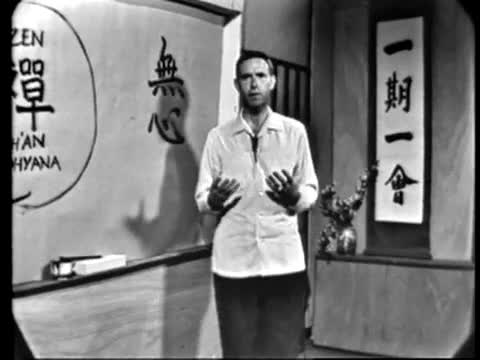
doing you're unaware of yourself. And this an awareness of self is called in Chinese. That means no. Should literally no mind that not no mind in the sense of having no sense and being stupid. This particular character pronounced shin in Chinese is approximately what we would mean by the ego the I sense that I described before the sense of being somebody standing apart observing your sensations. Thinking your thoughts and feeling your feelings so Lucian. All in Chinese I'm giving you the Japanese pronunciation is pronounced in Chinese Wu shin means perhaps more
accurately no self. The state in which in other words one is completely involved in completely absolved in what you are doing in a state of complete presence of mind or complete concentration. Now according to legend Zen was brought from India to China probably around 500 A.D. by a person called Bodhi Dharma. Who is always depicted as around the Fiesta looking fellow with a bushy beard and big wide awake eyes you can see he's not only all that. He is alert and although this may be a legendary character Bodhi Dharma is credited with introducing Zen into China as I said about 500 years A.D. in relation to Bodhi Dharma those are all that are an important story about his interview with his first and only disciple. This was a Chinese by the name of wake up who came to Bodhidharma
with the usual trouble that afflicts us all. He said I have no peace of mind and the word he used was sion. Please pacify my mind. In other words he was a man suffering from the perennial human problem of in an anxiety the sense of a kind of psychological collywobbles that is going around here and grinding in most of us most of the time and he wanted it set piece. So he said Master I have no peace of mind. Please pacify my mind buddy Donna who was a gruff old boy said Bring your mind out here before me I'll pacify it and wait I said but when I look in my mind I can't find it. Buddy Donna said that it's pacified. And immediately had an insight into the meaning of Zen. Because you see when he tried to realize as something
actual and concrete and physical his shin his self his mind he couldn't find it. In other words it wasn't there. Now the man who is even more responsible for the development of Chinese than body dogma is known as a guy who lived in the eighth century died in seven hundred thirteen. And this picture of him by a young guy shows him at his profession if we can call it that or is trade. Before he was a great Buddhist master he was a bamboo cutter and he was drawn in a very rough peasant like the kind of way. Such is the style of those artists favorite. And this man as a boy somehow quite naturally came to an understanding of Buddhism
and sought out one of the greatest masters of his time who presided over a monastery. It is said more than a thousand Buddhist monks that you know those monks seem to be going about the whole problem of attaining peace of mind in a way that was quite contrary to the real spirit of Buddhism and of zen that is to say they were trying to attain in enough peace by suppressing their thoughts. And you may think if you've seen figures of a Buddha sitting quietly in meditation with his eyes closed that what he's doing he's just got his mind blank so that nothing at all bothers him. And that's a lot of people's idea of nirvana. But when young pointed out to those monks that if that is what wisdom consists of if that's what Buddhism is all about then a piece of rock would be the same as an Enlightened Buddha
a piece of rock has no mind at all it's not thinking any thoughts it's just a dead as can be and therefore according if the way to peace of mind is to suppress all thoughts suppress all emotions oppress all sensations and feelings then you become a stone buddha instead of a living Buddha. Now just off the plane arrived at the monastery of this great mosque the master announced he was going to die and that he was going to hold a poem competition and whoever wrote the best poem expressing the secret of Zen would receive the Mastership from him. So there was one head monk whose name machine shop and all the monks said well he's sure to get the job because he's FOS a period of the rest of us. And so they didn't write any poem and just left Ed. Shabbat Shinsho in his heart of hearts he knew that he didn't really understand and
so he set up a stratagem in the middle of the night. He went to the passage outside the master's room and wrote a poem on the wall with the idea that if the master came out and saw it and approved of it he would admit to being its author if the master didn't approve of it he'd keep quiet. And he wrote a poem which said in effect that the mind is like a mirror which has to be kept carefully wiped from dust. And then of course it would attain calm the master saw this piety and although we approved of it publicly he took the head monk aside and said I'm not good enough to write another. But when I'm heard about this and he had another written up beside it which said in effect that that isn't really in Iraq. So where can the dust fall and the mostest saw this but realizing that this was just a boy just a novice a country hick who'd
come into the ministry that if he acknowledged him as the one with real knowledge all the other months would be jealous of him so he took him aside quietly and said you understood and sent him away for a long period until the trouble should die down and then he would emerge and teach. No. There's a very important point underlying what whitening wrote. You see if we we all know that to be completely present in mind and to be fully in what we are doing makes for not only peace but efficiency in all our deeds and in our everyday lives. Therefore we often say to people well it just takes things one at a time. It's so easy to do things that way. Keep your
keep your mind on your job concentrate. But the difficulty with this is that if our concentration in our work is a constant effort is something in other words we have to exercise ourselves to do all the time. Then as soon as our strength flags a little off it goes and we lose it. That's the same thing you see when we say oh you want to concentrate or you ought to be fully aware of what's going on around you and you as it were force your mind. That's the same thing as wiping the mirror or trying to pacify the mind by driving thoughts out of it. It's a forced action. Point on this point was that you don't achieve this by false you achieve it by insight. In other words while one school of thought is trying to pacify the mind by ironing out the thoughts which is a matter of fact is about
as effective way of getting a calm mind as trying to smooth rough water with a flat on the other. I was getting the same effect by realizing that there is no as it ego knows stuff to whom thoughts happen to whom experience happens and through that insight. The idea of the constant entity called the ego to whom life happens and for whom life is a problem is seen to be unreal. In other words in just the same way as when I move my hand I move it like this and then like this. What has happened to this movement when this one is happening it's vanished. It isn't that. And in exactly the same way as we move. We don't really move as it were from a past to a present there is no past there is always only a presence. As one Buddhist master put it
we don't say that spring becomes summer. We say there is spring and then there is summer. In other words we don't have to try to live in the present. We have to understand that only the present is real. There is no past. There is no future. Look at the practical wisdom of this in say climbing a mountain. You've got a long task ahead of you and you keep looking up at the top. You feel weary and weary. And every step is like lead or if you're a housewife washing dishes you've got a great pile of these things and you begin to think as you walk through them you wash dishes for years and you're probably going to have to wash dishes for further years and then in your mind's eye you see this prodigious pile of dishes as high as the Empire State which has been your drudgery in the kitchen all your life and for all the years to come and you are appalled in the press. It isn't a matter of trying to forget it is to realize that in actual fact you only have
one dish to wash ever. This was only one step to take this one. And that is Zen. That is concentration as it's put here. Look at this piece of calligraphy by a great Japanese modern Japanese artist Sabra Hasegawa and it says literally one meeting one life one every encounter every moment. In other words every meeting every experience is a life time is all there is. So then.
Ah problem you see is that we feel inside us. The constant struggle off fight with time. The tension between the press and on the one hand and the past in the future on the other. We may feel it as a kind of jazzy feeling in the stomach a way may feed it as a tension in our eyes. Somewhere in here a constant sense of having to struggle to beat time to keep up. And actually this doesn't do anything for us at all. It doesn't enable us to perform any work or business any better. All it does is as it will put us in a conflict with ourselves which holds us up and therefore the first thing that is necessary to learn in the
study of Zen is to be quiet not to be like a log you know with nothing in mind but simply to be all here. And that's why enormous importance is attached to knowing how to do it. Just sit and you will see often. The Zen monk in a position something like this. Sitting quietly and you may think that's a great waste of time because it just like this. Maybe for a long time maybe for an hour maybe for two hours some time for a whole day. But the point is that a person who can't really see it as if there was nothing else to do also won't be able to act because he'll never be completely here.
So when you learn to sit just to sit to be completely press completely quiet was none of that jazz going on inside which we call ourselves. Then you can move one of the Masters when being asked what is the path or in Chinese what is the Dow. He replied. Walk on. In other words go but you can't really go until in the first place you can sit. So one of the old masters said walk or sit as you will. But whatever you do don't wobble. So if we can sit and be funny here we can also get up and go. This is any National Educational Television.
- Episode Number
- 17
- Episode
- The Rise of Zen
- Producing Organization
- KQED-TV (Television station : San Francisco, Calif.)
- Contributing Organization
- KQED (San Francisco, California)
- Library of Congress (Washington, District of Columbia)
- AAPB ID
- cpb-aacip-55-30prrw7h
If you have more information about this item than what is given here, or if you have concerns about this record, we want to know! Contact us, indicating the AAPB ID (cpb-aacip-55-30prrw7h).
- Description
- Episode Description
- Mr. Watts discusses personalities and techniques involved in a new way of trying to communicate the Buddhist view of the world during the T'ang Dynasty. Stories of the first Zen masters and their unique and startling methods of instructing their students are illustrated by Chinese and Japanese paintings. (Description adapted from documents in the NET Microfiche)
- Series Description
- This series deals with the themes of Eastern philosophy and their application to modern life. The episodes are illustrated by Chinese and Japanese paintings and other Asian objects of art. Photographs and physical demonstrations of various principles and processes are also incorporated in the presentation. Host Alan Watts uses Chinese ink and brush for drawings and diagrams he executes during the series. Alan Watts is a scholar, lecturer and the author of many books on comparative philosophy and religion. His special interest is in the thought and culture of the Far East and its relevance to modern problems. He is a member of the American Oriental Society and an associate editor of Pantheon Books, Inc. He conducts a weekly half-hour series, "Way Beyond the West," over radio station KFPA, in Berkeley, California. He is the former dean of the American Academy of Asian Studies in San Francisco, CA. Between 1951 and 1953, he held a research fellowship in Oriental Philosophy form the Bollinger Foundation. Watts is the author of more than a dozen books on comparative philosophy and religion. His most recent books are The Way of Zen, Pantheon, 1957, and Nature, Man and Woman, Pantheon, 1958. This series of 34 half-hour episodes was originally recorded on videotape and kinescope. (Description adapted from documents in the NET Microfiche)
- Broadcast Date
- 1961
- Asset type
- Episode
- Topics
- Education
- Philosophy
- Media type
- Moving Image
- Duration
- 00:29:12
- Credits
-
-
Producing Organization:
KQED-TV (Television station : San Francisco, Calif.)
- AAPB Contributor Holdings
-
KQED
Identifier: cpb-aacip-741e916f109 (Filename)
Format: U-matic
Generation: Master
Duration: 00:30:00
-
Library of Congress
Identifier: cpb-aacip-98da4f7aa7d (Filename)
Format: 2 inch videotape
Generation: Master
-
Library of Congress
Identifier: cpb-aacip-b934fdd2b98 (Filename)
Format: 2 inch videotape
Generation: Master
-
KQED
Identifier: cpb-aacip-3002a18c531 (Filename)
Format: U-matic
Generation: Master
Duration: 00:30:00
If you have a copy of this asset and would like us to add it to our catalog, please contact us.
- Citations
- Chicago: “Eastern Wisdom and Modern Life; 17; The Rise of Zen,” 1961, KQED, Library of Congress, American Archive of Public Broadcasting (GBH and the Library of Congress), Boston, MA and Washington, DC, accessed August 20, 2026, http://americanarchive.org/catalog/cpb-aacip-55-30prrw7h.
- MLA: “Eastern Wisdom and Modern Life; 17; The Rise of Zen.” 1961. KQED, Library of Congress, American Archive of Public Broadcasting (GBH and the Library of Congress), Boston, MA and Washington, DC. Web. August 20, 2026. <http://americanarchive.org/catalog/cpb-aacip-55-30prrw7h>.
- APA: Eastern Wisdom and Modern Life; 17; The Rise of Zen. Boston, MA: KQED, Library of Congress, American Archive of Public Broadcasting (GBH and the Library of Congress), Boston, MA and Washington, DC. Retrieved from http://americanarchive.org/catalog/cpb-aacip-55-30prrw7h