Women To Women; Women: On Empowerment
- Transcript
City University Television, the Women's Study Certificate Program, and the Center for the Study of Women in Society at the CUNY Graduate School and University Center present Women on Empowerment. Joining us for this conversation are Joyce Gell, Professor of Political Science and Director of the Center for the Study of Women in Society at the Graduate School, Barbara Omalotti, a member of the faculty at the Center for Worker Education of the City College, Marilyn Gattel, Professor of Political Science and Director of the Howard Samuel State Management and Policy Center at the Graduate School, Virginia Sanchez Corrol, Professor and Chair of the Department of Puerto Rican Studies at Brooklyn College, and Mimea Brahmavitz, Professor of Social Policy at the Hunter College School of Social Work. Moderating this discussion is Manhattan Borough President Ruth Messinger. Hello and welcome. I'm here with a very special group of women who have themselves
each, long histories of working with women on behalf of women, looking at how women mobilize and empower themselves, helping to make that happen. But we've been asked to begin this discussion with a particular focus on how have things changed or not changed as a result of the 1994 elections. What did those elections say to women? What is likely to be the consequence to women given some of the outcomes in those elections, federal and state? And what should women in this city of various ethnic backgrounds in various economic classes, in different neighborhoods, with a whole range of issue concerns, be doing for our own futures? And I thought we would start by getting people to make a sort of summary point going all the way around and then just open it up for discussion between and among ourselves. Maybe? Well, I think the election has been a disaster for women and women are beginning to recognize it. Just one other point about before I say
anything else, the assumption that women are not politically active, it's a long-standing assumption. It has been somewhat corrected, but I still think that women get into trouble for being unfeminant when they're politically active. And so we still have the stereotype to overcome as we move into political circles. And what I'd like to comment on is the activism among poor and working-class women who have begun to be mobilized and responds particularly to the budget cuts and to the punitive welfare reforms that are being legislated. There have been national actions which I'll talk about later. Well, I'd like to think of these elections and the disaster that they've created with regard to public education. And that is an area that I feel is going to suffer miserably because of the people who are in power, the ideas that they are bringing in, the retrenchment of so many of the projects and undertakings that were finally beginning to see the light
for minority students and faculty and women and communities because we do not separate our students from our communities or our faculty from our communities so that I am very, very disturbed by what has happened. I wanted to contrast 1992 which was widely known as the Year of the Women in Politics with 1994. And the news is mostly bad as we've just mentioned. It isn't totally bad in that women held their own to some extent. But I think there are a couple of problems that occur that are kind of a clarion call for the future. And I'll mention a couple of the mail and perhaps come back to a couple of them later. Fewer women ran for office for the first time in 20 years so that the incremental increase that had occurred where more and more women were running every year, particularly for state legislature, has declined
as of 1994. And I think another important factor was that all of the 10 women who ran for gubernatorial office lost. So that says something about perhaps a backlash and a view that voters, maybe men and women, have about women candidates. And perhaps we can come back to some of these issues later. Okay. Yes, I think in the history of African American women we have always struggled and organized in situations similar to the 1994 election and the aftermath of the election. We have a long history of struggling and organizing in spite of situations of dire adversity. However, after this election, I think that there are two or three factors that face African American women that were not in place before. And that is that we have made a strong showing in public service employment that is now the very areas that are in jeopardy. We've made a strong showing in public colleges, especially colleges that have special programs
and special missions like the City University. And that now is in jeopardy. So the question is whether African American women can now use some of our traditional ways of organizing and mobilizing each other within the new context to give us at least leverage to be able to sustain ourselves, you know, just basically through the cuts as well as to hopefully organize on another level so that we can become stronger. Okay. Well, I guess I agree with everything he said before. I was glad no one mentioned to leave it to me that probably the dominant analysis after the election was that the white suburban males created the bigger gap than the gender gap that we saw before. I mean, they really had a pronounced gender gap and the analysis is that they were reacting to the years of there being put in the corner, so to speak, and with the affirmative action programs
with the emphasis on people who are poor, the emphasis on women's needs and rights and what have you, and that this was a backlash. And I think it has to be contended with, but not in the way in which most analysts have suggested. I don't think it means we back off when we apologize or we say, well, affirmative action really isn't necessary anymore, which is our tendency. The analysts tell us, in fact, by their analysis, what they want us to do. And I think women have to be very strong as a reaction to the selection and not fold, so to speak, on that issue. I think if suburban white males are unhappy, they're going to have to stay unhappy. And we're going to have to find a way to bring out a vote which counterbalance is that vote which they established this year. And I think it's important to remember that only 31% of the eligible vote is voted in this election, which means that 15% of the vote is determined the outcome of the election. And it's somewhat
similar to the Dinkins election in New York City when the African American vote didn't come out. If it had come out, the election would have turned around. The difference in the outcome is really minimal. And to make a travesty of all this, only reinforces, I think the policies we're seeing take hold at this time. So I think we have a very important struggle in reasserting the very policies which we are being told with the reason for this election. I just like to take welfare as an example. I made a speech recently before a state committee in which I said, let's go back to income maintenance. I mean, why are we penny-anting these changes and trying to wheel and deal with the people who claim to be doing welfare reform, which there, of course, is not doing? Let's go to income maintenance. I mean, they're going to make payments so low now that who can argue that income maintenance isn't even a desirable end. I don't think backing off these issues is the answer. So, you know, even with the affirmative action discussion, it's interesting,
there's time to be a few articles in the paper that have been these angry white men targeting women as the enemy of their enemy in the affirmative action battles. And I'm wondering if this, I think that is an issue, they will identify, but whether this would be used as a way to attack affirmative action, which instead of their deeper racism, the deeper concern about race to target on women is sort of a code for the whole thing. It somehow might be easier to go after it sort of politically in public discourse around women. So I think it provides out to watch, because there are several groups affected, obviously, by the current challenge to a affirmative action. They don't play us off against each other. I was going to pick up on that. I think that we also should not spend a great deal of time simply reacting to the policies, the rhetoric, the arguments, the strategies of those who I would characterize as our opposition, but really try to look both forward in terms
of where we think we should go, what kind of welfare policy if we do believe in that we should have, what kind of affirmative action we should fight for. Because I feel that just as the black vote didn't come out for Dinkins, but I feel in the last 10, 15 years Democratic Party regulars, the left, liberals have themselves been quite reluctant to and certainly have not participated as earnestly and as diligently as they could, even when some of these hand writings were on the wall. So I'd like to spend more time really looking at a proactive strategy that we can look at across the board. I think it'd be very useful if people talked to that and talked about initiatives that you know are underway, efforts that people could join in on, because I want to Joyce, I just want to make one separation. First of all, in 1992 when people started saying it was going to be the year of the woman, there are several of us who said don't say that because if they give us a year, they have all arrested the years. And that is exactly
what happened. There were a group of women elected and no surprise to anybody around this table. Those women began to give voice to some of the issues that have been put on the table need for more attention to public education at both the pre-college and at the college level need to have some proactive strategies about what would meet families needs. And the result has been a very quick backlash. And unless and until there are empowered groups out there, it's not entirely surprising that there are fewer women who choose to run for office. It doesn't look like a very pleasant venue to get involved in because you can't take my word for it. You can't be in there without a network of supports and without local initiatives becoming stronger and stronger and helping you by keeping the pressure on. So I don't know, Brittany, maybe you're a word for something. Yeah, I was sort of a reaction to what Barbara had just said. I believe very, very strongly that we cannot waste time talking about what a miserable situation we're in and reacting
to things that are being done on a daily basis, but that this is the time. You see, the point of this is, it's almost analogous to our situation of the university where our departments and programs have always been vulnerable because they were the smallest, the least funded, the newest, the nontraditional. And so whenever it came time to divvy up the pie, it was always, well, what is going to be expendable? That's not how it works anymore. Nothing is expendable. What we have to be doing right now is realizing A, that the backlash hits all areas. So no one is immune. And B, that the only way to fight a backlash is through unity and coalition. Those people who are in office right now who would be willing to speak to our interests need to know that there are people there that are
willing and ready to support them. And one more point about voting, students didn't vote. Students do not vote. Why don't students vote because they don't think it's necessary. They do not see themselves as power players in the large picture. But we have to begin to get that word out, that everyone is a player here because no one, this is a no-win situation. Right now, just to talk about the last city election which is the, and the state election which are the source of the cuts on the public university system. There are more registered student voters in the city university who didn't vote than the margin by which those elections were won. On a more positive note, poor women and their allies have begun to mobilize. And I find it very energizing and I've been spending the past month on an organized national day of action which took place on Valentine's Day.
And I mean just the press did not cover it. The press has not let the politicians know what happened on that day. So I'd like to mention what happened which is that in 77 cities in 38 states there were coalitions. Coalitions, each representing many groups and thousands of people mobilized did something to protest the war on the poor. The theme of the day was our children's hearts are in your hands. And so thousands and thousands of people demonstrated from Maine to Hawaii. And while there were local, there was local coverage in some cities. It was not covered in New York. We had 600 people out there. We collected 15,000 postcards of Ruth spoke to the crowd, the freeze in crowd, out there. And the opposition really is very deep and very widespread. And the other thing that was interesting to me about this in terms of ongoing mobilization was that this project was launched by a group in Utah. Women are welfare and their support is in Salt Lake City, Utah. Not a place where people think there are a lot of welfare.
And that's a racial issue because the state's 94% white. And within a month, coalitions were identified in 77 cities. That means that we were not stunned into inaction like we were when the Reagan cuts began. But that since then, groups have formed. There are many of them are single-ish groups, but they have formed around hunger, homelessness, welfare, all the issues that are troubling our population. And so it wasn't hard to find coalitions in 77 cities. We now have a list of them. We have names. We have telephone numbers. This is an enormous resource for future actions. And they're already being planned. I think here in New York, there's an action with other groups, labor-based among March 1st. There's another one on March 4th. The National Organization for Women is planning a mass demonstration on April 9th. And they've included for the first time, I think, in their history, or in a certain past history, not only violence against women, which was the original focus of the March, but feminization of poverty and breaks a contract on America. And this takes me to just another thing that I find optimistic. The feminist
groups, like now, and the now legal defense and education, have been taking up the issues of poor women, not taking over, but taking up the issues, building bridges with groups like the National Welfare Rights Organization, the union, and so on. I think that the potential is there for protest. And we have to break through the press barrier. This was just an outrageous that this was not covered by the press. It was an amazing event that took place on balance. I just wanted to add that in the coverage, for example, of the food stamp, reversal, grocers, lobbying groups, and farmers lobbying groups were mentioned. There was not a word mention about women's groups, their allies, poor women, or any people who objected on a more personal and human level to what the cutbacks would have had. I agree with you, Joyce, but I actually want to take an opposite tack on that. I was just about to say that people have mentioned the notion of alliances, and I want to be sure that viewers of this program understand that there is a press barrier, you're right.
The information that's breaking through that barrier, the information that you're getting, which is coming from political leaders like the mayor and the governor, are designed to make you believe that the programs being cut are programs that only benefit poor people of color, in whom you have no interest. That is not true on two dramatic levels. First of all, the universal programs being cut will affect almost every poor working class and middle class family in this state. We'll deprive you of tuition assistance. We'll probably raise your budget fair. We'll cut the parents to people who are dependent on home health care workers. So the assistance programs being cut are programs that help virtually every family in this state and the replacement costs will be much higher than any small dollar saving and state income tax. But second of all, everybody in this state will be affected if this amount of expendable dollars disappears from the state if there
are not people who are able to pay tuition. If there are not people able to go to the grocery store, so I wish in this state that we can get the doctors, the hospital boards, the groceries, the large supermarkets, the landlords to understand that this is an attack on everybody's available income. Because I like to ask you a question, because it seems to me, while organizing, may take place at the level that Mimi says, it seems to me that we have a real problem in the fact that the Democratic Party does not offer an alternative. And what Barbara said earlier, and I would say the reason students don't vote in large part is because they don't see a difference between the two parties and they don't see themselves having a choice. And it seems to me that this is a real problem for people in Democratic Party, anyone who's here who's not a Democratic Party can close their ears. But isn't it a real issue as to how we create an alternative agenda, because so many people in Democratic Party are not
interested in an alternative agenda. They seem to be merely reacting to the Republican position, and in some cases, out-republicing the Republicans in terms of that agenda. How do I go about that? I think that's very true, but one way you go about it is, which is really part of the point of this program, is to mobilize and make sure that those, that the individuals who are our last best hope, even when they're not much hope, which some of them aren't and some of them are, have to hear from constituents. And that's why I'm hoping that they won't only hear from the organized students and the organized women and welfare, but we'll hear from all of the people who are going to be affected. I've been meeting with many of you, this is a city university program. I've been meeting with the Manhattan College Presidents and saying, get your students, get their parents, get your alumni. Those are the people who have to write, because they're all over the state. Now, having said that, let me say, some Democrats are running for cover and missing the point that you articulated so well before that these are very small political margins, and most of the electorate
isn't voting. But some Democrats, even if it's only reactive, are our strongest bastion against disaster. And, you know, Shelley Silver, for sure, needs to hear from people in this city that he is representing the people of this city. The mayor of this city went to Albany and said, the governor's cuts are fine, except I wish he would make them deeper. And if you have a clue as to what that does to Democratic legislators from all over the state who are used to fighting a very tough battle to increase aid to cities, to increase aid to education, to try and get New York City, it's fair share of balance, to have, I mean, how can a, I'm elected, a state legislator from Rochester said to me last weekend in Albany, how can I vote to increase education aids in New York City after the mayor of New York City has come and said, we don't need any more money? I don't want any more money. I want the people. I want the people. I want the people. I want the people. I want the people. I've got two things that I know I work for the Center for Work of Education as a division of City College. And we work with working adults who are taxpayer voting New York City citizens
who are striving to get their undergraduate degrees so they can better their employment situations. And we do have a very strong lobby in campaign. I'm going up to Albany next weekend. We go yearly, by the way. And I think that there is a sense that, yes, that the Democratic Party certainly has failed us, certainly as African Americans, although we were very instrumental in moving the Democratic Party to whatever progressive stands they've had. And I think some of that fire under them, you know, needs to be rekindled. But I want to say something else, because I think the city university is one of the keys to mobilization in the city, I think, as we were saying earlier, tremendous success stories of how public dollars are being spent and how well the return is on that if we have to talk in those terms and certainly the development of human potential comes out of the university. But the university has failed to give a coherent and cohesive picture to New York City residents who are themselves impacted by killing the police officers around the teachers. I would
say almost every public institution that is successful has been touched in some way by CUNY. And I really feel that for you to have to organize the president, it's wonderful, but certainly our leadership is really to be called into question about leading this university to really make the connections between students, faculty, staff, alumni around, even those numbers are about a million people. Well, I think you're right, but let me just be clear for the, for the regans that this was a joint meeting, they for President of City College and the President of the Graduate Center asked me to join with them in convening the presidents and the Manhattan legislators. I believe this is now happening in other boroughs, but I think you're absolutely right that what we need goes back to the statement you made before we need to get the positive and proactive stories out. And the President of John J. Coward tells me that he can introduce me to police officers with law degrees who started in the social grammar, John J. That's my question. And we need to get those individuals to go call them the editorial boards of the newspapers. I'd like to make another comment about the impact of the cuts in terms of a universal kind
of impact and that many of these programs have a particular benefit for women. When you make it easier to get housing, when you make it easier to buy food, when you make childcare available and when you support families, you are reducing the burden on women, especially working women. And because there's money available, there are resources. In fact, if we cut these programs, not only do we cut women out of the jobs, which the public sector has been a source for women, but we also shift the burden of caretaking and all the ramifications, homemaking, caretaking. We deepen that burden on women in the home because the resources they had that alleviated it or reduced it a little bit are lessons. And this hits poor women, middle class women, women have to find ways to manage work and family responsibilities. If you have a lot of money, you can buy childcare, but most people can't afford that. So they rely on public services to absorb some of the burden of caretaking. And if we
are insisting, especially that poor women go to work and we're cutting their daycare, what are, I mean, there's sort of an obliviousness, there's a total inability to see what women's job is, so that this is women to women about these issues. I mean, this has a particular impact on women, both as workers and as caretakers. I just came from a city budget. One of the, I know what you're saying, I hear what you're saying and I think to myself, how do I tell the people in Long Island where I live, that this is an issue that they should be concerned about? Well, you tell them the cons, because I think one of the problems that we have had with the type of information that is going out in the lack of leadership and the lack of any type of cohesive public relations plan to begin to put these issues on the front burner and to begin to sensitize people to the fact that this is everybody's concern is that the negative press has so nicely divided for against middle class, white against black latinos
forget it. They're not even being addressed in terms of these issues. Upstate against downstate, city against rural area, and it amazes me that our leadership thinks that we're still in business as usual, that this is not a time of crisis where we should be putting all of these major resources into putting together this type of information that Barbara is talking about. How many people do we have out there that directly were affected by the CUNY education? Success stories? We have a million of them. I think though it's very important to realize that we live in a different era and that we're ignoring the impact of the Reagan years and the last two decades you can't go home again so to speak. Having experienced this and I think we have lost our sense of commitment and public good as a social goal, the values that all of us sitting here I know share
no longer exist in our society in the way they used to and I think it's too simplistic to say we organize some movement politics and some protests and let's all recognize that we have certain things in common and not split ourselves but I think and I go back to what I said originally. Unless we reassert some very strong social goals and make clear that taxation when I tell my students now that people were happy to pay taxes in the 50s and the 60s because they knew that was the only way to achieve a social good. You couldn't have a park by creating it yourself. You had to pay taxes to get a public park that your kids could play in with other kids. You had to pay taxes to get better schools. Taxes were good things. Not bad things. That's been totally reversed. Everybody wants not to pay any taxes. The relationship between paying a tax and achieving a social good is totally gone. I think we have to reconstruct those values that are so important to a democratic
society that citizenship is essential. Why are people not voting? We don't even teach and encourage them to vote anymore. We say a stable society because there are not many people vote. The whole background of when I was in the third grade and you are already learning that you have to go out and vote, it seems to me all of these things are very fundamental values. The willingness now for people to be openly racist which they weren't in the 60s or even the 50s in a way. So it seems to me there's a much more fundamental kind of reconstruction that has a place that we're all ignoring. No, I don't think we're ignoring. I think playing directly to it, in fact my students do work out of the sense of public good. The black and Latin women I work that I teach do have those values and they have them very strongly. They're working women who participate in a lot of community based organizations and they vote and they try to get other people to vote. They have the strongest leaders in those communities.
- Series
- Women To Women
- Episode
- Women: On Empowerment
- Contributing Organization
- CUNY TV (New York, New York)
- AAPB ID
- cpb-aacip/522-xs5j961h4n
- NOLA Code
- WW 950005
If you have more information about this item than what is given here, or if you have concerns about this record, we want to know! Contact us, indicating the AAPB ID (cpb-aacip/522-xs5j961h4n).
- Description
- Series Description
- In depth interviews with women of distinction in the arts, education, journalism, health, politics, and social sciences. Hosted by Frances Degen Horowitz, former President of the City University of New York's Graduate School and University Center. Women to Women ended its eleven year run on CUNY TV in 2005.
- Description
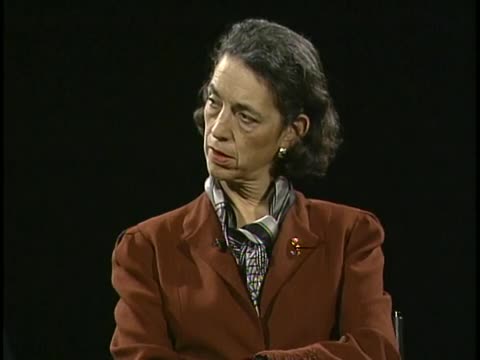
- In this edition, a panel talks about the empowerment of women and the role of women in politics and the issues it effects. Panel: Mimi Abramovit,z Professor, Hunter College; Dr. Joyce Gelb, Ph.D. Professor/Director, The Graduate School; Marilyn Gittell, Professor of Political Science, The Graduate School; Pres. Frances Degen Horowitz, President, City University Graduate Center; Barbara Omolade, Member Faculty, City College; Virginia S?nchez Korral Professor/Chair Person, Department of Puerto Rican and Latino Studies/ Brooklyn College. Moderator: Ruth W. Messinger, Manhattan Borough President. Taped February 28, 1995.
- Description
- Taped February 28, 1995
- Created Date
- 1995-02-28
- Asset type
- Episode
- Media type
- Moving Image
- Duration
- 00:28:00
- Credits
-
- AAPB Contributor Holdings
-
CUNY TV
Identifier: 15929 (li_serial)
Duration: 00:28:00:00
If you have a copy of this asset and would like us to add it to our catalog, please contact us.
- Citations
- Chicago: “Women To Women; Women: On Empowerment,” 1995-02-28, CUNY TV, American Archive of Public Broadcasting (GBH and the Library of Congress), Boston, MA and Washington, DC, accessed April 5, 2026, http://americanarchive.org/catalog/cpb-aacip-522-xs5j961h4n.
- MLA: “Women To Women; Women: On Empowerment.” 1995-02-28. CUNY TV, American Archive of Public Broadcasting (GBH and the Library of Congress), Boston, MA and Washington, DC. Web. April 5, 2026. <http://americanarchive.org/catalog/cpb-aacip-522-xs5j961h4n>.
- APA: Women To Women; Women: On Empowerment. Boston, MA: CUNY TV, American Archive of Public Broadcasting (GBH and the Library of Congress), Boston, MA and Washington, DC. Retrieved from http://americanarchive.org/catalog/cpb-aacip-522-xs5j961h4n