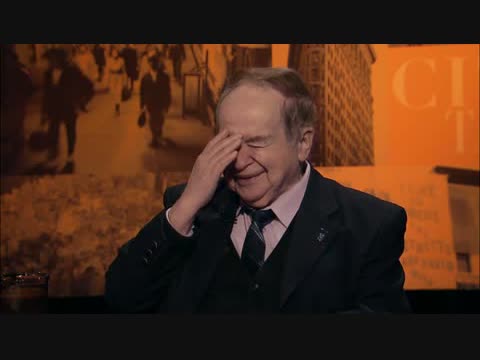
City Talk; Joe Franklin, legendary New York TV/radio host. Pt. 2 of 2
- Transcript
How I'm Doug Musio. This is City Talk. Larry King. Forget Larry King in his 25 years of interviewing. How about 300,000 interviews? A Guinness record number of consecutive TV shows, 21,425 from 1950 to 1993. How about a cult favorite, the King of Nostalgia, from a regular Joe to a living legend. A guest again this week on City Talk. Joining us to wax nostalgic about Nostalgia to take us down the memory lane of memory lane
is Joe Franklin. If you were in New York or in the 50s and 60s and 70s and 80s and into the 90s, you grew up with Joe Franklin and walked down memory lane. His TV and radio shows were and looking at some of them a half century later trips, trips of the mind and trips of entertainment. Joe, welcome back. We had a great time last week, last show. Let's sort of pick up where we left off and that was with the show, the TV show, and your relationship to the guest. Who do you really miss out of all the personalities that you have interacted with over decades? Interviewed on my show. By the way, I was walking down the street a week ago when somebody says to me, he was watching Channel 13 at a cavalcade of talk show hosts. He saw Johnny Carson, Mike Douglas, Rosie, Mike Douglas, and Merv Griffin and Jack Parris, Steve Allen, but no
Joe Franklin. You know what I said? I'm catching him. They were all dead. That's right. You well, lift them all. The ones I miss are those that I just mentioned, and of course, I miss Jack Benny. Jack Benny was on my show so many days. He told me one time. When Franklin and the Roosevelt needed laughter or cheering up, he would send for Eddie Cantor. When Harry Truman needed laughter, he would send for Jack Benny to come to the White House and tell him some jokes. So, one time, Jack Benny goes to the White House and he's carrying his violin case. So, security guy says, Mr. Benny, what's in that case? He said something he shouldn't have said. It's a bomb. Security guy says, oh, thank God. I thought it might be your violin. So, I miss Kate Smith. Yeah, is that a person? I was a guest. I used to write a radio show every week. Every day, five days, we called Kate Smith sings from my records, from my case with archives. And she would talk with her manager Ted Collins and she would invite me to her house and that she would sing God bless America to me privately, which is a thrill of thrill of it. And you didn't have to go to a Philadelphia fly again. And Eddie Cantor, I loved Eddie Cantor. He
was my boy. Everybody's got a mentor, I guess. And I loved Eddie. I loved his. How was he a mentor? He was, I used to lie and say he was my uncle. He wrote me a letter. He said, stop saying, you're my uncle. You're my uncle. You're my uncle. You're my uncle. We've got friendly. And I wrote his radio show called Eddie Cantor Show Business. Okay. I mean, we didn't do enough history last time. And you're sort of piecing it together. When you start in your showbiz career, if you well, I wanted to be a journalist. I went to Columbia University for a couple years. And because my father, when my father was a kid, he used to write on a newspaper called Evening Mail. He had the desk alongside Ed Sullivan, who was then a sports commentator in the sports writer in those days. And I wanted to, but then I got the phone call one day. I met Martin Blockey, offered me his job, choosing his records. And after this. And this is Make Believe Boy. And he was somebody out, Joe, going the hallway, bringing Frank's and out to bring in Daineshua, bringing in Juan Monroe. So I figured I'll stay in that business for six months. That was a few years ago, I guess, right? And that was all my life. And what was the attraction?
I just, I love being with celebrities. I would always ask them for a souvenir. I would ask, I got Thai clips from George Raft. I got Mickey Rooney's Andy Hardy outfit. I'll wait a second. Okay. We have to then go to the archives and Joe Franklin's famous office, which has been written. And, you know, the times, the associated press. You've been called the master or the maestro of mass. I've seen you literally climbing over mountains of memorabilia. Talk about your office and your archives. And when you're going to straighten it up. Well, on a semi facetious note, I got Rudolph Valentino's coffee cup from 1926 with the coffee still in there. But I've got, I've got maybe one million 78 RPM records of jazz, Louis Armstrong, and King Oliver. And I think the 78s, as I recall, only had music on one side, right? At the beginning at the beginning, right? I don't got to remember playing them. I'm getting old.
You were a kid. And I've got Case Smith, Rudy Valley. What other kind of memorabilia? I mean, you must have a music. Why don't you have the Joe Franklin Museum? I'm very disorganized. I'm just a slob. I've got maybe maybe 100,000 lobby cars in mint condition with L'Anceini, with Al Joe's with Mary Pickford. You've got to have an archivist put this together and do it. Do come some kind of a show. Forget it. I mean, you can become a multi-millionaire selling it. But forget about selling it. You can have a museum. I'm so emotionally. The Joe Franklin Museum. I'm a son of you want to buy it. And I'm that emotionally attached. I hate to part with most of them. Right. Right. I'll take it with me downstairs. Doug, you're going down. You're not going upstairs? Oh, no. Either way, right. Okay. Your last show, I read somewhere that you had threatened or I had promised that the fat lady was going to sing on your show. See what the fat lady sing on the show? I was just saying, I am when you were wondering through memory lane. That was the closing. And you know, people said to me, Joe, so many friends were saying, Joe, after 43 years after 28,000
shows, you're going to have such a trauma. You're going to wake up in the morning. You're going to scream. You want to know something? I woke up in the morning. Like nothing happened. The whole 43 is just forgotten. There was no trauma. I was so afraid that I would not be alone. But you're still doing your life. I mean, no one did this. No trouble. Listen, I called you up. We've had a couple of telephone conversation and anticipation of this interview. And there you are in the background. There's phones ringing. And you know, you knew you were going to watch now. And then they keep ringing in this producers and this schemas and this documentary people. Documentary people. Documentary people. I mean, what does your life like? Just that. Just that telling people, I'm not available right now. If I can help my will. And maybe 10 calls a week from aspiring talk show hosts seeking my wisdom. I tell them, you could write a book. We could go into business. You could write a book on the secrets of talk show hosts. I tell number one, don't bump into the furniture. Don't leave your wallet in this dressing room. You can't give any advice. You just got to get out there and try.
Okay. Let's talk a little bit about that. Let's let's be a little bit analytical. What makes a good or a great host generally? Number one is the likeability factor. You got to have that face that look. And number two, I tell them, get the plug for the book out fast because they're always afraid. Maybe the end is going to end. It's not going to plug my book. So I always got the book out. Plug fast. That's so important. Well, economics is especially going to realize one thing. The most talk shows are built around a guest who would much rather not be there. He'd rather be home in his ivory tower, writing more books. What is that? It says, listen, you want to sell books. You got to make the rounds of the talk show. So reluctantly, against his will, he's making the rounds when he rather not be there. So you got to get the celebrities who are a little bit different. Don't they want to be on? They want to be on a question. But the main guess to me, I've been to you authors. I enjoyed authors. I enjoyed books. I had a friend of my Barry Gray. Oh, yeah, absolutely. He never read a book. But he was so great. He talked with a
guest about the book. But he never read the book. Yes. See, I mean, having done only 400 and 10 years not nearly the half million you did over 50 plus years. The amount of homework that goes into it, there's a lot. And you did homework. I mean, you would have this tremendous memory. You did homework as homework. You used to, I've watched some of the clips. You're memory about movies is astounding. And I want to turn to movies. What, what's, I mean, what's your, I do this every think, let's question. What's your favorite movie or genre of movies? Well, I was back to the fact that I deal in nostalgia and people say to me, Joe, it's passay. I found out that 30% of every dollar spent on romanticizing the past goes into people that the big four sellers in the, in the, in the video business are still gone with the wind. Citizen Kane. Great movies. What's the Judy Garland Wizard of Oz? Oh, and Casablanca. Oh, there's a tremendous, probably all made within
four or five years or another. Compilations of Dick Clark and Frank Sinatra and you know, the number one seller in the whole world is still not King Cole in Japan. They can't buy 19 Cole fast enough. So it's a question that nostalgia is here to say. And that's, and in a sense, nostalgia has become present as well. Exactly. Exactly as the president as well as exactly as the past. Talk about the silent movies because this book that you, uh, co right, co wrote with, we've ever sent on classics of the silent screen. I mean, this is a fairly substantial work of scholarship here, and I've seen you talk about these movies. What is it about silent movies? I teach silent movies, and the professor said they'll, the students will never engage. They do. What is it about silent movies that engages people? They were, uh, just plain, incredibly great. My, my, uh, dedication is the picture of me here with Buster Keaton, one of my first guests. Oh, God. You want to know something? He's like, he sold his whole library one time for a thousand dollars.
Harold Lloyd became a multi-millionaire Charlie Chaplin, but, but, uh, Buster Keaton never had the right management. He sold his entire library for $1,000. Fabulous. Oh, he was, uh, Harold, and Harold Lloyd was a dear friend of mine. I mean, did, was it the comedies then that you love? I love, I love, I love, I love, I love, I love, I love the big parade. King Vito was a dear friend of mine. I remember the big parade with Renee Ray. Yes. In fact, I, I like silent films. John Gilbert, they were, they always said that John Gilbert had a squeaky voice. He had a great voice, but, believe you made it didn't like him so much, so he sort of relegated the same. Well, I mean, talk about that transition from the silent films to talkies because there were a lot of actors who were either foreigners or didn't have the voices who, it was like the dinosaurs. They, they sort of died off. They lost out. They were sent in on vaudeville tours and anywhere to sort of keep busy till the contracts ran out, but it was a very exciting period when the sound came in and the guy who invented everything was Al Joltz and Georgie Gessl had played the part of the jazz singer on Broadway for three years. They wanted him to make the movie, but he wanted
money. He wanted maybe $25,000. They didn't have it, the one of them I didn't know. So they got, so the guy who speculated was Al Joltz and he took the part for, and he made $14 million and won a brother's stock from that movie. So when Jessl made mistake, he made a big mistake. Now, do you interview Joltz and didn't you? Twice, twice. He died. I got to confess that I interviewed him, but not on radio. He died about a year before I started, but I had dinner with him twice. Okay. I got photographs with him, and he was, he loved bread. Before the meal started, we did a lot of bread. Then I was, I was dessert first. He was like, I have no room at the end for the dessert. I had the dessert first. You know, this makes perfectly logical sense to me, but I mean, that's me. We talked a little bit about what makes a good, a great host. What makes a good, a great guest? That's depends on the host. Again, you got to, you got to stop thinking about the next question, and just looking his eyes and hypnotize him, mesmerize him. I've seen so many shows where the
guest is thrown up in the air when the guy asked him something, but it's not even related to the last question. You got to keep the continuity flowing and just looking his eyes, and so it's engagement on both sides. You've just got engaged both the guest at the host and the host of the guest. Okay. I would say, I would say, you are the prince of trivia. Why didn't you invent trivial pursuit? Everybody would be a fortune. Everybody, the man who invented a diet about a month ago, he left $180 million. Excuse me. I mean, why didn't you invent this game? Come on, many things. I mean, because I was so busy when doing three shows a day and radio all night, but I should, I was the first guy to say the word trivia. Then I said, I called it a significant, but if I gave you a list of things, I've never done. You know, you want to hear one or two? I never had a driver's license in my life. I've driven, but I'm glad to. Oh, you've driven, but you're without a license? Once or twice. I never went to a beach. I never had my feet in the sand per se. Ever? Never once. Oh, and now that's, I mean, come on. That's horrible.
I never, I never had a credit card. Always pay kids. I never played cards. I never played golf. Well, golf is if that's a plus. I can give you 30 things. Then you never did. You never, I never went to the beach. I did nothing. I went to a horse race. I did nothing in my life. What did you do? What did you do? Goddamn it. Come on. I don't know. Just to find your existence. There's always been showbiz. I was like, you know, I was a, I was a, a groupie. I was a groupie of Al Joe's. You were, you were red nuts sticking your toes in the beach. No, not at all. You're, you're a real city kid. I think so. I mean, I didn't get my license until my wife got pregnant and I had a driver to the hospital. I owned the car for seven years before I drove. You never drove. Never in my life. You, you were subway and cab guy. You were subway guy or a kid. I have been in subway in 40 years. I spent around $400 a week on taxi cab. Oh, why not the subway? Come on, you're a Democratic guy. I get lost. I get lost in the subway. I don't know how it works. I hear about metro cars and, you know, I'm, I'm from the old school. I, oh, do I want you something else?
You have tokens. You ready for this? Go ahead. I got no computer. No fax. Oh, no wonder I can't get email to you. No, I mean, I have no phone. No cell phone. Oh, people ask you, what's my fax number? I always say, I got crazy glue stuck in the fax machine. You can't, you can't, you can't get me the fact you got it. So you're a telephone kind of guy. I had a semi snail mail, I'd say, or a telephone, right? And then your phone has a cord, right? It's not even cord. I finally got a push button. Oh, hey, you're, you're really getting. How many phones do you have in your office? Every time I talk to you, it sounds like there's 27 phones ringing in the back. I, I get maybe 500, 600 calls a day. Most people want to be on radio, they want to believe it or not. A lot of those calls are people who are on, on bend and knee practically pleading that they go back into TV. They've got real agents, stations, managers, they want to see another Joe Franklin show. They said, they want to do an old fashion, Joe Franklin show, sweet and pure and so different from today where everything's, is mass production quick. Does anybody do anything close to what you did now? I don't think so.
I don't think so. Is there a market for it or is it too soft and too good nature? I might decide next year to try that good nature for a mat again. Oh, but maybe not, maybe you haven't recharged it. I'm going to retire. Nice. Okay. Let's talk about your relationship to the press. I've read dozens and dozens and dozens of stories going back into the 70s. Talk about the press. I've been put down this week in the Sunday Times, the reviewing Dick Cabot's new book. And do you see it? I saw the review of the book. And I also say so, Cabot, you know, deliver a tribute to you on that verse. What the man said in the Dick Cabot review in the Sunday Times book review this past week, it said, it was not too kind to the book, by the way. But he says, the book is mainly nostalgia, which is an upgraded version of the Joe Franklin show. Now, that's what you call, maybe a left-hand to comment. But I think it was a
message to come to the book, but it is a compliment. And Frank Richard, it's a great right he wrote it in the last Sunday Times a year ago, and the end of the year review, he said, Joe Franklin had Milton Berlin on the show. He had the great Milton, and Milton, Burrow was 12th on the end of the line. Milton, Burrow, and he said, Milton, it was always number one, the only guest, the only guest, not 12th on the other last night. So, if something's tick you off, I live with it. They get a little bit facetious, and I guess that's their license, that's the actual poetic license to be a little facetious, but David Hinckley is great, David Hinckley. Oh, wait a second. I mean, the shoutout to David Hinckley, do a Google search on David Hinckley. He's so great. He really did a nice piece on you about- When I left TV, right? When you left TV, and when I left radio, too. And they talked about your office, as well as you as an individual. Yeah, I would go, if I were a viewer and wanted to know more joke, Franklin, I'd go to YouTube, Wikipedia, and look at the David Hinckley article. What piece of writing about you ticked you?
Did it have a tick you off? I mean, you read and you said BS. There are so many little dings through the years, but I've certainly overcome the many of the people who wrote about me no longer with us. I hate to talk like that. Right. The advantage is longevity. And I've got maybe two million old-time song sheets. So I was the advisor on the Joel's story. You know, with Larry Parks, I was- Right. The advisor on the Eddy Canisteria, Keith Bosell, so they always call me for advice on what songs to do to use in movies and plays and TV shows. So I'm sort of a literary consultant along those lines. Wow. Okay. My next book is called Growing Up. That's what I was going to ask you. Growing up, talk about the book. When I was a kid, it'll be out about it. And by June, it's- Do we have to come back then? I was listening every night to Amos and Andy and Bob Hope and Walter Winchill, who was a good friend of mine, and I was listening to Al Pierce and to Fivergee and Molly. This is my mother's generation.
Kate Smith and I missed the era someday. What about Radio Now? Radio Now? I do listen to Radio Now. Radio has gotten more or less, you know, with the exception of people like John Gambling and people like that. Yeah, that the era is gone. Yeah, John is the greatest. It's just a matter of today. It's all pre-programmed and pre-computarized and it's kind of- You can't knock it still there to stay, but it doesn't bring in the revenue you're used to bringing in and it's TV, certainly. What about just TV in general? The reality shows. I mean, one of the things that struck me about your show was it's genuineness. What strikes me about a lot of both daytime TV and otherwise is it seems old stage rehearsed in phony. I mean, is that- Well, I'll be being on- On the average TV show when somebody says, how do you feel? It says on a card, fine. People think it's all that. Live is not that limited. It's all rehearsed. Every worker's
rehearsed. And it's just a question that the reality shows their popular, but I think I give them another couple of years to getting the getting wider. What do you see coming up? I mean, how do we- how do we entertain ourselves? Or has it become so diffuse that we just don't know? Can't keep track. You can't keep track. Talk about radio versus television. You've done both forever. I mean- Listen, I want to say something. I love radio, but you've got to face it a radio personality is what you would call a disembodied voice. Okay. I'd love to be recognized. I love it. I just love to- Man says to me about week hours. Joe, I've seen you on TV. I've seen you in movies. Now I see- I see you alive. Right. You actually exist. I wonder how it says to me a few years ago. This is- My TV set was on the bomb that's on me. Now I saw you. Now the bomb was on the TV set. That was quite a tribute to me. Good jokes. I mean, yeah. You got good liners. Well, these are what people said to me. I know, but they're still funny. So you like- you like TV better. I think so. And you like TV better simply because you're working on the focus? Yeah, you're more
than- and the big reason that some TV hosts don't make it. They're too much in the dialogue. Thousands of times I knew the answer to something I asked the man, but I had a suppressor. I had a suppressor. Let him give it. Let him give them- it weakens me. It makes the audience think, I don't know. I do know, but I want to let the man express it. Talk about that. I mean, because I- I sit on sometimes on both sides of the table and I- I'm doing right now in a sense following in your footsteps. How did you avoid jumping into conversations? I mean, you really had an extraordinarily self-discipline or you didn't need any discipline because you just aren't that well. It does irritate. It does hurt when you've got to keep it back, but you just hold it back and let him give the answer. Let him give the answer. Don't- and don't be a wise guy in the wise guy. My- my big kick is being the first guest on talk shows. I was the first guest with Conan O'Brien, like like the man who invented the medium or the media or the technique gives the- the new- the new kid on the block gets the advice from the man who invented the talk. What's your advice?
I told him- he- he asked me, Joe, what- what- what can be my motivation? I said, Conan, your motivation should be your paycheck on Saturday night. Oh, so it's economic. Yeah, right. Exactly. It's a- it's a business. How is the business changed? Both TV and radio. You've been on- well, been around a while and the economic- the- the economics of the business have changed dramatically. I would say- I'll say what Mickey Rooney says, he's crusading all his life that those movie stars should get some residuals which they don't get up until certain years of Mickey Rooney is one of several who were- when he was the biggest star in the world, it was maybe $500 a week. Judy Garland was he made Wizard of Oz, was making $500 a week. So just a question of that. That's- that's my crusade. My crusade is to bring back the residuals for those- the biggest stars in the world, Dan Daly and people- they've made $1,000 a week and they were the biggest stars in the world. Today they'd make $31 million up front. Those salaries in the old days wouldn't pay for the first day of catering on the movie set. Nice.
Who do- who would you pay- who do you pay for to see in the movies? I haven't seen a movie in many- I used like Myrtle Oberon with number of movies. Oh yeah. I'm out with- you're talking about decade there. What was the most recent movie you saw then? I got to probe this. What's the reason when I saw it was the story about Betty Page, the famous model. Oh God, you got me- I saw one of our Steve Reeves. Oh my god. So your- your- your driving experience and your reach of no free experience is just about the set. You haven't seen it. Why not? I wanna- I just- I'm a first night critic. I do go to see the Broadway shows. Okay. And I want to see one called The King's Speech or The King's English. Right. Have you seen it? No, I have not. I hear it's supposed to be really this is when the Academy Award. And- and well do you remember any movie's past 1970 that you liked? No, for me the world ended about 1934. No, no, that's not true when you're kidding.
But I- I'm looking forward to my next book and I- I don't know- What is it going to come out? I got a new one out in my call with Joe Franklin, the great entertainment trivia game, which is a paperback. Uh-oh, go ahead. What's the concept here? It's like a new activation. It's a- it's a very complicated format, but it's fun. And I- and my book, well, my big one, for Simon and Shuster, which goes up late with Joe Franklin. Right. Right. No, I mean, that's- that's sitting on my desk. And this one- I- I- I- as a matter of fact, this one's got a little pencil-mocking since I've used- classics of a silent screen. Yeah. Made a man named Lyle Stewart into a million. They're very different. He was a famous publisher who died recently and it's- it goes on forever and ever. The favorite silent again? My favorite silent ever would be, uh, I would say the Big Parade. With, uh, Red Day and Dory and John. He directed that. What is it about the Big Parade that you love? I mean, I- I gotta- I gotta find that about this love of silent movement. This, uh, hero goes into the war. And, uh, loses- he falls in love with a French lady and he loses a leg in the army and it's tearful when
he's got to say goodbye to her. Comes back to the United States and this is- if you don't say doesn't like him anymore, it probably goes to he lost his leg with other reasons. So he goes back. It just makes you tear your heart out that he goes back to- to marry the French girl that he- that he left. We- we call you a less TV show. What was it? It was, uh, who was on? It was a compilation of, uh, everybody that I loved. It was like Larry King's. I had, uh, uh, Bill Cosby of course and Bob Hope and Jack Benny and Richard Nixon was a big fan. He used to come from Saddle River and sit in my audience. Just sit there? That's right. I don't know. What was it about Joe Franklin that Richard Nixon liked? I don't know. He gave me somebody who had to grab pictures and, uh, he wanted to move into an apartment house in the city and a certain man who, uh, is no longer with us, uh, wouldn't let him move into- he was on the board. He said, he doesn't want Nixon in his house because the elevator will be crowded all the time with Secret Service, right? That's right. I mean, that's real problem. Who else?
Who was on that list? Show. I had, uh, let me just think now. I had, uh, Mickey Roney again. Oh, God. I had, uh, my long-time anchor man fell in and Richard Ornstein. Right. You know, Richard, and I had, uh, it was just a fantastic- What was the feeling? I felt- I mean, when you started the show and when you ended it, what- what did you feel? You know, suddenly, it's a great question. I just felt absolutely nothing. I opened the show and closed the show the same way. I said, be back very soon. And I said, uh, I did a lot of reminiscing. I- I- I reminisced about a show I did when I was a kid called memory lane junior. It was sponsored by flavor straws, you know, you know, you had sucked. I remember flavor straws. I loved strawberry. I was like, come on. And I just opened the show and I said, I'll be back soon. And, uh, I learned newspaper reports there and they were crying. I didn't cry. It was just another one more day. Will you be back soon? Last question, yes or no? I begin to see Joe Franklin. I probably will. I mean, well, I'm very happy. I'm Bloomberg Radio. I do these interviews.
Yeah, no, that's fun. It's been fun chatting with you. Excellent. Excellent. My special thanks to the great Joe Franklin for being a guest on the show. See you next week. Hello, I'm Doug Musio. Let us know what you think about this show. You can reach us at cuny.tv. When you get there, click on the board that says contact us and send your email. Whatever it is. Thanks. No thanks of notches. Do it. Send it.
- Series
- City Talk
- Contributing Organization
- CUNY TV (New York, New York)
- AAPB ID
- cpb-aacip/522-mw28912v2g
- NOLA Code
- CITA 000262
If you have more information about this item than what is given here, or if you have concerns about this record, we want to know! Contact us, indicating the AAPB ID (cpb-aacip/522-mw28912v2g).
- Description
- Series Description
- City Talk is CUNY TV's forum for politics and public affairs. City Talk presents lively discussion of New York City issues, with the people that help make this city function. City Talk is hosted by Professor Doug Muzzio, co-director of the Center for the Study of Leadership in Government and the founder and former director of the Baruch College Survey Research Unit, both at Baruch College's School of Public Affairs.
- Description
- In the second half of a two-part series, Doug is joined again by legendary NY television and radio host Joe Franklin. His talk show, "The Joe Franklin Show" ran on TV for a record 40 consecutive years. Mr. Franklin can now be heard on Bloomberg Radio. Taped December 21, 2010.
- Description
- Taped December 21, 2010
- Created Date
- 2010-12-21
- Asset type
- Episode
- Media type
- Moving Image
- Duration
- 00:28:01
- Credits
-
- AAPB Contributor Holdings
-
CUNY TV
Identifier: 15725 (li_serial)
Duration: 00:28:02:00
If you have a copy of this asset and would like us to add it to our catalog, please contact us.
- Citations
- Chicago: “City Talk; Joe Franklin, legendary New York TV/radio host. Pt. 2 of 2,” 2010-12-21, CUNY TV, American Archive of Public Broadcasting (GBH and the Library of Congress), Boston, MA and Washington, DC, accessed April 3, 2026, http://americanarchive.org/catalog/cpb-aacip-522-mw28912v2g.
- MLA: “City Talk; Joe Franklin, legendary New York TV/radio host. Pt. 2 of 2.” 2010-12-21. CUNY TV, American Archive of Public Broadcasting (GBH and the Library of Congress), Boston, MA and Washington, DC. Web. April 3, 2026. <http://americanarchive.org/catalog/cpb-aacip-522-mw28912v2g>.
- APA: City Talk; Joe Franklin, legendary New York TV/radio host. Pt. 2 of 2. Boston, MA: CUNY TV, American Archive of Public Broadcasting (GBH and the Library of Congress), Boston, MA and Washington, DC. Retrieved from http://americanarchive.org/catalog/cpb-aacip-522-mw28912v2g