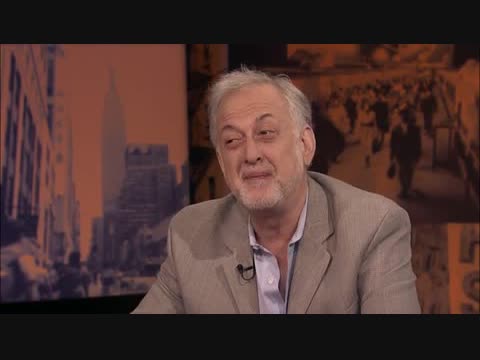
City Talk; Michael Sorkin, architect and author, "Twenty Minutes in New York"
- Transcript
How I'm Doug Musio. This is City Talk. Take a 20-minute, really 28-minute walk in Manhattan and learn about gentrification, Washington Square Park, grids, loathsome landlords, brain scans of London cabbies, La Caboocier, Jane Jacobs, garbage disposal diplomacy, disinformation, and lethal tidiness, and a lot more. Stay tuned. Leading on the Strohtrum in Hatton is Michael Sorkin, the distinguished professor of architecture and director of the graduate program in urban design at CUNY's City College. He is the author
of 20 minutes in Manhattan. He has been the professor and director of the Institute for Urbanism at the Academy of Fine Arts in Vienna, and he lectures widely. He is the author of 17 books, several hundred articles on architectural and urban subjects. For 10 years, he was the architectural critic of the Village Voice. He is also the president of Terraform, a nonprofit engaged in urban research and advocacy, as well as the president of the Institute for Urban Design, and he is the principal in Michael Sorkin Studios. Michael, welcome. Thank you very much. Pleasure to be here. This was a great tour. This 20 minutes. In fact, it took me several hours, and then the research took me several, several more hours, and literally this is a course. Congratulations. But like the Village, this book is full of serendipity and surprises. Talk to the, you're feeling of the city. What should a great city be? You're a lover of cities,
and you're a critic of much of what goes on. What makes a great city? Well, certainly one of the things that makes a great city is serendipity and surprises. I think I probably say somewhere in the book that I think about cities as being juxtaposition machines. Places that engender all sorts of encounters between people and space, between people and people, between people and dogs, between spaces and spaces. And each of these encounters is a formulation of what the city is and what the city means. And the accumulation of such encounters in all their diversity, weirdness and surprise, I think constitutes the soul of the city. What, this is a multifaceted answer. I know, what is, what do you find wrong with the way the city has developed in terms of its architecture, its life, its urbanity? Well, I've spent a large part of a career. No, notice some of these deficiencies. I would say that if there is one thing that I have noticed
having lived in the city for, what's not going to that, but 40 years, is the growth of the income gap. You know, the reconstitution of New York as a center of privilege. The re-segregation of many neighborhoods in favor of, and we speak about gentrification, it's a serious matter. Over the time that I've been living in New York and certainly observing New York, our powers as an industrial city have ebbed new forms of productions, quote unquote, you know, the invention of various derivatives by Goldman Sachs, you know, have become too much of the creative enterprise of the city. And I think that all sorts of things are slighted in this shift. We now have, you know, the richest census tract and the poorest census tract in the country within a mile of each other. And this seems to me to suggest a failure on
the part of city administrations and the public. Let's talk about that. Mike Bloomberg has talked about New York as a luxury city. This seems to fly directly in the face of the city that you envision. And in fact have lived in it at various points. Yeah. Well, I don't want to romanticize poverty, but I do believe with all my heart that city should be open, that city should be diverse. We just had a Sharon Zuchen and I, Sharon, who also teaches here, just had a mocking review in the Atlantic magazine, in which the idea of mixed use and diversity are referred to in inverted commas by the author as somehow sentimental ideas. Yeah, nostalgia. It seems to me that these are core values of decent urbanity. Mixed use and diversity. And I think that to the degree that New York is successful, it is because it represents a mix of uses and peoples. But the author here talks about these moments
as being on a knife edge, these visions of urbanity, Jane Jacobs, Deaf in life in the early 1960s. But in a sense, Jacobs vision in some sense failed because of the very success of her vision that it became such an attractive place that it drew in people with money. And as those people came in, they drove out to people who made it interesting in the first place. And you have the spiral when you come to what would you obviously are not comfortable with. And I would almost say, low this gentrification. Yeah, well gentrification, I think cuts in a number of ways. Go ahead. One of them is we tend to make a confusing mistake in associating gentrification too much with its physical effects and not enough with its social effects. So I am off for the preservation of the historic fabric and to the degree that new residents of neighborhoods,
including Jane Jacobs, who this review accuses of being a gentrifier, that new populations, new citizens, the city is constantly, whoops, the city is constantly being refreshed by the arrival of new populations. Before this on-air session, we were chatting in the green room about you're having taken kids on the number seven trade. Right. Yeah, I mean, this is one of the miracles of New Yorkers. This is a section through the city to use architectural language that embraces people speaking 110 languages, whatever it is, it reveals this constant influx of new populations with new skills and new sensibilities and new cultures. This is part of the genius. So the problem with gentrification is the way in which it systematically represses the possibility of diversity. To the degree that it is a strategy for taking poor neighborhoods and converting them into rich neighborhoods, never mind the fate of the original inhabitants. Right. It's a bad thing. To the degree that it can be a force for saving the architecture, preserving
the texture, the scale, a lot of the morphological things that Jane Jacobs talks about. This is a positive thing. One of the passages in the book is about rent control, and we were also talking about the fact that I have benefited from stabilization. Yes, and you make it a very interesting argument about rent control. Go ahead. Yeah, I think that rent control is completely vital to the possibility of a diverse city. One of Jacobs arguments is precisely that a neighborhood should be able to embrace all of its citizens and should provide opportunities for people of different, we love to say, classes of different social classes, different sensibilities, different professions, different outlooks. People need to be protected nowadays against the market, which in its cruelties and myopia, tends to look at real estate prices as the only
descriptor of value in the city. If I have a beef with Mike Bloomberg, it is that he tends to see this bottom line as the primary measure of urban success. I'm afraid that we need to interfere with the market a little bit. If we believe that the idea of a diverse, mixed, friendly, hospitable city is a value to us. Just as we interfere with the big market in bellowing out the banks. Talk about city planning commission and what it does and doesn't do. Is it part of a solution or is it the problem or is it neither obvious? I don't think it's quite so black and white. It's an interesting moment. I mean, I think in the city right now, for all his faults, Bloomberg has appointed some very good people in city government, the Department of Design and Construction. He's led by somebody extremely enlightened. We have an almost miraculous
commissioner of the Department of Transportation, the person who's responsible for the closure of Times Square, 400 miles of bike paths. It has a very sensible outlook about public transportation. Janet said it kind, yeah. The city planning commission is slightly more problematic. And the question arises, they have been doing a massive rezoning, you know, as with all such matters, the question is who benefits. There has been a recent study that suggests, out of NYU, that suggests that all this rezoning has not resulted in any net gain in housing numbers, which may be neither here nor there, although the mayor is quite vocal in talking about the likelihood of adding a million to the population of the city. I'm not persuaded this will necessarily take place nor that it's necessarily a good thing. But seems to me, and again, I would
want to do much more careful analysis, that the city planning commission is doing good things in terms of its recognition of the importance of architecture and design. We're all in favor of that. But I suspect that the main impact of the rezoning that are taking place are essentially to protect property values, rather than to stimulate the growth of housing for a more diverse population. You are the planning czar. You've been named the planning czar. What do you do? What's your first actions as planning czar's in New York? Well, I think that it's important to sort of split it up. Again, the impetus, you have an architect. My impetus is it would be to do physical things. But I think that the defense of the rent laws is probably the most important thing, a planning czar, might think about doing it. Perhaps even extending the rent laws to some
commercial properties. On the other hand, if I were in charge of the physical city, of which you know, of course, long to be, of Houseman Dreams, I would immediately take half of the street space of New York and turn it back over to the pedestrian realm. I am outraged every morning when I walk up and cruise on the block. That's what I loved about the book. I had wake up out, I wake up outraged exactly it. Then I have my first company. I know the feeling well. Okay, let me tell you one of the things that a number of things that outraged me. Setting aside the derelict condition of the hallways of my building, which is in your loathsome landlords go ahead. I proceed down the stoop and I observe a couple of things. One of them is that two lanes of my little street, which is four lanes wide in Toto, are given over to the storage of private automobiles. Maybe there are 30 cars, all this street space given over
so 30 people. Public space. Public space. Public space. That's right. Streets are the largest area of public space under municipal control. To use them to, in essence, subsidize this doomed transportation technology is outrageous to me. I say, let us take these lanes back. Let us plant trees and deal with the urban heat island effect and sequester CO2 and produce architecture. Let us install garages for our bicycles. Let us deal with the other outrage, which is our ridiculous waste disposal system, in which we construct three days a week, a kind of Alps of black plastic bags along the length of the street. We are in the 21st century in New York City and this is how we dispose of it. I want to take back the streets literally. Yes. Now, obviously, we're not talking about political considerations. We're talking about philosophy here. This ain't going to happen, is it? Well, there is a beginning. Again, I think
Jeanette and Adrian Benapea, there is some move to make greener streets. The reconstruction of the streets would solve all sorts of problems. One creates more public space. As I say, we can begin to grow food. We can deal with waste. We can deal with transportation and bicycle storage. We can also begin to deal with another of the great physical problems of the city, which is the combined sewer system. Go ahead, explain that I'm shivering. You flush the toilet and the contents go into the sewer. It rains and the runoff goes into the same sewer. What that means is, in effect, number one, that every time it rains, the system is taxed beyond its capacity. We dump the sewage right into the river. It also means that many books have been written in which water shortages are identified as the petroleum crisis of the
21st century. It also means that we're not collecting this water. We're just wasting it. As you know, I'm very committed to an idea of maximizing the literal autonomy of cities. One of the bedrock of local autonomy is water supply. We are squandering billions of gallons of water that might be otherwise used to one of the plants and introduce a gray water system into the city. This is a triple system in which partially or largely remediated water is used for not for drinking, but for toilet flushing, for watering the garden, for industrial uses, etc. The reconstruction of the streets begs a whole series of issues for the ecology of the city that we're not looking at. Let's talk specifically. You mentioned the time square broadway pedestrianization, if you will, that both parks, aging, and transportation,
genetics, that are kind of done. A success? I think absolutely. And an expanded elsewhere? Where else does it go? Well, where else does it go? There is a fantasy, a broad among municipal officials, which is that it goes all the way down broadway, which is fine by me, but it should go anywhere. Again, the kind of Manhattan-centric approach is something that needs to be interrogated, but there are neighborhoods all over the city that are begging for this kind of improvement. And I would say, parenthetically or even centrally, that I do believe that the neighborhood is must and will remain the essential framework for thinking about cities and urbanism. And that if we can't carry on with the speculation about how the city becomes more autonomous,
I think one of the ways is that neighborhoods themselves become more autonomous. How? Well, let's take transportation questions, for example. One way that one can solve the problem of excessive transport is by eliminating the need for it, not simply looking on the supply side, more subways, more buses, more needy. But look at the demands, right? So if a neighborhood is something that you conceptualize as a place where all of your daily needs are met, which is to say living employment, culture, commerce, recreation, then suddenly, if you can walk to work as I do, great privilege. And you know, traditionally small minority of the population can afford to do this afford meaning many things. But if we have distributed our social technical and physical infrastructure more astutely, if we begin to locate places of work, not in the center of the city
uniquely, but distributed in the neighborhoods. And if we, as has been called, for by every Bempo summer urbanist since the year of Gimmel, begin to distribute to the residential population, the fastest growing residential site in the city on percentages is lower Manhattan. And there are a variety of reasons for this, but this is essentially a good thing that people will be living in proximity to their workplaces. Now, I don't think there should be any compulsion here. But if you take a view that in thinking about planning, you want to harmonize a series of functions at the local level, which would include, as I say, this list of daily functions might include waste remediation, which can be dealt with locally rather than centrally. You think about schools and which are already established as a kind of basic neighborhood bulwark,
then these more autonomous neighborhoods, I think, will make a more equitable city, make a commerce city, and certainly make a more sustainable city. Okay, let's talk about sustainable and sustainability. What is the sustainability? We have an office of long-term planning and sustainability. What is sustainability? Just to find it for me. Well, the standard definition is that one does not create any deficit for future generations. Okay. In terms of what's available as planetary resources. And concretely, if you will. Well, let me answer slightly obliquely. The bottom line here is that we have only one planet for the time being, reading in the story, in the times about some famous physicists who are saying, we've been to not colonize Mars because we'll bring our microbes. And if there's any life there, it's at it. Oh, we just don't have to worry about that.
You and I, we don't have to worry about that. Exactly. I don't think that an extra planetary solution is enough to come along. No, no. But the fact remains that if everybody on the planet, and it's growing exponentially, we're six and a half billion, half of these are living in cities, half of those are living in solutions. And an increasing number of living in cities in cities. That's right. Over half the population, we had a million people to the urban population on the planet every week, a million people. So, I mean, another line might be the argument about the absolutely under necessity of creating new cities. Right. People rather than the continuation of the megacities sprawl model. So you must have done a lot of thinking about what these new cities might be. I mean, let me finish my last class. You have a professor. Now, the point is that six and a half billion people, so if all of these people were to consume at the rate that we do here, the surface area of an additional two planets would be required. I mean, this is simply to outline the extreme nature of what is becoming a global crisis.
So, that means, for me, and my research is all about looking at sustainability as literally taking responsibility locally for all the forms of urban respiration. So, as you know, we've been working for years on a study in my nonprofit about how New York City can become completely self-sufficient in every place within its political boundaries. Right. It's very well along, you know, we've demonstrated, I think, that we can do it with food, we can do it with water, we can do it with waste variation, we can do it with kind of thermodynamics of the city, we can do it with air quality, and we're working on manufactured goods and building technologies and so on and so on and so on. And I think we will prove it. I mean, we may not be able to have the second cup of coffee, and don't get me started about that chocolate bar, you may have to surrender, but as a technical matter, I think that we will be able to demonstrate that we can literally take responsibility for our
own inputs and outputs. So, we have closed the loop. We have technical feasibility, then the question is, do we have political feasibility? Do we have the ability and will to do it? And that seems... Sure. And I don't know, frankly, if the end of the day, how rigorously I would make this argument in terms of the permeability of the city and the necessity to spend whatever extra money it might cost to do this as opposed to importing energy supplies from other sources. But, what we want to do is to show that radical responsibility taking really is possible. Okay. You know, that we hold the solutions in our hands, and if we have the will, we can solve them. In fact, compiling a morphological and technological encyclopedia that can be used should a city decide, and we want to supply half of our necessities or quarters. So, this is an essential generalizable across the planet.
Yes. That's not unique to any particular economic social or political system. This is potentially universal. Yes. And that's certainly not true. Sure. I mean, the question of costs is obviously at the center of this. So, you know, what we give ourselves as a limiter is that we only employ technologies that exist. Right. Because there's no anti-graphs in the 18th year. And you know, and assume that mass production is going to bring down the price of things. So that there is an increasing feasibility, as one goes on, I mean, take photovoltaics, for example, which, you know, the silver bullet from lots of people. It's still a bit expensive, but, you know, like computer chips and everything else, it'll get cheaper. Right. So, that's a technology. Right. We assume we have available to us, as well as some, you know, tidal energy and winds and geothermal energy and, you know, the whole range of possibilities that presently exist on the planet.
Okay. Okay. So, we're looking at packages. Some of the things that I've noticed outrage, and we're going to go into the sort of the outrage segment, or of the program, we're going to do sort of a, I stream of consciousness. Yeah. Disnification and Times Square, you've got a minute screen. Huh? Well, Times Square, you know, is a good place in a bad place. You know, I notice when you sent me your notes and said something like, seems to have sentimental attraction to Hooker's junkies and- No, I have a sentimental attraction to Hooker's junkies and pimps. Yeah. But I sort of missed the Gora even though- All right. Well, here's the point about Times Square is that number one, it becomes part of a very homogenized culture that is the culture of corporate globalization. You know, one thing that we have come to learn, I think, you know, us academics and citizens as well, is that when one speaks of the public, one is in fact speaking of multiple publics. And one of the appeals of the old Times Square was the intersection of, you
know, an extremely raunchy public and an extremely proper public and the, you know- You don't have that now. And your mother going to the matinee, you know. Right. And she's avoiding Times Square. And she's avoiding Times Square. Great course. Yeah. So, you know, there's an upside and a downside to that. But what the new Times Square has done in many ways is squeezed out that diversity and replaced it with this pre-digested cultural product, which channels Madame Tussauds- And, you know, and the Lion King, you know, all of which you can consume in Dubai or Singapore or Paris and exactly the same form. So to the degree that Times Square is something remarkably central to our sense of identity, and deeply indigenous to the idea of New York, and to the degree that all those things that are New Yorkish are being kind of squeezed out or recycled as New York and inverted commas. Right.
I think it's a bad thing. On the other hand, the closing of Times Square and the gathering of great crowds in the street is something beautiful and miraculous. So, you know, it's cut in both ways. But it's a contested space. You know, there are publics that have a hard time there, and there are publics that have an easier time there, and that's part of the glory of the city is that it is the grounds of this kind of contestation and dispute. Oh, you love the... Okay. 15 seconds. Yeah. NYU, Columbia. What does it say about universities as neighbors? Well, you know, I live near NYU, and I was at Columbia in the day when they were making their incursion into the morning side park. I don't know why these institutions have such ten years. Why they think of themselves as not responsible to the fate of their immediate neighborhoods. You know, in the one hand, I mean, higher education is one of the best things we do. And this is, you know, I mean, particularly those of us who teach at public institutions,
you know, I think we are doing a remarkable service. But, that doesn't, I think, relieve these institutions from more canny plans. I mean, in my nonprofit, we've been doing a counter proposal to the Columbia scheme. And it's not to oppose the expansion of Columbia, which is very valuable. Rather it's to say that if you think a little less, empirily, you know, if you think that your campus need not be this contiguous bounded entity, and think about a more disaggregated approach in which facilities are located around communities that can profit from them. You know, maybe this will be of greater benefit to the city. We have to stop. Ah. They're yelling at me. They're way over. But that's fine. So, we're not finished with this conversation. We're going to have to continue with this tour at a later time. My thanks to Michael Sorkin for taking us on this tour of Manhattan and his observation of the city and city's life, see you next week.
Go on to the museum. Let us know what you think about this show. You can reach us at cuny.tv. When you get there, click on the board that says contact us and send your email. Whatever it is. Thanks. No thanks. I'm not just do it. Send them.
- Series
- City Talk
- Contributing Organization
- CUNY TV (New York, New York)
- AAPB ID
- cpb-aacip/522-db7vm43t9b
- NOLA Code
- CITA 000240
If you have more information about this item than what is given here, or if you have concerns about this record, we want to know! Contact us, indicating the AAPB ID (cpb-aacip/522-db7vm43t9b).
- Description
- Series Description
- City Talk is CUNY TV's forum for politics and public affairs. City Talk presents lively discussion of New York City issues, with the people that help make this city function. City Talk is hosted by Professor Doug Muzzio, co-director of the Center for the Study of Leadership in Government and the founder and former director of the Baruch College Survey Research Unit, both at Baruch College's School of Public Affairs.
- Description
- Doug welcomes architect and author Michael Sorkin to the program in this episode. The Michael Sorkin Studio has, for over thirty years, been devoted to both practical and theoretical projects at all scales with a special interest in the city and in green architecture. His most recent book, "20 Minutes in Manhattan" is about the walk from his apartment Greenwich Village to his studio in Tribeca which takes about twenty minutes, depending upon the route and whether he stops for a coffee and the "Times." Taped May 18, 2010.
- Description
- Taped May 18, 2010
- Created Date
- 2010-05-18
- Asset type
- Episode
- Media type
- Moving Image
- Duration
- 00:29:10
- Credits
-
- AAPB Contributor Holdings
-
CUNY TV
Identifier: 15716 (li_serial)
Duration: 00:29:11:00
If you have a copy of this asset and would like us to add it to our catalog, please contact us.
- Citations
- Chicago: “City Talk; Michael Sorkin, architect and author, "Twenty Minutes in New York",” 2010-05-18, CUNY TV, American Archive of Public Broadcasting (GBH and the Library of Congress), Boston, MA and Washington, DC, accessed April 1, 2026, http://americanarchive.org/catalog/cpb-aacip-522-db7vm43t9b.
- MLA: “City Talk; Michael Sorkin, architect and author, "Twenty Minutes in New York".” 2010-05-18. CUNY TV, American Archive of Public Broadcasting (GBH and the Library of Congress), Boston, MA and Washington, DC. Web. April 1, 2026. <http://americanarchive.org/catalog/cpb-aacip-522-db7vm43t9b>.
- APA: City Talk; Michael Sorkin, architect and author, "Twenty Minutes in New York". Boston, MA: CUNY TV, American Archive of Public Broadcasting (GBH and the Library of Congress), Boston, MA and Washington, DC. Retrieved from http://americanarchive.org/catalog/cpb-aacip-522-db7vm43t9b