City Talk; Ed Rollins, Errol Louis, Pt. 1 Of 2
- Transcript
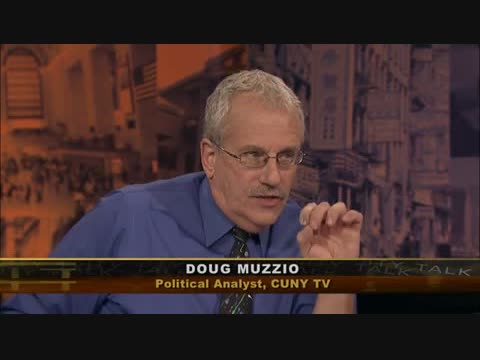
How I'm Doug Musio, this is the season premiere of City Talk, the elections 2010, the voters angry, fearful, disgusted, cynical, the U.S., an unsettled nation, a Republican takeover of Congress, tea parties, ground zero, mass, Obama, what went wrong? Joining me in the first of a two-part conversation on national and state politics and the 2010 elections are two of my favorite political wise guys, I mean wise men, Ed Rollins and Errol Lewis.
Ed Rollins is in his 40-plus year as a university administrator, political science professor, political adviser to presidents and presidential candidates, to governors and senators. He's the mastermind of the historic 1984 Reagan landslide. Errol Lewis is a columnist for the Daily News and a member of its editorial board, a CNN contributor and host of the Morning Show on radio station, WWRL. Both Ed and Errol are active members of the Chattering classes, often quoted analysts and commentators. Welcome back, Gents. We've got so much to talk about in so little time, let's start with national politics and Obama, the question I sort of ended with in the intro, what went wrong? I think Obama got overused, I said, Errol and I used to do a new job show on a regular basis and I was very concerned early on that this was a guy who was out every other day, he was the only messenger they had, he has an invisible cabinet, so nobody knows who the
commerce secretary is or any of the rest of it, so he basically, every time they got in trouble they put him out. After a while, just like a television show running else, you can wear yourself out. I think he is great communication talent but I don't think he's a great communicator at this point in time and I think to a certain extent what he's not the threshold he's not crossed is the American public has not said, gee, this guy's a great leader, I'm going to follow him. Yeah, go ahead Errol. There's a remarkable difference between the communication strategy they ran during this successful 2008 campaign and what goes on now, it's really just remarkable. There's very same people that were out in the field and were giving us lots of information and we had a great time working together and sort of capturing what it was that was going on out there and what he was trying to communicate, all of a sudden you can't get phone calls returned or they're rolling it out in these very cut and dried cookie cutter kind of town hall meetings and just as Ed says, it starts to wear on you, you know and you start thinking it's like, well, don't they have anybody else to sell this stuff? I mean, he's the product, he's not also, he can't also be the Chief Salesman.
But at the same time he's this Chief Salesman, do we know him? He really hasn't defined himself for all the exposure, do the Americans never really get a sense of that. He's never let anybody close. I thought one of the great things that we're going to occur with this election and once again Errol and I commented all through the election. I thought it was going to be a fabulous thing to have an African American family, a beautiful family in the White House that would be a part of our lives as the store presidents have. This has kind of been an invisible family. I mean, we see her go off to Spain, gets widely criticized, we see them go on a little vacation here and obviously it's important to have normal life for your children. But I think what's happened is, as you say, you don't really know him. Why didn't he go? He's a Christian. Why didn't he just pick one of the great churches in Washington, D.C. and go every Sunday and if the crowd gets in convenience, tough, tough, you know, they'll still show up every Sunday, they'll be excited about it, they'll tell all their neighbors they go to the President's Church.
They didn't. And I think to a certain extent, why half the country or fourth of the country thinks he's a Muslim has nothing to do with any of that. But I could have knocked that down early on and we don't feel like we're part of his life. We think he's a smart intellectual who basically lectures us on a regular basis and none of us like to be lectured. Yeah, I mean, this is true, he's not a touchy-feely kind of a guy and the reality is he never was. I mean, he's impressive, you know, but he's cerebral. Yeah, he's cerebral, he was in fact a professor for a long time, you know, those professors are. Yeah. And cerebral charming. And when he talks about the American people, it sounds like an abstraction. It doesn't sound like his family or his neighbor or his life or your life or anybody that you've ever heard of, it sounds like this thing that he's been entrusted to take care of. So he loses some points there and it makes it hard for him to deal with what any president including Ronald Reagan who Ed worked for, to recover from which is a disastrously deep vicious recession, very hard to work with that kind of a challenge when people don't feel
like inside you're with them, you're fighting for them, you're somebody who relates to them. You have two wars that also command the chief executive's attention, so you've got that problem. Can he rebound? We're focusing on Obama rather than the party. Can he rebound? You were part of a group that was put together by the times in the Washington Post to talk about this. What is your sense of? You're advising him. What's your advice? Collections are always about the incumbent and if the country wants to change, which he probably would if the election were held in five, six weeks from now, but we've got another two years to go and there's plenty of time for him to come back. He is the agenda. I'm not sure the economy is going to get better and we'll talk about the other stuff that I think is going to be very difficult, but if the country wants an alternative, they'll find an alternative, if they don't and they get pleased with his performance in the next year, he'll be reelected.
There is one caveat though. If Republicans nominate Sarah Palin or Newt Gingrich, then it doesn't matter what he does, he probably gets reelected. If they nominate someone who's not known but becomes a viable candidate in the course of being unknown, he may be a governor or someone out there, but in the course of the next two years, you get known awful quick in American politics today, we have a credible alternative. Okay. You look at the headlines, you look at the analysis for the November election, the congressional, the Senate, the gubernatorial elections, and the headlines tend to be the same, that it's a GOP blowout. That all by itself tells me that it probably won't be, or it's very likely going to be. On the other hand, people that I talk to and I ask them, well, what do you think is going to happen? And I'm talking about long-time members of Congress, people with decades in Congress, long-time people, consultants, pollsters. What they're all saying is, well, if you'd asked me this 10 days ago, I would have said the Democrats might hold on in the House now they're not so sure.
And the evidence seems to be piling up that there's a money-advantage that Republicans are taking advantage of, there's an enthusiasm gap that is very sizable and, in fact, measurable. We just finished a primary in August in Florida where, despite a 750,000 vote advantaged that the Democrats have, they underperformed. 1.2 million Republicans came out and about 900,000 Democrats came out. And you've seen this enthusiasm gap almost throughout the country in this primary season. And that's like a catnip to people in its business who are trying to really focus everything on election day. So I think they're going to, and the Democrats are going to have a very bad day on November 2. Because if you look at, for example, Rothenberg, Cook, you know, the otherwise guys, real clear politics, 538, all the numbers seem to suggest that Republicans are not only going to make inroads in both houses, but could conceivably take the House and conceivably take the Senate even though less likely, go ahead.
Both can, both can occur. I would, I was certainly never predicted the Senate three or four months ago. And I wouldn't have predicted the House a year ago. I think both are doable. I ran the Congressional Committee. I know how you, I know how these things come apart in the closing days of the campaign. I live through water, one of the things of being in the game forever is I live through Watergate. Watergate was, it all collapsed. I was the White House political director in 82, when unemployment hit 10%, it collapsed. My sense today is it collapsed way early. So it's given, unlike 94, where a lot of these Democrats got knocked out and didn't know what was coming, they all know they're in trouble. And even those who aren't in trouble, and you know, a lot about reapportionment, the lines are drawn in a way that there's a couple hundred of them on both sides have safe seats. You're not going to beat an anti-plossey in a district that 81% Democrat. But you could beat John Hall in New York 19. That was a Republican seat four years ago. Obama barely carried it. Bush carried it twice. There are people who have voted Republican, but in order to win this thing, we've got
to win four or five seats here in New York, which is not easy with Cuomo being the probable governor and no Republican at the top dragging people across. So I think at this point in time, the opportunity is certainly there. We have great candidates, there are going to be well-funded, and I think to a certain extent it's a question of can these incumbents, Democratic incumbents, fight off the challenge that they're prepared for. And also, it's a question of can the Republican incumbents fight off challenges from the Tea Party folks and folks to their right? I mean, it's not only the Democrats, the Republicans have a strength, but there's weaknesses here. You point that at New York State, for example, in a couple of those congressional districts where the Republicans could win or the Democrat could lose, you've got a split. And if those splits hold up after the primary, then the Republicans are in trouble. If you're in the state, and I'm not going to come to your time, Staten Island should have been our seat.
I think we have a knockdown drag out primary, I don't know who's going to win it. There's two sides. Two Warren factions, New York won, which is the mission seat, and I should have won that easily. Two strong candidates spending millions of dollars against each other in a primary. I can't predict who's going to win. But if that would have been a cleared-out process, it would have been a strong party, which I'm going to predict to you today that the endorsed candidates for governor and Senate, and this is the day before. This is the day of the primary, are not going to be the nominees of this party. So Paladino wins, and the other non-establishment candidates. What does that mean for the Republican Party, well, the Republican Party in New York is comatose anyway? Does it mean, is there a largest significance out there nationally, or the similar things happening nationally? There's a difference once again, I don't mean to take away time. The Tea Party, take Delaware today. Okay, Delaware's a state with 181,000 registered Republicans, it's like a big congressional district. I assume 67,000 of those people vote today.
Most of those voters, or at least two-thirds of those voters, are pretty conservative voters, and Mike Castle, who's the congressman, if he wins that nomination today, he's the next senator. If he loses to a sort of unknown Tea Party candidate, then you've got a real race, and the probability is the Democrats hold it. But the bottom line is conservatives, this goes, I go back to Reagan against Ford, Reagan against Bush, the establishment. These conservatives at this point in time don't want Washington, don't want Albany, don't want these other places to dictate to them. They're going to go out and choose their own people, and they want people who are fiscally conservative, they want people, it's not the social issues, it's not the libertarian, it's really the fiscal issues. You're basically a run in this country and a debt, there are no jobs out there, we want to basically give you to go back to the fiscally conservative Republican Party. If that doesn't happen, and my sense of what's going to happen in New York, as I hope, it makes some smart people, and I'm sure there's a lot of them around here, who can basically
say we have a system that's broken, people like Pataki and others who've been around have to come back and help the process get better. In fact, Pataki is somewhat responsible for the lack of team, because during his 12 years of governor, he didn't do anything to build this, this is the most close, I've lived in New York for 15 years, I moved here from Washington 15 years ago, I've never once, I'm a national player, I do races all of this country, I've never once been invited to come into New York and either talk to the Republican Party or to basically help a candidate, I do it everywhere else, but I don't do it anymore. What's your assessment, you're looking at, in a sense, the same terrain, what are you saying? The local Republican brand was already going to be in trouble, you've got the top candidates like Rudy Giuliani and George Pataki already looking at the national stage and famously did not build much of an infrastructure here, so they were already going to have a problem, the state has been turning more and more blue, the party here would have had a challenge trying to keep up with it, anyhow, without leadership, it does all start to fall apart
and that bloodbath in upstate New York, where the Tea Party candidate actually went after the endorsed Republican, you know that the anger is real and that it's not related to whether or not people hold seats, I've met and interviewed some of the Tea Party people from out along Ireland, same kind of a thing, they really have a grudge and a distrust of government that is so deep that it really transcends Party labels, Party affiliations. But don't the purest then, in a sense, fort, they sacrifice the good for the person. That's all that time. Happens all the time. Democrats have been doing it for generations, you know, nominating candidates who have absolutely no chance. In fact, my little prediction for today would be if Schneiderman, as is widely predicted, wins as it becomes the Democratic Attorney General candidate, he's going to have a hell of a race on his hands in Canada. Right, I mean, Dan Donovan is a guy who is very, very solid. I wrote endorsements of them a little bit, a few years ago.
They called me up to ask to come on my show, which builds itself as New York's progressive talk station. He's going to be my guest the day after elections. Come on. So he's interested in everybody, he's interested in winning, and he's interested in pointing out some of the stances that Schneiderman has taken over the years, where the other candidates were actually trying to warn the Democratic bases, like look, this is a guy who voted against civil confinement for sex predators, you know, I mean, is he going to be the top law enforcement officer in New York? So it's not an unknown phenomenon, and we're going to have a lot of turbulence as a result. And then you've got Wilson versus Danapoli again, which looks to be a strong candidacy. I don't know what Andrew Cuomo's thinking, but I can almost see Andrew looking at the Attorney General's race and the control is race and saying, in a sense, he's almost better off having Wilson and Donovan than having Schneiderman and Danapoli. My sense is that the Attorney General who will be the governor elect in November 2, I don't think needs to be strategic.
I think he needs to worry about what a mess he's in there. All right. And I think to a certain extent, who's in other positions is not as relevant to him. I mean, the ideal situation would be to go back and have a Republican Senate and the Assembly, so you have a little bit of somebody to deal with, that's probably not going to happen. I think the state is in big, big trouble. I think as a Californian, I watched my state fall apart. I think New York is falling apart. And the tax base here with the potential of an increase in federal tax, potential state increases, city taxes, it's going to make living in New York, New York City, New York's surrounding areas almost impossible for well to do people. And they can go anywhere they want to these days. The lucky thing that they have is the Connecticut doesn't have its old system of no income tax. Everybody move in there, but I think at the end of the day, corporations can go anywhere they want. Anybody starting small businesses can move anywhere they want, telecommunications, all the rest of the fancy things we have today. There's no great need to be in the heart of Manhattan.
Okay. Let's move from New York back out to the larger electorate. If you look at the polling and the most recent ABC Washington Post poll, this headline, the vote against status quo gives Republicans, record lead in 2010 midterms. What's your sense of the electorate? Is there a national electorate? Are they angry? Are they fearful? Are they distrustful? Are they all of those things? One side is angry. Republicans are angry and intense. I think Democrats are disillusioned and especially those who voted the first time or second time for Obama. I think they had great hope and when you look at the first of all, there's a third or less vote in midterm elections and it's very hard to get enthusiastic. If you're a young person who went out and was all for Obama, it's real hard to go out and find your local Congress when they get equally enthusiastic. So I think the drop-off will be among African-Americans. I think it will be among younger voters that voted both who voted record numbers for
Obama. I don't think they turn out. I think at the end of the day, your labor people are going to turn out. Even though some polls indicate a third of them, basically you're going to vote Republican which is a big, big jump from where it's been since the Reagan days. So my sense is the die-hard Democrat and even the progressives aren't happy at the end of the day that the only thing that may drive them out is the potential of a Boehner or someone like the Republicans taking back, although Boehner's not a bogeyman. It's hard to make John Boehner into a bogeyman. I mean, it's, we couldn't make Nancy Pelosi into a bogey person and then my sense is bogeywoman, a bogey speaker. We've tried to run against speakers whether it was Jim Wright, Tip O'Neill, I believe. I beat Foley so I could at least at least say no, I didn't know, but that was what we did in that campaign. That was part of the 94's. We said, after thank you Tom Foley for your 30 years of service, this district no longer needs a speaker, we need to listen to him and we tapped into that, you know, I didn't mean that's, it's, this is, this is a reference.
It looks to me like the Republicans want to nationalize the election and they've been successful in doing it. And I guess the counter-democratic strategy has to be to localize the election. No, they've got to want to want to, you know, John Hall's got to beat off his candidate without help from Obama and without having Obama wrapped around his neck. You know, he is West Point in his district, I mean, here's, you know, the military is not exactly a group that's enthused about this, about this president. So my sense is, you know, the biggest dilemma the president has, once again, I'm going to take all the time here is Reagan and they always want to compare it to Reagan. We hit the unemployment numbers the same way, but Reagan's tax plan didn't come in existence till January of 1983. So as those things started, the benefits, we passed the programs in the first year, but they didn't come in until January of 1983. So we went through the midterm, we got our teeth kicked in, we lost the philosophical majority, we had lost 26 out of seats, and we had the conservative Democrats who gave
us a philosophical majority. We didn't have those the last two years, but we didn't need any programs. We had the programs, our programs started coming into existence, the economy came back. The problem this president has is, and Reagan was defined as a leader because he had fired the air traffic controllers. He was standing up to the Soviets, he had rebuilt everything. He had been around for 40 years and he was a two-term governor. So people knew Reagan, but they don't know Obama. And the problem with all of that is they don't know Obama, even the Democrats aren't sure what kind of leader he is, he's passed his big programs, none of which basically kick in in a way that benefit the economy, and equally as important, at least not in the foreseeable future. And so my sense is, however this election turns out, and I think it's a pretty divided election, a pretty divided Congress when it comes back, it's going to be very, it's going to be no stimulus programs. You're not going to cut the entitlements, you're not going to raise the taxes. You're going to have two years of real-time commitment. And the question becomes how do you get back to the base? I mean, one of the things that we'll fall by the wayside is any possibility of action
on immigration. There go the Latinos, you know, the unemployment will continue to be stubbornly high. That's going to bleed out some of the enthusiasm in even the black base. And then the unions who wanted their employee free choice act, you know, and they're not going to get their car check bill, it's not even going to come up. They're not going to necessarily see, I mean, maybe he can make some progress on foreign trade or some of these trade deals, but he's not going to have a lot to work with, which suggests that he's going to end up having to do for 2012 what Bill Clinton did in 1996, which is a lot of little programs and, you know, sort of play them up and kind of be the governor of all 50 states and throw a little here and a little bit there. But one of the big differences between this president and Reagan was, you know, there was this three-legged stool of support for President Reagan. It was the defense conservatives, the social conservatives, the fiscal conservatives. He tended to that base religiously, a small business, by the way. And this president, you know, I can tell you that the view from the base is that there
are a few too many key parts of the base that are being ignored. The most important one, incidentally, is the suburban. The suburban swing voters. Those are the folks that I'm going to be looking at as the midterms come and go, because if they don't come back, he's going to have a very hard time in 2012. Okay. Let's look at Belweather. As you talked about swing voters, are there any particular states that we should be looking at as sort of indicative or evocative of what might happen or are they all in the unique? I think they're all unique. Interesting enough, as we sit here talking about, Delaware used to be the ultimate Belweather. And how Delaware went, so the country went, you know, it's no longer that way. But I think to a certain extent, Pennsylvania used to be a state that basically always was, I think the key thing here and what I'm watching closely is the nine presidential campaigns. It always comes down to Ohio, it always comes down to Michigan, it always comes down, Illinois used to be Florida, California, Texas, which are the big ones, and New Jersey.
All of those states that the president did much better in than any traditional immigrant places like Virginia and others, if he could have cemented those states, you know, there's always, there's always rhetoric of a permanent majority, whichever, and the bottom line which doesn't listen to them at last year, what is occurring, and you teach young people, I teach young people. These young people who are going to be the future of this country are really not tidy either party. They're going to thuse about Obama, but they're not going to march out there and find their local congressmen of the local assemblymen. They're going to be independence, and they're going to be independence their entire life. And independence, basically, you're going to go back and forth in 206, when independence voted Democrat, they won the Congress. When 208, they voted overwhelmingly for the Congress for Democrats and for the president, now they're back with us. Now they're not going to stay with us unless we basically appeal to their base. I want to move from sort of the politics. We'll talk to that a little bit more about that in the next show. The state of the national political dialogue, if you will, it seems to
be coarser, more angry, more talking past. Are we at a different state that we've been in before or have we been here before? I've only been around for a hundred years, so I can only tell you that. And I came to Washington starting California politics in the 60s, came to Washington in 72 for the second next administration, lived through the Watergate that would have you. I sort of attribute this to what I call the Jim Wright New Gingrich era of where it started in the late 80s. And a lot of it was the breakup of the social system in Washington, D.C., where Danny Rosten, Kowsky, and Abob Michael would play golf and have dinner, and they'd say, we're diametrically opposed to here, how can we find some result? There's none of that dialogue anymore. And when I have many friends who are Democrats, many members who are Democrats, and what socialize, and we love the game, just as the three of us love the game. I mean, Earl and I may have some different ideological events, but at the end of
the day we enjoy each other's company and we like the game. The problem today is the game is the partisanship. And I blame a lot of it on the reapportionment. I blame a lot of it on the fact that we do have these 200 seats on either side that are basically drawn and there's no competition. And so at the end of the day, all a Democrat is to worry about us getting attacked on this left. Carol Maloney is to worry about not a Republican, but someone challenging her on the left. Republican has to basically worry about getting challenged on the right. So you're forced to go further and further. And the country is less partisan. Go on to the point I was making earlier about the independence. I mean, literally the plurality of voters today are self-identified and independence. Pollsters don't let them sit there. They force them, but they really are, they really are independent. And we're going to have a very difficult period in politics as a result of this because we've got an electorate that's crying out for somebody to bring everybody together and all of the rewards in the political system are for doing the opposite. So we're going
to see more polarizing elections. I mean, the fact that I think there's something like seven or nine of the Republicans endorsed candidates for Senate lost a Tea Party candidate. That's not a great thing. Democrats have been jumping up and down because it creates the possibilities and a few instances. But overall, that's not good. It's just semically it's not good. Not a good thing. And for the president to have so stubbornly insisted on bipartisanship because it did ride him from that speech in 2004 all the way to the White House. But then not being able to deliver on it, there's going to be a certain amount of cynicism that trickles in, that kicks in as well. That's not going to work for him. That's not going to work for the system. So at a time when the party system is, is causing problems or has its problems, you have to add that or lay that on top of all of the other institutional failures that are bothering people. And this is where the rage comes from. The market is running over people and costing them their homes and their lives and their jobs. The schools aren't teaching the way that they're supposed to. The, the, the, the, the, the politicians are lying to them or playing with them. This is the way people feel. And the party system's not working. The unions are dwindling, you know, the corporations are fleeing and cheating things.
We're going to continue next week. You got to stop. I mean, you'll keep going. Well, we'll fix it next time. That's right. We'll talk about that. Gentlemen, thanks. Join Ed Rowland's era Lewis and me next week when we continue our discussion of state, national and local politics and the 2010 elections. Hello, I'm Doug Musio. Let us know what you think about this show. You can reach us at cuny.tv. When you get there, click on the board that says contact us and send your email. Whatever it is. Thanks. No thanks of notches. Do it. Send it.
- Series
- City Talk
- Contributing Organization
- CUNY TV (New York, New York)
- AAPB ID
- cpb-aacip/522-5x2599zz89
- NOLA Code
- CITA 000246
If you have more information about this item than what is given here, or if you have concerns about this record, we want to know! Contact us, indicating the AAPB ID (cpb-aacip/522-5x2599zz89).
- Description
- Series Description
- City Talk is CUNY TV's forum for politics and public affairs. City Talk presents lively discussion of New York City issues, with the people that help make this city function. City Talk is hosted by Professor Doug Muzzio, co-director of the Center for the Study of Leadership in Government and the founder and former director of the Baruch College Survey Research Unit, both at Baruch College's School of Public Affairs.
- Description
- Joining Doug for the first of a two-part conversation on national and New York State politics and the 2010 elections are Ed Rollins and Errol Louis. Ed Rollins in his 40 year career has served as a university administrator and political science professor - a political advisor to presidents and presidential candidates, to governors and Senators - the master-mind of the historic 1984 Reagan landslide. Errol Louis is a columnist for the "Daily News" and a member of its editorial board, a CNN contributor and host of the Morning Show on radio station WWRL. Both Rollins and Louis are active members of the chattering classes, often-quoted analysts and commentators. Taped September 24, 2010.
- Description
- Taped September 14, 2010
- Created Date
- 2010-09-14
- Asset type
- Episode
- Media type
- Moving Image
- Duration
- 00:27:54
- Credits
-
- AAPB Contributor Holdings
-
CUNY TV
Identifier: 15730 (li_serial)
Duration: 00:27:55:00
If you have a copy of this asset and would like us to add it to our catalog, please contact us.
- Citations
- Chicago: “City Talk; Ed Rollins, Errol Louis, Pt. 1 Of 2,” 2010-09-14, CUNY TV, American Archive of Public Broadcasting (GBH and the Library of Congress), Boston, MA and Washington, DC, accessed April 5, 2026, http://americanarchive.org/catalog/cpb-aacip-522-5x2599zz89.
- MLA: “City Talk; Ed Rollins, Errol Louis, Pt. 1 Of 2.” 2010-09-14. CUNY TV, American Archive of Public Broadcasting (GBH and the Library of Congress), Boston, MA and Washington, DC. Web. April 5, 2026. <http://americanarchive.org/catalog/cpb-aacip-522-5x2599zz89>.
- APA: City Talk; Ed Rollins, Errol Louis, Pt. 1 Of 2. Boston, MA: CUNY TV, American Archive of Public Broadcasting (GBH and the Library of Congress), Boston, MA and Washington, DC. Retrieved from http://americanarchive.org/catalog/cpb-aacip-522-5x2599zz89