Festival; 22; Igor Stravinsky. Part 1
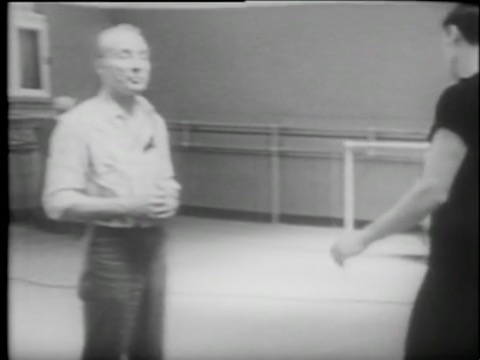
- Transcript
Any tea? Stravinsky. Take one. National Educational Television presents Igor Stravinsky, venerated innovator in music of this century, in a recent conducting appearance at Boston Symphony Hall. His concerts included seldom-heard older compositions from his work, such as two song cycles, Bursou's Tusha and Privoudki, and the more popular sweet from Pulsianella. Also presented with a Boston Intellivision premieres of the more recent Elegy for JFK and Abraham and Isaac. This music will be performed later in this telecast.
Though in his 80s, the life of Igor Stravinsky is active and crowded as ever. The National Film Board of Canada, not long ago, superbly documented this vigor. Igor Stravinsky, a giant of the 20th century, has just entered Massey Hall in Toronto. There, the CBC Symphony Orchestra and the Festival Singers will be required to put on recording tape once and for all the definitive interpretation of a Stravinsky classic. The meticulous preparation is almost complete. It is supervised by Stravinsky's protégé Robert Kraft and by John McClure of Columbia Records. Stravinsky is waiting. I've wanted to meet you so much. We were at Dartington. I was there when you were there. That was right. We never met, actually.
I always wanted to very much. How are you? Enjoy your time. I am fine. You are. You're working very hard recording away. All my life. Yes. Julian Bream is the world's best player of the loot. I always wanted to play to you sometime on the loot because I read that you find the loot very beautiful and expressive instrument. Of course. But then? Well, anytime, anytime. I'm sure it's very difficult. There are people who have time. There are people who have money. People who have meetings, you know. I have something. But you've got great gifts, which is more than the time or the money. Oh, nice. And you're making a film here. Well, they are filming you out here. Which film? Well, I see thousands of cameras. Would you like to see a loot? Would you like to see my loot?
I brought it with me. Oh, nice. Stravinsky is excited by the physical presence of musical instruments. The loot, he says, is perhaps the most perfect and certainly the most personal instrument of all. It's a very much more for the loot. Then for the piano. I'd love some time to play with it, please. Perhaps I could play a bigger beginning now. Problem with this instrument is so many strings it takes a lifetime to tune it. Ah. Recording such as we've done today, Phil. Let's go. This is a little pavan. He goes Stravinsky remembers back into the summer forests of Imperial Russia.
When an old peasant who was mute, plucked his tongue and smacked his armpits to make music for the children. He remembers even earlier a song of some peasant girls coming home from the fields. And how he delighted his parents that evening by repeating the song, although he had not yet learned to talk. Why don't you continue this in the next break?
We have to do a different kind of work. Sure. Thank you very much. Thank you very much for playing. It's been a great pleasure. Very, very good to meet you. Now we have to work ourselves. The world pays homage. It was different on a Paris night in 1913. A confused and furious audience drowned out his music. Barbaric, they said. But soon the world decided it would be best to listen. Good afternoon. No, not a horsey, just played through. Are we ready?
Not yet. What do you say? Stand by please. Rynski, simply of songs, first movement, take one. Rynski's music is completely like that of a new extraordinary band,
a very light band and of an insect. An extraordinary insect. I was always very much interested by the fact how much he physically, his movements, his way of smiling, his weight, the way of talking, his mannerisms even, resemble his music. Nicholas Nabokov, director general of the World Congress of Cultural Freedom, has known Stravinsky since 1925. I was always surprised when he, I see him conduct, when Stravinsky conducts. The way he turns his right hand in the, to show the counterpart of the rhythm,
it's so essentially the rhythm itself, the visualization of that rhythm. That is another thing which always excited me best to see is he conduct. I mean, I think that his conducting is very interesting. Maybe he's not a virtuoso of the other conducting, but I think that this particular virtue, which Stravinsky's conducting, Stravinsky's presence has, that people are then solely concerned with the problem of how to make music.
And the music is not written on the face of the conductor as many conductors think, but it's written in the part, it's written down in the part. And the conductor is there to help realize what's written, to help in the realization of realize what's written in the part. And there, Stravinsky gives a very good moral lesson to conductors. Excuse me, but I ask to access here, access for tanto piano, if you play piano, once more 24. Give this for tanto piano, each same as it is written. That's good. No.
Action. Yes. Action. More action. The same as the ladies. piano, subitopiano. Stravinsky is an extraordinary flower. It's sort of an extraordinary plant. A plant which always wants with its roots to find fresh water, fresh juices in the earth. And needs for his own nourishment. It is sort of Stravinsky, I would say, is exactly dramatically the opposite form of genius.
Then is, for example, Wagner, was Wagner, I suppose. Wagner is completely, I mean, once he had covered the field of Mr. Mahabair, and there is no relation to anything which he needs. He feeds on himself somehow. He's a plant sitting tightly on his piece of soil and doing what. Stravinsky on the contrary. Stravinsky is a curious phenomenon that he needs an enormous amount of heterogeneous genius. heterogeneous nourishment for his talent. Stravinsky on the contrary.
Stravinsky on the contrary. Stravinsky on the contrary. Stravinsky on the contrary. Stravinsky on the contrary. A day out of New York and bound for Hamburg. Stravinsky has crossed this ocean 97 times.
He has always had to travel and has always hated it. Lifeboat drills for a man of more than 80 years are events to be ignored. So are the other trials of the sea. I never am seasick. Never. I am sea drunk. It's quite different. There was chaos. How do you explain the miracles of the phenomena of music? Why should there be music? Is it possible to live without music? It isn't for you, obviously.
But it was very difficult to answer because I was always with music. And so I cannot imagine myself to be without music. Without any music. Without even bad music. Who created music? All the eggs. Listen. Listen. Bad, you know. I don't care. I don't care. I don't see hierarchy. I don't see hierarchy. I don't know the hierarchy. Yeah, after creation. It was created probably by God. And I think I even don't think. But I am sure that when we read about the creation of the world,
it was created. Just a big drum and cymbals. And music. Thanks very much. Stravinsky and tribal activity. Excuse me. Symphony of songs. Second movement, take one. In my eye. Good. Sir, if you're right. The son of an opera singer he was raised in St. Petersburg.
A manufacturer of galoshes lived below. The Tsar would drive by. His horses hung with blue nets to catch the flying snow. Then in the spring, the ice would break with a single great crack. And barges would carry scenery down the Krukov Canal to the opera. He studied two days a week with Romsky Korsakov. In 1910, he left Russia for Paris. The firebird brought immediate fame, great friends and memories. Of Diagolep, the impressario, who had a servant to do his praying. Of cocktail. And of being arrested with Picasso when they relieved themselves outside the Naples opera. And being stopped at a frontier when he could not convince Italian police that a sketch by Picasso was not a plan of fortifications. Switzerland, the Riviera, and here in Paris in 1927. He has seen Chakowsky and Ipsen and the heavy veils of Bale Hart.
He has felt the soft fingers of the sculptor Rodel and the hard eyes of Benito Mussolini. He has known the friendship of Ravel and Debussy and the love of beautiful women. Very de Basse, painter and second wife to Stravinsky. I was in Paris and you were a well-diagolephe. He called me and said, are you free for dinner today? And I said, yes, come, we will go with Novel, with Bachst and Stravinsky. To a little restaurant in the Maumartar. The dinner was very gay. Stravinsky was moody. I don't know yet. Something happened in the family or I don't know what happened. It was rather a moody. And Diagolep taught me even. He had some difficulties. He didn't say what.
So, be gay and friendly. This is all. The first time it was very gay dinner. And then later he came to... What year was that, my husband? It was twenty-one. Twenty-one. Yes. And you had come to Paris when... Twenty-one. And then Diagolep spoke very much about the sleeping beauty. He will make in London. And he asked me if I want to be the queen there. You know, there's not very much dancing. There's only a pantomime. You will be saying no? No. Yes, it. So there was to be a pouch. Yeah. I wasn't throwing it. And then I started to see Stravinsky all the time. She used to play chess with the great Prokofiev. And Charm, the novelist Thomas Mann,
who thought her the perfect Russian. She has been married to Stravinsky since 1940. And then we see him very often to the rehearsals and to the essayage of the costumes. And then it was this way. It started this way. Can you imagine the situation of... I mean, it's really unimaginable when I think about it. A man of the valor of Stravinsky. A man of the thoroughness of work who produced in his early age three works which were, well, let's just say, real bestsellers on the international market. Petruska was of the fur and the strategy factor. Can you imagine that these three works because of a stupidity of the Russian...
of Tsarist Russia and then the Soviet Union continue that stupidity? Not belonging to the Berlin Convention. It's not covered by copyright. Can you imagine that when he saw people like Strauss and even Ravel getting wealth and rich on one or two works, Ravel and Valero, Strauss and his two or three of his authors and he's Stravinsky having to struggle financially for two thirds of his life. He was really in a difficult financial condition. You know that in 1917, 1918, people were collecting money for the Stravinsky family to survive. I mean, Stravinsky, at the time he was writing this world he sold out at a very hard time financially. People say, yes, but he always lived in a kind of luxurious way. Well, this is none of people's business. He wants to live that way. He was accustomed to live that way. And he should be living that way. Man like Stravinsky should be living without having constantly
the thought, my God, what will happen to me? Stravinsky saw his first ballet probably at a very tender age. I know that he saw the Big Tchaikovsky Ballets when he was eight years of age. And he became an amateur of ballet as an American child would have, perhaps at, by the time he was ten, he knew all the standard ballets. He knew the steps, the positions. In fact, if you watch him take a bow at the end of a concert or here in Hamburg at the end of the first performance,
he'll truly come on stage and take a bow. He bows in the tradition of the Mariansky Theatre. But he has a very keen eye for classic ballet. However, at the time that the students' first ballet broke upon the scene, the classic ballet was already in some decline. It was interesting, new music was not being written for it. And it had come into a sort of barren period. That of course is the achievements of Diagoleth who started, who had the idea, who saw in Sturinsky somebody who could rejuvenate the ballet. For the first time in the history of music, you have a major composer appearing through the ballet.
And a work like Ballon Sheen's choreography to Sturinsky's movements for piano and orchestra, this seems to me almost more successful than some overtly composed ballet pieces. Sturinsky's ballet music is said to be the greatest ever written. He has been called a platinum grasshopper scooting along at the head of the pack. Still, he is furiously attacked. One critic explained that it is hard to make a father image of an insect. Ballon Sheen of New York, a master of movement, is one of the few who has kept pace with Sturinsky. Unlike an earlier collaborator in a Jinsky,
Ballon Sheen has a deep and full understanding of music. He is, as Sturinsky, the perfect collaborator. Together, they have dominated ballet for 40 years. There are young friends too. Robert Kraft, conductor, composer and teacher, wrote to Sturinsky in 1947 for advice. They met, and since that meeting, Kraft has been musical assistant and constant companion. He has introduced Sturinsky to new trends and new people in music and has helped the old man to a second life. Another young friend was Dylan Thomas. They were going to write an opera together. A telegram announced that Dylan was dead, and the old man wept. A half way through, and the session is two-thirds over. One-third through, and the session is two-thirds over. Symphony of songs.
Third movement, take one. Ah! Ah! Ah! Ah! Ah! Ah! Ah! Sturinsky has always concerned in everything it is with ritual. And man in the ritualistic way, which himself creates,
but then which becomes to take hold of him. Petruska is the earliest example. Sturinsky is concerned with and profoundly concerned with everything which has to deal with the leaf, with the cushion face. And there is probably one can also speak of Sturinsky's religious composer. One can say that, however, very few composers in our time have dealt with religious subjects in his art as the Sturinsky. Now pray for this transition to work. I tell them all what to do. Everyone please hear across their fingers,
except the controlman who may need his. I'll take a look. I drew them a bunch of before this day, and they didn't. They didn't. I think this was. Right there. Right. It's all going to be done. That's two bars. You always get a little behind. That's a matter of course. If they drag him. They're not either.
It's not the chorus. The more bass drum I meant to tell him, never mind. Good. It's none of that. I'll say this. I'll say this. I'll say this. I'll say this. The chorus is driving me down. This is the only time you'll get. Oh. Uncue raised the chorus. No, maybe not.
They were all right before. Wait a second. One and a half. Uncue. Uncue raised the chorus. Uncue raised the chorus. Uncue raised the chorus. Stop it. It's not good. It's tempting. Better to go back and make it insert. Well, I got the two. Oh, now. Do it now. Okay, excuse me. What is the timpani enjoying the 13? It's not correct. Listen, wonderful tempo, everybody. It's very good up to here. Let's start right on 13. It's a complete cuddle. Can we start right at 13 on tempo? Tempo, 80. I give up. One bar for nothing. Maybe I'll be 12.
13. For who is this? Okay. In that case, you do this. If you want to do that, you do this. It's not any good anywhere. Five before nine. Go ahead. Maybe it's better now to go back there. For going to redo chorus here, let's go back to five before nine. chorus very careful not to drag at your entrances. What is the union on the hour break? All right, let's start one before nine. Please, everyone stand by. No, I mean, between sessions. I think they're supposed to have an hour. I give you one bar for nothing. In four. And the bar before nine is in three. Here we go. Third moment simply of songs. Insert two, take one. And three. All right, bar before nine.
In a third moment insert two, take two. Two. Hold this distribute, right together with two people. It's like a clean, clean star, far before none, last time. Third move will insert two to three. Cheers. It's not confusing. It's the old barbell. It's not good. It's not good. Stop it. This is hopeless. Maybe it's not a good place to start. Let's start with eight. And then we have a little more face drum please. Two before none. I don't like eight. Six is better. Good.
What? Six. It's all right. Do it at six. All right, announcing. Yeah. Okay. Stop a minute. What is six? Hello? Six. Six is okay. Six. Six. Yeah. Cheers. Let's do it. Okay. Stand by please. Number six. We better talk to Harry if he's here. Third move once in a few songs. Insert two, take four. The crowds for concerts grow greater. But there are fewer old friends for lunch. Nebuchadnezz is one of the last remaining old friends. That's not fair. It's a sponsor. Hello, how are you? How are you going to Canada?
I'm happy to see you. I'm happy to see you. Two years. I'm happy to see you. I'm happy to see you. I'm happy to see you. Thank you. How are you? Thank you. You're right. I was thinking about the teacher. The teacher who taught me, I was very bad at my head. I was better off in my room. I had to work for the police. I had to eat because I was hungry. I was very bad at my head. It's all my fault.
So, I'm going to go. Now, you can end up giving me your hand. You want to do it? No, sorry. You don't have to speak French. So, I will translate it. You can finish the business. Yes. Give me your hand. Shake the hand. Thank you. Shake your hand. Thank you. It would not be possible for us to photograph a little more. Some of your conversation, Mr. Nebacoff. We'll talk about it. Yes, I'd be marvelous. We would love to have some film of you talking Russian. Really? Yes, would be. Would you like to sit down? Please. Please, don't forget us. I didn't know that you wanted it. Yes. I didn't know that you wanted it. You wanted it just a drop of scotch. No, I shouldn't. Wonderful. Shouldn't it mean wonderful, Narosha? If you want, I translate what I say, Narosha. I will translate you.
I have professional translator. I have no glass. I have only one glass. As a little drink of this glass, let me give you that hourglass. Give you one. The vegetables. The vegetables. That's dumb. Satire. Satire. We can sit down. You see, Russian is a language, all of French word, like what is not of Satire. Satire. Satire means WC. But means also again. It means... Satire. Satire, where? To WC. How do you feel here? Actually.
No, really. And you are looking well. You are looking well. Everybody says to me, you are looking so well. And I say, you think so, but I don't feel well at all. I cannot stand this 30-gate. These are 50-gate in Russian. Yes, sirs. These are 50-gate in English. Dampness. Dampness. Damp weather. Maggi damp weather. These are 50-gate of French. French. Italian, Romanian. Romanian. Very good health. Very good health sentiment. You are going to say anytime,
but in this? lling and so on. With the Shoe not – on earth 3 days from Mama, the holy heaven was there, and it was so lucky... You could give it to me... What would you do to write it? I'd like to introduce you to Drurol, but don't put that right. Is it strange, or do you Entertain, or, you see... whether, something special is special. What was that? Something, could be amazing. How often a sweet home is carried out? I don't remember. How often do you parody sweet home? I go to 사회 Now you have to drink enough, you are too, conversation beers. that you are much too...
...acidious to... ...acidious, no. ...acidious, no. When you say a boy is very studious, not studious, but... ...acidious...acidious. But he does... ...when he does his work too well. Yes. What's the word for that? I will tell you. I have a dictionary. Always with me. Russian. English. English Russian, English. English, Vietnamese. I don't know. Oblient. It's the old dictionary. But with a new Prabhupi sign of course. HKD, in honor of him. English. To... ...hang out... ...to... ...forward. he's an Indian carpenter. Here,
he's not just lentils, he's also an Mans. He's drunk guy. He's very happy! There's less interest in money here than this. He's going to pay you $60 and that's that Michaels too! Happy late. We've got nothing to say now. How is he? You know, you are a local boy, you are a Ukrainian. You know, Canada is full of very dangerous Russians. You have Duha Borg and Canada. And I was at the meeting at the Tolstoy conference in Venice. A lady Duha Borg, in front of all, as I had Berlin was there and all kinds of people were like those bastards writers. And suddenly a lady got up and said,
and now, ladies and gentlemen, I must address and be naked. And I advise you to do the same, because we must be naked in front of God. And to which, to which Brunke said, oh, perfavor, I'm not fachable, la, in the condention of Chini. They walked naked around. Yes, they gave us a lot of trouble. A long trouble, yes. Yes. And you know who you owe them to? Oh, no. Tolstoy. Yes. Tolstoy, what are you paying for that trip? She paid the whole thing. She paid the whole thing for them to come to Canada. A naked country. Yeah. A naked before God. But there is God. But he had stayed second all on Swinsky. No, what? Did you tell him a cop tour? No, I didn't. I seem very concerned. Was that your justice, cop tour? What?
No, I didn't tell him. I didn't tell him. No, Jean had a cop. Yes. And we thought he was going to die. But he is not dead. But we believe he is completely paralyzed. No. Yes. Yes. But what? But what? But what happened? Because it's the body. I didn't tell him. No. Maybe it was me. But suddenly I had a nerve. No, I didn't tell him. I didn't tell him. Yes. I didn't tell him. There are two parties. So I told him that you had only one room. It's very difficult. So he didn't tell him. He stayed for 20 seconds. Because he had a cramp. He didn't tell me. I didn't tell him. That's why I didn't tell him. Yes. But Jean... He generalized them.
But he explained. I don't know. But he didn't tell him. He was in the coma. Now he is outside the coma. We can't tell him yet. We are waiting for him. We will not tell him. There are four doctors. Stravinsky has moved a great distance. His first wife and a multitude of friends are dead. Shortly after this conversation, Gogel, Stravinsky once said, died screaming. The Agilef died laughing and singing Labo M. Ravel died slowly. And that is the worst. So, the leds go now. I don't think it's open yet. I don't think it's open yet. Five minutes to all o'clock. Well... I don't know if you... ...shook it. You forgot about it. And one day...
...all the... ...the ones we wish for... ...to have a good little one. No? No, I'm fine. I'm fine. I'm fine. Here. For a while. For a while.
I'm fine. Here. For a while. I'm fine. Here. For a while. I don't know if you can hear me. I You Oh
how if O know The cameras follow Stovinsky as they have done for 55 years. The people of Hamburg wait for loved ones. Some say, who is the little old man? Others say, look, there goes Stovinsky. Are you making up? Bravo everyone.
Beautiful, we have it. Thank you very much. This is NET, in a moment we will continue with Igor Stovinsky.
- Series
- Festival
- Episode Number
- 22
- Episode
- Igor Stravinsky. Part 1
- Producing Organization
- WGBH Educational Foundation
- National Film Board of Canada
- National Educational Television and Radio Center
- Contributing Organization
- Library of Congress (Washington, District of Columbia)
- AAPB ID
- cpb-aacip-516-zg6g15vh8b
- NOLA Code
- NFIS
If you have more information about this item than what is given here, or if you have concerns about this record, we want to know! Contact us, indicating the AAPB ID (cpb-aacip-516-zg6g15vh8b).
- Description
- Episode Description
- National Educational Television's "Igor Stravinsky" is an exclusive profile of a musician considered by many to be the greatest composer of the 20th century. This program is part documentary, part concert, and includes the American television premiere of two of Mr. Stravinsky's latest works. The documentary portion of the program was produced by National Film Board of Canada, and shows Mr. Stravinsky conducting a recording session of his "Symphony of Psalms" in Toronto, Canada, and it includes the commentary of those who know him well, such as writer-critic Nicholas Nabokov and his second wife, painter Vera de Bosset. The concert portion was taped in Symphony Hall, Boston, by NET and WGBH-TV, Boston, with Mr. Stravinsky and Robert Craft conducting. The program includes the American television premieres of Mr. Stravinsky's "Abraham and Isaac," a sacred cantata commissioned for the 1964 Israel Festival of Music, and "Elegy for JFK" set to poetry written especially by WH Auden. "Bercuses du Chat," "Pribaoutki," and the "Pulcinella" Suite round out the all-Stravinsky concert. Igor Stravinsky is a 1966 National Educational Television production. (Description adapted from documents in the NET Microfiche)
- Created Date
- 1966-02-18
- Asset type
- Episode
- Genres
- Documentary
- Performance
- Media type
- Moving Image
- Duration
- 00:50:21.056
- Credits
-
-
Associate Producer:
Slevin, Thomas W.
Director: Davis, David M. (David McFarland), 1926-2007
Producer: Davis, Curtis W., 1928-1986
Producing Organization: WGBH Educational Foundation
Producing Organization: National Film Board of Canada
Producing Organization: National Educational Television and Radio Center
- AAPB Contributor Holdings
-
Library of Congress
Identifier: cpb-aacip-ed32137081f (Filename)
Format: 2 inch videotape
Generation: Master
Color: B&W
-
Library of Congress
Identifier: cpb-aacip-20fb3c9f854 (Filename)
Format: 2 inch videotape
Generation: Master
Color: B&W
If you have a copy of this asset and would like us to add it to our catalog, please contact us.
- Citations
- Chicago: “Festival; 22; Igor Stravinsky. Part 1,” 1966-02-18, Library of Congress, American Archive of Public Broadcasting (GBH and the Library of Congress), Boston, MA and Washington, DC, accessed June 3, 2026, http://americanarchive.org/catalog/cpb-aacip-516-zg6g15vh8b.
- MLA: “Festival; 22; Igor Stravinsky. Part 1.” 1966-02-18. Library of Congress, American Archive of Public Broadcasting (GBH and the Library of Congress), Boston, MA and Washington, DC. Web. June 3, 2026. <http://americanarchive.org/catalog/cpb-aacip-516-zg6g15vh8b>.
- APA: Festival; 22; Igor Stravinsky. Part 1. Boston, MA: Library of Congress, American Archive of Public Broadcasting (GBH and the Library of Congress), Boston, MA and Washington, DC. Retrieved from http://americanarchive.org/catalog/cpb-aacip-516-zg6g15vh8b