Local Issue; 19; To Save a City
- Transcript
This is downtown Milwaukee, Wisconsin, as it looked in the early 1930s. That's the Marquette University campus in the background. Here in the yard of an average urban dwelling of the era, within walking distance of downtown proper, a sanitation official demonstrates for the housewife and for the motion picture camera the latest prescribed methods for the disposal of garbage. Coupled with rationalization and the promise of the new deal, this meanio effort was at the time deemed sufficient to force all of fervently predicted stagnation of the spreading American metropolis. And here another urban dwelling, likewise within walking distance of downtown, and another housewife equally concerned with neatness in her daily chores.
But this is 1966. On all sides, it giants, struggles to raise itself from an abyss of the upworn, working incessantly the temple of a shrill and pulsating new heartbeat spawned of the national necessity called urban renewal. In congress man trap of monstrous dimensions, Frank Lloyd Wright called it enormity, devouring manhood, confusing personality by frustration of individuality, the mullet that knows no god but mullet. On the other hand, Delaware universities, Dr. Edward Higby says that this is for people, for people who want to enjoy the great variety of opportunities which only this can offer. Diversity of people and of things to do is the compensation of the city. Two contrasting opinions of what has ironically become the challenging new American frontier,
downtown USA. But on one point, both of these men and nearly every other recognized authority on the subject are in full accord. Time and completions have inflicted here a brutal wound. New York mayor John Lindsay says that the remainder of the 1960s will be adventurous years in America. For in their span, we shall do much to decide whether major cities will rise proudly at the center or disintegrate at the core. The people of Milwaukee, Wisconsin have very definite ideas about their core, their downtown, and what must be done with it and for it. If the viability of the city itself is to be sustained, they feel this is where the surgery must begin. For such they have designed programs, introduced proposals, initiated projects, and of course run into problems, all of which we intend to explore as national educational television presents local issue to save a city.
In the midst, the city of Milwaukee, a massive lady that's been nestled here on the bank of Lake Michigan for more than 120 years, Chicago is about 90 miles to the south, Green Bay about 90 miles to the north, and for over a million and a half people, this is home. And this is the lady's face, her downtown, from the bottom, from the top, from the river, and from the roof.
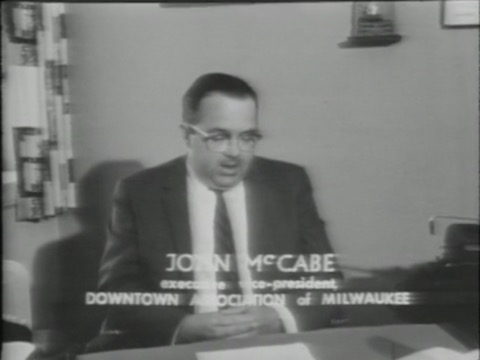
This face at one time was also the body of an entire entity called the city. Now the body has grown immense. Southeastern Wisconsin and common with other metropolitan areas in the United States is undergoing an unprecedented population growth and urbanization. Southeastern Wisconsin is the fourth fastest-growing region in the United States that contains the 12th largest city in the nation. Out of all proportion to the features of the face, well I think our downtown area needs a lot of redevelopment, been in a lot of other big cities around the United States, and I've noticed that they've done a lot more in this area than this city has. I think Milwaukee's about 10, 15 years behind the times. And she's finding the struggle back to prominence of painful process.
Now that we have run into this period of demolishing the good deal of that which had become blighted and old and ransackled, we wind up with cleaned up gaping areas of parking stations, unfortunately I find today as I look over the city and fly over it almost daily. We suddenly have nothing but parking lots and very little to come down to park for. In salvaging this core where a population once pointed proudly and said, look world, that is the face of our city. Paul Spirgeon says, no generation of architects at any time in history has had as promising and inspiring an opportunity. And no generation of Americans ever had so great a responsibility. In my opinion it is essential that a community have a strong central area. This adds to the character, this is the community, this is where the visitor evaluates and
notes what goes on in the community. We should have a more interesting city pattern caused by elements of surprise in our buildings, elements of delight of all sorts in our landscaping and our pattern of the city. More harmonious silhouette of buildings as we look up at them and as a person on the street walks about he should have this beautiful element of silhouette before them in the tall structures. And we should have interesting texture and pattern. We should have freshness in our buildings and in our city. I feel that in our overall long range planning one word comes very much into focus again. That word will have to be percussion and by percussion I mean this. The walkie does have some real old flavor or architectural ambience which could and should be preserved as baroque as it may be.
It is not a purely neutral city of the mid century or something of that entry with a bland overall look of sameness. I think that downtown is vital to any successful urban renewal program not only in Milwaukee but in the entire United States. And although downtown has lost some of its retailing strength and this is coming back to now, nevertheless it has still remained the center not only of the city but of the metropolitan area. So as a place to start you have to have a good looking downtown if you're going to think in terms of rebuilding all of your city. Personally I would hate to see a standardized type of building constructed here following a particular Victorian or William the Burg or whatever the pattern may be. But on the other hand as I say we've had some rather unfortunate examples of where we've
had incompatibility of structures improperly cited, the height is not compatible and it seems to me that the municipality or the people as a whole do have an interest as to what happens to the downtown area and to this extent they should have some role to play in trying to guide people and new development in this particular area. Our society will never be great until our cities are great. These are the words of President Lyndon Johnson spoken in the height of America's current urban crisis. But some years ago in the height of America's industrial revolution an inventor named Henry Ford made a proclamation that has since become closely related. I will build a motor car for the great multitude he said. So low in price that no man will be unable to own one and enjoy with his family the blessing of ours of pleasure in God's great open spaces.
And in 1966 American cities have yet to subdue the cumbersome paralysis and deformity left in the wake of Mr. Ford's ingenuity. Of equal significance is the fact that those who profit at most from what the automobile could bring into downtown the industry that people the revenue soon discovered that the same facility made it possible for them to live further and further away from that downtown and away from the congestive noisy snarle of motorization. Urban sprawl was born, subdivisions, shopping centers, suburban. Downtown residences and eventually business areas were left to those who could lease to Ford their maintenance.
The resultant depreciation and plight burled into and enveloped the city then began a subtle but rapid encroachment into the surrounding areas. We must seriously consider what Fred Vigman stated in his 1955 publication, Crisis of the Cities. The great suburbs where the absentee classes there will coalesce into the cultural social units of the future. Already, ever larger segments of suburbia have less reason to come into the city. Stores, social centers, and the light follow the line of the greater wealth on the periphery of the city. And then, we must wonder not only if, but how downtown and in turn the city as a whole is to survive. I consider Milwaukee's community renewal program the number one achievement of the city. The program gives us an organized attack on our problems of redevelopment and our problems at blight.
The whole idea is to draw the blight line out here and to have a number of stage projects on a definite set of priorities to attack blight in this city and to eventually stop blight completely from encroaching ever upward into our good neighborhoods and to at the same time remove and upgrade our poor neighborhoods. Downtown Milwaukee will continue to have a very important place in the future growth and development of the entire metropolitan area as it has in the past. Perhaps this role will change in the future. We have seen some indications of change already. However, there are certain aspects that are provided in the downtown area in a way that cannot be provided in any other location. Probably some of them are traditional and some are historically. I think the downtown as we know it now is going to be and is in developing at least here in Milwaukee into the educational, the cultural, and the business center of this urban community.
The center of the city is an excellent place for the various elements of government, state, county, and city to have their headquarters. Everyone comes to downtown, everybody, regardless of economic status or where they live. Whether it's suburbia or the inner city. There's a certain excitement about different kind of people having an anonymity and meeting in the downtown, doing the various things that they have to do. There's nothing more exciting for people and people watching and downtown is the best place for this kind of excitement. But the downtown area should be saved because a downtown area of anything is a representative of the life of the city. The downtown area now does offer some entertainment, however, the only thing it does offer is movies and there's little in the way of real theater and real music. I think some of this should be brought in.
I think we've got to go all out to increase our convention business because this is a very important and integral factor to the retailer, the restaurant tour, the theater arm, and just about everybody that does business in the area. And I think we need to bring in a new industry. And I think some of the things we're doing now will do it. We want to bring in the tourists. Hundreds of thousands of people visit Wisconsin in the Great Lakes, north of us, each summer. And we're statistically sure that most of these tourists bypass downtown Milwaukee. We're talking about, hopefully, redeveloping the Milwaukee River with a promenade, with fine restaurants, and with places where people would wish to come. This ties into with the music hall. The idea of a music hall, which on which ground is recent, but broken, is not only to have a place for the performing arts, but for people to enjoy themselves.
And having come to see a play or to hear a concert, that there are other things that they can do before they go home and say, well, let's call it an evening. And to this end, we certainly hope that the Milwaukee River will offer some possibilities. There is a great deficiency in most cities today of the lack of water-oriented recreational resources. And we have one of the finest in our Lake Michigan, and we should exploit it to every extent possible. All of this is geared to the idea that people must be brought into the downtown area. Where you have people, you have business. And where you have business, you have money spent, and money earned. And this, of course, is the lifeblood of the city's economy and of any trading center. Dickman's dismal prediction for the city was based almost entirely on the premise that
with an urban population principally proletarian, increasingly dominated by immigrants and almost totally lacking the resources of those economically capable of escaping to the suburbs, the city's potential for maintenance and rehabilitation could only become less and less over the years. In that respect, his prophecy couldn't have been more accurate. Only no public official in the country has moved with more despats or more provato and grasping the situation and alerting the public to its ominous implications than Milwaukee's mayor, Henry W. Meyer. The central city itself was the beginning point for the metropolitan area, but many of its wealthier citizens and most of its wealthier citizens have left the central city. And with them has gone. Recently, at the United States Conference of Mayors held in Dallas, he successfully initiated the acceptance and adoption of a nationally significant proposal aimed at the partial
alleviation of the problem, not only in Milwaukee, but in every major metropolitan area of the country. The proposal calls for help from the federal government in refusing aid to those suburbs and willing to share the poverty costs of the metropolitan area, although called somewhat blunt and idealistic by some and reverse bigotry by others, it nevertheless has been generally hailed nationally as the first major step in the right direction. Two weeks after the convention on June 29, he graphically presented the local significance of the same enigma to the people of his own city at a public crusade for resources meeting in downtown Milwaukee. But first of all, I want to thank all of you for this fine turnout. I want to thank President Schreiber for his participation in the program. And secondly, I want to ask your kind indulgence.
The matter is that we are going to discuss tonight. Early in his talks, the mayor probably pointed out how the city had, in his words, pulled itself up by the bootstraps since 1960. Our central civic and business district was run down, and some had even given up on its recovery. But now we are in the midst of a Milwaukee Renaissance, the biggest central area building boom in our history. We have succeeded in rehabilitating our central civic and business district. And by 1972, we shall certainly have one of the most beautiful, if not the most beautiful, low rise central areas in the tire country. And I emphasize the words low rise, because it means that we shall have desirable light and air.
Milwaukee, three years ago, the statement that the city made to me when I first saw it driving in from the airport was the statement of a clean, heavy, industrial downtown. Each week and each month later, my opinion changed slightly because I was exposed to some of its newness, for instance, the art center, the new marine plaza building, and then eventually some of the other downtown projects like the Milwaukee Road Depot building, the new fister tower, and some of the other buildings on the east and west side, which are, in my opinion, lightening this heavy look, changing the downtown mix, and certainly changing the total concept of downtown in terms of what it means in the eyes of any viewer, particularly a new viewer.
And by 1970, what's happening here will allow that new viewer to grasp this changing concept from a single viewpoint. This is one of the vital links in that part of the county expressway system designed for downtown. A unique feature of Milwaukee's downtown freeways is the loop that is comprised of the four freeways around the downtown area. The east-west freeway serves the downtown area on the south side of the area. The lake freeway along the eastern edge, the park freeway along the north, and the north south freeway, which extends along the western edge of the downtown area, together these freeways form a complete loop around the downtown area. Well, in my humble opinion, this will do for rebirth and an expansion in a downtown area in Milwaukee, what generations ago, the elevated railway eluded for Chicago and made it a tremendous commercial and industrial center and a point of direction.
And I believe the same thing will happen in the Milwaukee area and that we're very fortunate in that such a loop is being projected and that in our case, we'll bring about an area wide downtown complex, which today has been confined to only a few streets. This is the area in downtown Milwaukee known as McArthur Square, as it looks for over 40 years. This is the same area as it looks today, seemingly torn to shreds by the dispassionate tools of random renovation. But this is the combination of 50 years of planning and anxiety, the construction of Milwaukee Civic Center, an area covering some nine square blocks laid out on an axial from the classic courthouse building on the west, to the German Gothic City Hall on the east, to be linked with grass, trees, fountains, and delightful forms of new architecture, intended to both
counterpoint and highlight the priceless heirlooms that serve as backdrops for the extremities. The area you see here will eventually be a three-level underground parking structure, bordered by underground tunnels leading to and from the north-south expressway. And this entire complex will serve as a foundation for three distinct plazas, the lower plaza, with its ultra-modern planetarium located at the southern end will be dedicated to the future of the city. The medium plaza will pay tribute to the present activity of Milwaukeeans, and the upper plaza next to the courthouse will represent the older historical values of a fond and memorable past. The cost of the Civic Center will primarily be the burden of the city itself, supplemented hopefully with elements from private investors and gifts from interested donors. But from the standpoint of total urban renewal success, this is Milwaukee's Shining Example,
Juno Village, an apartment in commercial development that will occupy a 25-acre tract within walking distance of downtown. Formally dedicated on July 22nd of this year, it will, when completed, contain 1,872 apartment units, 135 townhouses and a shopping center. Its facilities for year-round rooftop sunbathing, lavish malls, swimming pool and underground parking will make it the ultimate in modern urban living. You're seeing just one building of a $40 million complex consisting of many high-rise structures and a magnificent shopping center. We cut the ribbon today. This is the start with federal assistance of a large urban renewal project Milwaukee, the biggest in the state of Wisconsin, one of the big ones of the nation. But the real question is, what is this going to do for this whole area around us? Predictably, private enterprise is going to destroy some of the remaining blight and
rebuild with apartments and business institutions. This can be done and will be done because there'll be demand for living in this area, a demand which had almost disappeared in years gone by. But the rebirth of this community, this portion of the city of Milwaukee, spells success for the total city, for the sets of examples, that living can be good in an old area of the city if there is rebirth. And rebirth is the goal of current urban renewal legislation. It empowers the city and federal government to assemble and clear previously unavailable tracks of land, which can then be offered to the private investor. When successful, this joint effort results in benefits for all concern, for the investor, for the city and for the people. From this impetus, each day finds more land being cleared, making room for the new structures
that will continue to revitalize the long neglected face of downtown Milwaukee. A new post office building adjacent to the Milwaukee Road Depot, a 1,000 room convention hotel proposed for the Civic Center, the 616-foot high star-spire with revolving restroom, the Marshall and Ellsley Bank Building, the Cathedral Square Office Building, a new home for the Milwaukee School of Engineering, a new Methodist church and a joining motor hotel, a complex of modern structures for the urban campus of Marquette University. The Milwaukee County Center for the Performing Arts, commonly known as the Music Hall.
And this, according to artist Ralph Winter, will be the new face of downtown Milwaukee, representing an investment of some $200 million from both public and private sources, reshaped in function and design to thrive once again as a proud identity for the ever-growing giant that surrounds them, and to hopefully generate in the same giant a complimentary rebirth, an effort certain to save this city, to make it what its mayor Henry Meyer calls the Great City. The Great City must delight the eyes with both natural and man-made beauty and it must feel the year with the sounds of happy people. It must be a city that lives fully in the present with pride in its past and with greater plans for each future.
Next week, local issue examines the God is Dead Movement in the United States. This is NET, the National Educational Television Network.
- Series
- Local Issue
- Episode Number
- 19
- Episode
- To Save a City
- Producing Organization
- WMVS (Television station : Milwaukee, Wis.)
- Contributing Organization
- Library of Congress (Washington, District of Columbia)
- AAPB ID
- cpb-aacip-516-hx15m6375q
- NOLA Code
- LOCI
If you have more information about this item than what is given here, or if you have concerns about this record, we want to know! Contact us, indicating the AAPB ID (cpb-aacip-516-hx15m6375q).
- Description
- Episode Description
- For decades the image of the American way of life was a busy downtown area. But in the years following World War II this picture changed as Americans by the millions abandoned the cities for the suburbia. Left behind were the less affluent - those with little means or desire to attack the growing blight that began marking the cities. Now, local officials and planners are working for a rebirth of American cities, knowing that by the end of the century four out of five citizens will live in a metropolitan area. How this is being accomplished will be examined on National Educational Television's "Local Issue - To Save a City." Filmed by NET affiliate WMVS, this half-hour documentary focuses on urban redevelopment in Milwaukee. Milwaukeeans have invested $57 million in redeveloping their downtown area since 1960, and by 1972, says Mayor Henry W. Maier, $200 million will have been spent. "To Save a City" reports on Milwaukee's effort to rebuild its downtown area, looks at some projects under construction, and reveals plans for the city. Many of the city's problems are common to other metropolitan area across the nation. Mayor Maier discusses Milwaukee's community renewal program which is aimed not only at halting the spread of blighted areas, but which is also geared to upgrade poorer neighborhoods. Also appearing on the program are Richard W. Perrin, director of the Department of City Development; John Doyne, Milwaukee County executive; Lawrence Katz, regional director of the Federal Housing Administration; and Brooks Stevens, an internationally known designer. TO SAVE A CITY is a presentation of National Educational Television produced by WMVS-TV, Madison, Wisconsin. (Description adapted from documents in the NET Microfiche)
- Series Description
- In this series several of National Educational Televisions affiliated stations take a close look at controversies in their own areas that may greatly affect the entire nation. Each of the local problems is presented from the points of view of those who have been involved in it, or who have watched its gradual development. The 32 half-hour episodes that comprise this series were originally recorded on videotape. (Description adapted from documents in the NET Microfiche)
- Broadcast Date
- 1966-08-07
- Asset type
- Episode
- Media type
- Moving Image
- Duration
- 00:29:53.726
- Credits
-
-
Director:
Long, Larry
Executive Producer: Weston, William
Narrator: Esther, Jon
Producer: Long, Larry
Producing Organization: WMVS (Television station : Milwaukee, Wis.)
Writer: Long, Larry
- AAPB Contributor Holdings
-
Library of Congress
Identifier: cpb-aacip-e95b03e2861 (Filename)
Format: 2 inch videotape
Generation: Master
If you have a copy of this asset and would like us to add it to our catalog, please contact us.
- Citations
- Chicago: “Local Issue; 19; To Save a City,” 1966-08-07, Library of Congress, American Archive of Public Broadcasting (GBH and the Library of Congress), Boston, MA and Washington, DC, accessed October 15, 2026, http://americanarchive.org/catalog/cpb-aacip-516-hx15m6375q.
- MLA: “Local Issue; 19; To Save a City.” 1966-08-07. Library of Congress, American Archive of Public Broadcasting (GBH and the Library of Congress), Boston, MA and Washington, DC. Web. October 15, 2026. <http://americanarchive.org/catalog/cpb-aacip-516-hx15m6375q>.
- APA: Local Issue; 19; To Save a City. Boston, MA: Library of Congress, American Archive of Public Broadcasting (GBH and the Library of Congress), Boston, MA and Washington, DC. Retrieved from http://americanarchive.org/catalog/cpb-aacip-516-hx15m6375q