Senate Communications Subcommittee Hearings; 2
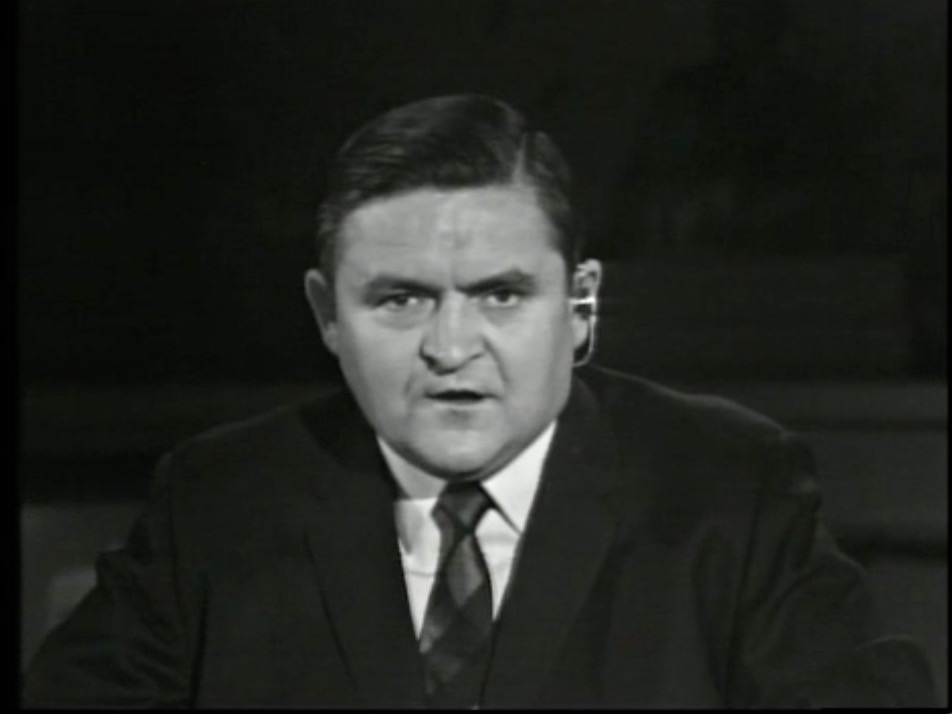
- Transcript
... . . . . . .
From Washington, NET the national educational television network presents highlights of the Senate hearings on educational television. NET's Washington correspondent Paul Niven. Good evening. The Senate Commerce Subcommittee on Communications today held the second in a series of hearings on the proposed public television act of 1967. Most of today's witnesses were officials of two large foundations which have been deeply involved in educational television. The Ford Foundation has been the largest single benefactor of ETV. Its contributions to individual stations and to the national educational television network have totaled more than $125 million. In January of this year, a commission set up by the Carnegie Corporation completed an exhaustive study of all aspects of educational broadcasting. Its report was welcomed by President Johnson and became the
basis first of his recommendations to the Congress and then of the actual bill now before the Senate. There are, however, some differences between the report and the bill. The Subcommittee chairman is Senator John Pastore of Rhode Island. Senator Edward Kennedy is not a member of the panel. He came in today for the purpose of introducing his Massachusetts constituent, Dr. James Killian. Dr. Killian is chairman of the board of MIT and was chairman of the 15 member Carnegie Commission on Educational Television. That commission has officially gone out of existence but its chairman appeared today with two of his colleagues and three staff members to amplify its recommendations. Here is Dr. Killian. Commission, what confronts our society is the obligation to bring television into full service so that its power to move image and sound is consistently coupled with the power to move mind and spirit. Television we feel should enable us not only to see and hear more vividly but to understand more deeply.
As we concluded our study we formulated a dozen recommendations which are listed in a abbreviated form on the chart which we have put up here and I will use that as background for the discussion as I proceed. These recommendations provide the building blocks for the public television system proposed by the commission. This system we would emphasize is not the educational television system we now have. It is not pattern after our commercial system or the British system. It is not a BBC. It is not pattern after the Japanese system or any other existing system. We have attempted to design something that corresponds to American traditions and American goals. That can coexist homicably with commercial television. We feel that to be a vital importance and that together with commercial television can meet the highest needs of our society. As conceived by the commission the new system has
these characteristics. It is to be constructed on the farm foundation of a strong and energetic system of local stations. The heart of the system is to be in the community. Initiative will lie there. The overwhelming proportion of programs will be produced in the station and scheduling will be determined by the local station and style. Local skills and crafts will be utilized and local talents tell. Public television is to be divided with such abundant programming as to offer for each local station both diversity and choice. Enough of this programming will come from major national production centers or from stations in the great metropolitan areas to assure that localism within the system will not become parochialism. Like a good metropolitan newspaper, the local station in the system will reflect the entire nation and the world while maintaining a firm grasp upon the nature and the needs of
the local people it serves. The local stations must be the bedrock upon which public television is erected. But the commissions are an overwhelming need for a national institution which could provide high quality programming and leadership and strength for public television as a whole while leaving to the local station autonomy with respect to its own operation. We therefore recommended that the Congress establish a non-profit non-governmental corporation to be known as a corporation for public television. It should be authorized to accelerate it to the maximum degree from the budgetary and annual appropriation procedures. It should provide grants and enter into contracts for programs but should not itself engage in program production. It should serve the stations but not control the stations. And above all the corporation should be led by men and women of varied background and of a human and achievement and a sense of public
television. The commission considered the creation of the corporation fundamental to its proposal and would have been most reluctant to recommend the other parts of its plan unless the corporate entity was brought into being. The Carnegie commission made three basic determinations as to the financing of the corporation. That it would require substantial annual songs, songs if it were to support public programming and to support some of the required magnitude could be supplied only in part from private and state and local governmental sources and therefore federal funds must be provided and finally that the federal funds must flow to the corporation in such a manner as to insulate the programming activities of the corporation from the government. S1160 provides for that kind of insulation and protection. Simple as stated the technical question is how can we develop a free innovative creative public television service which at the same time will be
dependent in substantial measure of federal funds, ultimately dependent. Two basic principles of a democratic society involved in the solution of this problem. The tradition of control by Congress or federal expenditures and the tradition of fostering the expression of ideas and communication of information from government control or oversight. The commission was sensitive to both these principles and so there means a reconciling man. We believe that our proposal is a practical and reasonable approach. Fundamental to it is the premise that the corporation should be established to carry out policies defined by Congress as being in the broad public interest but the corporation should itself not be an agency or establishment of the government. The fundamental line principle is that the federal money should come through a trust fund which would be established by an act of Congress and would not require annual appropriations. I must point out however that the Congress would still retain its
ultimate power since it could repeal the source of the funds if the corporation were to embark upon the course of Congress regarded as fundamentally inconsistent with the public interest. It would go as far as its practical and protecting public television program from the dangers of governmental interference while maintaining congressional control over federal funds. We are accordingly recommended that federal funds be provided the corporation to revenues from a manufacturer's excise tax on television sets. Proceeds would begin at $40 million a year and rise at time in time to $100 million a year and would be received by the Treasury as we have said and held in a trust fund. The tax of the outset would be at the rate of 2% and would rise in time to a ceiling of 5%. Just half the tax that was imposed on television a few years ago. This mechanism would permit federal funds to float a public television outside of the ordinary budgeting and appropriations
procedure and this was the particular reason that we were attracted to the excise tax. Do you mind if I interrupt you at this point of what have you to say to the assertion that this would be a discriminatory tax? We feel that the tax is so low that mounting only to a few cents a week on a color television set that it could hardly be described as regressive. But we also feel that as television public television develops as it serves a whole American family, the parents, the children, as it serves a community that the uses of public television would be so wide throughout the whole American community that it could in no sense be considered discriminatory. In other words what you're actually saying is that it's effect would touch someone in any family at some time. We feel certain that it was. That the all members of the family from one time or another would benefit
from this medium. So on balance it seemed to us that and now I'm talking about the future, Senator, not about the immediate particular information of the very that it was the best method of financing the cooperation in terms of its clarity stability, ease of administration, public acceptability and its equitable impact. We recommended the exercise tax and trust fund financing as a most suitable fiscal arrangement, but it is a principle and we would like to emphasize this that is critical. Insulation from the annual budgeting and appropriation procedures. If Congress should approve the exercise tax but require the annual procedures of review and so on, then our plan would have failed. Exercise tax or no exercise tax. We've been authorized in S1160 deferred from the Commission's proposal but I think wisely and we understand why for the first year it provides for $9 million to be appropriated
from general funds for fiscal 68 and such funds as may be necessary for 69. If the future means of financing the cooperation will remain tied however to annual appropriations it would in our view seriously compromise the independence of the cooperation and should be rejected but now we're talking about what might be happened in the future. We understand how our other annual appropriations are deserved only as the initial method of financing the cooperation. As stated in the president's message to the Congress, next year he will make further proposals for the cooperation long term financing. In the interim we urge that safe guards be added to minimize the effects of appropriations from general funds. The cooperation for public television is designed as we repeat as a non-governmental organization and it should have all of the latitude and freedom that its private status confers and its special functions require.
This fundamental view of the cooperation's character should not be compromised at its inception. We strongly urge therefore that it should be exempted from civil service, public bidding and GAO auditing requirements and that for next year it means providing the cooperation with the trust fund next year be adopted for the Congress. Since the bill provides for the establishment of a non-governmental cooperation which is not an agency or establishment of the United States, financing through a trust fund should not present these problems. One more comment on the financing of the cooperation. The commission felt strongly that it should have adequate funds and in our view we estimated what these funds should be and they are given in our report. I think we must say in all Kendra that we could not support S1160 with its lesser amounts. If we felt that for the second year and later sums in the ballpark of those we recommended would not be
made available. Let me turn now to another part of the section 396G2C which authorizes the cooperation to do this. To make payments to existing and new non-commercial educational broadcast stations to aid in financing local educational television or radio programming calls of such stations, particularly innovative approaches there to another cost of operation of such stations. Here I am specifically concerned with the last of operation of such stations. The Carnegie Commission recommended that the federal government share with the state and local governments and private sources support of the operating cost of the local stations. Such operating costs include salary costs as well as light power communications, rent insurance fees and materials and supplies. In general they might be considered to include those kinds of operating costs that relate to the instructional responsibilities of the local stations.
The poverty of the present educational television service in this category is extremely damaging at the present time. The lack of adequate operating funds results in shutdown of stations on weekends, operation with skeleton crews, inability to recruit and print adequate managerial and production and technical personnel, absence of experimentation and innovation of all the inability to serve properly local community needs. For many managers of educational broadcast stations, the daily tasks is simply survival. Their energies are focused on raising enough funds from contributions and from local government sources to keep their stations live. Many of the stations are victims of a vicious cycle. Too often they are merely transmitters liking the resources to provide a service which reflects the life and activities of the community. And because of this life, the stations make no impression on their public and therefore fail to draw the necessary financial aid.
While I cannot overstress the critical need for federal aid to local station operation, I would express reservations as to the wisdom of placing this responsibility in the corporation for public television. The commission recommended that station operations be provided through the Department of health education and welfare. We did so for several reasons. The sums that are required from federal sources for station operations are substantial. Initially we estimated these at $30 million annually, later increasing to $50 million a year. And to raise these sums in addition to the other needs of the corporation might require a higher excise tax than we were. We also believe that the corporation should be limited to public television and should not be involved with instructional television. We wanted no part of centralizing educational and instructional activities in the system. Now that you are meeting yourself a little bit coming down the hill. I am sorry?
I am meeting yourself a little bit in coming down the hill. I think you start out with the very, very serious premise that you want freedom of interference on the part of the government with reference to programming. A very essential part of the life of a station is its operation. Yet you would take this authority away from the corporation which is independent of the government and you would put it in the HEW which is a government agency. Now there couldn't you exercise control or some influence over programming? We made the distinction between the programming responsibility where we felt the maximum sensitivity was and that clearly that should be handled by the private corporation, the corporation for public. Yeah, but how are you going to show any kind of a program and let me have the money to operate? And if you shut off that source, we have had of course the educational television facilities I, which has been handled by
HEW. That's right. But that says to construction. Now we're talking about operation. Now you're suggesting here that you would prefer to see the operational grants made through HEW rather than the corporation. And I'm just feeling you out on whether or not here we're not bringing back in the government where you have so assiduously tried to leave it out in your report. There is another aspect of this that led us to the conclusion that we reached and that is that we wanted to make a distinction between instructional television and public television. And we felt that the corporation should not get involved in instructional television and so much of the operating funds that are involved in the local station are helped to do with instructional television. How much emphasis do you put on this position? I simply stated as one of our conclusions I think there's a matter that marines careful consideration as to what
is lodged in the corporation and what is lodged in HEW in terms of the responsibility for the local station. It's clearly made. I have to question it. Yes, yes. We'll probably have other questions but right on this point of the fund is flowing through HEW. I have something certain about the possibility of setting up a ticket here or using another analogy of a sort of a basket where you're weaving in the government and private enterprise and weaving them out and you I'd like to know first of all the funds distributed as you proposed through HEW including operating costs of the station use this phrase and other costs which could include salaries for example.
The funds which HEW distributes would be funds which come both from the government and from private enterprise is that right? HEW funds all come from the government. HEW funds would be only funds to see from the government and could be $50 million at a short time as your statement says. Now what concerns me is the fact that HEW is also as worthy of agency as it is is constantly engaged in federal lobbying practices and perhaps in a very nice sense of the word because they do it for nice people. But they have many access to grind. Now what I'm thinking of is the enormous temptation that you put before any government agency. You have them $50 million. They have a series of programs to get through on Capitol Hill. They have at hand $50 million to use
to pay stations for operating stations which otherwise would be struggling including the salaries of the voices which speak out on the station and one of the enormous temptation that is for those voices to speak well of HEW and the praise pending HEW program. Even the ladies are documentaries which carry on the HEW philosophy. Isn't that a danger? I think it's important to make a distinction between the people who have responsibilities for station operation. These are the engineers, these are the production people. They are not the people who are on the programs. The programming would be handled by the corporation. The performers would be independent of these other people. But there will not be this connection that you talk about. You understand? I'm not doing it critically. I'm doing it too. I understand the process of self-education. You are raising a very complex and important point.
I want to wait until after these communications media will stop buzzing. They go eight times. HEW then, in paying salaries, does not pay the salary of the person who is hard as a commentator or broadcaster? I would think that in general, the funds for operations would not be involved in the payment of the performers on the programs. That's a part of the programming responsibility of the station. I would recall the fact that HEW over the past five years has administered the Educational Television Facilities Act, as we mentioned before, and has done this with great skill, carrying out the wishes of Congress here. It has, therefore, experience and has a start in providing facilities funds for these stations.
This could well be continued through an extension of the Educational Facilities Act. The commission and the Congress are both chair of the same concern. How do we safeguard and protect the independence of the stations? How are we protected, for example, from covert government pressure? How does the Edison Bureau... How can he be protected against some government agency operating on the private station, lobbying or pressuring for a point of view? Are you not talking about the corporation for public television? Yes.
I'm talking about this mix of the corporation and the government. How is the Bureau, who will be presumed to be... The Bureau is presumed to be Edison until proven... proven guilty of apathy or stupidity or some other time, but the allegedly Edison Bureau. Now, how is he protected from... You spoke of the fear of creating this corporation as a monolith. But as between two monoliths, that is the government and one more corporation. I have less fear of the private corporation than I have a constant fear of government. If you protect the Edison Bureau, we would think that the programming is protected and that you have gone, done the major thing to protect the Edison Bureau. And you feel that your recommendations protect the program? We do. This is our best friend. The Internet's capacity for government agencies to maneuver. Up behind you. I have no real judgment on this. Well, I'd like to mention one horrible example,
which is not a perfect analogy, but in 1944, the Armed Forces Radio Network, for the only source, which our soldiers and sailors had to find out what was going on in this country. That program made one broadcast of a political convention in July of 1944, I think. The broadcast, I was in a bunch of Marines at the time, heard by a bunch of mariners, soldiers, and sailors saying, that one of the political parties met yesterday, a nominated at Thomas E. Dewey for president. Mr. Dewey is believed to have an appeal to older persons. Period. Now, that is all that was ever brought to us. Thomas E. Dewey for president. The guy that provides president wasn't even mentioned. And that brought to us. I went to London and checked the network manager. He turned out to be a constituent, which tempered my irritation somewhat. It turned out that he had that fed to him by the government.
Who was the government? The government was the agency interested in seeing that people who were serving any armed forces did not get information. I know the analogy isn't perfect, but that's the psyche's world that I bear. And I want to make sure that you're asked to let freedom of expression mean freedom of expression, that is protected. And that there's some way for the fellow who turns the knob if he suspects he's being jobbed. Now, to go somewhere and say, I've been jobbed. I'm not been told the truth. Government is selling me a bill of goods. They're making me support an HEW appropriation. They're brainwashing me on a political campaign, or they're doing something they are not to be doing. It can be shown as a generally. Government is engaged in doing a lot of things that are not to be doing. I would like to look at this whole thing to see if we can't, if necessary, if we've got to have a monolith. I'd rather see a private monolith than a public one.
That's what I'm getting. I hasten to say that I am impressed by your emphasis on the importance of freedom of these local stations. This is certainly fundamental system. Thank you, Mr. Monroe. Did you want to plan this? No. I wanted Dr. Killian to know where the private funds would come from. I think the private funds for the cooperation can come from many different sources. No, I mean in pursuit of Senator Scott's ideal, mainly no government. Where is the private money going to come from? I take it, you were not suggesting that there would not be federal funds available to the cooperation. I'm suggesting that the independence of the public cooperation, I would suggest shifting the emphasis of this bill to the private enterprise phases of it to maximum feasible control within the cooperation over the operation of the system
and total freedom, if that could be attained, in programming and in the presentation of ideas and in the protection of the thought we had. This is the whole discussion of the unpleasant of opposition. The protection of the law delies of this country, for example, who like to get out and weigh uniforms and run for office. The protection of the oddball, the beatnik, the crackpot, the jackass, the fool, and the protection of anybody because if you're worried about minority groups, let's worry about the right to be unpleasant, to be different, to be arrogant, to be wrong, and I wonder whether or not you may be heading into a sort of a bland governmental programming of grand corporate programming, and how do we protect the infinite opportunity for people to be entertaining
as they seek to register their one-person impact on a community mind, let's do. We feel that the independence of the local station, the fact that the local community stations of which there are some 30 to 40 in this country with their own boards of trustees representing responsible members of that community, determining the policies of those stations, having freedom to do so, is one of the best insurances that we can have that they will be independent, and that they will not permit any kind of usual influence in their program. I am pleading. The record is good on this so far. I am pleading for the maximum opportunity for folly, for example, to be ad. I think nothing is more helpful to freedom than for fools to be free to flourish.
I want to guarantee that right now. Those buzzers, which you hear intermittently, are sounded in the committee room, but as someone members to the Senate floor for quorum calls and roll calls. Senator Scott, who indicated strong support for educational television and principle, then brought up one of the differences between the Carnegie report and the bill. The report proposed that the corporation for public television have a 12-member board of directors. The president of the United States was a point six, and they would intern elect six others to join them. The commission was anxious to avoid both the reality and the appearance of political control over the corporation. However, the drafters of the bill, chosen instead, to recommend a 15-member board of directors, all of whom the president would appoint. Do I have some concern about the 12-man board? I don't like either method very much, and I don't know any better way of doing it. I'd like everybody to be sworn in by the president.
I think that's nice. But... The trouble with the appointment of boards is that every president has to consider geography and he's got to consider ethnic considerations. He has to consider religion and a lot of things that have no basic genuine relationship to the operation of a rather technical board, but he'll consider them. He'll consider them even if he isn't going to run again because it's ingrained in him to do it. And I wish there were a better method or some advisory commission that could be set up or some consulting board perhaps that could at least be a voice which isn't dictated by the considerations which led to the formation of the original board. They're not critical of the president doing it. If I were president which goes for bid,
I'd probably do the same thing, but I don't think it's the... I don't think it necessarily gets you the greatest technical oil the precise competence that you want in a board. Dr. Lang, do you want to comment on this? I think that's a nice... I suppose that is the reason we finally arrived at the idea of having the president pick some of the members and then having the other members pick the rest for the idea that they would be... First of all, if the president were to pick only a few, then he would feel compelled to consider not only the fact as you have mentioned, but also the fact that's of absolute confidence because if he is picking only three or four, he would want to be sure that those were really good. He would be in a better position to resist the pressures from various ethnic and geographic groups because he'd say, well, I'm only picking four
and they have to be good. Obviously, good. Then when those were picked, they would obviously be free of the detailed kinds of pressure to which the president himself is subject. Although one could argue that in the last analysis, the first ones picked, which is some extent, creatures of the president, it's only to some extent. And they would, we felt the far freer to spread and select people on the basis of absolute confidence, particularly because in this busy world, they would want someone to share the big job with them who was really confident to share it. We have found in our own experience of the last 15 years with presidential boards, many of us having served on them, there is a very powerful and effective American tool that of all the instruments of democracy, this one seems to be one of the best ones
and that the grandeur and sense of responsibility that ties itself to the presidential task along with the political aspects of the presidential task seems to show best in this commission and board system. Somehow, anyone on a presidential commission comes to feel that he is going back to the beginnings of the republic. There is some great tradition which still obtains and which is still forceful. And as to that tradition, we are trying to tie this bill. Is that rather lean toward other two proposals? That rather lean toward the idea of the board members choosing some additional board members? Because I think they'd be looking primarily for confidence. Then I think we could arrange for everybody to be sworn in at the White House together, or form weather in the garden, and then everybody can get in the picture. Oh, absolutely. I don't know yet.
I recognize the senator from Utah for 10 minutes. Well, I was promised to chair and turn back some of those minutes. I just, I wanted to return briefly to the comments made by the senator of Pennsylvania, where he worried about the president keeping in mind and making his appointments, that there be geographic and ethnic and religious, political balance. And I wondered if you thought that there was anything wrong with the president having those things in mind, provided he has in mind number one confidence, and then consider these other factors. It wouldn't be a little bit destructive if all the whole board happened to be picked out of, say, New York City, or Boston, or Los Angeles, or someplace, and in the public. Not in, not in, not about that. But if we're talking about having great public confidence in this board, I think these other factors might be helpful.
What do you think? If you really exclude Boston, I think your remarks are well taken. No, I feel that it's very important that, that representing the various elements of our national community on this board, not representing geographically every part of the country of what not, but picking people of confidence who represent differing backgrounds would be very important. I think it would not be good. And this is one of the reasons why we think that the presidential or party process is valuable here to have a group of specialists on this board. We want people who represent the broadest and best interest of the general public of the United States, and who have sound judgment and a sense of public responsibility. We would not, I think, be in favor of having old television people on this board. Earlier in his testimony, Dr. Kellyanne has compared the views of his commission
with those of the Ford Foundation. Last August, the Ford Group proposed a new domestic communication satellite system which would benefit educational television in two ways. First, several of its channels would be used free by ETV. Second, commercial broadcasters would use the remaining channels on a commercial basis, and part of the resulting revenue would be turned over to educational television. The Carnegie report did not reject the satellite plan but in order to give public television an immediate source of income, it proposed the excise tax on television sets to which Dr. Kellyanne referred earlier. The Ford Foundation attaches more priority than does the Carnegie Commission to the development of a permanently interconnected educational network for live broadcasters. But the Carnegie and Ford Groups also have many views in common as Dr. Kellyanne pointed out. The proposal of the Carnegie Commission it should be stressed agrees an important respect
with other proposals which have been made recently. As for example, the proposal of the Ford Foundation. The Carnegie Commission and the Ford Foundation to quote a statement that the foundation itself made recently are united in their view that educational television has unlimited potential to deepen the awareness and understanding of the American people and to raise the quality of American life. That the prime source of the required funds must be the federal government. That new institutions must be created to direct and manage this developing resource, including a non-profit corporation to receive into its first funds. And that such institutions must be independent of the normal processes of repeated review, authorization, appropriation, and other aspects of control by the executive of the Congress. The Ford Foundation proposal, however, as we understand it, goes beyond the domain studied by the Carnegie Commission
and raises broad issues of national policy concerning national satellite communication organization and operation. We did not study this particular issue. Now, have we any recommendations to make with respect to the organization of our domestic satellite system? We did feel that we would hope that this issue can not necessarily get in the way of making decisions with respect to public television. That the issue does not have to be resolved before a program to strengthen non-commercial television is undertaken. Moreover, is uncertain whether the Ford proposal could ever provide enough funds for the corporation. We concluded that the most urgent problem before us was to begin to build without delay a strong system of public television. Whatever decisions might ultimately be made about domestic satellite communication. Public television can flourish with any one
of the proposed satellite systems. In addition to the above variations and the two proposals, the Carnegie Commission advocated the use of interconnection facilities primarily to distribute programs to the stations, whereas the Ford proposal placed the stress on live networking. We, of course, anticipated that however communication satellite technology is managed in the end, that it will provide cheaper and more copious interconnection for public television. In fact, we recommended free satellite interconnection for public television. The Commission viewed interconnection primarily as a means of program distribution and not as a means of establishing a fixed schedule network kind of operation. This is a very important innovation in our approach to educational broadcasting in this country. We sought to foster local autonomy rather than the establishment of a powerful centralized network agency. We would use interconnection to bring to each local station
all virtually all programs designed for more than local use, which are financed for the cooperation. We would expect that there would be an abundance of programs available to the stations through interconnection. It would be the responsibility of each station to decide which programs coming over the lines are suitable and desirable to broadcast to in its community. Normally, the programs would be transmitted over the interconnection facilities during the morning and afternoon and early evening, and each station would be required to make its own decisions as to which programs it wished to record on videotape for broadcast on the station's facilities. The station decided not to carry a program sent over the interconnection, that would be the responsibility of the station, and the cooperation clearly would be exceeding its authority if it sought to control the station's program schedule. The cooperation would provide each station with descriptive material regarding each program,
but this would be designed only to assist the local station manager in his decision as to whether it would be worthwhile to record the program for later broadcasts. The underlying principle of the cooperation's control of interconnection is to send the greatest abundance of programs to each station, rather than to select some programs for interconnection and exclude others. Normally, the contracts for program production made by the cooperation with the production centers of the stations would provide that the programs finance for the cooperation would go over the interconnection lines. Basically, the stations by their individual decisions, as to whether they would broadcast the programs or would not, would determine the success or failure of the programs that had been produced. This, of course, is not the whole story. There would be some programs carried over the interconnection during evening hours, either on a regular basis, on special occasions, which would normally be intended for simultaneous broadcasts.
But even here, each station should have the right and obligation to determine for itself, whether it would broadcast the program as it came over the lines. Delay it or not carry the program at all. So important, do we believe, is the desirability of using the interconnection facilities principally as a method of program distribution, rather than of central networking, that we feel that control of the interconnection must be with the cooperation. It was then the turn of the authors of the Ford proposal to give their views on its relationship to the Carnegie Commission report and to the bill. The foundation's president is George Bundy, who went to that post from the White House, where he served president's Kennedy and Johnson as special assistant for international affairs. Its consultant on television is Fred Friendley, former president of CBS News, who resigned from the network when its management declined to interrupt regular schedules to provide live coverage of a Senate hearing. This afternoon, we're honored to have Mr. Mick George Bundy,
who is an old friend of this committee, and mine, and Mr. Fred Friendley, who is a Rhode Islander, and a good friend of mine, and their attorney, Mr. Ginsburg. All right, gentlemen, you may proceed. Mr. Chairman, members of the subcommittee, Mr. Friendley and Mr. Ginsburg and I are delighted to respond to your invitation to appear today to discuss S1160, a bill for public television, introduced by Senator Magnuson, last March, too. We strongly support the bill. Will you turn that mic around? I start again or are we in? No, I don't think it's going to be. We support the bill. That's the point. I think you can... You can go on with... We think it's the right bill at the right time. Probably we can be most helpful to you if we do most
of our talking in response to your questions. In this opening statement, we want to make only four points. First, we are in strong agreement with the message of President Johnson in February 28th. The President's message in our views states the issues and charts the current best course with the clarity and skill on which we cannot improve. It takes account of what we now know and do not know of what can be enacted now and what needs spiritual careful study, of what we need this year and what can reasonably wait on experience. S1160 is a sensitive and skillful translation of that message into legislative action. Second, we are in strong agreement with the eloquent and timely report of the Carnegie Commission, and we are glad to be here on the same day and for the same purpose as Dr. Killian and his colleagues. We agree with the Carnegie Commission on every one of the fundamental propositions of its report. We find no inconsistency whatever between that report
and the positions advanced by the Ford Foundation. There is a marginal difference of emphasis between us on the relative importance of interconnection, but we agree that the difference is best left to the test of experience. Carnegie and Ford both believe in local autonomy with stronger local programming. They both believe in strengthened and diversified national programming. They both believe in a public television corporation with adequate funds protected from politics. They both believe in the need for much greater effort and much more homework on the problems and promise of instructional television. They both support the present bill. Third, we are very glad that the present bill leaves the road open for anyone of the many possible ways of harnessing the satellite to the needs of television. The bill is particularly helpful in its express declaration that there is no bar to free or reduced rates for interconnection services.
Fourth, while we recognize that specific questions about the organization of domestic satellite service are not at the center of your concern today, we do wish to reaffirm our own conviction that there is a special promise and opportunity in the satellite for public television, for instructional television, and for commercial television too. Our argument has been developed in detail, both before this committee and in three successive submissions to the Federal Communications Commission that argument has two central elements. The first is that the power and economy of the satellite open the way to a wholly new level of diversity and quality in the distribution of programs. The second is that the satellite offers us a powerful solution to the most difficult, single problem of public television. The need for program funds that are fully protected
from pressure of any kind from any source. I might take a moment here, Mr. Chairman, to make clear a point which was in the discussion this morning, and that is that in our view, the funds made available in this fashion by the satellite should be turned over to a public television corporation of the sort which is proposed in the current bill for allocation by them along the lines that are proposed in the present bill. We have always emphasized, and this point again came up briefly this morning, that satellite savings cannot pay more than a part of the bill for public television. We made this point with the emphasis last August when we first appeared before your committee on this subject, and we therefore strongly support the Carnegie Commission's basic conclusion that some form of dedicated tax will be needed for the larger share of the funds. But we believe that satellites can generate much more money than any other force
except a tax. Money enough to guarantee the freedom which is essential to the whole undertaking. Because of the importance of this point and because of his unsurpassed experience as a broadcast professional, I've asked Mr. Friendly to focus on it in a statement following my own, if you're willing. Eight months ago, Mr. Chairman, you called us before this subcommittee to discuss these matters. We've all come a long way since then. Those who believe in the promise of American television and you and your colleagues have earned high rank in that company have every reason to take new heart for the road ahead. We owe a great debt to the Carnegie Commission and a still greater debt to the President of the United States. The right next step is the careful review and the timely enactment of the Public Television Act of 1967. I want to thank you, Mr. Bundy,
for a very excellent statement. The chair will now recognize the honorable Fred Friendly. Senator, you know how I feel about prepared statements. But my colleagues have dragged me kicking and screaming here with one that I've written and my former colleagues in the press insisted I read it so that there won't be two versions of it, the one I add live and the one that's written down. All right. And it's a nice spring afternoon, so let's make it easy for everybody. Okay. I wish to confine my prepared remarks to one point on public television and, of course, I am for this bill. The money that pays for broadcasts and news and public affairs programming is what I want to talk about. Where this money comes from and how is critical to the freedom of the broadcaster to report on current events without fear of political control or restraint. It is only because I have such enthusiasm
and face, face, in what you are about to do that I sound this early warning. A warning is necessary because birth defects would make such a service two week and dependent to achieve the high goal that the president of the United States, the author of this bill and the Carnegie Informed Foundation have dreamed of. Public television is going to need money, lots of it. Not because money alone ever guaranteed good broadcasting, but because professionals in the performing arts and in news and public affairs cannot succeed without the tools and resources of their craft. I am now hopeful that those funds will be forthcoming, but I am not so hungry for them that I am willing to say I don't care where the money comes from or how so long as we get it. Specifically, I have two concerns. First, as the consensus of negatives wears away at all the various plans for financing, one special group against the Xi's tax, another against the satellite plan,
another against a tax on station franchises, the decision-making system will perhaps compromise and settle on general funds taken from the federal budget. And second, even a dedicated federal trust fund insulated from annual appropriations may not be independent enough for the sensitive area of news and public affairs programming. Perhaps annual federal funds will be necessary for antennae and cameras and tape machines where we are dealing with facilities, the problem is not acute. And perhaps trust funds will be sufficiently insulated from the federal government to preserve the integrity of much of what public television will be interested in. But I am sure that we must avoid at all costs any situation in which budgets for news and public affairs programming would be appropriated or even approved by any branch of the federal government. Even the most distinguished and courageous board of trustees could not insulate such programs
from the budget and appropriation process. But one thing we can be certain, public television will rock the boat. There should be times when every man in politics, including you, will wish that it had never been created. But television, public television, should not have to stand the test of political popularity at any given point in time. Its most precious right will be the right to rock the boat. Let me cite the words of the Carnegie Commission to delineate the challenge of this kind of contemporary television as I see it. Public television, the report said, can extend our knowledge and understanding of contemporary affairs. Its programming of news should grow to encompass both facts and meaning, both information and interpretation. It should be historian in addition to being daily journalist. Its program should call upon the intellectual resources of the nation to give perspective and depth
to interpretation of the news in addition to coverage of news day by day. This enlarged canvas should show us the interplay of people and events in terms of time and place, history and consequence. Programming in contemporary affairs should be sensitive to the long ground swells of civilization as well as to its earthquakes. All public television must be completely isolated from annual appropriations. But I would go further and suggest that in this area of news and public affairs, public television should be insulated even from dedicated tax revenues, not because the officials who make such appropriations are malevolent or because the people who will be administering those funds are weak. They are not. But because both of these groups require independence of each other. The dedicated tax proposed by the Carnegie Commission is one possible answer for much of public television's programming. The Ford Foundation supports such an approach.
But in this special field of programming for contemporary affairs, the phrase is Carnegie's, we see a special value in the satellite proposal submitted by the Ford Foundation last August and refined in December and again in April. This proposal provides private funds for public television. Private funds for public television. It wholly removes all tax funds from the delicate funding of the most critical ingredient of the entire enterprise, the right to know. If it supplied no more than $20 million, and it might supply more, it could assure a protected flow of private funds for news and public affairs on public television and a bulwark against political interference in news. To conclude, general appropriations for equipment, trust funds for cultural affairs, but not one cent from these sources for news and public affairs.
Last summer, Mr. Bundy called the satellite proposal a people's dividend. It can also be a people's safeguard and in perpetuity with all the checks and balances that our system of separate powers demands. Friendly, I agree with you that the measure of the independence of public television is the measure of its freedom from the appropriating and budget-making processes. And what you have said is thoroughly understood by you and I'm sure by the committee, but to get it on the record, I'd like to point out that the budget-making process, fundamentally an executive process, will be confronted if it is to be influential in regard to the future of the system,
will be confronted by those people who will each year say to themselves, did I like what public television did last year? Did I, the budget-maker, and his system, like what I heard, were they kind to me, did they gee at too much at bureaucrats? Did they make fun of the government? Perhaps they don't need as much money, in other words, perhaps I don't want to hear them as often. And then the legislative side, the appropriations making, providing process, the House and Senate committees are on appropriations and the Congress, are up to judge how much money they give. By whether or not they think one of the other political parties was favorite, whether some investigation worked out favorably to the, in the point of view,
of the particular senator or representative. And I'm putting these obvious things, rather obvious things on the record because I don't believe you will have a free and public system that the Congress is aptly is able to use the power of the press to restrict the further functioning of the system. Or the executive is able to conceal behind a budget wall its prejudices against an irreverent search for information or even an irreverent search for misinformation. I think the thing that could say to me most about this, the whole approach is to how to find enough safeguards to keep the government coming up with the necessary scratch to provide certain needed structural forces
but keep the dirty hand of government all five years. If we can find a way to do it, I'm for it. And here we are imperfect and this consensus of the negative is an excellent phrase. That worries me too. But I feel that we may have so many objections to so many ways of financing and we'll end up with an easy way and that is to throw the tax payers money at it by the appropriating process and then go off and forget it until the first crisis arises. Then the victim of the crisis will be the perpetrator of the offense and the eyes of either executive or legislative. So maybe I'm not being very helpful but I'd like to record the show that unless this is free, it's worse than not having it. And I'm going to support whatever measures I think
that will tend to support the insulating process because I want this electricity that could flow through this system to shock but I don't want those who are shocked to turn around and turn off the Jews. To use your phrase, we must insulate the scratch. And I wish, I hope there's a tape of what you said because it's a better statement than I made. No, it's not that. But I wish... The benefit of listening to your statement and trying to think of how I reacted about it. But I do think that in the news and public affairs, the contemporary affairs that the idea of insulating it is crucial and I do think that one way not to have those who are occasionally going to be shocked by this be able to register that shock on an annual basis is by having that part which is in contemporary affairs
get its funds from the dividend of the satellite. And I think that is a way. If it doesn't work and the whole thing is a bus five or ten years from now, nothing goes on forever. But it would mean that if certain broadcasts were on or certain hearings were on or that set of forces that you discussed were used, that this thing would have permanent funding directly from the satellite, private funds going to this public use. And I think it would isolate that. And I think that your statement and mine say almost the same thing. I think so. I think fundamentally what we ought to be careful to do is to, in this committee and in the House Committee, to seek to protect this system and this legislation from the almost inevitable temptations which these two committees themselves will be faced with later
and perhaps subconsciously to find ways to exert reprisal for this system doing exactly what it should do and what we won't like them doing sometimes. The first time they jumped me, I will be full of ideas about reprisal. We'll play this protect the system from me. What did you say? I said we'll play this protect back. But it has to be protected from the individual. We who helped to create it ought to send it up but we can't later come in through some loophole and undermine the effect of our own own work. That's all I have to say. Well, the only observation I'd like to make is a member of the Senate Appropriations Committee, gentlemen. You may rest assured that that committee will not only insulate the scratch or even scratch the insulation. I think of the insulation which worries me and regulates scratch in a way. They don't appropriate money that easily.
Mr. Hot? You were just to make a difficult situation possibly more difficult. You seem to get some comfort in the distinction between public affairs, contemporary affairs, and cultural programs. Suggesting additional insulation be provided for the public affair. I agree that the politician will react more acutely to the public affairs programming. But I have a hunch also that the public is perhaps more liable to react adversely to controversial presentation of cultural affairs. You know, the dispute among anthropologists is to who's smarter or apply.
Or a religion's role. Now, if that's true, there'll be a secondary, but perhaps equally strong reaction on the part of the politician who can be objective about the anthropologist debate only until the public gets nervous about it. And then you're back in the same situation. So I suppose ideally, if you agree that there's a potential for broad public displeasure, ideally, then you would argue for satellite funding of everything. If, first let me say, I agree with what you say, and I wish all of it could be insulated, because I do think that, although I have my competence in news and public affairs, if in anything, I certainly want there to be cultural affairs and the place for the performing arts
and a sense of laughter, sense of humor, sense of history. And I think it is a problem with those. And I think the first time I had a real controversial play is there. There will be scratches. But I think you have to start some plays. And I think the primary fear, because it will determine so much of what we are, is in the contemporary affairs. Now, I think the satellite rates could be higher. If there could be another source, I'm not embarrassed to say, if attacks were pay on licenses, I don't speak for anybody, but myself on that. And other funds were generated in perpetuity from other users of public logistics. There might be enough money. But I keep going back to the consensus of negatives there. And we do live in the art of the possible, as one of your bodies said 25 years ago. And I don't think there is much value in trying to isolate everything from public funds when it's not likely to be that way. I think that the dedicated tax, whether it's on television sets
or whether it's on licenses or if something else may provide almost enough money to do it with. The less money that comes from public sources, the better its public tax, general revenues, the better it would be. I wish that not one cent had to come from that. But in the equipment area, I think it probably will be necessary. What my warning is, that in this consensus of negatives, some kind of hysteria, well, let's get a bill through somehow, because we just got to do it. All the money comes from public revenues. And I think that would be a disaster. Thank you. Mr. Hartke? Mr. Friend, do you endorse the bill then as it's president? Yes, I do. And do you envision, then, to the future that this would be substantially modified? Well, I think the word seed money was used before. I think the expression that my fellow Rhode Islander used, get the show on the road, get the broadcast on the air,
it's start money. This is really just going to start the ball going. It's going to take a great deal of endeavor to figure out just how to organize this. But I would say there is nothing in that bill that anybody who really believes in public television wouldn't endorse and, in fact, rave about it. You can be for that bill, like you can be for the declaration of independent. Or the kind of way of that import. Do you envision substantial amounts of private contributions and state contributions? Well, I'm the private. I would hope that no private source gave very much, including any one foundation. The way it is now, I would have to tell you that one of the most difficult parts of Mr. Bundy's job and mine is that so much of this money comes from the Ford Foundation for public television right now, and I think that's wrong. Just if I may elaborate that point a minute, we are in the curious position in this deeply impoverished field.
And I fully agree with what Chairman says. It's the root of the problem here is poverty, desperate poverty, really, throughout the system of educational television. And as the private organization, which has been the largest contributor to public television to instructional television, we are necessarily the big banker in the eyes of the people working in the field. That puts us in a very difficult position. We are not subject to political feelings or to political pressures in the degree that men in political life are, and we have been enjoined by our trustees as administrators from interfering in any way with the programs which are funded by our grants. But the fact is nevertheless that we are too big compared to the total size of what goes into television. And I fully agree with Mr. Friendly that down the road
there ought not to be any single private force with that large a roll. That's, of course, again, one of the reasons for our belief that there is a special opportunity to satellite because there you would generate the funds essentially from a great technological development, which has been financed by the American people. You would not generate them from the decision of any private group, however well-disposed or virtuous, and naturally we're inclined to think we're both at the Ford Foundation. Let me ask you this. It's that you're, do you have a plenty of departure from the Carnegie Statements here, especially made by Dr. Killian this morning, in regard to the continuation of the grants made by H.E.W.? No, I don't feel that there's a sharp point of difference there. My own feeling is that the bill is right in making it possible for the Corporation for Public Television to make grants for costs of operation,
make payments for costs of operation. When that's necessary, I also agree with the view that many have expressed that Mr. Friendly has just repeated, that its facilities are not as sensitive and probably the salaries of engineers are not as sensitive as the salaries of broadcasters. I see no great pain in having two channels, one through H.E.W. and one in cases where it may be appropriate to have the Corporation free to use its money for that purpose. I think that the Corporation will feel a very heavy pressure to protect its resources for programming, simply because programming, first class programming, is very expensive. Now programming is very expensive, and in view of the fact you're making a substantial contribution to NET at the present time, do you feel that the programming is going to have to be in greater depth and greater with a great deal more attention being given to programming than it's being presently given,
and even on the limited number of stations that are appearing? Oh yes, Senator Hartke, that's an important point. NET currently produces five hours a week of new programming. That isn't very much. Carnegie Commission recommends 10 hours a week of new programming. I would say that's a minimum, and that down through time we will see a demand, an insistent, an insatiable demand, for a larger level of new programming than that on a national or regional or varied basis. This is really nothing different than the commercial stations have and their own difficult in programming. An individual station just does not have the financial resources to provide the type of program, which even they would like to present on their own station. Therefore, they resort to what's available and that's used in network programming, isn't that true? I would have to say, Senator, again for myself, that the problem of independent and connected television stations is not one of lack of money. I think there is sufficient money.
The licensees have been very well rewarded through the years. They make it in those programs that they program themselves. They get a very good return on their investment, on that which they get from the network. They get a good return. I think that it is a very involved commercial system that makes networking the way it is. I think the problem is that commercial television, I've said this before, forgive me again, makes so much money doing its worst that it can't afford to do its best. Non-commercial public television could do its best because it has so much time available to do it on and not enough money. Word you used last summer and you were right in using it. What all of this is about is to try to stabilize that and to put it into slightly better attitude so that some of that enormous resource will be available where the time is available
and the time is available on public television. I don't want to emphasize these negatives in which you refer to in your statement. But for the moment, let's assume that you do not get the money from the satellite. And for the moment, let's assume that you cannot successfully pass excise tax in the Congress on the television receivers. Which would leave next year after the 9 million which probably will be appropriate this year would leave you with an operation where you either went to the general fund or you called it quits. Well, in such a case, what would you recommend? Well, if it were only to come from federal funds and I were young enough to still be a practitioner, I would want no part of the news and public affairs part. And nobody speaks for anybody in this. But I think a great many people who have my background feel the same way. But if the satellite were not on, we're not available.
And it is my fondest hope and prayer that it will be available. And I know it is others. And if the excise tax, which the Carnegie people put such faith in, is not available, there are other ways. In the Carnegie report, there was, I guess, you'd call it the McConnell Reservation, in which he's asked for an exploration of why the licensees who have been given this great ledges might not pay some kind of rent for that, for their licenses. That's been suggested before. I know it's not before you now, but what I'm trying to say rather clumsily is that the satellite and the excise tax is not the only way and that the tax on general funds is not the only way. And that there are other ways and that I would rather suspect that a combination of all of them in the wisdom of the Congress and this committee might be a road to go down. I will. Yeah. I comment to that Senator Hartke and say that we feel very strongly, and I take it,
this is also the position of the Carnegie Commission, that we don't want a public television corporation without some form of protected revenues. We believe that that will mean a need for a dedicated tax. I myself would hope very much that this record could show and that the eventual legislative record in the Congress would show that this is a first step which cannot fulfill its promise unless the second step is taken. And that second step does imply a dedicated tax and we hope satellite revenue too. It's my own opinion that if you do not write into this legislation at this time, the second step that you're going to take at the second step next year will be an appropriation of a larger amount than the 9 million. Now, it's my own personal opinion. I think that's the only course of action because that the Congress will follow
because I do not see the type of drive. I know that you people are for it, but I do not see the type of drive which is going to insist on a new tax of that nature. I may be wrong. And the dedication of the satellite light funds represents a technical problem involving that law and the investment that those stockholders have made into that stock which might even be challenged legally. Well, I think what I'm really saying is to you is that, wouldn't it be better if we're going to write this law now to try to write that second step into it as well as we can at this moment? Rather than to wait and have something which in a year from now that you people would say it's better to not have public television at all. Senator Hartke, my own judgment is that it's better to go ahead with this first step. I am confident on the basis
of the response and understanding that has been shown to the position developed both by ourselves in the Carnegie Commission and by many others that there will be found a way that will command general support, effective support in the Congress for a dedicated tax. Let me put the satellite to one side for the moment because it's a special case. We think especially valuable one but it really weighs in in terms of the system as a whole on the private side in terms of the kind of money it would be for the corporation when the corporation is in business. I believe that we can find a national agreement on a kind of dedicated tax. I don't think we need to wait to get started while that process of analysis and discussion is worked through the President and the administration and leaders in the Congress are reaching a conclusion upon which a firm executive recommendation and then a legislative course can be developed.
I do think it's important and if the committee shares this view I would think it will be very valuable for this committee at this stage. When it comes to report this bill if it does, to make clear that a dedicated tax is in the long run a necessary part of this system. Well, wouldn't that be denying the President the latitude that he needs his chief executive to study this? Don't you think that this would be more or less a rebuke to the President's message? No, sir. I just asked the Congress to give him a year to make a proposal in this regard. Now, the fact that we write it in the report is binding on no one. I think it might have an irritating effect and might do this bill more harmed and it will do it good. Now, if we attempt here to write anything about dedicated taxes or try at this venture to write in the dedicated tax we will be usurping the jurisdiction of another committee. Taxes have to originate in the House.
They have to go before the Ways and Means Committee. I mean, we would do this bill irreparable harm gentlemen. I mean, you come here and you tell us you're all for the bill and then do invent a lot of schemes to kill it. That's certainly not the intention, Mr. Chairman. Well, I think we've got to be pretty careful about what we're suggesting here. Let me say, this committee has no authority when it comes to taxation. Whether or not you're going to have a ex-ice tax on television sets where you're dedicated or not will have to originate in the House. It will have to go before the Ways and Means Committee and I have to go before the Senate Finance Committee of which I distinguish colleague from Indiana Resummember. And I would hope that they would look into this matter. But I think, as we have said before, this is seed money to get the show on the road. All of us agree there's got to be a freedom from interference on the part of the government. I think we all agree on that.
I think much of that depends upon the caliber of the people who constitute this corporation. I don't care how good a law you're right. Unless you have a good administrator or a good honest man of integrity or woman of integrity to run it, it's just a facade. And therefore, gentlemen, I think that we ought to be a little cautious about the suggestions we're making here today that go beyond the jurisdiction of this committee. If we're going to hope to pass this bill. Senator, you're entirely right and I didn't mean and I certainly it was not my intention to suggest that this committee should take on the functions of analysis and judgment of the appropriations committee. No, no. No, no. Do you want the finance committee as the senator? Or the finance committee? Or the finance committee... Or the finance committee. Or the finance committee ouways and means. I entirely agree with that. I think it is within the preview of this committee and you correct me if I am wrong to take note of the very great importance of finding ways and means
of financing needed financing this enterprise, which are insulated from the pressures, which would be particularly dangerous to this kind of public operation with that. And that's all that I'm trying to say. The day's final witness was John Kiermeyer, president of the nation's largest educational station, WNDT in New York, and president also of the Eastern Educational Network, which embraces 22 stations in the northeast with a potential audience of about a quarter of the country's population. Kiermeyer pointed out that he was the first witness in this series of hearings to represent ETV from the working station level. He addressed himself first to the suggestion that passage of the bill might mean political control of programming. Thus far, fear of federal control over program content is most often mentioned as a bar to this legislation. In this station, we are in a peculiarly authentic position to comment on this danger. For in any system, we will be the object of the pressure's fear.
We hold the danger to be manageable, and the reasons appear clear to us. The proposed public television corporation will be a highly visible institution. By the nature of its pursuits, it will operate in as bright and hot a light of public scrutiny and criticism as can possibly be imagined, a restraint against success if ever there was one. The diverse and pluralistic nature of the system and vision will create its own framework or freedom in which many different individuals will contend. Eventually this should be a system which mounts two national centers for production, one of them, the fine organization which already exists, namely educational, national educational and television, and special subsidiary producing units in some 20 different locales, plus widespread local production. There is not to be one great eager hand on a single switch if there were we would be here in opposition.
We do not intend to become passive pumping stations for a central source. A special opportunity of public television lies in its unspoiled capacity to develop as a strong or autonomous, articulate, local and regional force. Now, given all this, and the independent and creative natures of the people who will work at these local levels, not to mention the responsible and influential citizen boards which have and will oversee them, who is to say that some single group will manipulate all this for propaganda or some other unhealthy purpose. The more compelling logic is that the system is self-correcting and suggests an atmosphere of constant action, reaction and interaction which in diversity creates its own cumulative protections against abuse. With this bill, we can begin to launch the subtle and difficult mission of creating new excellence, new talents, new voices from the local and regional potentials which
exist all around us. There will be no sudden miracles of programming. The creation of wide-ranging and fresh broadcasting excellence in local America will be a lengthy but valuable process, a process which has gone neglected far too long. Now as it's already been observed by many, but I want to stress the point because we are stations. We do not feel as possible to consider non-commercial television and radio separate from the strong commercial system which now dominates broadcasting. Commercial broadcasting is a confusing, changing mixture of substance, quality and excellence, highly effective entertainment, and all too much emptiness. But whatever the final accomplishments of commercial broadcasting in the intellectual community and the serious critics have long since turned their sharpest arrows against the failings of the system, yet we detect no practical grounds well, rising to push the industry into major reform through public pressure.
Despite this, not even the most zealous commercial broadcaster would argue for the status quo in their present programming patterns, yet some say that given a viable active public television, the commercial broadcasters would flee their cultural and informational responsibility to take refuge in perennial escape. We simply do not believe this. Indeed, the world of commercial broadcasting is generously populated with men and women of taste, responsibility, and great pride. They would instinctively move commercial programming to consistently higher ground, but for the very real economic flex of life which restrict their flexibility. In the last two years, for a number of complex reasons, the creative programming efforts of educational television have improved impressively. Some of what we do is very, very good. Favorable audience reaction grows daily, and the commercial broadcasters are already beginning
to respond to this new challenge. The signs are many, and they are there. All of today's witnesses endorse the pending bill. When any of them express reservations, Senator Pastore intervened to ask, you are for the bill aren't you, and the answer was always positive. There were differences among the witnesses, however. Mr. Friendly continues to insist that the money to be used for news and public affairs programs be free of any possibility of political control. In his view, money collected in excise taxes might carry some tank, or as revenue derived from commercial use of a satellite would not. But as Senator Hart pointed out, the same concern might also be felt in the cultural field. And if the excise tax is abandoned, as a source of income for the proposed public television corporation and no substitute is found, then the Carnegie Commission's report becomes rather hollow, or at least incapable of implementation pending resolution of the satellite question.
More witnesses tomorrow and Friday, good evening. To all tonight, any team will continue its coverage of highlights of the Senate hearings on educational television. This has been a live production of any TV and national educational television network.
- Episode Number
- 2
- Producing Organization
- National Educational Television and Radio Center
- Contributing Organization
- Library of Congress (Washington, District of Columbia)
- AAPB ID
- cpb-aacip-516-fj29883n00
- NOLA Code
- SHTV
If you have more information about this item than what is given here, or if you have concerns about this record, we want to know! Contact us, indicating the AAPB ID (cpb-aacip-516-fj29883n00).
- Description
- Episode Description
- Scheduled to appear before the Subcommittee on April 12 were members of the Carnegie Commission on Educational Television including Chairman James R. Killian, Oveta Culp Hobby, Edwin H. Land, and Leonard Woodcock; Ford Foundation president McGeorge Bundy and Fred Friendly, the Foundation's consultant on television; and John W. Kiermaier, president of the Eastern Educational Television Network. (Description adapted from documents in the NET Microfiche)
- Series Description
- The National Educational Television network interconnected some 70 affiliate stations for a series of special broadcasts of taped highlights of the Senate Communications Subcommittee hearings on the Magnuson bill for public television. The public television bill, proposed by Senator Warren Magnusson (D - WA) calls for the establishment and funding of a non-profit educational broadcasting corporation, allocation of additional funds for the construction of educational television facilities, and authorization for the Secretary of Health, Education and Welfare to conduct a comprehensive study of instructional and educational television. The Subcommittee, chaired by Senator John Pastore (D - RI), held the hearings April 11 through the 14th and April 25 through the 28th. NET presented hour-long summaries of each day's proceedings. The Senate Communications Subcommittee Hearings were produced by NET through the facilities of its Washington DC affiliate, WETA-TV. (Description adapted from documents in the NET Microfiche)
- Broadcast Date
- 1967-04-12
- Asset type
- Episode
- Genres
- Event Coverage
- Media type
- Moving Image
- Duration
- 01:30:12.864
- Credits
-
-
Director:
Mifelow, Alvin R.
Executive Producer: Karayn, Jim, 1933-1996
Producing Organization: National Educational Television and Radio Center
Reporter: Niven, Paul
- AAPB Contributor Holdings
-
Library of Congress
Identifier: cpb-aacip-69d238fbea9 (Filename)
Format: 2 inch videotape
Generation: Master
If you have a copy of this asset and would like us to add it to our catalog, please contact us.
- Citations
- Chicago: “Senate Communications Subcommittee Hearings; 2,” 1967-04-12, Library of Congress, American Archive of Public Broadcasting (GBH and the Library of Congress), Boston, MA and Washington, DC, accessed September 19, 2026, http://americanarchive.org/catalog/cpb-aacip-516-fj29883n00.
- MLA: “Senate Communications Subcommittee Hearings; 2.” 1967-04-12. Library of Congress, American Archive of Public Broadcasting (GBH and the Library of Congress), Boston, MA and Washington, DC. Web. September 19, 2026. <http://americanarchive.org/catalog/cpb-aacip-516-fj29883n00>.
- APA: Senate Communications Subcommittee Hearings; 2. Boston, MA: Library of Congress, American Archive of Public Broadcasting (GBH and the Library of Congress), Boston, MA and Washington, DC. Retrieved from http://americanarchive.org/catalog/cpb-aacip-516-fj29883n00