Local Issue; 5; The Cattle Crisis
- Transcript
Millions like her are the center of one of those continuing problems in the whole scheme of problems affecting United States agriculture. At marketing centers like Omaha, Nebraska, in the world's largest stockyards, the prices paid for cattle have been dropping almost steadily since 1960. The problem is not a local one, though, for prices paid to cattle feeders and ranchers all over the country are running many of them close to the edge of the no-profit, break-even point, and putting some of them completely out of business. The National Educational Television Network presents, Local Issues, a seven-part series of regional documentaries produced by affiliated stations of NET. This week the cattle crisis produced by University of Nebraska Television in Lincoln, Nebraska. The raising of cattle and production of beef is big business in this country. Every one of the fifty states is involved in this industry, but it is centered in three
major areas. The range area raises over 13 million hit of cattle, about 47 percent of the total production, and feeds 39 percent of cattle slaughtered. The corn belt raises 32 percent of the nation's output, and feeds 57 percent of slaughtered cattle. The southeastern states have been steadily increasing the number of cattle they raised until it now stands at 21 percent of the national total. They only feed 4 percent of the cattle sent to slaughter, however. The main areas in the country feeding cattle for slaughter are in California, and primarily in the corn belt Great Plains area. The cattle crisis is an issue local and character, but national in scope. It is local because the major effects of this drop in cattle prices are being felt on the local level. But the cattle crisis is national in scope because of the way this drop in income from cattle has filtered back to the economy, affecting retailers, wholesalers, and manufacturers of
consumer and producer goods. Though the cattle industry is large and complex, we should briefly see out upgrades. Cattle are raised primarily on wrenches. These cattle roam the range feeding on grass until they are 1 to 2 years old. They are then sold to cattle feeders who fatten them for 6 to 9 months on diets of grain and forage to produce steers and heifers weighing 900 to 1200 pounds. These finished cattle are then sold to meat packing firms which slaughter them and send this beef on its way to your table. In this program, we are going to look at the problem, causes, effects, and possible solutions to the cattle crisis. The problem is identified by Dr. Everett Peterson, extension economist for the University of Nebraska College of Agriculture. Well, the basic problems of the past 18 months or so have been that of prices received for their products.
What has happened is that the production of fed beef has increased faster than the demand has grown for this kind of beef. This has been going on now for several years, but especially since the fall of 1962. The result was that prices declined rather sharply during this period. Back in November 1962, choice steers averaged $30.00 a 100-way to Chicago and this declined to a low point of $20.50 in May of 1964 and that's a reduction of one-third in 18 months. To the cattle feeder, this has meant a reduction in his net income, in some cases financial losses, particularly on the part of those cattle feeders who bought their feeder cattle to put on feed in the fall of 1962 at rather high prices and then sold them in the spring of 1963 or in the late fall of 1963 at much lower prices. The problem from the rancher standpoint is also a price problem. Feeder cattle prices tend to follow the price of the fat or finished cattle and these have
declined in the past 12 months and more declines are in prospect because we have a large supply of such cattle available. This decline was from $29 for choice yearling feeder steers at Kansas City in November 1962 down to $21.50 in May of 1964. Lower incomes to cattle producers are reflected in less business for the stores and towns where these folks trade. The consumer during this period has had an abundant supply of beef at reasonable prices. Now the final aspect of the problem is the disagreement over the solution to the problem and its causes. Some people have blamed beef imports which have increased sharply since 1958 and have felt that this has been the main factor in the decline. Others realize the role that the increased domestic production has played and some feel that the retail price has stayed too high and this has tended to retard consumption on
the part of the consumer at the retail level. The problem with cattle prices is rather easily stated, they've dropped. But what has been causing this drop in cattle prices? Well, it's a combination of probably four things. You have the highest number of cattle in the United States you've ever had in history. There have been quite a few cattle overstayed in the feed yards. Your ranchers have overstayed calves and yearlings and your retailer has had a pretty fair year of the last year and a half. Well, there's numerous ones but of course imports we know has hurt some but I think the biggest problem is the feeder himself by overfeeding in length of time. There are two major causes, one is the so-called overproduction in this country of cattle. The other and the major cause, the most substantial cause, are the imports of beef products
into the nation, beef and veal. What are the nature of the government's present agreements now with countries that send beef into the country? Those agreements are made with four or five countries as of the present time. New Zealand, Australia, Ireland, Mexico, they're working on other countries. The nature is this, to hold down the volume and the character of imports to those which prevailed in the years 1962 and 1963. No, it just simply isn't true that the major part of the drop in prices can be attributed to imports from New Zealand or Australia from anywhere else. They have had some effect. There's been a relatively minor part of it. You see, we've always had some measure of importation of that kind of meat. But about three years ago it peaked up pretty sharply and it did come up to 10 percent of the total supply of meat in this country. There were a lot of reasons for it.
The United Kingdom changed its supply relationship, shifting over toward Argentina. Many of the West and Europe being countries put in really difficult blocks to importation. We on the other hand had a very low per capita production of cow meat, almost half of what had been at the preceding peak. We had a bright and increasing demand for hamburgers, for ground meat, sausage meat generally. We had the heaviest production of beef in the history of the country here, which meant trim that had to be blended down. And it was also extremely fat beef, as a heaviest beef we've ever killed. The contention that the imports are not the cause of distress in the market today, but it is overproduction is a fallacious position because certainly if we have overproduction as an evil, the admission into the country of the equivalent of some three to a three and a half million head of cattle each year just magnifies that factor of overproduction.
And we should not have it. Now mind you, nobody has contended that we should eliminate imports. Nobody. Oh, I think that imports have a bearing on livestock business and the general farming business. But I doubt very much if it's as big an influence as some people would think. The economists tell us that we must have imports to have a solid and substantial agricultural economy, and I think that's true. The imports have had, in our opinion, a very marked effect upon the price levels prevailing here in the United States. We think that it has encouraged more cattle to be fed, thus creating an oversupply of finish cattle. We also think we can prove and have proven, in our opinion, that the imports have caused more cows to go back out to the country and produce more calves and thus contribute to more total beef cattle domestically here in the United States.
In our countercows, instead of going to markets, like they usually do in the last few years, they've been going to Iowa and Illinois and farmers take them back there and feed them in good feed and get another cropped calves or two out of them. That's increased a lot there. Then when the old cows go off, they tell me if they're too fat for hamburger, they don't want them to go slabby cows and they're too much not enough red meat and that's why they import a lot of this meat from Australia and Brazil and stuff. And as I look to the future, it seems to me that Australia will continue to supply considerable quantities of low-grade lean beef to the United States. Australia, however, cannot compete with our better quality rain fed beef. Australia is primarily a pasture or a range country, does not have grain to produce finished animals and then there's the distance factor.
So our own producers will continue to have an advantage in the production of high quality grain fed beef. We ask Hurrey Webb, General Manager for Beef Procurement of a major packing company, to compare grain fed and grass fed beef. I can readily point out to you where this animal has a real plump ribeye. The other, your boning type beef would have a real narrow ribeye. This animal has a fine covering, a very abundant amount of marbling through the beef, the end of the loin. This is a plump full loin, whereas the other would be shallow and lend itself to manufacturing type beef for hamburger and more processing. This is a type of beef that we hope that the bulk of the people in the United States are having on their tables.
If this beef is mainly table beef, what are the principle uses that have imported beef? Would beef for mainly hamburger and what is known as manufacturing type beef? After the refusal of a nationwide retail food chain to discuss the use of imported beef, we ask Wayne Bartley, meat buyer for a regional supermarket chain, about the use of imported beef in this country. In the seaboard areas, I think, it was more popular than it is in the Midwest because of the time you brought it in and paid to duty and the transportation and the storage onto it, it got to be where it cost just about as much in the Midwest as we could buy good domestic beef for the poor, and so consequently there was no advantage here. In other words, the reason they're using it on the coast is it's just good business. In economics? Yeah. Any time you replace practically a month to buy a beef with imports, I'm sure it's bound to reflect on our income.
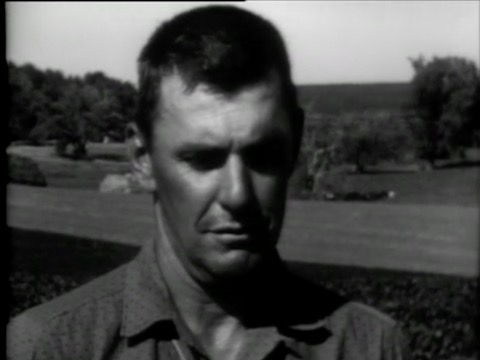
And it has reflected on incomes. The effects of both domestic overproduction and beef imports are being felt in the cattle industry and throughout the total economy. Here is Art Bukholz, cattle feeder near West Point, Nebraska. Well, are you going to feed next year? Are you going to farm next year? What are you going to do? Well, my tentative plan is now, or I'm going to, I don't know if I'm going to farm or not, but I have a job starting August 3rd. I'm going to be a scale officer for the stay in Nebraska. Could you give us an idea of maybe how much it has cost you per animal to feed? The type of feeding I did in the past few years, it cost me about 23 and a half to put the gain on. That's average with probably feeding someone past year and some in dry lot and things like that. Running them in corn stalks. You might have averaged out at about 23 and a half. And well, at first, it seemed like we didn't realize we were taking 20 cents, 21 cents,
we didn't realize we were losing money on these cattle that we were to begin to keep better records. It just wasn't paying out. Is your reason for, part of your reason for not feeding any longer, the low price that's being paid for cattle right now, for bed cattle? Well, I think the low price, it hurt, I mean, as you might say, I practically went broke feeding cattle and I can't see my way through, trying to farm and feed cattle and make a goal of it anymore. John Chauncey, Executive Vice President Omaha National Bank. I would say that feeders and ranchers are just not buying hard goods and very little soft goods. They are trying to make do with old equipment, make do with old automobiles. They're not buying new refrigerators. And this alone affects the merchants in the small towns and it affects the larger towns
such as Omaha and Lincoln because of the wholesalers and so forth. I think it'll have a very adverse effect. It's had a adverse effect all this summer. Cecil Means, Cattle Expert for the Stockyards National Bank. I've visited in some of the communities out across Nebraska and Wyoming. The automobile dealers tell me they're feeling it very greatly. The implement dealers are feeling it. These people have learned that they can drive that car another year or use the old tractor when they're scared of their income. Automobile and implement dealer, John Lubker. And have you ever seen a situation as bad as it is right now? No, not since the 30's. It just about compares to the early 30's right now. As the decline in cattle prices hurts your business any.
It has certainly has hurt our business. It has lost at least 30% in implement sales. We lost 60% in tractor sales and another 30% in automobile sales. Furniture store owner, Ray Smith. Have you had cattlemen order merchandise in your store and then not be able to take it? Yes, I have. I've had cattlemen especially at the holidays last year, come and say, well, I'm going to buy my wife a living room suit for Christmas and I want a lazy boy chair for Christmas and so forth. They'd come in and say, well, I'm sorry, Ray, I just lost 50 dollars ahead on my cattle. I can't afford to do any Christmas shopping. So we'll just have to postpone it until the time comes when we get back on our feet. Being in the furniture business, do you think this drop is going to continue for a while or what?
I think that we're going to suffer in our business for some time to come because, you know, any county like our particular county that has lost anywhere from 10 to 15 million dollars in the livestock industry is going to suffer for some time to come. It can't help it. How does the banker look at the cattle situation in terms of loans to these ranchers and feeders? Well, this fall, the banker is going to be a lot more choosy than he has been in the past. I just don't think there's going to be a place, much of a place for the marginal operator in this year's operation. The sandhills of Nebraska provide some of the best range land in the United States. Wesley Hansen owns the 20,000 acre 77 ranch near North Platt, Nebraska. Have you begun to feel the effect of the depressed fat cattle market out here? Oh, we most certainly have. We begin to feel it last fall. And of course, our industry is, as these things happen, lags a little bit behind the feeding
industry, possibly a year, some time in lag. It also, we lag, possibly a year behind when feeding cattle prices are higher. So there is a lag, but we'll feel it this fall to about an extent, I'm quite sure. Mr. Hansen, what was your, just a rough trend? What was your average income this year compared with past years? Well, in 63, I might go back to 62. We've probably made a 3% return on our investment in 62 and 63. We were down to less than 1%. This fall, we don't know yet, but I'm sure we'll be in a red. George McKinley, Ogalalo Nebraska rancher.
Mr. McKinley has the depressed cattle market begun to work a financial hardship on you. Yes, it has our financial hardship, nothing it has on all the ranchers. This machinery and labor just kept doing up and taxes has been doing up and cattle prices have been going down. No, sir, I don't see the end of the cattle crisis in sight. The cattle population is up. We are continuously confronted with those figures. I think that the rancher has a large supply of large cattle back yet, and those cattle have got to be moved and consumed before we're going to get very much relief. As we have seen, the probable causes of the cattle crisis are domestic overproduction and the importation of foreign beef into the United States. The effects of this cattle crisis have reduced incomes to cattle producers, which have in turn affected their purchases of producer and consumer goods. Now the possible solutions to the cattle crisis fall into several distinct areas.
Those things which ranchers and feeders can do, limits on the importation of foreign beef and other government price stabilizing programs. There is Winfinter, staff economist for USDA. I would say the most important thing that needs to be done to get back to the reasonable levels of income now is to adjust production. We've had a terrific increase in our domestic output of beef in the last two years. 1963 was 7% above the previous year. The first half of this year we were running 13% above 63%. 20% increase in two years. Now our consumers can eat, what, three and a half, maybe 4% more one year than next. A little higher income, more people, a little shift away from some other foods to beef. But this means that in the two years they could have eaten in 64, they could eat 7.5% to 8% more beef than we did in 62, and yet we have 20% more to consume. We think that the adjustment in moderation of this increase will come both from, to some
extent, from feeding animals to lighter weights, perhaps more importantly getting numbers back in line. One of the very important things to us is to keep moving cattle into market as rapidly as they reach the grade that the feeder is shooting for. Move them in with regularity and move them steadily in order to get them out of the way. Well, of course, we have built our cattle numbers up to record heights. And as you look around the yards here this morning, you see a lot of cows on the market, which we haven't had for a long time. So I think the rancher is taking the most direct course in helping himself. He's getting rid of his old cows, he's culling, he's heard, and there's no way to cut down the numbers of cattle in the United States any faster than to sell cows. Well if his sell the cows, these cows get slaughtered, they won't be bearing cows.
Of course, we are continuing and hope to very quickly have something done about our import situation, which will move those supplies back. We are entirely on a supply market, there are other demand and supply market. There isn't any question about it, despite some arguments that are advanced sometimes. And we merely have to bring our supplies into balance, a little closer in the balance with the demand for it. And the demand that consumers will exhibit at a fair price to the industry. Ralph Rakes, a cattle feeder near Iceland, has put the supply and demand factor into practice. What I do in determining what I feed and the various factors about my feeding are the economic facts. In other words, I try to feed the kind of cattle that will make me the most money, that
I will get the greatest return for the feed that I put into them. And consequently, in the last few years, I have noticed that the lower grades of cattle, the whole steens and the cross-breds, have come up in price a great deal more than was true some years ago. So we have fed more of the lower grades of cattle. And these grades of cattle, of course, have, to a greater extent, gone into Hamburg and the lower costs of meat. Well, I think there will be a natural law of supply and demand. I think they care of some of our overproduction in the United States. Of course, I think we can help it along by calling our cowards a little more closely. Certainly, I think we need some legislation as to restricting imports. Until recently, the United States was the only country in the world without quantitative
restrictions on the amount of beef and veal imports. This August, Congress passed, and the President signed into the law, HR 1839, which places statutory restrictions on the amount of meat which may be shipped into the country. This bill will set a basic limit on imports of about 725 million pounds. However, this basic amount may be varied by a growth factor determined by comparing imports to growth in domestic production. In addition, the President has the power to suspend the quotal limitations entirely if he decides it is in the national interest. The actual amount of imports allowed will be determined each quarter of each year by the U.S. Secretary of Agriculture. We have a firm understanding from all of the major suppliers who are covered by the voluntary agreements that their imports into the United States and calendar 1964 will in fact be much less than the voluntary agreements we negotiated with them. We have every reason to believe, and to believe quite firmly, in fact, that in 1964, taken
the whole calendar year, the imports from Australian New Zealand will be about at the average of 1959 through 1963. This is the major, one of the major reasons that we in the department are opposing legislation on beef importance because they're not needed. The United States Department of Agriculture has a number of programs now in effect to help solve the price drop in cattle and beef. The cattle industry has had its problems in the past, and it's having them now. This is a most critical period. The department is greatly concerned about the drop in income, the widespread drop in income. It is taking a number of steps to help moderate the present situation. We're encouraging exports. We're buying large quantities, bought our over 150 million pounds of beef since March. We are engaged in the vigorous promotion program. We are contemplating, considering grading changes, all of which we believe have had some
effect already in prices, and we think we'll help in the future. Nevertheless, I think it is important to underscore that the big adjustments, the big changes, the important ones that will put the industry back into the black ink generally will have to come from the ranchers and the feeders themselves. In the past few months, there has been an upturn in cattle prices. This rise may be caused partially by a decrease in imports, which occurred before the present legislation went into effect. It may be a result of some of the government's beef buying and promotion programs, and it may be a result of better marketing procedures by domestic producers. But the cattle industry, a vast segment of our total agricultural economy, has already been extensively damaged financially by the severe drop in prices over the past four years. And there are large numbers of cattle still on the range, which must be fed, sold, slaughtered, and eaten.
In an industry such as the cattle business, which depends primarily on supply and demand, and the free enterprise system for survival, price fluctuations such as the current ones have occurred in the past and will occur in the future. But as far as I'm concerned, I believe that I like this free enterprise system, and I'm not complaining that the price of cattle has gone down, because I was hurt much worse a number of years ago, when I paid 36 cents for some heifer calves and sold them when there were yearlings for 18 cents. But those years that followed were the most profitable years I've ever had in the cattle business. And I think that many of us overlook the fact that it's this type of free enterprise system that has made agriculture the efficient industry that it is, because in my book, we farmers contribute more to the American public than any other group of people, because there's no group of people in the world that have cleaned up and become as efficient as we have, because we've had to do it to survive.
And that has accrued to the benefit of the American public. The National Educational Television Network has presented local issue, a seven-part series of regional documentaries produced by affiliated stations of NET. This week you have seen the cattle crisis, produced by University of Nebraska Television in Lincoln, Nebraska. This is NET, the National Educational Television Network.
- Series
- Local Issue
- Episode Number
- 5
- Episode
- The Cattle Crisis
- Producing Organization
- KUON (Television station : Lincoln, Neb.)
- Contributing Organization
- Library of Congress (Washington, District of Columbia)
- AAPB ID
- cpb-aacip-516-cc0tq5s94c
- NOLA Code
- LOCI
If you have more information about this item than what is given here, or if you have concerns about this record, we want to know! Contact us, indicating the AAPB ID (cpb-aacip-516-cc0tq5s94c).
- Description
- Episode Description
- The critical conditions plaguing American beef producers with tremendous reductions in cattle and beef prices are closely scrutinized on "The Cattle Crisis," the fifth episode in National Educational Television's "Local Issue" series. Since 1960, the "cattle cycle" has been experiencing and expansion stage. During this time, the amount of beef produced in the US has jumped 20 percent while the population has only risen some eleven percent. Amounts of beef imported from foreign countries have risen to a point now where they account for ten percent of the per capita consumption. US producers of beef have seen cattle prices drop as much as fifty dollars per animal. As a result, many efficient producers are the brink of ruin, and many marginal and small producers have been put out of business completely. "The Cattle Crisis" focuses on the size and complexity of the cattle industry. Examined at length are the causes, effects, and possible solutions to the problems facing one of the nation's largest industries which by necessity must have a sound market for its survival. Appearing as guests on the program are a number of experts who are deeply involved in the state of the cattle industry. They include: Roman Hruska, US senator from Nebraska; George Mehren, assistant secretary of agriculture for marketing and consumer services, US Department of Agriculture; Dr. Everett E. Peterson, extension economist at the University of Nebraska's College of Agriculture; Don Magdanz, secretary of the National Livestock Feeders Associate; and CW. McMillan, executive vice president, American National Cattleman's Association. Individual ranchers, feeders, bankers, and businessmen also express their views on the crisis. THE CATTLE CRISIS, produced for National Educational Television by KUON-TV, Lincoln, Nebraska. (Description adapted from documents in the NET Microfiche)
- Series Description
- In this series several of National Educational Televisions affiliated stations take a close look at controversies in their own areas that may greatly affect the entire nation. Each of the local problems is presented from the points of view of those who have been involved in it, or who have watched its gradual development. The 32 half-hour episodes that comprise this series were originally recorded on videotape. (Description adapted from documents in the NET Microfiche)
- Broadcast Date
- 1964-09-27
- Asset type
- Episode
- Media type
- Moving Image
- Duration
- 00:30:42.006
- Credits
-
-
Director: Dudley, Robert C.
Director: De Prenger, Jerry
Executive Producer: Weston, William
Guest: Mehren, George
Guest: McMillan, C. W.
Guest: Hruska, Roman
Guest: Magdanz, Don
Guest: Peterson, Everett E.
Producer: Dudley, Robert C.
Producer: De Prenger, Jerry
Producing Organization: KUON (Television station : Lincoln, Neb.)
Writer: Dudley, Robert C.
- AAPB Contributor Holdings
-
Library of Congress
Identifier: cpb-aacip-8db5f48cd36 (Filename)
Format: 2 inch videotape
Generation: Master
If you have a copy of this asset and would like us to add it to our catalog, please contact us.
- Citations
- Chicago: “Local Issue; 5; The Cattle Crisis,” 1964-09-27, Library of Congress, American Archive of Public Broadcasting (GBH and the Library of Congress), Boston, MA and Washington, DC, accessed April 2, 2026, http://americanarchive.org/catalog/cpb-aacip-516-cc0tq5s94c.
- MLA: “Local Issue; 5; The Cattle Crisis.” 1964-09-27. Library of Congress, American Archive of Public Broadcasting (GBH and the Library of Congress), Boston, MA and Washington, DC. Web. April 2, 2026. <http://americanarchive.org/catalog/cpb-aacip-516-cc0tq5s94c>.
- APA: Local Issue; 5; The Cattle Crisis. Boston, MA: Library of Congress, American Archive of Public Broadcasting (GBH and the Library of Congress), Boston, MA and Washington, DC. Retrieved from http://americanarchive.org/catalog/cpb-aacip-516-cc0tq5s94c