At Issue; 44; The Negro Voice. Part 1
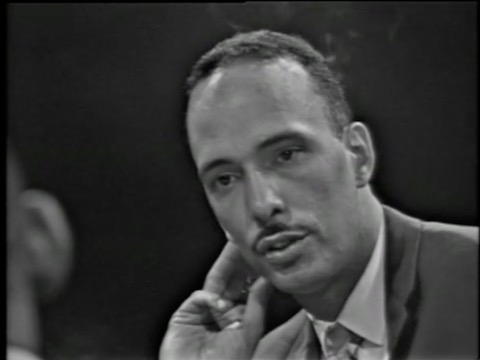
- Transcript
Any key, the Negro voice, take two. The National Educational Television Network presents, at Issue, a weekly commentary on events and people in the news. At Issue this week, the Negro voice, the first of two special programs examining the grassroots view of Negro leadership from Mississippi, Chicago, California, and New York. Talking with local leaders is veteran reporter and staff writer for the New York Post, Ted Poston. The long-hot summer so much predicted is upon us. The civil rights struggle has truly become national. Despite the enactment of the strongest civil rights legislation since reconstruction, the Negro drive for full equality has not abated.
Violence, interracial violence, has broken out on the streets of Harlem, Rochester, Boston, and threats of similar violence hangs over the heads of cities from coast to coast. The problem is truly national, but its solution must be found on the local grassroots level. So today we examine the situation on that level, in Harlem, in Chicago, and on the west coast, and in Mississippi that enduring symbol of America's failure to live up to its own dream. To assist us in this examination, we have assembled specifically for this program grassroots leaders from all of these areas. From them we hope to elicit the answers to questions which most thoughtful Americans are asking. So let's open our discussion with Harlem, where the first manifestation of the much predicted long-hot summer erupted just three weeks ago. Let's hear from Reverend Eugene Calendar, pastor of the Church of the Master, and co-chairman of the Harlem Neighborhood Association. Dr. Calendar, what is the mood of your community, and what do you consider its most pressing
problem? The current mood of Harlem, Ted, is that of uncertainty, anger, resentment, and fear. And perhaps the most pressing problem is how can we restore better feeling and attitude on the part of the people of Harlem toward the police who exhibited severe brutality during the recent violence? Thank you. In Chicago, we have Al Rayman, the convener of the Coordinate Council of Community Organizations, President of Teachers for Integrated Schools, and very active in the whole several rights movement there. How do they feel in Chicago, and what do you regard as a problem? Well, we have every problem, I think, that every northern city has, among eagles, we have the unemployment problem, the education problem, the relief problem, and you go down the list, and all these problems exist.
The one that we have been engaging in, or the one we have been directing our activities toward, has been the school board in Chicago. We have the misfortune of having superintendent Willis as our administrator. And I think the frustrations that rise out of hitting against a stone wall, continually, and having a Board of Education and a city administration failing to meet any of the problems, brings about the kinds of frustrations, which creates a climate, similar to the one that's in New York now. And from Mississippi, we have Dr. Ager and Henry, who's president of the State Conference of NAACP branches, he's a pharmacist. He's probably the most bombed civil rights leader that we've had across the country. Dr. Henry, how do they feel in Mississippi, and what do you regard as the most pressing problem there? Well, Ted, you know Mississippi is indeed a land of turbulence. At this particular stage, we have quite a few Americans, both indigenous to the State,
and from outside of the State, that have come in to try to change the status quo. This is meeting with a great surge of resistance in the White community. Our primary objective for this summit, at this particular point, is trying to secure the right to vote, to some 450,000 Igros who are over the age of 21. The right to vote, we feel, is crucial. We've had some 67,000 Igros to ask for the right to vote in the last four years, around 7,000 have gotten by. We have a very difficult time trying to secure the right to vote, and right now that's some major problem. And from Oakland, California, we have DG Gibson, who's a political leader, who has been active also in the whole, most phases of the civil rights struggle. Mr. Gibson, how are the people feeling in California? And what do you regard as their most pressing problem right now? The most pressing problem in California, we have been fortunate enough to get two laws
on the books by Rumpford, the Employment Law, and also the House of Law, which they're trying to set up initiative to not only do away with the House of Law, but right into the Constitution that to preempt cities or legislature from dealing with this again. And so this is an urgent and pressing problem, because once you stop the Igros from moving around, then you, and tie them into a ghetto, then you tie them into a fixed situation. And we have the school problem in which we are trying to get an understanding of how you integrate school activity. We have, in state of California, we have a greater situation in which the, all people go to the high school and the whole city of Warkley.
All people go to the elementary school in the city of Warkley to the same school, only one of the lower grades for you to do otherwise. Thank you, Mr. Epstein. Well, gentlemen, as you know, last week, the leaders of our six largest civil rights organization held a summit conference in New York. And out of this conference came an appeal to all of their followers and members to curtail if not completely halt demonstrations until the November election. Obviously, the move was made not to give aid and comfort to Senator Goldwater, who is the Republican candidate, the president. How do you think this appeal will be heated, will be accepted in your communities? How do you think it will be in Harlem? I think it will meet with a mixed reaction in Harlem. I think there are just some people who survived by demonstrating and having rallies. Malcolm X announced last week that he was coming back from Cairo, and the first thing he was going to do is to have a rally in Harlem, and he's going to call on the people
who go to war against the police. If this happens, then we're in serious trouble. I don't think that the national civil rights leaders who made that statement speak for the Malcolm X's or the Black Nationalists or the Jesse Gray's or others who are called the professional demonstrators who use this tact and technique to accomplish their goals and to create turbulence and unrest in the community. Right before, how do you think it will be received in Chicago? Well, I think it will be examined carefully, but I don't think it will be the determining factor. I think it certainly will weigh in the decision. I think the prestige and dedication of these gentlemen have brought gives some way to the comments they make. But on the other hand, I think it's also true that the decision has to be made on the localational local basis, on the basis of the strategy that is devised and agreed upon by the indigenous leaders of a particular locale, but I think it will be considered as such. Mr. Henry?
I don't think either that the civil rights leaders should speak for all the Negroes in this country, but they speak for a downside more than any other one organization would have the opportunity to do so. And likewise, the civil rights leaders in New York do not push a button and say that a demonstration will take place in a certain area. These decisions are indigenous to the area from whence they come. And if the civil rights leaders have a panacea that would prevent me from demonstrating, they must also have that same panacea that will take the white man's foot off my neck before I can concede that this is the only thing we can do. Mr. Gibson? My feeling is that there's no way to decide who demonstration who do not demonstrate. We have a very organized, united approach to the whole thing in my state in which we have tied the two minorities in the Negro and in the Mexican together with the white people and they're working closely together and within those limits you might be able to do that.
But demonstration is individual and it comes out of a submerged group because of the fact that they can't break through. And do you think there is enough resentment against the nomination of Goldwater and the weak civil rights plight? Do you think there's enough resentment in the Negro community, in the Negro communities around to give more weight to this appeal for abstinence at this time? Yes, I think that will be a desire to comply. But the result of reaction in the white community toward the Negro people will very probably lift the lid off of this desire and it will erupt again. I think one of the needs in terms of the Goldwater campaign is to try to get as many registered voters for this coming election as possible. I think there's a danger though that in terms of the Johnson versus Goldwater and that is that the administration takes a position that Negro has no place else to go.
I think they will have an indication that the administration is taking that position. Have I seen any indication? No, not yet. And I'm very happy to say that they haven't and I hope they don't. I think that Senator Humphrey's statements last week, Johnson's statement that he didn't want any inflammatory issues brought up, not racial issues, but inflammatory is very important. I think that if they had come out with any agreement that racial issues would not have been discussed it would have been a tragedy and certainly would have foreshadowed possible dangers of eliminating this kind of discussion on an issue that is very important to our society and to certainly a large proportion of our population. I think that most of the people at least in Holland aren't particularly concerned about the national election or the Goldwater issue, which I think is a very serious one. I think that the present mood at least is directed towards specific problems that they
have faced over a number of years, certainly within the last 15 years, that really cannot be affected by any kind of national election or whoever is in the White House. I think the problems are related to schools, for 15 years they have been trying to get the Board of Education of the City of New York to come up with a meaningful program for a quality integrated education and for 15 years they've met with frustration and rebuff. For years they have been trying to get a meaningful fair housing law implemented, a law which has passed in 1957, which has not been significantly implemented to make it possible for Negroes to live anywhere they want to live in New York City. It just angered me and angered many people in New York City that when the mirror came back from his vacation during the Holland Ryan's rise, the first thing he did was to support his police commission.
He didn't inquire whether or not Mr. Murphy was doing the right thing, whether the police were using bullets indiscriminately, whether Lieutenant Gilligan shot this boy unwantingly or not, all he did was support his commission. He speaks out in that vein, but we have yet to hear the mayor speak out on school integration. We have yet to hear the mayor speak out against the labor unions and the job discrimination. We have yet to hear the mayor speak out meaningfully on integration of housing and a real program for an open city. This is what's concerning the people, their feelings of frustration and of course it does have its national significance because Mayor Wagner is being talked about as a vice presidential candidate. I think if he's on the ticket, it will hurt the national ticket and the people will just stay home in Holland. They won't vote. I don't think they will vote for gold, but certainly they're not going to vote for Wagner if the current mood continues. How are you mentioned, the school problem in Chicago, do you think that you're better off or worse off than people are in New York on the school city?
I had a footnote to what the calendar said first, that certainly any kind of activity we engage in Chicago or the state of Illinois will direct itself at local problems. It will not be a total endorsement of the Democratic Party if we, in fact, decide that Johnson, we need to carry the vote for Johnson. The state of Illinois is a Republican state. There's only been four Democratic governors for example, so that we can not engage in good faith in any kind of political activity on a national level which at the same time endorses the political activities of the machine in Chicago, which has steadfastly supported superintendent of schools, which has refused in too many instances to deal with the many problems. With regards to the question you asked me about schools, I think we're really, we had a meeting here before the first boycott in New York, the second boycott in Chicago. The thing that struck me about that meeting was the fact that each of us were trying to credit our city with having the worst school system in the United States.
And I think as you look across a magazine, we have integrated education, you find that the problems are very, very similar. Now, there may be different personalities and so forth. I think that we probably have the most rigid superintendent in the nation, and I think he epitomizes all that's bad in a superintendent, and all that's bad in not only in terms of human relations, but even administration. There is a myth going around that superintendent will us in Chicago is a good superintendent, he's a good administrator, he's bad on human relations, but that's a lie also. He's neither a good administrator nor a good human relations man nor does he have a good personality. In fact, I can't find one positive thing that I could say about the man other than that I hope he leaves or he's soon to retire. We have in Chicago the housing report, which we were told was a result of a court case in Chicago, the web case, and we were consistently told that all we had to do before the second boycott was wait until this report came forward and that certainly our problems would be resolved.
I attended the meeting in which the report was presented, I attended the later meeting in which they turned over to a committee, the responsibilities for the report. They turned over to, they dissolved the committee that was formed seven months before to work on the enactment of the armed strong law, seven months later they canceled off that committee which had done nothing which had made no report to my knowledge to the Board of Education and formed a new committee to take the housing report until this day in Chicago, not one thing, one aspect of the housing report has been implemented. It appears if it continues that nothing will be done in September and we will have the same segregated unequal education that has been going on in Chicago for the last ten years in its most intense form. And why are we still on schools if I could? Someone told me one time a friend of mine that Elijah Muhammad should give Mr. Willis
the Superintendent of Schools in Chicago the man of the year war because he's done so much to preserve segregation. Well, Dr. Henry, it seems like why we're still talking about schools that Mr. Simple will have its first public school integration on the lower levels of this time. What do you anticipate will happen when the court orders are carried out in I think Baloxie league counted in Jackson? Well, as you have mentioned, the court has ordered that desegregation will at least begin in the first year of public schooling in these three areas and of course on the 30th of July, the court has also ruled that the Clarksdale Mississippi school board must submit a plan of desegregation which we anticipate will also be on the face year level. To our great appreciation perhaps and to some degree surprise has formed an organization statewide on save our schools that is saying that we ought to accept some degree of desegregation
without an abolition of the school system. The governor has set on several occasions that he does not desire to abolish the schools. Of course the legislature has done what we ordinarily expected will do. It has passed several laws that have already been stricken down by the Supreme Court as being unconstitutional. But Mr. Simple is a lot like Missouri. You got to say it there before we believe it, you know. We have enacted a school tuition grant almost identical to the Syracuse and we plan to use it until the Supreme Court knocks it down. And I think that we are going to continue to use hedgerows to retreat behind until finally we have run out of them and then we will begin to accept some form of desegregation. So you think that even this one year, one step a year plan may not go into effect from
September? There's a possibility it may not, yes, because you see when we get a federal ruling in Mississippi from a federal judge, you still have to understand that the only thing that's federal about the man is the name federal because here we have gotten continuous decisions in support of the status quo, the delays, the very ulterior tactics that are used on the state level are duplicated in the federal courts and consequently there is very little if in the difference between the rulings we get on the federal level and the state level. You have to win all of your cases on appeal then. Yes, yes. In light of all this information, it's hard for me to understand, you see, the request by the national civil rights leaders that we don't demonstrate, the only way that we can keep our demands, I think, before the national public is in the form of peaceful, nonviolent demonstrations and with this kind of frustration that we face not only in Mississippi and California
Chicago, New York, the black man for this entire country, he has nowhere to recourse then to take to the streets. Well, I certainly agree to all of that, but I will, and I certainly don't think that we have a right to decide whether for the demonstrates in the streets or not if he has been injured in some manner and I think that the young people are going to continue, especially the student group, to demonstrate whether we want them to not. But I do think that where you have organizations like it seems that we are putting together in the state of California which you have white Negroes and Mexicans all working together and have the student group, that are a very energetic group and will join any demonstration or you can sit down and talk to, that we are concerned because of the housing issue as it's laid out there, it's going to become a part of the Constitution and we are concerned about these laws as they go forward, the administration, this is why we are concerned about goldwater.
We can't believe that a guy will try to enforce a law that he doesn't believe in and therefore we are concerned about goldwater selection and I take in the state of California, it's going to swing up on these issues, the education, the housing and goldwater and I think that we have the same feeling that they feel that we have nowhere to go and but we think that we can reorganize the democratic organization and so we don't have to go. Dr. Hinter on the political front, now you're planning your groups there, planning to send a rival delegation to the democratic convention, this delegation that seems to have some possibility of winning but with this called curtailing of demonstrations, how will you act at the democratic convention in Atlantic City? I know. You see we will in all probability place our own interpretation on the word demonstration. One perhaps will take on a connotation to us that the request is not to take to the streets
shall we say and become involved in violence with policemen or become involved in violence with, shall we say, white citizens of the area which we do not anticipate anyway. I would suppose that the call for non-demonstrations on the national level was largely aimed at communities well perhaps outside of the south, I think that what is happening in Rochester and in Harlem would be the emphasis where the emphasis was being placed. In the area of being involved in the democratic picture we have no other idea but to continue to organize our forces to go to Atlantic City to place all of the pressure that we know how at the national convention calling upon the national democratic convention to affiliate
with Mississippians who will support the philosophy of the National Democratic Party, who will also support the nominees of the National Democratic Party. We hold to some degree that the National Party has not really been happy in the past with having to associate with the bottom and the billboards, the Eastlands, the Bonnets and now the Johnson's and the John Bell Williams that predict that present the image of the democratic party within the state, we think that the only reason that they have associated with these people is because they had nobody else to turn to. Now we are offering to the democratic party, we think a real way out that they will not have to associate with such ulterior characters in the future because we will be persons who will support the philosophy of the democratic party, we will support the nominees and we will do all we can to get them elected. Well John, we've seen an expression of Harlem's discontent in the ratch that had to interview
anticipate any trouble like that in the North and other cities. I think it's very difficult to say the all the elements of an explosion I suspect exist in almost every Northern community where there's a large segment of Negroes because all the grievances which give rise to that kind of explosion exist and it's very difficult to tell. I will say this, it is certain that these grievances aren't resolved, that if it's not this year it's going to be next year or the year after or some year in the future and the question is really are we prepared as a total community, as a society, to deal with the problems in such a manner that will relieve the tensions that give rise and give and act as sparks to that kind of explosion? Briefly there, gentlemen, what has been the effect of the new civil rights law in your immediate community? Has it been any effect at all, Dr. Kalantau and Harlem? Not at all in Harlem because most of the provisions of the civil rights law already exist
in New York City. We have fair housing legislation, we know board of education on papers committed to school integration, people can register and vote, the unions give lip service to employment opportunities for Negroes, so really it doesn't affect our community because the legislation is passed. What we need is implementation of laws already on the books of the state of New York. Dr. Henry? In Mississippi we have had one area that has given any indication of compliance with the law and that's the capital city, however you know the government of the state has called upon the white population of the state not to comply with the law. I personally have been involved in some 10 or 12 tests of the Public Accommodation Section and only in one instance have we been successful in being served or housed in a hotel that has previously been segregated, so it appears not. Mr. Gibson has had an effect at California. I think it has had some effect but in California I think you have a liberal governor and a liberal
administration. And therefore you have had an honest effort in most cases to enforce the law. You just had a resistance on the part of big of trade and so forth but you have also an understanding of what the issue is about, it's economic and those pickets have just implemented the law themselves. Good. And how is this Chicago? Not at all. No effect at all. Well now that the right that the bill has been passed, well gentlemen I see that we are approaching the end of our two brief discussion and I'd like to thank you all for coming, Reverend Calender, Mr. Roby, Dr. Henry, Mr. Gibson. In the limited time allotted us, we tried to answer some of the questions facing America in this long hot summer of the civil rights, but it's quite possible at the time allotted America to seek basic answers to questions involving its own destiny, maybe even more
limited. The distress in fact is that most Americans, Negro as well as white, have never faced up to the reality of race relations in our country. We refuse to face this reality because the real truth is too horrible to bear. Who among us will admit, for instance, that white America has no intention of granting the black American his full and equal rights without a long and possibly mortal struggle, that all that the Negro can hope to get for himself in this country is what he's strong enough and determined enough to take. On the other hand, who among us, including the members of this panel, will admit that the Negro in this country is really inferior because America has made him so through centuries of denial and oppression, who will admit openly that if all the restrictions faced in this segment of our population were removed, say 11 o'clock tomorrow morning that the position of the Negro in this country would not be materially altered. For no inferior, no matter how he became that way, can hope to compete with the superior on any basis of equality.
It was not always so. Now does it have to remain this way, but we cannot hope to alter the facts unless we are willing to face the facts. It is the hope of this observer that our brief discussion here may have contributed in some small way to the recognition of the reality which faces us all. Our time has been limited, but still is the time a lot in America. We can never realize the American dream unless we wake up and work to make it come true. What it seems to me is what is at issue here. Next week, part two of the Negro Voice, a grassroots view of Negro leadership from Mississippi, Chicago, California, and New York. Next week, on at issue. This is NET, National Educational Television.
- Series
- At Issue
- Episode Number
- 44
- Episode
- The Negro Voice. Part 1
- Contributing Organization
- Library of Congress (Washington, District of Columbia)
- AAPB ID
- cpb-aacip-512-xs5j961d7r
- NOLA Code
- AISS
If you have more information about this item than what is given here, or if you have concerns about this record, we want to know! Contact us, indicating the AAPB ID (cpb-aacip-512-xs5j961d7r).
- Description
- Episode Description
- For the second consecutive week, At Issue will present a half hour interview with a member of the Presidents cabinet. This program will present an interview with U.S. Secretary of the Interior, Stewart Udall. In the interview, conducted by Julius Duscha, political report from the Washington Post, Mr. Udall will appraise the rise of conservatism in his home state of Arizona, the current wilderness bill, the development of the Pacific-Northwest power project to serve the California area, and water and land conservation progress in the United States. Running Time: 29:15Four guests are being brought to New York City by N.E.T. to discuss in front of At Issues cameras their own local civil rights problems. As you know, in cities across the nation, city officials are talking with civil rights leaders in an effort to stop rioting like the rioting that has occurred in New York. The four guests are Albert Raby, a leader of the Coordinating Council of Community Organizations in Chicago; Rev. Eugene Callender, co-chairman of the Harlem Neighborhood Association, in New York City, and one of the leading Negro leaders who, along with Rev. Martin Luther King and others civil rights groups has agreed to curtailment of mass picketing until after the presidential election; Aaron Henry of Clarksdale, Mississippi, druggist and National Association for the Advancement of Colored People leader in that state; D.G. Gibson (correct spelling) of Oakland, California, administrative assistant to the Democratic State Assembly members. The guests will discuss who is speaking for the Negro, how effective is the current leadership, can the Negro struggle for equal rights be accomplished on the national level, and how popular among Negroes is the idea of a militant approach. Running Time: 28:57 (Description adapted from documents in the NET Microfiche)
- Series Description
- At Issue consists of 69 half-hour and hour-long episodes produced in 1963-1966 by NET, which were originally shot on videotape in black and white and color.
- Broadcast Date
- 1964-08-03
- Asset type
- Episode
- Media type
- Moving Image
- Duration
- 00:29:32.694
- Credits
-
-
Guest: Raby, Albert
Guest: Henry, Aaron
Guest: Callender, Eugene
Guest: Gibson, D. G.
- AAPB Contributor Holdings
-
Library of Congress
Identifier: cpb-aacip-7a5fd0f5d19 (Filename)
Format: 2 inch videotape
Generation: Master
If you have a copy of this asset and would like us to add it to our catalog, please contact us.
- Citations
- Chicago: “At Issue; 44; The Negro Voice. Part 1,” 1964-08-03, Library of Congress, American Archive of Public Broadcasting (GBH and the Library of Congress), Boston, MA and Washington, DC, accessed April 2, 2026, http://americanarchive.org/catalog/cpb-aacip-512-xs5j961d7r.
- MLA: “At Issue; 44; The Negro Voice. Part 1.” 1964-08-03. Library of Congress, American Archive of Public Broadcasting (GBH and the Library of Congress), Boston, MA and Washington, DC. Web. April 2, 2026. <http://americanarchive.org/catalog/cpb-aacip-512-xs5j961d7r>.
- APA: At Issue; 44; The Negro Voice. Part 1. Boston, MA: Library of Congress, American Archive of Public Broadcasting (GBH and the Library of Congress), Boston, MA and Washington, DC. Retrieved from http://americanarchive.org/catalog/cpb-aacip-512-xs5j961d7r