White House Seminar; 5; Responsible Government Investigation
- Transcript
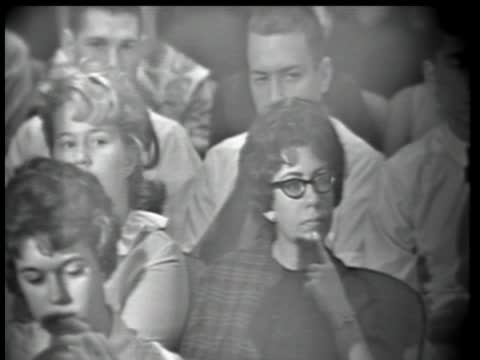
National Educational Television presents White House Seminar We welcome you to another series of White House Seminar programs originating in Constitution Hall in Washington DC. These are college students, some 7,000 of them who are gathered here in the nation's capital from all the states in the Union working for various governments. We're assembled here to learn about the inner workings of our federal government directly from the highest officials of each agency. Our principal speaker today is Senator John L. McClelland of
Arkansas, chairman of the government operations committee who will speak on the subject of responsible government investigation. Before we get underway with our program, we want to carry on our custom of interviewing some of the students who gather here to see these seminars. Our first guest this morning is Miss Susan Byer. How are you, Susan? Very fine, thank you. Susan, where do you live? I live right outside of Washington and Chevy Chase, Maryland. We get these statistics first so that we can base our questions later on. Are you a lifelong resident of the district? No, I was born in New York City, I've been here for half of my life. I see, where do you go to school? I go to the University of North Carolina. And your major there is anthropology. Is anthropology? Yes. Are you a senior? No, I'm a junior this year. You're a junior, going back for another year. Have you worked for government before in the summertime? Yes, or last summer I worked at the post office and this summer I work at the
White House, detailed from the post office. I see. Is it a fair question to ask what you do at the White House? Well, I handle presidential correspondence. I see. You're not by any chance involved in the preparation of these seminars, are you? Well, my superior officer, Mrs. Dorothy Damies, is involved with this program. I do a bit for mostly dirty women. Well, it's quite interesting to talk to somebody who really has a clear picture of the background of this seminar because we want to find out first of all, what you think in your office has been the result of this innovation, fighting college students here, two constitution hall, to inform the inner workings of government. I think it's been very, very profitable, especially for the students who come from out of time, we've had a very hazy idea. I know even myself who live in Washington had a very hazy idea of government. You forget you're able to feel a part of your government much more.
You're working with it. It's interesting that you would say that as a Washington resident and been so close to the seat of government, that you too would have hazy ideas about some branches of government. I think this is the purpose behind these seminars to dispel some of the misconceptions or some of the erroneous ideas of government, the enormity of it and so on. It exists all over the country and it's not necessarily limited to some other state in the Union that can't exist right here in the district of Columbia, too, right? Susan, are you going to make a career of government or are you going to marry, settle down and let anthropology go by the point? Well, I can't even say that. I'm not that firm of a line. I don't plan to get married right now. You don't? I don't even know about government right now. I just want to get asked. I want to finish your last year and then let the future take care of itself. I imagine I'll go on to post-graduates and then from there I'll be on the
treadmill class. Why did you choose anthropology? Well, there's a hard question. I am happy with it only because I'm very, very interested in it. It is a passion, it is a hard job to read. Susan has been awfully nice talking to you and I hope that you enjoy the base of your heart. Now we'll turn to our next guest. Thank you very much Susan Byer. Our next guest is Jean Sidor. Jean, how are you? Well, five. Very nice. Jean, how are you from? Uh, New Hampshire. New Hampshire? Just a little closer to Mike and you can't just say that. That's fine. New Hampshire and where do you go to school? Ah, the Yale Law School, sir. The Yale Law School. Yes sir. So, Jerry, New England, Barn, Brad, and New England educated. Well, we moved up to New England in 1940 from New York to how you did. And I was too thin. Have you been in Washington before? No, sir. Have you worked for a government agency? No, outside of Washington. This is your first year, right?
And who are you? Who are you working for now with what agency? The General Services Administration. This is one of the lesser-known branches of government, but I think maybe it would expand just a little bit on the type of things that GSA does. Well, GSA has six services. It has a defense material service. It has a supply service. You know, I think we'll have to interrupt because we're turning now to Mrs. Katie-Lock, and the Deputy Assistant Secretary of the Department of Education. Thank you very much. We're talking to you from the American National University of England. I'd like to tell you that he was saying 111. I'd like to tell you that he said 111. Thank you, Mrs. Lockheim. Distinguished guests.
Young Americans and ladies and gentlemen. I didn't hear all of Mrs. Lockheim's remarks. I only heard a part of them. If the rest she said was as good as what I heard, they were indeed flattering and I possibly have been over-introduced. I don't know whether she told you that I'm a Democrat, did you? And I don't know whether she told you I'm a Southern Democrat. But anyway, North, South, Easter, West, or wherever we are, we live under the same flag we enjoy the same freedoms we're all Americans.
You were very kind to invite me here today and I'm most proud and gratified to have a part on this seminar program. It's a high honor and a privilege indeed to address such a magnificent audience of young citizens and college students from all sections of our country. This summer you've had the good fortune to be employed by the biggest business enterprise in the world, a business in which you have and in which we all have a beautiful and vital interest. It is the business of the United States government.
We've already had some good reports of your work on the hill from your superiors. They seem to have quickly recognized and learned to respect both your capabilities and your well-developed sense of responsibility. I congratulate you for having so quickly earned their admiration and commendation. Each of you, I should think, will benefit considerably from the knowledge you will gain from this brief period of training and employment here in Washington with your government.
As you may benefit from your experience here, so will our nation and our government profit by. For after all, the greatest full walk of our liberties and the mightiest fortress against the infiltration and weakening influence of totalitarian ideologies is in and informed, enlightened, and militant citizenship. The training you receive here, the experience in working for your government and with its career, public servants, and officials will certainly equip you better for the responsibilities of adult citizenship and may well lead to your having the opportunity and experience yourself
of permanent employment of becoming an official of your government. Certainly this program, what you are doing and learning here is calculated not only to benefit you, but also it is designed to further strengthen and reinforce our national sovereignty, the strengthen our independence, and to preserve the great freedoms that are our heritage. You are here now, you who are here now, I feel are a very fortunate and favored group. Out of some four million college and university students in our country, I understand as something less than 8,000 of you here this summer. So each one of you who are present in effect
represent 500 other college students in the United States. Only one out of ever 500 are being afforded this opportunity that you enjoy. I sincerely hope that in future years we'll be able to accommodate a larger group. I didn't hear what Ms. Lockheim said, not all she said, I don't know whether she announced my subject or not. But I've been asked, then suggested that I talk to you about congressional investigations. I wouldn't know much about it of course, but at any rate I'm glad to comply. And this is important in your government. Investigations are not just incidental,
they have become definitely a fixed and permanent necessity. From time to time and from some sources, questions are raised as to the necessity are the propriety of a particular congressional investigation. Criticisms may also be directed in some instances at the manner in which a current investigation is being conducted. Some of these complaints may be justified and well-founded. Others may not. There is, however, no longer in a serious contention that the Congress is without the power that it is not vested with the authority to make
investigations. Whatever questions ever raised about that is now put it rest. For that authority has been with us all the way. It is reposed in Section 1 of Article 1 of the Constitution of the United States, which says that all legislative power here in granted shall be vested in a Congress of the United States. Although this provision does not expressly grant the power or specifically charge the Congress with the duty to conduct inquiries and investigations, both such power and such duty are forcefully implied and are inescapably inherent in that language. Surely the framers of the Constitution expected and intended that the Congress would legislate wisely. They knew then
just as we know now that in order for it to legislate advisedly and intelligently, it would need together facts to get information and to become enlightened with respect to the subject matter and issues involved in the legislation legislative proposals. This also holds true with respect to the efficient and effective administration of the laws which the Congress has already enacted. Further, with respect to its appropriation functions, it is charged with the duty of informing itself regarding the proper and economical cost of operating the different agencies of the government. In fact, there is nothing real in you are startling about congressional
investigations. History records that the first congressional investigation was undertaken in 1792 a hundred and seventy years ago when the House of Representatives created a special committee to investigate the disastrous losses that were incurred when General St. Clair carried out a military exposition against the Indians in the Northwest Territory. Since then, there has hardly been any period in the history of our country when we were without congressional investigations. The major factors, however, that are present today in investigations that were not present
in the earlier history of our country are those that have been introduced by the technological developments that subject the inquiry to the wide exposure and bright spotlight of publicity. They are the modern news services of the daily press, the radio and television reporting. There are some who object to and criticize television coverage of congressional investigations. On the contrary, I do not, I approve of it. It supplies a medium of reporting that gets the whole story across just as it is happening, free of any inaccuracies and without embellishments
or subtractions. I do not believe that either the Congress or a committee there are should permit television reporting of a public hearing to be commercially sponsored. I would not permit, we have never permitted any business enterprise to buy the time and sponsor the reporting of the public business of public hearings. However, when a hearing is of such importance that there is intense public interest, it may be economically feasible for the television network to televised and broadcast the proceedings as a public service, then I think it should be permitted to do so.
Such coverage and reporting in my judgment should be encouraged and not prohibited. In fact, I believe that the public business in so far as it is practical to do so should be transacted in the public. The basic elements of responsible investigations are generally quite simple, but their effective implementation requires long hours of hard work, tedious attention to minute detail and an unwavering devotion to duty and more a well developed moral sense with respect to what is right and what is wrong. I should like to stress that investigations are much more than the bright lights, radio operators and TV cameras,
and the newspaper men and women, hurriedly scribbling notes and running to the telephone to report in their stories. It is more than the seemingly ever ceasing flow of witnesses, some of them colorful, some pathetic, some famous, some mediocre and average, and some contemptuous and defiant while others are openly and eagerly cooperative. I think during the past ten years I have looked in the face of some of the coldest, most cruel and callous criminals in this country. It isn't easy sometimes to sit there when they give you that cold, penetrating stare.
When you realize, you realize it possibly there, rather, do your great violence, than to do anything else, it takes some self-control, it takes some discipline of temper to continue to pursue objectively the business at hand. Investigations as a whole are somewhat like icebergs, about seven-eighths of them, of the work involved in them are submerged and not visible to the public. This is not necessarily by design, but by reason of the requirements and the very nature and extent of the work that is essential in the proper preparation of a case for public hearings,
and also to make sure, as best we can, that public hearings are justified and that they are well organized, that they will be unbiased, thorough and fair. The preliminary labor and preparatory proceedings are of the routine, unexciting, humdrum staff work, but it is work that must be done. To illustrate, in the current investigation now being conducted by the Senate Permanent Subcommittee on Investigations into the Billisol Estus transactions with the Federal Government, the Department of Agriculture, we've already held some twenty-eighths of public hearings. We'll resume this afternoon. I anticipate there'll be at least eight more days
before we shall have finished with this phase of the inquiry, that pertaining to the cotton allotment program. But in the preparation for this series of hearings, during which we will hear approximately seventy witnesses, there will have been involved about seven thousand mandates of labor on the part of the staff composed of about fifty people on the average working daily. Another striking illustration of the amount of work involved in a successful investigation is the record of the Senate select committee that conducted a series of investigations and hearings in the labor management relations field. During three years of the life of that committee, it held 207 days, 1199 hours of public hearings, 1526 witnesses testified before.
And now that number 343, almost one out of ever four, took the Fifth Amendment. This testimony produced some fifty-eight printed volumes, containing twenty thousand four hundred and thirty-two pages, eight thousand subpoenas were issued, between thirty and thirty-five thousand people. Prospective witnesses were interviewed. A hundred and twenty-eight thousand documents were photostatic, much of it, made a part of the record. There were nineteen thousand field reports that came in from the staff conducting its work out in the field. Ninety-thousand index cards were made. Two and a half million miles were traveled by the staff with bus, car, train, and plane
in covering the areas necessary to gather the information. There were a number of unions investigated. There were also some businesses investigated. I shall not take time to name all of them, but the committee filed seven major reports containing over two thousand pages. It is very significant, I think, that when this select committee expired in nineteen hundred and sixty, appreciating the value of its work and realizing that there was need for continuing investigations in this field, decimated by appropriate resolutions, transferred all of the authority and power that this select committee had
to the government operations committee and to the permanent investigating subcommittee. There are, although the select committee known as the Labor Rackets Committee is no longer in existence, the powers and functions of it still are under the direction of the government operations committee. I think it is also significant that in January nineteen hundred and sixty-one, without any request or solicitation whatsoever from any member of the permanent subcommittee on investigations, the leadership of the United States Senate asked us to take on the further additional authority of investigating, organized, or syndicated crime in this country that is using the interstate commerce facilities to carry on its gambling operations. Thus today, with these special powers and functions that I've just described,
added to the original basic authority vested in the Senate subcommittee that of studying government at all levels to determine its efficiency and economy, the Senate permanent subcommittee has today broader jurisdiction and greater investigative powers that was ever vested in or possessed by any congressional committee in the history of our country. Sure, I'm proud. I'm highly honoured to be the chairman of such a committee, but with that great honour, there also attends tremendous responsibility. For soon, I may say to the vested authority that was conferred upon us last year,
the subcommittee conducted two very important and highly valuable investigations. One, it investigated the strikes, the slowdowns, and work stoppages at our missile bases. The revelations of that investigation were astounding. We found that they were having these strikes and slowdowns solely for the purpose of delaying the work so that the government or the contractors would have to put on work for overtime and double time in order to meet production schedules. We found that some electricians and some plumbers under this system of work stoppage and in Christ program to get it done by a given date that under those tactics, they were earning some of them higher than $700 a week, more than the salary of the Secretary of Defense himself,
more than the salary of Dr. Werner Braun, the distinguished scientist. Those conditions should not prevail. We have exposed them as a result of these shocking disclosures made by the committee. That was established the President's Missile Site Labor Commission largely as a mediation and as a persuasion authority to attempt to resolve peacefully labor disputes and prevent strike at these missile plants and these missile bases. But unfortunately, I regret to say that that procedure has not worked satisfactorily. Why, during our hearings, we developed that 162,000 plus man days of labor had been lost by those strikes and work stoppages to which I
referred. Notwithstanding the existence of this Presidential Commission, Labor Commission, and its sincere and devout effort no doubt to try to prevent these strikes within the past 60 days, more than a hundred and seven man hours, a man days of labor had been lost at two of our vital construction bases. One of them at Groughton, Connecticut, were a number of Polaris missiles. Polaris missile submarines are now under construction by the electric boat division of General Dynamics Corporation, 100,000 man days of labor has been lost there by reason, most of it by reason, of a senseless and contrary useless strike. They kept striking because one man had the power to
agitate and influence them, notwithstanding that three different times, their own representatives and managed midagreed upon a settlement and submitted it to the men for their approval. One man had been fired from a union, one man demanded to be reinstated, one man demanded five thousand dollars. He was able to keep them out on strike. The next, down at Huntsville, Alabama, if you've been reading the papers in the last few days, I think yesterday's afternoon's paper reported that it all gone back to work, where the saturn booster test stand is being constructed. 7,335 man days of labor have been lost. Why? Because two are three men were working on the job that are not members of a union and had refused to join. Does that make sense to you? No wonder,
no wonder we may be falling behind in this race for the command of space. Such work stoppages in my judgment cannot be justified. I think that the committee has done its job. We brought the information that is needed to the Congress, the information that is necessary to inform it of what the conditions are and what the need for legislation is. I do not think we ought to stand by and let these strikes that do irreparable injury to our defense program let them be committed without making them a violation of the law. And I have introduced a bill according. I would not deny any man. The right to quit work. I would not deny any union. The right to have a fair settlement.
But in a time of crisis, we have no right to strike this government ought to be sovereign enough to set up a means of resolving these disputes and settling these strikes, settling these arguments without the necessity of committing strikes that do this irreparable damage. This year, the Senate subcommittees looked on the other side of the coin. We have held hearings inquiring into the pyramidding and the charging of excessive profits by some of the companies that are contracting this defense work. I regret to say we found that there were in my judgment tremendous excess profits. I state to you now unequivocally and without fear of responsible contradiction
that the investigation of these two areas alone, these two investigations on the work stoppages and on the excess profits being charged. I say the taxpayers of this country untold millions of dollars. But carrying out our mandate to investigate organized crime, subcommittee conducted a series of investigations last year that resulted in the enactment of four new laws and in that field and which are put many of the racetrack wire services out of business and cause the closing of many betting establishments throughout the land. Maybe, maybe there are those who say these things are none of the business of the Congress of the United States. What I remind you that crime in America
is on the increase if law and order is to be preserved, there must be an awakening among our people and the Congress of the United States. All of us must be willing to meet our responsibility to combat this enemy of society. Congressional investigations, I predict, are destined to increase rather than to diminish a number in the years ahead, a growing government and a rapidly expanding economy dictate the necessity therefore, positive, constructive, fact-finding investigations are essential. They are indispensable today to the democratic legislative processes and to
a well-ordered, well-administered and economical federal government. The only suggestion I have made, and I say this in all sincerity, I hope as we progress that the character, the quality of the investigations we conduct, will improve. Thank you. Senator, I know that to provoke questions in all of us, we're going to take as many as we can and without any further formality begin on the right, please.
Jay Baker, Bethesda Maryland. Get to the microphone, get right down to it. Jay Baker, Bethesda Maryland. Naval Research Laboratory, Department of Defense. Senator McClellan, several weeks ago, Justice Douglas spoke to us about protecting the rights of the individual. We can't hear you too well, please try and get a little closer to the mic. Several weeks ago, Justice Douglas spoke to us about protecting the rights of the individual against the arbitrary use of government power. Now you and Robert Kennedy have been waging a long battle against Jimmy Hoffa, first through your committee and now through the agency of the Attorney General's office. So far, these efforts have been completely unsuccessful. In view of this, why do you continue to attack Mr. Hoffa in this manner? Well, I don't know why you call it a battle against Jimmy Hoffa. We went into several unions.
It turned out that possibly there was more corruption or as much corruption and mismanagement in the Teamsters Union as any other. Mr. Hoffa, you will recall, succeeded Mr. Beck, but the investigation continued because there was information that was needed and as a result of the information that was developed during this long series of hearings, not only the investigation of the Teamsters, but other unions. Two major pieces of legislation was enacted. That definitely strengthened the labor laws of this country. It's not a case of personalities, but when you investigate, you'll try to find out where is wrong and what is wrong and whoever happens to be associated with that wrong may come under the spotlight of exposure. Senator, before I take the next question, I'm sure all of you would want to know that the person who took the now attorney general's place on the staff of Senator McClellan is here
and want to meet him, Mr. Jerome Adlerman, who was the Chief Council of the Permanent Committee on Investigations. Well, he was Mr. Kennedy's Chief Assistant. I'll try the center aisle. Senator, I'm Joe Bianco from the Graduate School at Georgetown University. Senator, are you satisfied that the Landrum Griffin Bill has been successful in benefiting the country in terms of bringing more freedoms to our unions and making them a better operating unit? And if so, do you see need for more legislation in this area? I think I understood you. Yes, I do think the Landrum Griffin Bill was a great improvement. It made decided progress over the Taft Hartley Law, although the Taft Hartley Law at the time it
was passed, was a mark of progress itself. Yes, I think the Landrum Griffin Bill could be greatly improved. Someone spoke about the rights of individuals a moment ago. The people who often suffer the most is the individual union member. Too many times they walk into a union hall and they have to leave their Bill of Rights as an American citizen on the outside because they cannot speak freely now. This is not an all-Union. I'm not casting an aspersion on organized labor. I'm talking about in some unions that we investigated. They'd have to leave their Bill of Rights on the outside. They couldn't talk if they're objected to proceedings that were underway. If they undertake to get information, various things if they undertook to do. They're allowable to be subjected to violence. They can also be subjected to loss of work and many other things can happen. So when
this Bill got on the floor of this Senate, I introduced and fought a hard battle to get adopted as an amendment to that Bill what is known as the Bill of Rights of Working Men. Now the only problem is about it. It sets out the rights. It gives them the right to speak. It gives them the right to be heard. It gives them other rights. The only problem about it is the enforcement provisions. They're not strong enough. The little union member who may be mistreated can't finance a big lawsuit. He can't afford to have a lawsuit and to pay the cost thereof himself. All of the union's funds, the union treasury may be against him, may be used against him. What we need is to strengthen that and place a responsibility possibly on the Department of Labor or on somebody in government. Maybe the National Labor Relations Board to see to it that his rights are protected and enforced.
Yes, there is another two. I think there should be an improvement of strengthening of it with respect to a secret ballot election. There are some other weaknesses in it maybe, but certainly it was a great move forward, a great step forward. And I don't condemn it. I supported it wholeheartedly. And I will support it. I hope I'll have the opportunity while I'm still in the Senate to support strengthening and amendments to it. Over here, please. Peter H. P. Conrad, Central Intelligence Agency. Should and or will provisions be written into future? You're looking down and reading. Get closer to the mic, please. Should and or will provisions be written into future government contracts with private industry, prohibiting work stoppages on vital national defense and space projects?
I'm sure. Should a provision be written into government contracts, prohibiting stoppages, prohibiting stoppages on vital defense projects? Well, I think it would be well prospered to have that provision, but again, it's like the bill of rights if you don't enforce it, if you don't have the power and provide the machinery to enforce it, why they can still stop by the way under the under the president's labor commission that he has set up. They secured voluntary agreements from these unions not to strike. Well, that's when it breaks down or when they refuse to carry out their contract. When they refuse to do it, what are you going to do? They can breach their contract. How do you enforce it? Unless you have a law to compel enforcement. And I think that's needed. I think what we need is a tribunal established a commission,
a board before whom these disputes, these controversies can be submitted, each side be heard, and let it be resolved. Now, I'm not talking about that throughout all labor relations. I'm talking about it only in our defense program, because I do think we government ought to be sovereign enough to be able to carry out a defense program without the hampering and hindrances of work stoppages that may sabotage it. On the right, Senator, my name is Chris Cohen. I'm a 10th University of Michigan, and I'm employed in the office as Senator Kerr. I'd like to ask you two short questions. The first is this summer, I've noticed that in investigations with respect to the Fifth Amendment, where this has been employed by certain witnesses, that you have tried very hard to establish a legislative history,
so that in future judicial decisions, they would know very definitely what you and other people's position would be. My question is, for the ideal situation, what changes in judicial constitutional and legislative changes would you suggest so that your investigative powers would be strengthened? The second short one, if I may ask, is would you support a bill which would allow television of debates on the Senate floor? Your first question, I really don't know that a legislative of congressional investigating committee needs more powers than it has now. I haven't suffered, we haven't suffered from lack of power and lack of authority. There, we have been handicapped, because there have been those who exercised, their constitutional right to take the Fifth Amendment.
Now, I think in many instances, the taking of it was an abuse of the privilege, because I think many took it simply not, so they wouldn't have to testify as to what they knew about someone else, rather than to protect themselves against possible self-incrimination. I don't know how we'll ever solve that problem, but that is the most serious problem. That is the problem that has hampered the investigative work, I think, more than anything else. I don't know that we need an authority, your authority comes, the Senate or the House, as the case may be, passes a resolution. Creating the committee are delegating a committee, such as that already created, the permanent subcommittee on investigation, delegating, authorizing and directing it to
perform certain functions to do certain things, and within that we usually have all of the power that we need to do the job. Now, with respect, you're asking me about culture, are you? If I understood your question? No, sir. No, sir. I was asking simply if you would support work for and vote for a bill that would allow television and radio stations to broadcast and telecast actions on the Senate floor. Well, I don't think that would be necessary, just be a resolution if the Senate or the House wanted to pass it. I'd want to weigh it. I don't think these services ought to be permitted to interfere with the expedition of public business, but I would have no objection if it could be arranged so that it would not interfere or impede the work of this Senate. Again, I say to you, I believe that the public business should be transacted in public wherever it can be done expeditiously
as a practical matter. Again, I come back to television. I don't favor television, particularly over any other media of news services. It just so happens that if we were holding a hearing and will be this afternoon in the caucus realm, there will probably be 100, maybe 200 citizens present. In that room, American citizens are watching their government work, watching a Senate committee conducting an investigation. Well, if people can be present and see it, if a radio system or radio network feels that that investigation is of that importance, that the public has that much intense interest in it, that it can afford as a public service to broadcast it, to televised it, and I see no reason why we shouldn't let millions of American citizens throughout the country
in effect be present and see what happens just as those other citizens. I am far more of it, not less of it, and certainly I'm not saying that because I want to be in a political primordinal, I've had very much honoring and I'm proud of it, but I don't need it for political reasons, or trying to make a flash in the pan. Well, if a fellow's on television, let me point out something to you about these television hearings. If your senator or your congressman conducts himself in properly, if he tries to make some display of, you know, being smart, you catch it, don't you, just like that. I've been on two or three of these hearings, when I thought I saw some people forget that they too were on trial, just like the witness in the chair, how we conduct ourselves in the course of these hearings, we your public service,
how we conduct ourselves is all so important, and I'm not afraid to do my work before the cameras are away from it. Again, it's not to accommodate me or to accommodate a member of the committee, the purpose of it is to let the public, the American people see and know as much as we can about their government, when it happens and as it happens. Senator McClellan, my name is Don Deutsch from Bethesda, Maryland, I go to Miami University in Oxford, Ohio. My question you partially answered in your last little dissertation. In your talk earlier today, you mentioned that one out of four people will come before your
committee take the Fifth Amendment. Now, I was under the impression that the Fifth Amendment was conceived to protect and actually be a safeguard for those who would like to not incriminate themselves. Well, your committee, and especially the press, have the opinion that taking the Fifth Amendment is an emission of guilt. Now, I'll go along with you that maybe 99% of the time it is. However, I question whether I question as to whether the attitude that taking the Fifth Amendment is an emission of guilt is correct. I wonder if you'd speak. Well, I think you're in error. I don't know that the committee has ever said, and I'm sure I have never said that it was a legal admission of guilt, but there's no luck and change my mind or keep me from thinking. And I've
seen them come before me when they took the Fifth Amendment and I thought they were guilty. And all the presumption of innocence, they were not on trial, but as to my relation, as to my evaluation of them, as to my appraisal of them as American citizens, and the duty and obligation, they owed to their country. I think I saw them take the Fifth Amendment not to protect themselves from incrimination, but in order that they wouldn't be required to testify against someone else. I've heard about, you know, I think the Bible tells us we shouldn't bare false witness against our neighbor, but you shouldn't bare false witness for him either. Frank Johns, Virginia, a University in New Mexico, and I work for CIA. My question concerns the House rather than the Senate, but I think you can answer it, sir. Since there's such a
controversial attitude towards the House on American Activities Committee, I'd like to know what steps could be taken to eliminate the committee and in its place establish a committee to encourage American activities. What steps could be taken to eliminate the committee and establish a committee on pro-American activities? Well, you can take a step by simply abolishing it to house refused to pass a resolution next time, if it wanted to. There's no problem about how to do it. The question is the wisdom of doing it. I'm not speaking of the House committee primarily. I know in the Senate we have a sort of a companion committee, and that is the Committee on Internal Security, subcommittee of the Judiciary Committee, and I may say to you that it has done tremendous good, and I will not fall. I am not for abolishing, unless we can substitute something better. My name is Robert Maryweather, I'm from Silver Spring, Maryland.
This has been another in the series of White House seminars presented in consideration of all in Washington, D.C. for the benefit of the thousands of college students from all parts of the country who work in Washington for various branches of the federal government. These seminars are held with the express purpose of informing these students and you of the true function and scope of the branches of government, and they present some of our most distinguished officials at these sessions in a discussion of the operations of their departments. Today's talk on the circuit of the responsible government investigation is given by Senator John L. McClellan about the saw. Chairman of the government operations committee, acting as moderator for the seminars, is the Deputy Assistant Secretary for Public Affairs of the State Department, Katie Lockheim. White House seminar was produced in cooperation with WETA-TV through the facilities of WTTG
Washington for the National Educational, Television, and Radio Centers. Your announcer is Jeff Bacon. This has been an NET public affairs special.
- Series
- White House Seminar
- Episode Number
- 5
- Producing Organization
- WETA-TV (Television station : Washington, D.C.)
- Contributing Organization
- Library of Congress (Washington, District of Columbia)
- AAPB ID
- cpb-aacip/512-wm13n21m1v
- NOLA Code
- WHSE
If you have more information about this item than what is given here, or if you have concerns about this record, we want to know! Contact us, indicating the AAPB ID (cpb-aacip/512-wm13n21m1v).
- Description
- Episode Description
- This episode includes comments from Attorney General Robert F. Kennedy and Senator John L. McClellan. This episode was produced through a facilities of WRC-TV in Washington. (Description adapted from documents in the NET Microfiche)
- Series Description
- A series of meetings designed to interest and stimulate college students working in Washington over the summer in various branches of government service, to make a career of government service after completion of their studies, as well as to serve as missionaries, explaining government service to those with whom they come in contact. The 7 half-hour episodes originate from Constitution Hall, Washington, were originally recorded on videotape, and were produced in cooperation with WETA. The host of the series is George Jeff Baker of WETA. (Description adapted from documents in the NET Microfiche)
- Broadcast Date
- 1962-00-00
- Asset type
- Episode
- Genres
- Talk Show
- Event Coverage
- Topics
- Politics and Government
- Media type
- Moving Image
- Duration
- 00:58:39
- Credits
-
-
Host: Baker, George
Producing Organization: WETA-TV (Television station : Washington, D.C.)
Speaker: Kennedy, Robert F.
Speaker: McClellan, John L.
- AAPB Contributor Holdings
-
Library of Congress
Identifier: 2440185-2 (MAVIS Item ID)
Format: 1 inch videotape: SMPTE Type C
Generation: Master
Color: B&W
Duration: 0:58:15
-
Library of Congress
Identifier: 2440185-1 (MAVIS Item ID)
Format: 2 inch videotape
Generation: Master
Color: B&W
Duration: 0:58:15
-
Library of Congress
Identifier: 2440185-3 (MAVIS Item ID)
Format: U-matic
Generation: Copy: Access
Color: B&W
Duration: 0:58:15
If you have a copy of this asset and would like us to add it to our catalog, please contact us.
- Citations
- Chicago: “White House Seminar; 5; Responsible Government Investigation,” 1962-00-00, Library of Congress, American Archive of Public Broadcasting (GBH and the Library of Congress), Boston, MA and Washington, DC, accessed April 3, 2026, http://americanarchive.org/catalog/cpb-aacip-512-wm13n21m1v.
- MLA: “White House Seminar; 5; Responsible Government Investigation.” 1962-00-00. Library of Congress, American Archive of Public Broadcasting (GBH and the Library of Congress), Boston, MA and Washington, DC. Web. April 3, 2026. <http://americanarchive.org/catalog/cpb-aacip-512-wm13n21m1v>.
- APA: White House Seminar; 5; Responsible Government Investigation. Boston, MA: Library of Congress, American Archive of Public Broadcasting (GBH and the Library of Congress), Boston, MA and Washington, DC. Retrieved from http://americanarchive.org/catalog/cpb-aacip-512-wm13n21m1v