Lyrics and Legends; 9; Negro Religious Music
- Transcript
From a ter Can you hold, can you talk? Can you see or can you hear? You don't know just how blessed you are. How blessed you are. Can you hold, can you talk? Can you see or can you hear? You don't know just how blessed you are. How blessed you are. I've got my health hurt, my heart. How blessed is my birth? So many things, I can Vocêsd so many things. How blessed you are. How blessed you are.
You don't know just how blessed you are. How blessed you are. The girl on the street and the next door and the sweet little lady who sits next to you with the dinner party all knows something about religious music, even if they know nothing about American folklore. And that's because the Negro religious music is the most sincere and the most spectacular and the most popular form that American folk song is taken. And this program is about that music, about its origins in West Africa and in the religious revival it swept Europe during the 17th and 18th centuries, about its emergence in slavery and about its development in the holiness revival of the 20th century. You better go. I've seen a New Street. And I'm at the speed. I've moved to the town of play. It's dead somewhere. It's dead. You ain't both dead or you. You're the place to live in. Tell me what you have, won't you?
No, no, no, no, no. You don't know just how blessed you are. How blessed you are. How blessed you are. One place we could start our story is in the middle of the 17th century when the church fathers decided that the congregations were too stupid to read the Bible. And therefore they thought it'd be a good idea if the minister lined out the Psalms. And so the minister would line out the first verse and then the congregation would come back and so on through the entire Psalm. Now this way of singing or chanting was brought over by the colonists to the New World. And in the New World it spread into the Appalachian regions where it still survives today in the primitive Baptist churches. Remember now everybody, go down to the riverside where there's some hippos sing. It's about dodging, it'll be just above the bridge, out there. Just above the bridge. Whoa! Oh, God!
I pray that you save us so, Heaven's Father, and he asks you this morning, I bless you on the earth. Whoa! That's morning. I'll offer my mother down here, I ask you out here, go back to the bridge and find. I say, the whole bridge, I'd rise up here to my pain. I'd rise up here. Here, give my pain with your help, strip the man with your hand with my hand. With the great awakening
of the mid-18th century and the second awakening that came a couple of generations later, Anglo-American religious music, underwent a number of changes. The new revivalistic Protestantism demanded lighter and brighter tunes, and an energetic sort of group participation, which frequently resulted in getting the jerks or rolling on the ground or shouting. In order that the common man had better participate in the brush arbor or camp-meeting type of singing, the shape-note songster was developed along the time of the American Revolution. The shape-note songster, where the ordinary man can tell what notes he is singing by their shape as well as by their position on the scale. These shape-note songbooks made religious singing easy and popular all over the South, so popular that the tradition exists even today. Music The West African Negro
already had a tradition of religious trance and spirit possession and hypnotic rhythm. Of course, the White Slave owners denied him as African religion, and they offered in its place this wild revivalistic Christianity. In order that you can see how easy it was for the Negro to accept this kind of Christianity, we have a recreation here of Negro dancing in colonial times. And this will show you the rhythm and the hypnosis and the revivalistic spirit that was already present among the Negroes. The three traditions that we presented to you, the lining-out tradition
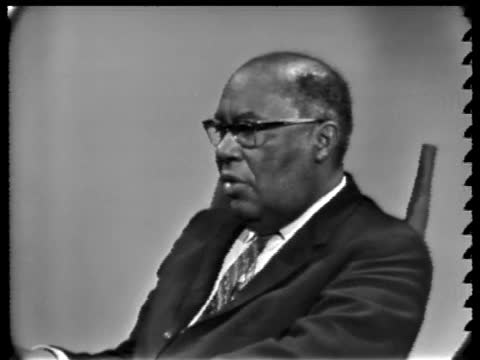
and the shape-note tradition and the African tradition were all in the South before the Civil War. And somehow the Negroes spiritual rose out of these traditions and from the intermixing of these traditions. In order to help us out in this complicated problem, we have Dr. Willis James of Morehouse College and Spellman College in Atlanta, Georgia. And Dr. James is a leading music collegeist and a leading authority on the Negro spiritual. Dr. James, what's your opinion on all of this? Well, I believe that the Negroes heritage which he brought from Africa in terms of melody and song and by all means rhythm had a great deal to do with it. You notice I didn't say everything to do with it, a great deal. Well, you were in Africa weren't you last year or so? Yes, I was. I was in Africa in Lagos, Nigeria, particularly during December. And I saw some wonderful manifestations there
of these various things that I am talking about. They have a manner of playing drums there which I think surpasses anything of its kind in the world. These drums are referred to as a Yailu, Omailu, for the large drums, the Kananga, and the Kirikere, which are drums which seem to reproduce their names in some. And the Gu-du-gu-du, which is a kind of accompanying drum, and the Udu, which is a kind of a bass. I was just going to say were the Negroes allowed to play these in the colonies they weren't? At first they were. At first they were. But when the white men observed how these drums affected the Negro and caused him to go into states of ecstasy and hypnotism, well I think he became what alarmed about the possibilities and he wouldn't let them use the drums. So the Negroes transferred these rhythms as much as they could to their hands and to their feet
and developed wonderful hand claps and footpats in the rhythmic order which today does not exist entirely. And use these in their course and later in their churches after they had been embraced by Christianity. Well Christianity was an enthusiastic religion so some of this hypnotic effect that the Negro was used to was present already in Christianity wasn't it? Very much so. But you see the Negro did not understand Christianity and he had also the vest himself of some of his traditional beliefs in order to accept it so that it was a rather slow process. It came over a number of years. It wasn't a certain thing. And in fact, even today, if you go into the West Indies you will find remnants of Negro African rhythms and singing in the churches there. Well the preacher was probably the most significant or influential force in all of this wasn't he? Yes, the preacher. You see he was a leader. It was very easy for him to create a type of antiphany
because he could preach to the people and they would answer him. And he could use his voice in beautiful cadences and almost sing an amount of which was referred to as Zooning a graveyard preaching, you might say, by the Negroes. And it was he who knew the Bible and he could tell the stories and in this manner, using these rhythms and these manifestations of speech, they learned to sing in a different manner. Well now, the white preachers were important too. Did the Negro copy the white preacher? I don't think the Negro copied the white preacher in substance because he couldn't. He wasn't that trained. But he did, of course, emulate him in terms of general practice. He got the idea of preaching as the white preacher certainly did that. Well, if we listen to a spiritual by someone like Katie Bell Noobin, would we hear all of this? Would we be able to see all of that? I think you couldn't help hearing it because it is certainly there and she is a very embodiment of the spiritual
as it does exist. All right. In the morning, yesterday, about to break a beat, the angels came from glory and rule a story. The women came along, found at the safe of a gun that can all grieve for my body down. Oh, can all grieve for my body down. No, can all grieve for my body down. When the first shrub its sound, I'm going to get out of the ground. Oh, can all grieve
for my body down. Long can all grieve for my body down. Oh, can all grieve for my body down. When the first shrub its sound, I'm going to get out of the ground. Oh, can all grieve for my body down. Go your way gable spread on the land and on the sea. Don't you blow that shrub air till you get an answer from me. Oh, can all grieve for my body down. Oh, can all grieve for my body down. Oh, can all
grieve for my body down. When the first shrub its sound, I'm going to get out of the ground. Loathe can all grieve. Oh, can all grieve for my body down. It is about to break our deep. When the angels came from glory, roll the stone leaf. Where do women's become a lot long? It's part that the Savior was going to say kind of grieve. Oh, my body down. Loathe can all grieve. Oh, my body down. Oh, can all grieve. Oh, my body down. Oh,
in the first shrub its sound, I'm going to get out of the ground. Oh, can all grieve for my body down. Loathe can all grieve. Oh, my body down. Wasn't that tremendous? I'll tell you one thing, Dr. James, no white singer could have sung it that way. Well, I don't know whether that's absolutely true or not, but I'll say this. Nothing but a great spirit could have sung it that way. I think when you hear Kate Bell and Nuban sing that, you have heard what the spiritual really is, and you have seen it in action. She is, to my mind, one of the truest examples of what a spiritual singer was and can be. I think we are very fortunate to have her alive today to sing for us. Think about the text of that thing, which is one of the requirements of any great song. Ain't no grave can
hold my body down. When I hear the trumpet sound, my body will get up out of the ground. And she sings it with a vibrancy and a voice and a spirit and our hands shiver and she gives a very rhythmic footpath, which is almost a sum total of her being. And when you hear it, you have to join in with her in believing that she utterly believes this song. You see, when people hear the spiritual today, they hear it so diluted. So shall I say, color or discolour, by so many modern feelings that it's almost unfair to say that it is a spiritual? Well, you know, if she were to sing this way in front of a group of people, she would inspire them, wouldn't she? And they would respond to her and would respond with a harmony, wouldn't they that would fit in the background of her singing? Oh, yes. Absolutely. But let us say, if she said, sing a song,
with the people, rather than for them, because I don't think that to sing to them would be quite the thing that she would be thinking of. I think that Cated Bell Nuban, at this moment, is singing as much for Cated Bell Nuban as she is for anybody else. And I think that's the grandeur of the spiritual. It begins with the individual and goes out. And people hear it, rather indirectly so far as the thing is concerned. Yeah, and of course that is the real root of folk song. That's the thing we've been trying to talk about on this program over and over again, the sincerity, the simplicity of folk song, as opposed to the elaborate sophistication that comes in. Now, this, as you've pointed out, has happened to the spiritual too. The gospel tradition has diluted the spiritual and really cheapened it, I suppose, hasn't it? Absolutely. The gospel song today, in my opinion, is neither fish, nor foul, nor fine, red wine. The gospel song is so diluted that it's almost
impossible for anybody to point out that this is a true one. It has so many other components in it. This came about, I suppose, as the Negro went into the city and came in contact with all of the musical tradition and the radio eventually, and that kind of thing. Isn't that right? Yes, that, and also there was another concern. You see, the gospel song is a commercial instrument. It's another industry. It is music in the trade sometime, but it is not music of the trade. There's quite a difference there. I know, however, certain ministers and I know certain musicians, some of whom I have trained in my lifetime, who have been employed by certain gospel preachers, to go into the trade and play jazz in order to liven up the services, as they said, and these things have gotten over into the singers to the extent that they are, in many cases, jazz singers. You know, you told me once that the poor jazz players were
the ones that went into the churches. That's right, because they were not good enough to deal with the jazz that the real jazzmen perform. You see, jazz is a highly improvisational music. To be a good jazz man today requires a good bit of ability. Many people don't want to admit that and don't know that it does, but to be a good jazzman is a quite an order. And these musicians who could not fulfill that order found it lucrative to go into the church. And as we may say, say the Lord. Well, it does the beat come into this music with the jazz. I know that Negroes call it beat music now, the gospel music in the churches. Yes, you know some time ago, I referred to the fact that the drums were taken away from the Negroes, and they tried to transfer these rhythms to the hands and their feet to follow well. Well, when they got these instruments again, even though the instruments were European and though the drums were European, they found the correct medium to manifest these rhythms in themselves. And these went into the church and transferred themselves over into the singers. We're going to go out to
the Christian tabernacle church on Columbia Avenue in Philadelphia, which is a church that sings over the radio and is a very well-known singing church. And we're going to hear some music there, and it really comes in three segments. And you've heard that music. And you know the first segment has that Jesus, Jesus, quality. You know, what would you say about that far? Well, that's what we call a fragmentary piece. It has a terrific punctuation. It's almost like a steam drill. This word becomes hypnotic. And these things know that by experience. Keep saying the word over and over again and again. It's as a constant dripping, wearing away the stone. After a while, it wears away the resistance. And the person becomes ecstatic and then becomes sometimes hypnotized by it. And I have seen them absolutely become delirious. And I have also understood the preachers know this and they practice that to some extent too. Well, and then the second segment sounds to me like an Italian opera almost in places. And it sounds like
blues and other places. It's a sort of potpourri. Yes, that's second of what it is. Is that what I would call it? It's a large bunch of many things. And that's the hallmark of the modern day, so called gospel song. You went one position one minute and then five next minute and maybe in ten the next minute, listen to it. Now in this song, you had some ten panelli. You had some old love ballad. You had some hymn. And you had some attempts at operatic singing. And all of these have come about perhaps by this person listening to these kind of things over our system of communication. Well, but now the third segment of this goes back, doesn't it, to a more traditional type of singing? When you hear the third section, it is a further verification of what I was trying to say. This takes you back to the camp meeting. And it is very interesting. It is very important that you know, except the organ is in there as a kind of accessory to the rhythm, being a drum and at the same time a vocal instrument. Well, Dr. James, I certainly want to thank you because I don't know what we've probably never gotten through all of this
if it hadn't been for your help. And we'll now go out and listen to these three segments taken in the church in North Philadelphia. It's a pleasure to have you on the show. Thank you so much. And a pleasure to be with you. Thank you very much. Thank you.
One thing that I found out in life... that I was to meet you. But I was wondering too is that I got through it. I was looking a little fairer in the room. I just stood to that name. But you must see others, as you wish there would be you. For the long gone I would not allow you to do any more for him but he was here for you. If you be true to God, God will be true to you. I'm saying just for God be true. God will. Amen. Amen. Amen.
Amen. Amen. Amen.
Amen. Amen. Amen. Amen. Amen. Amen. Amen. Amen.
Amen. Amen. Amen. Amen.
Amen. Amen. This is
the National Educational Television.
- Series
- Lyrics and Legends
- Episode Number
- 9
- Episode
- Negro Religious Music
- Producing Organization
- WHYY (Radio station : Philadelphia, Pa.)
- Contributing Organization
- Library of Congress (Washington, District of Columbia)
- AAPB ID
- cpb-aacip/512-v11vd6q507
- NOLA Code
- LRLG
If you have more information about this item than what is given here, or if you have concerns about this record, we want to know! Contact us, indicating the AAPB ID (cpb-aacip/512-v11vd6q507).
- Description
- Episode Description
- Dr. Coffin explains how slaves in the South were exposed to early white revival singing and the musical heritage the Negro brought with him from Africa is shown in a film that recreates colonial times. Dr. Willis James sketches the synthesis of the two traditions. The practice of "lining out" songs is shown in a photographic essay by Kentucky photographer George Pickow; Dr. Coffin discusses "shape note" singing; and Mr. Pickow introduces a film clip of Negro rhythms in colonial Williamsburg. Katie Bell Nubin (mother of well-known spiritual singer Sister Rosetta Thorp) sings "Ain't No Grave Can Keep My Body Down," and we hear songs by the Newberry Gospel Singers and the Christian Tabernacle Gospel Choir of Philadelphia. (Description adapted from documents in the NET Microfiche)
- Series Description
- The intimate history of the life and thought of a people is found in its folks songs. Particularly fascinating are the folk songs of the United State, for these gathered from all corners of the world, reflect a variety of traditions yet remain close to the life and work of the new land. The fifteen half-hour episodes of LYRICS AND LEGENDS deal with the major sources and areas of folk material in this country. Ethnic, occupational, and regional songs and stories all receive attention. For some episodes, camera crews journey to areas where certain songs are sung. For other episodes, outstanding scholars and performers come into the studio to illustrate their specialties. Permanent host for the series is Dr. Tristram P. Coffin, who introduces guests and provides some of the authoritative historical background for the performers. LYRICS AND LEGENDS was produced in 1963 by WHYY-TV, Philadelphia, in association with the University of Pennsylvania and the American Folklore Society. (Description adapted from documents in the NET Microfiche)
- Broadcast Date
- 1963-00-00
- Asset type
- Episode
- Topics
- Music
- Media type
- Moving Image
- Duration
- 00:29:33
- Credits
-
-
Art Director:
Boyle, Pete
Cinematographer: Pickow, George
Director: Twaddle, John P.
Executive Producer: Burdick, Richard S.
Film Editor: Hentz, John
Guest: James, Willis
Host: Coffin, Tristram P.
Music Advisor: Goldstein, Kenneth
Performer: Nubin, Katie Bell
Performing Group: Christian Tabernacle Gospel Choir of Philadelphia
Performing Group: Newberry Gospel Singers
Producer: Twaddle, John P.
Producing Organization: WHYY (Radio station : Philadelphia, Pa.)
Videotape Director: Beale, Bruce H.
- AAPB Contributor Holdings
-
Library of Congress
Identifier: 2004555-1 (MAVIS Item ID)
Format: 2 inch videotape
Generation: Master
Color: B&W
-
Library of Congress
Identifier: 2004555-2 (MAVIS Item ID)
Generation: Master
-
Library of Congress
Identifier: 2004555-3 (MAVIS Item ID)
Generation: Copy: Access
-
Library of Congress
Identifier: 2004555-4 (MAVIS Item ID)
Format: 1 inch videotape: SMPTE Type C
Generation: Master
Color: B&W
-
Library of Congress
Identifier: 2004555-5 (MAVIS Item ID)
Format: U-matic
Generation: Copy: Access
Color: B&W
If you have a copy of this asset and would like us to add it to our catalog, please contact us.
- Citations
- Chicago: “Lyrics and Legends; 9; Negro Religious Music,” 1963-00-00, Library of Congress, American Archive of Public Broadcasting (GBH and the Library of Congress), Boston, MA and Washington, DC, accessed August 20, 2026, http://americanarchive.org/catalog/cpb-aacip-512-v11vd6q507.
- MLA: “Lyrics and Legends; 9; Negro Religious Music.” 1963-00-00. Library of Congress, American Archive of Public Broadcasting (GBH and the Library of Congress), Boston, MA and Washington, DC. Web. August 20, 2026. <http://americanarchive.org/catalog/cpb-aacip-512-v11vd6q507>.
- APA: Lyrics and Legends; 9; Negro Religious Music. Boston, MA: Library of Congress, American Archive of Public Broadcasting (GBH and the Library of Congress), Boston, MA and Washington, DC. Retrieved from http://americanarchive.org/catalog/cpb-aacip-512-v11vd6q507