White House Seminar; 2; The Judicial Branch of Government
- Transcript
Are we taking it straight up, dummy? Stand back, please. One minute. Washington Seminar, associate justice devil. Program number two, date 62662. Take one, five seconds from Wolf. National Educational Television presents White House Seminar. You are invited to join us in Constitution Hall in Washington, D.C.
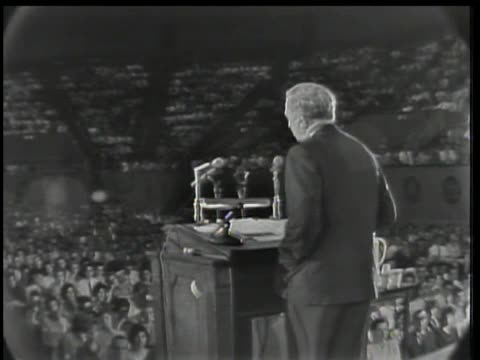
for another in the series of White House Seminars, in which some 7,000 college students from all parts of the country will participate. These students, all of whom are working in various branches of governments in Washington, are gathered here to hear some of the highest officials of our governmental system, explain to them the functions and scope of their departments. Following the formal talks, the floor is thrown open for a question and answer session. This session today will be conducted by the solicitor general of the United States Archibald Cox. Through the medium of these seminars, these students and you, our television audience, will be able to appreciate and understand more clearly the operation of the agencies of our government. In this session, associate justice of the Supreme Court of the United States, William O. Douglas will speak on the judicial branch of the government. Moderator of these White House Seminars is a recent appointee to the important post
with the State Department of Deputy Assistant Secretary for Public Affairs, Mrs. Katie Lockheim. One of the vigorous new women leaders on the Washington scene, Mrs. Lockheim will open our program and introduce Justice Douglas. Welcome to the second session of the White House Seminar. It is my great pleasure and privilege to introduce to you this morning a man who is one of the country's most interesting and great figures. Our speaker is a man whose creative talents are in no sense limited ever by his great judicial achievements. William O. Douglas was born in Walla Walla, Washington, the son of a missionary.
He went to school in Yakima, received his AB from Whitman College, and his doctor of law from Columbia University. He taught law at Columbia and then at Yale. Having already then developed an expertise in a variety of subjects, at the request of President Roosevelt, he took on various government studies, which today we might call task forces. In 1936, President Roosevelt appointed him Chairman of the Securities and Exchange Commission, the agency whose functions he had been studying. In 1939, as we all know, President Roosevelt appointed him to the Supreme Court. This morning, he could take us to the Himalayas, North from Malaya, and all the way to the Soviet Union, to many strange lands and friendly people,
to which he has been our unofficial ambassador, bringing to the leaders and to the people of those lands the best of America. Or he could stay at home and take us to the Pacific Northwest, where incidentally he is going this morning for his vacation. We would like to be going with him. This is what the Justice calls my wilderness. The places I have mentioned are just a few of the titles of the 18 books Justice Douglas has authored. Of men and mountains that happens to be my favorite, most nearly describes the Justice. He is the man who not only climbs mountains, but understands their affinity to man. For all of you who would like to know how a great man becomes great, I recommend that you read this autobiography.
In this book, he says, we cannot become self-reliant if our dominant desire is to be safe and secure. We will be self-reliant only if we have a real appetite for independence. The man who wrote those lines has long since made his choice. It is my great honor and privilege to present to you the Justice of the Supreme Court William O. Douglas. Mrs. Lockheim and friends, this occasion this morning brings back many sentimental memories,
because I was just a little older than perhaps the oldest of you. When I first came to this town with Franklin Roosevelt, promising to stay six months, and I never got away. I hope that you may suffer the same fate and have as interesting experience and as high adventure as I have had, because those of you who are in government are headed for government, whether at home or abroad, can find in the contemporary world seen opportunities for great excitement, great undertakings, great idealism, great ingenuity and creativeness.
The committee asked me to talk to you about our judicial system this morning, the American judicial system. Those of you who will travel, the world in the future, will run into many forms of federalism. India has a federal system, Russia has a federal system, Australia, Canada. A federal system is almost necessary when you have a nation occupying so many square miles as any of those countries do. Because it's impossible for the center, it is impossible for the center to know enough, to be wise enough, to make the regulations concerning the affairs of the local units, the municipalities and the counties and even the states.
And so it's necessary even if you were just creating for the first time this morning, if this were the constitutional convention, it would be necessary for you to create a federalism for a country as large as the United States. One of the distinctive features of the American federal system is that the states and our federal system are much more prominent and important than the states in the other federal systems as in Russia or India. Because the constitutions of Russia and India created the states and therefore they became subordinate receiving only such powers as were delegated to them, while as you know the history of this country was different and the states created us, the federal government, saving unto themselves all the powers that were not delegated to the center. And as you know the one of the great constitutional issues throughout our history has been whether this right that the state is exercising is a right that has been retained or does the federal government have control over that field.
And that is the importance of the Supreme Court in our federal system. Some people at some times all through our history have been unhappy about our court's decisions from the days of Marshal on down to the present. But if people would get sufficiently unhappy as to do away with the Supreme Court by amending the Constitution, they nevertheless would have to provide by a new provision, a some referee because every federal system needs a referee so that the states who are parts of the federal organic unit comply with the charter, the central charter,
whether it concerns trade barriers or whether it concerns civil rights of individuals that are protected by the federal constitution. So the main, when you think of the Supreme Court in the American picture, you think of essentially as the referee between the federal government and the state governments or between the two conflicting state claims. And it was due to that conception vigorously applied by men of broad visions such as John Marshall that developed in America, for example, the first great big common market among all of our states by using the commerce clause to keep trade barriers from being erected and keep America from being vulcanized. The independent judiciary is not necessarily a part of any federal system, some federal systems as in Russia do not have an independent judiciary in the American sense of the word.
India does, Australia does, Canada does. Those of you who will travel in the future will find many countries where the judiciary is not independent, where the judiciary can be manipulated, removed, enlarged the salaries reduced according to the convenience of the people in power. And for the judiciary must follow the particular ideological line in some countries. In the Middle East, even today, judges have each judge has his broker. So if you have a case, you go to the broker and find out how much the judge would want to decide in your favor.
These experiences abroad that you will have, as you see, federalism in operation in other countries, as you see courts in operation in other countries will be really little pieces of history that all nations have gone through. The struggle of man has been to have an independent judiciary. This is one of the great historic struggles to keep a center in a storm where there is calm and quiet and repose and dignity and the absence of passions and emotions or corruption. There is a man or a woman can stand before the tribunal and get equal justice, whether it is rich or poor, whether it is black or white, whether it is Catholic or Protestant, etc. The struggle has also been, as you know, from your history, to keep other powers from being blended.
Some philosophers have thought that it would be a great mistake to blend the executive power and the legislative power. The executive power and the legislative power are very closely allied, as you know, in the parliamentary systems, as in England, as in India. We have a different system, of course, for the special reasons of our own history. Separation of powers, at least between the judiciary on the one hand and the legislative and the executive on the other, give us the citizen the protection that he needs against arbitrary action. These federal systems, such as we have in America, Russia and India, they all require written constitutions. We can have the free society, of course, as in England without a written constitution.
In England, as you know, the House of Commons is the custody of the free society, the custody of the constitution, whatever the House of Commons decides is a construction and a substance of the unwritten constitution, and the judges do not sit in judgment on the constitutionality of what has been done. But where you have your federal system, where the restraints on the chief executive, or on the legislature, or on the judges, then somebody must sit in judgment, whether or not the person involved in a controversy is being deprived of his rights or liberty or his life and violation of the written constitution. So the written constitution is very much involved in these new nations that are emerging because they, too, have known throughout their history discrimination of one kind or another, perhaps it was discrimination by the white man who was ruling them. Or perhaps it was discrimination by one religious sect that was dominant over the minority, or might have been discrimination of a futile kind, where a landlord society was holding down the serfs, the sharecroppers, to miserably low standards of living without educational opportunities or health opportunities and so on.
So you find as you travel that these new nations are all adopting written constitutions, saying what cannot be done to the citizen and so on, what the restraints on government are. You would be proud, I think, of your country when you travel and read the talk to the judges and the lawyers of other countries who have their written constitutions, to see the extent of which the interpretations of American constitutional law by our court from the very beginning from Marshall's day on down, has such a tremendous impact.
Their opinions are fairly drip with citations to American decisions. The American experiment in government is having a very broad, wide impact in these new nations. There's nothing mysterious about the ingredients of the free society that is represented in our constitutional framework. There are certain substantive provisions that will vary perhaps from country to country, but in the main, they come down to certain things that government shall not do. And certain things that that majorities that are in control may not do. The protection of all citizens against government, the protection of minorities against majorities, those are deep in our constitution. Congress shall make no law that abridges freedom of speech. Congress shall make no law that abridges freedom of assembly. Congress shall make no law that abridges the free exercise of religion and so on.
Those are substantive provisions that fence off government from those domains that history has shown are important for the welfare of the individual, so that he can do what he likes, so that he can pursue intellectually, any matter to the horizons of knowledge, without somebody saying no, you shall not go beyond this point, or you shall not think this, or you shall not speak unless you speak along this party ideological line. The ingredients of the free society also involve important procedural provisions. The provisions that set up protections for the citizen when he comes into contact with this, the awesome power of government. If government is to proceed against the citizen, it may do so only in a certain way.
So the bill of rights in large part, the American bill of rights in large part, tells the things, tells the government the things it must do if it wants to charge a person with a crime, if it wants to proceed against him in a prosecution, and so on. These are procedural matters that we sort of take for granted. Many of them strangely missing from constitutions in other countries. The right to the jury trial that the Americans, early in history, have found to be so important to liberty and freedom is pretty much even today restricted to the Anglo-Saxon world, to the Western world, the Anglo-Saxon part of the Western world. The right to be tried at the place where the crime was supposed to have been committed, the right to be free from police coercion, from torture, that produces confessions.
These are all part and parcel of the procedural protections written into our bill of rights. It has seemed to me that one of the things that we have not emphasized enough in our education, especially for those who are going to serve overseas, is instruction in the provisions of the bill's rights, bill of rights. These provisions of our bill of rights and provisions in the main body of the Constitution, protective of the rights of the individual, are really the great distinctive marks of the free society as opposed to all the forms and types of dictatorships that you will find all around the world. I wonder how many of you know what a bill of a tanger is. I wonder how many of you have been taught the bill of a tanger in your school to date.
Would you raise your hands? That's really wonderful. I judge that maybe there are a fourth or a third. That's wonderful. The bill of a tanger is not very well known in most circles, most American circles, I fear. The bill of a tanger, as you know, was the device whereby the legislature sat in judgment on the individual. And a judged him guilty of a crime, appropriated his property, sometimes banished him from the country, made him incapable of attached to disabilities so he couldn't hold public office, sometimes that disability went down his blood stream to his sons and grandsons.
That's not in our bill of rights, the outlawing of the bill of a tanger. It's in the main body of the Constitution, as you know. The bill of a tanger is being used around the world these days by some new governments. The way Necruma got tight control of Ghana was through the bill of a tanger, legislative condemnation of his political opposition. The British and their parliamentary system have a very mature kind of society, tolerance for the unorthodox, the non-conformist, civil liberties flourish in England. It took, however, 600 years to develop that tradition. And the young nations, inexperienced and self-government, cannot, of course, be expected to acquire those restraints in that degree of tolerance overnight. It takes time. It took the British time. It took us lots of time.
That's why the written Constitution is so important. They gave to Ghana the Westminster model for the Westminster model, for the legislative and the executive are combined, and traditionally, as in England and in Canada, the majority is a trustee, really, for the opposition, too. I don't know how many of you know it, but in Canada, the leader of the opposition is paid by the government, $15,000 a year to criticize the government. It's the recognition of the desirability of more than one party, recognition of the disease that enters the body politic once just one party fastens itself on a people to keep alive the opposition to stand ready to answer all questions and criticisms. That is the essence of the Canadian system and the British system. But when Ghana received this Westminster model, she was not acquainted with these traditions in personal experience,
and seeing the potential utilized the Bill of a Tanger. That's the most modern, most recent use of the Bill of a Tanger. Some of the constitutions like in India have provisions for preventive detention, or by you can lock up a person for a year if he's a, quote, troublesome, quote, closed. The British introduced the preventive detention into India to control people like Gandhi and Nero, and this new Indian government wrote it into their constitution and abused it very extensively to lock up people who were commonists or other so-called subversives, troublemakers, and they've had thousands under preventive detention in India, and it's a constitutional measure.
And perhaps who are we to judge at this distance, perhaps if fragile society needs something of that kind. But the inventive genius of man in search of power is a very great Ghana, an accruement invented borrowed the idea of preventive detention, not through the constitution, but just through general legislation, and the Supreme Court of Ghana recently upheld the constitutionality of preventive detention, which to Americans, of course, is horrible, because nobody can be detained by the police in America unless they have probable cause that he has, or thinking that he has committed a crime. The expost factor law next to the Bill of Attainer is one of the most powerful, vicious, effective means for controlling your political opponent, the opposition. It is used very extensively in under commonist regimes. I don't know how much of a Soviet law you may know.
Last July 1961, as a matter of fact, the Supreme Soviet enacted a law that increased the penalties for illegal dealings in foreign exchange, July 1961. The presidium then issued an edict, what we would call an executive order, and they made that July 1, 1961 law retroactive to crimes charged against two men that were being held at that time by the police, crimes committed prior to July 1, 1961. And those two men last summer were tried in Moscow under the expost factor law sentenced to death and executed.
The expost factor law is a powerful weapon, as you can see, because all you'd have to do would be to look over your past record of your opposition, and then in light of what you found past the necessary laws making criminal, as of now, the things that were innocent when done and arrests the political opposition, try them and send them off to prison. The communists are not the ones who have an exclusive monopoly by any means. When you get to look at the laws of this government presently in control in South Korea, you will see that the South Korean government has many laws that are expost factor. Justified on the basis of morality, how extensively they are used, that we're not told much by the American press, but there are hundreds upon hundreds upon hundreds of South Koreans in the last year and a half who have been prosecuted under expost factor laws.
The expost factor law being a devilish political device is outlawed by our constitution. Well, to go through all of these details would be very boring, and it would be very time-consuming, perhaps if given you enough of the highlights to indicate why I think that the American experience in government is so timely to the new nations that are appearing on the stage of history for the first time. We have, I think, present time 104 members of the United Nations, and in your lifetime there probably will be several dozen more.
Young nations walking on for the first time alone with some of them without much education. For example, the only person in the Belgian Congo, whoever graduated from college, was the recent ambassador to the United States, Mario Cardozo. Some of these countries like Libya have no teachers of their own or qualified to teach at the college level and have imported 2000 from the outside to demand the faculties of their colleges until they can get enough of their own people educated to take over the task. These people need guidance and help. I have been very disappointed in the American performance since World War II because we were not in on the drafting of these constitutions. There were no task forces of American lawyers and judges and law professors going abroad, sitting in consultation, helping these people draft their constitutions.
The Britishers who drafted the constitutions of help draft the constitutions of India, Pakistan, Nigeria, and Ghana were, as a matter of fact, rather ignorant of American constitution law. I say that based upon my own conversations with them and somewhat hostile to it. We assumed for 15 years or so after World War II that the problems of this age could be managed in one of two ways, either by pouring out millions upon millions of American dollars into underdeveloped nations. Or by building tanks and bombs and jet fighter planes and so on, either by financial aid or by military aid. The victories for the free society, however, I think will be one in the classrooms and the schools and the universities. They will be one by men and women who are trained as you are in what the ingredients of the free society are.
Why they are important, why it is fundamental that a minority of one be protected against government, why it's important that all the idiosyncrasies of the individual be allowed to flower, why it's important that government keep its hands off certain areas. We are beginning to get more and more, I think, on the wavelength with the peoples of the world. Last evening, there were 200 members of the Peace Corps who were going out to several nations in Asia and Africa. I was honored by being invited to go with them on a hike up the Sino Canal and we hiked up and had a picnic and then hike back late last night.
These people are going out and some of you probably, I hope, will be going either for the government or for foundations or for churches or for business, American business concerns into these areas. These people are going out as really as evangelists of the American way of life, meaning the American way of preserving human rights, the American way of establishing the principle of equality for all people regardless of color. Americans, as I told the Peace Corps squad last night, we Americans are not perfect. We live on earth and not in heaven. We have many imperfections, but you can all be proud. You can all be proud that your constitution is on the side of freedom and equality and our laws are on the side of freedom and equality and the administration of this government, including the distinguished listed general who was here this morning, is on the side of equality and freedom.
And that's more than almost any other country in the world can say. In engineering and physics and mathematics, you probably could get as good a training in Soviet Russia as you could get here. But when it comes to the ingredients of the free society, there's no commonist block that has anything to offer. As respects the basic human freedoms, the Atlantic community and nations such as India and Israel and follow the Western traditions, have a virtual monopoly. While the commonists can build tractors as good as ours, they do not and they cannot build multi-party systems. While they can build steel mills as good as ours, they do not and they cannot have an opposition press. And while they have freedom of research in science, they do not and they cannot have freedom of speech and freedom of expression in the humanities. On those matters that are measurable only in intellectual and spiritual terms, the West, which includes us in Europe, and India, and Israel, who live in that tradition, we have a virtual monopoly.
That's why our cause is so strong and that's why when you speak for us, you will make such a profound impact on all the peoples of the world. Thank you very much. And now as a great exponent of what is in our judiciary system, that the justice may not have touched upon and to answer your questions, we have the very able solicitor general, Arts Ball Cox.
He, it probably will not surprise you, graduated from Harvard. Over his career, he has had many posts in government. At times, even at one time, serving on the staff of the office of which he is now the chief, this should be encouraging to you, young people. In between his services in the government, on the defense mediation board, in the state department, and wage stabilization board, he has been teaching at Harvard Law. It is my great privilege to present to you the solicitor general of the United States, Arts Ball Cox. Thank you.
Mr. Glock, I'm friends. My role this morning was assigned to be that of answering questions which might be raised by the Justice's talk or other questions about our judicial system. I think that I should have to confine my answers to the judicial system because I lacked his more varied and ventious of attendance. May I say just a word or two before opening the Florida questions? It seems to me that in thinking about our judicial system, that it is important to drive distinction between the Supreme Court, or perhaps I should say public litigation and constitutional litigation, and the ordinary work of the courts. The ordinary work of our courts has to do with the administration of criminal justice, with the litigation between private citizens growing out of contracts, personal injuries, unhappy sometimes family quarrels, and the like.
In that respect, our judicial system is much like that of other lands, say that we have a truly independent judiciary, and that we have founded it upon trial by jury, and the representation of the parties, by an independent bar. The great distinction, perhaps, between our judicial system and that of other countries, and indeed the great distinction between most of our state courts and the federal judicial system is the jurisdiction, especially of the Supreme Court, the role of the Supreme Court, in constitutional litigation. For a number of reasons that the justice alluded to, because we have a federal system, because we have a written constitution, because the federal government is one of limited powers, and because both the states and the federal government are circumscribed by restrictions, such as those in the Bill of Rights,
and finally, because of the doctrine that an independent judiciary is the interpreter of the constitution. We have developed in this country over the years what I sometimes think of as an extraordinary facility for casting social, economic, political, and sometimes even philosophical issues in the form of lawsuits, and taking them to the Supreme Court for a decision. This Chief Justice Hughes said on one occasion, perhaps the Supreme Court is the most truly American contribution to the science, I prefer to think of it as an art of government. This is invariably drawn the cart into sharp controversy because it deals with the most emotional questions, and frequently the most difficult, most fundamental questions of the period.
Back in the day of John Marshall, the questions were whether we would really be a nation or a loosely net confederation of states. The second question was whether we would truly have an independent judiciary, then coming to the period in which I was at school in college. The great questions were whether the powers of the federal government were broad enough to keep pace with the growth of national markets and the spread of the great nationwide companies. And whether either the state or federal government had the power to enact the kind of social and economic legislation that was necessary as we became transformed from a nation of farmers and shopkeepers into primarily an industrial nation. Today, I think by today, I mean during, say, the past decade or the past decade, five years either way, the court has been concerned primarily with three great areas.
The first is the question of civil rights, the conflict between the ideals and the declaration of independence of liberty and equality, and the habits of many of the people in the country and all regions, which went back to a period even before the declaration of independence. The second great question, or a series of questions, has been the conflict growing out of the pressures for conformity in a very dangerous world on the one hand and the needs for individual personal liberty on the other. And those you have seen in the cases dealing with the prosecutions under the Smith Act, prosecutions for contempt of Congress when witnesses refuse to answer questions concerning what they thought were their private thoughts and political activities. The third area, and one which is tremendously important, but sometimes does not track quite as much tension, the court has been very greatly concerned with the improvement of the procedure in criminal cases.
So as to make it more humanitarian, more fair, perhaps I could add a fourth that has come into prominence during the current term of court, and this of course is the struggle to secure a more nearly equal representation in state legislature. The decision this year in Baker and Carr was probably one of the truly landmark constitutional cases, because it does provide a judicial remedy against gross malaportionment of a state legislator. I've already said more just by way of introduction that can hardly be called that than I should. I now invite your questions one at a time, preferably in a big loud voice because this is an awfully big hall. Yes? My name is George White, I work in the non-education welfare department. I'd like to know, do you think the recent change in membership of the Supreme Court with the addition of Byron White will bring about a change in the balance between liberals and conservatives, especially if you think that the Supreme Court will hand down a new type, a new wanton's type decision, which will allow witnesses before congressional investigate any committees.
To use the First Amendment to refuse to answer questions which violate their correct right. The question is, first, whether I think the appointment of Mr. Justice White in place of Justice Whitaker will change the balance of the court between what the questioner describes as liberal and conservative. And second and more specifically, do I think that the court will now hold that one may refuse to answer questions by the House on American Activities Committee or the Senate Internal Security Committee, but may refuse to answer them on the ground that the questions are an interference with freedom of speech. Well, neither of those is a question that I can very effectively answer in my presentation.
I think that Justice White, and I say this sincerely, not just as plug for a friend, should be one of our very great Supreme Court justice. He's a strong independent thinker, and so far as I know, defies any label and classification. Just how his decisions will go on the court, nobody could possibly foretell at this point. I would, though it's not an answer, also simply like to assert that the current public categorization, liberal and conservative of the court, I think is really a gross oversimplification as anyone who followed the court closely would know. As to the question which you raise, I presume that it will be decided again in a case known as silver against the United States, which has been set for re-argument in October, since it will be my duty to represent the United States.
In contending that silver was guilty of contempt of Congress, I am not the most impartial judge of how the question is likely to come out. Next question. The National Red Cross Justice Douglas was speaking about what we haven't done concerning the new nations, the rising nations, particularly in African Asia, concerning their constitutions and legal structure. Is there now a program with the government concerning these new nations that will be coming up within the next year, concerning legal advice? Well, I don't think there is as strong a program as the justice would have liked to see undertaken.
There is advice being given of that kind, normally through private institutions, I think, but sponsored through the government for various kinds of educational programs. I think, you know, a candor to try and answer is the justice would, he would say that should be a very great deal more. Robert and the public health service. Do you think the House of American Activities Committee serves any useful purpose? I'll take the fifth. I have a friend who is a lawyer and you said the third major interest of this decade or the past decade is a procedure. He told me, you know, which to be corrected if I am wrong, of a case in Georgia where three sailors were sentencing condemned to three years of hard labor within one day without defense. And sent to Georgia that evening.
I would like to know what happens to, well, later on, it went to a Supreme Court. They were not all, but anyway, I would like to know what happens to the Aaron judge and district attorney after this happens that this can be corrected. The decision is reversed. What happens to the district attorney in most of our states depends upon the voters. If enough voters are offended by that kind of procedure, then the district attorney doesn't get reelected. The judge, if it could be shown that he where corrupt could be impeached, ordinarily, one of the prices of the independence of the judiciary, which we have historically, and I think properly always laid great star by, is that the judiciary is independent to do wrong as well as to do right. Judicial temperament is a phrase which has been used to describe an outstanding quality possessed by many of our greatest jurists.
What, in your opinion, are the characteristics which are embodied and symbolized in this phrase, and how can persons who aspire to the bench attain the judicial temperament? Well, I would think that to answer the second part of your question first, I would think that the best answer to that, in most complete answer, would be to refer you to an address by learned hand, certainly one of our greatest judges, and one with a supremely fine judicial temperament, entitled, I think, of toleration or something like that. You'd find it in the book, it's very liberative. And the plea that he made there was for the breadth of understanding and toleration that comes from breadth of study, of reading, of interest, and I think that it is the freedom from prejudices, which does come from that, which is probably more important than anything else. But the judicial temperament, as I phrase, certainly should include courage. I guess one finds that within the depths of his spirit in all kinds of personal experiences.
It should include, also not necessarily, but frequently, I think best includes a certain humility that should accompany the courage. The judge, who is sure that he is wiser than anyone else, I think makes a rather dubious judge, because one of the critical things about the law is that it must be more important than those who declare the law. The judge really isn't trying to make the world after his own image, but trying to speak for the heritage and ideals of the community, and that does require courage and independence, but at the same time it requires humility. And I think one last little sentence, I think frequently people, mean the humbler qualities of simply being able to sit on the bench, and despite all the irritations, to keep your temper, and provide, preside in a dignified, calm way.
Please ask people with the best ways to come, go to a national and come up to the line today. Will you come up here to the mic? From Constitution Hall in Washington DC, we have brought you another in the series of White House seminars. The thousands of young people you have seen here today are all young college students from all parts of the country who are working in various governmental agency jobs. These seminars are held with the express purpose of introducing to these young people the functions and true scope of our government, our highest official appear on these programs to clarify the operations of their branch of government. Today's discussion of the judicial branch of the government was presided over by Associate Justice of the Supreme Court of the United States, William O. Douglas.
The question and answer session, which is still going on as is being adroitly handled by the solicitor general of the United States Archibald Cox. Acting as moderator for these programs is the Deputy Assistant Secretary for Public Affairs for the State Department, Mrs. Katie Lachheim. White House seminar was produced in cooperation with WETA TV.
- Series
- White House Seminar
- Episode Number
- 2
- Producing Organization
- WETA-TV (Television station : Washington, D.C.)
- Contributing Organization
- Library of Congress (Washington, District of Columbia)
- AAPB ID
- cpb-aacip/512-rj48p5wb72
- NOLA Code
- WHSE
If you have more information about this item than what is given here, or if you have concerns about this record, we want to know! Contact us, indicating the AAPB ID (cpb-aacip/512-rj48p5wb72).
- Description
- Episode Description
- This episode includes comments from Chief Justice Earl Warren, and possibly comments from Associate Justice William O. Douglas. This episode was produced through a facilities of WRC-TV in Washington. (Description adapted from documents in the NET Microfiche)
- Series Description
- A series of meetings designed to interest and stimulate college students working in Washington over the summer in various branches of government service, to make a career of government service after completion of their studies, as well as to serve as missionaries, explaining government service to those with whom they come in contact. The 7 half-hour episodes originate from Constitution Hall, Washington, were originally recorded on videotape, and were produced in cooperation with WETA. The host of the series is George Jeff Baker of WETA. (Description adapted from documents in the NET Microfiche)
- Broadcast Date
- 1962-00-00
- Asset type
- Episode
- Genres
- Talk Show
- Event Coverage
- Topics
- Politics and Government
- Media type
- Moving Image
- Duration
- 00:58:45
- Credits
-
-
Host:
Baker, George
Producing Organization: WETA-TV (Television station : Washington, D.C.)
Speaker: Warren, Earl
- AAPB Contributor Holdings
-
Library of Congress
Identifier: 2439876-2 (MAVIS Item ID)
Format: 1 inch videotape: SMPTE Type C
Generation: Master
Color: B&W
Duration: 0:58:14
-
Library of Congress
Identifier: 2439876-1 (MAVIS Item ID)
Format: 2 inch videotape
Generation: Master
Color: B&W
Duration: 0:58:14
-
Library of Congress
Identifier: 2439876-3 (MAVIS Item ID)
Format: U-matic
Generation: Copy: Access
Color: B&W
Duration: 0:58:14
If you have a copy of this asset and would like us to add it to our catalog, please contact us.
- Citations
- Chicago: “White House Seminar; 2; The Judicial Branch of Government,” 1962-00-00, Library of Congress, American Archive of Public Broadcasting (GBH and the Library of Congress), Boston, MA and Washington, DC, accessed May 9, 2026, http://americanarchive.org/catalog/cpb-aacip-512-rj48p5wb72.
- MLA: “White House Seminar; 2; The Judicial Branch of Government.” 1962-00-00. Library of Congress, American Archive of Public Broadcasting (GBH and the Library of Congress), Boston, MA and Washington, DC. Web. May 9, 2026. <http://americanarchive.org/catalog/cpb-aacip-512-rj48p5wb72>.
- APA: White House Seminar; 2; The Judicial Branch of Government. Boston, MA: Library of Congress, American Archive of Public Broadcasting (GBH and the Library of Congress), Boston, MA and Washington, DC. Retrieved from http://americanarchive.org/catalog/cpb-aacip-512-rj48p5wb72