Great Ideas; 36; Arts as a Common Human Possession
- Transcript
You You You Good afternoon
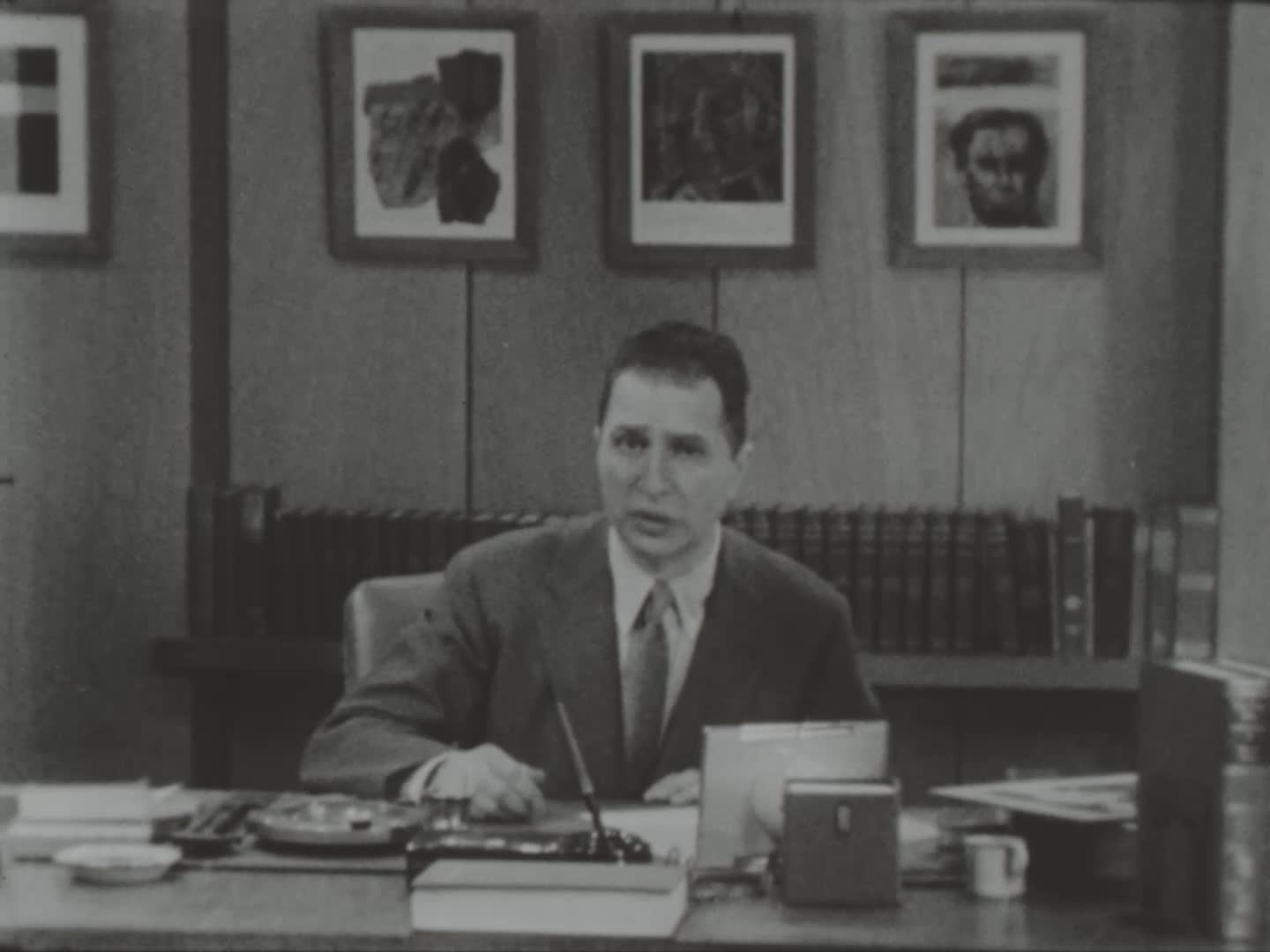
Mr. Luckman and I Welcome you to another discussion of the great ideas Today we begin the discussion of art and we begin with the most general consideration of what art is And what its significance or role is in human life Now there's something I've been meaning to say for some weeks now Something that I think many of you have recognized yourself That in the discussion of ideas Worlds often get in the way This is particularly true of the great ideas Words make great difficulties for them And among the great ideas it is especially true of art The word art Has on the side of it the words that the word itself Cause there's some difficulties in understanding what art is And unless we face this typically about words in this series of discussions about art We will not I think reach a truly philosophical understanding of art and the arts Now the evidence
Of what I've just been saying Is I think quite plain in the letters we have received this week In these letters there are many questions about art But they're all about art as if art was not only Even more narrow than that As if art consisted mainly of painting or sculpture Now this meaning for the word art Is a very recent meaning, it has happened only in the last hundred years Or even less than that It is quite different for a meaning for the words that was used For centuries before I've been taught We must face that a deep and serious conflict In the use of the word art a contemporary use of it And an ancient and traditional use of it And I think I should warn you as we start But I take sides in this battle between the ages, between the centuries Are the ten to favour?
The ancient and traditional meaning of art Because I think it is more of a patience Takes more than and enables us to understand more Nevertheless, in the questions we receive this week There were some questions I take live There were some questions which do lead into a general consideration of art And which will enable us if we take them to the very beginning To get some classes that will help us to clarify the meaning of this basic and important work I think in particular life of the questions from Mrs. Springer And Mrs. Berger, would you read those please? I have them right here, Mrs. Springer is a resident of Sacramento And she asks the following question She says from the beginning of civilization Man's progress has been measured by the development of what are called the arts and sciences That familiar phrase, arts and sciences Makes Mrs. Springer want to know how you distinguish between art and science
Mrs. Springer, I think that the distinction itself is easy at the phrase is familiar In fact, it is another familiar phrase that all Americans are acquainted with But enables me to explain the distinction. The phrase is, no, we speak of people having no how And when we say that a man or a woman has no how, we mean that he has a certain skill Or expertness or technique in something or producing something In the most enough, so the word technique In fact, that word technique in English comes from the Greek word technique Which in Greek means art, in contrast, science is not known But consists in knowing that something is the case Or what case, or even in some cases knowing what is How the other question lies from Mrs. Berger Yes, she's a sound from Siskin And she's been reading a book on our subject, a book by Jacques Mar By the way, like an excellent book, one of the best books on the subject, art and schlaxin, that's the one And she says that Maritin asked the following question
How this prints at once an intellectual virtue and a moral virtue differ from art Which is a merely intellectual virtue And she'd like to know how you answer this question posed by Maritin My answer, Mrs. Bergeron, is going to be exactly the same answer that Maritin gives us the only answer I know But first, let me say that you must understand how Maritin is using the word virtue In a mountain in the modern world in general, we tend to use the word virtue To name the molecule things like tenbrates Or cups or potavers But using the word virtue in a broader sense for good real habits as well as good mud habits, and softness and wisdom and understanding as much as temperance and justice and culture. Now, in terms of understanding of virtual, let me say, that these two intellectual virtues prudence have a book that consists in the book, but the difference between them is that
prudence consists in knowing how to act well, knowing how to do something well, whether in knowing how to produce or something in a good manner. To produce something in his gut, perhaps, I can do the summarize of the two distinctions that these questions call for in a chart that puts together the distinction we've discussed are science and prudence. Let's look at this chart together, science and our and prudence also involve knowledge or knowing, but whereas such consists in knowing that something is the case, or what something is, or what is, but our and prudence consists in knowing how, knowing how. But whereas our consists in knowing how to make something well, prudence consists in knowing how to act well, how to behave well, morally, or politically.
Now, let me come back in terms of this to the generic meaning of art that I think we should face, which is the ancient meaning that I referred to at the very beginning. The generic meaning of art as skill in production, skill in making something, so that anything in which human being has had a hand and has expressed his skill in the production of it, that thing is a work of art. Now, the rest room, or as you look around the room in which you're sitting, I seem to be surrounded by nothing but art. This paperweight is a work of art. This telephone is a work of art. This cigarette box is a work of art. This pencil is a work of art. These cigarettes, that clock, the desk gets some work of art. In fact, everything I see, except you lot is a work of art. And I exclude myself as well, but I think perhaps we ought to get personal about ourselves
in this respect. So I'd like to show you, I'd like to show you a picture of something which is not a work of art, I have to go outside of your room. Here is something which is not a work of art, a tree in a prime evil forest, which came as a being and grew without a hang of it on man's paws, an extraordinarily big and glorious tree. And you remember, of course, those trunks, but quite true lines of the poet Joyce Kilmer, which says this, very thing, are made by fools like me, but only God can make a tree. Nothing considers another thing which is not a work of art. I hope you all agree with me that this, a human baby, is not a work of art. But as soon as you, if you do agree with me that a human baby is not a work of art, we get
to difficulties at once, because I said that the tree was not a work of art, because it came into the forest and grew there without any human effort. I can't say of the baby, that no human effort is involved in its production. But I can say that I shall try to explain this later at the kind of human effort that is involved in its production doesn't make it a work of art. Now, according to the contemporary sense of what art is and what works of art are art, I would not have the difficulty I just had. In fact, according to the contemporary sense of works of art, there's nothing on my desk or in this room, which is strictly a work of art. Again, I must leave the room. I must go now to a museum for the contemporary sense of work of art, consist of thinking of things, referring to things which hang on the walls of museums, or stand on pedestal there. And here is a very famous work of art. A statue will be great statues by Michelangelo, the Pieta, which stands the very entrance
to St. Peter's in Rome. If I show this to you, you and all of the contemporary persons would say, yes, that is a work of art. But if passing from this, I would go to this picture, the picture of a great tennis player. In the act of playing tennis, you would not, most people today would not think this was an artistic performance, they were regarded as an athletic exhibition, an exhibition about athletic prowess, not a performance that reflected art, no matter how great the skill that is involved in performance that this man is here doing. Now, this contemporary sense of art is, I think, summarized in phrases that we all use, in which the word art seems to be most natural to us as we speak. We speak of museums of art. We speak of art institutes. We speak of an art student, and we say an art student, we usually mean a person studying
painting or sculpture, or some other kind of plastic art. We even say, I think, I really think the phrase is quite abominable, literature, music, and the fudge, as if literature were not a fine art, as if music were not a fine art. But even if that's not what makes the fine art the plastic art for broadened, so that the fine art were understood by us to include music and literature as well, that that meaning is still to narrow for a deep and profound understanding of what art is and the role it plays in human life. Let me ask you, is this your meaning of art, this narrow restricted meaning? You may think it is, but I would like to show you that it isn't. I would like to show you that in your own vocabulary, in your daily speech, you have faces of the ancient and traditional meaning.
For example, all of you talk about the industrial art, do you talk about the arts of war, do you talk about the art of teaching and the art of medicine, everyone uses the phrase, the arts and crafts, and everyone understands, I think, that in the meaning of that basic word of medicine, there is much the meaning of art as in the hunched word artist. Now, this I think, this meaning, which you have in your own vocabulary, as these phrases that are familiar to you, I think, reveal. This meaning is the meaning that the word had the notion expressed in the beginning of Western cultural history. One finds this, by the way, the plainest of all in the writings of the two great Greek philosophers, Plato and Aristotle. The works of Plato are full of references to art, perhaps more frequently than his references
to philosophy or science, and not only did he refer to art and talk about the various art, but he gives very frequently everyday examples of what he means by the art and art. And I would like to illustrate, show you pictures of artists that Plato talked about. I cannot show you these in the dress they would have worn upon the street of Athens, street of Athens, but I can show you the same artists in modern dress. Plato, very frequently, and with great pleasure talks about a basic art, the art of the cook. Here is the picture of an artist in the deep platonic sense of what human art is. Plato, even more frequently, talks about the art of the palette. Plato, of course, thinking of the palette, was thinking of a navigator of a vessel on
water. But for us today, in modern dress as you as it were, here are pilots, pilots in the air, instead of on the sea, but nevertheless, basically the same art that Plato was talking about. And another familiar art in Plato's day is still familiar art in our day and carries this basic meaning of the notion art, the art of the division. Here is a picture, not a position simply, but of a surgeon performing an operation. This also is a basic human art. Now when one understands, we don't understand this meaning, what is entitled to ask, is it just a platonic meaning? Is this a car only among the Greeks? Did only Plato and Aristotle have this broad meaning of art to cover everything from cochlearty to painting and poetry? The answer is no. This meaning, this basic meaning of art, and what a vicious meaning of art, persisted through almost the whole of Western European civilization until yesterday.
It ran through the romanatic with the Middle Ages and the Renaissance, and came down to the middle of the 19th century. Let me show you this, by reading two passages from the great books. One from Rousseau, at the middle of the 18th century, and one from Adam Smith, towards the close of the 18th century. These passages, which I've marked in this topic on to read you, indicate that as recently as a century or half ago, this basic meaning of art, this broadening of art, was still a common meaning in everyday speech, my glasses on, Rousseau, like Lucretius, the Roman poet, looked upon the rise of civilization itself as something of dependent upon basic human arts. Lucretius had referred to the rise of civilization as a result of the fashioning of metal tools and the domestication of animals and the colorations of the soil.
And here, centuries later, many centuries later, Rousseau said, metallurgy and agriculture were the two arts, metallurgy and agriculture were the two arts which produced this great revolution. Then in 1776, just as the Industrial Revolution was beginning. In 1776, it had barely begun. In 1776, most productions still went on in homes or in small shops with hand tools and by hand work. We didn't have industrial production by large machines and assembly lines. At this moment, Adam Smith said, talking about the division of labor in the production of a coat, listen to the words, the shepherd, the saunter of the wool, the wool, coma or cada, the dia, the scribbler, the spinner, the weaver, the fauna, the dresser. With many others, must all join their different arts.
In other words, must all join their different arts in order to complete even this homely production, a well-encourable. You know, as I listened to you, particularly reading that quotation from Adam Smith, I'm rather puzzled, particularly by this one thing. The enumeration in Adam Smith seems to me to fit the definition of art as simply a skill in making, because in all of the instances in that particular instances of making a coat and artificial product is produced. Now, either produced or becoming produced, and then there's another question that arises to if this art definition and making is involved, I'm concerned about your illustrations of the potter, or the doctor, or the teacher, or the farmer. I don't see what they make if art is making. A lot in the sense in which the couple of makes is true, or the cooker pastry, or the various art mentioned by Adam Smith makes a well-encourable.
In that sense, these other art, as you mentioned, the farmer, the pilot, the division, that they don't produce anything that you would call an artificial product. That's right. On the contrary, the things they help come into being help generate themselves, like help in the case of the division, or knowledge in the case of the teacher, or the fruits and grains of the field in case of the farmer, these are the products of nature, and they are natural effects, not artistic effects, and I'm going to try to explain, therefore, I can't today, Lloyd, but I'm going to try to explain next week these very special and queer art, which are different from the other art, in this case, helps to produce, turns out the actual product, not an artificial thing. Now we just will not, we'll be one more. But, because there's one thing that's clear from this, and that is that if you look at these art, like healing and teaching and farming, as compared with shoe making and cooking, the meaning of art must not be something that is not connected necessarily with an artificial
product, the meaning of art will not be skill. And we do know that the physician has skill, the thumb of his skill, even if the product is something natural, not artificial. Well, now I can come in with my concern about this distinction between artificial and natural. And I'm particularly concerned because I remember a question here about the distinction between these two words. It's the one that Mrs. Stevenson sent in from San Francisco, and she asks right to point, whether the distinction between the artificial and the natural throws them any light on the meaning of art. It does indeed. Mrs. Stevenson, that distinction between the artificial and the natural, goes right to the heart of the matter. Let me see if I can state it for you. We call things natural, which can come to be without any human effort. And when we call something artificial, we call it that because some human effort is necessary in its coming into being its production.
That unfortunately brings us back to the baby again, because everyone is right to say, but human effort is involved in the production of the baby. What is the idea of natural, and that is the question I've got to answer. Let me see if I can answer it, answer it, I can't answer it directly. I've got to answer it in terms of a three-fold distinction that I think will explain the difference in works of art, life, between natural productions and the divine creation. Let me look at another chart together. In this chart, I'm trying to compare for you three different ways in which things can come into being. By process of natural generation, as the baby is born. In fact, how do we say about the baby, about the production of the baby? We don't say it's produced, we say it is reproduced, we don't say it's created, we say it is created. That's terribly important. The fact that we use reproduced and pre-created there. Natural generation, which consists in the reproduction of another body out of itself or
it's like, notice that a body out of a body or something like itself, either its own body or something like itself. As compared with natural generation, artistic production and divine creation both are alike and that the production is by the mind, by the mind. The idea in advance of the thing is going to produce. No parent has an advance, the precise idea of the baby that's going to be reproduced. But where is the artistic production of men? Is by mind an idea out of natural materials, materials afforded by nature, divine creation on any theory of creation is by the divine mind and idea, as we say in theology, out of absolutely nothing. Let me come back to one of the points. The difference between a human reproduction of baby and the work of art is that the baby may resemble the parents or may not resemble the parents and if the baby resembles the
parents and the post of the grandparents may resemble the parents in both rather than mine. But any whether it be the simplest thing that's fashioned by a man or a great painting or a great poem resembles the special aspect of the maker. This is why art. This shows you that art involves the human spirit, the human intelligence, the human most ideas as reproduction in the case of the baby does not. Now this leads to two concluding points I would like to make. The first is the distinction between making by instinct, making by instinct and making by art, making by instinct is without conscious plan, making by art is with conscious plan by the application of rules and by the making of deliberate choices. This is the distinction and a very important distinction between human and animal making. Let me read you one passage from Karl Marx on this distinction between human and animal
making. Karl Marx says, a sputter conducts operations that resemble those of a weaver and a bee puts the shame many in architect in the construction of herself. But what distinguishes the worst architect from the best of bees is this, that the architect raises his structure in imagination before he erects it in reality. It leads to my second concluding distinction, between making by rule and by choice as opposed to making by chance. If a piece of music happened to result from a cat walking on the keys of the ano, it would not be a work of art, but if a human composes this down to imitate what a cat would suffer if a cat was a piece of the ano and produces something of jazzy music like kitten on the keys, that's the work of art. And this is totally important because of a essence of human art is the avoidance or elimination of chance in human affairs. To do something by rule, by preliminary and preparatory design, is what human art does
for man, as opposed to touching the chance and accident. The Greek and ancient Greek and Roman doctors made a short distinction between the opposition who was an artist and what they call the empiric. The empiric tried to cure diseases by trial and error, whereas the provision who had art, art keeps sense, proceeded by knowledge and by rule, and trusted as little of a chance as possible. And one other way of understanding this is Aristotle's very deep insight, but only the person who has an art can make the mistake in that art. Only a person who knows the art of grammar can intentionally make mistakes and speech. The person who makes unintentional mistakes and speech has no art in this particular respect. So I wish, Lloyd, that we had time for more questions. But I'm afraid that we should have to postpone all further questions until next week, when we go on with the discussion. I'd like to summarize and say that art is the principle of all human work, of all skill labor.
And I mean very deeply that all human labor is skilled. One of the least skill labor has skill in it. At the point that we've considered today, I know I'm not entirely clear, but I hope as we go on with the discussion they will become clearer, particularly next week as we discuss the different kinds of art, of the distinction between the fine and the useful art, the distinction between the liberal or free and the servile art, and above all, the distinction between the simply productive art, like shoe making or cooking, and the extraordinary cooperative art, like farming, and healing, and teaching. I hope you will send questions in on these subjects, so we'll be guided by your interest and your inquiries. And I hope you'll be familiar with this again next week. Thank you very much. Thank you very much.
Thank you very much. Thank you very much.
- Series
- Great Ideas
- Episode Number
- 36
- Producing Organization
- KGO-TV (Television station : San Francisco, Calif.)
- Contributing Organization
- Library of Congress (Washington, District of Columbia)
- AAPB ID
- cpb-aacip-512-pn8x922h04
- NOLA Code
- GTID
If you have more information about this item than what is given here, or if you have concerns about this record, we want to know! Contact us, indicating the AAPB ID (cpb-aacip-512-pn8x922h04).
- Description
- Episode Description
- Dr. Adler begins this subject with a discussion of the generic notion of art as against the restricted notion of art as painting and sculpture. Art, he says, is skill in makingall men are artists and art is indispensable to human life. He includes a comparison of human making with divine making and animal making. Dr. Adler then turns to a distinction between art and naturethe artificial and the natural. This relation of art to nature, he says, has a bearing on the distinction between human making and divine making. He also makes a distinction between art and science and concludes by tracing some of the early art forms. (Description adapted from documents in the NET Microfiche)
- Series Description
- The Great Ideas is a series devoted to discussions on the "basic ideas fundamental to man's everyday life." There are episodes on government, philosophy, law and labor. Dr. Mortimer J. Adler, noted philosopher and teacher, discusses these problems in an informal, nontechnical style. He makes extensive use of visual materials and a blackboard to illustrate his points. At the conclusion of each episode Adler answers questions sent in by the audience. Originally broadcast over KGO-TV, San Francisco, the series drew a heavy listener response. Appearing with Adler on the series is Dean Lloyd Luckman, coordinator of studies at San Francisco City College. This series of 52 half-hour episodes was originally recorded on kinescope. (Description adapted from documents in the NET Microfiche)
- Broadcast Date
- 1957
- Asset type
- Episode
- Rights
- Published Work: This work was offered for sale and/or rent in 1960.
- Media type
- Moving Image
- Duration
- 00:28:40:22
- Credits
-
-
Host: Adler, Mortimer J.
Host: Luckman, Dean Lloyd
Producing Organization: KGO-TV (Television station : San Francisco, Calif.)
- AAPB Contributor Holdings
-
Indiana University Libraries Moving Image Archive
Identifier: cpb-aacip-6edac2c5178 (Filename)
Format: 16mm film
-
Library of Congress
Identifier: cpb-aacip-1e6f3a75774 (Filename)
Format: 16mm film
Generation: Copy: Access
Color: B&W
If you have a copy of this asset and would like us to add it to our catalog, please contact us.
- Citations
- Chicago: “Great Ideas; 36; Arts as a Common Human Possession,” 1957, Library of Congress, American Archive of Public Broadcasting (GBH and the Library of Congress), Boston, MA and Washington, DC, accessed April 3, 2026, http://americanarchive.org/catalog/cpb-aacip-512-pn8x922h04.
- MLA: “Great Ideas; 36; Arts as a Common Human Possession.” 1957. Library of Congress, American Archive of Public Broadcasting (GBH and the Library of Congress), Boston, MA and Washington, DC. Web. April 3, 2026. <http://americanarchive.org/catalog/cpb-aacip-512-pn8x922h04>.
- APA: Great Ideas; 36; Arts as a Common Human Possession. Boston, MA: Library of Congress, American Archive of Public Broadcasting (GBH and the Library of Congress), Boston, MA and Washington, DC. Retrieved from http://americanarchive.org/catalog/cpb-aacip-512-pn8x922h04