Conversations 1967; 6; General Dwight D. Eisenhower
- Transcript
... ... ... ... ... ... ... ... ... ... ... ...
... ... ... ... My older brother and I went through high school together. Our dad could help some. He couldn't help too much. He had four boys coming up. Or four other ones to go to university. And so Ed would go ahead with his savings. And he'd get a job. I'd help him. And dad would help him. And then after two years, I'd go ahead. Either then, he would have such a good job. That I could go along with him and we'd just go through school together. Or he'd stay out for a year and help out. And we worked it out if it took us six years together. Well, all right, we'd go through. Well, doing that period that I got this appointment. And I got the one of the competitive examination. Did you want to go to West Point?
No, that came along just about the time I was a graduate from high school. 18, something like that. A boy that I had known from very little. He'd gone off to a private school. It was a military school. And he got interested in the military academies. And he'd failed to get into Annapolis in 1910. No nine. And he came back and got another appointment. And then he got me interested. And so I thought I'd try to go along with him to Annapolis. It looked easy to me, but I didn't know what the difficulties were. One of them was that I became 20 years old. But the papers are these instructions said you could go in from 20 to, or 16 to 20. And I didn't think about the 20th birthday. I thought along with you were 20, that was it. So I was studying like I think it was for Annapolis. Well, I just found out it's too old.
So that's when you got to West Point. Of course of your life, but it would have been very different if you were a few months here. Yes, that's right. What do you remember about West Point? What did you like most? Well, I'd tell you, of course as a kid, starting way back. My older brother and I were very keen on athletics. And the only athletics we knew at that time was football, a baseball, and boxing. And we didn't ever heard it go off. In none of us, we didn't play tennis. We saw tennis courts, but they had a paddy kick. We'd see girls playing that sort of thing. This is the only I own the athletics. But we were absolutely sold on that. And so I think one of the reasons we wanted to go into college was athletics. But that was after all, became when we were a side-life. We were very keen on it. You got the title, Daredevil Dwight. Absolutely. Don't be done. No, I'll tell you.
I think I was a rather careless cadet. And most cadets. You see, in order to keep out of the merits and get from walking the area, which are punishment tours, they call them. They're very careful. Well, I just wasn't careful, I think. But that was just something in the last eight. No one ever called me that. My nickname was Ike. Been from that time, when I went to West Point, I thought I'd lose it. I was called Be Called Ike, and it must have fit me. Do you know where that came from? Ike. No, as a matter of fact, my older brother was called Big Ike for a while, and I was little Ike. But I don't think that any of the others, maybe my two youngest brothers, were called Ike too. But anyway, it felt it was with us for some years. But I'm the only one to stuck with. How did you meet Dad and Mrs. Eisenhower? One day I was a son on guard duty. You know, in the guard's officer, I was going to inspect the whole row of sentinel posts. And I was just starting out of my quarters to do this, with a belt on, you know, and my pistol and everything else.
And across the street was a lady that I knew, as she was one of the officers' wives. And she said, Ike, come over here. And I said, I'm sorry, Mrs. Harris. I've got to go inspect the guard. She says, I just want you a minute. Come over here, don't have to stay there afternoons. I want you to meet some people. I met this girl, and on the way over, according to what I was told later, she said, hmm. The woman, a woman hater of the post. Well, I was only the second to tell her, I don't know how I got that name. I didn't know I had it. Because I assure you I didn't hate women. But in any event, I didn't must intrigue this girl. So when I said, well, I'm going to inspect the post now. And if you'd like to go along, I'd like to have you along. She just walked off, and then we started. Which is your favorite picture over here? Well, of course, she was 16 then. I like that. These were all the styles. Now they're all out of time.
It's very daring. Look, actually. I always like her in that dress. But I don't remember her. I don't care about her being combed like this picture, over two. But all of these, I never, I never saw that. I never liked that too much. A little bit staged. Yeah, yeah. Didn't last no of when General Marshall summoned you in 1942 to be the commander of the All-American forces in Europe. Did he give you any indication of why he chose you? No. He, I knew one or two of his, well, you might say, his pet elections. General Marshall hated anyone that was too avid for promotion. And really might, you might say, was ready to trample on somebody's head to get it. Now, actually, because after World War I was over, I was old for my age and a new law that just passed.
There was never, is impossible for me ever to get to a place where I could be selected for a bigger day and time of peace. Because of this, I urged my family, never to think of promotion. I didn't want them to be disappointed with if I had to retire as a colon. And so we just made light of promotion. So one day, General was talking to me, and he told me that because of the position he'd put me into the war department, I'd never get promoted. Well, I reacted very bitterly because I just thought it's unfair what he said to me. You know, I ain't working, but I got down to the long office and I went out the gate and I turned around and I felt so ashamed of myself for putting that into his burden. This was right after the war started. And I kind of grinned. And two days later, I had a memorandum on my desk and he just recommended me for me to general.
From there on, he just put me up. Denizen, it was on Christmas Day of 1943 that the world knew that you were to be commander of all the Allied places. What was your reaction when you heard the news? Well, what happened was, you remember the Cairo conference and the Tehran conference. At that time, this was not yet decided, and the president would rather have thought he would send the Marshall to that job. But in any event, Joe Marshall wouldn't express any preference, and of course, I didn't. So the result was that he made the decision while he was still in Cairo, or Tehran, I forget which, that he would send me to Overlord. Now, Marshall went on to the around the world. President Roosevelt came back through our place and told me that I was going to go to Overlord.
Now, before that, I'd gotten a garbled cable said, you better let me know who you want to take to your new job. But I didn't know where else to go. Now, Marshall sent this cable to Stalin, signed by Roosevelt. The reason I like this piece of paper so much, it was my really most precious piece of memorabilia for the war. Here is directed to Stalin, signed by Roosevelt, and then this note of Marshall's, which is so nice, he said, dear Eisenhower, I thought you would like to have this as a memento. It was written very hurriedly by me at the final meeting, broke up yesterday, the president signing it immediately to George Marshall. So it's got all those names on and the thing that really made it official. Did Eisenhower, were there any sharp differences between you and Prime Minister Winston Churchill? Oh, naturally, we had a few. One of them was about the first part of the war. He didn't like this Overlord operation at all.
This is the invasion of Norwood. That's right, across the channel. And then, after we'd gotten aboard the coastline, he didn't like the expedition. We were going to send in. We don't have a Frenchman. Yes, we do. Here's a move. See, after we went across here, the next expedition has come here, come up the road and then come under my command. He didn't like that. He thought all of our troops now ought to go in this direction. Well, I thought that was a political reason, I thought. And I said, look, I'm not a politician. And you go back to my president and argue that. And he said, no, we're talking military things. And I said, well, if it's military, I have to be the boss. And so we had a seven hour argument that afternoon. And it was all very friendly, but it was very tough. And you came out the victor? Well, he couldn't move because I had my orders, what I was to do, you see, from the joinsys to staff. And he was only half of it.
And the president, of course, stood by me. He would argue very earnestly about an official thing, a military thing. And there's only two or three times this happened. Most of the time, our relationships were ideal, just ideal. Can you give us some of the events that led up to the actual invasion itself? Well, it was a long period, you know, of preparation. And then we were concentrating troops with the British and ours together with the Canadian. I think on D-Day, we're up to about 34, I recall, 34 divisions, with all of the additional artillery and air and all that sort of thing. And so it was a very busy island. Now, this went on from, I got there in January 16th, but the original paper planning had been going on for quite a while, and troops had been coming in.
So the time of the June came around, June 6th. We were about 34, 35 divisions, all the auxiliary forces that you needed in your air, and with all of the shipping tanks and everything. What was the darkest moment that you faced in this endeavor? Well, of course, right at this moment was those hours after the ship sailed until they got aboard. That was really, that was really a tense time. Now I occupied my time, going around and seeing troops here. This was, now the people out there were in the ships. We're out in the channel right now. And this was one of the things I was doing. This was airborne. And these people were going to leave about 10, 30, or 11. And so I was out talking to them. This was about, I guess, 9, 30 or 10, night. And then it was about an hour and a half back to my headquarters. So I saw them all going to the 101st Division.
Then I drove back and forth shortly after I got back to my own headquarters. I got a message from some of these people, a little radio message, that the part of my landing. So I knew it wasn't a complete failure, but nevertheless, until the ships were there, strong forces were on those beaches. It was a really tense, tense 24-hour tense. I know there's a message here when you assume all responsibility. Oh, that, you know, is off-strainsing. And I didn't, I didn't know it existed. But I think it was my aid, a naval aid. I showed it to him some day when I was going to tear up. And he just got a hold of it some way. But the point of it was, if it was going to fail, someone had to be said. So I thought, well, I was still cool and calm. I would write out something just what I wanted to know. You noticed, I wasn't so darn calm because I said, you live there. It was just a June 5th.
I would do that. About that day. It's marvelous. Do you know what was your feeling when the surrender, the unconditional surrender of Germany was signed? Well, you know, we were so now anticipating a thing. There was a let down, really. There was no celebration in my headquarters whatsoever. It was 2.30 in the morning. I was so tired I would have gotten in bed with a wild cat. I had anything. I was just worn out. And I think everybody in the whole place was. And the next day, we had to work. We had a lot of work to do because we were under orders to send a lot of our divisions over to Japan now. And we had to begin reorganizing because some of the older men had to be taken out, sent back to the United States because they had served their time. And reorganizing, we were wearing my dogs, you know. So we never did get sent to celebrate. It was within a real relief. That's what it was. Who was this? Marshall Zucoff. And he was the best Soviet I ever knew. He at that time. He was very independent of his government and politicians.
But he finally was disgraced and put in his place. Which you really got along with him before? Oh, very fine. He was a soldier. Matter of fact, he was a communist, but he didn't push it. And all he wanted was to get along. Very nice man. Very funny thing, how sensitive they are. He had a wife. That was a little bit taller than he was. And he had two daughters. A time magazine. Published an article about him in which he said, he was shorter than his wife and he had three sons. You know that he thought this was a personal affront that was unforgivable. He came to me the only time I ever saw a man here with me. He just come on and he insisted that I am as close up a time magazine. I spent a half hour trying to tell him our system or the freedom of the press and so on. After he listened, he said, that's all right. He said, I know this.
If you wanted to punish them, you could close them up. And he said, I'll tell you this. If a magazine in this country or a country would say those things about you, I'd see them close to today. General Eisenhower, when the war was over, you and Mrs. Eisenhower must have had plans and hopes about what you do. What were they? Well, what we wanted to really go for living was out in the southwestern some we thought had a little wrench. What I wanted to do and once she agreed with me was to go some short rural area where there was a college. I've always felt that undergraduate work, if you possibly could do that, ought to be in the rural areas and all of your graduate work in the cities. So that's what I was looking for. And, matter of fact, I had one or two suggestions about that line. But you see, when they came back from war, the president immediately put me in the chief's staff. And what I was there is when this fellow Tom Watson senior, he began to talk to me about Columbia.
And he did it for, it was went on for 18 months or two years and he had a couple of pals came with him. And they argued and they finally got me one day to say, come on up and visit the place and I did. Well, I succumb, but I'll tell you this. There's a little long ways from what I thought I was going to do. Was it a difficult decision for you to decide to run for president? Yes, very. Not in fact, you know Patricia, the first time that ever proposed to me seriously, it was in 43, even I still in Africa, by this head that was, he was head down on the think of the UP or something like that kind of Virgil Pinkley. And he said, you know, any Jones ever won this kind of a campaign is bound to be a thought of as a mention as a candidate for president. I said, Virgil, you've been standing out in the sun too long. This is crazy. I don't tell him to say anything more about it. Well, he was very insistent that I should have to think about it someday.
But that's start. Now, until we had a hiatus, then in 1945, when the president came to Berlin, we were in writing in a car with General Bradley in the president and I. And he said, a gentleman, he said, I just want you to know that I for one, I'm ready to get you anything that you want. And he says that very definitely includes the presidency in 1948. I said, Mr. President, I think of anyone as less interested. I'll never be here, but no worry about that. But he was from there on. It began gradually to grow up this pressure, particularly after the president brought me back to be chief of staff. And from there on, I never was free of it. No, finally, I said, oh, here we go. Let's go Monday. Were you sure that you wanted to be a Republican? Was this something that you would not be ahead of? No, no, that I knew I was a Republican. And then a few people did.
For example, I first had a chance to vote in 1948. And I just was convinced that we needed to change. And I thought the Republican policies were fit my view better than the other. And so I admitted I was a Republican, and that was the beginning of the end. General, the campaigning must have been a completely unfamiliar thing to you. Oh. Look at all these buttons here. Did you take to it? Well, I'll tell you. I just, this is the kind of thing. You learn as a soldier. If you've gotten a undertaken a mission, you just do your best. And so I did my best at it, but it was just look at all the crazy things. What do you view as your most significant accomplishment as president? I think in the political arena was the success we had in maintaining peace in spite of the many threats in Iran, Guatemala, Formosa, constantly in Formosa, in Lebanon, Suez, all those places.
And in Korea, of course, the fighting when I went in was already still going on in Korea. But from that time, in the late June of 53, when we stopped out, we never lost another soldier. Was there any time at which you felt the world was heading towards World War III? No. No. Matter of fact, I still believe this. The two main powers with all of this atomic capacity, they're still not anxious to use them at each other. There's no question about it. And I'm sure that today, the Russian government, no matter how intransigent they are, sometimes about how much they use DC and lies and all the rest of it. They don't want major war anymore than we do. Absolutely.
What was your most disheartening time as president? The one that was when Nixon got defeated. And I still think that was very bad for the country. I don't know. I think that when I finally realized in 56, that no matter how big a majority I could, I couldn't get the Republicans to go along with me enough to get the Congress. For six years, I had a Congress controlled by the other party. So, naturally, everything I got done, I had to do by negotiation and almost using every kind of persuasive thing you could possibly could. I, as a matter of fact, all three of us, fortunately, are from Texas. I was born in Texas, Sam Rayburners in Texas, Lyndon Johnson in Texas. I used to get the two of me and alone in the evening. And we would, over a high ball or something, we would talk about the affairs of the country. And as long as I could convince them that something I was doing was non-political.
And it's a fact on the government. Usually, I get to go along. Now, of course, if they thought that it was had a suspicion that it was going to help the Republicans and more of us Democrats, then it was a different story. But that's what I had to do all the time from every behind the scenes all the time. I couldn't get out and pound the desk because that would have divorced all of them from me. Do you find being president more satisfying that way than being a general or were they both equally involved in this? Well, of course, I had been trained for all those years to be a general. But as far as the making of decisions was, I had my training was prepared me beautifully for the presidency, because that's what you had to do with all the facts in front of you, all the analyses they can make, all the recommendations you can get. Now, you have to do it. Now, that's in that sense, if my training had been almost perfect. There's a letter here from the German Kruche.
And it seems very business-like. What is your remembrance of Kruche? What is your feeling about him? You know, he was two different men. Of course, he played the same old crack record that all communists have played. There is, inside, met the first one, which is 1941 in the soldier there. It's always that you, people, are aggressors, you're selfish, and we have an idealistic organization and a government system. You are all for just, you know, making yourselves richer, and we are to try to help people all that. But, despite of that stubborn ideology that he was expounding, when he came to see your grandchildren, or visit with you in your home, out in your gallery, why he was a very pleasant man. And the way he just captivated my grandchildren, they were all about this size then.
Let me see, that was in 59, I guess, he came over here and visited me in the farm and all that. And then they were then from 12 on down, and he just captivated my son's to them. Oh, this is a painting of violence, isn't it? Oh, yes, he gave me my choice of an exhibition of 30, he'd sent over here. And this is the one I picked, and I have to keep it in my office now. Did you— Did you— Did you or a acquaintance tip with Winston Churchill, like lead you to paint yourself? I think it did, to this extent, he told me. He said, look, don't be afraid of the darn thing, just go ahead and do it. He said, just take a brush and start putting someone on the canvas. And this was a very good piece of advice, because I was really. I don't know as much about painting as, well, I don't know, my youngest granddaughter does. The only thing I know about it is, having gone in a scientific school, I knew about a linear perspective, that's all.
I had to paint colors, sometimes I'd take two hours trying to get the shade. I wanted to say that or something. How did you ever find time when you were president to paint? I had a room that was right at the elevator door. And I had no one could touch it. I had the paints all the way out, the brushes were all the way out, everything ready. I'd paint ten minutes at a time, all doing the white house. Of course, it'd be daylight hours, you can only use daylight hours. But I had that, sometimes I'd paint ten minutes, sometimes two, sometimes Sunday afternoon, and paint the three hours. Would you advise for very busy pressure people to take up the painting? Yes, particularly if they can get it where you don't have to stock everything away and then get it out every time you paint. The thing, if you can have a place, any little corner, that behind the screen, that can be yours when you can come by, when you just want to do it, at that moment. I think you'll get anyone, we have tremendous satisfaction. Because there's no one to see how bad they are doing. And if they all of mine would have been burned up, except people coming and seeing me paint,
they'd say, oh, give me that eye, please, can I have this? And so, otherwise none of these would exist, I'd tell you. And Lazar, I'd like to close with just a last question. We've seen your whole life before our eyes here in a way. And I wonder if you have any closing words to the many young people that are going to be reading about you in history books? Well, I'll tell you what I think would be a worthwhile point. That's this. I hope that most of our young people won't believe some of the strictures that have made about them because of, you might say, extreme incidents that have happened in some of our colleges. In other words, I don't want our fine young kids believing that that's what the world thinks of them. I think of the finest generation we've produced. And the only thing that's happened is that to two or three percent of rebels or five percent, whatever it is, they have it to this day in time because they are against the establishment.
Now, we want to be useful members of society. And the vast number of these kids do. And I just hope that they will be encouraged to go ahead and do their work and ignore these people that I think are just making America look like a madhouse. So you're optimistic in general? Indeed I am. You bet I am. I think America is going so much further than you and I know it. Of course, you will see much more of them, I will. But I think if we can come back and be talking like this in another 50 years, it would be talking about things we don't even know anything about now. This country just can't be stopped. And it's because of these kids. And leaders like you, general. You're moving, you're moving. Thank you so much. This is NET, the National Educational Television Network.
Thank you. Thank you. Thank you. Thank you.
Thank you. Thank you. Thank you.
Thank you. Thank you. Thank you.
Thank you. Thank you. Thank you.
Thank you. Thank you. Thank you.
Thank you. Thank you. Thank you.
Thank you. Thank you. Thank you.
Thank you. Thank you. Thank you.
Thank you. Thank you. Thank you.
Thank you. Thank you. Thank you.
Thank you.
- Series
- Conversations 1967
- Episode Number
- 6
- Episode
- General Dwight D. Eisenhower
- Producing Organization
- National Educational Television and Radio Center
- Contributing Organization
- Library of Congress (Washington, District of Columbia)
- AAPB ID
- cpb-aacip/512-pg1hh6d662
- NOLA Code
- CCBL
If you have more information about this item than what is given here, or if you have concerns about this record, we want to know! Contact us, indicating the AAPB ID (cpb-aacip/512-pg1hh6d662).
- Description
- Episode Description
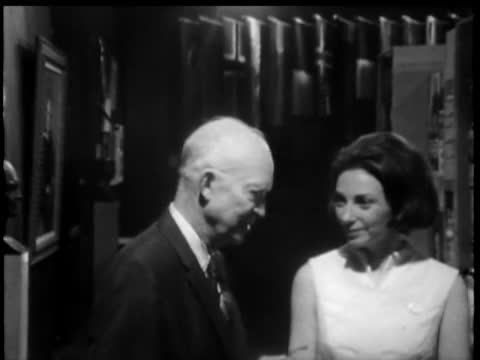
- Filmed at New Yorks Gallery of Modern Art where an exhibition of the former presidents paintings and memorabilia is currently on display, this relaxed interview with reporter Patricia Marx touches on a variety of subjects ranging from the Generals remembrances of his early life and school days through the turbulent years of World War II, from his presidency to his reflections on world leaders he has known and his thoughts about his paintings. As the General and Miss Marx stroll leisurely through the Gallery, he relates the paintings and mementoes on exhibit to his life: On his decision to enter West Point: I was studying like anything for Annapolis when I found out I was too old, thats the reason I got in West Point. On arguing with Churchill over the Normandy invasion plans: He thought all of our troops should go in another direction. Well those were political reasons, I thought, and I said look, Im not a politician. You go back to my President and argue that. He said No, were talking military things, and I said, well, if its military I have to be the boss. So we had a seven-hour argument that afternoon and it was all very friendly, but it was very tough. On General de Gaulle: As a matter of fact I always kept him as a good friend but hes always been a very sensitive man and a very self-confident person, its not easy. On Nikita Khrushchev: He was two different men. He played the same old cracked record of all communists but in spite of that stubborn ideology he was expounding, when he came to see your grandchildren or visit with you in your home, why he was a very pleasant man and he just captivated my grandchildren thats all there was to it. On his first offer of the Presidency: In 1945 when the President (Truman) came to Berlin he said General, I just want you to know that I for one am ready to get you anything you want and that very definitely includes the presidency in 1948. I said, Mr. President, I cant think of anyone whos less interested and Ill never be, dont worry about that. But from then on, it began gradually to build up, this pressure, particularly after the President brought me back to be Chief of Staff and from then on I was never free of it, until finally I said, Here we go, lets go Monday. On the most significant accomplishments of his presidency: I think one material accomplishments was the interstate highway system of 41,000 miles and the other was the St. Lawrence Seaway. I think, in the political arena, there was the success we had in maintaining peace in spite of the many threats in Iran, Guatemala, Formosa, Lebanon, Suez and in Korea where the fighting was still going on when I went in. But from that time, in late June of 1953, when we stopped that, we never lost another soldier. That was something. On the possibility of World War III: As a matter of fact I still believe that the two main powers, with all of this atomic capacity, theyre still not anxious to use them on each other, no question about it. Im sure today, the Russian government, no matter how intransigent they are, how much they use lies and deceit and all the rest of it, they dont want major war any more than we do. On why he paints: Im fascinated with colors and I want to use colors as something I think will represent something to someone else. I am absolutely hopeless if you talk abstraction or heavy impressionism, I wouldnt know a thing about it because I want to paint something that you can see whether I use the color I should have or not As a matter of fact all of mine (paintings) would have been burned up, except people coming and seeing me painting said Oh, give me that Ike, or oh, please can I have this and so on, otherwise none of these would exist, I tell you. Conversations 1967-68 General Dwight D. Eisenhower is a 1967 production of National Educational Television. (Description adapted from documents in the NET Microfiche)
- Series Description
- Conversations 1967 brings together interviews conducted by KQEDs general manager, James Day, and Bostons Elliot Norton in one series of 6 half-hour episodes. The two hosts talk to a variety of performers about their craft, their careers, and their lives.
- Broadcast Date
- 1967-08-06
- Asset type
- Episode
- Genres
- Talk Show
- Media type
- Moving Image
- Duration
- 00:45:04
- Credits
-
-
Guest: Eisenhower, Dwight D.
Host: Marx, Patricia
Producer: Slate, Lane
Producing Organization: National Educational Television and Radio Center
- AAPB Contributor Holdings
-
Library of Congress
Identifier: 2010613-6 (MAVIS Item ID)
Format: 1 inch videotape: SMPTE Type C
Generation: Master
Color: B&W
Duration: 0:29:10
-
Library of Congress
Identifier: 2010613-6 (MAVIS Item ID)
Format: 1 inch videotape: SMPTE Type C
Generation: Master
Color: B&W
Duration: 0:29:10
-
Library of Congress
Identifier: 2010613-6 (MAVIS Item ID)
Format: 1 inch videotape: SMPTE Type C
Generation: Master
Color: B&W
Duration: 0:29:10
-
Library of Congress
Identifier: 2010613-1 (MAVIS Item ID)
Format: 2 inch videotape: Quad
Generation: Master
Color: B&W
Duration: 0:29:10
-
Library of Congress
Identifier: 2010613-1 (MAVIS Item ID)
Format: 2 inch videotape: Quad
Generation: Master
Color: B&W
Duration: 0:29:10
-
Library of Congress
Identifier: 2010613-1 (MAVIS Item ID)
Format: 2 inch videotape: Quad
Generation: Master
Color: B&W
Duration: 0:29:10
-
Library of Congress
Identifier: 2010613-7 (MAVIS Item ID)
Format: U-matic
Generation: Copy: Access
Color: B&W
Duration: 0:29:10
-
Library of Congress
Identifier: 2010613-7 (MAVIS Item ID)
Format: U-matic
Generation: Copy: Access
Color: B&W
Duration: 0:29:10
-
Library of Congress
Identifier: 2010613-7 (MAVIS Item ID)
Format: U-matic
Generation: Copy: Access
Color: B&W
Duration: 0:29:10
-
Library of Congress
Identifier: 2010613-4 (MAVIS Item ID)
Format: Betacam: SP
Generation: Master
Color: B&W
Duration: 0:29:10
-
Library of Congress
Identifier: 2010613-4 (MAVIS Item ID)
Format: Betacam: SP
Generation: Master
Color: B&W
Duration: 0:29:10
-
Library of Congress
Identifier: 2010613-4 (MAVIS Item ID)
Format: Betacam: SP
Generation: Master
Color: B&W
Duration: 0:29:10
-
Library of Congress
Identifier: 2010613-5 (MAVIS Item ID)
Format: Digital Betacam
Generation: Copy: Access
Color: B&W
Duration: 0:29:10
-
Library of Congress
Identifier: 2010613-5 (MAVIS Item ID)
Format: Digital Betacam
Generation: Copy: Access
Color: B&W
Duration: 0:29:10
-
Library of Congress
Identifier: 2010613-5 (MAVIS Item ID)
Format: Digital Betacam
Generation: Copy: Access
Color: B&W
Duration: 0:29:10
-
Library of Congress
Identifier: 2010613-3 (MAVIS Item ID)
Generation: Copy: Access
Color: Color
-
Library of Congress
Identifier: 2010613-3 (MAVIS Item ID)
Generation: Copy: Access
Color: Color
-
Library of Congress
Identifier: 2010613-2 (MAVIS Item ID)
Generation: Master
Color: Color
-
Library of Congress
Identifier: 2010613-2 (MAVIS Item ID)
Generation: Master
Color: Color
-
Library of Congress
Identifier: 2010613-3 (MAVIS Item ID)
Generation: Copy: Access
-
Library of Congress
Identifier: 2010613-2 (MAVIS Item ID)
Generation: Master
If you have a copy of this asset and would like us to add it to our catalog, please contact us.
- Citations
- Chicago: “Conversations 1967; 6; General Dwight D. Eisenhower,” 1967-08-06, Library of Congress, American Archive of Public Broadcasting (GBH and the Library of Congress), Boston, MA and Washington, DC, accessed April 2, 2026, http://americanarchive.org/catalog/cpb-aacip-512-pg1hh6d662.
- MLA: “Conversations 1967; 6; General Dwight D. Eisenhower.” 1967-08-06. Library of Congress, American Archive of Public Broadcasting (GBH and the Library of Congress), Boston, MA and Washington, DC. Web. April 2, 2026. <http://americanarchive.org/catalog/cpb-aacip-512-pg1hh6d662>.
- APA: Conversations 1967; 6; General Dwight D. Eisenhower. Boston, MA: Library of Congress, American Archive of Public Broadcasting (GBH and the Library of Congress), Boston, MA and Washington, DC. Retrieved from http://americanarchive.org/catalog/cpb-aacip-512-pg1hh6d662