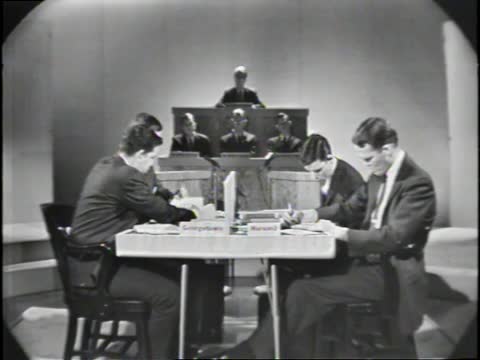
Championship Debate; 3; Quarter-final Round 3: Georgetown University vs. Harvard University
- Transcript
I'm sorry Sorry, sorry
sorry This is Championship Debate 1964, Quarter Final round. The teams you will see in this National Educational Television Series are eight of the best college debate teams in the country. They have won the right to appear on Championship debate 1964 by defeating other top college teams. In the next weeks, you will see the competition that will determine the National Television Champion. The moderator for Championship Debate 1964 is Dr. James H. McBath of the University of Southern California, Chairman of the
Television Debate Committee of the American Forensic Association. Good evening. The ground rules for Championship Debate give each team equal opportunity to convince us. The affirmative has four and a half minutes in which to make its case and the negative three minutes to cross -examine. Then the negative has four and a half minutes in which to present its case and the affirmative cross -examines. Following this, each team has three and a half minutes for summary and rebuttal. This clock will indicate to the debaters how much time they have remaining in this unrehearsed debate. Immediately following the closing affirmative argument, we learn the judge's decision. Our three professional critics today are Dr. Robert Carr, Director of Forensics, Wisconsin State College, and Oshkosh, Dr. Will Lynn Kugel, Director of Forensics, University of Kansas, and Dr. Ronald F. Reed, Director of Forensics, Purdue University. The subject for tonight's National Quarter Final Debate is resolved that loyalty oaths for teachers should be
abolished. Defending the proposition is Georgetown University, the team that defeated Boston College and the Eastern Competition. Our debaters from Georgetown, John Hempelman, Bob Schrum. Upholding the negative is the team which defeated Penn State and the other half of the Eastern Regional Draw, Harvard University. The debaters from Harvard, Jim McGrew, and Arden Dawes. Ladies and gentlemen, Championship debate 1964 Quarter Final Round, resolved that loyalty oaths for teachers should be abolished. And now opening for the affirmative is John Hempelman, Georgetown University. John, thank you. Ladies and gentlemen, before telling you why loyalty oaths for teachers should be abolished, we'd like to clarify one key term. Now the phrase loyalty oath does not refer to a pledge of allegiance, or to an affirmative oath like the president takes on an auguration day. This question is concerned with the removal of disclaimer affidavits, loyalty oaths in the
popular sense, which require our teachers to swear that they are not now and have not been a member or supporter of any subversive organization which advocates the violent overthrow of the government. Now the first reason why Bob and I feel loyalty oaths should be abolished is that they are ineffective in combating subversion in our schools. They simply cannot prevent disloyal teachers from teaching. Let me explain. It only stands to reason that a person whose aim is the violent overthrow of the government will use any means at his disposal to achieve his end. Now if becoming a teacher requires him to purge or himself, he'll will. He'll lie on those loyalty oaths. John Kennedy made this clear in 1960. A loyalty affidavit will not keep communists and subversives out of our colleges. Card -carrying members of the communist party will have no hesitancy about purgaring themselves. Now you may ask the question, if they purge themselves, can't we prosecute them? This is the second reason why loyalty oaths are ineffective. They have proven useless
in prosecuting disloyal teachers. The reasoning of the United States Supreme Court in Scales versus US indicates that in order to prosecute for purgaring a loyal oath, it must be clearly proven that at the time the oath was taken, the teacher was an active member of a subversive organization and was fully aware of the intent of that organization to overthrow their government. Now these two intentions, first of all, there must be active membership and secondly, there must be full knowledge of subversive intent, almost impossible to prove in a court of law. Indeed, so impossible that no successful prosecution of a teacher for purgaring a loyalty oath has ever been completed. Loyalty oaths then are ineffective because they can neither block subversives from entering teaching or can they today prosecute disloyal teachers once they are there. Now keep this uselessness in mind as we proceed to our second point. That loyalty oaths today harm innocent teachers and disrupt the educational process. How do they harm innocent teachers? We'll understand that many innocent teachers simply refuse to sign loyalty oaths on personal or religious reasons.
For example, Dr. Richard Wagle, president of St. John's College, observed in 1952 that those penalized most by the Maryland requirement were teachers of the Quaker faith, who objected on religious grounds and yet everyone knew were excellent security risks. In California, 26 college professors refused to sign because it violated their principles. Even the Board of Regents of that University who fired the professors admitted not one was accused of being a subversive. They were all judged loyal and competent. Well, what's the harm to those Quaker teachers, to those California professors and to many others who refused to sign? Well, first of all, we've already indicated they lose their jobs and future job potentials are impaired, but even more important, their reputations are destroyed and they lose their standing in the community. How does this happen? Well, it results from the fuzzy type of thinking which proclaims that any man who refuses to sign a loyalty oath must have something to hide. Mr. Bentley Glass, former president of the American Association of University Professors sums this
up. A disclaimer affidavit by its nature cannot fail to be invidious. If a principled individual refuses to sign, he raises a suspicion that he is unworthy of public trust or benefit. But loyalty oaths do more than harm the individual. They also disrupt the educational process. Remember that case in California? Well, the first harm with loyalty oaths is they force many of our best teachers out of the classroom. The New York Times from March 25, 1951 points out because of the oath requirement, the University of California has lost over 100 scholars and had to drop 55 courses from the curriculum. The Times assessed the whole situation with this statement. A great university has in the space of six months been reduced to a point where it is condemned by leading scholars as a place unfit for scholars to inhabit. But even more, loyalty oaths reduce education to conformity and indoctrination. Mr. Justice Black points out, loyalty oaths tend to stifle all forms of unorthodox, popular thinking or expression. The result is stultifying conformity, he
points out, which can be more harmful to our country than foreign agents could ever hope to be. All right, at this point two things are clear. Loyalty oaths are ineffective, and secondly, they harm innocent teachers. Thank you. I'm going to the roster now, Harvard's Arden Dost for Cross Examination. John Waller on the subject. Will you take a note to tell the truth, the whole truth, and nothing but the truth? I certainly would. Did that hurt? No. I'm glad. John, if I ask you to pledge loyalty to the American Constitution and Bill of Rights and not to advocate the violent overthrow of the constitutional government, would that be a loyalty oath? No, it wouldn't be. That's not loyalty oath in the popular sense of the word. In a popular sense. In other words, if you pledge or are required to take an oath of loyalty to the American government, you're contending that that is not a loyalty oath. That's an oath of allegiance, Arden, as it's popularly fine. Loyalty oath is a disclaimer, affidavit. John, do you have any examples of a loyalty oath that has ever been required of a teacher? Yes, we do. We have some
wording. Yes, and did that particular oath require a pledge of loyalty to the American government? We have oaths, which require only that the teacher proclaim that he will never advocate the violent overthrow of the Constitution. Right, that is a loyalty oath there. Yes, it is. It's a denial of any subversive intent. Right, and there was a loyalty oath that the play you pledge not to advocate the violent overthrow of the government. That's what you're again. That's correct. John, you think it's important that young people are exposed to a diversity of views while they're in school? I think that's true, yes. Is this because if an individual student is exposed to say one kind of view, like democracy instead of communism, he might accept that view without giving it proper thought? I think that might be one reason, yes, Arden. Would you really think young people are that impressionable, it's that they have to be have all views before them? I think young people are probably as open to impression as all of us. I take it from your speech that you don't believe that loyalty oaths have been established on the well
grounds that are rational and justified. I never said that. I just said that they weren't effective. Well, they weren't effective, but they were established for justifiable reasons. I didn't say that either. Well, would you mind telling me, are they justified for justifiable reasons? Or the motivations, in other words, proper, they're concerned? Personally, I don't think so, Arden. If you recall, most of them cropped up during the McCarthy era when there was a communist scare going around. In other words, you think that it's because of people's fright, perhaps an irrational prejudice or suspicion against communists. That very well could have been the reason for many of these oaths, yes. And perhaps most of them? Well, I don't know what was the intent of the legislatures when they passed them, Arden. I was wondering, do you know of any cases where the courts have held invalid the dismissal of a school teacher under loyalty oath? Yes. So, in the case of Wyman vs. Updegraff, the question of loyalty oaths in Oklahoma were brought up and they were struck down as unconstitutional. In other words, I think this is an Oklahoma teacher's case, right? The subject. And the teacher was deprived of her rights by being unfairly dismissed from a loyalty oath. This was not the situation. She had no right to teach. But the law in Oklahoma was declared first
to be a bill of attainer and second to be an expel's factor. Yes. Now, if the state should impose or unfairly dismiss a teacher under loyalty oath, can he appeal to the courts? Yes, he can. And would the courts give him a fair trial? I'm sure they would. And would you trust the courts? Yes, I would, because... And now, Arden's colleague from Harvard, Jim McGrew launches the negative. Jim? Ladies and gentlemen, in 1952, the Supreme Court declared, a teacher works in a sensitive area, shaping the attitude of young minds toward their society. In this, the state has a vital concern. The right and the duty to screen teachers as to their fitness to maintain the integrity of our schools cannot be doubted. Because Arden and I agree with the Supreme Court, we believe that loyalty oaths for teachers should be maintained. Let's get it right clear, clear right at the outset, what we mean by a loyalty oath here. A pledge to be loyal to the principles of the Constitution and not to advocate its violent
overthrow. The same kind of a pledge that was used at the University of California that a hundred percent of its teachers used to subscribe to before the addition of what Georgetown has specifically named as a disclaimer, Affidavit. Now, obviously anyone who does advocate the violent overthrow of the government advocates a criminal act. We believe that just as we shouldn't permit those who openly advocate burglary or armed robbery to teach, so we shouldn't allow those to advocate the violent overthrow of the government to teach. Now, John said that he was going to select disclaimer affidavits to indict. We'd like to point out number one, he has not indicted the entire principle of the loyalty oaths. So we're going to defend the principle of those loyalty oaths and point out to you the large areas in which loyalty oaths are used and applied that John overlooked when he specifically selected those areas. We're going to contend first that private schools and colleges should be free to use loyalty oaths for their teachers. Today, five million students attend private educational institutions as a matter of choice. These
institutions have every right to decide whom they want to hire to be on their payroll. The Quaker College that John mentioned just might decide that it wants to have the teachers pledge a loyalty oaths, a Lutheran College, for example, which doesn't believe in rebellion against the state might want to assure the people who endow that college that the people they hire as teachers would be loyal to the Constitution and pledge not to rebel against the state. As the Yale Law Journal pointed out, those who have established private institutions and who support them financially have often been motivated by their belief in free government. Their continued support, and therefore the survival of institutions they endow, hinges on the assurance that their money will not be used to pay the salaries of those who cannot honestly pledge to refrain from advocating the violent overthrow of constitutional government. So loyalty oaths then are necessary to our private educational institutions. Secondly, we contend that loyalty oaths should be free to use loyalty oaths for its teachers. According to the Office of
Education, there are 30 million schoolchildren and our public schools under the age of 13. As John admitted in cross -examination, these children are highly impressionable and they are influenced greatly by their classroom teachers. Without loyalty oaths, it's quite possible that these students could end up with a biology teacher who indoctrinated them with a point of view that the Aryan race was superior and was selected by their very nature to rule, and that to rule they must overthrow the government by force. Because we must depend on these children for leadership in future years, the public has a vital interest in protecting them from this kind of distorted and biased education. Third, public colleges and universities should be free to use loyalty oaths for their teachers. Any college student can learn about the violent overthrow of the government from teachers who do not themselves advocate such violent overthrow. Now, if the college wishes to acquaint its student body with the actual advocates of the violent overthrow of the government, they can always
invite guest lecturers to come to their campus. The point, Arden, and I want to make clear is that there is no academic gain in hiring the subversive. If they are actually higher -disk teachers, our government would be in the absurd position of supporting financially those who advocate its own overthrow. Turning again to that Yale Law Journal, we find many of our legislators would yield readily to the pressure to divert money from education to other uses. If educational appropriations were channeled to those who refused to pledge their loyalty to government under law, loyalty oaths then are necessary to our public colleges and universities. Thank you very much Jim Agroup and Harvard University for opening the negative. It's Georgetown's time now for interrogation, and here is the first appearance of Bob Shrom. Bob? Jim, do you know specifically of any communists who has ever been prevented from entering teaching by a loyalty oath? I couldn't name him to you now. You don't know of any communists who has
ever been prevented from entering? I'm sure that there are from my reading, I can't give you their names now. No, you can't. Do you know specifically of any communist teachers ever been prosecuted successfully for perjuring a loyalty oath? I have also read that the prosecutions have been successful, but I can't give you any four teachers. Prosecutions have been successful for teachers under loyalty oaths. This is what I have read and this is what I have given you from our reading. I can't give you, I can't, I don't remember the actual source of that. Well so up here right now you can't remember any teachers who have ever been prosecuted successfully for violating a loyalty oath or any teachers who have ever kept out. Now both of these things are true, don't you think that maybe loyalty oaths are ineffective in combating communist teachers in the schools? Not necessarily, there may be a lot of communists or people who advocate the violent overthrow of the government who refuse to consider teaching because of the loyalty oath statute. We can't be sure about these people, there's no way of finding them out. Oh, in other words you think communists will not go into teaching because of the fact that the loyalty oath keeps them out. There could be a lot of
people besides, oh you don't think communists will not decide not to teach because of the loyalty oath. You don't think a communist will necessarily lie on a loyalty oath. It's quite possible that he wouldn't, besides we're considering other people who advocate the violent overthrow of the government. Oh I see, so the people you're talking about are principled people. They wouldn't lie on these loyalty oaths and that's what keeps them out. Of course not all of them, but you don't have to be afraid of the principle. You can be afraid of the actual prosecution itself. Oh, but has there been a successful prosecution? This is my impression. I can't give you the specific evidence. Don't you think that there are people who for reasons of conscience, these are non -communist people who refuse to take a loyalty oath, sure, quakers, they might and they might not. So everyone who refuses to take a loyalty oath isn't a subversive. That could be, but how, how sure of their competence can we be if these people won't judge their allegiance to the Constitution? So in other words, people you will admit have conscientious reasons for not taking loyalty oath. I think a quaker quaker has a conscientious reason to give a loyalty oath. Will these people lose
their jobs if they don't take that loyalty oath? Some of them may never get jobs if they do. Right, they won't get jobs or they'll lose the jobs. Some of them may never get jobs if they don't take loyalty oaths. Loyalty oaths then can harm these innocent people, these people who really have no crime against the government, who haven't been engaged in subversion, but who have reasons of conscience for not taking them. And the abolition of loyalty oaths can harm our colleges. The abolition of loyalty oaths will harm our colleges. Why? Communists will get in. Because those who endow the colleges have an interest in free government. If we don't give them the assurance that we're going to promote free government, the endowment declines. Do those who endow our colleges demand that loyalty oaths be present? They demand some assurance. That's right. And these loyalty oaths, as far as you know, you can't name a single teacher that's been kept out that can give these people the assurance. As I say, I don't know the specific names of the teachers, none of them. You don't know any teachers. Do you know that in general, many people have been prosecuted under loyalty oaths? The elimination time is finished. Returning to the rostrum is Harvard University's Arden Doss for the final negative summation. Arden? Thank you. We've
been looking for the name of a single teacher. Well, we found one. Try Mr. Adler in the case of Adler versus the Board of Education. I'd like to take this affirmative analysis. You know what they told you? They told you that a loyalty oath is not effective in preventing people coming from taking the oath because they're going to lie. Well, now we have nothing against lying, you see. Our point is if the teacher lies and then goes into a biology class and says, you know, two plus two equals four, and by the way, I advocate the overthrow of the government, they can be dismissed. Now, of course, they came back and said, well, you know, we have never seen a person effectively prosecuted for perjury. We don't care about prosecuting them for perjury. We just want grounds for dismissal. And they have never indicated, number one, that if a person goes into the classroom and has signed that loyalty oath and advocates the overthrow of the government, he cannot be dismissed. The only question is, well, can you tell whether or not they're advocating overthrow the government while in a biology, math, or history class, if there are reasonable grounds, the principal
can fire the teacher. If the teacher thinks they're fired unjustly, they can go to the courts and get a fair trial right there. So I don't think there's much of a problem. loyalty oaths can work. But what about the harm to innocent teachers? They said many people, by conscience, cannot sign a loyalty oath. Then we suggest that go to colleges that don't require loyalty oaths. Then we were told that many people could lose their jobs under a loyalty oath. But losing a job under a loyalty oath can only occur if you are disloyal and advocate the overthrow of the government. They told us, well, reputations are destroyed because of fuzzy thinking and prejudice. Ladies and gentlemen, any teacher who ever enters a classroom is going to put his reputation on the line when he advocates a particular issue. Fuzzy thinking people or people of prejudice and hate have known to condemn teachers whether without loyalty oaths. That isn't the issue here. And I don't think the gentleman have ever been able to show us a sufficient number of people that have been harmed for that cause alone. If a man takes a particular stand, those people with fuzzy thinking you're going to get him anyway, whether he does or does not take a loyalty
oath. But then we were told that we disrupt the educational process because many people will not sign a loyalty oath. Well, now, if those 100 professors in California, by the way, they didn't tell us that they didn't get professors to replace them and that those professors didn't find jobs other than other places, actually were unwilling to promise that they would not advocate the overthrow of our government in their classroom situation. I think that it would have been pretty disruptive to have them in those classrooms advocating the overthrow of the government. Let's keep in mind this basic issue. A loyalty oath is a pledge of loyalty, not a pledge of disloyalty to the Communist Party, not a disclaimer affidate, but a pledge of loyalty to the American Constitution and that you promise not to advocate the violent overthrow of our constitutional form of government. We think, I think that we have seen that the freedom of a private university or the state to require or use a loyalty oath against such teachers who advocate the overthrow of our government in the classroom is
justifiable. The question of prevention really isn't relevant. The question of perjury is not the point. We dismiss those teachers anyway. We still see, I think, a reason why the principle of loyalty oaths can be justified in the 20th century. Making his second appearance is Bob Schrum of Georgetown for the final affirmative summary. Bob, ladies and gentlemen, I think there's one thing we ought to get straight right away and that is exactly what is a loyalty oath. We're going to contend that a loyalty oath in the popular contemporary and accepted sense today is a disclaimer affidavit. First of all, let's look to the report of the subcommittee on constitutional rights of the California Assembly when it was discussing the loyalty oath in California. They said when the oath requires an affiant, someone who swears to it, to promise not to hold certain beliefs or associations, it becomes a loyalty oath rather than a simple oath of allegiance. So there's a real distinction here. Oze of Allegiance are not loyalty
oaths. Let's look to Senator John F. Kennedy in 1959. He wrote elaborate loyalty oaths in affidavits, which go far beyond the simple pledge of allegiance or the oath to uphold and defend the Constitution, have inevitably been the answer to crises in America. In short, then there's a real distinction between a loyalty oath and the oath of allegiance the President swears. We want to get rid of the disclaimer affidavit, which requires someone to swear that he is not now or has not been a member of the Communist Party. Now let's look and see exactly what Arden and Jim have said, and I think we're going to find out that we do indeed have a need in today's debate. What was the first thing we were told? Let's look at what Arden said. He said, well, loyalty oaths aren't really ineffective because the teacher can be dismissed anyway for advocating the violent overthrow of the government. Now, we'd suggest that if the teacher can be dismissed anyway for advocating the violent overthrow of the government, the loyalty oath is wholly unnecessary. The minute he walks into that class and advocates violent overthrow,
we'd suggest that he be fired, we'd suggest that no loyalty oath would be necessary. You'll also notice that Arden told us, wait a minute, these people can't lose their jobs unless they're disloyal, unless they go into classrooms and advocate violent overthrow. You'll notice that Jim admitted in cross questioning that there were people who had conscientious reasons or religious reasons for not taking these oaths. In other words, not everyone who refuses to take them is disloyal, so people lose their jobs because they won't take the oaths and they're not disloyal people. We think this is an unjust situation. Finally, what about the whole idea of advocating overthrow in California? They said, well, obviously, these teachers should have been fired. They advocated the overthrow of the government. Remember what John pointed out to you in his speech? That the California Board of Regents admitted that there was no doubt that every one of these men was loyal. They just refused for reasons of conscience to sign a loyal deal. So we think number one that they've never shown us that loyal deals aren't effective. We
think number two, they've never shown us that loyal deals don't harm the innocent. Now, what did Jim say? He said, well, the teacher works in a sensitive area and should be screened. Fine, if loyal deals aren't effective, how can we screen the teacher through these means? We don't think that's an objection. Next, they told us private schools should have the right to decide and use loyal deals. We don't think they should for two reasons. Number one, they're not effective. Number two, they harm the innocent teacher. We think they should be abolished there. We don't think those basic intentions have ever been attacked. Next, they told us that the state must protect its children. We've pointed out and it's never really been denied that the loyalty oath cannot protect children because it can't keep communists out of the schools. Finally, what about public colleges retaining these oaths? There's one assumption here. And that's the assumption that these oaths work. So in closing, I'd like to point out two things. Number one, it's never really been denied that these oaths are ineffective. They don't keep communists out. Number two, they harm innocent people and our educational system. Thank you. Thank you very much, Father. Now will the three critics please
record their decisions. These decisions are based upon the judges' estimates of the comparative quality of debating done today. First, Professor Carr. My judgment in this debate is based on the following factors the reasonableness of the position outlined by both teams, the development of that position, the defense of that position, and the skill and cross -examination both in questions and answers. It seemed to me in terms of reasonableness and development that two issues emerged. One, should communists be allowed to teach, which we would say no. Two, is a loyalty oath effective, which I would say also know. And on the basis of those two issues, I would vote for the affirmative. Additionally, I would like to comment on the cross -examination technique. I thought that Georgetown hid at the essential points in their cross -examination. Thank you very much. And now Dr. Lin Google. I thought in this debate that there were at least two issues, perhaps three that
emerged very readily. Number one, being the effectiveness of the oath. And I thought that on this particular point, the negative never was able to properly refute the affirmative's contention and establish that there is, that these oaths are definitely effective. Secondly, do they possibly do harm? And I thought again that the affirmative had the stronger position here. So my decision is for the affirmative Georgetown University. Thank you very much, Dr. Lin Google. Finally, Dr. Reed. I agree with my colleagues. It seems to me that they did show that the loyalty oaths are not effective even if there was some harm. Thank you very much, gentlemen. So the verdict is three to nothing for Georgetown University. With this victory, Georgetown earns the right to meet the winner of the University of Pacific and University of Redlands' semifinal debate. Our congratulations to both teams and two their coaches, Bill Reynolds of Georgetown and Larry Tribe of Harvard University. May I also thank our distinguished panel of critics tonight for their
expert judgment. The British historian McCauley once said, men are never so likely to settle a question rightly as when they discuss it freely. Each week, championship debate 1964 offers living evidence for that statement. Well, you've heard both sides of the argument, the verdict of the professionals, and now as always, the final decision is up to you in the audience. Championship debate 1964 has been a presentation of national educational television. In cooperation with the American Student Foundation and the American Forensic Association. This is NET, National Educational Television.
- Series
- Championship Debate
- Episode Number
- 3
- Producing Organization
- WTTW (Television station : Chicago, Ill.)
- Contributing Organization
- Library of Congress (Washington, District of Columbia)
- AAPB ID
- cpb-aacip-512-pc2t43k184
- NOLA Code
- CHMD
If you have more information about this item than what is given here, or if you have concerns about this record, we want to know! Contact us, indicating the AAPB ID (cpb-aacip-512-pc2t43k184).
- Description
- Episode Description
- Georgetown University debates the affirmative side and Harvard University debates the negative side. The subject of the debate is should the loyalty oaths for teachers be abolished? The judges are Dr. Wilmer Linkugel, University of Kansas; Professor Robert Carr, Wisconsin State University; and Dr. Ronald F. Reid, Purdue University. The Georgetown University team is John Hempelmann, a senior from Seattle, WA, and Robert Shrum, a junior from Los Angeles, CA, with coach William Reynolds, Director of Debate, Georgetown. The Harvard University team is Arden Doss, a senior Political Economics Major from Miami, FL, and James H. McGrew, a junior English Major from Denver, CO, with coach Larry Tribe, Director of Debate, Harvard. Georgetown University wins by a score of 3-0.
- Series Description
- The eight best collegiate debate teams in the United States, as determined by the American Forensic Association (AFA), complete with each other for top forensic laurels in a seven round elimination contest. In the four quarter-final rounds (the first four episodes), the eight collegiate teams are paired off and view with one another to decide the four semi-finalists (episodes five and six). The final round (episode seven) puts the two semi-final winners against each other to determine the champion team in the debates. For the purpose of selecting these teams, the AFA, which is the authorized collegiate debate organization, in conjunction with the American Student Foundation, has broken the country down into four regions East, South, Mid-west and west. Committees in each region chose sixteen teams from more than 500 colleges and universities throughout the United States. In non-televised preliminary rounds, eight of the sixteen teams were eliminated. They are: Stanford, University, California; University of Southern California; Northwestern University, Illinois; Augustana College, South Dakota; University of Alabama; Baylor University, Texas; Penn State University; and Boston College. The format for Championship Debate 1964 differs from formalized debating procedure primarily in the length of time allowed for statements and by the inclusion of a cross examination. The procedure is: 1. Affirmative Opening Statement: 4 minutes 2. Negative Cross Examination: 3 minutes 3. Negative Opening Statement: 4 minutes 4. Affirmative Cross Examination: 3 minutes 5. Negative Summation: 3 minutes 6. Affirmative Summation: 3 minutes. Each team is given a two-week period prior to its debate to prepare arguments. Affirmative and negative positions are decided by team preference, but where a conflict arises, a coin toss is used. Decisions in each debate are made by a panel of three judges (the judges differ for each round) who make their decisions immediately following summations. Criteria for judges decision are clarity and logic of arguments, response to cross examination, quality and quantity of facts, and manner of presentation. Last years debates, the first televised, were won by North Texas State College. Dr. James H. McBath, host and moderator for Championship Debate 1964, is a professor of speech at the University of Southern California and a past president of the American Forensic Association (AFA). He is currently chairman of the Speech Association of America (SAA) Committee on International Debate which selects the American collegiate debating team which tours British universities each year. Dr. McBath has served several years as delegate to the SAA legislative assembly and has been chairman of the AFAs professional relations committee. He is also Speech Activities coordinator of the Western Speech Association. Dr. McBath is the author of the Campus Library Service recording on argumentation and debate, co-author of Guidebook for Speech Practice (Harcourt Brace & World, Inc.), and editor of a 1963 textbook, Argumentation and Debate (Holt, Rinehart and Winstin). Championship Debate 1964 is a production of WTTW, Chicago. The 7 half-hour episodes that comprise this series were originally recorded on videotape. (Description adapted from documents in the NET Microfiche)
- Broadcast Date
- 1964-05-10
- Asset type
- Episode
- Topics
- Social Issues
- Education
- Media type
- Moving Image
- Duration
- 00:31:16.709
- Credits
-
-
Director: Kaiser, Robert
Executive Producer: Pickard, Larry
Host: McBath, James H.
Producer: Marschot, William
Producing Organization: WTTW (Television station : Chicago, Ill.)
Speaker: Doss, Arden
Speaker: Hempelmann, John
Speaker: McGrew, James H.
Speaker: Shrum, Robert
- AAPB Contributor Holdings
-
Library of Congress
Identifier: cpb-aacip-0224e4681d0 (Filename)
Format: 2 inch videotape
Generation: Master
If you have a copy of this asset and would like us to add it to our catalog, please contact us.
- Citations
- Chicago: “Championship Debate; 3; Quarter-final Round 3: Georgetown University vs. Harvard University,” 1964-05-10, Library of Congress, American Archive of Public Broadcasting (GBH and the Library of Congress), Boston, MA and Washington, DC, accessed April 4, 2026, http://americanarchive.org/catalog/cpb-aacip-512-pc2t43k184.
- MLA: “Championship Debate; 3; Quarter-final Round 3: Georgetown University vs. Harvard University.” 1964-05-10. Library of Congress, American Archive of Public Broadcasting (GBH and the Library of Congress), Boston, MA and Washington, DC. Web. April 4, 2026. <http://americanarchive.org/catalog/cpb-aacip-512-pc2t43k184>.
- APA: Championship Debate; 3; Quarter-final Round 3: Georgetown University vs. Harvard University. Boston, MA: Library of Congress, American Archive of Public Broadcasting (GBH and the Library of Congress), Boston, MA and Washington, DC. Retrieved from http://americanarchive.org/catalog/cpb-aacip-512-pc2t43k184