Playwright at Work; 4; Michael Vincente Gazzo
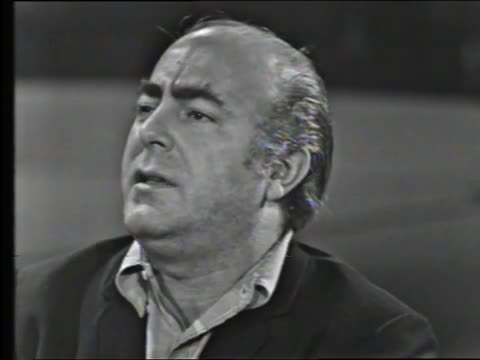
- Transcript
l'ma close? Well, the essence is, you know, you know, you know, you know, you know, you know, you have somebody
plays nowadays where somebody comes out and it's a back yard and somebody comes out and says, gee, it's a lovely day. The roses are blooming and the, oh, the sun is shining and for about seven pages, all you hear is flowers, sun is shining. And what is the audience supposed to do? The essence is, you come right out and the woman says, the old man died. In playwright work, we're exploring the creative thoughts, aspirations and methods of a group of newer writers for the theater. Our guest today is Michael Vincente Gotso. Mr. Gotso scored a Broadway success with his first
play, Hat full of rain. From the stark naturalism of this drama, he turned to a more poetic vein in his second Broadway play, Night Circus. Later in the program, we'll see a scene from Mr. Gotso's work in progress, The Night Harold's Burn Down. Scene will be directed for us by Arthur Storch, who is a member of the directors unit at the actor studio. Actors in the scene will be Mr. Rudolph Weiss, Mr. Henry Madden and Ms. Denny's Colette. Mike, it's a pleasure to have you here today. Good being here. You worked for a long time, I think, in the theater as an actor and as a director before you wrote plays, is that correct? Yeah, I did about 10 years of acting and directing. What made you turn to writing plays? I was always cast as a hood. I was giving a nice pick, an axe, a gun, and it just started to burn me up. So you decided to write plays? I just quit acting. You never write a role for yourself, will you? No. Did the experience you had
as an actor help you when you turned to writing plays? Yes, of course, directing scene designing too. I did a little scene design. I don't like to think of myself as a writer, frankly, rather than think of myself as a theater man, you know, all around. Yeah, all around, and now but I'm concentrated on writing, you know. There's a tremendous difference in the style you used in Hat full of rain, which is very, very naturalistic and night circus, your second play, which was more poetic. How do you explain this difference? I think that it comes down to coming closer to myself, you know, what I really feel and what I really think. I think when we're out in the street or we're having a drink with someone, we want to be one of the boys or we want to be, and now I'm kind of coming to myself, you know, and I just keep whittling things down to an essence. And what is the essence? Well, the essence is, you know, you have somebody plays nowadays where somebody comes out and it's
a back yard and somebody comes out and says, gee, it's a lovely day, the roses are blooming and all the sun is shining. And for about seven pages, all you hear is flowers, sun is shining. And what is the audience supposed to do? The essence is you come right out and the woman says, the old man died. And you skip the flowers. Skip the flowers in a talk. In other words, you want to get to the heart of the matter. The condensation of, you know, whatever I'm driving on. And are you able to reach it more easily through poetic language, Mike? I am, no. What themes concern you as a writer? Or have you been concerned with one theme throughout your work? Well, I'm working on a number of plays. But one thing that really burned me up a few weeks ago, I watched the television program and there was a very way out poet. And he was on with a couple of beatniks. And the one poet read a poem, which was a lovely poem, but I had difficulty following what he meant. And then the poet
said, it's a crime. They'll never let us, they'll never let us on a national hookup, you know. And I thought of, I had an image there, which is now in the play of a beatnik saying, I have had an image this morning of an old man in Missouri. And he's behind the plow and he's gone. And he's plowing this dry soil. And this man, this poor man in Missouri, a dawn, has never heard of Kafka. And the other character says, and we call this a democracy. Now, I'm anti -beatnik. That's one of those themes. I'd like to blow them sky high. And I don't mind saying it openly, you know. It's the age of anxiety. I think it's a big crutch, you know. You mean the reaction of the beatniks? Yeah, they're all kind of, they have a gold, golden crutch. What's the use of doing anything? It's going to happen any minute, you know. So, you have a more positive view of life? Now I do. But when you're out half full of rain, did you? Well, yes, I did then. But now it's more, I think, more
concerned with the world. You know, although I deal with, you know, within a limited setting. How does the use of poetic language help you to reach the essence of things, Mike, instead of naturalistic language? Let me ignore that question. The poet, the dangerous thing about poetic languages, on Broadway, it becomes pretentious, quotes. The play that we're seeing we're going to see today, I'm gearing this play for off Broadway. I think you have to make a division. You can't expect, you know, people to accept poetry. And they go to the theater to have a good time, the Broadway theater. And I'm separating the two and trying to do what I really want to do. And when I do a Broadway play, I want to do that as well as I can, too. But this is perhaps more, this is perhaps closer to you as a person. Absolutely. What's this play about that we're going to see a scene from? Well, the idea of this is a number of people have
been frequenting a bar for a number of years. These people don't necessarily like each other, dislike each other. But they're in a habit of coming here, particularly on Sunday night. They show up one by one. And then in the play, as they show up one by one, they all see that the place is burned down. It's a rubble. And they're all pleased that it's burned down because now they're not going to have to say one another. But ultimately, they wind up gathering orange crates, boxes, and they sit in this rubble. And they go on as they always do it. So they were hooked on the bar even without the bars being there. But the bar is an excuse. I understand. Good. I think with that, Mike, we'll have a look at the scene. We'll ask Arthur Storch, the director, to set the scene for us if he will, please, Arthur. The scene takes place in a bar that has been completely burned down to the ground. The place? Well, the place could be any place in America. The time
is the present. Excuse me. Aren't you playing the owner? Of what? Well, of this place. Do you see a place? Has there been a fire? No, no. No fire. This was especially designed by some lunatic. Excuse me. For what? This is you, Albert. I'm just passing through. Oh, the flowers have been. The jukebox is still alive? Yes. But the cat is lost. Everybody here has a big spender out there. Out there. It's a cheap, beard -rinking world. Say, who's she? You have seen her before.
She's the other woman. Excuse me. Hi, dear children. That little boy, that little girl. Their cheeks are red. Do they cry? Do they cry good and loud? Cryous. Good. Better they cry good and loud and don't cry at all. They're looking at us. I don't care. Let them look.
Last night, I said your name. Tell me you love me even if it's a lie. I love you. Is it a lie? You love her and you love me. You don't understand. I do love you and I do love her. You should have been twins. Triplets, right? Yes, then I could have you and she could have you and you could still have yourself. And all three of us would be happy. As simple life would have been, only God had been more generous. Did you ever love your husband? No, I only married him to get away. From unmade beds that put loneliness to sleep for a little while. And men, you discovered the night
before. Yes, and forgot the morning after. No, away from apartments with too many cats and a stacked garbage. And the parapanties on the sink with a string of pearls for our own. You never loved him? No, I hope I'd learn to. Where did it all start? I didn't see you coming. Well, if you have to know, we laughed. We laughed every time we met no matter who was around. All you'd have to do was walk in a door. And I'd smile. And so many things were funny. We just ran to our exhausted. Where did it all start? When we stopped laughing and we looked at one another. Once we stopped laughing, that's where it all began.
Women know everything. I've seen you in the lamp light of dark and wise lighting you cigarette. And your movie head from side to side so imperceptively saying no, no, and no again. But that's all right. How dismal life is without love. Yes, but how wonderful life is with love. And what is their life going to work, coming home tired, reading a newspaper, the children, the quiet understanding love, and then forgetting love, and living in the memory of a love that once was. The children, quiet understanding love. What did the children say today? Well, the little girl
said that the wolf was in the sky eating crackers. And the little boy wandered out loud where the tigers got haircuts. And the little girl, she wants pink hair when she gets a little older. And the little boy was very sad tonight. He wanted to say good night to the moon, but it was raining and he couldn't. But you should have told the boy that when it's raining, the moon takes a nap on the clouds. Look into it. And what have you seen? I have. And I see love. I see a tent, a campfire, and an empty table, the gypsies will always be there waving a lantern.
Go home. The table is full. What did that man say? He said you were a gypsy. Well no one likes the other woman, but it doesn't matter who you love me. All this talk of love. I don't want you forever and ever. You know every time you kiss me gently and I return the kiss gently where I lie. I wonder for it is to stare and stare into the eyes of a loved one. So behind his eyes there was even a great miracle. I wanted pink hair too when I was a child and now I want you. I'm asking you for you and I'm saying please
I can't stand the pain of not having you any longer. I'd given up hope of ever finding someone again. I'd forgotten what love was. It's all too human and being human confuses me. Your hands are shaking. I'm a boy again but that's ridiculous. If our love is changed it'll tear itself out and destroy. Love must turn to hate to protect itself. I don't want to go. Don't go. I don't want to go. Don't go. I don't want to go. Don't go. I can hear a dog barking in a
cellar far away. I can hear a leaf that just dropped out there. I think you better go. You know you look so moral with all your morality intact. Leave with our love and go home to her. I'll take our love and go to the moon and wait. Poor Gypsy. The ring is on her finger and they're at home sleeping their cribs. Every night I take them in my arms and I tell them not to forget to say good morning in the morning. Good night, love of that never was. I'll always love you. And I'll always hate you.
Good night. How sad love is. How sad it is. Please. Rudy. Thank you. Thank you very much, Arthur. Gentlemen, I'd like to open the discussion by asking Mike. We were talking in the first part of the program about the essence
of things and I'd like to know what for you is the essence of this scene and what you were working for in the scene. Well, it's a love scene. That's obvious. But a love scene where a married man falls in love with a woman. The woman loves him. The love never does take place or the affair or never goes any further. What I wanted to say, really, or what I will ultimately say in the scene is they part but love does exist. Even when she says I hate you, I don't know that she means that. And I think in life terms, I think that more people love more things and people. And since there's no logical solution to it, they deny love. And the thing is that the scene should say is we can love everything and everyone, the only thing is we can't have everything we love. But now, Mike, as we talked about at one time, remember about the fact when we talked about my working on the thing
and how we're going to approach it, that we don't. Because she's married and he married, that we don't judge it in the sense that she is the other woman, he's the other man. There's no moralistic judgment on these people. But here against the... Yes, although one does get, I think, from the owner, the sense of a kind of irony and detachment from this thing says the double thing. Yes, these people do really love each other and yet through the owner's eyes you do get a sense of irony, a sense of... It's almost all affairs become clichés, I mean, impossible affairs, you know? But still you're against the denial of love, is that right? Yeah, the denial of love, because you know it can't work out. It just means why can't you love a woman and love her but still maintain your own self? So why go around denying love, you know? Well, the owner at the end says, how
sad love is now do you agree with him? Well, I think it's sad, because I think, I mean, I'm not talking to the country at large, but I think there are many beautiful women and I think many women who think there are many handsome men or... That's not a question of beauty, but I think there's so much love that's canned and repressed, you know? And that's what sad about it. I think that's sad, yeah, you know. But full love is never sad. No. Well, Arthur, what were you working for in the scene as a director? Well, as I said before, was with the people that we don't get any kind of judgmental value in terms of the people. Also, I think this is one of the most romantic things Mike has written in a way. So when I worked on the scene, I was very careful that I don't go from being in a sense a romantic thing into a sentimentality. Is there any problem for you as a director in justifying for actors the speaking of lines which are non -realistic when they are... In other words, when they're poetic lines, is there any
problem for you? No, I don't think it should be a problem and I don't think it is a problem really. I think trained actors who have certain techniques if their command can do these things quite well and the better the training, the better they can do these things. Mike, why did you choose to put the scene in a no -time period or in the past in the future? Why were they dressed in it, worried in costumes and yet playing in a modern, modern idiom? Well, take love. I mean, I don't think love is any different than it is now. And you know, the basic human problems persist, you know. Not in this scene, but let's say the H -bomb is mentioned in relation to the Victorian age. Well, I don't see the difference in the human problem. Are you trying to imply the universality? Exactly. And why did you choose to use the characters' thoughts at one period of time instead of
having them say those words to each other in that scene? It's an author's suggestion and I bought it completely. Why did you suggest that, I think? Well, I felt, from the script I discussed it with Mike, but some of this stuff becomes so intensely personal that I felt it served dramatically better if we could hear the thoughts rather than they be spoken. I thought it served, it was slightly I felt too revealing to the people that they wouldn't reveal that much of themselves to each other. It was too putting themselves on the line too dangerous. We're in a rehearsal situation, of course, and it's a work in progress. But hypothetically, Arthur, if you were going into productions, say with a play, with this play, and this scene was part of the play, would you ask Mike for any changes in the scene? No, I find the easiest ride I've worked with, and that he is completely attuned to the actous problems. Mike is not wedded to an if and or but.
He is quick to see where a change might be needed, where what might have existed in his imagination on paper doesn't quite come alive when the actors come to cope with the lines. I think it's a strength of a rider to realize the more than threefold, the manyfold contributions of people involved in a theatre situation. Mike, what riders have influenced you in your work as a rider? Have any had any? Well, I think the two riders, that was long ago, because right now I don't even read my own stuff. Thomas Wolf, I think, was one of the most impressive riders I've read, and Doris Dayewski, and Jean Christophe, Roman Roland, in terms of the theatre, I'm not really. Would you call yourself a
Romanic rider? Some of those are certainly the men you mentioned were certainly Romanic with the possible exception of TUS Dayewski. I would know what to call myself, really. I would not leave that out to somebody else after labels. Mike, this scene, as we saw, took place in a bar room, and the entire play, Night Circus, was also in a bar room. Is there any special significance in that duplication of setting? I said before, I really don't know that this will take place in a bar room. It may relate to the H -bomb, the A -bomb. I really don't know that it's in a bar. At this point it is. I'd like to get away from that. Are these two characters beatniks? Oh no, not at all. They're our beatniks in the play, you know, who sit around and constantly discuss everything but themselves. They discuss they, them, the other guy. We've talked about the Age of Anxiety. What to you is the Age of Anxiety? What does that mean, that phrase? To me, it means
the ignoring of where we really are. I just think so many people are finding ways of ignoring the situation in the world today. And this produces an anxiety because they know it. They see it. They read it. They hear it. But somehow they go on as though it's, well, it'll work out. Do you find as a writer that a scene materializes in a different, on the stage in a different way than you envisioned it when you wrote it? Yes, I've had that. Well, I haven't done it in a broad way in a couple of years, but I've had a lot of trouble with directors lately. Now, I don't know whether it's the directors of myself, but working with Arthur, it's been a pleasure. We've had small talks and he's been left alone and he, I think he really wants to do my work and do his work. Have you had trouble over interpretation? Yes. The terrible trouble. And they want to change your opinion? Well, in the scene, for instance. Yes. The woman, the other woman,
in cliché terms, is a villain. And there was a young director working. I don't know if he wanted to make a kind of hard and crusted woman. In other words, putting a moral standpoint on it, I objected to that strenuously. That's what you meant when you said making no judgments about the characters. Mike, what kind of themes do you think will concern you as a writer in the future? Well, the first thing I must do a Broadway play, which I'll think I'll be doing in a fall, I really can't say this play. And I have another play on alcoholism that I've been working on for three years. Do you think a writer's themes change as time goes by or does he stay with one theme, essentially? If the writer changes as a human being, his themes change and if he doesn't change as a human being, his themes are repetitive. Are you changing as a human being? I think so, yeah. I have to.
Gentlemen, thank you very much. Today on Playwright at Work, we've examined some of the problems faced by those who are working toward a brighter future for the American theater. Our guests were Michael Vincente -Gotso and Arthur Storch. This is
NET, National Educational Television.
- Series
- Playwright at Work
- Episode Number
- 4
- Episode
- Michael Vincente Gazzo
- Producing Organization
- National Educational Television and Radio Center
- Francis Productions
- Contributing Organization
- Library of Congress (Washington, District of Columbia)
- AAPB ID
- cpb-aacip-512-m901z42t5p
- NOLA Code
- PWAW
If you have more information about this item than what is given here, or if you have concerns about this record, we want to know! Contact us, indicating the AAPB ID (cpb-aacip-512-m901z42t5p).
- Description
- Episode Description
- Playwright Gazzo, who plays A Hatful of Rain and Night Circus have had successful Broadway runs, says that he is in the process of transition from stark naturalism to a more poetic form of drama. He began his theater career as an actor, but found himself typed as a heavy and so turned to writing. He strongly objects to the meaningless chatter with which some modern playwrights clutter their scenes in an effort to get to the heat of the matter at hand. He is keenly aware of the danger of poetic language in the theater, which must be most carefully handled to avoid pretentiousness.Arthur Storch, a member of the directors unit at the Actors Studio, directs a scene from Gazzos work-in-progress, The Night Harolds Burned Down. Rudolph Weiss, Henry Madden, and Denise Collete appear as the bartender and the two lovers who continue their nightly activities at the bar despite the fact that it has just burned to the ground. In essence, the scene makes the point that we can love everything but we cannot have everything that we love.In the discussion that follows, Mr. Storch says that he visualizes the scenes as one in which there can be no judgmental values in terms of the people involved. It is a romantic picture that must be realized without being allowed to become sentimental.Gazzo indicates that Dostoevsky, Thomas Wolfe, and Jean Christophe are the three writers who have influenced him the most. Discussing the Age of Anxiety, he says the term merely means that people today ignore what they really are: that they know, see, and realize the truth about themselves, but go on as though that truth didnt exist. When asked about possible themes for future plays, Gazzo says he has not set ideas and implies that he intends to continue his current trend of transition and growth, both thematically and stylistically. (Description adapted from documents in the NET Microfiche)
- Series Description
- Ten of the most promising young writers in the theater today describe their working methods, philosophies, and aspirations. After a brief discussion between the featured playwright and host Frank Perry, a scene form one of the playwrights current works is presented under rehearsal conditions by professional actors. The scene is followed by discussion between the writer, director of the scene (in each case chosen by the featured playwright), and Mr. Perry. Thus the transition from script to stage is graphically presented, and the working relationship between playwright and director is explored. All participants are solid professionals in their individual areas of the theater and have developed their particular ideas through extensive experience and experimentation. PLAYWRIGHT AT WORK was produced for NETRC by Francis Productions, Inc. The 10 half-hour episodes that comprise this series were originally recorded on videotape. (Description adapted from documents in the NET Microfiche)
- Broadcast Date
- 1961
- Asset type
- Episode
- Genres
- Drama
- Topics
- Theater
- Media type
- Moving Image
- Duration
- 00:31:31.056
- Credits
-
-
Actor:
Weiss, Rudolph
Actor: Collete, Denise
Actor: Madden, Henry
Guest: Storch, Arthur
Guest: Gazzo, Michael Vincente
Host: Perry, Frank
Producer: Perry, Frank, 1930-1995
Producer: Brandt, Yanna
Producing Organization: National Educational Television and Radio Center
Producing Organization: Francis Productions
Stage Director: Storch, Arthur
Writer: Gazzo, Michael V. (Michael Vincente)
- AAPB Contributor Holdings
-
Library of Congress
Identifier: cpb-aacip-c0a47224a1c (Filename)
Format: 1 inch videotape: SMPTE Type C
Generation: Master
Color: B&W
-
Library of Congress
Identifier: cpb-aacip-d2f0c4fcfab (Filename)
Format: U-matic
Generation: Copy: Access
Color: B&W
-
Library of Congress
Identifier: cpb-aacip-daa2a2e15f0 (Filename)
Format: 2 inch videotape
Generation: Master
Color: B&W
If you have a copy of this asset and would like us to add it to our catalog, please contact us.
- Citations
- Chicago: “Playwright at Work; 4; Michael Vincente Gazzo,” 1961, Library of Congress, American Archive of Public Broadcasting (GBH and the Library of Congress), Boston, MA and Washington, DC, accessed June 11, 2026, http://americanarchive.org/catalog/cpb-aacip-512-m901z42t5p.
- MLA: “Playwright at Work; 4; Michael Vincente Gazzo.” 1961. Library of Congress, American Archive of Public Broadcasting (GBH and the Library of Congress), Boston, MA and Washington, DC. Web. June 11, 2026. <http://americanarchive.org/catalog/cpb-aacip-512-m901z42t5p>.
- APA: Playwright at Work; 4; Michael Vincente Gazzo. Boston, MA: Library of Congress, American Archive of Public Broadcasting (GBH and the Library of Congress), Boston, MA and Washington, DC. Retrieved from http://americanarchive.org/catalog/cpb-aacip-512-m901z42t5p