Four Score; 6; Brahms
- Transcript
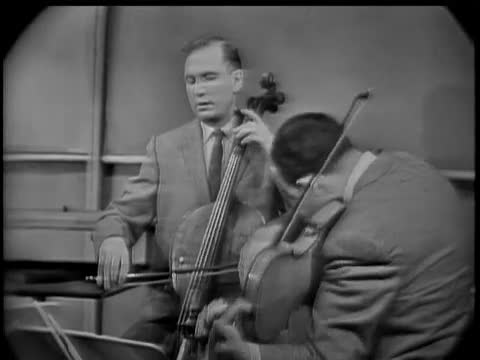
Quartet Literature, played and discussed by the Fine Arts Quartet. Here are the artists, George Sopkin, cello, Irving Ilmer, viola, Leonard Sorkin, first violin, and to introduce today's program, second violinist, Abram Loft. Music worth hearing is worth hearing well. Acting on this thought, we devote each of these programs to one specific movement or musical chapter by a master composer. We play the movement twice and between playing is discussed some of the important features of the music. In our discussion, we try to highlight a specific aspect of composition that is revealed by the music at hand. And also, since each composer represented as a distinct individual from a distinct
era in our musical history, we get to hear many different musical styles in these programs. The composer for this program is Johannes Brahms. The composition, his quartet number two in A minor. Our topic, New Wine and Old Bottles, featured is the third movement, Quasi Minuetto, or in the manner of the minuet. Here it is. Let's enlarge on that thought
of New Wine and Old Bottles. In music, composers are always faced with this problem of putting new thoughts into old containers. They want to do something new, individual, up to date. But they hear so much of the work of older composers that they can't help starting to work along the lines used by those older men. And they find that they have to make adjustments in the old times of musical containers in order to make them fit the new thoughts they want to package. Take Brahms as an example. He was a very scholarly type, even for a composer, and carefully studied the music of his predecessors. He was filled with respect for their work. Read us that quotation from Brahms. He writes this. One can never hope to get upon the level of such giants as Bach and Beethoven. One can only work conscientiously in one's own field. And when it came to work, Brahms was a powerhouse. He turned out a great quantity of compositions, all put together with thought, inspiration, and painstaking craftsmanship. And speaking about working methods, he once said that
in writing a piece, you must let it rest, and you must keep going back to it, working at it over and over again, until it is completed as a finished work of art. Until there's not a note too little, not a bar you could improve upon. Whether it's beautiful also is an entirely different matter. But perfect it must be. Well, let's see how this reverence for things past and things perfect applies to the movement at hand, the quasi -minuetto of the second quartet in A minor. Let's have a look at the plan of this movement. This is a very clear -cut, purposeful assembly. You have a minuet section alternating with and framing the two Allegretto Vivace sections. And just so you'll connect these titles with the appropriate sounds, here's some of the minuetto section. And now, here are some of
the Allegretto Vivace music. Now, suppose we compare this chart of Brahms' minuetto movement with a chart of an older minuet movement, as is found in Haydn, Mozart, Schubert, and others. On the surface of things, the older type is simpler. Three separate divisions instead of five. Well, as Brahms tells us by his title, minuetto, he is using this older kind of movement as his inspiration. But he qualifies his title, saying quasi -minuetto, that is somewhat like the minuet. There are going to be changes. And as we see on the chart, he swings back and forth between the minuetto and the Allegretto sections. Why does he do this? Of course, there's no simple reason.
But maybe we can find a clue by comparing the music of the Allegretto Vivace section. With music that seems a direct ancestor to it in sound, the Spritely Trio section from the Canzanetta movement in Mendelssohn's E -flat major quartet, written almost a lifetime earlier than our Brahms movement, notice the similarity in the constant stream of sixteenth notes. Now let's hear a bit of the Mendelssohn movement. Well, the actual sound of that music is certainly transparent
and very clear and untroubled. But now let's hear the Brahms for contrast. This music of Brahms is sprightly enough in its own way. But it's a more complicated way than in the case of the Mendelssohn example. Here the voices enter late, they chase each other, they grumble and growl at each other. Overstatement perhaps. But from the sound of this music, it seems clear that the easy grace of an older style will no longer serve Brahms's musical purpose. And also, the rhythm in this Allegretto does not trip along steadily and easily, but it starts humping in jazzy, syncopated, offbeat fashion. Well, the
straining in activity is even clearer in the second Allegretto. The first Allegretto seems to grow in intensity. It grows into the second Allegretto. And this way, from here to here. And here's another point. Just as the two Allegretto sections show growth, so also the Minuetto and the Allegretto section seem to react to interact with each other. The two clearly divided, contrasting and separate sections of the older
composer's kind of movement, Minuetto and Trio, will, obviously too, no longer serve Brahms's purpose. Well, at every joint in this movement, there's an organic transition from one section to the next. For example, from the Vivace into the short Minuetto interlude. Here. And from the tempo de Minuetto in turn back into the Allegretto. Here. These musical joints are a perfect example of the highly integrated nature of this music. These sections, which appear twice, once early in the movement and again just before the final statement of the Minuetto, are actually made up of the themes of both the Minuetto and the Allegretto, but played simultaneously. The second violin and the cello play the first part of the Minuet theme together. And while this is going on, the
first violin and the viola play the first part of the Allegretto theme, but slowed down quite a bit. However, that's still not the complete story. We actually see Brahms carrying this a step further. And we have the cello and second violin now playing one bar apart, and they sort of follow the leader's style. And now we have the same thing happening with the first violin and viola in their theme. Now, let's suppose we put all this together.
Well, having pointed to this relationship between the Allegretto and the Minuetto, let's ourselves go a step farther. Let's say that just as Brahms sprightly passages in this music are more trouble, for example, than that Mendelssohn passage we compared with it, compared with it a couple of minutes ago. So the Minuetto passage is far less sunny, less gay than the run of Minuet music from earlier composers. Listen to the opening measures of the Minuetto section. Notice the whistle drone of the cello, introduced
by the opening little sides, though to say, nostalgically, once upon a time. And the melody itself, notice how it starts out smoothly enough, only to stumble on this triplet turn before settling. As we follow the melody along, we find that this interrupting stumble recurs time after time. The result is a disturbing of the mood of tranquillity, even more so in the heavy size that soon marked the music. In short, let's music. Minuetto is hardly a light fantastic. Even when Brahms handles the
music in most elfin fashion, the sensation is still one of restraint, of holding back, of quiet brooding almost of yearning nostalgia. Why choose a Minuet movement, customarily a rather gay, dance -like episode in the quartet, in which to be pensive? Maybe it's because the very contradiction in terms implies an ultimate frustration. There's a sense of suspended searching in this music, and this is brought out with quiet forcefulness in the closing measures of the movement. We could also ask ourselves why a composer should want to
frustrate himself, and at the same time, possibly the listener. Well, let's remember that in drama, for example, just as in life itself, a happy ending is not essential. The dramatic situation need not be comfortably resolved every time. It's the composer's right, too, to temper his music as he sees fit. He can't help do this. He is, after all, reflecting his own outlook when he writes his compositions. And I think that Brahms is reflecting, too, the temper of his century, a time that brought forth comments such as this by that genius of the 19th century concert platform, Franz Liszt, who wrote, What is it that takes hold of us and sweeps us into the maelstrom of the passion, which carries us out of the world into the harbor of a more beautiful life? Is it not music, animated by elemental feeling like that which vibrates in us before it manifests itself, before it solidifies and turns cold in the mold of the idea? Well, just in case you're wondering about the eventual solution to this entire quartet, let's set your mind at rest. The finale, which follows right after the minuetto, starts out quite
stormily. And some six turbulent minutes later, however, it muses in this quiet fashion. And then Brahms launches into a closing passage that recalls the elfin line from the minuetto, but racing this time and leaving us at the end of the quartet scarcely, well, perhaps more resolved, but still in the same emotional climate that we experienced in the minuetto movement.
I think we have to admit that in his turbulence, in his searching, his yearning, Brahms is being consistent, not only with his own outlook, but with that of his time as well. And recognizing this consistency, let's turn once more to the quasi -minuetto and experience again its pensive round. Thank
Thank Thank you. Thank
you. you.
- Series
- Four Score
- Episode Number
- 6
- Episode
- Brahms
- Producing Organization
- WTTW (Television station : Chicago, Ill.)
- Contributing Organization
- Library of Congress (Washington, District of Columbia)
- AAPB ID
- cpb-aacip-512-k35m90320m
- NOLA Code
- FSCR
If you have more information about this item than what is given here, or if you have concerns about this record, we want to know! Contact us, indicating the AAPB ID (cpb-aacip-512-k35m90320m).
- Description
- Episode Description
- Music worth hearing is worth hearing well, remarks Abram Loft as he introduces this program. The theme of the discussion, he continues, might be the Biblical phrase new wine in old bottles, though in this case the musician does the opposite of the classic precept, putting new musical ideas into the older forms. The selection under examination is Brahms Quartet in A Minor, Number 2, and it is to the third movement that the players turn their attention. The form of this composition is similar in many ways to that used by Haydn, but the new musical ideas have expanded and changed it in several respects. Both the melody and the external structure (sequence of movements and use of rhythms) reveal a less than placid, more intense emotion; the quartet has become a vehicle for expressing some of the doubts and nostalgia of the composer and the times he lives in. Once again a brilliant performance of the movement in its entirety illustrates and complements the commentary. (Description adapted from documents in the NET Microfiche)
- Series Description
- Four Score is a concert-discussion series featuring the members of the Chicago Fine Arts Quartet. It offers to musicians, as well as to those who have not technical training in music, stimulating and graphic analyses of the development of the music for string quartet. The series emphasizes the variety of approaches by different composers faced with the problems of this form of music. The format is the same for each episode: a single movement of a quartet is performed, and then comes an analysis and discussion by the performers, and finally, a replaying of the movement. Although a certain number of technical terms are used, the combination of performance and commentary makes these episodes accessible to anyone who is interested in music. The Chicago Fine Arts Quartet is made up of the following musicians. Leonard Sorkin, first violin, was born and raised in Chicago. Formerly a member of the Chicago Symphony Orchestra and concertmaster for the American Broadcasting Company Orchestra and the Saidenberg Symphonette, he is one of the founders of the Fine Arts Quartet. He has appeared extensively as a soloist with various orchestras or in recital. He was a member of Leopold Stokowskis All-American Youth Orchestra, which toured South America in the early 1940s. Abram Loft, second violin, comes from New York City. He is a graduate of Columbia University where he also received his Ph.D. in musicology and served as assistant professor. He has performed in numerous concerts both as a violinist and as a violist. He is a former officer of the American Musicological Society and of the US Section of the International Society for Contemporary Music. Irving Ilmer, viola, was born in Vienna but educated in the United States. Formerly concertmaster of the San Antonio Symphony, he also served with the Indianapolis Symphony, the All-American Youth Orchestra, and the Chicago Symphony. He has, in addition, founded and headed a number of chamber music organizations. George Sopkin, cello, is a native of Chicago who studied with Daniel Saidenberg in Chicago and with Emanuel Feuermann. Formerly a member of the Chicago Symphony Orchestra, he was, before entering military service, a member of the Pro Arte Quartet with the rank of associate professor at the University of Wisconsin. Like Leonard Sorkin, he was a founding member of the Fine Arts Quartet. The 8 half-hour episodes that comprise this series were originally recorded on videotape. (Description adapted from documents in the NET Microfiche)
- Broadcast Date
- 1961
- Asset type
- Episode
- Genres
- Performance
- Talk Show
- Topics
- Music
- Media type
- Moving Image
- Duration
- 00:29:03.042
- Credits
-
-
Producing Organization:
WTTW (Television station : Chicago, Ill.)
- AAPB Contributor Holdings
-
Library of Congress
Identifier: cpb-aacip-2a6a0215d2e (Filename)
Format: 2 inch videotape
Generation: Master
If you have a copy of this asset and would like us to add it to our catalog, please contact us.
- Citations
- Chicago: “Four Score; 6; Brahms,” 1961, Library of Congress, American Archive of Public Broadcasting (GBH and the Library of Congress), Boston, MA and Washington, DC, accessed June 6, 2026, http://americanarchive.org/catalog/cpb-aacip-512-k35m90320m.
- MLA: “Four Score; 6; Brahms.” 1961. Library of Congress, American Archive of Public Broadcasting (GBH and the Library of Congress), Boston, MA and Washington, DC. Web. June 6, 2026. <http://americanarchive.org/catalog/cpb-aacip-512-k35m90320m>.
- APA: Four Score; 6; Brahms. Boston, MA: Library of Congress, American Archive of Public Broadcasting (GBH and the Library of Congress), Boston, MA and Washington, DC. Retrieved from http://americanarchive.org/catalog/cpb-aacip-512-k35m90320m