Senate Foreign Relations Committee Hearings; 1; George Kennan
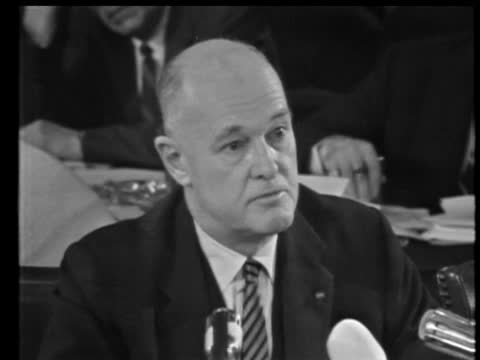
- Transcript
We had a vital interest in seeing to it that the Japanese and Philippine Archipelagos remain. In E.T., the National Educational Television Network presents highlights of hearings by the Senate Foreign Relations Committee on the American Commitment, the first in a series of special reports, N.E.T.'s National Correspondent Paul Nibbim. Good evening. The United States Senate has the Constitutional duty to provide the President with its advice and consent in foreign policy matters. The President Chairman of the Senate Foreign Relations Committee, Jay William Fulbright of Arkansas, is taking that clause more and more literally, and with the emphasis on the word advice. Repeatedly, Fulbright has called administration officials and outside experts to committee hearings for public discussion of the great issues of the day.
He says, frankly, that with the aid of television, the committee is trying to take on an educational function. Last year, there were hearings on Vietnam, China policy, and other subjects. Today, the committee began hearings on a what much wider topic, the responsibilities of the United States as a world power. Fulbright has intense views of his own on that subject, they'll come up later in the program. Today, as lead-off witness in the series of hearings, the chairman called in a distinguished foreign policy expert, who generally shares his views. George F. Cannon, a former ambassador to Russia and Yugoslavia, is now on the staff for the Institute for Advanced Studies at Princeton. He's been a student of communism for some 40 years, and he began today by tracing the history of the communist movement. Before the death of Stalin, he said, communism was monolithic and monographically hostile to us. But then came Titoism and Yugoslavia, rebellion elsewhere in Eastern Europe, and above all, they progressively over it and serious split between Russia and China.
Thus, Cannon said, the communist world which confronts us today is radically and importantly different. And this being the case, to attribute today to the various parties and regimes and factions that make up the world communist movement, any sort of a unified political personality, to speak of them as though they represented a single, disciplined political force operating under the conspiratorial control of some single political will. As I sometimes still hear people speak of them in this country, and occasionally, even in the walls of this August legislative body, is to fly in the face of an overwhelming body of evidence, to move intellectually in the realm of patent absurdity, to deny by implication the relevance of external evidence to the considerations and the decisions of foreign affairs.
The unity of the communist block is a matter of the past, and it will not be restored. Now this, of course, does not mean that there is no problem. These regimes and parties and factions remain communist or nominally communist, even if they are not united, and as such, they continue to reflect in varying degrees elements of the communist ideology that are adverse to our concepts, as well as to our interests. This also, we like to think, to the interests of world peace, but here there are certain circumstances which we ought to bear carefully in mind. First of all, what communism means today embraces a very wide spectrum of outlooks and behavior. Some of these communist elements, like the Chinese Communist regime, present from our standpoint as ugly and menacing a phenomenon, as did Lenin's Russia, at the height of its world revolutionary
enthusiasm. Others, as in the case of the Yugoslav regime or the Italian Communist Party, are operating on the basis of concepts which present no greater problems from our standpoint than those that govern the behavior of many regimes and parties that do not call themselves communist at all. It is simply impossible to generalize today about communism as a problem in the spectrum of American foreign policy. But in addition to that, even within the framework of the individual communist parties or regimes, the nature of communism is not a static thing. It has already undergone great changes in many instances, and it is still in a process of change everywhere. This is particularly important, of course, in the case of the Soviet Union. I think I can assure you that the outlooks that are prevalent today in the Russian Communist Party are greatly different from those that prevailed in earlier decades.
Of course, not all of these outlooks are reassuring. Habits of thought, prejudices and preconceptions still endure there that we have to recognize as hostile and dangerous to the star-only sort of world stability that we can imagine. Efforts carried forward from the communist side in the name of these outlooks merit our continued vigorous and vigilant resistance, but these are no longer the only outlooks that exist in Stalin's and Lenin's time they were. In the mean, the changes that have come over Soviet communism and the mental world of its leaders, particularly in the years since Stalin's death, have been hopeful rather than alarming ones, ones which, if properly understood and met from the non-communist side, hold encouraging rather than menacing connotations for the prospects of world stability.
The implications of all this from the standpoint of American foreign policy are of enormous seriousness at this present juncture. We stand today, it seems to me, as something of a parting of the ways with respect to our approach to the communist world. If we fail to take account of the encouraging elements in the situation, if we act as though they did not exist and carry our differences against individual communist powers as though we were still dealing with the naive world revolutionary force of Lenin's day or with the grim monoliths of communist power that confronted us in the days of Stalin, we may be neglecting and discarding the only chance that I can see to spare our children and ourselves or both the immeasurable catastrophes of a world war among nuclear powers. As one professional experience with these with communism runs back as I've said just
about 40 years, I think I have this intimate acquaintance with this phenomenon as anyone in this country. I saw it and knew it at first hand in the difficult times of the 1930s. I saw it again and knew it at first hand in the most difficult time of all, which was the heyday of Stalin's triumph and arrogance at the end of World War II. I had the temerity to urge at that time publicly upon our government and our people, patience in the approach to Russian communism, being confident that there would be changes and thinking it likely that these changes would be ones that would make it easier for us to cope with it without inviting the catastrophe of another war. These changes, as I see it, have now come. They are, in my earnest opinion, of such a nature as to give us for the first time since
1917, real and hopeful possibilities for the adjustment by peaceful means of our relations with certain of these communist countries, particularly the Soviet Union. Now I can think of nothing more tragic than that today when these possibilities are really coming into being. When rays of light are visible, which 20 years ago were only gleams of hope in our own eyes, I can think of nothing more tragic than that we should fail to perceive or recognize these hopeful elements, that we should lose patience just when it is most vitally important to retain it, and that we should risk driving our differences with communist powers to a violent and apocalyptic conclusion. Thank you very much. No man is an island, and United States Senators are no exceptions. United States Senators are human beings, and each of them brings to his committee assignments
a point of view reflecting his own background. Geography may be a factor, an eastern seaboard senator is likely to be more internationalist than his colleague from the Midwest, a southerner is likely to be interested in Latin America, a westerner, and the far east. The ethnic and religious background of the senator, or of large groups of his constituents, may be a factor in his viewpoint. For instance, no senator from New York is likely to be a carping critic of Israel, no senator from Massachusetts or Rhode Island would be in the vanguard of a crusade for world population control. Ideology is never far away. A liberal democrat is likely to favor closer relations with Eastern Europe than a conservative Republican. So today, the questions addressed to Ambassador to Kent often reflected the individual viewpoints of the question is. Full bright of Arkansas, or the chairman of this prestigious body, is one of the most original men in the Senate, and one of the most controversial.
He does not like what is happening in Vietnam, and his outspoken criticisms have drawn sarcastic public-ridden battle from the president. In response to Mr. Johnson's complaint that his critics never offer alternatives, senator Fulbright is outlined at eight point proposal for affecting the general neutralization of Southeast Asia. Full bright would be linked and negotiate with the North Vietnamese and the Vietcans. If they refused, he would consolidate U.S. troops in enclave in South Vietnam. This proposal appears in a newly published full bright book entitled The Arrogance of Power. It's larger theme in which extends far beyond Vietnam, is that the U.S. cannot and should not try to plug every hole in every dike in the world. Like Walter Lippmann, the senator wants a tight re-appraisal of our interests in the world at a retailering of our commitments and our military power to those interests. The Sherman is not at loggerheads with the administration on all issues. He's for the proposed consular treaty with Russia for the expansion of east-west trade
and efforts to halt nuclear proliferation. On these issues, he stands with the president of Vietnam, and on the wider question of U.S. commitments around the world, he stands against the administration and with the expert whom he invited to testify today. There are many things, many points that you have raised, but near the end, on particular on page 8, where you emphasize that we may influence the international communism or the development of it. I wonder if you could elaborate on that, particularly in view of present developments. This is purely a coincidence that this committee has before it today. We're presently considering, and we'll have hearings later this week, further hearings on the consular treaty. In addition, you noticed this morning, an account of apparently well-organized attack upon Yugoslavia consulates, embassies.
I wondered if you would apply the thoughts you have on page 8 to some of these current developments and see where we come out. Chairman, I think that the way in which we influence most immediately the policies of people on the communist side of the line is through retaining a proper balance of our policy, but our policy in all respects foreign policy as well as domestic policy. And by proper balance, I have this in mind that on the one hand we have to present to them a firm front against activities, tendencies, undertakings on their part that seem to us to be adverse to the prospects of world peace and to our own interests. And I hope we will continue to do that.
But on the other hand, we must always show them that the door is sufficiently wide, is sufficiently open, so that if at any time they begin to see things more our way and to feel the urge to follow policies which would be more conducive as we see it to world peace, then they do not find themselves confronted with a closed door. This is the reason why I think a number of the things which the executive branch of the government would like today to do in relations with the Soviet Union are very well worth doing and should be done because if we fail to do them, if we fail to show an interest in trade with them, if we fail to show an interest in exchanges of people, in cultural exchanges, in the development of our official representation with them, we may convey the impression that they would have no possibilities of good relations with us even if they wanted it.
And I think this would be profoundly unfortunate. We have to press them in certain respects, but we must not press them against a closed door because that's a futile mode of procedure. Now, some of these things that have been happening in our country, I'm thinking of the bombings of the Yugoslav official premises, night before last, are obviously inspired, I think, by people who do not wish for any peaceful outcome of our conflicts of interests with world communism. I'm afraid, I'm sorry to say this, but it seems to me perfectly evident that people who do that sort of thing wish for a violent outcome of this conflict. I cannot imagine why anyone should wish for that. I cannot imagine why anyone in this world, I don't care whether he's of Croatian origin or Serbian origin or Polish or Ukrainian or what, should think that his interests would be served by what would happen to this world if there were a war between ourselves and
the Soviet Union. But there are people who think that way, and they have been given a fairly long lead in this country, I think, too long in many respects. This is an issue in our national discussions and in our national life. It is an issue between people who would like to see this thing solve peacefully and people who apparently have already made up their minds that war is either inevitable or imminent or both. And I'm unhappy about this because it seems to me that this issue has not been sufficiently talked out in our public opinion. It is an issue which we have tended to evade, I think, over the course of the years ever since the late 40s. It has never really come to a proper discussion before public opinion. And because that has been the case, because we have not brought it out into the open, because it hasn't been talked out and hasn't been settled, our policies toward the communist block today are full of contradictions and hesitancies.
We do one thing with the right hand, we do the opposite of it with the left hand, and by this failure to make up our minds, we are inflicting upon ourselves a certain ineffectiveness out of point where we really greatly need every bit of effectiveness that our foreign policy can have. I think that's a very good answer to that, an observation to that question. You make a great deal of the point which I agree with that the unity of the communist block has been destroyed. Why do you dwell upon this as being a matter of greatest significance? Because with an ideological adversary who is multiple in nature, we can live far easily, more easily than with one which is monolithic.
The very fact that countries in the block are going in different ways, the very fact that they are obliged, as I have said before, to make their own decisions means that national traditions, considerations of national interest, what we might call normal impulses in the formulation of foreign policy, are going to play an increasingly great part in their councils. So with this it seems to me we can deal. The world has always been full of troubles as between sovereign nations. It's always going to be, but this didn't arise in 1917 with the Russian Revolution. This is the thing that has gone on all through history. I have the impression that we thought that the great problem arose here from the fact that we had an ideological adversary, who namely the Communist Party of the Soviet Union, which was the center of a great disciplined, controlled hostile movement hostile toward
us, and that therefore every extension of the ideological realm of communism was in effect an extension of the military power of the Soviet Union. And there was a time when that was true, but it is no longer true today. And this, it seems to me, is of the greatest importance. When did it come to an end? It came to an end gradually, Senator, between 1948 and 1958, I would say, in those ten years. John Sparks and the Vallejo Vallejo was his party's vice presidential candidate in 1952, and in those days was a liberal Democrat. Since then, the anti-Washington climate of the South is exemplified by the two governors Wallace in his own state, and pushed him toward the right on domestic issues. On foreign affairs, he remains internationalist. And Sparkman F. asked Kenan if he was familiar with the U.S. Soviet consular treaty now before the South.
Not called for legislative action. Are you familiar with that proposed treaty? I am, sir. What are your thoughts regarding it? I consider that we should get it into effect as rapidly as possible. I see no appreciable dangers involved in it, and I think at one of the small steps that we should take, that would be moderately helpful in the improvement of our relations with Russia, one of those steps, which if we do not take, we will create a negative impression much greater than we meant to create. I might just say this, that when I first went to Russia to the Soviet Union proper, which was at the time of our recognition of the Soviet government in 1933, we wouldn't have hesitated for a second to conclude an agreement of this sort, had the Russians been willing to do it. We at that time considered it highly wrong and regrettable that they were so afraid
of contacts between people, afraid of having foreign representatives in their country, that they put such a jealous control on foreign representatives, that they didn't want our councils around. We wanted to go in for the maximum amount of that sort of exchange. And I am somewhat surprised to find that now, 30 years later, we quail at an agreement of this sort, the main effect of which is simply to improve to some small degree the possibilities for protecting our citizens when they do travel and reside in the Soviet Union. This matter will be before us for action, I presume, but for long, there is, as you might imagine, a great deal of opposition to it, expressed to us from over the country. The same is true with reference to East and West trade, which I believe will be taken
up this year or so. Do you believe there ought to be stepped up trade between the East and West? If I might, we phrase that question a little, Senator Sparkman, I would say that I believe that the executive branch of our government ought to have a dual degree of flexibility in handling the problems of East and West trade, whether there is then to be increased trade or not depends on the traders. I realized I used the wrong term when I said stepped up trade, as a matter of fact, the trade never has been massive between the two areas. It has never amounted to very much. Now the opposition that has developed to the East West trade bill and to the consular treaty is a reflection of precisely that failure to talk out the issues that are involved in our relations with the Soviet Union and the bloc, to which reference was made a few
moments ago here. And I cannot but believe that there must be massive misunderstandings involved here at some point. I must say that I fail completely to understand the reasons why anyone should object either to the consular treaty or to giving the president the power to extend or withhold normal commercial, normal customs treatment to the Soviet Union and Eastern European countries. It seems to me that both of these things are obviously in our interests. And in fact, if they cannot be done, if we cannot take steps even as minimal and as easy as this, then I would feel profound discouragement about the ability of this country to conduct any effective policy toward the bloc at all. If we're going to come up against these barriers right here, this is not a good home and because there are going to be days when we're going to have much heavier problems than this
to face and ones that will require more important steps on our part. This seems to me, if I may say so, and I hope you'll forgive me for speaking thus frankly, but it seems to me that in many instances this is the reflection, either of a great misunderstanding of the nature of communist power and of the possibilities of our relation with it or of an entirely unwarranted timidity in the approach to it. The opposition to these two measures seems to me to be an emphasizing of the negative, the defensive elements in our relationship with the communist world rather than the positive and constructive and hopeful ones. Now admittedly, as I said before, there is always some risk involved in the hopeful and constructive measures. They are never without disadvantages. They are never, of course, without some degree, a risk.
But I can only say that if we never have to take measures that involve more risk than these here, we'd be a lucky power because the risks of these are very tiny and deep. Thank you, Mr. Chairman. The next committee member to question, Kenan, was the veteran Maverick and Republican turn Democrat, Wayne Morse of Oregon, a loud critic of administration policy in Vietnam, Morse is hinted that he wants an anti-war candidate for president next year. The most anti-war public figure in the country happens to be Wayne Morse. Today, he argues that the opposing Soviet and American rules in Vietnam makes it difficult to get ratification of the consular treaty, which he favors. It's Scandinavian countries, rather than the Lenin Marxist line, of a Stalin. That's true, isn't that correct? But applying these principles that you've laid down, what I think is scholarly and magnificent statement this morning, we, as senators, have to deal with specific issues, vis-a-vis the
United States and Russia. And so we've been discussing the consular treaty, and it's my intention on the basis of the evidence submitted to date to support the consular treaty, as well as the East-West trade. But we're getting now many postcards from various groups in the country, and I quote from one, it shows a cross with the GI helmet on it, bearing the inscription killed in Vietnam by a Russian bullet fired by a Russian gun. We have information that justifies the conclusion that 85 percent of the equipment that the North Vietnamese are using is Russian equipment, about 15 percent Chinese equipment. That is, the two areas of equipment that do not come from captured the United States
equipment. I think it's still true that a large quantity of their small arms that are used by the Vietnam cons are still captured the American arms. Some reason believe that a good deal of their food supply is also captured food supplies that come from the United States through the aid program. But we find no inclination on the part of the Russian leaders to date, to even join with Great Britain and the proposal to reconvene the Geneva conference. Now, I'd like to have you a state for the record, which you think is some of the explanation of the to date refusal on the part of the Russian leaders, or shall I say no show of interest on the part of the Russian leaders, to try to work out a basis for getting this horrible war into a conference stage, conceivably reconvening of the Geneva conference with the
form a platform for the beginning of the discussion. Now, if there's any desire on the part of the Russian leaders to work out a really meaningful day-tongued with the United States, what is your explanation of their obscency and is not wanting to cooperate to any degree at all and trying to bring this war to an end? They have, as they see it, their image to concern themselves for, and in this respect, they're mostly primarily concerned for the opinions of people in other kindness countries and in the non-line countries. Now, we have felt obliged to espouse the interests of the South Vietnamese regime to send troops there and to have our troops and a combat in that country. They have felt themselves obliged, also, with the view of the world opinion, to espouse
the interests of the North Communist regime. They have, however, not sent combat troops there unless it's some flyers to my knowledge, but they have given them arms. I think personally that they would like to see this conflict terminated. I think it's a double-edged sword from their standpoint. It has certain advantages to them, but I think it has even greater disadvantages. And I think they will, probably, use their influence in that direction as soon as they feel they can do so in circumstances that do not lay them open to attack elsewhere in the Communist world as being the defenders of American interest. They may be doing that for all I know now in the quiet way, but they're certainly not willing to do it publicly. I think they would say, of course, how sincere this is, true it is, I wouldn't know. They would say that if we would make the first step, it would be easier for them, that
is by diminishing the range of the combat in that country. I'm not prepared to subscribe to that statement. We've tried that before. It didn't bring results, and I couldn't promise anybody that it would today. But I do think it likely that if anything can now be done, and it seems to me the situation is changing rapidly, and there are certain hopeful elements in it, if anything could be done to bring about at least a moderation and perhaps a gradual composition of this conflict, I think that we will find that the Russians use their influence, perhaps not outwardly and not publicly, but behind the scenes in order to help that along. I wouldn't find the question you spoke about the... The administration has called us. He thinks Vietnam should not be a first priority in American policy. After talking with Kenan about the eventual emergence of red China as a world power, Gore asked him,
Now, what relevance does that have to the widely held notion in our country that the United States must draw the line, so to speak, on communism, whether by internal development, or surface aggression, or however, ideology, which is generally described as communist, whether it be in northern Thailand, or in the other part of the world? I think that's a dangerous principle to announce today, because communism means so many different things. If we just say that, that we have to draw the line, there must be no expansion of communism anywhere that doesn't involve us in a big way, we are making assumptions about what communism is, that I wouldn't want to see us make, and we are making ourselves, in a sense, the
victims of a semantic term here, rather than of realities, there are... I can conceive of cases where the expansion of the power of one communist state might involve our vital interests and the vital interests of world peace, and where we would certainly have to respond with our own armed forces in the strongest possible way, but I can conceive of other interests where this might not necessarily be true. When you have small communist countries, which are following an independent course, and when they used by them of the term communist has a reality that may not be particularly menacing to us, then these things have to be looked at in a different way. I doubt you know that there is going to be any... that we have to fear any great expansion of the territory of any communist power, just at this present time, except perhaps North Vietnam.
That would be the only place I sometimes think that people that we have not yet digested the full measure, even there of the changes that have occurred since this Vietnam conflict began. There was an excellent column yesterday in the New York Times by Mr. Cyrus Sultzberger about this, in which he described the Vietnam as being situated between the hammer of Chinese communism and the Anvil of the great Indonesian Communist Party. Well, look at this hammer in Anvil today. The Indonesian Communist Party is essentially destroyed, and the hammer of communist China is in a state of really extreme and spectacular, almost unbelievable disarray. Now so much, I mean, for the question of Vietnam, now elsewhere in the world I don't see this happening. I know of no immediate undertakings by the Soviet Union or by any of the Eastern European communist states to extend their territory in any direction, any serious ones that we would have to be
worried about. And what you have left, really, is Cuba and communist China. Now the communist Chinese have been guilty of what seemed to me to be at least very sharp actions in the case of Tibet and of the Indian border. Those were both areas in which they could at least claim a traditional Chinese interest and could link this to some extent to the traditional aims and area of sovereignty of China. They also, of course, intervened in the Korean War. I wouldn't mean to condone that intervention, on the other hand, I must point out that it did not happen until we approached their borders about which they are very sensitive. Otherwise I'm not aware that they have used their own forces for purposes of aggression anywhere else.
Now whether they're ideology or an ideology calling itself communist takes, comes to be the ideology of the governing group in a neighboring country is another question and a very, very difficult one for us, it always has been. And we have found varying answers to it, in some cases we have opposed it by force of arms and others we have not. I don't think you can make any rule about this. There might be instances in which we'd have to. You know to my mind as a diplomatic historian one of the beans of American foreign policy for decades back into the past has been the curious insistence we have on trying to generalize our conduct and to say that we will only do things on the universal basis in according to a single rule. This is particularly dangerous in the present instance because if we try to say we're going to behave this or that way in all cases where any government calling itself communism does this or that.
We may tie our own hands in ways that would prove to be undesirable later. This is a very, it's a spectrum that contains many colors today and before we make decisions on what we have to do about the behavior of this or that communist regime I think we ought to wait and see the whites of their eyes and make sure exactly how this relates to our security. I mean I too would like to find this evidence. Carl Munter, South Dakota, a conservative Republican, a hawk on Vietnam and a veteran and continuing communist Friday. I think we've got to go beyond the philosophical discussion to try to find something tangible under which to put our teeth before we start letting down our guard or in any way weakening our position vis-à-vis Russia. I'm greatly disturbed and I wish you would tell me how you relate your thesis of this morning to the fact that the Russians are supplying every sophisticated weapon needed and used by Hanoi in shooting down thousands of Americans who have died as Senator Morse's
postcard properly points out because of the fact that the Russians have placed those sophisticated weapons in the hands of the communist. Now if they're not interested in communism, if they would like to cozy up to the United States, if they'd like to make a better relationship, how do you explain this crude, rough, bloody, tangible fact? Well, I would not say that they're not interested in communism, particularly the Soviet leaders. Well, that's what we've got to talk about because the people who are non-commonist unhappy aren't running the country. Well, as I say, they are giving arms to the North Vietnamese, they do not have large combat units and operation there. I don't think you have any. I don't think you have any. We are both giving arms and we have constant. One fact now, because it's a worry, evidence has reached the Congress that every sophisticated weapon bar now, they're killing American boys in Hanoi today in the war with Vietnam.
I have not supplied by the communist and this evidence is slowly but surely seeping out to the people and naturally the people resent that. Certainly, the mothers of the kids getting killed, the boys about to be drafted. This is a hard, ugly fact. Now, how do you relate that fact to the philosophical discussion that there are evidence of silk gloves surrounding the iron fists of the government? Well, I don't think anyone has ever doubted that in the case of Vietnam, we have a clear instance of the sharpest disagreement between ourselves and the Soviet government. The Soviet government would like to see Ho Chi Minh come out of this successful. We would like to see the other people come out of it successful. I think Soviet arms would not be being used against our people there, of course, if we were not there. I mean, it is the very fact that we're fighting there. No, no, if the arms weren't there, they couldn't use them either, that's the situation balanced.
No, but I don't see any prospect of there being used in other parts of the world, unless a similar situation or a comparable one is created. It seems to me that the main burden of initiative right or wrong in bringing the Vietnam situation to the state that it's in today has been rather ours than the Russians and the Russians have shown more restraint than they could have shown. They could have put combat troops in there, too, and that would have been most unfortunate. Let's discuss another tangible fact that we can find the evidence now in the framework of world affairs. You said, and I've been said by many others, it's a hope of a great many, that if we would take the first step toward indicating an increased friendly relationship with the Russians, you thought or hoped that they would take some reciprocal step. And I'm sure that you would agree now as you did in 1945 that whatever we do has to be a reciprocal basis in terms of these relationships. Let me please not be misunderstood here in the first place.
I think there are real limits on what we can hope to accomplish in our relations with the Soviet Union in particular, so long as Vietnam goes on. I think that even if it were to cease the Vietnam conflict, we would still have plenty of troubles in our relations with that country. I didn't mean to say, and I've never been, I've never favored this idea, that we should make unilateral concessions to them in the hopes that they would feel grateful and respond. In the two matters that we had under discussion this morning, in the East West Trade and the consular convention, it is my view that we have something to gain ourselves from the standpoint of our own interests by these two measures, that they are not concessions to the Soviet Union on the contrary.
They advance American interests, and it is not as gestures of goodwill that particularly that I would like to see them adopted, it's for a reason more than that. On the other hand, I think that when one refuses to adopt such measures, this does attain a certain negative, carries a negative message to them, which is not in our interests to have conveyed. Let me explore with you as my last question, something related to the East West Trade. In relationship to your theory that if we take the first step, something will be done of a reciprocal nature that we can take another step, and this is the way to make a re-approachment, no question about that, if it works. But it didn't work when we tried it on October 12th, 1966. By presidential proclamation on October 12th, last year, the President opened up the exportation of 400 new commodities to Russia, which before that had been restrained under a license.
Some of the commodities are pretty closely related to war, like scrap iron and sulfuric acid, and electrical equipment, and rubber. Some of them are not so directly related, but at all events, that was a gesture. That was the first step. Let's look at the consequence. Fourteen days after that, the Warsaw Pact countries met in Poland and agreed to extend a billion dollars of extra military aid, military and economic, to North Vietnam. Since then, they have sent nearly a hundred migs, their very best migs, to kill American boys. Fortunately, we knocked a big batch of those migs out of the air and they have since replenished them. Now where is the tangible evidence that taking the first step gets you anything, except additional casualties in Vietnam, as conditions prevail today? Well, Senator Monde, I have obviously not made myself clearly understood here, but let us have this straight.
We must expect so long as the Vietnam conflict goes on that the Soviet government will give the maximum support that it can to the North Vietnamese without getting itself into a major war. This has been true all along, and I think this is going to continue. Now, if anyone recommended the release of these items from the control list in the belief that this was going to affect Soviet contact in the war in Vietnam, I think he was making a great miscalculation. I think it was a hideous mistake, myself. Well, I'm not sure that it was a mistake, but if it was down on that expectation, I think it was certainly misconceived. On the other hand, I think it was probably in our own interest for other reasons to release those items. Members of Congress frequently asked diplomats whether agreements with the Soviet Union are worth making. That question was put today to former Ambassador Kenan by a senator who is himself, a former foreign service officer, Democrat Claiborne Pell of Rhode Island. Speaking to you as a professional diplomat who had many dealings with the Soviet Union,
would you feel that when their signatures are fixed to an agreement, they had a formal agreement or an informal agreement that the likelihood of that agreement being violated once written is more or less than with the average nations with which you've dealt. That's a hard question. I realize it. It might be slightly more, but the difference would only be one of degree and not of kind. International agreements have a habit of retaining their vitality only so long as the strong elements of national interest which ended into their negotiation continued to be valid. And the archives of every foreign office in the world, I think, are full of agreements which have not only remained in force, but by common consent have lost their vitality. It's my impression that the Soviet government, if the agreements made with it are entirely
explicit, and if we do not make the mistake of using general language such as we're used in the outer agreements and the wartime agreements, if we don't talk about democracy or peace loving or words of that sort, but if we say specifically what they are to do in a specific situation and what we are to do, and if we then hold them to it rigidly and insist on every bit of this, that they will deliver. John Sherman Cooper of Kentucky is a liberal Republican and an internationalist. As a former ambassador to India, he has much interest in and sympathy for the underdeveloped world. His record on Vietnam classifies him as a dove. He is called repeatedly for more emphasis on negotiations. Today, he asked Kenan, whether in the absence of negotiations, it would be a worthwhile risk to halt the bombing of North Vietnam.
He's considering the argument that has made on the other side that to reduce the bombing in North Vietnam would add to the loss of life, at least for a time, but would you consider that a cessation of bombing of a North Vietnam, and I assume it would be attended by larger military measures in the South to protect our truth, but would you consider that to do that, even with its risk, would be worthwhile the effort in the longer view to reduce the cost to the United States, and also reduce the danger of further involvement? Do you think this cessation of bombing is a worthwhile risk to take, as in moving toward the possibility of negotiations?
Dr. Cooper, I don't feel that I am in a position to see all the factors that are involved in this situation, there are no doubt some that I can't judge from the information available to me, and also I would like to say at this point that I, I, in contrast, apparently, are great many people who criticize violently what we're doing in Vietnam. I have a very high degree of faith in the goodwill and the seriousness of the people who are guiding our policy, I feel that there are problems of not been easy ones, and I don't share the feeling that they are idiots to have done what they've done. I think this has been a very, very difficult problem. They have given their explanations for the continuation of the bombing. I have not been fully persuaded by those explanations, perhaps I'm wrong, perhaps they are. And it has seemed to me that this is a very extravagant undertaking from the standpoint
of the relationship between cause and effect, fantastically expensive, for a relatively small result. It has certainly had adverse effects in world opinion, and it has required us repeatedly to, to decline to follow the very solemn urging is given us by such people as you, Tant and Pope Paul. These are not liked considerations. You see, in addition to this, it has divided our own opinion here at home in a very grievous manner. And finally, you have the fact, which as the, as the administration admits any operation of the sword is bound to bring a certain amount of loss of innocence, civilian life. Senator Fulbright had a second exchange with Ambassador Kennan, this one on Vietnam. In this Vietnamese war, and many of the questions you'll notice this morning arose from that.
And I have the feeling that it seems to poison our political life. The only real objection to the contrary treaty I think arrives out of the Vietnamese war. It's the source of the poison that threatens any reconciliation with Russia. And there was the line of questions about there, the Russian supplying weapons to the North Vietnamese. And all of this, which, as you could well see, from the nature of the questions, threatens to prevent the adoption of the consular treaty. Well, if that is, goes by the board, what do you think will happen with all the other similar treaties, whether it be the air agreement or trade or so on, you can see how they're developing? So I think it's very important to understand this Vietnamese war, try to understand it, and particularly with respect to the, to the parts that communism plays in it. May I make it a little clearer this way that it seems to me, and I've put this question
before, that what you said about our purposes, they're being stopping aggression. You've heard this form, you've heard that given, and there's, the thought has been this, this is the testing grounds of commune, international communists' expansion through aggression. Is that not so? You've heard this. I've heard that said it. Well, first, may it perhaps, if you would comment on that, and if it is not so, could we hopefully persuade ourselves in the Senate and in the country that this is an erroneous way to look at the Vietnamese war, and therefore it might be able to pull its fangs with regard to proceeding with such things as the consular agreement. They all are tied in together, it's trice. Would you comment on that? I think that is an erroneous way of looking at the Vietnamese war. Seems to me that while the origins of this present stage of conflict in Vietnam are obscure
and fuzzy, that they're, why do you say that? Well because, because they go back a long time, you have to ask who sent, who did what first, you have to get back into the problems of what DM did. And one finds that there was a long interplay, a cause and effect between the North and the South. I do not, I must confess, see in this whole long process the guiding hand of either Moscow or Peking. And therefore I do not think that this is a testing ground of communist aggression. I think the word aggression is more misleading than clarifying when applied to a situation like this, which after all exists within what is regarded as a single country, namely Vietnam. I regard this as much more of a civil war with a very complex set of origins and not so far as I can see one deliberately sparked as a move on the international chess board by
any of the great communist powers. Well accepting your statement, because I regard it the same way, then what is the purpose that we have in waging this war and why are we there? Not just the fire of a purpose that we have in intervening in a civil war. Well, Senator Fulbright, you would get a better answer to that out of others beside myself, but I don't know why, you know. Well, I mean there are people, the people who... Can you suggest one? Took responsibility for it, should be able to answer that question better than one who didn't. I suppose that we are inclined to see in it a symbolic statement. To Kenan meant, of course, that Senator Fulbright should ask that question of the administration. On that note, Kenan approached the end of some four hours of testimony. From Fulbright's point of view, he had been a very satisfactory witness. Like Fulbright, Kenan was against the Johnson administration on Vietnam. He would place more emphasis on negotiation, less on military victory.
But also like Fulbright, Kenan supported the administration on the question of a more flexible approach toward the communist world, and specifically on the matters of increased trade and the consular treaty. Later in an interview, we asked Chairman Fulbright about his approach to these hearings. The first series of hearings deliberately undertaken with the purpose of educational hearings, and that was especially true of the China hearings and the Vietnam hearings. In a sense, this is a continuation. I felt, and I think a number of others felt, they were useful, and it is a continuation of those hearings. Prior to last year, you don't recall any series of hearings designed for this purpose. You would have isolated hearings. We had one year, a rather extensive series of studies made by reputable leading organizations outside of Congress, dealing with special subjects.
You may recall that. That was rather experimental, and it was educational, but it didn't touch the country or the Senate. It was a very valuable document we produced, but it didn't get out. So I think this is the utilization of television, and especially the educational television, and the other networks is a very important way to help educate the people in this particular area. Now, no one denies that we are in a very serious period in this war with Vietnam. It's affecting our whole national life, not just the war in Vietnam, but our domestic economy, and the whole life of this country, and that's the real reason behind seeking to have these educational hearings at this time, put it another way of the war should happen to stop tomorrow, and we settled out a normal way. I don't know that I would go on with the hearings, I don't know that it would be justification for this type of hearing. I don't know whether or not. It would depend on what the issues were that came before us, but in the field of foreign relations.
If we had no serious problems in that field, foreign relations committee probably wouldn't you would have hearings maybe on domestic matters, like the key for the hearings on crime. They were educational hearings to a great extent. They really didn't do much about crime, except it brought the subject out for public discussion and understanding. A supposing I presented the thing that you were in total agreement with the administration on all aspects of foreign policy, would you still be holding these hearings? Well, if there were, particularly if there was opposition, as for example, the hearing on the consular treaty, I am in agreement with them, and I am holding hearings trying to offset the determined and vigorous opposition to that treaty, which I would be a disaster of major proportions if they defeat that treaty. So I, of course, would, to build support for it. And Vietnam, you're moving the other way. Well, what I want, I've tried to make it clear, both in speeches and in the book published last week, we could go today that I would like to see that war brought to an honorable
end. I think it is undermining and poisoning the whole political life of this country. Well, Senator, is the committee with you in this innovation of using hearings via television for an educative purpose? They are because I brought this matter up in the first meeting of this year. We discussed the matter, and there was practically no dissent. There were one or two members who don't much prove of the way they're held, but I would say it mostly, two or three members who may not like it, but the vast, clear majority of the committee doesn't prove it. Tomorrow's witness will be Harvard professor and former ambassador to Japan, Edwin Reichsauer, who occupies a middle position on Vietnam. And later weeks there'll be more testimony, some of it from doves and some from hawks. But when all the hearings are over, some weeks or months from now, the balance of the testimony is likely to reflect the views of the committee chair. Senator Fobre thinks that American power is unrealistically deployed in general and disastrously bogged down in Vietnam.
Through these hearings, he hopes to press that point of view upon the public and hopefully upon the president, that he will. We had a vital interest in seeing to it that the Japanese and Philippine archipelagoes remained in reasonably friendly and reliable hands, and that we also had an interest of a negative sort in Formosa and in Okinawa. At the same time, NET will present another special report on the current hearings of the Senate Foreign Relations Committee. The witness will be Edwin Reichsauer, former ambassador to Japan. Yes. They're not in the long time plans or projections. This has been a production of NET, a national educational television network. Thank you for your time.
- Episode Number
- 1
- Episode
- George Kennan
- Producing Organization
- National Educational Television and Radio Center
- Contributing Organization
- Library of Congress (Washington, District of Columbia)
- AAPB ID
- cpb-aacip-512-j678s4kn2j
- NOLA Code
- SFRH
If you have more information about this item than what is given here, or if you have concerns about this record, we want to know! Contact us, indicating the AAPB ID (cpb-aacip-512-j678s4kn2j).
- Description
- Episode Description
- Mr. Kennan, a former Ambassador to the Soviet Union, testifies on "The Communist world in 1967. (Description adapted from documents in the NET Microfiche)
- Series Description
- These hearing have been called by committee chairman Sen. William Fulbright (D-Arkansas) to review United States foreign policy. They focus on what the Senator terms the responsibilities of the United States as a great power. Taped highlights of the testimony were presented each evening, together with analysis by NETs Washington correspondent Paul Niven. The Senate Foreign Relations Committee Hearings is a 1967 production of National Educational Television. Produced through the facilities of WETA, Washington, DC. The 4 half-hour episodes that comprise the series were originally recorded on videotape. (Description adapted from documents in the NET Microfiche)
- Broadcast Date
- 1967-01-30
- Asset type
- Episode
- Genres
- Event Coverage
- Media type
- Moving Image
- Duration
- 00:59:52.289
- Credits
-
-
Anchor:
Niven, Paul
Executive Producer: Karayn, Jim, 1933-1996
Producing Organization: National Educational Television and Radio Center
Speaker: Kennan, George F.
- AAPB Contributor Holdings
-
Library of Congress
Identifier: cpb-aacip-eb1721cbcc2 (Filename)
Format: 2 inch videotape
Generation: Master
If you have a copy of this asset and would like us to add it to our catalog, please contact us.
- Citations
- Chicago: “Senate Foreign Relations Committee Hearings; 1; George Kennan,” 1967-01-30, Library of Congress, American Archive of Public Broadcasting (GBH and the Library of Congress), Boston, MA and Washington, DC, accessed May 9, 2026, http://americanarchive.org/catalog/cpb-aacip-512-j678s4kn2j.
- MLA: “Senate Foreign Relations Committee Hearings; 1; George Kennan.” 1967-01-30. Library of Congress, American Archive of Public Broadcasting (GBH and the Library of Congress), Boston, MA and Washington, DC. Web. May 9, 2026. <http://americanarchive.org/catalog/cpb-aacip-512-j678s4kn2j>.
- APA: Senate Foreign Relations Committee Hearings; 1; George Kennan. Boston, MA: Library of Congress, American Archive of Public Broadcasting (GBH and the Library of Congress), Boston, MA and Washington, DC. Retrieved from http://americanarchive.org/catalog/cpb-aacip-512-j678s4kn2j