Playwright at Work; 10; Jack Richardson
- Transcript
Is the theater doing its job in your opinion if it makes controversy, if it makes people think? Oh, that is the so function of the theater. Besides all the other functions, it has a theater must be entertained and amused and move and have all the elements the theater has always had, but I think what the theater has lacked for the last few years or so, is this quality of inciting people to riot intellectually, you know, with themselves and each other, and as if it can come back to that, I think the theater will be everything it should be. In play-rided work, we're concerned with a new generation of writers for the theater, with
their creative methods, their philosophies, their aspirations. Our guest today is Jack Richardson. Mr. Richardson's two plays, The Prodigal and Gallows Humor, both presented off Broadway, have one critical acclaim for their combination of theatricality and trench and philosophic speculation. Later in the program, we'll see a scene for Mr. Richardson's play The Prodigal. The scene will be directed for us by George Sherman, who successfully staged the off-Broadway production of Mr. Richardson's Gallows Humor. Actors in the scene will be Nicholas Costa and Mary Herra. Jack, a pleasure to have you with us today. I'd like to open our discussion by asking, is there a principal philosophic question or attitude that your plays are asking or expressing?
Well if there is any one philosophical question, it's the problem, I think, that's one of the big problems in our decade or not, even further back than that, and it's one of commitment, what causes, what ideals, what, in a sense, structures outside of ourselves can we align ourselves with, and through, practically all of my plays, the two that I have written, which is hardly life's work, but I'm sure which will continue, is an examination of those external structures, external ways of life, that have been given to us by the past and what one in the present should do with them. Well has the problem of commitment concerned philosophers for a long time? Well most philosophers are terribly committed to their own philosophies, which doesn't disturb them too much.
I've ever in the last, since I think the Second World War, it has been, I talked about a great deal, commitment not to a specific philosophical ideas that one may or may not have created, but commitment to those forms of life that relate socially to other people, and what one should do with one's own talent, with one's own ideas in relation to these other ways of life. Is there any danger in the comfort of non-commitment? I think there's no particular danger in it, since I think it's not a very comfortable position to be in. If you're completely non-committed, it means in a sense you have been cut off from 90% of the world. You feel one must be committed then? I think one must be, but one must be very careful, and that's the problems of my players is to find what one should be committed to and how one should go about determining. Is this represent your own point of view as a person, a search for commitment on your own
level? I think it does, yes, first on a very academic level, and then it has since become more of a social level for me to find what schools on the very basic level of politics does one enter into. You write plays of ideas. Is there ever a problem of the ideas superseding the theatricality of a play or how do you approach the problem of making an idea dramatic? Well first of all, I don't see that there is a dichotomy between an idea and a dramatically experience. I think an idea can be dramatic in and of itself, so that doesn't particularly bother me too much. It's a question of how far you go into the idea and how depth you are at finding the essence of an idea so you do not have to surround it with peripheral explanation and
detail which can certainly bog down the dramatic structure of a play. And it's to find that balance between the two, which is really to find the one phrase that sums up an idea very well. Have audiences understood in your opinion the ideas that you've been putting forth in your plays or the questions? Well that's always hard to determine because it's as, by myself, no, when I read another person's work, how well do I understand his own ideas, I don't know. It brings a certain amount of intelligence and experience to a particular play and to a particular idea and with the time the idea is filtered through that personal experience. One doesn't know what one comes out, but I would say generally though I feel at the sort of oblique relationship to my plays from when I've read in papers and critical articles about me, that nevertheless the plays aren't doing what they're primarily intended to do. They are stirring up some connotation in some quarters of the world, so that's as much as I think any writer can hope for.
And in that context the theatre can have an effect, in other words, if it is the theatre doing its job in your opinion, if it makes controversy, if it makes people think? Oh that is the so function of the theatre. Besides all the other functions, it has a theatre must be entertained and a muse and move and have all the elements the theatre has always had, but I think what the theatre has lacked for the last few years or so is this quality of inciting people to riot intellectually, we know with themselves and each other and if it can come back to that I think the theatre will be everything it should be. What in your two plays or in your time in the theatre, what's given you the most satisfaction Jack is a writer? Well the most satisfaction I have is a writer, it's the one of my plays done well and that is the so moment of pleasure for me. What comes after that the critical reviews, whether they're good or bad, is certainly important but it's less pleasurable for me.
I understand. I understand. We're going to see a scene from the Prodigal and I believe it's the final scene because you tell us a little bit how this scene represents the search of the decision about commitment. Well it's specifically related to the problem, the central character arrest has been torn between the necessity to commit himself either with his father or with Augustus, both of whom represent different social attitudes. He has decided against it, he has decided that he is either not ready to make this commitment or he still has too many qualifications to make it and in a sense he distrusts any complete and total commitment to one or another group of ideas. So he has left August but the world being what it is at that time and I think today too there are certain pressures, social pressures that one must align themselves with one or another idea or attitude or sense of justice, whatever the abstract phrases must be.
And that's the problem he is faced with now is at the point where he knows that one cannot be totally uncommitted in this world without suffering a great deal and whether he is strong enough to endure it or not and that's where the plague begins. I'll see you again. Perfect, with that introduction I think, it's time we had a look at the scene. We'll ask George Sherman the director to set the scene for us if you would George please. Cassandra the prophet, just exiled from Argos, has sought out Prince Arrestes. The setting, a hillside near Athens on a promontory overlooking the sea. Time, six months after the murder of King Agamemnon, Prince Arrestes father. You are a prophet, Cassandra.
Tell me that I only postpone by refusal what I must become. I am no longer a prophet but a soothsayer. I now tell people what they want to hear, what is best for them to know. Doing otherwise has made me an exiled woman in my middle age. One small, Cassandra. One small for Agamemnon's son. I will not prophesy, but if you must have drama I will play the poet for you. I am your audience. You know, you are to be my player. You must imagine that this familiar place has the excitement of a stage you've never seen.
That's easy enough. If I am the player for whom do I perform? Let us suppose the sea is our audience, Arrestes. Let us change each wave, each cap of white, into a face. A spectator who we hope will have some interest in the problems we act before him. And as the poet, I must understand these faces and see that they are masks for desires, which if I am to be successful, I must fulfil. Cassandra, a popular poet in this instance, yes. Their wishes will mold my answer to your question. I will not be responsible.
Is it so clear what they want? Not at all. The business of a poet is a difficult one. We must look more carefully and try to judge. Some I believe have very moral crests. They consider poor, quite amnestrous conduct inexcusable, and would have Arrestes return. If for no other reason than to curse in public, the back stares activities of his mother. Oh, don't interrupt Arrestes. There's only a handful in this group anyway. A somewhat larger collection, along the horizon there, in the cheaper seats, think that progress must go on, even at the expense of individual misgivings. They're quite scientific and see themselves as Agamemnon's followers.
Let our country that far. And now, alas, we come to the majority. They are the ones who have been struck by the fact of murder, and are this very minute preparing precepts that justify their wish to see you balance this fact with another. For them, dramatic justice is an unto complex equation which can be simply solved by death. They speak with the lecturers' voice. And now, as the poet, you must choose, Cassandra. But since we are engaged in popular drama, the majority dictates the plot.
To please all, I must write of your return, your use of the sword upon a justice. And since the public never objects to a bonus slaughter, I'll add quite a mnestra as one of your victims. So I am to play this role in no other. Congratulations, King Agamemnon. We have heard the future's judgment. No, arrestees. We have obeyed the inclinations of the present. And look, see how the waves vanish and are replaced by others.
It will be the same with the faces watching us. And perhaps someday, through a chance collocation of atoms, we will have an audience other than the one we play for now. It might be that this new gathering will demand something better for your consent than edge-worn ideals or dramatic necessity. Even better, perhaps there will be a majority who would see you return to our ghosts with feelings other than tragic. But this, of course, would be unfortunate for the poets since such sentiments make for a bad drama. You dream, Cassandra.
There will never be such an audience in this world. Not so long as one person still suffers in it. The sea will never change. The waves give birth to their own kind and are rooted in one order. The sea will always roar with the lecturers cry. The waters will always rush towards Agamemnon's vengeance. Will cleanse or wash away the earth entirely, but it will never change. When you return, I can resist these forces no longer. I will go back, murder, and say it's for a better world, for this must be said to prevent
insanity. And when I'm standing, addressing the crowds of hargoes, telling them what great things are to come because of my act, I will know that it is nothing but weakness that brought me there before them. Well, I will speak to them of the golden days to come, and boast of my killing to achieve them, but great Agamemnon. I will do so on protest. I will do so, knowing that I was not great enough to create something better.
Shall I wish you well, Orestes? Wish. Now, we both know how little wishes matter, Cassandra. You wished for quiet years, and I, for no more than a gentle wife. And what we have are our separate exiles. Goodbye, Cassandra, Orestes has no more wishes and needs no more prophecies. Farewell, Orestes, Prince of Argos.
The waters are agitating for grand tragedy, and I, too old for such things now, had best obliged them by leaving our stage emptied, and ready for the popular and typical hero to come. Thank you very much, George, excellent job. Ellen, I would like to open the discussion by asking Jack, why does Orestes make the choice he finally makes in the scene to return to Argos? Mostly because of the precious external to him, there is accepted codes of behavior in society,
which society will not tolerate too much questioning and investigation into, or about and into. And though it's nothing in him, not no final intellectual commitment on his part, but it is, in a sense, a defeat, an acquiescence, and in that way, it is by no means a heroic act, a final conclusion for Orestes, and indeed no conclusion finally for the play itself intellectually, dramatically the conclusion is there, but it is no, I'm making no statement that one must be committed to any one particular idea, indeed commitment can be a very tragic thing when forced upon one, that's right. Is that what Cassandra means when she says life is popular drama and the majority dictates the plot? Exactly, and that's the metaphor for the intellectual content of the scene, anyway. Do you believe that that still holds that life today is popular drama and the majority dictates the plot?
Oh, I think, definitely, I'm a quick glance at the editorial in our leading newspapers, let us say, is an example of popular dramatic necessity with the very few exceptions and those people who do make exceptions and qualifications on generally either considered eccentric or in nihilistic or just not good neighbors and so much. George, what were you working for in this scene and how well do you think it was realized? Well, specifically what I was working for was a very simple emotional event, something that happens between two people who mean something special to each other. In this case, Cassandra, who, to me, represents a very lonely, isolated figure and orresties who is about to become a very isolated figure, isolated from the life which he had endeavored through the power of his intellect to achieve, I felt that the way to approach this was to establish a previous sense of relationship which we did in rehearsal
through conversation and proposition, found that the actors related to each other very easily and very well as people and made use of this in terms of the scene. Are there problems for a director in directing a play of ideas, a philosophic play like this one as opposed to a contemporary light comedy, for example? Well, I would not say there were problems but I think there are traps. I would say that the trap would be to attempt to present the idea where the author has made it very clear what the idea is. But I say the problems are the same as you would find, for example, with a simple naturalistic drama in which you again, attempting to present a real event taking place between two living human beings. This is always the problem to me in directing a play. The intellectual content is always taking care of more or less to a more or less a degree by the author depending on his villainy. Gentlemen, in his review of the prodigal Harold Clerman called a resties a princely
beatnik. What is your opinion or reaction to that statement? Well, I think that the word, the princely beatnik, I don't really know what the term beatnik means. I think it's a simplification, certainly, because I don't believe a resties once, in any sense, to beat this, beatnik, whatever they are, it's again, it's very hard to answer that. I mean, Harold Clerman has in his mind when he says beatnik, maybe something entirely different than I have in my mind. To me, Beatnik is an appropriate term given to someone who is very shallow, very indifferent to his fellows and to society about him, whereas a resty certainly is not. Well, in an article, Jack, you said that a resties was your contemporary. Now, I'd like to ask you what you meant by that. Well, a resties is my contemporary, and so far as I feel the necessity as a resties does to examine, to qualify, to not to accept in a package, so to speak, any one specific
doctrine over another. And this has meant my exclusion from many areas of society, and not that I've been hounded, as a resties was, but my exclusion, not from areas of society, social areas, but exclusion from my feeling apart, I'll let us say the democratic party, or the daughters of the American Revolution, or the John Burt society, and all these elements that sort of codify themselves and put themselves up as a final solution, and this can be on the lowest level that way, on the highest level of philosophy. And in that sense, it's an expression of your own personal dilemma, or my putting words in your mind. And this dilemma is a sort of dramatic way of putting it, and my own personal problem, my own personal methods of attending two problems. Can you identify with the resties in the same sense?
Well, yes. I felt, for one thing, that the effort Jack makes in his plays, through his central figures usually, is never a presentation of a solution. It is always an effort for an individual to make a search or an exploration toward an answer, which he does not know, but it is a dealing with problems which creates conflict and, therefore, drama on the stage. Jack, in the prodigal, you used a myth, and in the two plays of Gallo's humor, the two shorter plays which make up Gallo's humor, which George directed, you are very contemporary in theme and treatment, how do you explain your leap of 2,000 years? Well, I think the explanation is called for the leap back to 2,000 years. To the belief that Gallo's humor is not particularly involved with a specific myth, I think close examination of play will indicate a great deal of the same elements that were in
the prodigal, which is necessarily dictated by the structure of the play itself, the attitudes towards those, once again, systems of organization and order that one encounters in life the same sort of problems of order and qualification that one had in the prodigal are also in Gallo's humor. The myth itself, no, I did not use a myth, I think one myth every five years or so is about all New York theatre can take. Are there any contemporary myths in our own society now? Not in the way they were, not in certain ways that they were in the society of Greece. I think there are certain myths that we have, but they're very broadly stroked and very generalized myth, something perhaps like the Western heroes are mythic figures today. You mean they are the six-gun heroes?
I mean, they are mythic figures, but they're on such a popular level that they have not been yet treated and perhaps have not receded far enough into the past that they can take on a more general importance than they are now. Maybe it never will happen. I mean, it's ridiculous compared why it's up to Agamemnon, but perhaps they are the same, the same qualities, perhaps, pertain then as they do now, but I don't know. What problems do you feel, Jack, will concern you in the future as a dramatist? What subjects will you deal with and what kind of plays will you write? Well, the first problem, one problem that we'll always concern is writing a play that is interesting and amusing and entertaining on the stage, and that's the first problem as a dramatist I feel, and as far as the specific content of these plays, I really couldn't say, I'm sure there will be change as I change, and no, I hope, and I won't be repeating myself in any play I write. Gentlemen, thank you very much indeed. Today on playwright at work, we've examined the function and the role of ideas, ideals, and philosophy in the contemporary theater. Our guest was Jack Richardson.
This is N E T National Educational Television. Thank you very much.
Thank you very much.
- Series
- Playwright at Work
- Episode Number
- 10
- Episode
- Jack Richardson
- Producing Organization
- National Educational Television and Radio Center
- Francis Productions
- Contributing Organization
- Library of Congress (Washington, District of Columbia)
- AAPB ID
- cpb-aacip/512-hm52f7kr5z
- NOLA Code
- PWAW
If you have more information about this item than what is given here, or if you have concerns about this record, we want to know! Contact us, indicating the AAPB ID (cpb-aacip/512-hm52f7kr5z).
- Description
- Episode Description
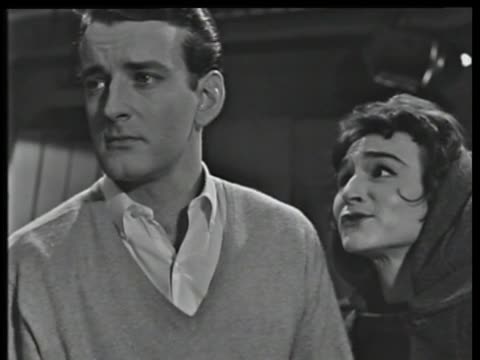
- The successful off-Broadway author of The Prodigal and Gallows Humor, Jack Richardson, has been hailed by critics for his skillful combining of philosophy and theatricalism. Discussing the role of the philosopher in the theater, he says he must incite people to riot intellectually. His aim as a writer, he maintains is to probe the problem of commitment the search for the cause outside ourselves with which he can identify. He feels that one of the most important functions of the playwright, in addition to entertaining and amusing, is to make the audience writhe intellectually. A scene from The Prodigal is directed by George Sherman, who also directed Richardsons play Gallows Humor in its off-Broadway production. Nicholas Coster and Mary Hara enact the scene in which Orestes, torn between his commitments to his father and to the people, meets with the prophetess Cassandra to learn what his future role is to be. In the discussion that follows, Richardson says that Orestes decision to return to the people is a defeat rather than a heroic act, since societys pressures forced him into the decision. In the scene, he says, he attempted to achieve a very simple, emotional situation two characters about to become totally isolated. Life, he says, is a popular drama, and the majority decides the plot. (Description adapted from documents in the NET Microfiche)
- Series Description
- Ten of the most promising young writers in the theater today describe their working methods, philosophies, and aspirations. After a brief discussion between the featured playwright and host Frank Perry, a scene form one of the playwrights current works is presented under rehearsal conditions by professional actors. The scene is followed by discussion between the writer, director of the scene (in each case chosen by the featured playwright), and Mr. Perry. Thus the transition from script to stage is graphically presented, and the working relationship between playwright and director is explored. All participants are solid professionals in their individual areas of the theater and have developed their particular ideas through extensive experience and experimentation. PLAYWRIGHT AT WORK was produced for NETRC by Francis Productions, Inc. The 10 half-hour episodes that comprise this series were originally recorded on videotape. (Description adapted from documents in the NET Microfiche)
- Broadcast Date
- 1961-00-00
- Asset type
- Episode
- Genres
- Drama
- Topics
- Theater
- Media type
- Moving Image
- Duration
- 00:30:59
- Credits
-
-
Actor:
Hara, Mary
Actor: Coster, Nicholas
Guest: Sherman, George
Guest: Richardson, Jack
Host: Perry, Frank
Producer: Brandt, Yanna
Producer: Perry, Frank, 1930-1995
Producing Organization: National Educational Television and Radio Center
Producing Organization: Francis Productions
Stage Director: Sherman, George
Writer: Richardson, Jack
- AAPB Contributor Holdings
-
Library of Congress
Identifier: 2275094-1 (MAVIS Item ID)
Format: 2 inch videotape
Generation: Master
Color: B&W
-
Library of Congress
Identifier: 2275094-2 (MAVIS Item ID)
Format: 1 inch videotape: SMPTE Type C
Generation: Master
Color: B&W
-
Library of Congress
Identifier: 2275094-3 (MAVIS Item ID)
Format: U-matic
Generation: Copy: Access
Color: B&W
-
Library of Congress
Identifier: 2275094-4 (MAVIS Item ID)
Generation: Master
-
Library of Congress
Identifier: 2275094-5 (MAVIS Item ID)
Generation: Copy: Access
If you have a copy of this asset and would like us to add it to our catalog, please contact us.
- Citations
- Chicago: “Playwright at Work; 10; Jack Richardson,” 1961-00-00, Library of Congress, American Archive of Public Broadcasting (GBH and the Library of Congress), Boston, MA and Washington, DC, accessed May 6, 2026, http://americanarchive.org/catalog/cpb-aacip-512-hm52f7kr5z.
- MLA: “Playwright at Work; 10; Jack Richardson.” 1961-00-00. Library of Congress, American Archive of Public Broadcasting (GBH and the Library of Congress), Boston, MA and Washington, DC. Web. May 6, 2026. <http://americanarchive.org/catalog/cpb-aacip-512-hm52f7kr5z>.
- APA: Playwright at Work; 10; Jack Richardson. Boston, MA: Library of Congress, American Archive of Public Broadcasting (GBH and the Library of Congress), Boston, MA and Washington, DC. Retrieved from http://americanarchive.org/catalog/cpb-aacip-512-hm52f7kr5z