Searchlights on Delinquency; 13; Who are the Delinquents?
- Transcript
This is a boy in trouble, but his real trouble is not with the law. He's in trouble with himself, with his community, his school, his friends and neighbors. To the average citizen, all delinquents are alike. Are they all alike? What is the solution to this grave national problem? Let's try to find out as we throw our search lights on juvenile delinquency. Search lights on delinquency. A blueprint for action produced for the educational television and radio center under the supervision of the Sheriff's Office of Cook County Illinois and featuring the nationally known criminologist and sheriff of Cook County, Joseph D. Lomond. And now Sheriff Lomond.
America's number one resource is its young people. What makes for their spiritual and social well-being auger's well for America's future? But by the same sign, social and psychological deficiencies, teenage crime, delinquency, or an ominous cloud which are obscuring America's future. Who are these delinquents? Who are these troubled youngsters? We have attempted to throw our search light on various aspects of the problem through many weeks. And today we summarize, collided scopically, if you please, the various avenues by which youngsters come to trouble and to conflict with the law. As are coming more and more each year, greater numbers of our young people into difficulty with the law. The last five years have produced a steadily increasing army of delinquents and teenage criminals. In these last five years, the number of juveniles passing through our courts increased by over 40%.
Upwards of 435,000 young people became wards of our juvenile and family courts. And furthermore, at least three times as many of these. Over a million, 250,000 youngsters were arrested or brought before the police departments of the United States to be disposed of without the benefit of a judicial proceeding. To be treated as what are called station complaints and to be handled by station adjustment, by local police officers on the beat. But if this trend were to continue both at the police level and in terms of referral of cases to the courts, for the next five years, our courts would be bogged down with the paythouse and tragedy of more than 750,000 youngsters as official wards. And this is something that gives us reason to pause and reflect upon the adequacy of our methods and our understanding of our procedures in preventing if you please, as well as treating crime and delinquency. The harvest of this mischievous whirlwind of wasted youth and troubled community affairs is always reflected
as an aftermath in adult crime, of confirmed criminality, the professionals of your pleas, and of course all of the attendant social and economic cost to the community. We have noted that it is in the metropolitan areas of the United States that the most notable increases have taken place. Striking changes in our population numbers and in our distribution is brought on by industrial and commercial expansion after the wars. We have had a flow of suburban residential development, pent up our housing needs by shortages of material supplies, suddenly overflowing the population following upon this construction into these outlying communities. And they are as yet unsettled, and in many cases they are still disturbed communities, so that for a time there is decreased amongst them the mature influence, the constructive guidance of a more settled neighborhood and community life. We must take stock of this situation.
We must direct our energies toward reestablishing community controls. For only these and these alone can bring the evil of delinquency to bay. But the delinquency problem less than any other is likely to respond to purely negative measures of arrest and detention. This is the first lesson that we must learn. This lesson must be brought home to every parent, every citizen of the land. If we need to judge delinquence, we must minimize the consequences of singling them out. We must avoid stigmatizing young people as delinquents. And most important is all, if we are to accomplish this, we must brush from our minds the cobweb-like myths that have obscured our thinking and have complicated action in this field. Who are the delinquents? What are they like? What are these myths? First, that all delinquents are alike, that they are only alike in the common name we give them, delinquent.
The sense in which we brand them, the reasons for their behavior, similar as it may be, are always different. Very remote from this common feature that arises, namely the sense in which we make them believe of themselves as a group with something in common. This becomes so important that it overrides their differences and obscures most important of all the reason why they have come originally to their difficulty. We must focus on this myth and eliminate it from our thinking. Second, that severity of punishment or treatment is the ultimate effective deterrent. It is not. Certainly criminal justice does deter, but the qualities about criminal justice which make for deterring of crime are not severity of punishment. It is the swiftness and the certainty of the justice which impress the individual, not the severity of that punishment.
This is the lesson of long years of study and experience in Western European society, and it is high time that we put aside this notion that by beating or by close confinement or by making a person feel badly through severity of treatment of him, we can in some sense reclaim him for constructive social living. Third, the notion that our problems are solved if they have been removed from sight. Every youngster must one day return to the community. We take an enormous risk when we place him in a correctional institution because we invite a social process which is unknown to most of us, namely one by which he is introduced to a community of persons like himself. With understandings, values, points of view that are strange to order and law, which are nevertheless comforting to these persons, and which have the effect of estranging alienating, making them enemies of the community. Fourth, the notion that the first defender should be merely admonished and given another chance, as the youngsters themselves say, a pass, which of course tells us more than we know when we merely give them always easily another chance.
It tells us that they are contemptuous of us if they have beat the rap, if they have gotten the pass, and we have not really given them another chance, which is to say addressing their underlying needs, facing them in touch with persons or agencies which are equipped to cope with those needs. This is a chance. Anything else is a pass, and a pass breeds only contempt for the law. And then there is a fifth myth that we must overcome, that there is a simple solution, some single and simple solution. There is no such solution. The solutions are as varied and as numbered as the causes themselves, the conditions of these various delinquents themselves. If delinquency is addressed in a community context, we can bring to bear those aspects of community life, and they are many which relate to each child's needs.
Nothing less than this turn to the community, an examination of its resources, the effective coordination of all of its elements can in fact deal with what is our problem, namely the needs that youngsters have, the failings of the community to permit them to realize what as ordinary human beings they require that drive them to delinquency. These things must be corrected. We must address our attention not to the acts alone, nor to the persons of the delinquents alone, but to the framework of experience which makes persons commit these acts. Our target is careers, not persons, not acts, and careers involve an examination of the whole structure of community life and the coordination of all of the agencies and services that can improve that structure of community life in the experience of any single person. Let's turn for a moment to the simple question, who are the delinquents? Who are they indeed? As I've indicated, they are many, and they are not in common except as we name them.
Roughly speaking, we might classify them into three categories. The first, the compulsive offenders, and here I grouped together a considerable number, those who are emotionally disturbed, those who are neurotic, those who are psychotic. And in short, we mean by a compulsive offender, one who knows not why he does, whose life and personality has been shaped in such a fashion that internal to him, there is a drive, a compulsion to do that which he cannot control, and this is often in the nature of crime. If this indeed is his condition, then our target is that condition, that compulsive quality, and this drives us beyond into the set of relationships that have made him a compulsive offender. The second large category, the situational offenders, and here we bring to bear that whole group of individuals who are influenced directly and immediately by circumstances outside themselves and that make for delinquency.
The gang, economic insecurity, those without a home, indeed without a father or mother, or without either, without therefore love and affection. In a host, amongst a host of other delinquents, in a community of delinquents, in a community that is not singular in its influence, whether it is conflict in the values of the elders, whether it is conflict between cultures, between ethnic groups. And then, of course, there is the kid who has visited upon him a spoiled character, for whom the world is his oyster, irresponsible, bread within him by an irresponsible treatment, again, through his parents from without. And then the frustrated youngsters who see the world uninviting and not satisfying, and as it converges upon them, drives them to troubled acts.
Let's turn to the third group, the habituated offenders. These are the ones whom we encourage further in delinquency. These are the ones who, by our boughty backs, are lack of understanding as to the effect of our treatment, become confirmed in attitudes of crime. They are schooled for it. They learn to make a living that way. They see themselves permanently socially rejected. They have developed what is called a delinquent self, a conception of themselves as delinquent, and are even prideful of it. They have a way of life, a life apart. These are the delinquents, compulsive, situational, habitual, and we can break these categories down endlessly. There are 101 different reasons why youngsters steal, and each different from the other.
Each one represents conditions and circumstances that need to be addressed. Let's look in a summary fashion at a series of shots of films, of youngsters exhibiting these various problems, rejected, driven apart, and all in common ultimately delinquents. Stealing, acting hostily, here is a youngster who seeks friends, and for some reason another he has not wanted, rejected. This group will not have him. What group will, for he must have a group life, and as a rejected person, simply in that very obvious and direct sense, he may be driven to delinquency. And here we see a world of different nationalities, cultures, if you please, at variance with the American standard in scene, the youngsters caught between the values of their elders, and the values of the school and the wider community, and the wider community may indeed regard these as less favored, less acceptable groups and members religiously in national terms. And this is a kind of group rejection that complicates our life. Here at church, in a community of Chicago, where there have been as many as seven different nationalities, living over a period of four years, moving each after the other, creating a differing experience for the youngsters of that community.
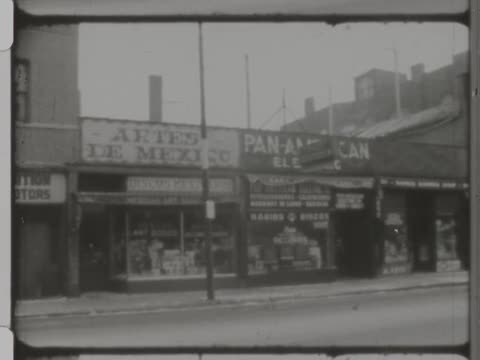
Presenting indeed a tradition of conflict with the broader standards of the community, and as a result, making a chronic problem of adjustment on the part of young people. Here the background of that institution, the slum, if you please, congestion of population, tenement houses, the dirt and filth of the surrounding community, the habitat of the gang. Youngsters without play space, youngsters in a world apart, under elevated structures, to themselves, and beyond the guidance and direction of the adult community. And here adjacent as well, another type of human material, which influences the behavior of youngsters.
The so-called flop house area, or a skid row, the street of homeless men, trance, moving in and moving out, many of them disorganize, many of them give into liquor, frequent, immediate, apparent in the community to the young people there, their stuff of life. And correspondingly, these things adjust to them and they to them, and it is reflected in such patterns as rolling drugs, such patterns as the unfavorable images and patterns that come about through these experiences. Here we come now to another area of life, not under privilege, sufficient material, opportunity and circumstance, everything that a middle-class home seems to require. But in that home, an attitude of apparent, hostile, embittered, without love and affection, this youngster goes to another parent, at the other extreme, overly lavish in affection, pampering, coddling, the youngster torn between these two extremes of parental expression.
And so that in what appears to be an adjusted economic environment, an adequate one, there comes again rejection, abandonment, frustration and denial. Here a father and a mother lavish affection upon a youngster, which every youngster requires, give it attention, and here comes the older youngster to find himself a rival in this younger child. No longer the idol of his father's eye, no longer cobbled by his mother, pushed aside, rejected if you please, and correspondingly lacking in that appreciation, the result of which is jealousy. And here's another youngster, who is also admired and loved, everything he wants, he gets. This young man wants a few, a sense, to go out on the date.
No, he can't have it, get away, they're preoccupied with these younger children, even to the extent of dropping pennies into a saving bank for the young child while at the same moment he had denied the same request from the older child. Rejected, one might say, ejected, thrown out of the home into the street, into the community, to find his comfort and his rewards and his satisfactions beyond the conventional pale. And here he is, again, a youngster in the home, doing what he thinks is of interest, commands his attention, watching television, reading books, but meeting a commanding, repressive, and arbitrary attitude by the parent. Conflict, again, between the father and the mother, this kind of inconsistency, lack of regularity in discipline and treatment, is a prime cause of delinquency.
The youngster seeks his comfort, and of course, as he seeks it, he also exploits, doges himself, exploits the attitude of his mother. Here another youngster, a classic example of one who has been pampered to such a degree that he has spoiled, he has everything he wants, television, he has apartment of his own people, even amenities that most children do not have. And this spoiled youngster, as disregard for property and things, anything he can have and take as it occurs to him. He steals for a different reason than the person who is underprivileged, he is indeed overprivileged. A car at night, or a car at day, joy-riding is the prime explanation for the theft of automobiles. 85% of an America are stolen, not to be sold, not for gain, but simply out of the boredom and the need for excitement from the part of young people.
The desire to be a man who would express himself, and with too little of any opportunity for it, except through theft. These youngsters were caught because the repeated thefts from this parking lot brought about systematic police surveillance, and when they came they were found. Now they are off to the police station and perhaps on their way ultimately to the courts. Here a group of youngsters in the streets and the alleys of the community, destroying hostility against things, we know it as vandalism, senseless, meaningless, and with our point. Here hostility against person, attacking, destroying, hurting, hearing youngsters innocently walking along with a little girl. And others, just because he presents this model of sanity, suddenly attack him to express themselves, again, personal violence.
Here a group of youngsters suddenly see one attack, and the gang follows the leader, and out of an innocent game of sport may come the meaning of life and person. Off along the street they go, just a bunch of kids, but with poison in their hearts, or lack of an opportunity to satisfy needs that rise amongst them within them. A gang dictating the behavior of the individuals who are members of it. They will be chicken if they do not go along. Here a youngster, a stranger, the gang sees him as a target. He big enough to answer them. Shout at them. They see another, a newcomer, an initiate, horseplay, pranks, just for fun. They see him. What can we do with him? How can we try him? How can we test him?
Is there a desire to do wrong? Is this criminality in the role? Almost out of innocence comes the criminal act. They see him as an opportunity for play, as a challenge to him. Can he be accepted as a member? And then from nowhere, boldly, in a taunting fashion, an ice pick, and we read of it later in someone's back or breast. They scare him. They don't mean to hurt him, but they are a gang. They are stimulated to each by the other. And the happenstance of an awkward act by him may mean that his really horseplay then suddenly becomes crime. The gang, one of the basic influences, the society of young people, removed from their elders. And here a youngster who attacks himself, hostility not just toward places, people, and things, but toward himself.
He has become an addict. He has the need for giving himself dope narcotics in order to feed his basic desires, to put aside his drab very life. To give him a bang out of boredom. And then systematically, he becomes the target. He destroys himself. Here he is in withdrawal symptoms. And because he fears, recognizes that this is something that will give him misery, he looks to the time when he can anticipate it by securing for himself drugs from wherever he can get them. Pity himself, no. Literally attacking himself if you place. This out of needs that have not been addressed. Control and effective treatment requires that delinquency be considered as a problem of not local, not simple proportions, but of complex and national proportions.
We must sensitize and increase the understanding and the competency of our law enforcement agencies. We must increase the capacity of local communities to reach and deal constructively with all of their young people. And increasing that capacity requires in the first instance an understanding of the irrelevance of much that we think can say and do. What do our children in common need? Good or bad? Well, inquent or non-delinquent. They need what every human being needs. They need economic and psychic security. An opportunity to grow up. They need a roof over the heads. They need shelter. They need clothing. But they need more than bread. They need psychological security. They need response, love and affection. They need status. Standing in the eyes of their fellows. They need to feel that they can't for something. They have a sense of power.
That it makes a difference if they are in the picture or not. They need to be recognized. They need to be rewarded. And they need to have the boring experiences of mass society, of the great cities of our land. Excited a bit. By constructive new experience. They need to do things novel, fresh, challenging. With these, they can become adjusted, rather than delinquent. We must work with young men who are becoming more hostile, especially those between 15 and 17, who are lingering aimlessly as they await the call to selective service. But taking in a large to work successfully with delinquents is to recognize this proposition. We must recognize specific problems and difficulties. Problem children must be dealt with as they really are. Persons whose emotional, spiritual, educational and recreational needs are not being met. Our target is not so much the delinquent as the framework of delinquency.
We must act not toward the delinquents nor they act. But we must act toward the delinquent careers. This is what our searchlight reveals. And this is what will make sense if delinquency is to be controlled. Searchlights on delinquency. A blueprint for action was produced for the educational television and radio center under the supervision of the Sheriff's Office of Cook County Illinois, featuring Joseph D. Lohman, nationally known criminologist and the sheriff of Cook County. Film sequences by Stephen Lasker. Searchlights on delinquency is directed by Thomas Aldrage, produced by Alan Sweetow.
Searchlights on delinquency was presented live from the studios of WTTW Chicago. This is National Educational Television. This is the National Educational Television.
- Series
- Searchlights on Delinquency
- Episode Number
- 13
- Episode
- Who are the Delinquents?
- Producing Organization
- WTTW (Television station : Chicago, Ill.)
- Contributing Organization
- Library of Congress (Washington, District of Columbia)
- AAPB ID
- cpb-aacip/512-gm81j9880f
- NOLA Code
- SLOD
If you have more information about this item than what is given here, or if you have concerns about this record, we want to know! Contact us, indicating the AAPB ID (cpb-aacip/512-gm81j9880f).
- Description
- Episode Description
- This summary of the series shows the many facets of delinquent behavior, probes the fact that no two delinquents are alike and points out that there are as many different types of delinquency as there are causes. In capsule form, Sheriff Lohman destroys some popular myths concerning delinquency: All delinquents are alike, authorities should be extremely severe, delinquents should be removed from the community, the solution to any individuals problem is simple. He touches briefly on some of the causes for the anti-social behavior manifested by the delinquent and accompanies his resume with film illustrations. He reviews the basic hostilities that the delinquent personality may feel toward society, toward things (the urge to destroy), toward individuals, toward himself. (Description adapted from documents in the NET Microfiche)
- Series Description
- Searchlights on Delinquency was conceived and developed by the Office of the Sheriff of Cook Country (Chicago) as a means of portraying to the general public information regarding the many myths and false notions concerning delinquency. These episodes are sociological studies of the various kinds of delinquency, their conditions and causes. Sheriff Joseph D. Lohman narrates all the episodes and discusses various phases of delinquency with guest experts on psychology and sociology. Lohman is assisted by Captain Richard Boone of the Juvenile Bureau who interviews delinquents masked for anonymity and gives their case histories. The episodes go further than pointing out what is wrong with the youngsters; they show the whys. The series suggests positive measures for dealing with them rather than the negative qualities of arrest and detention. The series was produced for the National Educational Television and Radio Center by WTTW, Chicago in cooperation with Sheriff Lohmans office. The 13 half-hour episodes that comprise the series were originally recorded on kinescope. (Description adapted from documents in the NET Microfiche)
- Broadcast Date
- 1957-00-00
- Asset type
- Episode
- Genres
- Talk Show
- Rights
- Published Work: This work was offered for sale and/or rent in 1960.
- Media type
- Moving Image
- Duration
- 00:29:33
- Credits
-
-
Host: Lohman, Joseph D.
Producing Organization: WTTW (Television station : Chicago, Ill.)
- AAPB Contributor Holdings
-
Library of Congress
Identifier: 2305009-1 (MAVIS Item ID)
Format: 16mm film
Generation: Copy: Access
Color: B&W
-
Library of Congress
Identifier: 2305009-2 (MAVIS Item ID)
Format: 16mm film
Generation: Copy: Access
Color: B&W
If you have a copy of this asset and would like us to add it to our catalog, please contact us.
- Citations
- Chicago: “Searchlights on Delinquency; 13; Who are the Delinquents?,” 1957-00-00, Library of Congress, American Archive of Public Broadcasting (GBH and the Library of Congress), Boston, MA and Washington, DC, accessed April 2, 2026, http://americanarchive.org/catalog/cpb-aacip-512-gm81j9880f.
- MLA: “Searchlights on Delinquency; 13; Who are the Delinquents?.” 1957-00-00. Library of Congress, American Archive of Public Broadcasting (GBH and the Library of Congress), Boston, MA and Washington, DC. Web. April 2, 2026. <http://americanarchive.org/catalog/cpb-aacip-512-gm81j9880f>.
- APA: Searchlights on Delinquency; 13; Who are the Delinquents?. Boston, MA: Library of Congress, American Archive of Public Broadcasting (GBH and the Library of Congress), Boston, MA and Washington, DC. Retrieved from http://americanarchive.org/catalog/cpb-aacip-512-gm81j9880f