At Issue; 41; After de Gaulle
- Transcript
An E-T-at-Vish adissue, after the call. The National Educational Television Network presents, at issue, a weekly commentary on events and people in the news. At issue this week, after the call. It is now almost three months since General De Gaulle was suddenly and almost secretly operated on for the removal of a prostate gland. His recovery has been excellent, and to prove the point the general has vigorously resumed his activities, with trips not only to the French provinces but also abroad. Plans for a grand tour of Latin America in the fall remain unchanged.
But his age, he is now 73, and the idea that perhaps he is mortal, has opened the way for possible opposition candidates in the presidential elections of 1965. De Gaulle has stated that he plans to run, but 16 months is a long way off. In a time of economic prosperity and political stability, the issues will be difficult to find. The one main issue will be De Gaulle himself, for the opposition, the principal problem, to find and build a candidate to oppose the general. This has been the prime preoccupation of the weekly liberal newspaper, L'Express. Back in February, the campaign began, a campaign to find Mr. X, the man against De Gaulle. The idea was conceived by L'Express political editor Jean Ferneau. In Paris, he explains to Andrew Stern what abstract qualities Mr. X needs. This candidate must be a man not too young and not too old. It must be a politician, but not a politician identified with former regime, the fourth republic. It must be a candidate with a family life, and if it is possible, an administrator, this is the portrayable. Mesh X.
This was the phantom candidate. Mr. Ferneau's creation had no face, but was endowed with a long list of qualifications. Many names were considered, including Jean Monet and Pierre Mondes France. But after several weeks, public opinions settled upon one relatively unknown man. His qualifications, mayor of a large city, Marseille, a minister in the fourth republic, but not closely identified with it. A simple man, a man with a good family life. And Mr. Ferne is the candidate. Gaston de Ferre, former resistance leader, is now a vigorous 53. He has been the socialist mayor of Marseille for ten years. As a member of the National Assembly in Paris, he, like many United States congressmen, spends three days a week in the capital. Here he attends to matters affecting his constituency.
Then there might be a day or two on the campaign trail, addressing groups such as this one in Lyon. Speechmaking, handshaking, and smiling. The universal campaign techniques. When time permits, he returns to Marseille for a Sunday of leisure. Sailing has been his favorite pastime since he was a boy. On his yacht, he can freely be the fun-loving and relaxed Mediterranean that he is. But even this part of his life involves some campaigning, such as awarding trophies to the winners of a local junior sailing event. In his elegant mayor's office in Marseille, where he can usually be found on Mondays, he talks with Andrew Stern.
How did you decide to become a candidate? Well, when the world says he needs a tape in the southeast of France, he will be candidate against. All the newspapers look if I were to find a candidate against him. And all these newspapers said, I am the candidate who is the mayor plus say, I will say, who is in the best position against the world. And they came and asked me what I will do. And before the world was candidate, I refused. I was not interested by that. When the world said he will be candidate, I began to be interested to be candidate, especially against the world. I know it's more difficult against teams and against another man, but it's more interesting. So, I began to think about it. And then, when people asked me, I said, I think about it. And a few weeks ago, each time I go anywhere to do a speech, I must do as a politician.
All the newspapers, men and all the journalists and foreign television asked me, will you be candidate against the world? Will you be candidate? So, after three months, I said, yes, I will be candidate. And I decided to be candidate. A man of the height cannot be elected against the goal, because the goal has the voices of the height. So, only a man of the left who is not communist can be elected. And that why, for this election, the opposition can be unified, a hand, a man of the left like me. But aren't there very many different kinds of forces within the party of the left? How do you hope to unify all of these?
You know, it's the first time, as you said, this has been attempted. It is rather difficult to know, but things are not as testing when they are not difficult. And I'm the first who has been candidate against the goal. And before the goal was operated of the post-tat, you know, in a time, everybody thought the goal was a very strong one, a kind of God, you know. Never ill, never old. And at that time, I was the first to say, I will be candidate against him. And now, all the men who speak about these elections, they speak about the goal and about me, you know. So, I can't hope. So, the opposition of the left and of the center will be attempted around me.
Now, France is currently undergoing one of its greatest periods of prosperity. And yet, you think that it's time for a change. What kinds of things would you want to do? Now, France is not in this greatest period of prosperity. Last year, we had six million, I will say, billions, six days of the strike. The crisis has gone up last year, more in France than in not all countries, but near all countries in Europe. And an economic situation, our situation is not good as a situation of Belgium, Holland, Germany, Germany, Germany. So, you are home when you say, the situation of France is now very good. It is not very good because the goal is, what the equals, is Domain Reserve, how do you translate that? It has private Domain. Yes. And in this private Domain, he does exactly what he wants. He spends money, he decides himself without concentrating anybody. And that's very bad for France, you know.
Now, the way the powers of the presidency are conceived under the articles of the Constitution of the Fifth Republic, there is a great deal of power invested in the office of the presidency. If you were elected president, would you like to see these powers remain as strong as they currently are? Well, the world as viola, I do say, violated, has violated the Constitution, you know. Because the president has some powers, but he has not all the powers without any control of the government, of the parliament. And if I'm elected, I will use the powers of the Constitution, but legally, legally, not like the goal does it, you know. Could you give me some examples of this? Yes, in a fine policy. The goal decides himself without concentrating anybody. The ministers, they don't know what the goal will do in fine policy. They listen the goal at the television to know what they will say.
And sometimes they resign after hearing him, you know. That's not good in France, in the French Constitution. All the important questions must be discussed in the cabinet, you know. In the meeting of the cabinet. If Gaston de Fair is to succeed, he will have to rally all the forces of the left around him. With an early campaign, he has a head start. One of the parties whose support he needs is the MRP or Republican party. Its president, Jean Lacanueur, comments. For the moment, the main challenger of General de Gaulle is Gaston de Fair, but he is a socialist, and our party doesn't support the socialist party. This is why we would like, and we try to build a new party, which would include the views of those who want to be European for the hapletic alliance and social progress, without the collectivism represented anyway by Gaston de Fair.
But the problem really is, is the French or Southeast party really for collectivism or not? In reality, they are divided, and we hope to draw on the support of some of the socialist in our new movement. What do you think the chances for success are? Possibilities of success exist now, because French would like to have a simplification of political parties and assurance that the instability of the first republic would not return. Then, essentially, Mr. President, what you would like to do is to form a new political party, which would be similar to one of the two large American political parties.
Yes, of course, it's too complicated to explain to you what is MRP radical or independent, and it is too complicated for French themselves now. So, what you would like is to establish the equivalent of what you call, in United States, the democratic party, which has both a progressive and conservative elements, but which generally is more progressive, that is our hope for French just now. Outside the headquarters of the radical socialist party, Maurice IV, its president, Jacques Douamel, its intellectual leader. Any new coalition will have to include them and have their support. Mr. Douamel evaluates to Gaul's strategy in the coming election.
I think he's waiting, but waiting what? My personal thinking is that as long as the Gaul will be living or willing, there will be no great change in France. So, what for people of our generation? The problem is to prepare what will happen after the Gaul. It will be only serious problem to look on. And to prepare the future, it will be necessary that some men are making a new party with a new program which will not be the same thing that we knew in the past, and perhaps a more concrete party on real problems and not on some philosophical quarrels like in the past. It's rather difficult to build a new party like that because it will be not only the addition of one or two or three different parties, but a new one with new men.
Of course, it's rather difficult for me to say it because perhaps some people, older than I, will think that we are not correct with them. But if we want to avoid some instability, if we want to avoid the souvenir of the past, I think it's necessary to make a new thing. The biggest problem for Gaston de Ferre or any opposition candidate from the left will be the Communist Party. It's support will be almost essential since it pulled more than 21% of the vote in the last general elections. The editor of the Communist newspaper, Humanité, René Andréa. A program is very good, but you have to find the means to implement it. One can only implement the program if there is a precise platform which the Democratic parties can present to the public.
We also would need a majority to apply this program. This majority must be united and the union cemented. And until now, we haven't accomplished this. Communist Party support will be hard to come by and the candidate will have to decide whether he even wants it. Alfred Grosset, professor at the Paris School of Political Science and noted author, assesses the current situation. Professor Grosset, the French presidential elections are still almost a year and a half away. But there are certain political movements now taking place and certain organization of candidates. Gaston of the Fair right now is trying to rally the forces of the left around him to present one single opposition candidate to General De Gaulle. How would you assess his chances?
Well, against the golden honor. Against anybody else, a slight chance, but even if Gaston of the Fair is elected, it doesn't mean that the left will be unified. Because there can be in my eyes no unification of the left for a very simple reason, because we have a Communist Party. And the poor left, among the people of the left, is in a very difficult situation. There are only three possibilities and the three possibilities are awful ones. Never to power, to power with a Communist, with enormous risk to be dominated by the Communist. Or to power with the right, and that is to be seized to be left. And to come alone, without the Communist as a left, there's no chance, because perhaps more than half of the French are leftist. But if you deduce 20% of Communist voters what remains has no leftist majority. Do you think that there is any chance that the opposition parties, particularly the parties at the left, will be able to form one block and unite behind one single candidate.
Well, it's rather difficult for many reasons. The first reason for the MRP is the MRP is the only one that is really ready to commit hierarchy to form a new unit. But only the leadership of the party. The electors, the voters are goodest. And as a poor MRP is in a very logical situation, to have an anti-goldest leadership and a goldest votership. For the other ones, as a socialist, think that the MRP is too clerical. And the radicals, while there's too old and party, to commit suicide as a party. Well, what about some of the other young leaders we've talked to, like Mr. Lecaneux, Noisper, do they have any possibilities of uniting marriage? No, Lecaneux, as president of the MRP, is one of the people already to discover that his party is not strictly necessary to the future of France, is that another political formation, including the president of the MRP people, could be better.
That is partly the case of the radicals. And among the socialists, there's a real strong count to go a bit more with the communists. And I think that shouldn't be the source of astonishment in the United States. Mr. Johnson smiles to Mr. Kutchef who is not an American. Why shouldn't Mr. Molle not smile to Mr. Torres with a Frenchman, like himself? Well, now, in terms of structure of political parties and France, the Gaulle has been able to rally at least one routeman around him, which provides him his great majority. Is it not possible that another majority form itself around another candidate, perhaps not even the candidate of the Left? Yes, well, I'm not entirely new. Mr. Kutchef was an agreement with the form of your question. The Gaulle didn't rely a party. It is a party that only exists because there is the Gaulle. For instance, even President Kennedy or Mr. Kutchef are very strong or very strong personalities.
But no candidate without a democratic party, no Kutchef without a communist party. In France, the situation is the reverse. We don't put any way right publically without the Gaulle. And so the question is, what will remain from the Gaulleist electorate you in air, when there will be no more the Gaulle? And I'm perfectly sure, I don't think he told you, that Mr. Defeer is playing firmly and strictly to have for him in the case the Gaulle doesn't run, but part of the Gaulleist electorate. And that is a very difficult play to play, because he has at the same time not to lose extreme leftist goals and to win a part of the Gaulleist people who would vote for him and not for Mr. Pompidou. But who would vote the Gaulleist candidate? Are there really any differences between the Gaulle and his prime minister, Pompidou? The Pompidou is only Pompidou. And that the Gaulleist will go. And when you look at the French political screen from the United States, I think one shouldn't forget that we have only an authoritarian personality, a Nordic dictatorship.
That is, we have no dictatorial structure, we have perfect freedom of a prime minister, we have only a man who is powerful because he is he. And not because he is president, not because we have a zet of zet constitution. And nobody else can be a successor. And when the Gaulleist says, I have no successor, and really part of the predecessor, nobody was before me, it is true in that sense. Because that kind of like the sociologist would say charismatic personality, we have no second one. Well, let me ask you a philosophical question then. What do you think might be the legacy that General De Gaulle will leave France? Well, the first one I think is already accepted by the opposition. That is, it is normal that we have the second source of national sovereignty beside parliament.
Because the French tradition since 1871 is that the parliament is the only owner of national sovereignty. And that is over. And today, 90% of people accept that the president is elected directly, at least to counterbalance the sovereignty of parliament. Now, of course, in the order of the Fifth Republic today, it goes to find another direction. The parliament is dispossessed by the president. But not to come back to the absolute power of parliament, I think is the kind of legacy of Gaulleism accepted by everybody. Now, the current French constitution gives a great deal of power to the president of the republic. Do you think that the president that will follow General De Gaulle will use these powers as much as the Gaulle has used them? It is a very difficult to say. Because for the moment, the most difficult position in French politics is to be a prime minister, because you are between parliament and president.
Till now, the prime minister, the way of Pompey do, has to be a kind of assistant to the president. But it is perfectly possible. Suppose the fair becomes president. And that, Maurice Farr, becomes prime minister. You can perfectly have a conflict, where the prime minister is supported by parliament against the president. And what will happen to the president then? Now, might this not create a situation like you might have in the United States, where you could have a democratic president, but a republican congress? Well, no, because in the United States, you have only one head of executive. In the French system, you have two. As long as the Gaulle is one of the two heads, the other head just doesn't exist. But if two average heads are at the two places, it's very difficult to say, who will be the most powerful? Now, if you had a president who was not as strong as De Gaulle, and a premier who, or as you just described, two average men, one as president and one as premier, might this not create chaos like you had in the fourth republic?
No, because in my eyes, the reason we had chaos and the fourth republic has nothing to do with institutions and men, but with problems. France has been the only country in the world to have as internal problems, the two main problems of the world means of 20th century. Communism against anti-communism, decolonization. Italy has a communist party, no colonism. Great Britain has decolonization and no communist party. We were divided by both. We had no liberal majority. To be decolonization, we needed the communists. To be liberal against the communists, we needed the conservatives on colonies. We have no major problems ahead. It's not a situation of the United States. So I think as a chaos in Belgium or the United States, it's more probable than France. And it's not a matter of institution. It's a matter we are no more, or only partly, a really divided political society.
And we have still problems with us, school problems, in both our action, religious problems on schools, and we have not enough schools, and so on. That there are more normal problems. The communist anti-communist is not a normal one, and the decolonization was not a normal one. If the girl had disappeared amidst the Algerian model, we could have had something like a civilian one, but no more. Could you speculate on what the political situation in France might be like in December of 1965? I don't know. It depends very largely whether general the girl will run again, and I think he doesn't know it himself. He is one of the very rare men in our century who doesn't live his life, that is biography. And what is important for him is not to be a declining president. He likes power, that he likes more, not to be declining. So he will perhaps prefer if the doctors give an answer, a wrong answer, a bad answer, to go back to Colombe, like since he netters,
but since he netters that would write a false volume to his men or his, and who would criticize sharply what his success would do. And oh, if it is a success, he has chosen to give him instructions from Colombe. Personally, I think that he will run again, and then nobody knows. According to the most recent French public opinion polls, if the election were held now, the girl would get 43% of the vote, defere less than half that figure. If the girl were not a candidate, defere would get 29%. George Pompidou, the girl's current premier, 21%, and the majority 39% would be undecided. For those 39%, the image of Charles De Gaulle will clearly be the dominant factor. If De Gaulle designates Pompidou as his successor, he will no doubt win.
If no successor is named, then the field will be open, and Gaston De Gaulle, or another Mr. X, could be the next president of France. This is NET, National Educational Television.
- Series
- At Issue
- Episode Number
- 41
- Episode
- After de Gaulle
- Producing Organization
- National Educational Television and Radio Center
- Contributing Organization
- Library of Congress (Washington, District of Columbia)
- AAPB ID
- cpb-aacip-512-bn9x05z598
- NOLA Code
- AISS
If you have more information about this item than what is given here, or if you have concerns about this record, we want to know! Contact us, indicating the AAPB ID (cpb-aacip-512-bn9x05z598).
- Description
- Episode Description
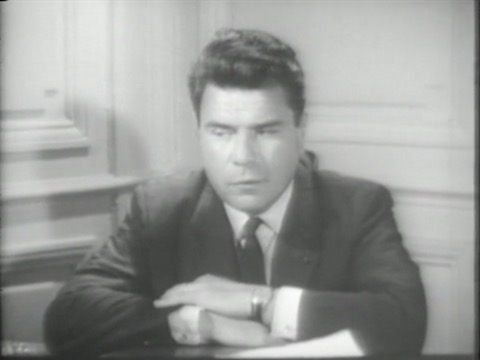
- The emerging political opposition to General Charles de Gaulle, his policies, and the possible effects of the upon the outcome of the December 21, 1965, presidential election in France are examined in this program. From Marseilles, Lyons, and Paris, AT ISSUE reports the diverse views of leading French political figures and, for the first time on television, shows how Gaston Defferres candidacy for presidency was started. Guests include Gaston Defferre, mayor of Marseilles and French Socialist candidate for President, who announced his candidacy for that office in December, 1963; Jean le Canuete, president of the Movement Republican Populaire Party; Jacques de Hamel, spokesman for the Radical Socialists; Jean Ferniot, political editor of LExpress, who tells the story of Defferres candidacy; Dr. Alfred Grosser of the political science faculty at the Sorbonne; He is interviewed by producer Andrew Stern. The host is Alvin Perlmutter. Running Time: 29:12 (Description adapted from documents in the NET Microfiche)
- Series Description
- At Issue consists of 69 half-hour and hour-long episodes produced in 1963-1966 by NET, which were originally shot on videotape in black and white and color.
- Broadcast Date
- 1964-07-13
- Asset type
- Episode
- Media type
- Moving Image
- Duration
- 00:30:16.949
- Credits
-
-
Executive Producer:
Perlmutter, Alvin H.
Guest: le Canuete, Jean
Guest: Ferniot, Jean
Guest: Grosser, Alfred
Guest: de Hamel, Jacques
Guest: Defferre, Gaston
Host: Perlmutter, Alvin
Producer: Stern, Andrew A.
Producing Organization: National Educational Television and Radio Center
- AAPB Contributor Holdings
-
Library of Congress
Identifier: cpb-aacip-2fb9fc72d59 (Filename)
Format: 2 inch videotape
Generation: Master
If you have a copy of this asset and would like us to add it to our catalog, please contact us.
- Citations
- Chicago: “At Issue; 41; After de Gaulle,” 1964-07-13, Library of Congress, American Archive of Public Broadcasting (GBH and the Library of Congress), Boston, MA and Washington, DC, accessed May 1, 2026, http://americanarchive.org/catalog/cpb-aacip-512-bn9x05z598.
- MLA: “At Issue; 41; After de Gaulle.” 1964-07-13. Library of Congress, American Archive of Public Broadcasting (GBH and the Library of Congress), Boston, MA and Washington, DC. Web. May 1, 2026. <http://americanarchive.org/catalog/cpb-aacip-512-bn9x05z598>.
- APA: At Issue; 41; After de Gaulle. Boston, MA: Library of Congress, American Archive of Public Broadcasting (GBH and the Library of Congress), Boston, MA and Washington, DC. Retrieved from http://americanarchive.org/catalog/cpb-aacip-512-bn9x05z598