At Issue; 45; The Negro Voice. Part 2
- Transcript
N-E-T, the Negro voice, show two. The National Educational Television Network presents, At Issue, a weekly commentary on events and people in the news. At Issue this week, the Negro voice, the second of two special programs examining the grassroots view of Negro leadership from Mississippi, Chicago, California, and New York. Talking with local leaders is veteran reporter and staff writer for the New York Post, Ted Poston. America is still shaken from the racial violence the last few weeks. In Rochester, New York, a cautious piece had just been restored. Then the violent nights began in Jersey City.
Following the Harlem rats, our National Civil Rights leaders met in New York. They agreed on goals, but not on tactics. Most of them joined in an appeal to end demonstrations of any kind until after the election, but two dissentant, fearing that the real needs of the Negro people might be ignored. Last week, out of discussion centered on the fact that the problem of civil rights is now truly national. But its solution must be found on the local grassroots level. So today we continue our examination of the situation at that level, in Harlem, in Chicago, on the West Coast and in Mississippi. And participating in this discussion is last week. We have Dr. Eugene Calender, pastor of the famed Church of the Master, and also co-chairman of the Harlem Neighborhood Association. We have Al Roby, Raby, a convener of the Coordinated Council of Community Organizations in Chicago, embracing about 26 civil rights groups. From Mississippi, we have Dr. Aaron Henry, president
of the State Conference of NAACP branches, and an active force in the Mississippi Freedom Party, which hopes to be seated at the National Democratic Convention. From California, we have Mr. D. G. Gibson, who is a political leader and an active worker on all fronts civil rights there. I would like to know, what do you think of the national leadership of the civil rights movement? Are there too many organizations? Have they been successful this far? Or should there be a change? Maybe a consolidation of these groups? What do you think? I personally am comfortable with the president civil rights leadership. I think that they've all indicated that they have a specific role to play in certain areas of the civil rights struggle. One, of course, is well aware of the traditional role of NAACP throughout the 50-ard years of its existence. The Urban League certainly has played a significant role in
the whole area of job opportunities for Negroes. The Southern Christian Leadership Conference has done a magnificent job in the South. The core groups have their own specific kind of program and have done a lot to carry the non-violence technique into northern communities. The student groups that have formed recently have certainly made their contribution through the citizens in the Freedom Rides. I feel that in spite of the differences of technique and approach and the kind of divisiveness that depressed likes to play out, that each of these groups have made meaningful contributions to the entire civil rights struggle. Mr. Gapson, well, I certainly thank you so obvious that we don't have too many problem not enough organizations. It is a matter of understanding and I'm certainly appreciate our present group and because they have the ability to move and work together to organize the forces, understand them and understand what the key problems involve. And it seems to me that we have no trouble with a number of organizations. We are having the trouble
of getting a common understanding and the type of leadership we have now was setting them move on a common understanding. Mr. Raevi? I think there is no problem with the national leadership. I think we certainly have differences of opinion. Sometimes our strategy comes in conflict and yet we come out with the United Front. I think where the lacking or the crying need exists is at the grassroots level that we need to develop more indigenous leadership as is being done in Mississippi and as is being done I think in parts of Chicago to really get the voice of the people that are victims of the problem speaking out to the problem and giving leadership to their communities. Dr. Henry? I think too that we are perhaps very fortunate in having the kind of personalities that we do have at the head of the various organizations that in his own way is able to understand the particular problem and give direction toward the solution. Now when
we come down the gamut of A. Philip Randolph and Martin Luther King and Roy Wilkins and John Lewis and Jim Farman and James Foreman, all of these men are strong dynamic individuals who understand the problem and there will be times when we attempt to attack particular issue with a different method but it all ends up with the focus on the one point of freedom and I think that with the diversity of the people we have in the leadership capacity that it is indeed a fortunate thing that we can go at a problem in many different directions as no one method might be the real solution. Well I think it is obvious that they issued this appeal for we could call it moderation at this time between now and election because they didn't want to create what has been popularly called more of a white backlash that might support Senator Goldwater. Now Goldwater is going to be campaigning all over this country. Do you think that there may be demonstrations
at places he speaks and is there a possibility that some of his far right supporters might attack demonstrators and I think this would help him. Do you think that they should call off demonstrations in that nature? Well I don't completely justify the white backlash as a situation that needs causes so much discussion I think that the black backlash is also a very important entity here wherein the eruption of whatever happened perhaps in Harlem and in Rochester were the results of days of frustration that wherein we had begun to give too much attention to the white backlash and decide that we shouldn't do particular things because we were losing the white liberals in the cause of freedom and this in itself was a frustration within the Negro communities. Just how we should handle the Goldwater situation in Mississippi it's
not really a problem as such because the number of vote we cast isn't going to have much to do with the outcome of the presidential race anyway we are really trying to get up to some of the other problems that the other country has. I was right now trying to get the right to vote wherein we haven't done too well with it. Well I'm glad you mentioned youth because in both the Harlem Erats and in Rochester and in Cipriot Erats elsewhere it has seemed that there have been a large number of youth flown participators. I covered four nights of the Harlem disorders and the youth went in front of who speaks for the youth in this new turn in our situation. I think in the South that the student and violent coordinating committee and the core people in the NAAC people have been organizing and speak for them in the South. I think it's unfortunate that in the north all too often there is no spokesman for the young Negro.
There is no organizing point. I think the role that the students have played, the unfortunate role in the violence in New York and there will play in other areas probably if there is a flare up somewhere else is one that can be understood if one examines the history of the children involved. For example in a Negro community these gangs have been permitted to exist for a number of years without with little concern on the part of the city fathers or the school system or anything else. They've given piecemeal acknowledgement of the fact that they exist but very little else. So that they are quite often pretty well organized. I had a discussion in my class I teach in a difficult neighborhood in Chicago one day about the question of gangs versus the authority of the state or of the city and it took me an hour to convince academically and I'm not sure that I convinced
them at any other level that in fact the government was more powerful in the gangs that they faced in their life every day on the streets and I brought down theoretically the army and put them on the streets after calling out to police force the National Guard and finally the army and they were convinced academically that this was possible. Now what creates an alienation of this kind in these children 14, 15 years old. They have seen that in terms of their fathers or in terms of their own livelihood, in the inability of their fathers or parents to get jobs, the failure of the school system to educate them, failure of the police within their community to protect them from gangs and they have quite often out of self-defense join gangs for self-protection and the whole problem of unemployment among youth there's 30% of unemployed youth in our country among Negro youth is 50% and all these kinds of problems have given them, have caused them to have no confidence whatsoever
in the ability of the state to deal with their problems as they see them and they have no respect for it and I see no reason why they should have any. What is the situation out in California which are you Mr. Gibson? The one of the main factors that have created so much disturbance in California is police lack of interest and that is to say that they are a community neighborhood and they want to be careful that they don't offend the Negroes and they would even at the risk of letting the law be violated. It's created a lack of respect for the police and that for the youth now began to attack the police on the basis of lack of interest in that welfare and you find the youth have just began to organize the state of California just began to put themselves together and they have not established any leadership in the state
of California but they are fast moving into it and they are joining with the forces there and we have a large part, this is important in California because a large part of movement there is a student movement, a large part of the help and the political work that we do comes out of the students coming in and asking for the opportunity to participate. So you have almost the same thing that the Negroes have been in for years. I think a key point that was made by Mr. Rabies remarks is the fact that the Negro youth at least in northern urban community and specifically in Harlem that I know about feel alienated. This is a new animal, this youngster in the cities and in Harlem. A concrete illustration of this as you know it said we have been working for two years to develop this HAU program which is supposed to bring about meaningful social change in the Harlem community particularly with youth. Well it was not surprising to me to see a number of how you associate these
young kids who have been in our program for two years, some 300 of them but a number of these kids were participating in the riot. They were throwing bottles and Molotov cocktails at the police too. These kids express concretely the anger, the resentment, the feelings of frustrations and defeat and sense of hopelessness and they just don't care. A number of us who are older than they are may have made our peace with the situation but these kids are not ready to make that peace with the situation and unless changes come they're going to continue to express their feelings of protest I think through violent means. The whole nonviolent philosophy is not accepted in Harlem. This was obvious yesterday in a meeting that was held where there were the strong viewpoint of retaliation of reaction against the police and even against the so-called leaders in the Harlem community that they're just not going to accept this sitting down a line down and they're not ready to turn
the other cheek they want to fight because they feel this is the only way that they can express the feelings they have. Well Dr. Henry I think your experience with youth has been a little different. Yours have seen more discipline yours and the youths and other stuff in communities. Well have they been an effective force in your fight for civil rights? Yes certainly as the summer program is proceeding the Mississippi Freedom Summer program the youth really is the dominant factor in this program wherein we have been able to attract youth from all over this country that have come in and combined with the local youth and the Mississippi Freedom Summer program is perhaps 98 to 98 percent participated in by the youth. You know even here from New York yesterday it was an occasion of sadness to some degree but certainly an occasion of appreciation. Young Andrew Goodman who was one of the young white fellows who was missing from Philadelphia Mississippi was a student at Queens College when it was not privilege to address a student by the Queens
College trying to get students to come in and I recall very well one of the things that he said to me when we were ready to leave the school that you really convinced me to come on down to Mississippi and you can you can understand the heavy burden here as we had done it with his mother and father yesterday and with the parents of several other children who are still there there was this feeling of what a great contribution these young people have made and what a great price that is also been paid. Maybe the blood of Goodman and the blood of Swariner and perhaps the blood of Cheney is one of the real move in factors that is causing the activity of youth in Mississippi and it's just too bad however that many times the price of freedom has to be purchased with the blood of models and certainly these kids really embalize that particular faction. This is what concerns me but this so-called white backlash you see in the light of the situations that was just mentioned by Dr. Henry I can't understand the so-called white backlash. I think what has really happened
is that basic prejudicial feelings of white people have now been concretized in the light of this strong, insistent, persistent demands and expression of these demands in demonstrations and maybe even in riots on the part of the Negro community. To me the goal water question is not a question for black Americans it's a question for white America for the election or goal water. I think we're only stimuli more of this kind of demonstration and violent activity and if white America wants that then they'll let goal water you see. That's what it says. It says that Mississippi is not a mutation in this country that the racially bigoted oriented people that are so expressive in vitro-productive actions in Mississippi and of course by valid actions too are the same actions and reactions that are taken place in the hearts of white people all over this country and we've got to get back to what perhaps is a basic thing in the thinking of the white community and that
is that many of the white people of this country feel that they are better than any girl god ever made and until we're able to destroy this kind of thinking within the hearts and minds of the white people we are still going to have this reaction whenever the Negro takes a step for freedom. Nothing we can do is the right thing in their minds. I think in terms of the reaction of the white backlash the one in order to engage in nonviolence in order to go through a great deal of self sacrifice in order to involve oneself in the movement has to believe ultimately that the problem is going to be resolved that we are going to we're going to break through the initial crust of white backlash and that we're going to find down deep in the hearts of America that our community is going to want to save itself and that it's going to want to give truth to the American dream. I think if that abiding faith however cynical at times we get we're not there and we could
not have a nonviolent movement and I think that when that when we give America that alternative when we create a situation in which they have to choose between whether we're going to have an America or whether we're going to have a fascist country and which some segment of that population is segregated when which leads gives birth to a system which leads to further segregation and further second-class citizenship that America will choose to make all Americans American citizens with equal rights and that charge before America just in this current situation. I think it is I think certainly at which point every American is going to have to make that decision. I'm not certain that this is it but I'm certain that we're on the road to making that decision. I want to how long are we going to give America this choice. I think time is running out. I am frightened really frightened by the success of Mr. Wallace in the North. I am frightened about the fact that it was California a so-called liberal progressive state that tipped the scales in goldwater's favor. I feel and this may be cynical and not correct for Christian
minutes to say. I don't think that the majority of white people in America like Negroes whether they can't they're here or combed they're here whether they were Ivy League suits or zoots suits whether they're dropouts or PhDs. I think that they don't like Negroes and I think that this will has expressed itself in the goldwater vote in Indiana and Wisconsin and Maryland and in the Wallace vote that is in the goldwater vote in California and when this white man gets behind that ballot box and pulls that curtain there's nobody sees what he's going to do and I frankly don't trust him. I think that this is a very serious situation and I think time is running out in America and frustrations are being built up in the Negro community and I don't think white America can afford to have a goldwater in the White House. Mr. Gibson, how is the situation out in California? Europe was a pivotal state in the Rockefeller goldwater contest. Is there concern there that the goldwater forces may sweep that state? That is concern and deep concern because the fact we have an issue and initiative that will right into the Constitution these
things. We feel that they are such dangers as we must play as we go along and study closely for the reason that we must at all cost prevent goldwater and get elected as out of feeling and we think that our vote at the initiative will be the same vote that he receives and we think that it's a matter of bringing together both white, Negro and Mexican you know in our state there's large numbers of white people that work closely with us. It's a matter of developing a type of election in which that in California we feel is a key state. It's a basic state. It's a state that if the California is carried by goldwater the whole thing is lost. If the housing issue loses in California it's going to spread throughout the nation. So that's the reason that we feel it's deeply important to put the minorities together with the whites that are reasonably progressive and take a look and not say that demonstrations we will stand together on all the means and efforts that Negroes want to provide
in order to meet decision. We must say that if we don't win it then we want to carry it on through to victory. Well the national civil rights leaders also urge that part of the energy of not most of the energy that has been in the movement has been put into it that we should change our tactics slightly and drive for the largest registration of the unregistered that we could have. Does anyone in your own communities has this been taken up? Are there concerted efforts really to get the Negroes registered? What is the situation in Harlem, Narev and Caledon? Where they've opened the firehouses? There have been significant increases in voter registration in the communities of Harlem. I think that we will have the largest number of people voting in a national campaign that has ever voted in the history of the city of New York from Harlem. And I think this is a significant thing. I think the very fact now that the politicians you see responding, for instance, they even bucking the mayor because they feel the Harlem politicians
see this increase in statistics and they are responding to the feelings of the people in the community and I think you're going to get a very large Negro vote against Goldwater from New York's state this year. Chicago. I think that there is no question that the president at this climate of both the Democratic and Republican Party remain the same, that the Democrats do not assume that we have no place to go, which is in part true, but we may not go any place, we may just sit. But given the present climate, I think that there will be increased activity on part of the civil rights movement and part of people in general to register as many voters in Illinois as possible. And this is a very important state for the election because it's a Republican state as such. And there have only been, in the history of Illinois, four democratic governors elected. The state was only carried by 9,000 votes for Kennedy in the last election so that we
feel the tremendous responsibility in this election. Dr. Henry, of course you said your vote won't be large in Mississippi, but it will be significant. Have you made any more progress such that passage of the civil rights bill? Have you made any more progress and overcoming the obstacles that face you down there to get a Negro arrested? Well, no, we have been able to get many more Negroes down to try. But you see, in Mississippi, we also have a law that says that the click doesn't have to tell you whether you passed until 30 days has passed. We have been getting many Negroes down to try since the bill has been signed by the president. But our voice testing period will come around August the 11th, wherein we will have some five or six hundred people in our particular area who will go down to find out if they passed. And we had planned a very definite demonstration based on how the click conducts himself between now and August 11th. At this particular stage,
the game, I don't know really how we're going to perform in, to some degree, in obedience to the the moratorium that has been suggested on demonstrations. Has the presence of the FBI and other federal agents in Mississippi since the disappearance of Goodman and the other two kids? Has that changed the climate any as it improved the situation, any? Do Negroes have any more faith than the FBI than they had before this? Well, in those that have come in from other areas, or we do, but when you look at an FBI agent in my hometown, in any other Mississippi city, and his headquarters is largely in the police station of the city, where he drinks coffee with the police, where he associates and plays bridge with him. And our big trouble in Mississippi is with the local policeman. Now, how are we going to expect any kind of support from the FBI when it's his but it is given us all the trouble that we have? I'm running, excuse me, if I could ask Dr. Henry
a question. I'm concerned that if the Freedom Party is seated, and I hope it will, of course, and every indication that I get seems to be that there's a large movement I know here in New York State to get it seated at the National Convention. What will happen between the regular democratic organization as opposed to the Freedom Party? Will this create violence in the community, will the regular democratic organization move to, shall I say, brutal activity toward those who are participating in the Freedom Party movement, knowing the Mississippi people money? Well, I think that they that there probably will be this action, but this will be normal action this far as we are concerned in Mississippi, because the persons who are involved in the Freedom Democratic Party are pretty much the civil rights leadership of the state, and most of those have been shot at, bombed, and cussed out, and it won't be any different. Well, gentlemen, we have a civil rights law. Of course, there is the problem of enforcement,
but do we have goals beyond that? Where do we go from here? Once we have obtained a certain amount of of and for compliance with the law. What do you think we should shoot for next, Reverend Cavendan? Well, what I would really like to see is meaningful acceptance on the part of the of white America, of the desires and aspirations of the Negro. Frequently, the question is asked, what does the Negro want? As if he wants and making some kind of excessive demands that he really doesn't deserve. The only honest answer to that question is that the Negro wants what every other American wants. He wants an opportunity to have to get a decent education, to work in a decent job, to live in a decent home, to raise his children as good American citizens. That's all he wants, and I think if white America will just understand this, that he wants to be a free person, to move, to live, to work, to play, like any other American, and this is the basic thing, and I know,
for some reason the other doesn't seem to get through to white America. Do you see any goals beyond the present accomplishment? No, I think Mr. Calder has, has Amply suggested all that there are. I would like to suggest though, the measurement for some of these things. For example, in Chicago, we have a housing program for schools, which means absolutely nothing at this point, until it reaches down into the classroom. And I think the successor failure of any program in terms of jobs and housing or anything else, must be measured ultimately. In terms of how many people have you given a job? How many children have, as educational opportunity, has been increased by some given activity, or some given report? And if in fact you can't come back and positively say that this child's reading has increased by a year, two years, or his opportunity, expectations have been increased, then the program is a failure. And I think we have to start measuring programs in Americans to start measuring programs in terms of people, and not in terms of
reports or anything else. I'm sorry, gentlemen, for how time is up, but I wish to thank you for your contribution to this good discussion that we've had. Dr. Eugene Calender of New York, Mr. Al Roby of Chicago, Dr. Aaron Henry of Clark's Dale Mississippi, and Mr. D. B. G. Gibson of Oakland, California. This is NET, the National Educational Television Network. Dr. Eugene Calender of Chicago, Dr. Aaron Henry of Chicago, Dr. B. G. Gibson of Oakland,
California.
- Series
- At Issue
- Episode Number
- 45
- Episode
- The Negro Voice. Part 2
- Producing Organization
- National Educational Television and Radio Center
- Contributing Organization
- Library of Congress (Washington, District of Columbia)
- AAPB ID
- cpb-aacip-512-bn9x05z51s
- NOLA Code
- AISS
If you have more information about this item than what is given here, or if you have concerns about this record, we want to know! Contact us, indicating the AAPB ID (cpb-aacip-512-bn9x05z51s).
- Description
- Episode Description
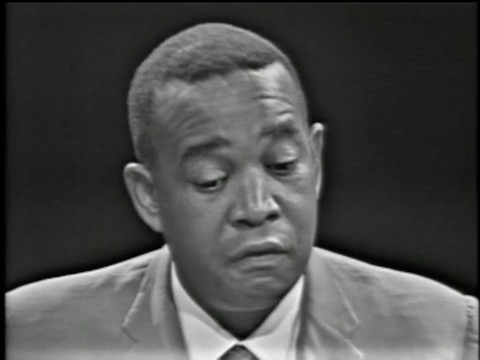
- In the second part of At Issues investigation of the views of local Negro civil rights leaders about the violence and civil rights struggles that have challenged the nation, a panel of four distinguished Negro guest will discuss what the Negro youth think of the what backlash reaction; the progress of Negro voter registration drives; the concerted effort of national Negro civil rights leaders to stop violent rioting and the effect of this upon any future demonstrations; and what the new Civil Rights Act means to the civil rights movement with respect to any future objectives. The guests include Rev. Eugene Callender, co-chairman of the Harlem Neighborhood Association, in New York City, which has pressed for better housing, education, and economic opportunities in our nations largest city; Albert Raby, a leader of the Coordinating Council of Community Organizations in Chicago, a council that embraces 26 Chicago organizations; Aaron Henry of Clarksdale, Mississippi, druggist and National Association for the Advancement of Colored People leader in that state; D.G. Gibson (correct spelling) of Oakland, California, administrative assistant to the Democratic State Assembly members. The host is Ted Poston, reporter with the New York Post, who has covered recent rioting in Harlem. Running Time: 29:23 (Description adapted from documents in the NET Microfiche)
- Series Description
- At Issue consists of 69 half-hour and hour-long episodes produced in 1963-1966 by NET, which were originally shot on videotape in black and white and color.
- Broadcast Date
- 1964-08-10
- Asset type
- Episode
- Media type
- Moving Image
- Duration
- 00:30:40.239
- Credits
-
-
Executive Producer: Perlmutter, Alvin H.
Guest: Callendar, Eugene
Guest: Gibson, D. G.
Guest: Raby, Albert
Guest: Henry, Aaron
Host: Poston, Ted
Producing Organization: National Educational Television and Radio Center
- AAPB Contributor Holdings
-
Library of Congress
Identifier: cpb-aacip-ee1143eb0a7 (Filename)
Format: 2 inch videotape
Generation: Master
If you have a copy of this asset and would like us to add it to our catalog, please contact us.
- Citations
- Chicago: “At Issue; 45; The Negro Voice. Part 2,” 1964-08-10, Library of Congress, American Archive of Public Broadcasting (GBH and the Library of Congress), Boston, MA and Washington, DC, accessed April 2, 2026, http://americanarchive.org/catalog/cpb-aacip-512-bn9x05z51s.
- MLA: “At Issue; 45; The Negro Voice. Part 2.” 1964-08-10. Library of Congress, American Archive of Public Broadcasting (GBH and the Library of Congress), Boston, MA and Washington, DC. Web. April 2, 2026. <http://americanarchive.org/catalog/cpb-aacip-512-bn9x05z51s>.
- APA: At Issue; 45; The Negro Voice. Part 2. Boston, MA: Library of Congress, American Archive of Public Broadcasting (GBH and the Library of Congress), Boston, MA and Washington, DC. Retrieved from http://americanarchive.org/catalog/cpb-aacip-512-bn9x05z51s