Searchlights on Delinquency; 12; Addiction Among Teenagers
- Transcript
I'll see you in the next one. Say, friend, ever see a guy with a big habit when they're ain't a fixin' sight? Ever see one when there's no scratch to make a connection? A guy's credit's no good in this spot. But, and there's always the drug spot on the corner to help out. And there's always the fence to hold that monkey on the junkies back. Watch now, as we focus our attention on narcotic addiction among teenagers, as we put our search lights on delinquency. Search lights on delinquency, a blueprint for action,
produced for the Educational Television and Radio Center, under the supervision of the Sheriff's Office of Cook County, featuring the nationally known criminologist and sheriff of Cook County, Joseph D. Lomond. Tonight's guest is Dr. Edmund Schimberg, consulting psychologist for the Cook County Jail. And now, Sheriff Lomond. It has been noted with General Alarm, the manner in which addiction amongst teenagers and juveniles increased in America during the past decade. Drug addiction, the use of narcotics, the smoking of marijuana, the injection of heroin into the veins, the bloodstream. These have become a major problem in most metropolitan areas of the United States over the past 10 years. For example, in Chicago, there are as many as four,
perhaps 5,000 young addicts under 21 years of age, and about 90% of these are addicted to heroin. Students of the subject have remarked upon the sense in which the problem of addiction is at one at the same time a problem in law enforcement and a problem in medication. They are here emphasizing the sense in which this is something more than a problem in increased vigor on the part of law enforcement agencies. For once a person is addicted, he becomes a victim of his habit. He is enslaved and virtually lives a living death almost to the end of his years. The known instances of persons who have affected cures are few and many of those questionable. And our major preoccupation from the standpoint of treating with the problem
as a medical problem is to achieve some measure of control over those who have become unfortunately addicted. And when we speak of a person as addicted, we're speaking of someone who lives in another world, the world of addiction, held fast by conditions which he cannot overcome and which are beyond his control. Let's look into that world of drug addiction. Inside of it, indeed inside the mind of the individuals who inhabit it. It can be said of a person who is addicted that he reflects three basic conditions. First tolerance, which is to say that the organism becomes adjusted to the intake of a certain amount of a drug. And after a time becomes so adjusted that it no longer thrills him and he needs more. Then there is the sense in which having fastened itself upon him,
there is a physical dependency of the organism on the drug. So that when it is not available, there are withdrawal symptoms. There is anguish, there is agony, and this is anticipated and makes one search for the drug. And even when this is put aside, when there is no longer physical anguish, there is emotional dependence, and this is a condition of the person who is addicted. Tolerance, physical dependency, emotional dependency. Let's look now at an addict as he becomes such. What are the stages through which he passes, the sequence if you please? For some reason or another, an individual may lose the power of self-control with reference to a drug and abuse the drug to such an extent that he or the society of which he is a part is harmed. And this may come about for many reasons. He may just by accident be introduced to the drug, may be persuaded by another.
And one begins in some way to take small doses. But taking these small doses soon challenges the tolerance of the organism. And these small doses no longer give him a lift. This pleasure shooting finds, he finds adequate in the beginning, no longer gives him pleasure. And so he must increase the dose to get his pleasure. The small doses are inadequate. And so he moves from one to four or five shots a day. And as the habit increases in size, he finds that he must get his drugs from other than the customary sources. More and more, he is driven underground. If he has a source of supply, he may find it even necessary to find new and additional and abortive sources of supply. He finds that more and more of his wages go for drugs. And he has less and less for his necessities.
Other things mean less and less to him. What means more is that he has become preoccupied in supporting his habit. And it grows and grows. And as it grows, he finds that he is less capable of performing his work steadily and with confidence. He becomes inefficient. There may be an interruption in his supply, which will disable him for a time. And hence, he may be sick. He may become panicky. This may be accidental. Or again, there may be an intentional withholding of supply. Or again, there may be an overdose, which he unwittingly experiences. And this may make him sick, or as the saying is, put him on the nod. So that he is drowsy and lackadaisical. And as a consequence, does not do his job well. And he may get fired and he may have to seek another one. He loses time. He is inefficient. And as a consequence, he becomes more and more economically dependent, rather than independent. And this means insufficient funds.
And this is circular. It means, again, that he cannot support his habit. He needs to have more money for more drugs. And he has less money for legitimate work. His legitimate employment will not support his habit. He has not sufficient money. And he may need from 10 to 40 to in some instances as much as $200 per day in exaggerated instances. And so he turns to crime. He turns to another easy way to support his habit. It is a form of crime, which is an alternative to his inability to earn by legitimate means the money that he requires. It may involve forging prescriptions if such an avenue is open to him. It may mean forging checks on an innocent and unsuspecting public. But more often, he will begin as he needs to steal even at home. From friends, from family, from neighbors, from relatives, and ultimately from strangers.
And if he lacks the skills in these respects so that he gets caught, he learns from those with whom he associates when he is caught, how to avoid being taken later. And this introduces him to what is all important, namely a world of the traffic of drug. Here he finds persons who like himself must steal. Here he finds persons who like himself must know many outlets. And he moves in this circle. And this is the circle of the person who is addicted. From whom he gets his comfort, his support, his understanding, his sympathy. And from the rest of the world, he gets antagonism and hostility. From the rest of the world, he is rejected and put out. He has been introduced into a world apart. Within the secret chambers of his mind, he is different. And externally, in his association, he is different, he is apart.
And this will hold him fast. As we shall see, as we learn from the lips of one, whose had experience as such as these I have described, as he is interviewed by Captain Richard Boone of the Sheriff's Juvenile Bureau. What sort of habit did you start out with? Marijuana. How long ago was that? In about 1948 or 49. And did you stay on that for any length of time or not? About a year. How did you get on it? How did you get started? Well, a few of my friends were blowing pots. And I started smoking reefers with them. You started smoking reefers with them? Yes. Are these were neighborhood friends? That's right. Did you stay on that or did you graduate to something else? Well, I stayed on pot for about a year, and then I went to service. What happened to me, sir? Well, I didn't mess around with all.
Unless I came in when I was leaves. I had cops. I had cops in pot. It means Marijuana? That's right. And when I got discharged from the service, well, my old friends were using stuff and I started using stuff. You came back to the same neighborhood? That's right. They had graduated to heroin? That's right. Now, when you started using heroin, weren't you a little bit afraid of it? You'd heard a great deal about it, I guess. Yes, sir. I heard about it, but I didn't think I'd ever get a habit from it. You thought that you could keep it under control? Yes. How much did you start with? How much did you use to begin with? Two or three dollars. Did you stay at that level? For about a month, two months. Then what happened? Then I started using it, but anywhere from seven to ten. Did you stop at that level? No, I went on with $35 or $40.
$35 or $40, how often? Every day. Per day? Yes. Well, now, was this an enjoyment that you went through? $35 or $40 a day is pretty expensive for any type of enjoyment, even. Well, I know, and very seldom got high. It was just to keep me normal. What do you mean by that? You very seldom got high. You mean even when you were using that much, you weren't getting high? No, sir. What do you mean? Well, I'd be sick every few hours, and I'd have to have another shot. Well, this was a thing of need. Yes, sir. Well, now, as you got up to that level of $35 or $40, you know that you were going higher and higher all the time. Didn't you ever try to kick it? Did you ever realize what was going on? No, I never paid no attention to it. $35 or $40 a day is quite a lot of money. Were you working at the time?
No. How were you getting the money? Well, for a while, I was. Stealing from my family, boosting them, and then I started dealing stuff. What do you mean dealing stuff? I was selling drugs. You yourself were a seller? Yes. Wasn't it kind of hard to get into that sort of business? No. How did you do it? Well, the connection I had that I was copying from, I told them that I wanted to cut the half-nonsense stuff. And I cut the half-nonsense stuff. I just bagged up and made my own packages. And that way I got loaned. I got loaned half it up. Well, who did you sell to? My friends. From a little habit, on to a bigger habit than a bigger habit, and a habit which needed to be supported, so that in time, he becomes himself a pusher to support his own habit, and consequently contributes to the development, as well, of other habits in other people.
A sickness? Something that rises above the individual's capacity to deal with the problem? Yes. This is the story repeated time and again. And let's turn to one who works with addicts. In an effort to find an answer to their problem, and to assist in society's control of the problem. Dr. Edmund Schimberg, clinical psychologist with a department of neurology and psychiatry of Northwestern University Medical School, and also consulting psychologist at the Cook County Jail, where he is engaged in a program designed to work collectively with narcotic addicts. Dr. Schimberg, are these people sick or is it just a law enforcement problem? Well, as sharp as we see it, they are primarily sick. However, it's obvious that it's also a law enforcement problem. I think they're two sides to the same coin. But I think before we go into any real discussion of this, perhaps if we saw a film we have today, we could talk about it while the film is going on
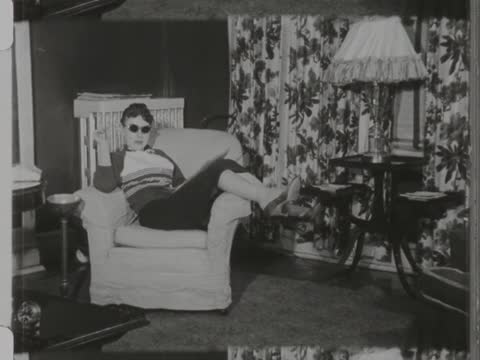
and discuss it a little further later. Let's shoot that film and have you comment on it. Here we see a young lady who isn't actual addict incidentally. Is she under the influence right there? We can assume that she is, yes. And this is a young friend of hers who is calling on her, who at this point is not addicted. He's rather fond of this young lady, and he's coming to visit her today. It looks like an ordinary little petting scene to me. Yes, it does. We'll see as the film develops that it's somewhat more than that. She at this point is a marijuana user.
He uses nothing, and as we've just seen, wishes to use nothing. However, his attraction for her is unfortunately so great, that he will very shortly begin to use a marijuana as we'll see. Is the smoking of marijuana habit forming? It is habit forming, yes. It is not addicting using the terms that you developed a little earlier on this program. Now, this, as we see, is a rather typical pattern with young drug addicts. Association with an individual or with a group becomes so important to the non-using individual that they will begin to use, merely so that they can maintain their association, their affiliation with the group, even knowing what the drug will do. In other words, you can't be a square and belong, and that applies to this as surely as it does, that it's said to a party or some other social event. There's no question about it. Now, here we see the young lady has almost finished the entire cigarette, and yet wants to get every bit out of it that she can.
These cigarettes retail, incidentally, for some way between $0.25 a dollar, depending on the locality. Is it hard for a young person like this to find a supply? Unfortunately, it's not hard. It's extraordinarily easy. Now, we see the time is $7.45, and 15 minutes later, the boy has been using the marijuana, and they are both high, or as the addict says, they've both taken off, and they have the feeling of relaxation, of lassitude, of general ease. Is this on the nod? This isn't a very real sense on the nod, and you can see why they use the term. Now, a few months later, the boy himself has begun to use what the addicts call heavy stuff. In all probability, this is heroin, which is an addicting drug, and the most commonly used of the addicting drugs. At this point, he's experiencing withdrawal, a very agonizing, horrifying experience.
There you can see the track, the little mark, over the blood vessel, the scar tissue that is formed by prolonged use of drugs which are injected into a major blood vessel. Now, in the withdrawal, he's now experiencing cramps. They perspire very, very heavily, there's nausea, vomiting, insomnia, aching joints, and all of these things that I've mentioned in an accentuated degree. Well, I take it, anticipating that agony, is one of the things that controls a person and keeps him on the habit, that is, keeps him looking for the drug to avoid those symptoms. Is that right? Very much so. Very much so. As we saw, or heard in the case, interview a little earlier, even though they no longer get a high, when they're heavily addicted, they must continue to use the drugs to avoid getting sick, to avoid withdrawal. Now, what do we have here? This is one way that an addict prepares a fix for himself, prepares his shot. This addict is emptying the capsules of heroin into a bent teaspoon. Now, after emptying the capsules of heroin
into the teaspoon, he will add some water to dissolve it, and heroin incidentally is very highly soluble in water. And that's right, the solution will be heated, the addict calls this cooking it. After cooking it, he will draw it up into the needle into the eye dropper, and incidentally, this is another common misapprehension that people have. The addicts don't use needles and syringes. They use an eye dropper with a small gauge needle attached to the end of it. It's very easy to conceal, they're very easy to purchase there. Not at all hard to come by. In other words, we won't control the traffic by controlling the sale of hyperternic syringes. I wish it were that simple. There have been proposals of that kind, which shows how young related to the facts some proposals for law and control are. Now, we see he's finished cooking it, and he's drawing it up into the eye dropper, and he'll very shortly inject it. The use of this teaspoon incidentally is one of the niceties
that most addicts don't use. Most of them will use a bottle cap or any other small vessel available to them at the moment. And likewise, using water, although its most common addicts have been known to use other fluids, they use body fluids of any kind in order to cook their fix. Now, here we see the addict, and beginning to inject the heroin into a blood vessel, and you can see the tracks once again. This is obviously a man who's been using drugs for a relatively long period of time now. Now, this man will build up this habit, so he has to take ever larger and larger shots, will he not? Oh, yes. This is, as sure as night follows day. This is what is meant by tolerance. Yes, this is one of the things that we mean by tolerance. The body builds up a tolerance level for the drug. After building up a tolerance level
for a certain amount of drug, the body then requires more, or the body in a very real sense is in imbalance. And so more drugs are required, and the level goes up again and more and more. And as you stated, $200 a day has been seen in a number of addicts as a size of their habit. Well, that interests me again. I think it needs to be pointed out that he takes more drug in order to get the effect, which he sought when he originally took it in small doses. He doesn't get that effect from small doses any longer, so that in order to get that effect, he has to have a larger dose. The small one will no longer do it. Right, and then they reach the point where they don't even get the effect that they used to get from the small dose. They take the drug merely to feel as you and I do right now, normal, if you will. Well, what does this mean from the standpoint of the medical problem? Can we actually get people off the habit? Can we cure addiction? Well, we think we have found that we can. Certainly not in all cases, we wish we could.
But we've been treating people here in Chicago, for example, for the past four years at two of our clinics. For the past three years, we've been conducting group psychotherapy, for example, at the Cook County Jail. We had a two-year pilot project. We didn't rush into this precipitously. We had a two-year pilot project at the County Jail, doing group psychotherapy with addicts. We've covered, pardon me, that. You can treat addicts. You can have successes in psychotherapeutic treatment with addicts as a consequence. We have recently expanded our project. We've added more professional personnel. We've gotten more space at the County Jail to see people. And we're seeing numbers of addicts now. And we think with some success. This is what we've learned from the treatment point of view. Well, in effect, you're dealing with the addict as a member of a group. It seems to be addressing itself to his world, to the social situation in which he finds himself. Too often, I suspect, we're disposed to think of individuals
as complete masters of themselves in the world around them. And in this instance, you're dealing with these objective conditions that obtain around this addict and put them on the side of your effort to bring about a cure of his addiction. Exactly. There's all too common of feeling that the individual in a sense lives in a vacuum. And that all you have to do is take him and treat him. This is not so. We try to treat our patients within the frame of reference that they live in a community. We cannot change the community at this point. Nor can we remove them from the community. And so we try to help our patients to adjust within the community that they must return to when they get out of jail. They'll go back to whatever area to Chicago they're from. How can they best get along in that area and become a healthy, fruitful citizen in society? Thank you very much, Dr. Schimberg. Again, we face the fact that our problems come out of the community and in the community we must find their solution.
For the community is part and parcel of the individuals who are our problems. They reflect in themselves these objective conditions. It has been suggested that to train to change the behavior of individuals directly, merely by admonition, or even wishing that it would be changed by that individual himself, is for the most part no more than magic, no more than a pious hope. Only as we enter into these objective conditions which are responsible for and are reflected in the behavior of the individual, can we indeed change that behavior? The addict is held fast by a social world. He may have come to addiction by some accidental means, by a quirk of fate, by the pressure of friends and neighbors who called him a square,
and he was ashamed. But what holds him fast is the habit that he has developed. The world of which he has become a part, and upon which he is dependent since he has this new condition within himself. The world of drug addiction, and in every addict, there is this condition that we must address, that he finds in the drug a way to get a kind of satisfaction, a kind of thrill, arising out of some prior emotional need or experience. And mechanically, that drug no longer satisfies him. So he must get more to get that same thrill which he earlier got with only a bit of drug. And this is tolerance. It leads him on and on and on. And so he has this physical dependency that follows a point. He must have it or be agonized. Have it or be in misery
and the spectacle, the anticipation of that misery, of the anguish, leads him to run, to seek the drug, to avoid its oncoming. And when its first symptoms come to him, he is panicky as he seeks the drug. And of course, even if that condition is cured, why was he dependent upon a chemical solution of his problems in the first instance? Because emotionally, because in his life, there is something wonking, not satisfied, that society itself must face up to. He has created a new world to deal with his special problem. And that new world must itself be treated and dealt with. For this is his sickness and he is at the very center of it. Drug addiction, yes, a law enforcement problem, a major law enforcement problem. But also a medical problem.
The fall on condition of the addict must be faced as such, if indeed we are to be effective in dealing with addiction as a law enforcement question. Searchlights on delinquency. On another occasion, we will review with you who the delinquents are. From once they come, how they differ, one can other, come with us as we look at the range of different kinds of violation, which are young people exhibit. Searchlights on delinquency. A blueprint for action was produced for the educational television and radio center under the supervision of the Sheriff's Office of Cook County, Illinois, featuring Joseph D. Lohman, nationally known criminologist,
and the Sheriff of Cook County. Tonight's guest, Dr. Edmund Schimberg. A film sequences by Stephen Lasker. Searchlights on delinquency is directed by Thomas Altridge. Produced by Alan Sweetall. Searchlights on delinquency was presented live from the studios of WTTW,
Chicago. This is National Educational Television. The screening led to president Osso Wilson, keynote on delinquency and teaching the studio. From theorousopen mic,
- Series
- Searchlights on Delinquency
- Episode Number
- 12
- Episode
- Addiction Among Teenagers
- Producing Organization
- WTTW (Television station : Chicago, Ill.)
- Contributing Organization
- Library of Congress (Washington, District of Columbia)
- AAPB ID
- cpb-aacip/512-9g5gb1zc22
- NOLA Code
- SLOD
If you have more information about this item than what is given here, or if you have concerns about this record, we want to know! Contact us, indicating the AAPB ID (cpb-aacip/512-9g5gb1zc22).
- Description
- Episode Description
- Dr. Edmund Shimberg, clinical psychologist, joins the Sheriff to discuss the tragic effects of drug addiction among the very young. Captain Boone interviews a drug addict, then Dr. Shimberg and the Sheriff talk of the deep-seated problems that cause young men and women to resort to drugs. Film illustration shows a girl who induces her boyfriend to take marijuana, thus starting him on the habit. In a matter of a few months, the boy is at the point where he steals to obtain money for heroin the final form of narcotics that the confirmed addict turns to for his necessary lift. (Description adapted from documents in the NET Microfiche)
- Series Description
- Searchlights on Delinquency was conceived and developed by the Office of the Sheriff of Cook Country (Chicago) as a means of portraying to the general public information regarding the many myths and false notions concerning delinquency. These episodes are sociological studies of the various kinds of delinquency, their conditions and causes. Sheriff Joseph D. Lohman narrates all the episodes and discusses various phases of delinquency with guest experts on psychology and sociology. Lohman is assisted by Captain Richard Boone of the Juvenile Bureau who interviews delinquents masked for anonymity and gives their case histories. The episodes go further than pointing out what is wrong with the youngsters; they show the whys. The series suggests positive measures for dealing with them rather than the negative qualities of arrest and detention. The series was produced for the National Educational Television and Radio Center by WTTW, Chicago in cooperation with Sheriff Lohmans office. The 13 half-hour episodes that comprise the series were originally recorded on kinescope. (Description adapted from documents in the NET Microfiche)
- Broadcast Date
- 1957-00-00
- Asset type
- Episode
- Genres
- Talk Show
- Rights
- Published Work: This work was offered for sale and/or rent in 1960.
- Media type
- Moving Image
- Duration
- 00:29:42
- Credits
-
-
Guest: Shimberg, Edmund
Host: Lohman, Joseph D.
Interviewer: Boone, Richard
Producing Organization: WTTW (Television station : Chicago, Ill.)
- AAPB Contributor Holdings
-
Library of Congress
Identifier: 2305006-1 (MAVIS Item ID)
Format: 16mm film
Generation: Copy: Access
Color: B&W
-
Library of Congress
Identifier: 2305006-2 (MAVIS Item ID)
Format: 16mm film
Generation: Copy: Access
Color: B&W
-
Indiana University Libraries Moving Image Archive
Identifier: [request film based on title] (Indiana University)
Format: 16mm film
If you have a copy of this asset and would like us to add it to our catalog, please contact us.
- Citations
- Chicago: “Searchlights on Delinquency; 12; Addiction Among Teenagers,” 1957-00-00, Library of Congress, American Archive of Public Broadcasting (GBH and the Library of Congress), Boston, MA and Washington, DC, accessed April 2, 2026, http://americanarchive.org/catalog/cpb-aacip-512-9g5gb1zc22.
- MLA: “Searchlights on Delinquency; 12; Addiction Among Teenagers.” 1957-00-00. Library of Congress, American Archive of Public Broadcasting (GBH and the Library of Congress), Boston, MA and Washington, DC. Web. April 2, 2026. <http://americanarchive.org/catalog/cpb-aacip-512-9g5gb1zc22>.
- APA: Searchlights on Delinquency; 12; Addiction Among Teenagers. Boston, MA: Library of Congress, American Archive of Public Broadcasting (GBH and the Library of Congress), Boston, MA and Washington, DC. Retrieved from http://americanarchive.org/catalog/cpb-aacip-512-9g5gb1zc22