Washington Connection; State of the Union
- Transcript
. . . . . . . . . .
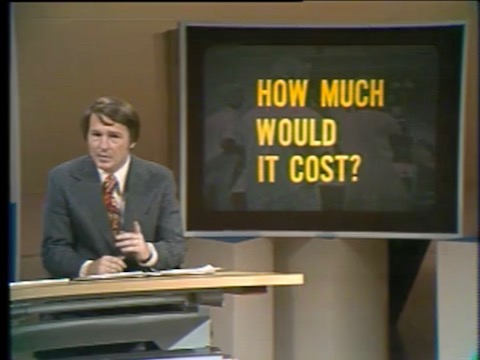
. . Good evening. I'm Jim Lehrer. The name of the series, Washington Connection, with the emphasis on the word connection, tying what people and institutions hear through their effects on the rest of us. This is State of the Unionite here in Washington. Later this evening, President Nixon is to give Congress and the rest of us, his view of our country right now. And further, what he thinks ought to be done to resolve its problems. Now, big to do is usually been made about the State of the Union messages, particularly since they went on primetime television a few years back. But above and beyond the presidential rhetoric,
brilliant or not so brilliant, depending on the president and the viewers' point of view, what does a State of the Union message mean to most of us? Or to borrow from our title phrase, what's the connection between these TV spectaculars and anything that really matters in our lives? Well, we're going to examine that question a bit tonight, looking ahead a few hours, as well as backward a few years. Beginning now, with a look at the special circumstances surrounding tonight's message by President Nixon. Impact correspondent Peter K. is in the Capitol Building right now. Peter? President Nixon, who is fond of making history, will make a little up here at the Capitol tonight. About 100 feet from where I'm speaking now, Mr. Nixon will become the first American president, ever to deliver a State of the Union speech to a Congress that is actively considering his impeachment. Now, it would be laboring the point to say that this is an important speech for the president. Not only will Congress and the country very closely listen to what he has to say, they will also pay close attention to how he says it.
The President hasn't made many public appearances lately, and there are increasing reports that he has tired, depressed, even ill from the pressures of Watergate, although the White House denies this. So tonight's speech then will take on a life of its own. It will be remembered not just for the programs proposed or the issues ignored. It will become a landmark in the political life of Richard Nixon, and it will have a chapter of its own when the history of these troubled times is written. What Mr. Nixon is doing tonight has its roots in the Constitution, which provides that from time to time he give to the Congress information of the State of the Union, and recommend to their considerations such measures as he shall judge necessary and expedient. George Washington started the practice of appearing personally before Congress each year, but it didn't last for a very long. Our third President, Thomas Jefferson, stopped what he considered a king-like ceremony when he came to office in 1801. Instead, Jefferson sent down a written message,
and that President was followed for more than a century until 1913, when Woodrow Wilson delivered his first annual message in person. Since then, written messages have been rare. President Eisenhower appeared before Congress for most of his annual messages, but both he and President Nixon did have one State of the Union and delivered to Congress. In 1972, Mr. Nixon broke with tradition to deliver two State of the Union messages, and in person addressed to Congress in a 15,000-word elaboration of his speech. The first President to speak at night was Franklin D. Roosevelt in 1936. Over a strenuous Republican opposition, Mr. Roosevelt persuaded Congress to convene at 9 p.m., rather than noon, so he could capture a large radio audience. Lyndon B. Johnson delivered the first televised message at night in 1965, and that has been pretty much the pattern ever since, including tonight's speech. Traditionally, State of the Union messages have dealt primarily with domestic affairs. Generally, they are followed by the President's specific legislative programs.
It is not unusual for President to use the State of the Union speech to announce dramatic new programs. In 1962, President John F. Kennedy used this forum to lay out new proposals in civil rights. But there is much more to be done by the executive, by the courts, and by the Congress. Among the bills now pending before you, on which the executive departments will comment in detail, are appropriate methods of strengthening these basic rights, which have our full support. The right to vote, for example, should no longer be denied through such arbitrary devices, on a local level, sometimes abused, as literary tests, and as poll taxes. As we approach the 100th anniversary next January of the Emancipation Proclamation,
let the acts of every branch of the government and every citizen portray that righteousness does exolder a nation. A constitutional amendment abolishing the poll tax and federal elections was the only positive outgrowth of President Kennedy's message on civil rights. It was ratified by the necessary three-quarters of the states in January 1964. Legislation easing literacy test requirements was filibustered to death in the Senate a few months after the President spoke. Now, although President Kennedy was unable to push his major civil rights legislation through Congress, landmark bills were signed into law by his successor, Lyndon Johnson, who in 1964 used the State of the Union to announce a major program of his own. And this administration today, here and now, declares unconditional war on poverty in America. And I urge this Congress and all Americans to join with me in that effort.
It will not be a short or easy struggle. No single weapon or strategy will suffice. But we shall not rest until that war is won. The richest nation on earth can afford to win it. We cannot afford to lose it. $1,000 invested in salvaging and unemployable youth today can return $40,000 or more in his lifetime. Poverty is a national problem requiring improved national organization and support.
But this attack to be effective must also be organized at the state and the local level and must be supported and directed by state and local efforts. For the war against poverty will not be won here in Washington. It must be won in the field in every private home, in every public office from the courthouse to the White House. President Johnson's war on poverty first took form in the Economic Opportunity Act of 1964. This was a $1 billion measure that set up the Office of Economic Opportunity in the White House. Despite complaints about OEO management, its budget was increased every year that Mr. Johnson was president. Republican opposition was unsuccessful until Richard Nixon was elected president in 1968.
Under Mr. Nixon, all but three OEO programs have been transferred to cabinet level departments. And in 1971, Mr. Nixon used the state of the Union speech to call for a more Nixonian program, new federalism. The time has now come in America to reverse the flow of power and resources from the states and communities to Washington and start power and resources flowing back from Washington to the states and communities and more important to the people all across America. The time has come for a new partnership between the federal government and the states and localities, a partnership in which we entrust the states and localities with a larger share of the nation's responsibilities and in which we share our federal revenues with them so that they can meet those responsibilities. Underline, this new federalism was a plan called revenue sharing, to pump federal funds directly into the budgets of state and local governments.
A year and a half after Mr. Nixon's speech Congress agreed to a compromise plan of revenue sharing. This set up a five-year program to divide $30 billion in federal revenues with local governments. The action marked the major victory of the Nixon administration in domestic affairs. It was the only one of six major goals outlined in the President's 1971 state of the Union speech to be enacted into law. One of the six great goals that didn't make it in 1971 was Mr. Nixon described as a far-reaching proposal to improve America's health care. He is expected to renew the health care appeal tonight along with major proposals for mass transit and a negative income tax. But of all the domestic issues that the President will cover in tonight's speech, none has more potentially dramatic and personal consequences than health care. So we're going to focus briefly on that issue this evening.
What is the President likely to propose and what will it mean to you? Peter, what is apt to be the difference between what Mr. Nixon proposed in 1971 and what we're going to hear tonight? Well, the reason Jim that Congress didn't act on Mr. Nixon's bill in 1971 is that most members believed it was inadequate. As a result, the program that the President will present tonight is far more comprehensive, a $40 billion a year plan to provide basic health care for most Americans. And if enacted, it would have an effect on doctors, hospitals, and insurance companies, all parts of the nation's $94 billion a year medical care industry. Now some say the program would be inflationary, it would cost $5.6 billion in new taxes, and certainly it would place a new burden on employers. But most important, it would have a direct impact on you, on your pocketbook, your health, even your life. So Jim Lara, let's look beyond tonight's state of the Union speech and explain just how this plan would work. For starters, who would be covered?
Almost everybody. According to William Morrell, the assistant HEW Secretary in charge of planning the program, there are four ways that Americans would get health insurance under this plan. Those on a payroll and their families would be covered under an insurance plan financed by the wage earner and his employer, family whose income is less than $5,000 a year would get the same plan financed by the government. Those who are self-employed or who retire before 65 would have a choice. No health insurance, a private plan, or participation in the government program at a cost 50% more than what they would pay if they were working for someone else. And finally, those over 65 would continue to participate in Medicare, but that program would closely parallel the new plan. How much would it cost? Well, the premiums might be a little higher than what you normally pay for health insurance now, but the protection against costs of catastrophic illness or injury would be much greater, specifically. Wage earners would pay 25% of the health insurance premium and their employers the other 75%. There would be $150 deductible for each person covered up to three in a family, but once the families out of pocket medical expenses exceeded $1,500 in a single year, the insurance policy would cover everything else.
What would we get for our money? Civil care, doctor services, including family planning, maternity, and well-child care, drugs for children under 12 eye examinations, eye glasses, hearing aids, and dental services, limited treatment for mental illness, and up to 100 days of home nursing care. Who provides the insurance? The present private insurance companies in most cases, either under agreement with employers or under contract with state agencies. The minister is the program, state governments, under new federal guidelines that enables the Department of Health Education and Welfare to set standards. Is there a way of controlling costs? Yes, both of insurance companies and of doctors and hospitals. One provision of the program that is sure to arouse controversy is a fee schedule for positions. Now, what if I belong to a health maintenance organization? You're covered. Everyone has the option of using prepaid clinics as well as private physicians.
And that, in very basic form, is the administration proposal. It represents one, but not the only approach for improving health care for all Americans. As a matter of fact, when this plan comes up here on February 5th in the form of a presidential message, it will be the eighth health bill before Congress. The others run the ideological gamut from a proposal by the American Medical Association, which would not change the present delivery system to the Kennedy Griffiths bill, which would change it completely. Now, almost everybody agrees that some days soon there will be some sort of a change. The question is, which approach will Congress take? Will it be a partnership with private industry as proposed by the administration? Or will it be Senator Kennedy's proposal for a universal health care program completely under the federal government? To discuss these opposing philosophies and to help assess the mood of Congress this year, our Senator Edward Kennedy, Democrat of Massachusetts, and Senator Robert Packwood, Republican of Oregon, who will sponsor the administration bill in the Senate. Senator Packwood, you haven't always supported everything the administration comes out with. What impels your interest to take this on?
Peter, I think it's a good bill or a part of it that I don't agree with, but the bulk of it I do, and I think the time for health insurance has come. My hunch is it's going to pass in this year, and this is as good a proposal as is in yet. And that's why I volunteered to carry it even though you're right from time to time. I have disagreed with the administration on a number of major things. One reason that a lot of people indicate something may come out and like this bill or something very much like it is that much of the medical industry is afraid of something like Senator Kennedy's bill. Senator, do you think you're being a catalyst for the administration to get its bill through? I think that the overwhelming majority of practicing doctors support a health insurance program that's going to guarantee to the American people quality health care at a price that they can afford to pay. The principal disagreements that those of us who have supported health insurance have been the organized medicine, the AMA, and those of us who served in the Congress have found a time and again that they really haven't spoken, for the overwhelming majority of physicians or for the American people. So I'm hopeful along with Senator Packwood that this is the year of health.
I think the American people want to feel that they can receive quality health and they want to be able to afford it for themselves and for their children. And I think we have a most serious responsibility to guaranteeing them that opportunity. Let's see if we can delineate the philosophical differences between your two approaches. I presume Senator Kennedy that you still favor a program of government social security health care. That's right. What we're really talking about here is building upon a system which has the confidence and trust of the American people, the social security system. We hear a great deal sometimes offered in criticism that the Health Security Act is a national program. Well, it's national in the sense that social security is national. And that has the confidence and trust of American people. And what we're going to do is use that as the financing mechanism. The only real difference it'll be is that the bills will go through the social security system, which only takes about three cents out of every premium dollar out of four health insurance as opposed to the private insurance companies, which have a responsibility to their stockholders.
And last year retained $3.3 billion that were paid in private premiums. I want to see that that amount of money that $3.3 billion invested in quality health care and trying to do something about the problems that we're facing in rural America and urban America and in the suburbs. I'll be more with Ted a bit if I can, Peter, because he's put his finger on the philosophical difference. Are you going to write out Blue Cross, Blue Shield? Are you going to write out the equitables and the etnism? Everybody else who provides health insurance now and have this insurance written directly by the government. Let's face it, the only two examples we have in the country today of what you or I might call government medicine is the veterans administration and the public health service medicine for Indians. That's the kind of medicine we're talking about giving to this country. I hope we don't fasten that system on our country.
Ted talked about some statistics. He said 3% on social security and Ted's right, but what he's quoting is not the Medicare part of social security. Ted, what you are talking about is the payout on the annuity, the old age. There's very little discretion. Are you 65 and have you worked enough quarters to get money? If you're talking about where do you get more for your dollar out of the Medicare section of social security or out of private health insurance, you get more for your dollar, you get more money put back in the payment to benefits out of private insurance and you do out of social security Medicare. I just wonder how the private insurance companies are going to be able to succeed if they're not in the business to make a profit. Every time they pay out a claim, they have to make a profit. Now, if I can just finish it. We in this country do not have a system of public education that is for profit. You know, if you've said that what we ought to have is a public education system to educate every child in the primary and secondary schools, a public education system.
We don't permit a profit making because we feel that the education of the young people is too important to leave to private industry. I think a decent quality health care is too important to leave towards a private industry that has their responsibility of making a profit and passing this on to their stockholders. We see what happens with the oil companies, major oil companies are in there to make a profit and how we have found exploitation and I don't think in terms of trying to provide decent health care that we ought to have the partnership which is a part of the administration's program which permits the very extensive of private profiting out of health in this country. We're going to prolong this phase of the discussion all night and we don't have much more time. Let's look ahead a little bit. There are, as I mentioned earlier, some eight bills running a complete philosophical gamut before Congress. There's a long ribocoff, the AMA, the two bills you mentioned.
You said earlier you thought some sort of bill would come out of this session. Do you think everybody can get together on something? I think that will be a combination of the administration's bill. I frankly don't think that Ted's bill is going to make it as my assessment. We are going to have complete medical coverage. Overwhelming bulk of the cost will be paid for by employers or the government. But I think the private insurance companies will remain in the field. Senator Kennedy. Look what's going to happen on the course. You're going to have to pay the first $150 as a deductible and you're going to pay 25% for every co-insurance. And that's going to be for every member of your family. Now say you're up to three. Say you have a child. You call your pediatrician. It's $15. You're going to have to take that child of the pediatrician ten times to get the $150 before you're going to be able to have that bill even paid for. And beyond that, you're doing absolutely nothing about the maldistribution of health care. If the, not a doctor there, the administration's bill isn't going to help you.
It's not going to do anything about the parent that calls up the doctor and finds an answering service. Or those that live in rural communities or urban areas that haven't got access to doctors today. This administration bill doesn't do anything for that. And that's part of the problem. It isn't only a question of cost. It's a question of making sure you're going to be able to have the health personnel and the facilities to deliver that service. And this is a part of the problem. Senator, you kind of finesse my question. Do you think we'll get a bill out of Congress this year? I hope so. And I'm willing to work with Senator Packwood. He served on the health committee. And the administration couldn't have a finer spokesman. Thank you. Gentlemen, thank you so very much. It looks as if we at least have agreement on the future progress. And based on what you gentlemen say, it is indeed possible that some kind of health care legislation will make it out of this session of Congress. Spurred on partly at least I suspect by Mr. Nixon State of the Union message tonight. Because all of this definitely would affect us all. It's interesting to overlay what some recent public opinion polls have found in this area of health care.
A recent Roper poll noted that 90% of us are now covered by health insurance. Although 80% feel satisfied with the quality and availability of medical care generally, 55% think medical costs are too high. As for changes, the polls showed an almost even division of those choosing a government plan over those choosing private insurance with a slight leaning towards private plans. There's another poll which adds further dimension to the specific question of health care as well as to the overall state of the union and the people in it. A Harris poll showed economy and inflation, the average Americans number one concern, with integrity and government a solid number two, then came crime, drugs, welfare reform, pollution ecology, taxes, and on down the line. On down the line, in fact, to the concern which was named next to the bottom and importance, health care. The message is obvious. There are many other things on the public mind which go to the heart of the state of this union right now, and how President Nixon does or does not deal with them tonight could ultimately dictate what history says about his total presidency.
Now, one closing thought about state of the union messages generally, a further dose of healthy perspective. We noted earlier, Mr. Nixon's one out of six goals record for 1971 that President Kennedy civil rights efforts didn't really make it. Many believe because Kennedy talked a great game in the speech but didn't follow his words with very much hustle. But there have been some even larger eggs laid, fancy state of the union rhetoric that went through the test of time and for a variety of reasons turned out to be just rhetoric. For instance, President Herbert Hoover predicted on December 3rd, 1929 that the worst of the depression was over and everything was just fine. 18 months later, the unemployment rate had jumped five times, 5,000 American banks had failed and over 32,000 businesses went bankrupt. Warren Harding also had a minor vision problem. In his 1922 state of the union message, he told Americans to buckle down to the permanent reality.
That prohibition was here to stay and that there was no chance that the 18th Amendment would ever be repealed. It was repealed in 1933. William Howard Taft suggested in 1912 that cabinet members be given seats in Congress with speaking privileges in order to remove the alarming separation that was growing between the executive and legislative branches of government. Interesting and light of current problems is it not. Now three presidents, Ulysses Ask Grant, Grover Cleveland and Theodore Roosevelt, used state of the union messages to wax eloquently about the evils of polygamy. Cleveland proposed a prohibition against the immigration of Mormons to our shores. Roosevelt suggested a federal divorce law that would somehow come to grips with the problem and Grant called for a law that would simply banish polygamy from the land. And then added, and I quote, while this is being done, I invite the attention of Congress to another, though perhaps no less an evil.
The importation of Chinese women, but few of whom are brought to our shores to pursue honorable or useful occupations. A few final bits of state of the union history to insert into the record tonight. Reminder from last week that we're still inviting mail about your mail for an upcoming story on the state of the U.S. Postal Service. Our address once again, Washington Connection, box 300, Washington, D.C. 2044. Until next week, for impact, I'm Jim Lara. Thank you and good night. .
. . Washington Connection has been made possible by a grant from the Ford Foundation. This has been a production of N-Pact.
- Series
- Washington Connection
- Episode
- State of the Union
- Producing Organization
- NPACT
- Contributing Organization
- Library of Congress (Washington, District of Columbia)
- AAPB ID
- cpb-aacip-512-901zc7sz0w
If you have more information about this item than what is given here, or if you have concerns about this record, we want to know! Contact us, indicating the AAPB ID (cpb-aacip-512-901zc7sz0w).
- Description
- Description
- No description available
- Date
- 1974
- Media type
- Moving Image
- Duration
- 00:30:26.492
- Credits
-
-
Host: Lehrer, Jim
Producing Organization: NPACT
- AAPB Contributor Holdings
-
Library of Congress
Identifier: cpb-aacip-f440dec7432 (Filename)
Format: 2 inch videotape
Duration: 0:30:00
If you have a copy of this asset and would like us to add it to our catalog, please contact us.
- Citations
- Chicago: “Washington Connection; State of the Union,” 1974, Library of Congress, American Archive of Public Broadcasting (GBH and the Library of Congress), Boston, MA and Washington, DC, accessed January 18, 2026, http://americanarchive.org/catalog/cpb-aacip-512-901zc7sz0w.
- MLA: “Washington Connection; State of the Union.” 1974. Library of Congress, American Archive of Public Broadcasting (GBH and the Library of Congress), Boston, MA and Washington, DC. Web. January 18, 2026. <http://americanarchive.org/catalog/cpb-aacip-512-901zc7sz0w>.
- APA: Washington Connection; State of the Union. Boston, MA: Library of Congress, American Archive of Public Broadcasting (GBH and the Library of Congress), Boston, MA and Washington, DC. Retrieved from http://americanarchive.org/catalog/cpb-aacip-512-901zc7sz0w