News in Perspective; 92
- Transcript
I don't know if I'm going to be able to do it, I don't know if I'm going to be able to do it, I don't know if I'm going to be able to do it, I don't know if I'm going to be able to do it, I don't know if I'm going to be able to do it, I don't know if I'm going to be able to do it, I don't know if I'm going to be able to do it, I don't know if I'm going to be able to do it, I don't know if I'm going to be able to do it, I don't know if I'm going to be able to do it, I don't know if I'm going to be able to do it, I don't know if I'm going to be able to do it, I don't know if I'm going to be able to do it, I don't know if I'm going to be able to do it, I don't know if I'm going to be able to do it, I don't know if I'm going to be able to do it, I don't know if I'm going to be able to do it, I don't know if I'm going to be able to do it, I don't know if I'm going to be able to do it, I don't know if I'm going to be able to do it, I don't know if I'm going to be able to do it, I don't know if I'm going to be able to do it, I don't know if I'm going to be able to do it, I don't know if I'm going to be able to do it, I don't know if I'm going to be able to do it, I don't know if I'm going to be able to do it, I don't know if I'm going to be able to do it, I don't know if I'm going to be able to do it, I don't know if I'm going to be able to do it, I don't know if
I'm going to be able to do it, I don't know if I'm going to be able The following program is from NET, the Public Television Network. In a month filled with dramatic developments, the Middle East again came into sharp focus with spy trials and hangings in Iraq. In Paris, the expanded Vietnam talks finally started around a big round table, but so far it has been the same harsh words and no progress toward peace. The fighting meanwhile slogged on and the big question now is whether the enemy will try another offensive during the Tet holiday later this month. In Prague, Czechoslovak's flocked to the funeral of Jan Pollock, a youth who set himself a fire as a protest against Soviet occupation. The resistance goes on.
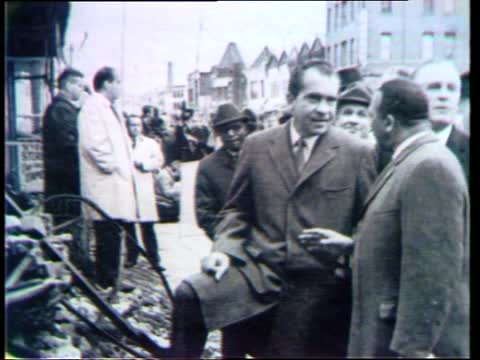
Spain suddenly popped into the news, the Franco regime imposed censorship and other restrictions to end a liberalization trend. Spanish students staged protests such as this in London. At home, of course, the Nixon administration took over, but there's been relatively little headline news as the president consolidates his position on Capitol Hill and elsewhere. President Nixon, however, gave his special attention to a domestic issue, crime and poverty in his new backyard, the nation's capital. And much of the nation's attention was drawn to the Pueblo inquiry, which raised questions about pelagon policies, navy traditions and the behavior of our servicemen under pressure. These then were the big news events of the month, a month when foreign problems over shadowed domestic activity. From
New York City, Wednesday, February 5, 1969, news in perspective, presented by National Educational Television and the New York Times, with Clifton Daniel, managing editor. Tom Wicker, associate editor. And Max Franco, chief of the Washington Bureau. Now, Mr. Daniel. Crime in the streets, stalemate in Vietnam, tension in the Middle East, repression in Czechoslovakia and Spain. It sounds like the same old news, which is really rather remarkable when you consider that we are in the first month of a new administration in Washington. By this time in 1961, John F. Kennedy was already making big headlines like this one in the New York Times on February 3. Kennedy Recovery
Plan asked increased benefits for aged and extended aid to jobless. In 1953, President Eisenhower was equally active. Eisenhower frees John to raid mainland, Bids Congress void all secret packs abroad, and so on. As of the same date in 1969, President Roosevelt, President Nixon, had made no headlines in the times bigger than these. President Nixon, the economist of London, said, President Nixon aims to lead Americans forward together. But where is he going to lead them? He still has not said what he's going to do. Max, you yourself said in the times the other day, that the President seemed unhurried and content, that he'd simply given in order to stop everything. When can we expect some orders to go ahead? Well, we're getting some at the moment, but I think they still fall in the category of cleaning up business.
The President has asked Congress now to ratify the non -proliferation treaty, which we've signed with 80 other countries. There are indications that he's going to move in the direction of proposing electoral reforms and tax reforms. I think we'll get some more efforts to make good on his effort of promise to look into crime in the country. But I think it all fits still into the general category of cleaning up, conveying a sense of order, reorganizing the government, making sense as the Republicans call it out of some of the Johnson programs. I think it'll be a long time yet, at least domestically, before we get a clear sense of direction. I think we'll have a long period of experiment and reorganization and reappearance. Tom, what's the purpose of this relax of dude beginning? Why would the President start out this way? Well, of course, I'm not unable to read his mind that sense, but I was just thinking as I watched those headlines flashing the screen after all, you know, Chong never did really raid the mainland, as I recall. And I remember that Kennedy
Recovery Program, and not all that much came of it, and in the scope of in the eight years since we can see that that was not really one of the great economic developments of the period. And I wonder there if perhaps the Times didn't place a little bit larger headlines on those things at the time than it wanted. But the point that it really brought to my mind was the question. You have one of those stories that you're suggesting that it was overplayed. I may have, but I wonder if there isn't something to be said for the kind of approach Mr. Nixon has made, because what those headlines do suggest is that a lot of what a President or any... Public leader does is the new jargon word in Washington is cosmetic. I mean, it's done to create an appearance of things, and the appearance is not always too close to the reality. And it may be, one has to suggest this of any politician, but it may be that Mr. Nixon just decided not to fool around with that much cosmetics this time. And try to form
an impression that would be, I think, genuine in this case, that his will be a methodical and a painstaking and a cautious administration rather than... Do you agree with Herb Klein, the President's Director of Communications, who said that the President's cool manner has made a good impression in the country then? Yes, I think that's true, by and large. There will be political content to this John Kennedy, after all, came into power with not only the campaign theme, but I think as far as he goes in the Democrats' sincere conviction that the Eisenhower administration had let things go too slow and too calmly and too contentedly, and get the country moving again and so on. And so you create a little bit of a razzle dazzle in the first 100 days to show the country that you meant it and you proposed a whole sweeping set of programs. Mr. Nixon came in under precisely the opposite circumstances. He said the country is in turmoil now. Let's calm down, let's stop. Well, you think there's a deliberate effort here to achieve a change of pace after what we might go the frenzy of the last
year and the compulsion that seemed to be driving the Johnson administration. I think that's true, but I think we might not have had that if it hadn't also suited both Mr. Nixon's personality and I think the political imperatives. He doesn't have more than thin margins in many directions. He's got a Democratic Congress, he's got to hoard the goodwill he's got there. He's a minority president in terms of the electoral results, the mandate that he received is not clear in any policy direction, and he's got to get the war over as a really first product. Well, now you've mentioned something that seems to me to be relevant, however calculated the president's behavior and policy may be. He has had the benefit of the fact that events, and I might say the Russians of whom we will hear more later on this program, are making it easy for the president. How long do you think it's going to continue to be easy, Tom? When are events going to require the president to act more vigorously? Well, obviously it will be sooner rather than later, just in the nature of the case. He's already expressed his own very sharp concern over the Middle East. He is no doubt going to
go to Europe quite soon. There are all sorts of things that will just be bound to generate action. But I think there's one thing ought to be noted in all, is the political imperatives, as Max say, fit a period of quietude here, but at the same time in the nature of the case, a period of quietude, of organization, of getting yourself together, of surveying what your problems are, and thinking out what you might have to do about them and might want to do about them. In the nature of the case, that's more nearly genuine than a period when you come in and try to create the appearance of a flurry of great activity, so that it may well be that the political imperatives for once are serving as well, in that an administration is going to, because it's good politics for it to do so, the administration really is going to get started on a more less firm basis rather than having to launch itself right into affairs overnight. There's an interesting debate among young Republicans
in Congress and out around Washington as to just ideally speaking how long it would be ideal to keep this up. Some are genuinely worried that any president has a year's honeymoon, both with the people and with the Congress, that some of the urgent domestic problems requires conveying a sense of conviction and urgency, and when is the right time to get off this cool, to stop cooling, to stop whispering, is becoming a subject of discussion. Well, let me, on that point, quote, the economist once more. They said the other day after eight years of dynamic government, a pause to take stock, to tidy up, is undoubtedly desirable. But they add, using the words you use, it's good to cool off provided one doesn't freeze to death. Speaking of events pressing in on the president, which they very well may max, what event is going to press in on him most quickly, most directly, most firmly? What's the first priority in his program? First priority in the sense that he can directly do
something about it, and it's not something unexpected that pops up here there around the world obviously is the war in Vietnam. It has soured the body politic in the United States, it has spoiled our relations with many countries in the world, more importantly, it has eaten up an enormous part of our budget. And if he is going to do anything meaningful domestically, and if he's going to give his administration a new tone, he must move, not precipitously, but at least fairly steadily, and with a clear sense of priority, to end that war, at least bring it down to a level where, no longer has that effect. Speaking of the ending of the war, you'll notice Tom that the president was very cautious in his first press conference about forecasting an end to the war. He simply said we have a new team in Paris, a new sense of urgency, a new direction, new tactics. But so far, of course, no new successes. Have you in Washington seen, in fact, in new ideas and new tactics emerging as yet? Yes, I think the
notable example was that when it is first press conference, Mr. Nixon very obviously shied away from talk of a ceasefire, which had been a, and gave the reason for it. He specifically eliminated that. That's right, but this has always been a part of the routine part of the Johnson administration formulations. And I think that was salutary in that, if it was salutary, if it represented, and I believe it did, and Mr. Nixon and his associates minds, a clear understanding of a clear approach to the kind of war that that is, because it is quite true that a ceasefire is not a practical proposition in a guerilla war of that kind. So that was one example, and I think there is evidence, I think, to show that the thinking of Mr. Kissinger on the approach to just the tactical situation in Paris is what is now dominating the administration. I think the ceasefire come in representing an effort to de -escalate the rhetoric as well as the war. There have been a lot of grandiose proposals about what we could do, and this surrounds any
diplomatic negotiation. But Mr. Nixon is really saying, let's get down to keeping even the public discussion on the level of what's possible. In terms of what is possible in tactics, I think he's not yet satisfied. He seems to be throwing some very provocative questions to the bureaucracy and to the military. It's such a pace, I gather, that in many ways they can't themselves take a new look, that they have to answer with some of the stock material on hand. But he's urgently asking, what's our real position on the ground? How do we know we control this much territory or so many people? What he seems to be trying to do is, if I have to end this war, my diplomatic tactics have to match my real situation on the ground, and I don't want to take past analyses of what my situation on the ground is as gospel. I want to be satisfied that my figures and statistics and advisors are right. Meanwhile, I think we hear from Paris that in the middle of that big round table at which the two sides are sitting, there has been found some common ground. I don't think we've been allowed to know what it was yet, and I must say I find it hard to imagine.
Have you had any indication max that there has common ground been found on any material point? None, except I think procedural. Now procedural can be very important. If there is an indication at least of a willingness to go off and meet in private and begin to find common areas that have been mentioned in both parties formal presentations, and let's throw away the areas where we disagree, but here we both seem to be talking about the Geneva Agreement of 54. Let's see if we can begin to talk about it. That kind of thing. Out of such procedural triumphs, petty as they may seem, come agreements. That's what happened last year. Marshall Key, I think, said that he was ready to talk privately with Hanoi, and that may be one of these procedural steps that you are talking about. Yes, although I'm a little worried about the tone that he used, because the South Vietnamese have long been trying to use that ploy of gracious offer to talk as a way of forcing Hanoi to recognize them as the one and only authority in South Vietnam. So I'm not sure whether that was quite as much progress as he said it
was. Let's turn from a moment to another negotiation. Actually one that's been concluded in now waiting ratification. That is a ratification of the treaty to control the spread of nuclear weapons. Does this mark a step forward? Is this going to lead to a further, shall we say, advance in international negotiations and discussion? Well, I would think so that the nuclear non -proliferation treaty has, it presents its difficulties too. There are many countries that are not entirely happy with it as you know, West Germany in particular. But it seems to me that the non -proliferation treaty has always been a necessary building block towards some following on the nuclear test band treaty. The building block towards a broader arms limitation, a broader discussion of this whole question between the Soviet Union and the
United States. Mr. Nixon never suggested, I think, at any point that he was opposed to the non -proliferation treaty. The slowdown followed a slowdown ratification followed the Czechoslovakian crisis of last year. Well, this means I would assume that Mr. Nixon is now willing to put that in the background, or he thinks it has ceased to be an acute issue, and willing to proceed with discussions with the Soviet Union on this and other questions. Well, I think willing to put it in the background, probably, I put Czechoslovak in the background, probably expresses it correctly, and it's difficult to see how you could go on to what is obviously the major question in this whole area, which is nuclear arms limitation agreement with the Soviet Union. You couldn't conceivably go on to that until you dealt with the non -proliferation issue, now that non -proliferation has reached the point that it has, the treaty has already signed. So, as I say, it seems to me to be a kind of a necessary
step that has to be taken before you get on to the next steps. I don't want to underestimate the importance of the non -proliferation agreement itself, but I don't think that isn't nearly so much an end that seems to me as it means. We spoke of Czechoslovakia, and in that context a moment ago, I mentioned Spain as well. Have the events in Spain made any impact in your opinion on this country, public opinion here, or the attitude of the United States government? My impression is not. No, I agree. It's very strange that this country, which played such a large role in the emotions of Americans, when it went through the Civil War and created a lot of residual attitudes of pro and con in the Nazi period in Germany and then in the effort to line up Spain against the Soviet Union user for bases and so on. Oddly enough, I think it's slipped from attention. It's a fascinating story. I think all the old issues and loyalties will, one of these days,
be evoked. But for some reason, Americans have kind of cut off Spain as a picturesque little country, cheap tourist rates and pleasant music. Well, I guess there's another fact to two, it seems to me, and that is that I think we all, those of us, liberal incarnations, and that includes vast majority of American people. As far as Spain is concerned, feel that this may be a step backward, but not an irreversible one, and also I think we all live with the expectation that there will be a change in regime someday in Spain. And my own feeling is the American people are simply waiting for that as I expect the Spanish people are. Yes, and I think, too, we've gotten what words should I use, but we've become probably overly accustomed and overly irritated with demonstrations and so forth, particularly by young people and by students. It's becoming a sort of a
common phenomenon around the world, and to the extent that what happened in Spain was pictured as being that kind of unrest. I suspect people not only weren't very surprised by it here, after what has happened in France, what has happened in Berlin, what has happened in our own country, what happens in Mexico, Japan. People not only weren't surprised by it very much, but I'm rather sorry to say that I do think it's a mood abroad in the country now that you aren't really quite as upset by repressive methods if they appear to be directed at these sort of unruly young people. As you might have been 20 or 30 years ago when it seemed somehow that the liberties of the whole people were being gone. Well, let me give you an opportunity here to express your dismay. While President Nixon seems to me has not been particularly aggressive, and for a good reason, according to the way it looks to all of us, I think, he has come up with one rather startling idea, at least it's startling to me at my age, and you can gather my age from the fact that a while ago I mentioned President Roosevelt, I'm still living in another era. And
I can't imagine this happening in Roosevelt's time. President Nixon gave tentative endorsement the other day to a policy of preventive detention for chronic offenders who are awaiting trial. And it strikes me initially as unconstitutional although I read in the New York Times that it can be fitted within the framework of the Constitution, but in any case, it strikes me as contrary to our system of justice max. It seems to me that the remedy is to speed up the processes of justice, have more courts, more efficiency in the courts while removing the causes of crime. That brings me to a very personal question, both of you, both live in Washington. Are you afraid to live there, Max? No. Why not? Well, we read and we hear that crime is vastly increasing geometrically almost, and yet you say you're not afraid. Well, two reasons. One is that much as I hate it, I live in a segment of a pie
Washington, you know, is a radial city in the Northwest quadrant. Is half white and half negro, most of the other quadrants are predominantly negro. And I live in that little slice of pie that the government and the permanent bureaucracy and then the white residents who have come there and live kind of a top of the city as a whole. It's an uncomfortable feeling, but it's true that the turmoil of downtown and in the other quadrants touch us much less. There are robberies and so on, but often as many white youngsters as negro. But there's a more basic reason in that we find this as reporters. Any story that we are involved in, once we report it back home and it lands in the newspapers and with pictures and so on and then statistical abstracts are made seems much more frightening than when you're involved in the thing. Washington's crime rate has gone
up. They are concerned about it, so has that of every other city. I don't think it's gone up more alarmingly. And a lot of it is at a relatively petty level. With another city, lots of long ago people were saying here, Tom, you know, they were afraid to walk the streets at night and they still say it somewhere. Here in New York, they were afraid to take stroll in Central Park. When I first came to New York again in the Roosevelt era, it was possible to sleep out in the park on very, very hot nights safely to sleep in the park and we didn't have air conditioning. Nobody would dare to sleep in the park these days, but how do you compare Washington with New York? Well, it'd be difficult for me to do because I don't live here, but I'll just express this for you that I think the notion that Washington is a city of terror, a city of fear and crime is vastly overrated. I don't suggest for one moment that we don't have a bad crime situation and it's worse than in some other cities in the country. But actually, we know very little about
these things. Our statistics aren't very good. The rate of armed robbery has gone up as an example, and we know that we're counting armed robbery is better than we used to. But since we didn't use to count them very well, and since crime is very badly reported, I don't mean by newspapers, but to the police. We don't really know how many armed robberies take place this year or haven't took place last year or the year before, so that all this area, it's very easy to exaggerate. It remains a fact that a great many of the violent crimes that are committed in Washington and everywhere else are the kind of crimes that happen within a family. A crime of passion, I think, is the literary phrase for it. Now, street crime literally is the sort of thing that we're concerned with in a political and social way right now. Street crime obviously has gone up in Washington, it's gone up everywhere else. We have a particular situation there that raises this preventive detention question because of a
federal bail reform act that applies to the District of Columbia courts, which are federal, and not so strongly elsewhere. Judge doesn't have the option in Washington that he doesn't, has in many places if he's, if he's secure to survive, to set very high bail for someone who looks like a habitual criminal. So the man can't meet the bail and he can be kept in jail. Can't do that in Washington, and I don't think you should because liberty ought not to be conditioned on whether or not you can buy or pay for it. So the net effect of that has been that in Washington, there are good many people whom you feel uncomfortable to have on the streets are turned loose and they have to wait a year for trial. And there are some cases that have been cited of people who have been arrested as many as seven or eight times while awaiting trial on an original charge. I think that property is the exception rather than the rule, but it does happen there are repeaters this way. And this is the thing that they're trying to cope with there in Washington. While you're talking about people you find uncomfortable to have on the streets, I think we all know that the crime rates have been increased both in Washington and New York by the influx of a large number of poor
people primarily from the south. They happen most of them to be black. One reason they come as we all know is because the welfare benefits are better in the north than they are in the south. Sometimes ten times better as in a comparison between New York City and Mississippi. Now, the new secretary of health education and welfare was talking the other day about a national minimum standard for welfare to be financed by the federal government. Do you see any real prospect of that in the first year of the Nixon administration? Well, I think it doesn't sound very Republican to me. I think the prospect that they might make a move towards that in the first year of the Nixon administration is probably good. But I think they're considering it. You know, Vice President Agnew is a very strong advocate of that, Governor Rockefeller is. And there's quite a movement within the Republican Party and this administration to do that. I think it's going to be politically difficult because in that effect of it, long run, if you set a federal minimum standard, what it would fundamentally
do would be to raise the amount of money that some states would have to pay to welfare recipients. If you set federal minimum standards of eligibility and so forth, the net effect of that is going to be that more people are going to be eligible because the states have, by and large, they have very restrictive laws about who can get it. The object of welfare in many states is not to do anything to help poor people, but it's to keep as many people off the roads as possible and keep taxes down as much as possible. States like that, the net effect is going to be that you're going to put more people in the welfare roads and pay them more money. Now, you may not on a national basis because otherwise, people from states like that may just come to New York or Michigan or somewhere where welfare is not. The cost of politically very difficult to put more people on the welfare roads and pay them more money. Mr. Nixon pledged specifically to do the opposite. Cost of setting at least some standards has been estimated about two billion dollars, the cost of taking over the whole program can go to nine and eleven billion dollars, but of course then you would use the other monies that are freed. Interesting what you said about doesn't sound very Republican. And it didn't sound
like Mr. Nixon. No, exactly. It didn't sound like the Mr. Nixon who campaigned for the presidency. But this is most interesting, and I think it's a consequence of a Republican administration coming to power, first of all, in a very unideological spirit. Second of all, coming a top Republicans taking over what is it now? 30 states of Mr. Nixon is an ideologue. No, not at all. And he comes now with a quite different spirit than the last time he ran in 1960 in the interim. The Republicans have taken over 30 state governments. And when you say welfare to them, whether it's Governor Rockefeller in New York or Governor Rockefeller in Arkansas or Governor Reagan in California, there are real problems that they now know. And they know finally that the federal government must act in order to relieve the terrible pressure on the states. And if they don't, then the migration patterns, which welfare in many cases induces or at least promotes, are going to get worse. And then their city problem becomes worse, and they're really going to lose in the race against the cities. And this kind of thing would at least
give them a chance to take stock. So in the final analysis, it really is a Republican notion because, I mean, in the sense of traditional republicanism, because if one can do it, if one can overcome the political obstacles and federalize, as it's saying, goes the welfare system quite the opposite from what that may sound like. In fact, that would be a measure that would very substantially strengthen the states. And I think that's one of the things that's an issue in the state of New York where Governor Rockefeller's budget has been cut back so drastically. I think there's an effort to, in one of the two largest states in the Union, to lay that problem very graphically and dramatically on the president's desk and making face it. And I think in his administration, this problem is going to have to be faced. Well, you've talked about relations between the federal government and the state governments. No issue between them, at least, as far as the southern states is concerned, is more acute. I think then the question of whether the federal government is going to withhold funds from school districts that do not follow the desegregation guidelines.
The president has, in effect, moved that one onto the back burner for a moment again while he makes a study. One of these many studies that he's ordered, one of the many things on which he has sought advice, one of the many things he has asked for time to consider. But it's going to be the ultimate resolution of that in your opinion, Tom. Well, it's very hard to tell. Of course, there's even a controversy on Washington again, of Republican attitudes. We can't even agree on Washington what's already happened in this case. Well, I think that my own view is that in this particular case, and I emphasize that this is my own view, this particular case, I think Mr. Nixon and Secretary of Defense have made it harder on themselves. Because I think the inevitable result of having, however you slice it, delayed final decision on this matter for 60 days. No matter what you say your motive was, I wanted to believe whatever they say. I'm not at all cynical about this, but no matter what the motive was, the net effect of it is,
it seems to me it's bound to raise the hope in the minds of those in the south who want greater latitude on the question of school desegregation. On that question, that they're going to get it. And then when they don't in 60 days, if that happens to be the outcome of it, why then that much the harder politically, I think. That's a very pertinent point I would ask you as a fellow southerner. It was said that President Nixon had an obligation to the south, and that he was going to pay it off somehow, rather. Do you think the south is going to be paid off now? I think the south is going to be developed politically by the Republican administration. You are very delicate and subtle in your phraseology. If they are going to try to do it by relaxing to any substantial degree the pressures on the southern school districts to move ahead to the elimination of dual school systems, then I think not only are they creating, are they creating a really
explosive situation in the south, but they're going to lose ground in the north. Now I don't think that I am so perspicacious that I can see that in Mr. Nixon came. So my own view is that they are not, that is not precisely the way to go about developing the Republican Party politically in the south, and I don't believe they'll do that. Do things very difficult question for Mr. Nixon because no doubt a great many southerners voted for Mr. Nixon or saw him come into office in the expectation that he was going to ease the pressure on school desegregation. Tell me as a New Yorker, would Commissioner Allen have agreed to come to Washington to be Commissioner of Education? If they had not assured him that they would be vigorous. So far in this discussion incidentally we have not touched on one of the most acute areas of difficulty I think for President Nixon or indeed for any world statesmen. We haven't mentioned those explosive words Middle East. In his first press conference as President
you'll recall Mr. Nixon described the Middle East as a powder keg. He said it must be diffused because an explosion there could involve the nuclear powers. Now last Saturday he spent most of his day examining the diffusing problem with the National Security Council in Washington. At that moment attention was focused on the Middle East again by the public hangings in Iraq. Fourteen men accused of spying for Israel were executed including nine Jews. United Nations Secretary General Uthand rebuked Iraq for the hangings. He said the action was a blow to peace. The United States, Britain and the Soviet Union indicated that they would take up President De Gaulle's proposal for Big Four talks aimed at breaking the Arab -Israeli impasse. The Big Four talks would reinforce the mission of the United Nations mediator Guna Yaring who returned to New York for consultations. Meanwhile Egypt's President NASA
proposed a five point plan as the basis for a settlement. In the background was a Soviet note to Washington indicating the Kremlin's desire for cooperative efforts to reach an agreement. To represent the Soviet viewpoint in this discussion we have invited to our table Mel Austura, the New York correspondent of his vesture. He is not a spokesman for the Soviet government but his vesture is the government newspaper and Mr. Surah knows the government's policy. Mr. Surah, what seems to be your government's immediate aim in the present Middle East situation? Well, before I start to discuss the main aims of my government in the Middle East as a matter of effect I won't stress that my newspaper isn't an organ at newspaper of the government. It's saying our publisher is the Supreme
Council like your Congress. The Supreme Soviet. The main purpose of the Soviet policy in the Middle East is to liquidate the consequences of Israeli aggression. And I mean the immediate purpose and the main purpose for the future to restore and to establish the lasting and just peace in the area. Tom, to what extent do you think that the United States government would be able to share those aims as described by our guest? Well, they would share them in the second aim fully of course and the first aim I think except semantically because it's not conceited here that the present situation in the Middle East is the result of Israeli aggression. Now the present situation in the Middle East is indisputably the result of the Six Day War in 1967 and
of course many events have led up to that. So I think our government would share with the Soviet government a desire to in the short run to find a means of eliminating the difficulties it would cause then of restoring boundaries of opening waterways of defusing the whole situation and certainly in the long run of establishing a just and lasting peace in the area. I think you will agree with me that semantics play quite substantial role in politics and even in discussions we have the recent example of it, the superiority and the sufficiency. I think that also in this situation the aggression or the Six Day War plays also some part because it helps to understand what happened in the Middle East. We know that war, somebody starts war and
the country which starts war is regarded as aggressive. That's why I used this word aggression. I think the semantic argument here does go really to the heart of the peacemaking problem because unless we have reasonable agreement on how this war started and more than that the war is really part of a larger state of war in the area and how we got into this fix. If the two sides are going to continue to insist that the Israelis continue to believe genuinely and sincerely that the United Arab Republic is determined to wipe them off the face of the globe why then anything they will agree to or not agree to will be made by that measuring run. If the Arabs continue to feel that Israel was placed in their midst artificially as an expression of Western aggression or territorial englandism and that Israel's ambition is to enlarge herself then they will only agree or not agree at the peace table with that
consideration. This is a situation of perpetual war unless we do get at these basic attitudes and semantics express them. I think that the situation in the Middle East is very dangerous but not because of fear of Israel to be wiped out. Now it's very interesting everybody accepts that the situation is dangerous. You just mentioned Mr. Nixon's press conference he described this situation as a powder cake which can explode and provoke even the nuclear confrontation. The United Nations also admits the danger of the Middle East situation. The Arab countries they also say that it's very dangerous. It's very interesting that only one side in this confrontation insists that the situation is not so dangerous and this side is Israel. Well
I have some quotation from the New York Times. The Israeli think Mr. Nixon in his powder cake mood is exaggerating the danger. Well I think there's a difference between the danger of war today or tomorrow on a sensitive day. It shows that Israel is not so interested in peaceful settlement because Israeli ruling people want maybe to take advantages because they have occupied some Arab territories. And this is dangerous not only for Arab countries but also for Israel itself because this is a real danger. Tom Mr. Story has said that everybody seems to be in favor of peace but the Israelis. I suppose if we had an Israeli spokesman here he probably wouldn't agree to that. But do you find that in
Washington the proposals put forward by various people, first of all the Soviet Union itself and a note to the United States government. Secondly the intervention by the United Nations, thirdly General De Gaulle's proposal for a meeting for power discussions to reach and dream. Do you find that all these are somehow positive and encouraging to people in Washington or do they do are they simply going through the motions there? Well they're certainly not going through the motions because Mr. Nixon's statement of concern to the news conference I think more or less accurately reflects the government's approach to the Middle East. It is a powder cake in that view. So they're not going through the motions. How much they are encouraged by anything specific that has happened so far. I don't really know it seems to me and I find this attitude reflected people I talk to that the key to this situation in the long run lies in finding some means by which the Arab
countries and the Israelis can sit down under whatever auspices might be arranged. And begin to talk about these things directly and in some rational manner. Now you get into all sorts of questions semantic or otherwise. Here as to whether or not the Israelis should withdraw first or whether or not there's a question now precisely as to whether or not some manner of dealing with the refugee question ought to be undertaken before you get to other questions. At that point just a moment we come back to that. Does the Soviet government hold firmly that they must be a withdrawal before there are any other steps taken or can the withdrawal be simultaneously with other steps? What is the latest opinion in Moscow? The latest opinion is as I understand it that of course it must be withdrawal before the peace talks
start. But it doesn't mean that the withdrawal itself isn't a part of these peace talks maybe by foot but it is. Because we suggest that maybe the United Arab Republic and other Arab countries and Israel declare that the war is over then declare non -beligerence, declaration of non -beligerence and other make other steps which will help in the future to restore peace. And there is such a suggestion that all these declarations must be deposited in the United Nations and after the withdrawal is completed these declarations or other documents will be published or announced and
that's why this is very difficult to explain to you. Because the withdrawal of the troops is not a precondition but it helps for useful and fruitful peace talks. You can't negotiate when your country is occupied and Mr. Nasir in his recent interview with Newsweek stressed this point. Yes he said precisely that. And he gave also the example of the United States and it's understandable. But what's very interesting, you know that the Western press and communication media is very sympathetic towards Israel. But despite of this fact in Tel Aviv people are afraid that they are a sort of vilain and they are afraid that they are losing the propaganda war. It's very interesting despite this fact that Western press is
sympathetic, despite this hanging in Baghdad why? Because facts are against Israel, who started the war? Then we know that the Arab countries accepted the UN resolution, November resolution. They tried to be flexible, you know that last proposal by the United Arab Republic President Nasir shows also this flexibility. I didn't find a great deal of flexibility in it myself. It seemed to me to be simply a return to the resolution passed by the United Nations, which our country believe should be the beginning of discussions for the termination law. Would you agree with that Max? I do agree and you know with all due difference and I mean here not only the Soviet diplomats, I mean our own as well. They tend to rush into these situations and very quickly focus our attentions on this proposal and that step and if you'll do this, we'll do this. And all this is very
necessary and very central because we've got to create a climate in which people begin to talk about the issues and begin to find the shape of the table or whatnot so that tempers can cool. But I do think that this situation dramatic example of how there are certain situations that are really beyond diplomacy and certain power factors have to impress themselves on various parties. The sense of insecurity in Israel whether or not they feel that there's a danger of a war this week or next is self -evident when you see the country and talk to them. And the sense of passion among the Arabs about this situation is equally self -evident. And now after a long history which is involved, they've come to the point where Israel got herself into a war where she for the first time got a powerful chip on the bargaining table which is territory and which is a thorn in the side of her Arab neighbors. And she is going to cash in that chip for something that she has never before in all the previous agreements gotten which is a sense of or she
says that's what she wants which is direct access direct confrontation direct recognition with the implication of permanence that is involved in that. Now that's a reality that our diplomatic friends must not move us off from right or wrong. And precisely to the extent that you do believe Soviet government or anyone else does believe and consider that the Israelis are aggressors and that they started the war they did it precisely for that reason so much the less are they likely simply to to exceed and pulling back from those positions without having without having achieved the kind of fruits of the move. Let me ask you a specific question there do you believe that the United States government could oblige the Israelis to withdraw from some of these territorial possessions that they now occupy some of these areas that they now hold. Is there any means that the United States is disposal? Mr. NASA, President NASA, the UAR says that the United States could.
Well no I don't I don't regard the Israeli government to that extent it's a puppet of anyone so I mean there they're a course of action in many ways would be quite different than what it is now. I suppose we have it within our the government let us say has it within its power to exert a considerable pressure on the Israeli certainly the on Israel certainly the Western powers and concert do Israel is not entirely a free agent. I wouldn't want to lead I wouldn't want to suggest that but the I don't really think that we can or and I certainly don't think we would attempt to force them to do something against what they consider to be their total vital interest. Now I think there may well be ways in which that can be found in which the United States might be able to persuade Israel to a point of view that something was indeed within their interests and was supportable. But I find it very difficult. I don't think things would do in that way really that we would just set the throw down the garment to this. Beyond that it's the diplomatic equivalent of bombing someone in the submission in the
military field when it comes to life and death questions the strongest of the powers can be awfully weak against. We should ask Mr. Stewart whether he feels that his government would be in position to enforce on the Arabs some settlement that they regarded as contrary to their nationality. Well Mr. Frankl just mentioned that the person in the Middle East is beyond diplomacy but it doesn't mean that diplomats must must gave up and let guns talk. I think that the Soviet Union as well as the United States voted for the UN resolution. It means that they have responsibility. They must try to implement this resolution. Then the Soviet Union and the United States are both of our countries, are members of the Security Council and it's their responsibility to secure world peace. You say that the United States government can't impose the decision upon Israel. Well the
same question of semantics. I like Utan's expression, the moral pressure. Speaking of moral pressure and the position of the Soviet Union it's ability to exercise out of pressure. I would like to say that when I first went to the Middle East in 1945 at the end of World War II the Soviet presence in the Middle East could be sensed but it was just over the horizon beyond the Black Sea and the Caspian but it was scarcely visible. Britain was still the great power in the Mediterranean. The United States was just beginning to exercise its influence there. Now all that has changed. There's the Soviet fleet of about 50 ships in and around the Mediterranean refueling and showing the red flag in Arab ports. Moscow is supplying badly needed trade and material aid to bolster the lagging Arab economies and the wind friendship in the process. Soviet experts have been engaged in the greatest engineering project in Egypt's modern history, the huge S1
dam. Russia also is sending thousands of technicians to the Arab countries to train them in agriculture and industry. As for military help, the Arabs fought the Six Day War in 1967 very largely with Soviet weapons and the Russians are now replenishing the losses that the Arabs suffered. In brief, the Soviet Union now has a very strong voice in Middle East and fares. What I'm interested in finding out, if we can, is how that voice can be brought to bear effectively now on the Arab countries to induce a settlement in what we all consider a most dangerous issue. To begin with, I think it's quite understandable why the red flag was shown in the Mediterranean because, as you mentioned, time is changing and the Soviet Union is a big power, great power, has many connections, many responsibilities and that's why
the Mediterranean is also very important for our policy to defend ourselves or to defend our friends in the area. Of course, it's a bad taste to confront your question with my question, but you're also very much present in the Mediterranean. We help United Arab Republic and other Arab countries to build their own economy. We support their justified fight for independence and I don't think that it has to be stressed that we don't have any egoistic purposes, helping Arab countries. If you remember, this point was mentioned in Mr.
Nasser's interview. He told the newsweek reporter that he asked the Soviet leaders, what do you demand from me and they said nothing. Well, what does it mean nothing? We want Arab countries to be developed independent and of course we want that Arab countries as our friends. What we do now to restore peace in the Middle East. Our position is maybe easier than yours because the Arab countries and the Soviet Union are equally interested in restoring the peace and equally accept the resolution adopted by the Security Council. Well, I'm sure Max that the Israelis would not do this quite the same way. No, this causes them considerable unease. Why? Well, the Soviet aid to the Arab countries in the Israeli views sustains what
they regard as a direct challenge and military threat to them. I think that Mr. Stura has put very well the reasons why the Soviet Union is in the area and they might serve for us as well. I'm not sure that big powers are quite as selfless as he suggests. I would include ours as being equally selfish but I think he was absolutely right in saying the Soviet Union had a much easier time of it because the Soviet Union is in effect writing off the friendship of two, three million Jews who live in Israel. And is in its policy of seeking friends in the area, seeking those friends among the Arab countries. We've got the very difficult, I can say, cross the bear because neither the Arabs know the Jews bear crosses. Of trying on the one hand to retain a relationship and a sense of moral commitment to Israel while also seeking the friendship of the Arabs. I don't think that the real friendship is only to supply to your friends candy. Sometimes it needs also bitter medicine.
That's true. And I think the bitter medicine for both sides in this case is a big dose of the truth. Rather than continuing with the question of who has the hardest to the easiest job though, isn't it true or does anyone agree, at least with what I said earlier, that the real key to this thing somehow, the big powers role in this is to create some means by which the actual part is involved can get together. I think it's a good point to end on time. Thank you very much and thank you, Max. And a special thank you to Mr. Storia, our Soviet guest, the New York correspondent of the Soviet government newspaper, or the Newspaper of the Council of Ministers of the Soviet government, is Vestia. And now to summarize, it will be most difficult for the great powers to impose a settlement on the reluctant Israelis and Arabs. I think we all agree. But without cooperation among the great powers, a settlement is not merely difficult. It is, in my opinion, impossible. In the absence of a settlement, tension will persist, and that
is clearly a danger to the world peace. We have one conspicuous precedent for the success of great power collaboration in the Middle East. In 1956, when the United States and the Soviet Union joined forces in the United Nations to stop the invasion of the Suez Canal zone, they were immediately effective. Some people now say we should have stayed out of it, and we wouldn't have had NASA or a second round in the Arab -Israeli War. Blessed are the peacemakers, for they should be called the children of God, and everybody else will second -guess them. Using perspective will return in two weeks. Until then, thank you, and goodbye. News in perspective has been presented by National Educational Television and The New York Times, with Clifton Daniel, Tom Wicker, Max Frankel,
and Special Guest Melor Storura. Two weeks from tonight, Green Egrow correspondence of The New York Times, Tom Johnson, Earl Caldwell, and Nancy Hicks, joined Clifton Daniel to report on Black Americans. For a look at the Nixon program and his administration, which does not include a Negro in a major post, don't miss Nixon and The Blacks on the next News in perspective. This is NET, the public television network.
- Series
- News in Perspective
- Episode Number
- 92
- Producing Organization
- National Educational Television and Radio Center
- Contributing Organization
- Library of Congress (Washington, District of Columbia)
- AAPB ID
- cpb-aacip-512-445h99055b
- NOLA Code
- NWIP
If you have more information about this item than what is given here, or if you have concerns about this record, we want to know! Contact us, indicating the AAPB ID (cpb-aacip-512-445h99055b).
- Description
- Episode Description
- This program is a review of current events with regular panelists Tom Wicker and Max Frankel. Among the topics covered are the Paris negotiations and Middle East hostilities. Clifton Daniel is moderator. (Description adapted from documents in the NET Microfiche)
- Series Description
- This series of hour-long episodes goes behind the headlines of the past month and looks briefly ahead - at the places, people, and events that are likely to make headlines in the coming weeks. A distinguished team from The New York Times summarizes and interprets the major news developments throughout the world and provides a back ground for better understanding of probable future events. Each NEWS IN PERSPECTIVE episode is designed particularly to clarify the complexities of current history. Lester Markel is the editor-moderator of episodes 1 - 89. Clifton Daniel took over for Mr. Markel for the remainder of the series. Max Frankel, diplomatic correspondent for The Times in Washington, DC, and Tom Wicker, White House political correspondent for The Times, are guests on many episodes. Starting with episode 38, the switched switched from monthly to bi-monthly. One of the month's episodes would follow the standard format, with a host and usually Frankel and Wicker commenting on current events. The other episode would be focused on a particular topic and feature subject experts in addition to Times reporters. Throughout each episode maps, photographs, cartoons and slides are used to illustrate the topics under discussion. NEWS IN PERSPECTIVE is a production of National Educational Television, in cooperation with The New York Times. Episodes were frequently produced through the facilities of WNDT, New York. The facilities at WETA, in Washington DC, were used at times, in addition to other international locations. This series was originally recorded on videotape, sometimes in black and white and sometimes in color.
- Broadcast Date
- 1969-02-05
- Asset type
- Episode
- Topics
- Global Affairs
- War and Conflict
- Media type
- Moving Image
- Duration
- 00:59:16.787
- Credits
-
-
Associate Producer:
Boyd, James
Executive Producer: Cherkezian, Nazaret
Guest: Frankel, Max
Guest: Wicker, Tom
Host: Daniel, Clifton
Producing Organization: National Educational Television and Radio Center
- AAPB Contributor Holdings
-
Library of Congress
Identifier: cpb-aacip-415b3988ade (Filename)
Format: 2 inch videotape
Generation: Master
If you have a copy of this asset and would like us to add it to our catalog, please contact us.
- Citations
- Chicago: “News in Perspective; 92,” 1969-02-05, Library of Congress, American Archive of Public Broadcasting (GBH and the Library of Congress), Boston, MA and Washington, DC, accessed May 10, 2026, http://americanarchive.org/catalog/cpb-aacip-512-445h99055b.
- MLA: “News in Perspective; 92.” 1969-02-05. Library of Congress, American Archive of Public Broadcasting (GBH and the Library of Congress), Boston, MA and Washington, DC. Web. May 10, 2026. <http://americanarchive.org/catalog/cpb-aacip-512-445h99055b>.
- APA: News in Perspective; 92. Boston, MA: Library of Congress, American Archive of Public Broadcasting (GBH and the Library of Congress), Boston, MA and Washington, DC. Retrieved from http://americanarchive.org/catalog/cpb-aacip-512-445h99055b