Community of the Condemned; 18; Forgotten Ones: Families of Inmates
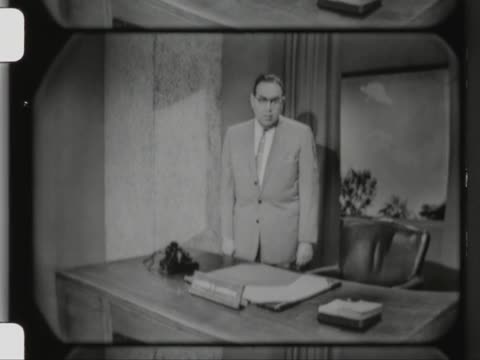
- Transcript
Or just, haven't you? I'll be back when I'm back. When a man goes to prison, he's not the only one sentenced. Who suffers even more? His family, the loved ones. These are also sentenced. These are the forgotten ones. This is the community of the condemned. The story of the forgotten ones in the world in which they live, the jails and prisons of America. What are they like?
Here is the story as told by leading prison authorities and by the prisoners themselves. Produced for the educational television and radio center, and featuring Joseph D. Lohman, eminent sociologist and for four years Sheriff of Cook County, Illinois. There was a little known and not often realized aspect of the crime problem that should be seriously addressed. It is represented in the forgotten ones. Many times the innocents who are involved in the punishment, which is meted out to criminal offenders as well as to the criminal offender himself. Indeed, a crime is not disposed of by sending a man to a penitentiary. For in so doing, there are effects upon his wife and upon his children, upon his friends and neighbors, and these are part of the price which society must pay, in dealing irresponsibly with persons who are charged with crime and who are punished as individuals.
What are the costs to the community? They may take the form of families which are no longer economically competent where the mother must go out and work, and indeed where there must be aid to the dependent children. These, the community must pay for if there is ascending of a man to a penitentiary who might otherwise be dealt with and remain economically productive and makes secure his own family by his own efforts. The effects upon the parties concerned are myriad. There are delinquents among the families of criminals. We have noted this time and again, but this delinquency of young persons whose fathers have been delinquent is not inherited is usually as a result of their abandonment, and this takes two forms, the stigma and rejection of their own parents and the way in which the rest of the community regards them and how they regard themselves as a result of their fathers having been imprisoned.
And then there is the abandonment which arises as a result of the failure to provide adequate home environment as a result of the failure to provide a mother and a father to influence the developing personality of the child. The ex-convic finds it difficult to reestablish himself with his family in his new life in the community. Indeed, he is in opposition often to accept the responsibility of father and breadwinner which he indeed might like to do. And this is reflected again in the way in which the family is developed and governed so that in sending a man to prison who might be dealt with in relationship to a family that remains behind, in other ways, we sometimes visit upon the community of penalty which is greater than the penalty visited upon the man himself. It is not what the ex-convic has done, but where he has been that is most serious in his future career
and where he has been brands the child as the child of a convict and the wife as the wife of a convict. And whenever and if ever we can deliver children and wives of this stigma we serve society as well as the family itself. People usually think of men in prison as individuals to themselves but here, of course, is a man trying to establish beyond the prison bars contact with his family with his loved ones. And here is the response and the form of a letter which must replace the ordinary interaction between husband and wife and children. A family is jeopardized by the lack of the appropriate relationships between man, wife, and children. When he does visit with his wife, it is before the eyes of a guard, the destruction, the utter destruction of the privacy which is so necessary to family life. It is a wonder sometimes that families can survive the experience
of one of their members being imprisoned. And yet this must be done, the woman as well as the man suffers imprisonment and the sentence at the hands of the court. Most of us think of the prison population in terms of the sentenced and convicted offender alone. But every time sentence is passed and a man is imprisoned, there are others that are sort of speak sentenced as well. They're loved ones, the family, wives and mothers, relations and children. Here in my office is a young lady who is a wife and mother, and whose husband is today in a penitentiary. Let's turn to her for a picture of the impact of that sentence upon the family, upon the innocent ones. Helen, your husband is in a penitentiary today, I understand. Yes, he is. What is his sentence? He's doing five years. And that means that he's away from the family and has been away for some time. Yes, he has, he used to be released of May 58. And all this time you've been on your own and away from him?
That's right. But now I'd like to get a picture of what the incidents or the events that took place on the occasion of his conviction, where and how they affected the family, at the time he was removed. What did it mean to you and the children? Well, it meant quite a lot to me because my husband has no immediate family outside of his brother who was sentenced with him, who is unmarried, and quite a help to the family and the absence of my husband. And we have two daughters, and I have no close family. So it meant that I was left alone with the two children. That mean you went out to work? Well, off and on, I went to work, and then situations became so acute that I did things and got into difficulties myself, and the children were placed in the foster home. And I have been unable to straighten out the affair since my husband had been gone, because the agencies won't agree to having the children's home life disrupted by frequent breakups and separations, and suggested that I wait until my husband was released,
and we could establish a permanent home for them. Well, they've been away with you then, and ever since they were taken from you, so to speak, and put in an institution. That's right. Well, let's go back to the time when they were with you. When you were a happy family before your husband was imprisoned, what was the effect upon the children? What was their reaction that these things went forward? Well, the children have never known exactly what happened, and where their father was, or where I might have been in short absences away from them, and I have been able to keep in pretty close contact with them in the foster home, and been able to do things for them and write them when I was out of town, and visit them when I was in town, and have them spend time with me. But nevertheless, they have been dissatisfied during the whole time, and have been very difficult to adjust to foster home, living because they were accustomed to being around their father and their mother and their uncle.
Well, now, what about relations to other people in the community where you lived? What about the attitude of neighbors and friends at the time when the explosion, so to speak, took place when he found himself imprisoned? Well, in some instances, more or less, the children don't question what's happening in another child's home, but children become very close when they're out together going through their various activities, and they know when there's an abnormal situation existing between another child's family life and their own. And it has made my children feel very badly at times to be classed as one of the foster home children. And there are certain things that the foster homes do not provide, such as little extra needs for children that have made the children dissatisfied because they thought if they were with mother or with father, things were going smooth,
that they could have the things and do the things that the other children did without limitations. Now, tell me a bit about your own experience. You suggested that you tried desperately for a time to keep the family together without your husband, that you got into difficulty. Can you give us the story of that experience? Well, it was no cause of neglect from the beginning. My husband was arrested in another city, and I was indirectly implicated with the arrest. And to keep him from doing a longer sentence, I had to accept the less apportion of the sentence on one of the side charges. And because I didn't live in the city, it wasn't a resident. The sit in my eye was going to jail, and my husband was going to the penitentiary. It was suggested that the children be set back to the last place of settlement so that they could be taken care of while we were away. And when the situation was searched into and how long he would be away,
and all that was when it was decided that the children would be better off in the foster home since I was alone and had to go out to work to earn a living. What about the context between each of you? Your children and yourself, you and your husband and the children and their father? Have they been maintained during this period? Well, I suggested that my husband not communicate with the children while he was away. And during the last part of his sentence, which is now, he got sort of jittery and sort of feeling crumbs of conscience and wondering what the children would think about such a long lapse of not hearing anything from him. And he pleaded with me to allow him to write the sentence and send them some money because he earns money in the penitentiary where he is. And I agreed to it, and he did that. Well, that caused complications because they went to searching into different factors about what I had been doing and found out about my last incarceration
and things that they didn't know before. Now, what about your contacts with your husband? Have you been able to maintain them during any satisfactory sense? Well, due to the fact that he's in the penitentiary and another state, while I was living in that state, I used to go every month regularly to visit him. And now he's in an honor camp on the outskirts of the city where he was in prison. And it's still, I still can visit, but I don't do so with the frequency because it's too much expensive, too much inconvenience. Well, Helen, you're looking forward to rejoining your husband apparently soon. I am. What plans have you made or how do you see the possibility of bringing your family together? Well, it will be necessary for my husband to, he'll have a year's parole when he comes out. And it will be necessary for him to find employment,
which he already has lined up. And then we will have to petition the juvenile courts and go through their routine and establish the fact that he is living legitimately and earning an adequate income to support his family and give them the promise that there will be no reoccurrence of a breakup in his family due to a crime. Do you anticipate problems in that respect in regaining the children? Well, I do because they don't give up the children so easily, but due to the fact that my children growing up and they are in a temporary placement agency that doesn't allow much finance for the children's upkeep, they would be glad to sort of shift it back on the parents as their responsibility. By the way, Sam, throughout this whole period, it's not alone your husband that has been imprisoned, but your children have had a special experience.
Right within. And your children in effect have done time in this foster home kind of situation. That's right. What kind of assistance do you get or have you gotten from any agencies working through your problems while your home has been broken up? I haven't gotten any. I'm desirous of trying to get, since they will come around and question you and find all the flaws in your life and why this happened and why the other happened. They don't offer any help, but if they would allow me some assistance and allow me to bring the children home with me and the money that is paid to foster parents to care for the children, allow that for the children's keep and let me earn enough to supplant that myself. And they also have an agency to help you find employment in some cases because they try to lift the burden off of the well. It's much of the burden of the welfare as they can. Well, thank you very much, Helen, for this picture of the sentence which is unwittingly visited upon families, upon children, upon wives,
and mothers, as well as upon the men that themselves stand convicted of crime. When a man enters prisons, for most persons, this is the end of the matter. But this is by no means the case. For there are others who suffer with him, indeed are punished and the rest of the community is unaware of it. Those who are at home, but forgotten ones. Let us visit with one who has worked with these persons, who suffer with the prisoner, and who have been punished by the law indirectly and without the awareness of the general community. Our guest is Faith Jones Killings, case work supervisor with the John Howard Association, a private prisoner's aid society. Miss Killings, you've worked with prisoners both in institutions and with their families on the outside. You've meant them when they've let the institution to return to their families. What is the impact of the prison on these forgotten ones at home? Well, Sheriff Lohman, when the imprisoned person is the head of the family
and has assumed the responsibility of major wage earner, it necessarily requires an adjustment, an immediate adjustment, for that family. Because their maintenance has to come from someplace. It might mean that the mother will leave the children and secure employment. It might mean that there are older children who are of working age, but who are still in school, who have to leave school and secure employment. Frequently, relatives find it necessary to cool their resources to assist. And then there are situations where all that the family can do doesn't meet the need. And in that case, it is necessary for them to apply for financial assistance from one of our tax-supported public agencies. Not ordinarily appreciated, to what extent then, the community itself is penalized when a man is put in an institution. If we have to support the family on the outside, if it is dependent, and indeed if it is put to ends or means which are or not ordinary for that family.
But on the other hand, there must be other consequences as well when a person who they love is beyond them. What are these other impacts? Yes, indeed, there are the emotional factors are very, very important. For example, the mother is left in the position of having to explain to the children, and it's usually the mother who does it, what happened to father, where he is, and why he's no longer at home. If they're small children, the importance and the significance to that child is scarcely realized by adults. For example, we know how children adore their parents and look to their parents for guidance and maintenance. If the child has built an image of a father who has all the good things that the child thinks are important, and the child suddenly discovers that that father has done something which has resulted in his complete rejection by society. The youngster is then in the position of having to either also reject his father
or adjust his own concept of the goodness that he thought was there. I think, for example, of a little boy about five or six years old whose father earned his living by traveling about the country performing before groups. The child worshipped the father, the father was very kind and loved the child. When the father went to prison, the youngster was told that his father had gone to the penitentiary. But because the child was accustomed to dad traveling about, he thought the penitentiary was something really very grand. So when people asked where his father was, or sometimes even he volunteered the information that dad was in the penitentiary, that child at some point along the way had to reconstruct his own set of values about his father. Of course, unwittingly, that child was contributing to the emphasizing of the stigma and the rejection of his family by the rest of the community. And I suspect that creates special problems.
It does. Children are very often told by parents of neighbors that they should not play with the children of a prisoner. Adults who have been a part of social groups, it might be a community organization of some type. It might be a social club. Suddenly find that instead of being included normally as they had always been and being given responsibility, find that they're shunned. Well, it's clear that there's an enormous consequence, then, in taking the calculated risk if you please, of taking a man and putting him in a penitentiary, particularly from the standpoint of these young persons who might, if not adequately dealt with under those circumstances, themselves termed a crime. That is true, because there can be a feeling of loneliness and complete rejection, which is the hotbed for the development of anti-social activities. Another byproduct of that is the fact that so often families of prisoners come in contact with each other in court or meet each other when visiting the prison or when traveling to and from the prison.
And they're searched for friendship. They're quite likely to reach out and encompass the families of other prisoners, which means that they build a little group of their own, which also carries problems. Well, here's a man away from his family. He can't see them, but only infrequently. The normal family life has been disrupted. How can they maintain any kind of effective family relationship looking to his rejoining the family? Well, that is a very pertinent question. We know that it isn't unusual for a person to leave his family to go into the armed forces or to do other things, but there we have many normal ways of maintaining contact. The prisoner's family resorts to the same thing by correspondence and by visiting, but it's under very abnormal circumstances. For example, we know that prisons have to regard certain security regulations. One of their regulations is that correspondence usually doesn't begin
until 30 or 60 days after the person has been imprisoned, when he, as well as the family, are going through a very traumatic experience. Then when letters come, they can come only from approved persons and answers can be sent only at certain intervals. Letters which might be saved for reading are also restricted. I think of one prison, for example, where a person can keep only 15 letters. And it isn't because it's the desire to punish or to pride, but there are practical problems for the prison where space is limited. Then visiting presents its problem. The normal thing when a father and mother need, or if children go to visit, is to rush up and embrace each other. Sometimes that even is not possible in prisons that have not encompass a living room situation for the visitor. And I might say that that's done as far as I know, only in federal prisons.
However, in most of the state prisons, the prisoner still sits on one side of a barricade. It might be a glass or a wire petition. They have to talk loudly in order to be heard, and there are others seated along the petition so that there is no degree or opportunity for privacy at all. I'm sorry to report that in the Cook County jail that I administer, that's a pathetic sight to see a wife and a child shouting through a piece of strong glass without even an opportunity to avoid raising their voices and communicating with their loved one on the other side of that barrier. And certainly it is a strained, friendly relationship that arises under those circumstances. The strained as it may be, I suspect in your experiences, the act of crime which brought them to jail is not for the first time in which that family has been so to speak under stress. That is true. There are signposts of difficulty, usually along the way.
It might begin with an adolescent or a young adult who gets into difficulty. And sometimes the family is successful in handling the adjustment itself. It might be that it's a disorganized family group. There's also the possibility that they live in a community where there are influences that are difficult for the family to cope with. In all of those situations, if it were possible for the family to be given guidance and help, assistance in making the necessary adjustments, it is possible that many of the more serious offenses could be avoided. Ms. Kellings, how can we relate more positively to the lives of these prisoners to their families than is currently the case? How much work goes on of the sort that you are a pokey to? Well, I regret to say Sheriff Lohman, but very, very little. The John Howard Association, by which I'm employed, is a prisoner's aid agency and one of only 29 throughout the United States.
I'm sorry, I'm an error there. There are 37 prisoners aid agencies, but only in 19 states, which means that there are 29 states without that type of service at all. And when we relate that to the fact that in 1955, there were 185,000 men in prison. And many of those men, family men, with families going through many of the problems that we have discussed. There is great need for an extension of that type of service. It's true that in some instances they are known to agencies, but it is only incidentally when there are other problems which make it necessary for them to go to the agency or come to the attention of the agency. Well, I think many of our listeners will realize that your work and the people who join with you in it is being done on a very small basis. For the most part, then, working with families, which is an essential aspect to the problem of crime, that is the families that these men who have offended, remains untouched and needs to be reached
if indeed we are to be effective in the rehabilitation and the changing of these men in the future. Thank you very much, Ms. Kellings, for giving us these insights into the world of the forgotten ones. Our guest has been Faith Jones-Killings, case work supervisor of the John Howard Association, a private prisoner's aid society of which there are all too few in these United States. So we see that when a man is sentenced to prison, others are sentenced as well. And there are other consequences for society beyond the experiences of the man alone. What will happen to his loved ones? What will they do in their new relationships and how will they affect in turn society as a result of this experience they have as a family? The families of offenders are lost in the community after the breadwinner is sent to prison. And this has two major consequences for us that cannot be forgotten for their effect is there to be lived with.
There is of course first this economic problem of losing the wager. The wife is forced to work quite often, as well as the older children. And the agencies of the public welfare type must come as they frequently do into the picture, if the income is not sufficient on the part of the mother or the older children. But this is only part of the story. The emotional impact is even greater for the children and being stigmatized as the children of a conflict face a different world than that of other children. They are not raised any longer in a normal family. They are indeed raised in a family the effects of which are to give us in this instance what we know we get generally from broken homes, namely more delinquency, more crime. So what was in the first instance not a broken home is now through the fact of imprisonment a broken home.
And the impact of this economic insufficiency on the part of the family is to produce emotional insufficiency and inadequacy. The interconnectedness of these things cannot escape us, we must attend to it. It is clear as the family income falls the children are forced into an unsatisfactory way of life, new and embarrassing and unsatisfying relationships come about. It is impossible to hold the family together through merely correspondence through the males or an occasional visitation at the penitentiary. This infrequent visiting means that they will prevail other forces and influences with reference to the young people in that home rather than those which make for good and conventional living. Most families then are turned into broken homes which in turn produce disproportionate numbers of juvenile delinquents. And then we must recall that the agencies indeed are few which have the specialized techniques and services which are required by such families.
And as a result we have other crimes generated out of the fact of this initial sentencing to prison. This has been community of the condemned, produced for the educational television and radio center, featuring Joseph D. Lohman, eminent sociologist and for four years Sheriff of Cook County, Illinois. This is National Educational Television.
- Series
- Community of the Condemned
- Episode Number
- 18
- Producing Organization
- WTTW (Television station : Chicago, Ill.)
- Contributing Organization
- Library of Congress (Washington, District of Columbia)
- AAPB ID
- cpb-aacip/512-183416tr0q
- NOLA Code
- CEDD
If you have more information about this item than what is given here, or if you have concerns about this record, we want to know! Contact us, indicating the AAPB ID (cpb-aacip/512-183416tr0q).
- Description
- Episode Description
- The special guest this episode is Mrs. Faith Jones Killings. Mrs. Killings is a professional case worker who deals with the problems of released prisoners. She was formerly Case Work Supervisor for the John Howard Association. Criminologist Joseph D. Lohman points out that the families of offenders are lost in the community after the husband-father is sent to prison. He mentions the economic problem of the loss of a wage earner and the emotional impact on children. Filmed scenes show the limited contact inmates have with their families and the effect on the inmate is brought out during an interview. Mrs. Killings and Lohman review the impossibility of holding a family together through the mail and infrequent visiting days. Mrs. Killings points out that these families become broken homes, which in turn produce a disproportionate number of delinquent children. (Description adapted from documents in the NET Microfiche)
- Series Description
- Community of the Condemned brings to the public a searching study of penal institutions and correctional systems and their inmates, indicating the damage done by outmoded penal practices which follow upon lack of understanding, inadequate information and public apathy. In each case, nationally-known criminologist Joseph D. Lohman discusses the problem with a group of guest experts. On-location filmed prison scenes and direct interviews with actual prison inmates are seen. Various differences in prisoners are investigated along with the multiple kinds of institutions, often too all-equipped to allow beneficial results. The dramatic need for new procedures, new kinds of institutions and correctional programs, and professional, well-trained staffs to administer them is indicated during the series. Joseph D. Lohman, nationally-known criminologist and Sheriff of Cook County, Illinois since 1954, is the host for this series. Lohman is Consultant on Juvenile Delinquency to the Ford Foundation and has been a member of the staff of the University of Chicago since 1947. He was chairman of the Division of Corrections of the State of Illinois from 1949-1952, and chairman, Parole and Pardon Board of the State of Illinois from1952-1953. He has been a director of the American Prison Association and a director and past president of the Illinois Academy of Criminology. Lohman received his B.A. degree from the University of Denver and his M.A. degree from the University of Wisconsin in 1931. The 26 half-hour episodes comprising the series were originally recorded on videotape. (Description adapted from documents in the NET Microfiche)
- Broadcast Date
- 1958-00-00
- Asset type
- Episode
- Genres
- Talk Show
- Topics
- Social Issues
- Rights
- Published Work: This work was offered for sale and/or rent in 1960.
- Media type
- Moving Image
- Duration
- 00:29:47
- Credits
-
-
Guest: Killings, Faith Jones
Host: Lohman, Joseph D.
Producing Organization: WTTW (Television station : Chicago, Ill.)
- AAPB Contributor Holdings
-
Library of Congress
Identifier: 2302843-1 (MAVIS Item ID)
Format: 16mm film
Generation: Copy: Access
Color: B&W
-
Library of Congress
Identifier: 2302843-2 (MAVIS Item ID)
Format: 16mm film
Generation: Copy: Access
Color: B&W
-
Indiana University Libraries Moving Image Archive
Identifier: [request film based on title] (Indiana University)
Format: 16mm film
If you have a copy of this asset and would like us to add it to our catalog, please contact us.
- Citations
- Chicago: “Community of the Condemned; 18; Forgotten Ones: Families of Inmates,” 1958-00-00, Library of Congress, American Archive of Public Broadcasting (GBH and the Library of Congress), Boston, MA and Washington, DC, accessed April 4, 2026, http://americanarchive.org/catalog/cpb-aacip-512-183416tr0q.
- MLA: “Community of the Condemned; 18; Forgotten Ones: Families of Inmates.” 1958-00-00. Library of Congress, American Archive of Public Broadcasting (GBH and the Library of Congress), Boston, MA and Washington, DC. Web. April 4, 2026. <http://americanarchive.org/catalog/cpb-aacip-512-183416tr0q>.
- APA: Community of the Condemned; 18; Forgotten Ones: Families of Inmates. Boston, MA: Library of Congress, American Archive of Public Broadcasting (GBH and the Library of Congress), Boston, MA and Washington, DC. Retrieved from http://americanarchive.org/catalog/cpb-aacip-512-183416tr0q